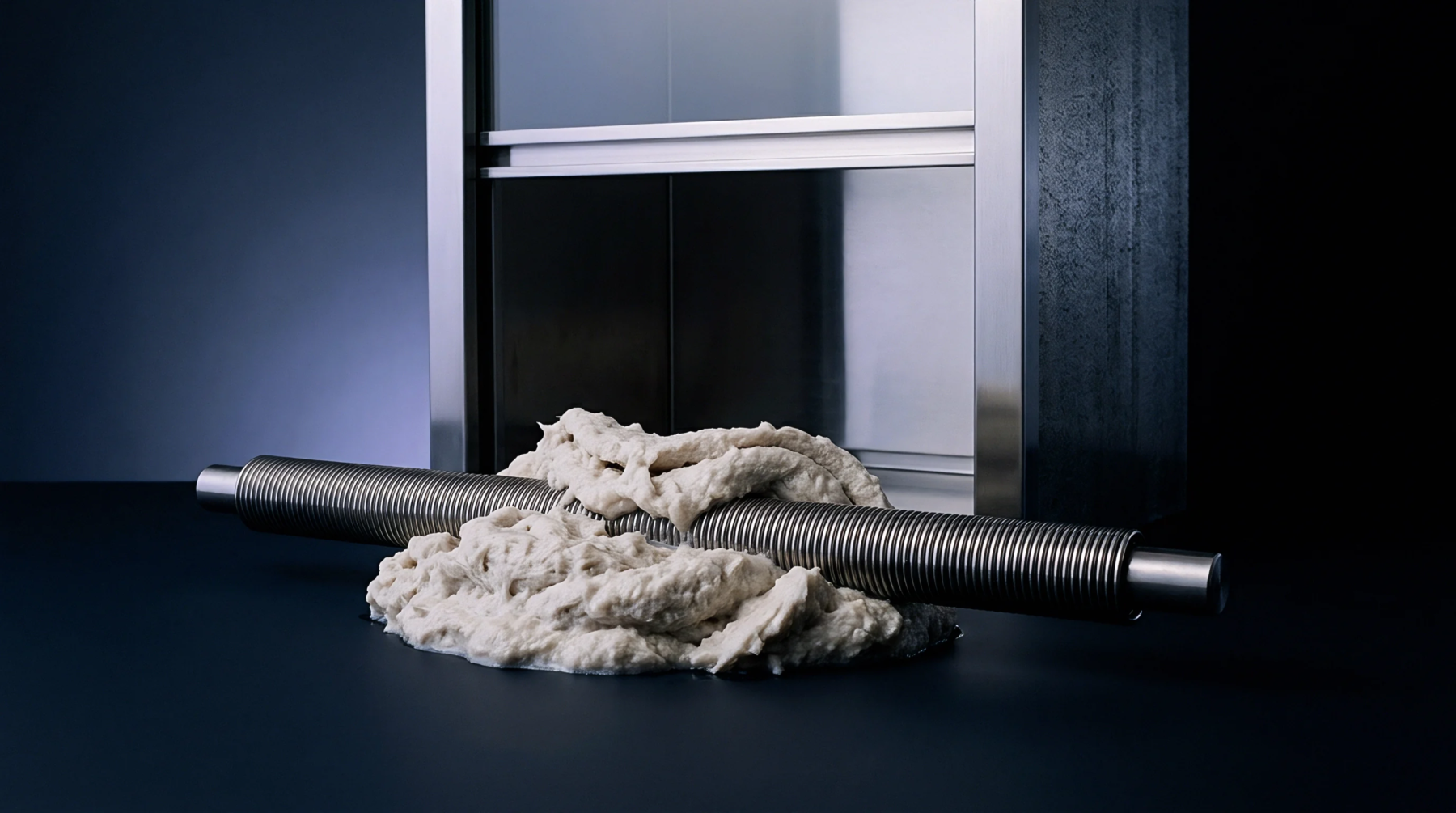
Dispersion Instability
Gravitational downward migration of micronised particulate additives through liquid coatings, varnishes and inks leads to non-uniform additive distribution and dense bottom sediment. Encountering matting agent settling alters the specular gloss profile of dried packaging films because suspended particles abandon the upper liquid boundary over storage periods. The phenomenon affects solvent-borne, water-borne and UV-curable overprint lacquers formulated with porous amorphous silicas or organic waxes intended to scatter reflected light on paperboard cartons.
The operational boundary concludes at the redispersion threshold, separating loose, easily resuspendable flocculates from irreversible hard cakes welded by interparticle van der Waals bonds.
Sedimentation Dynamics
Stokes’ law governs the sedimentation velocity of dispersed solid particles, showing how settling speed scales with the square of aggregate particle diameter and the density differential between pigment and liquid medium. Liquid formulations containing un-treated amorphous particles experience matting agent settling when storage temperatures rise, lowering fluid viscosity and accelerating phase separation. Weak interparticle repulsion triggers aggregation, forming large clusters that fall rapidly toward container bases.
Surface-treated silicas coated with polyethylene wax resist hard packing, forming voluminous, porous sediment structures that shear thin readily upon mechanical agitation, whereas untreated mineral grades form dense cakes that resist redispersion.
Formulation Control
Coating performance hinges on maintaining uniform particulate suspension through package shelf life and pressroom transfer cycles. Progressive matting agent settling inside coating storage drums results in initial print runs delivering high-gloss finishes, followed by excessively dull, powdery surfaces as the depleted varnish reservoir reaches its particle-rich bottom layer. Liquid rheology modifiers, such as fumed silicas, cellulosic ethers and associative polyurethanes, build a false-body yield stress that suspends particulate matter under static resting conditions.
Automated recirculating fluid loops and continuous low-shear container agitation preserve pigment dispersion, preventing anilox roll clogging and maintaining uniform gloss across long packaging converting campaigns.