Material Waste
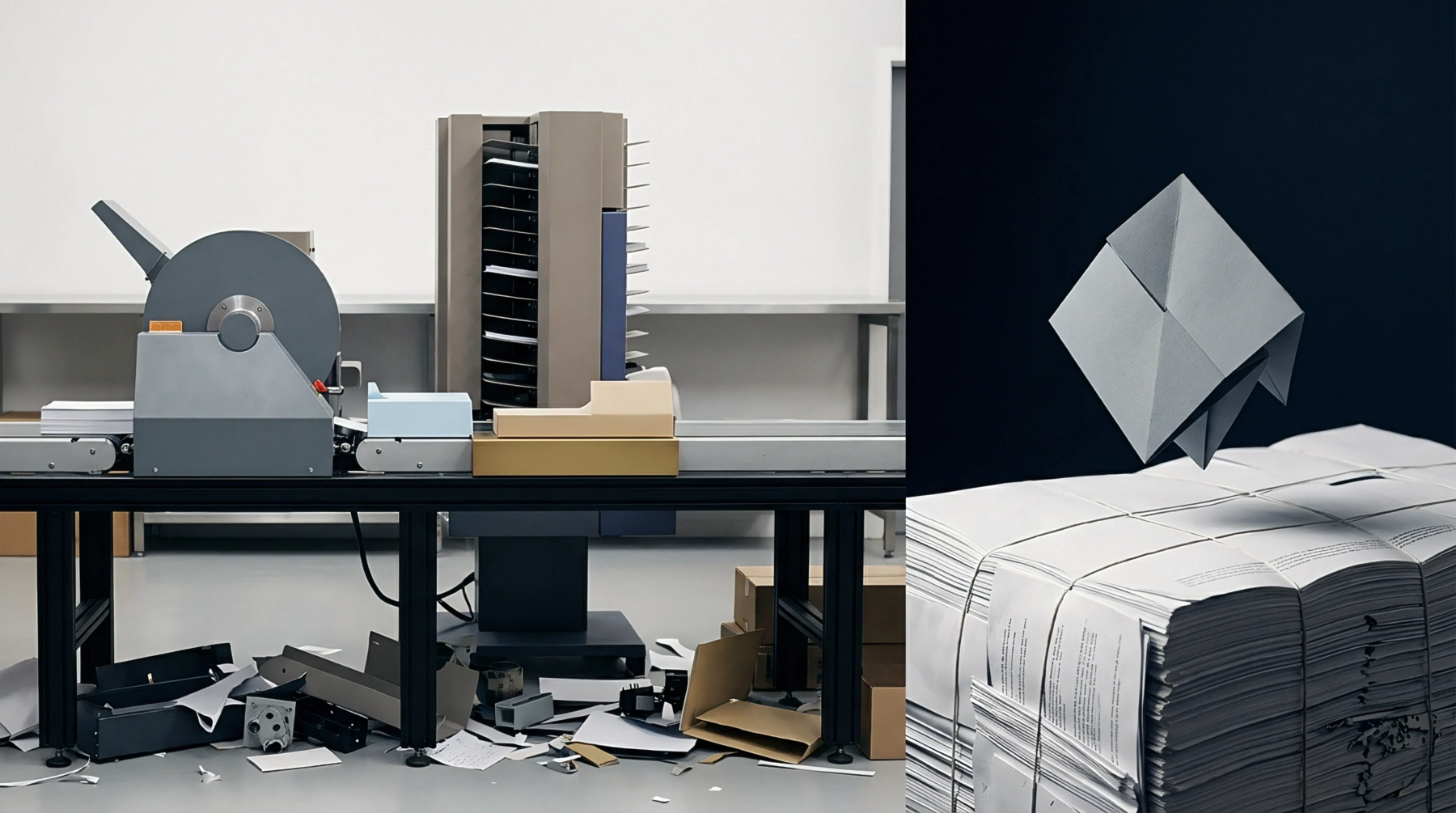
Non-conforming paper, board, or finished print generated during make-ready setups, colour adjustments, registration alignment, and unexpected machine stops constitutes discarded production waste. In commercial folding carton and publication printing, press spoilage consumes substantial raw cellulose volume and represents a major cost factor in packaging conversion. The discarded volume falls into two clear technical classes, make-ready waste generated while dialing in ink density, web tension, and die-cutting registration, and running waste produced during continuous operation from web breaks, misfeeds, blanket smashes, or colour drift.
Spoilage ends where trimmed converting edges, matrix skeletons, and finished offcuts are collected, as these are inherent process scrap rather than product failure. Minimizing this unrecoverable consumption protects profitability and supports carbon reduction targets across certified production chains.
Process Sources
Make-ready phases on large-format sheetfed offset presses consume between one hundred and five hundred full sheets before reaching spectrophotometric colour balance and accurate cut-to-print registration. Mechanical instability in high-speed feeders, plate-clamping errors, and dynamic roller friction drive early press spoilage before the run settles into steady-state production. During continuous flexographic or gravure web printing, reel splices introduce sudden web tension transients that trigger register hunting, forcing downstream automated camera inspection systems to divert scores of running metres into the waste hopper.
Paper surface flaws, such as loose lint, weak surface sizing, and calender pinholes, contaminate ink ducts and foul print blankets, requiring unscheduled stops that amplify running waste. Dampening imbalances on offset presses lead to emulsification, scuff marks, and ink set-off in the delivery stack, rendering entire pallets unconvertible for carton blanks.
Measurement and Control
Quantitative monitoring uses automated sheet-counting systems, optical vision web scanners, and mill reel barcoding to capture discarded mass against net production. Real-time logging partitions press spoilage into distinct categories, tracking whether losses originated from substrate defects, mechanical registration drift, chemical drying failures, or operator intervention. High-value substrates, such as solid bleached sulfate or holographic metalized board, demand strict target caps on allowable spoilage, typically governed by standard industry curves that allocate higher waste percentages to short runs and lower margins to volume runs.
Modern sheetfed presses lower make-ready scrap through closed-loop spectrophotometers and automated plate changers, reducing start-up waste to under fifty sheets per job. Converting facilities separate spoiled board into clean unprinted scrap and printed waste, sending each waste fraction to specialized hydropulper streams to maximize recycling yield. Precise scrap control remains an unyielding benchmark of manufacturing discipline.