Mechanical Pulp Core Bulk Retention during Shoe Press Dewatering Operations
Core bulk retention during shoe press dewatering requires asymmetric pressure profiles and controlled temperature to prevent mechanical pulp lumen collapse.
Matrix
Chemithermomechanical Pulp Morphological Stability
In middle-ply furnishes, fiber morphology dictates how well bulk is retained under mechanical dewatering. High-yield pulps like chemithermomechanical pulp (BCTMP) and thermomechanical pulp (TMP) keep native lignin in the fiber wall matrix at yield levels between 85 and 92 percent. Initial stiffness depends heavily on wood species.
Black spruce and balsam fir produce thick-walled fibers with narrow lumen cavities that resist transverse mechanical compression. Aspen BCTMP offers high initial specific volume, but its thinner fiber walls collapse more easily under external hydraulic loads.
As wet fiber networks enter the shoe press nip, applied forces drive both elastic deformation and plastic wall collapse. Unbleached spruce chemithermomechanical pulp maintains a rigid lumen architecture under compressive loads that flatten bleached chemical softwood fibers. In the middle ply, lignin stiffens the fiber structure under ambient thermal conditions.
Inside the nip, wet fiber walls face multi-axial stress, where normal nip pressure combines with transverse shear generated by speed differences between the backing roll and press belt.
Unbleached spruce chemithermomechanical pulp retains a rigid lumen architecture under compressive loads that collapse bleached chemical softwood fibers.
Spruce fibers resist lumen crushing until local transverse compressive stress exceeds the wet yield stress of the cell wall matrix. Fibrillar delamination inside the S2 layer weakens high-yield fibers, triggering structural buckling. Once lumens collapse, fiber cross-sections flatten permanently, turning a bulky three-dimensional network into a dense sheet.
Maintaining this three-dimensional fiber geometry remains the main way to preserve core thickness during pressing.
Mechanical Pulp Core Compression Failure Modes
The transition from structural elastic compression to permanent ply consolidation inside the press nip involves distinct micro-mechanical breakdown pathways across the middle ply thickness.
- Lumen flattening under hydraulic load occurs when internal pore pressure in the wet web exceeds the transverse hoop strength of uncollapsed mechanical fiber walls.
- Wall micro-compressions at fiber intersections create localized structural hinges, lowering the overall bending rigidity of the fiber network under mechanical pressure.
- Fibrillar delamination within the S2 wall layer reduces fiber wall stiffness as mechanical shear forces break internal hydrogen bonds during nip transit.
- Permanent flexural hinge formation develops along long softwood fibers when localized compressive strains exceed fifteen percent during peak web deformation.
Refining intensity directly alters these deformation mechanisms. Heavy low-consistency refining strips the protective primary wall and increases fiber flexibility, causing cell walls to flatten under lower press loads. High-consistency disk refining keeps the fiber wall intact while introducing axial curl, which aids bulk recovery after the nip.
Core bulk loss during extended nip dewatering is often attributed entirely to excessive web moisture entering the press section rather than shoe profile geometry.
Gradient

Hydrodynamic Pressure Kinetics in Extended Nips
Dewatering inside a press nip depends on the balance between total applied mechanical pressure and internal liquid pore pressure. Water movement generates hydraulic drag, so total pressure on the wet sheet is the sum of hydraulic pressure from fluid flow and structural pressure carried by the fiber network. High-speed dewatering requires fast water removal through outer kraft plies without creating destructive hydraulic pressure peaks in the bulky middle layer.
Hydraulic pressure drives water outwards as wet webs enter the shoe press nip at dryness levels between 18 and 26 percent, though fluid friction creates significant resistance to Z-directional flow. Dense outer kraft plies, heavily refined for smooth surface properties, act as flow barriers. The resulting hydraulic pressure build-up in the mechanical pulp core temporarily reduces effective stress on the fiber framework, but its rapid release near the nip exit causes destructive internal shear if fluid velocities exceed critical thresholds.
Controlling the rate of hydraulic pressure rise requires careful management of shoe slope and nip entry geometry. Standard roll presses, with narrow nips between 30 and 50 millimetres, compress wet webs rapidly and produce sharp hydraulic spikes above 5.0 MPa within 2.0 milliseconds. Extended nip shoe presses widen the compression zone to 250 or 300 millimetres, spreading fluid removal across residence times of 10 to 30 milliseconds.
This longer duration lets water drain through felt voids at lower fluid velocities, avoiding localized web rupture.
- Measure wet web solids content before the press entrance using online microwave transmission sensors calibrated to ISO 287.
- Calculate maximum hydraulic flow rate based on machine speed, basis weight, and targeted dryness increase across the shoe nip.
- Adjust shoe inclination tilt to set entry clearance, keeping the entry pressure rise rate below 0.15 MPa per millisecond.
- Verify press felt capillary suction and water handling capacity using ultrasonic flow meters on the felt dewatering suction boxes.
If fluid removal outpaces the drainage capacity of outer plies, hydraulic pressure forces the wet core to take an excessive share of the mechanical load. Surpassing critical peak hydraulic pressure turns the porous middle ply into a dense sheet, permanently destroying bending stiffness and increasing fiber consumption for every metric tonne produced.
Shoe Press Configuration and Dewatering Dynamics
Press section layout determines how hydraulic forces distribute across multi-ply web structures during consolidation.
| Nip Configuration | Peak Pressure (MPa) | Residence Time (ms) | Exit Dryness (% Solids) | Core Bulk Retention (%) |
|---|---|---|---|---|
| Single Roll Press | 6.2 | 2.1 | 38.5 | 64.2 |
| Double Roll Press | 5.5 | 3.8 | 41.2 | 69.8 |
| Symmetric Shoe Press | 4.2 | 18.5 | 47.0 | 78.5 |
| Asymmetric Inclined Shoe Press | 3.1 | 22.0 | 49.5 | 88.3 |
Impulse

Thermal Effects on Lignin Softening and Viscosity
Web temperature in the press section alters dewatering performance by changing fluid viscosity and polymeric fiber wall modulus. Heating water from 40 °C to 70 °C drops dynamic viscosity from 0.65 to 0.40 mPa·s, accelerating flow through pore networks. Higher temperatures increase dewatering rates at lower applied nip pressures, reducing the mechanical force needed to reach target exit dryness levels.
Native lignin within mechanical pulp fibers softens at elevated temperatures, undergoing a glass transition (Tg) when saturated with water. Saturated native spruce lignin shows a glass transition range between 60 °C and 75 °C. Operating shoe press nips above this range dramatically lowers the elastic modulus of mechanical fiber walls. Under combined heat and pressure, softened fibers deform plastically at a fraction of their room-temperature yield stress.
At a web temperature of 72 °C and a press impulse of 0.85 kPa·s, chemithermomechanical core bulk drops by 0.22 cm³/g compared to pressing at 50 °C under identical peak pressure.
Press impulse represents the integrated pressure over nip residence time (I = int P(t) dt). While high press impulse maximizes water removal, combining elevated impulse with web temperatures above Tg permanently collapses mechanical pulp cores. As the wet web plasticizes thermally, fiber lumens fold flat and fail to regain volume after leaving the nip.
Operating temperatures in the press section must balance liquid drainage against mechanical fiber wall rigidity.
Is Mechanical Pulp Density Irreversibly Altered by Peak Pressure?
Peak nip pressure determines whether mechanical pulp consolidation stays within the reversible elastic strain region or crosses into permanent plastic degradation. High linear loads up to 1,400 kN/m increase post-press dryness and save dryer steam. However, once peak local stresses exceed the mechanical yield threshold of wet BCTMP fibers, structural compaction becomes irreversible regardless of post-press expansion.
Elastic recovery occurs as the web exits the peak pressure zone of the shoe nip. Rebound forces in the compressed fiber network depend on wall resilience and preserved lumen integrity. If peak pressure stays below 3.5 MPa, BCTMP fibers expand after hydraulic stress relief, regaining up to ninety percent of their pre-press thickness.
Exceeding 5.0 MPa crushes cell walls, capping volume recovery at less than fifty percent. Finding the balance where thermal dewatering gains outweigh the commercial cost of lost core bulk remains a constant challenge for press section engineers.

Profile
Shoe Curve Geometry and Pressure Slope Optimization
Tailoring the pressure profile along the machine direction length of the press shoe allows precise control over core bulk compaction. A hydrodynamic oil film supports the flexible press belt over the solid curved shoe surface. Adjusting multi-zone hydraulic loading pistons under the shoe alters both the tilt angle and the pressure distribution curve from nip entry to exit, directly reshaping pressure slopes.
A gentle entry pressure slope lets wet webs consolidate gradually, forming fluid channels before peak mechanical loads arrive. Setting an asymmetric shoe tilt with a low entry slope prevents hydraulic crushing at the web entrance. Peak pressure then occurs near the exit edge, where web dryness is high and hydraulic pressure has largely dissipated.
This asymmetric force distribution maximizes solids content while shielding the bulky core from destructive initial pressure surges.
Gentle hydraulic pressure buildup in early nip zones preserves mechanical fiber bulk far better than reducing overall linear load at the press roll.
Press felt design heavily influences core structure preservation, as felt density dictates water flow. Stratified felts with coarse base fabrics and fine surface needle batts retain high void volume under peak loads. This high void volume prevents hydraulic backpressure from building at the felt-sheet interface, allowing rapid water transfer out of the core ply.
Parameters for Core Preservation
Machine controls must balance dewatering efficiency against structural caliper retention across various board grammages.
- Entry shoe slope setting controls the initial rate of hydraulic pressure rise, preventing internal web delamination and early lumen collapse.
- Press belt surface topography selection determines contact area fractions, influencing localized pressure distribution across the top liner sheet.
- Felt void volume retention under peak load maintains low fluid flow resistance, preventing hydraulic pressure accumulation inside middle-ply pores.
- Hydraulic load balance across machine direction aligns peak pressure with maximum sheet solids content to minimize structural cell compaction.
Optimizing shoe profile parameters enables higher linear loadings without exceeding the physical yield strength of mechanical pulp fibers.
| Shoe Profile Type | Entry Pressure (MPa) | Peak Pressure (MPa) | Exit Pressure (MPa) | Core Caliper (µm) | Core Density (g/cm³) | Bending Resistance (mN) |
|---|---|---|---|---|---|---|
| Flat Symmetric | 2.8 | 4.5 | 2.8 | 210 | 0.62 | 175 |
| Steep Entry Tilt | 4.2 | 4.8 | 1.5 | 192 | 0.68 | 148 |
| Extended Gentle Entry | 1.2 | 3.8 | 2.2 | 238 | 0.55 | 218 |
| Double Peak Profile | 2.1 | 3.5 | 3.5 | 222 | 0.59 | 192 |
Maintaining a wide entrance clearance on the shoe press remains the most reliable operating habit for protecting core bulk across high-grammage board production runs.

Audit
Measurement Methods for Z-Directional Density
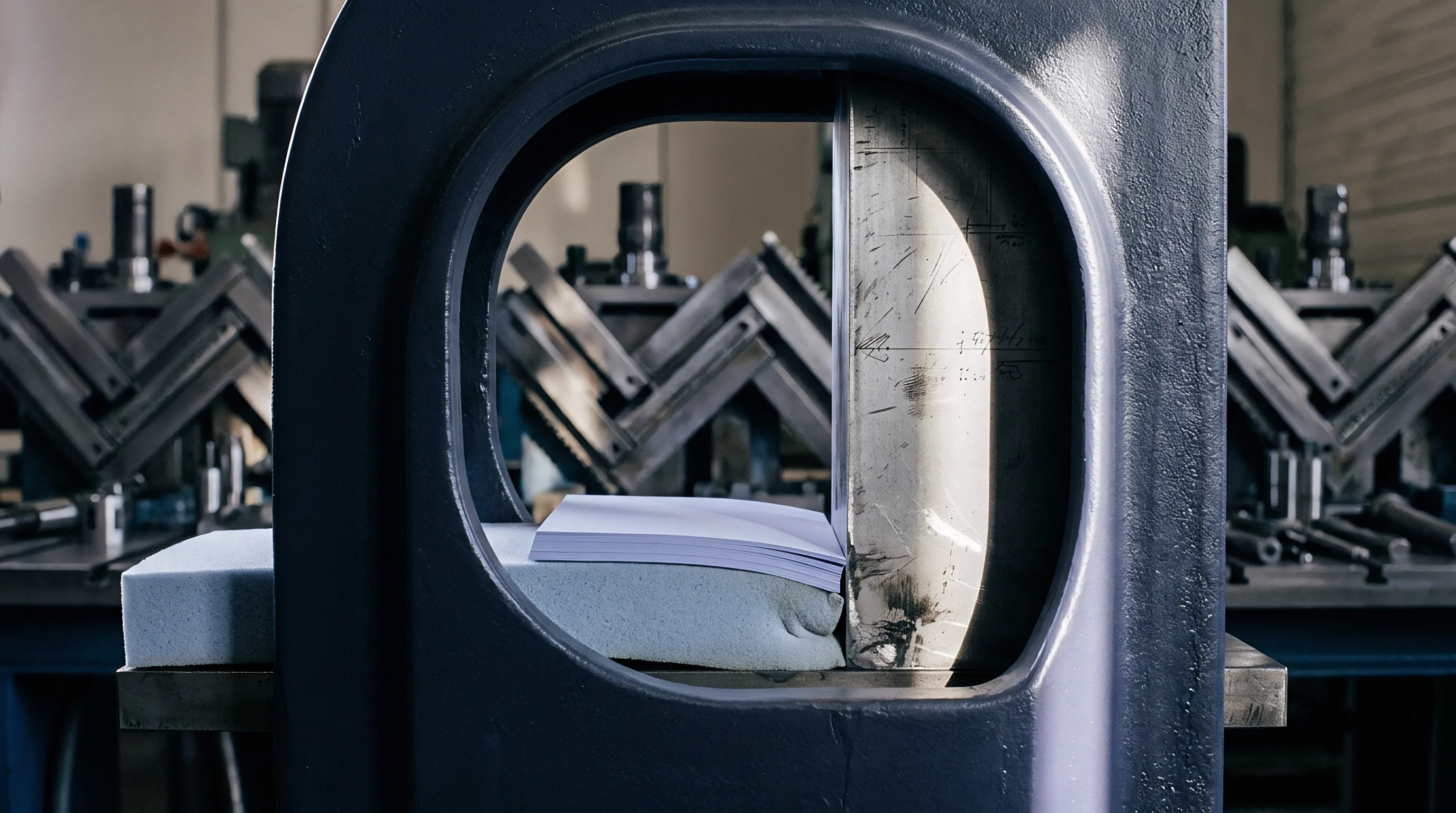
Evaluating multi-ply sheet structures requires analytical techniques capable of distinguishing middle-ply caliper from total board thickness. Because standard micrometers apply static loads ~ ISO 534 specifies thickness testing using a spring-loaded foot applying 50 kPa pressure across a 2.0 cm² anvil ~ this standard load compresses soft, high-bulk mechanical cores during measurement and underreports true uncompressed sheet thickness.
Optical imaging avoids structural compaction altogether. Cross-sectional analysis involves embedding paperboard specimens in cold-curing resin, followed by diamond polishing and high-resolution light microscopy. Image analysis software then calculates individual ply thickness (t1, t2, t3) without applying external mechanical load.
Cross-referencing optical thickness against total sheet grammage yields true apparent density profiles across individual furnish layers.
Specifications citing ISO 534 require caliper verification under a 50 kPa load, which underreports true uncompressed mechanical pulp thickness by up to eight percent.
X-ray computed micro-tomography (μCT) offers non-destructive three-dimensional density mapping of multi-ply structures at sub-micron resolution. Micro-CT scans map local density variations along the Z-axis, revealing collapse zones caused by shoe press pressure peaks. Environmental control during testing is mandatory; ISO 187 requires preconditioning at 23 °C and 50 percent relative humidity to keep moisture-induced fiber swelling from distorting bulk values.
Documentation Requirements for Stock Qualification
Validating mill performance declarations requires detailed technical documentation confirming that core bulk retention targets are achieved without sacrificing structural integrity.
- Cross-sectional ply thickness MTR reports generated via optical microscopy quantify individual ply thickness values under zero applied compressive stress.
- Z-directional density profile scans obtained from micro-tomography confirm spatial density distribution across top, middle, and bottom plies.
- ISO 2493 bending resistance test certificates establish two-point bending stiffness values measured at 15-degree deflection angles.
- Moisture and density uniformity tracking maps document cross-machine direction consistency across full reel widths post-calendering.
Discrepancies between standard mechanical micrometer readings and non-contact optical measurements frequently lead to commercial disputes over stock compliance.
| Measured Property | Standard Method | Conditioning Parameters | Applied Load / Sensor | Precision Tolerance |
|---|---|---|---|---|
| Sheet Caliper | ISO 534 | 23 °C, 50% RH | 50 kPa static pressure | ±1.5 µm |
| Optical Thickness | ISO 16649 | 23 °C, 50% RH | Non-contact microscopic imaging | ±0.8 µm |
| Bending Stiffness | ISO 2493-1 | 23 °C, 50% RH | 50 mm gauge length, 15° bend | ±2.0% |
| Grammage | ISO 536 | 23 °C, 50% RH | Analytical balance, 500 cm² cut | ±0.5 g/m² |
| ISO 534 micrometer foot pressure overestimates compaction of soft porous cores compared to non-contact optical imaging methods. | ||||
Standard supply contracts specifying caliper compliance under ISO 534 allow mills to pad core grammage when low-load optical measurements reveal uncompacted core bulk.

Margin
Converting Mechanics and Bending Stiffness Economics
Bending stiffness is the key performance criterion for packaging board grades, directly governing carton stacking strength and runnability on high-speed cartoning lines. Because bending stiffness scales with caliper, multi-ply folding boxboard (FBB) bending stiffness (S) depends on the elastic modulus of the outer plies (Eface) and total sheet thickness (t), modeled through the multi-layer beam equation:
S = fracEtop ttop3 + Ebot tbot312 + sum Ei zi2 ti
where zi represents the distance of ply i from the neutral bending axis. The bulky mechanical core acts primarily as a lightweight spacer, holding the high-modulus chemical kraft outer plies apart to maximize the area moment of inertia and save expensive pulp. A five percent decrease in core thickness caused by over-pressing in the shoe section drops total board bending stiffness by approximately thirteen percent.
To compensate for lost caliper and re-establish required stiffness targets, mills must increase total sheet grammage, raising furnish consumption and shipping weight.
Consider a three-ply folding boxboard mill running a 300 g/m² grade at 1,000 metres per minute. Target web caliper is set to 420 micrometres to meet a specified cross-direction bending resistance of 210 millinewtons. The middle ply consists of aspen BCTMP accounting for 60 percent of total basis weight (180 g/m²), sandwiched between two 60 g/m² bleached softwood kraft plies.
Market BCTMP trades at 680 USD per air-dried metric tonne, while fully bleached chemical softwood kraft costs 920 USD per tonne.
If inefficient shoe press settings crush core apparent density from 0.45 g/cm³ to 0.52 g/cm³, middle-ply thickness drops from 400 micrometres to 346 micrometres. Total board caliper falls to 366 micrometres, dropping bending resistance from 210 mN down to 142 mN. To restore bending resistance to the required 210 mN target without altering press settings, the mill must raise BCTMP core basis weight from 180 g/m² to 222 g/m², adding 42 g/m² of fiber to the sheet.
Across an annual production volume of 100,000 metric tonnes, this grammage penalty forces the consumption of 14,000 additional tonnes of BCTMP pulp, adding 9,520,000 USD in direct raw material costs.
Beyond raw material costs, core bulk retention directly affects converting performance on packaging lines. Inadequate core thickness impairs crease formation during die-cutting. When creasing matrix knives strike thin, over-compacted board, shear stress concentrates in the outer kraft plies and cracks scores along carton folds.
Maintaining a porous, resilient mechanical core permits controlled shear delamination within the middle layer during creasing, producing clean, low-resistance ninety-degree folds that prevent stoppages on high-speed filling lines. Box compression strength (BCT) likewise relies on sufficient core thickness to resist vertical sidewall buckling under top-load stacking in warehouses.
Reducing total sheet basis weight while meeting bending stiffness targets remains the primary driver for optimizing mechanical core dewatering in modern paperboard mills.