Dynamic Core Hygromechanical Plasticization and Delamination Kinetics in Non Climate Controlled Storage
Dynamic moisture entry plasticizes paperboard core binders and depresses matrix glass transition, driving interlaminar delamination and pallet stack collapse.
Dew
When atmospheric moisture enters an unconditioned warehouse, it penetrates stacked paperboard along the exposed edges of stored pallets. Capillary action draws water molecules into the core plies, setting up a steep moisture gradient from the perimeter inward. Dry paperboard relies on direct hydrogen bonding between hydroxyl groups on adjacent cellulose chains for its rigidity.
As free water diffuses into the sheet, it substitutes these direct fiber contacts with water-mediated bridge bonds, which forces the fibers apart and drives up caliper dimensions. Once bound water exceeds eight percent by weight, the internal furnish shifts from elastic deformation toward irreversible plastic creep.
Microclimatic Sorption and Core Hydration
Unconditioned storage spaces regularly see diurnal relative humidity swings topping forty percent. The outer plies of stacked board take up moisture rapidly during humid periods and dry out as ambient temperatures rise, while thick multi-ply core layers respond far more slowly. This uneven diffusion rate generates localized hygro-expansion forces through the sheet thickness.
Standard ISO 535 Cobb testing measures only surface sizing performance, giving little indication of vapor diffusion into the core, which is governed by internal porosity and binder distribution. Once water vapor penetrates these internal voids, native starch adhesives soften hydrolytically, lowering the mechanical force needed to pull adjacent plies apart.
| Substrate Layer | Test Method Conditioning | Equilibrium Moisture Content (%) | Matrix Softening Rate (MPa/hr) | Retained Internal Bond (%) |
|---|---|---|---|---|
| Coated Top Liner | ISO 187 (23°C, 50% RH) | 6.2 | 0.02 | 100 |
| Coated Top Liner | Unconditioned (30°C, 85% RH) | 10.8 | 0.18 | 78 |
| Mechanical Pulp Core | ISO 187 (23°C, 50% RH) | 7.1 | 0.04 | 100 |
| Mechanical Pulp Core | Unconditioned (30°C, 85% RH) | 13.4 | 0.45 | 42 |
| Recycled Filler Core | Unconditioned (30°C, 85% RH) | 14.9 | 0.68 | 31 |
At 85 percent relative humidity and 30 degrees Celsius equilibrium conditioning, native lignin glass transition drops from 140 degrees to 42 degrees Celsius.
Depression of Matrix Glass Transition Temperature
In dry conditions, the amorphous fractions of the cell wall ~ amorphous cellulose, hemicellulose, and residual lignin ~ each have distinct glass transition thresholds. Infiltrating water acts as a low-molecular-weight diluent, increasing the free volume between polymer chains and lowering the energy needed to shift the rigid matrix into a rubbery phase. Dry hemicellulose transitions around 180 degrees Celsius, but absorbing fifteen percent moisture depresses that threshold straight down to ambient room temperatures.
Inter-ply starch adhesives experience an identical decline. Once ambient temperatures cross this depressed transition point, the core matrix gains molecular mobility and loses Z-directional tensile strength under compressive pallet loads.
Facilities lacking humidity controls routinely blame clamp truck handling for edge delamination that actually stems from moisture equilibration during storage.
Shear
Internal mechanical stress builds up whenever moisture diffusion stalls midway through the sheet thickness. As ambient humidity rises, outer plies expand against a dry, unyielding core, setting up skin compression balanced against tension in the central layers. When humidity drops, the skins dry and contract faster than the core, flipping that stress profile entirely.
Repeated humidity cycling subjects internal fiber bonds to alternating stress fields that gradually fatigue the core.
Transient Strain Gradients across Caliper Depths
Moisture transport across multi-ply board follows non-linear, Fickian behavior governed by concentration-dependent diffusion coefficients. Dynamic vapor sorption confirms that penetration rates depend heavily on furnish bulk, pore tortuosity, and sizing levels. Because fiber alignment is lower in the cross-machine direction, hygroscopic expansion there can outpace machine-direction rates by a factor of four.
This differential swelling across adjacent plies converts hygro-expansion forces into concentrated interlaminar shear stresses at the interfaces.
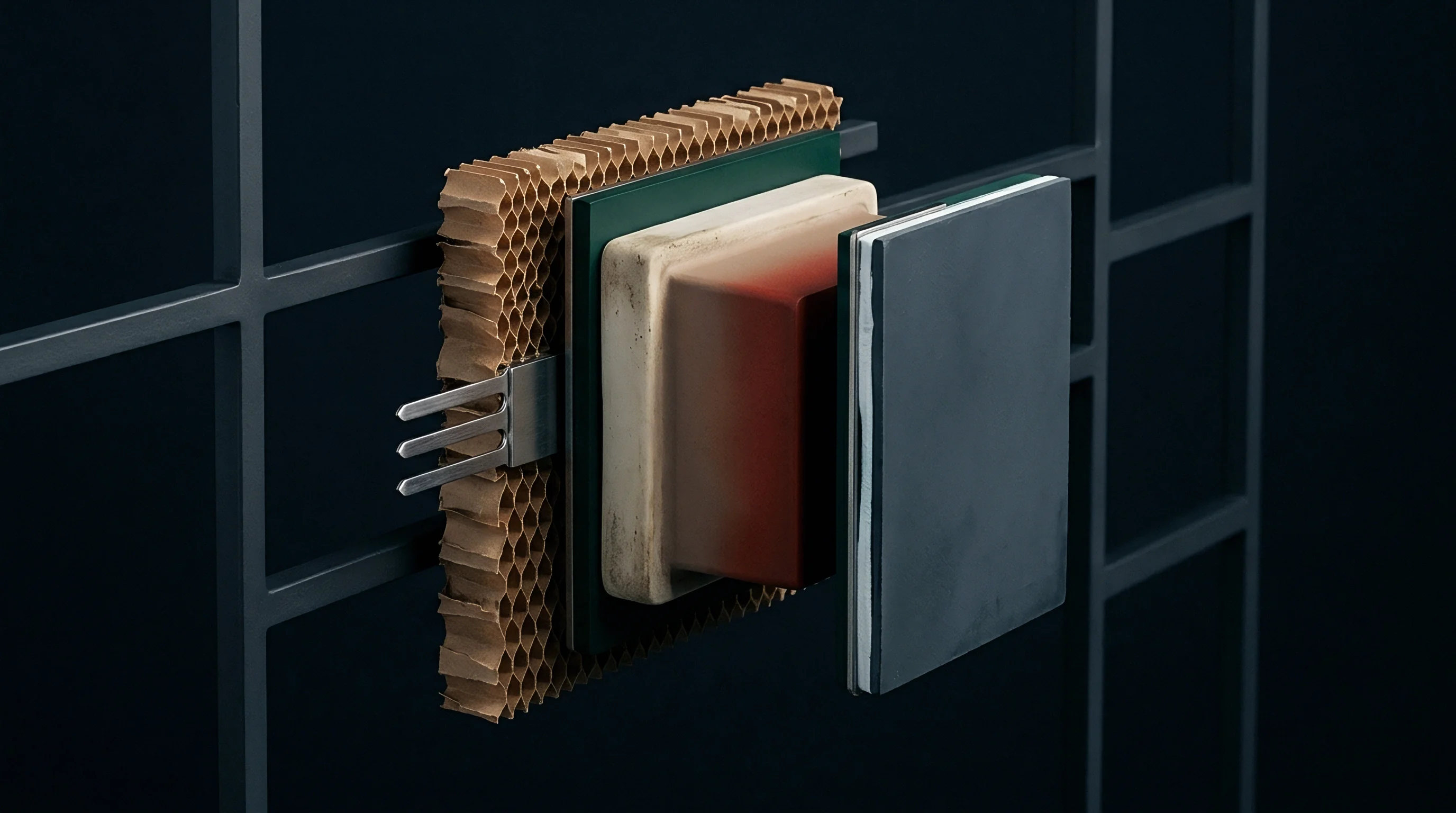
- Interlaminar Bond Disruption occurs when moisture-induced transverse shear forces overcome inter-fiber hydrogen bonding within the central plies.
- Hygrodifferential Buckling develops when top and bottom liners expand at different rates, forcing the structural board to cup.
- Z-Direction Micro-Checking initiates localized micro-cracks along starch adhesive interfaces subjected to cyclic expansion stress.
- Ply Separation Propagation expands microscopic core voids into continuous delamination zones across the entire sheet area.
Applying ISO 1924-2 testing after 48 hours of humidity cycling demonstrates a 35 percent drop in cross-direction tensile energy absorption.
Delamination Kinetic Progression under Cycling
Crack propagation within paperboard cores follows strain energy release kinetics described by fracture mechanics. Initial micro-fissures open around void spaces near coarse fiber bundles or filler agglomerations, and ongoing moisture cycles drive the shear forces that spread these fissures into continuous delamination planes. Heavy static loads on bottom-tier pallets multiply the internal shear stress and speed up crack growth.
Because moisture-softened core plies cannot redistribute concentrated shear, strain energy channels directly into the advancing crack tips.
Whether non-destructive ultrasonic resonance testing can isolate micro-delamination before visual ply separation remains unproven on high-speed packaging lines.
Gauge
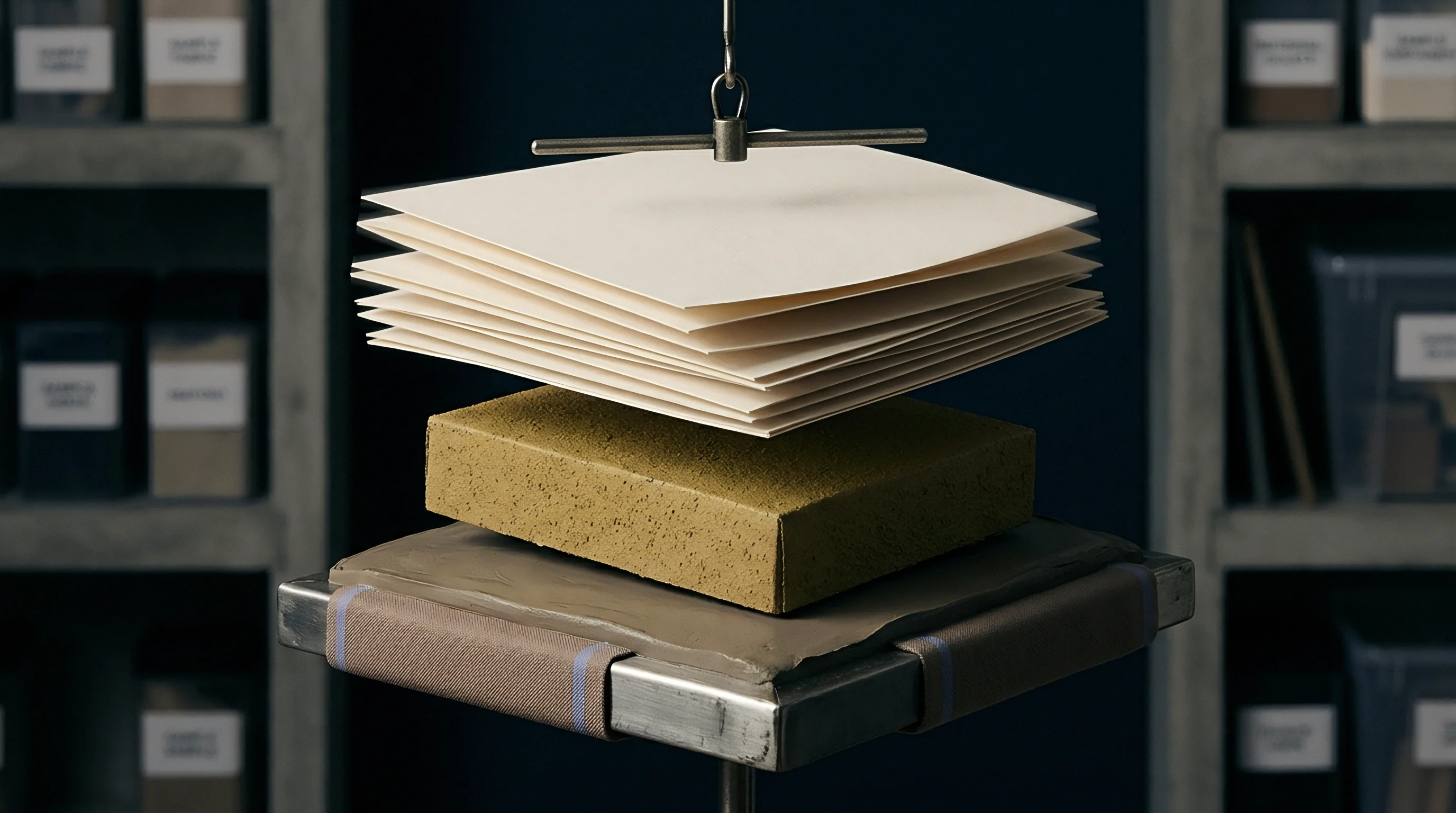
Evaluating internal ply bond strength under moisture stress requires standardized physical testing protocols to catch structural weaknesses before board reaches converting lines. The standard ISO 16260 Scott Bond test records the energy absorbed when an impact pendulum splits a sample along its weakest plane. Running these tests solely under ISO 187 standard atmosphere conditions (23 degrees Celsius, 50 percent relative humidity) conceals vulnerabilities that emerge in real-world transit and warehousing.
Testing samples preconditioned under cyclic elevated humidity provides a far more realistic assessment of dynamic delamination risks.
Which Bench Test Predicts Storage Delamination Earliest?
Z-directional tensile testing per ISO 1924-2 or TAPPI T 541 applies direct perpendicular tension to the board surface, measuring the precise tensile force required for internal separation. Comparative evaluations show that Z-directional tensile tests identify moisture-induced core breakdown earlier than Scott Bond pendulum methods. Pendulum testing applies high-rate impact loads where viscoelastic fibers appear artificially stiff, whereas static Z-directional tests expose bond weakening caused by plasticized starch adhesives and hydrated fiber matrices.
Dynamic mechanical analysis tracks accompanying spikes in loss modulus during humidity ramps, pinpointing the moisture threshold at which failure begins.
- Cut twelve test specimens measuring 25 by 25 millimeters from undisturbed interior reams.
- Condition the specimens at 23 degrees Celsius and 50 percent relative humidity according to ISO 187.
- Transfer test pieces to an unconditioned environmental exposure chamber held at 85 percent relative humidity for 72 hours.
- Mount samples onto aluminum plies using high-tack acrylic double-sided adhesive tape under standardized 1.4 megapascal compression.
- Execute internal bond strength measurement in accordance with ISO 16260 to quantify ply separation resistance.
Sheets stored in unconditioned transit spaces absorb atmospheric moisture faster through exposed pallet sides than through compressed top surfaces.
Laboratory Conditioning Protocols for Moisture Degradation
Standard laboratory conditioning fails to recreate the non-equilibrium moisture states found in unconditioned distribution centers. More effective accelerated protocols alternate relative humidity between 35 percent and 85 percent on 12-hour cycles. Edge preparation is critical: sealing test edges with paraffin wax isolates face penetration, while leaving them exposed replicates palletized reel storage.
Tracking thickness gains with an ISO 534 gauge during cycling reveals irreversible caliper swell, a clear precursor to core bond failure.
Including a mandatory ISO 16260 minimum threshold after 72-hour humidity conditioning within purchase specifications reallocates financial liability for moisture damage back to the paper mill.
Furnish
Fiber selection and ply arrangement largely govern how well a board resists hygromechanical core failure. Solid Bleached Sulfate, made entirely from virgin chemical pulps, holds up far better under moisture than multi-ply grades built with mechanical or recycled fiber, as long softwood fibers create a dense, bonded network that resists water intrusion. Folding Boxboard pairs chemical pulp liners with a bulky mechanical pulp core, whereas Coated Recycled Board incorporates mixed recovered furnishes containing short, degraded fibers and high filler fractions.
Core Structure Resilience across Pulp Types
Mechanical pulps used in boxboard cores, such as TMP or CTMP, retain substantial native lignin, which provides a brief hydrophobic delay against liquid water. Once water vapor penetrates the network, however, lignin plasticization softens the matrix and can trigger core collapse under compressive loads. Recycled cores present a different problem: hornified fibers have lost swelling capacity and offer fewer bonding sites due to their shorter length.
Papermakers add starch to bridge these gaps, but the resulting bonds degrade quickly once ambient humidity climbs.
| Grade Family | Furnish Architecture | Dry Scott Bond (J/m²) | Scott Bond Post-Humidity (J/m²) | Caliper Swell (%) |
|---|---|---|---|---|
| Solid Bleached Sulfate (SBS) | 100% Virgin Chemical Pulp | 180 | 155 | 2.4 |
| Coated Unbleached Kraft (CUK) | Virgin Softwood Kraft Core | 210 | 175 | 3.1 |
| Folding Boxboard (FBB) | Mechanical Pulp Core / Chemical Skins | 130 | 72 | 6.8 |
| Coated Recycled Board (CRB) | 100% Recycled Mixed Furnish | 95 | 38 | 11.2 |
Groundwood pulp fibers in boxboard cores maintain physical bulk while suffering accelerated bond degradation under elevated ambient moisture.
Recycled Fiber Degradation and Bond Loss
Repeated recycling shortens fibers, strips outer cell wall layers, and curbs internal fibrillation, while hornification from successive drying stages lowers their water retention value. To meet target calipers and basis weights economically, recycled board mills add mineral fillers like calcium carbonate and clay at rates up to twenty percent by weight. These particles fill inter-fiber voids without forming hydrogen bonds.
Under humid conditions, moisture pools around filler clusters, speeding micro-crack formation through the weakened core and leading to early delamination.
- Solid Bleached Sulfate maintains high internal bond integrity due to long bleached softwood chemical fibers and uniform hydrogen bonding across all plies.
- Coated Unbleached Kraft delivers maximum fracture toughness under moisture stress, leveraging unrefined kraft softwood fibers to resist strain energy release.
- Folding Boxboard Mechanical Core provides superior structural bulk per unit weight, but experiences sharp reductions in core shear modulus when relative humidity exceeds 80 percent.
- Coated Recycled Board displays extreme sensitivity to moisture ingress, exhibiting high caliper swell and rapid ply bond loss due to short fibers and high filler loads.
Selecting virgin chemical fiber cores preserves carton structural integrity through extended non-climate controlled warehouse storage.
Loss
Box compression strength, whether measured by ISO 12048 or TAPPI T 804, relies on the flexural stiffness and shear modulus of the paperboard walls. When internal ply bonds soften through moisture absorption, the board loses its resistance to localized face buckling. Under static compressive loads in cycling humidity, creep deformation accelerates sharply, causing warehouse stacks to lean, crushing lower cartons and damaging primary contents.
Structural Compression Failure and Stacking Creep
Dynamic compression failure under load stems directly from core shear breakdown. Intact multi-ply panels distribute top loads across all plies through interlaminar shear, but once core plies separate, individual layers buckle independently under much lower thresholds. This loss of structural composite action slashes overall box compression resistance by up to sixty percent.
The resulting pallet creep transfers vertical loads straight from collapsed bottom-tier cartons onto the packaged goods inside.
| Storage Duration (Weeks) | Average Ambient RH Range (%) | BCT Retention (%) | Converting Spoilage Rate (%) | Net Landed Loss per 100k Units ($) |
|---|---|---|---|---|
| 2 | 45 – 60 | 96 | 0.8 | 420 |
| 4 | 55 – 75 | 84 | 3.2 | 1,680 |
| 8 | 65 – 85 | 68 | 8.5 | 4,450 |
| 12 | 70 – 90 | 48 | 19.4 | 10,180 |
Economic Yield Impact and Spoilage Arithmetic
Calculating the true cost of core delamination means accounting for substrate waste, converting downtime, and damaged product claims. On a run of forty tonnes of folding boxboard at 1,450 dollars per tonne, baseline spoilage in a climate-controlled plant averages two percent, or 1,160 dollars. Storing that same board in an unconditioned warehouse for eight weeks during high-humidity periods drives internal moisture up to twelve percent, dropping ply bond strength well below operating tolerances.
Running moisture-compromised board through high-speed creasers and gluers causes score-line cracking, surface blistering, and feeder jams. Spoilage climbs to 8.5 percent, driving direct substrate waste to 4,930 dollars for the same forty-tonne job. Additional expenses follow from reduced machine speeds, extended make-readies, and rejected transit pallets.
Buying cheaper board at the outset often leads to a net cost increase once unconditioned storage exposes the substrate’s weak interlaminar stability.
Ignoring moisture-induced ply bond degradation during warehouse planning leads to catastrophic bottom-deck pallet compression failures and unrecoverable product claims.