Dynamic Mechanical Analysis of High Speed Shear Dissipation in BCTMP Middle Ply Hemicellulose Networks
Dynamic mechanical analysis identifies hemicellulose moisture thresholds that prevent score cracking during high speed converting of mechanical pulp middle plies.


Viscoelasticity
High-speed mechanical loading during packaging line scoring demands rapid energy absorption within middle ply fiber layers. Bleached chemithermomechanical pulp carries intact hemicellulose networks composed primarily of glucuronoxylan and glucomannan. These polymers establish viscoelastic dissipation mechanisms that prevent mechanical shear stresses from propagating into outer kraft liner layers.
Oscillatory mechanical analysis measures the real storage modulus and imaginary loss modulus across defined temperature boundaries, establishing the mechanical loss factor across varying deformational frequencies.
Lignin restricts polymer mobility, and unrefined chemical pulps lose hemicellulose during alkaline kraft cooking, which diminishes the fiber wall’s natural polymeric damping capability. Chemithermomechanical processes, by contrast, retain up to 25 percent hemicellulose content by yield, forming an amorphous matrix around rigid cellulose microfibrils. Under high-speed shear stress, bound moisture within the hemicellulose network acts as an internal plasticizer.
As loading rates increase during high-velocity creasing, the mechanical loss factor shifts, moving the effective glass transition response directly into converting temperature windows.
At standard atmospheric conditioning of 23 degrees Celsius and 50 percent relative humidity under ISO 187, the glass transition temperature of moisture-plasticized xylan within BCTMP drops from 180 degrees Celsius to 34 degrees Celsius.
Standard static tensile measurements fail to capture time-dependent polymer movements occurring within millisecond scoring windows. Oscillatory thermal testing subjects middle ply mechanical pulps to cyclic shear strain while tracking energy storage and dissipation. Higher loss modulus values indicate efficient conversion of mechanical strain into localized thermal energy; without this molecular mobility, mechanical energy accumulates as structural strain, initiating micro-fractures within the fiber network under high deformational velocities.
Hemicellulose Matrix Dynamics under Shear
Inter-fiber bond points within middle ply layers experience multi-axial strain during boxboard folding operations. Hemicellulose molecules form hydrogen-bonded bridges between intact BCTMP fibers. Oscillatory strain sweeps demonstrate that these amorphous bridges undergo reversible conformational changes under low strain amplitudes before reaching yield thresholds.
The loss tangent reaches peak values when deformation frequencies match the molecular relaxation rates of the glucuronoxylan chains.
Refining energy applied to mechanical pulp alters the accessibility of hemicellulose hydrophilic sites, modulating the equilibrium water content held within the middle ply layer. Well-refined BCTMP exhibits higher loss modulus values than unrefined mechanical pulp due to increased surface exposure of swollen hemicellulose fibrils. Lowering middle ply density while maintaining inter-fiber damping capacity requires precise calibration of refining energy against chemical pulp additions.

Glass Transition Temperature Shifts in Mechanical Furnish
Glass transition events within wood polymer networks depend directly on water molecule distribution. Completely dry hemicellulose exhibits a glass transition temperature exceeding 180 degrees Celsius, far above ambient packaging line temperatures. Ambient water absorption depresses this transition point into operating ranges between 20 degrees Celsius and 40 degrees Celsius.
Higher testing frequencies shift the measured glass transition upward, moving the damping peak away from room temperature unless relative humidity remains controlled.
Uncontrolled shear energy accumulation during high-speed converting leads directly to structural liner splitting. Inadequate dissipation within the middle layer forces peak shear stresses into outer liners, cracking outer clay coatings across printed scores and destroying package barrier integrity on automated filling lines.


Strain
Time-temperature superposition principles allow high-frequency shear dissipation responses to be modeled from lower-frequency laboratory measurements. Oscillatory testing conducted across frequency ranges from 0.1 Hertz to 100 Hertz over temperature steps between -20 degrees Celsius and 120 degrees Celsius generates master curves for storage and loss moduli. Shift factors calculated via the Williams-Landel-Ferry equation translate thermal sweeps into equivalent strain rate behavior operating up to 10,000 reciprocal seconds.
Converter scoring blades penetrate paperboard substrates at linear velocities exceeding 300 meters per minute, generating localized strain rates within middle ply BCTMP networks that exceed conventional laboratory testing speeds. The dynamic storage modulus rises sharply at elevated deformation rates, causing the material to behave more rigidly. If loss modulus values fail to scale proportionally, the middle ply loses its ability to deform plastically during crease formation.

Time-Temperature Superposition at High Deformational Velocities
Master curves constructed for BCTMP middle plies show distinct viscoelastic regions dependent on pulp yield and shive content. High-yield pulps containing residual native lignin display elevated glass transition shoulders compared to low-yield mechanical pulps. Superposition validity requires that the underlying molecular relaxation mechanisms remain unchanged across the temperature range evaluated during testing.
Moisture loss during mechanical testing invalidates high-temperature master curve construction. Specimen environmental chambers must maintain precise vapor pressure equilibrium during thermal sweeps to prevent specimen drying. When water evaporates from the hemicellulose network during analysis, the apparent storage modulus increases artificially, producing inaccurate strain rate projections for mill operations.
Dynamic Modulus Measurement Standardizations
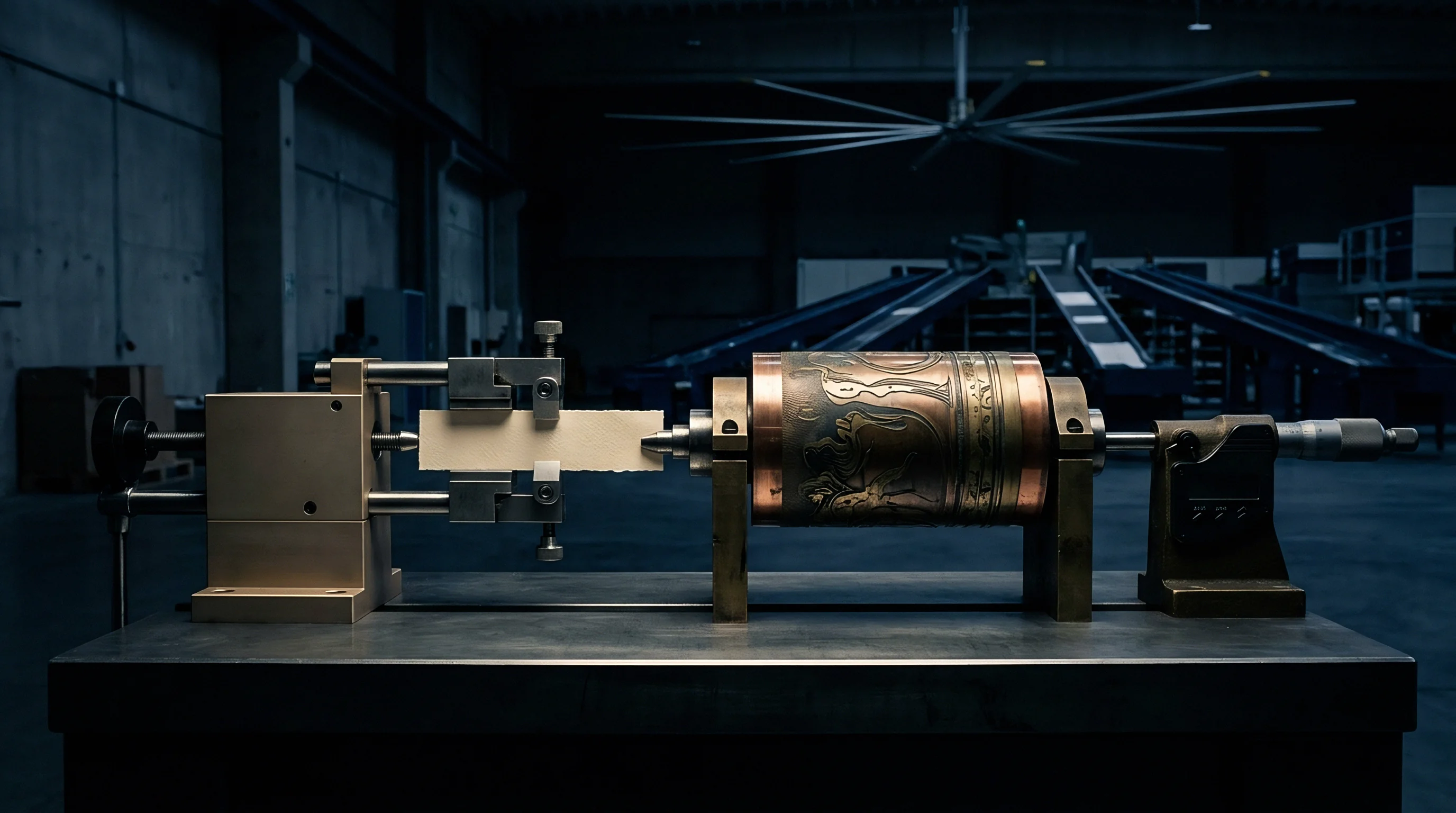
Standardized testing of flexural and shear strain behavior demands strict control over specimen clamping geometry and oscillatory force amplitude. Torsion and cantilever fixtures impose different stress distributions across thick paperboard samples. Single-cantilever geometries isolate z-directional shear stresses within middle ply layers effectively, provided the outer kraft layers remain aligned parallel to the clamping plane.
- Frequency Sweep Range Multi-frequency oscillatory measurements from 0.1 Hertz to 100 Hertz establish the master curve foundation for strain rate extrapolation.
- Isothermal Temperature Increments Steps of 2 degrees Celsius across the target range of -20 degrees Celsius to 120 degrees Celsius prevent thermal gradients within thick board samples.
- Controlled Strain Amplitude Strain levels held within the linear viscoelastic region below 0.05 percent prevent irreversible network micro-cracking during testing.
- Relative Humidity Control Sealing the specimen test chamber at constant relative humidity prevents moisture loss during elevated temperature sweeps.
Calibrating mechanical test instruments for high-yield fiber analysis requires verifying transducer compliance against rigid steel calibration bars. Machine compliance contributions corrupt loss tangent calculations if raw displacement signals are not corrected for instrument frame deflection. The table below presents measured viscoelastic parameters for middle ply mechanical pulps compared against bleached chemical pulps under controlled laboratory conditioning.
| Furnish Composition | Test Frequency (Hz) | Storage Modulus E’ (MPa) | Loss Modulus E” (MPa) | Loss Tangent tan delta |
|---|---|---|---|---|
| 100% Spruce BCTMP (80% Yield) | 1.0 | 1450 | 116 | 0.080 |
| 100% Spruce BCTMP (80% Yield) | 50.0 | 1820 | 182 | 0.100 |
| 70% BCTMP / 30% Kraft Softwood | 1.0 | 1680 | 118 | 0.070 |
| 70% BCTMP / 30% Kraft Softwood | 50.0 | 2100 | 179 | 0.085 |
| 100% Bleached Kraft Hardwood | 1.0 | 2400 | 120 | 0.050 |
| 100% Bleached Kraft Hardwood | 50.0 | 3100 | 171 | 0.055 |
Mill certificates listing only static tensile stiffness orientation fail to indicate converting line crack resistance. Incorporating ISO 1924-3 high-speed tensile energy absorption limits into purchase contracts obligates the board supplier to guarantee minimum viscoelastic damping performance across conversion speed ranges.
Swell
Water molecule sorption into BCTMP middle plies induces anisotropic fiber swelling, directly altering mechanical energy absorption capacity. Chemithermomechanical pulp fibers retain cross-sectional geometry due to stiff lignin-rich outer cell wall layers. Hemicellulose concentrated within the middle lamella and primary cell wall absorbs water rapidly, causing transverse fiber swelling up to five times greater than axial expansion.
Excessive water content lowers storage modulus values below structural threshold requirements for package rigidity. Conversely, low equilibrium moisture contents cause hemicellulose matrices to vitrify into glassy states, forfeiting shear dissipation capability. Maintaining equilibrium moisture within strict specification bands prevents both score delamination and creasing line roll-back during high-speed carton erecting.
Compliance with ISO 535 Cobb water absorption specifications prevents moisture gradients that alter the viscoelastic damping response of middle ply BCTMP during high-speed converting.
Equilibration protocols prior to mechanical testing govern the reproducibility of viscoelastic data. Laboratory technicians follow strict conditioning sequences to ensure uniform water concentration across multi-ply board cross sections.
Hygrothermal Swelling Kinetics in Lignin Rich Fibers
Swelling rates depend on water vapor diffusion through the porous network of the middle ply. BCTMP features open pore structures with bulk values exceeding 1.8 cubic centimeters per gram. Water vapor diffuses rapidly through bulkier mechanical layers compared to dense chemical pulp liners, accelerating moisture equilibration during converting plant processing.
Lignin inhibits full cell wall dissolution, restricting maximum volume expansion. Solvated glucuronoxylan chains expand into inter-fiber voids, creating soft hydrogel bridges that dissipate energy under shear displacement. If relative humidity drops below 40 percent, these hydrogel bridges collapse, increasing storage modulus while reducing energy absorption capacity.

Converter Room Moisture Equilibrium Controls
Equilibrating paperboard reels within unconditioned packaging plants induces steep moisture gradients between reel edges and core centers. Edge-dried reels exhibit asymmetric scoring behavior across converted web widths. Mechanical testing of edge-dried BCTMP shows a 45 percent drop in loss tangent compared to core samples held at target moisture content.
- Transfer board samples directly from sealed mill packaging into test atmosphere within two minutes to prevent moisture exchange.
- Condition specimens for 48 hours under ISO 187 standard conditions of 23 degrees Celsius and 50 percent relative humidity prior to dynamic testing.
- Measure specimen caliper at five distributed locations across the test strip using an ISO 534 dead-weight micrometer to verify uniform thickness.
- Mount the specimen into the single-cantilever testing fixture using a calibrated torque wrench set to 20 Newton centimeters.
- Purge the test sample chamber with conditioned air matching target relative humidity before initiating thermal sweeps.
Score delamination on converting lines during winter runs stems from insufficient hemicellulose retention in mechanical pulp streams rather than ambient plant dryness.
Hysteresis
Mechanical hysteresis represents the energy lost as heat during cyclic loading and unloading of the BCTMP hemicellulose network. The area enclosed within the stress-strain hysteresis loop quantifies total dissipated mechanical energy per unit volume. Higher hysteresis values in middle ply layers correlate directly with reduced outer layer tension during 90-degree scoring folds.
Hemicellulose polymers exhibit non-linear viscoelastic hysteresis under large-amplitude oscillatory shear. When strain amplitudes exceed linear viscoelastic thresholds, hydrogen bonds within the xylan matrix rupture reversibly; this structural reorganization absorbs deformational energy before stress can rupture surface fibers, preventing catastrophic crack propagation across inter-fiber bond faces.
Mechanical Energy Conversion Mechanisms
Shear deformation converts mechanical work into thermal energy within the middle ply. Thermal cameras deployed on high-speed scoring presses record localized temperature increases up to 8 degrees Celsius along active creasing channels. BCTMP furnishes with elevated hemicellulose content show higher heat generation rates, confirming active mechanical energy dissipation within the middle layer matrix.
High-yield mechanical pulps containing unrefined shives exhibit poor hysteresis characteristics. Coarse fiber bundles lack accessible hemicellulose sites, acting as rigid stress concentrators rather than energy absorbers. Refining BCTMP to controlled freeness levels breaks intact shives into flexible fibrillated fibers, expanding the total viscoelastic surface area available for dissipation.
Higher loss tangents in the middle ply furnish allow sharp creasing folds without delaminating outer surface layers.
Quantifying shear dissipation requires testing across combined temperature and strain rate spectrums. The table below presents dissipation parameters measured across variable strain rates and moisture levels using oscillatory mechanical analysis.
| Strain Rate (s⁻¹) | Moisture Content (%) | Storage Modulus E’ (MPa) | Loss Modulus E” (MPa) | Loss Tangent tan delta | Hysteresis Energy (kJ/m³) |
|---|---|---|---|---|---|
| 10 | 5.0 | 2100 | 105 | 0.050 | 12.4 |
| 10 | 8.5 | 1650 | 148 | 0.090 | 21.8 |
| 10 | 11.0 | 1300 | 143 | 0.110 | 24.2 |
| 1000 | 5.0 | 2850 | 171 | 0.060 | 16.2 |
| 1000 | 8.5 | 2200 | 220 | 0.100 | 28.5 |
| 1000 | 11.0 | 1750 | 210 | 0.120 | 31.0 |
Data determined via master curve shift factors applied to single-cantilever oscillatory measurements. Specimens conditioned under ISO 187 atmospheric standard variations.
Dissipation efficiency varies across wood species used in BCTMP production. Aspen BCTMP carries higher xylan concentrations than spruce BCTMP, yielding superior damping performance at room temperature. Softwood BCTMP delivers longer fiber networks that enhance structural tear strength while spruce hemicellulose provides mid-frequency dissipation balance.
Increasing the proportion of long softwood fibers in the mechanical pulp middle ply broadens the viscoelastic dissipation window across rapid temperature variations.

Splitting
Z-directional delamination performance dictates paperboard converting reliability on high-speed cartoning equipment. Standard Scott Bond test methods apply impact forces in the normal direction, recording total energy required to rupture internal fiber networks. Static impact testing fails to differentiate between brittle cleavage of rigid cell walls and plastic deformation of viscoelastic hemicellulose networks under pure shear displacement.
Because bending stiffness depends heavily on caliper, scoring tools compress the middle ply down to 30 percent of its initial thickness while inducing high shear displacement parallel to the sheet surface. If the middle ply hemicellulose network fails to yield viscoelastically, internal shear stresses exceed z-directional bond strength, causing uncontrolled delamination along weak fiber interfaces.
How Does Hemicellulose Softening Prevent Score Cracking?
Softening the middle ply hemicellulose matrix lowers internal shear resistance during initial crease indentation. When scoring blades displace the paperboard, soft hemicellulose chains permit controlled micro-sliding between intact BCTMP fibers without breaking structural fiber-to-fiber bonds. This localized yielding redistributes bending stresses away from outer liner layers, preserving liner surface smoothness and print integrity.
Over-refining mechanical pulps increases internal bond strength but reduces middle ply bulk, diminishing overall flexural rigidity. Converter operations require high flexural rigidity paired with controlled internal delamination within the crease channel. Precise control over hemicellulose solvation balances z-directional shear dissipation against structural packaging column strength.
- Ply Delamination Uncontrolled internal cracking propagating parallel to the sheet surface when storage modulus exceeds loss modulus during rapid bending deformation.
- Outer Liner Fracture Tensile rupture across the creased ridge caused by rigid middle ply cores that fail to absorb transverse shear forces.
- Internal Score Flaking Localized fiber bond cleavage inside the BCTMP matrix generating loose dust and weakening score line hinge stiffness.
High-speed convertors track score quality using cross-sectional optical microscopy paired with mechanical hinge stiffness measurements. Well-formed score channels demonstrate uniform internal delamination confined within the BCTMP middle ply while top and bottom kraft plies maintain continuous intact surface profiles.
Correlating dynamic loss tangent values with converted score cracking rates remains an ongoing focus across paperboard converting operations. Whether dynamic mechanical analysis can fully replace standardized Scott bond testing as an online mill quality metric for score crack prediction remains unresolved.

Yield
Selecting paperboard substrates involves trading raw material tonnage costs against converting performance and package strength parameters. Middle ply BCTMP delivers bulk values exceeding 2.0 cubic centimeters per gram, allowing board mills to construct thick, stiff paperboard structures at lower grammages than solid chemical pulp sheets. Substituting BCTMP into middle plies reduces total fiber mass requirements per square meter while maintaining bending stiffness targets.
High-yield mechanical pulps cost less per metric ton than fully bleached chemical kraft pulps due to wood resource utilization efficiencies reaching 85 percent. Incorporating BCTMP into multi-ply packaging board cuts overall raw material spend, but requires careful verification of hemicellulose content to avoid converting line downtime caused by rigid score failures.
Optimizing middle ply BCTMP content lowers raw material mass while retaining the flexural rigidity required for heavy packaging applications.
Modification of middle ply furnish recipes alters both landed sheet yield and converting headroom. The commercial model below calculates yield variations, structural stiffness values, and landed unit costs across three board compositions engineered for heavy folding boxboard packaging.
| Board Grade Architecture | Grammage (g/m²) | Caliper (µm) | Bulk (cm³/g) | Taber Stiffness MD (mN·m) | Landed Cost Per 1000 m² (USD) |
|---|---|---|---|---|---|
| Solid Bleached Board (100% Kraft) | 350 | 420 | 1.20 | 18.5 | 682.50 |
| Folding Boxboard (50% BCTMP Middle) | 300 | 480 | 1.60 | 22.1 | 540.00 |
| High-Bulk Boxboard (65% BCTMP Middle) | 275 | 510 | 1.85 | 24.0 | 474.38 |

Bulk Retention and Flexural Rigidity Economics
Flexural rigidity scales with the cube of sheet thickness. Positioned at the neutral axis of bending, the middle ply contributes minimal tensile resistance during flexure but maintains the distance between top and bottom kraft liners. BCTMP provides structural space at minimal fiber mass, maximizing flexural rigidity per dollar of fiber cost.
Replacing 50 grams per square meter of chemical pulp with high-bulk BCTMP maintains package stackability while generating substantial savings on high-volume production runs. Packaging buyers purchasing millions of converted cartons capture immediate unit cost reductions through grammage optimization.
Delivered Sheet Cost Calculations
Evaluating board options demands translating metric ton pulp pricing into landed converted sheet costs. Freight charges levied on volumetric weight favor lower-grammage, high-bulk board options. Reducing grammage from 350 grams per square meter down to 275 grams per square meter lowers transport emissions charges and municipal packaging waste fees in European target markets.
Substrate choices finalized without verifying high-velocity middle ply shear properties introduce financial exposure during peak production runs. Brittle middle plies force convertors to reduce machine operating speeds, increasing hourly press costs and eroding the financial gains achieved through lower raw material unit pricing. Adjusting BCTMP blend ratios based on dynamic mechanical property targets yields predictable creasing performance while holding board bulk within strict commercial tolerance bands.