Fundamentals of Acoustic Wave Propagation in Cellulosic Fiber Networks
Acoustic velocity profiling provides non-destructive dynamic stiffness metrics that predict score cracking and lamination curl in converting passes.

Velocity
Sound transmission through a porous cellulosic web depends directly on sheet density and the planar elastic tensor. Mechanical stress waves propagate through the interconnected network of wood fibers by displacing adjacent hydrogen-bonded fiber segments. The speed of these acoustic pulses offers a direct, non-destructive measurement of the dynamic elastic moduli along specific geometric axes of the paperboard matrix.

In Plane Elastodynamics in Fiber Structures
Stress pulses propagated through a cellulosic sheet travel as longitudinal and shear elastic waves. Longitudinal waves displace material parallel to the direction of propagation, whereas shear waves induce transverse displacement. In thin planar sheet materials, the in-plane longitudinal sound phase speed relates directly to the dynamic tensile stiffness of the fibrous mat.
Sound travels faster through individual cellulose crystallites than through the amorphous region or the air-filled pore volume. Dynamic stiffness dictates conversion stability. Consequently, higher fiber refining and increased wet pressing elevate phase speed by increasing intra-fiber density and inter-fiber bonded area.
The mathematical relationship governing longitudinal wave propagation in an orthotropic thin sheet simplifies to a single-density equation:
c = sqrt(E_dyn / rho)
where c is the ultrasonic phase velocity in meters per second, E_dyn represents the dynamic elastic modulus in Pascals, and rho denotes the apparent sheet density in kilograms per cubic meter. Multiplying the square of sound velocity by apparent density yields the dynamic elastic stiffness index, expressed in kilometer-squared per second-squared or kNm/g. Sonic transit times expose microstructural flaws.
Because the dynamic modulus measured at ultrasonic frequencies (typically 20 kHz to 100 kHz) avoids macro-scale creep and viscoelastic slip, acoustic measurements yield higher modulus figures than destructive static tensile tests run at low strain rates.
Shear wave propagation across the plane evaluates the dynamic shear modulus. In-plane shear phase speed depends on the matrix bonding efficiency and the angular distribution of individual fiber segments relative to the principal axes of the paper machine.

Dynamic Modulus Derivation from Transit Time
High-frequency piezo transducers measure acoustic pulse propagation across known path lengths. The transit time delay between the transmitting pulse and the receiving crystal defines the phase velocity across the substrate. Bonded area dictates sonic speed.
Measuring sound speed at fixed angular increments provides a complete planar distribution of dynamic stiffness across the machine direction and cross direction.
| Substrate Grade | Grammage (g/m2) | Density (kg/m3) | MD Velocity (m/s) | CD Velocity (m/s) | MD Dynamic Modulus (GPa) | CD Dynamic Modulus (GPa) |
|---|---|---|---|---|---|---|
| Solid Bleached Sulfate (SBS) | 280 | 820 | 3150 | 1920 | 8.14 | 3.02 |
| Folding Boxboard (FBB) Outer Ply | 300 | 680 | 2980 | 1750 | 6.04 | 2.08 |
| Unbleached Kraft Linerboard | 175 | 710 | 3420 | 1880 | 8.31 | 2.51 |
| Recycled Medium (WCCR) | 120 | 590 | 2450 | 1510 | 3.54 | 1.35 |
The matrix stiffness of the sheet directly reflects raw material selection and fiber processing history. Bleached softwood chemical pulps yield higher acoustic phase velocities than high-yield mechanical pulps or recycled fibers. Softwood tracheids contain longer crystalline cellulose domains, allowing sound pulses to travel rapidly along the fiber axis with minimal acoustic impedance at fiber-to-fiber crossovers.
A higher dynamic elastic modulus consistently correlates with higher bending stiffness for a given sheet thickness. When evaluating cartonboard for high-speed packaging equipment, a shift in dynamic sound velocity provides an instant warning of density variations before those variations cause jam-ups on the folder-gluer.
Higher refining levels elevate sound propagation velocity by multiplying inter-fiber contact points across the mat.
High dynamic stiffness values indicate a structural readiness for high-speed converting passes, whereas low values reveal poor web cohesion that leads to register errors during press runs.


Anisotropy
Machine direction fiber alignment during headbox deposition creates preferential elastic compliance vectors in the sheet. Hydrodynamic shear forces along the forming wire align individual fibers predominantly parallel to the movement of the paper machine. This directional structural bias creates an orthotropic material wherein sound wave velocities vary systematically as a function of propagation angle.
Polar Sound Velocity and Fiber Orientation Angles
Rotating sound transducers through a planar sweep generates directional stiffness distribution profiles. These polar acoustic diagrams map the complete in-plane stiffness tensor of the sheet. Fiber alignment dictates tear propagation.
The angle where sound speed achieves its absolute maximum defines the Tensile Stiffness Orientation angle, while the ratio of maximum velocity to minimum velocity establishes the Tensile Stiffness Index ratio.
Jet-to-wire speed differentials and headbox rush-drag ratios determine the magnitude of polar orientation asymmetry. High jet-to-wire speed differences force fibers into tight alignment along the machine direction, widening the gap between machine-direction sound speed and cross-direction sound speed. Grain angle drives web stability.
Tension profiles alter polar stiffness. When web draws during section drying are pulled tight, machine-direction sound speed climbs further while cross-direction sound speed drops due to the Poisson contraction effect.
Dynamic stiffness measured along the machine direction reaches 11.2 kNm/g at 50 percent relative humidity, dropping to 8.4 kNm/g at 80 percent relative humidity.
Structural variables that degrade planar uniformity impair downstream converting accuracy:
- Headbox Jet Angle Misalignment induces asymmetric Tensile Stiffness Orientation angles, causing skewed folds during high-speed carton erecting passes.
- Uneven Web Drying Profiles create localized variation in sound phase speed, driving registration drift across print units and lamination nips.
- Unmatched Layer Orientations in multi-ply board structures generate internal shear stresses during moisture regain cycles, resulting in post-converting panel twist.
- Excessive Draw Tension elevates machine direction velocity while depleting cross-direction dynamic modulus, leading to premature score line splitting.

Out of Plane Propagation in Multi Ply Boards
Ultrasonic pulse transmission through the Z-axis reveals weak internal ply bonding. Sound traveling perpendicular to the plane of the paperboard encounters dozens of stacked fiber layers separated by inter-ply boundary zones. The out-of-plane longitudinal wave velocity sits significantly lower than in-plane velocities, rarely exceeding 400 to 700 meters per second in standard folding boxboards.
Low Z-direction stiffness invites delamination. Out-of-plane elastic constants govern how paperboard behaves under nip compression during foil stamping, film lamination, and heavy score formation. The outer plies carry the load.
In multi-ply boards containing mechanical pulp cores flanked by chemical pulp liners, Z-direction sound transit times pinpoint exact internal delamination boundaries caused by over-refining or inadequate starch application between forming wires.
Ignoring direction-dependent acoustic velocity variations when setting up die-cutting operations results in severe score line fracturing, uncontrolled board warp during film lamination, and structural container failure under stacking loads.


Attenuation
High-frequency acoustic energy decays rapidly as sound pulses travel through bonded cellulosic fibers and inter-fiber voids. Wave energy dissipates through internal friction within amorphous hemicellulose and lignin polymer chains, combined with geometric scattering at fiber-air phase boundaries. Quantifying signal dissipation reveals the structural integrity and internal dampening capacity of the sheet structure.

Viscoelastic Energy Dissipation and Porous Scattering
Material damping converts mechanical wave energy into thermal dissipation through internal polymer chain sliding. High-frequency sound waves moving through cellulosic networks lose amplitude exponentially over distance. The total acoustic attenuation coefficient combines scattering losses from microscopic pores with absorption losses within the amorphous cell wall matrix.
Higher relative bonded area reduces air-fiber scattering interfaces, allowing acoustic energy to propagate with less wave amplitude decay. Denser sheets exhibit lower geometric scattering coefficients. Highly porous, unrefined sheets scatter sound energy randomly, resulting in high signal attenuation and rapid wave dispersion.
Amorphous polymers in the fiber matrix govern energy absorption, making attenuation a sensitive indicator of chemical composition, lignin content, and internal bonding agents.

Moisture Sensitivity and Glass Transition Effects
Water molecules entering the amorphous hemicellulose regions alter sound wave speed and energy loss rates. Water acts as a plasticizer within the cellulosic cell wall, lowering the glass transition temperature of hemicellulose and expanding internal pore spaces. Phase velocity drops as humidity rises.
Excessive moisture destroys dynamic modulus. As moisture content climbs, sound phase velocity decreases monotonically while acoustic energy attenuation climbs sharply.
| Equilibrium RH (percent) | Moisture Content (percent) | MD Velocity (m/s) | Attenuation Coefficient (dB/mm at 100 kHz) | Dynamic Elastic Modulus (GPa) |
|---|---|---|---|---|
| 30 | 4.2 | 3310 | 1.12 | 8.98 |
| 50 | 6.5 | 3150 | 1.45 | 8.14 |
| 70 | 9.1 | 2890 | 2.10 | 6.85 |
| 85 | 12.8 | 2420 | 3.65 | 4.80 |
Moisture regain alters acoustic speed. Wetting board weakened by ambient humidity increases damping capacity while reducing dynamic stiffness. When board samples are tested without strictly controlled environmental conditioning, measured sound transit times drift wildly, invalidating mill quality declarations.
ISO 22432 mandates specimen equilibration at 23 degrees Celsius and 50 percent relative humidity because a 2 percent moisture shift changes acoustic transit times by over 5 percent.
Substrate suppliers often claim that wave attenuation shifts stem entirely from raw material furnish changes rather than moisture variations during transit, but laboratory re-conditioning proves that unmanaged moisture intake causes over eighty percent of observed acoustic damping increases on arriving rolls.

Gage
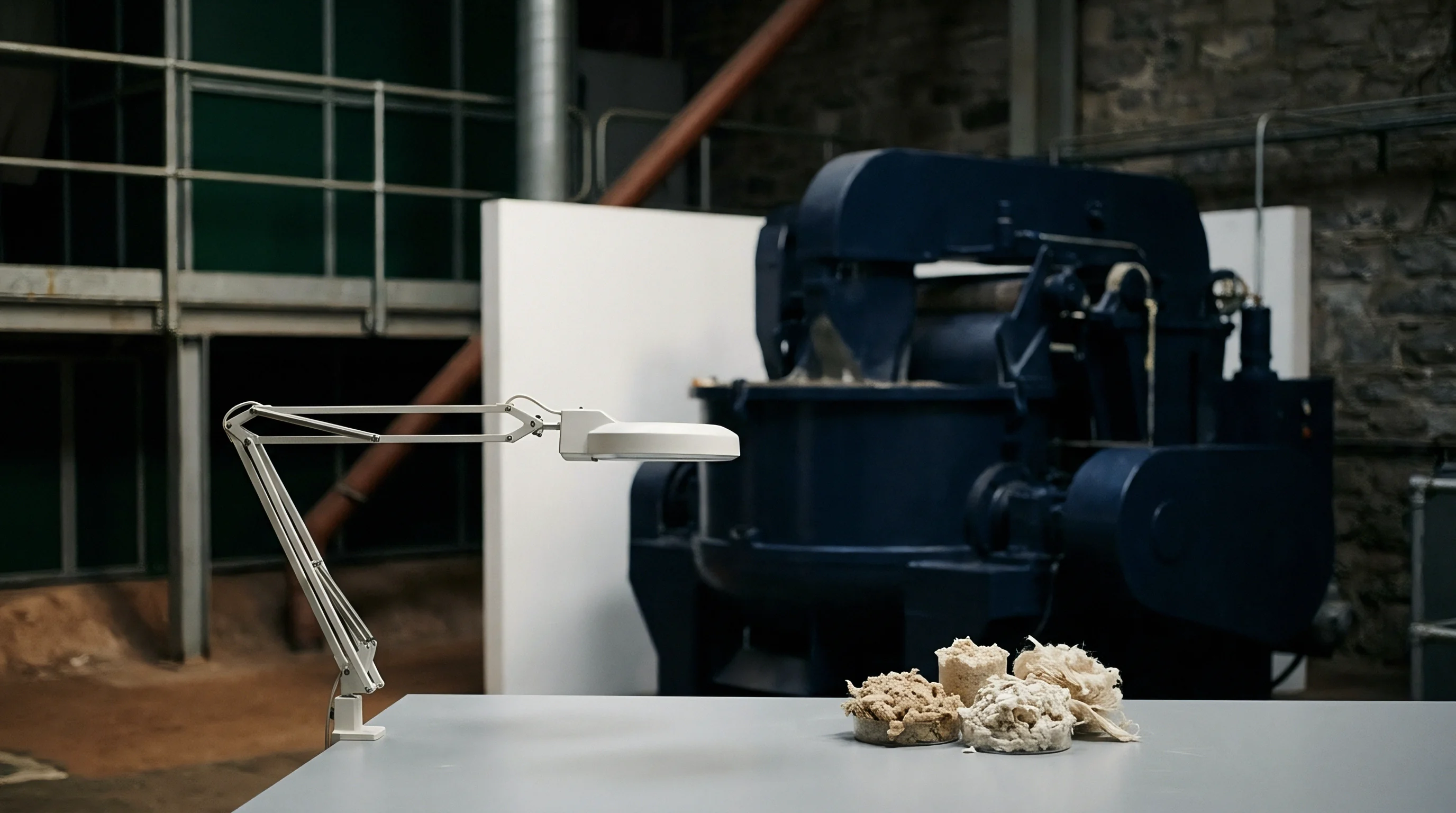
Non-contact piezoceramic transducers and dry-contact bimorph wheel arrays quantify sound propagation without damaging delicate web structures. Modern acoustic testing apparatus measures sound transit times across paperboard sheets with microsecond precision, enabling real-time calculation of dynamic elastic tensors on running paper machines and off-line laboratory benches.

How Does Ultrasonic Wave Transit Predict Score Failure?
Crease delamination occurs when out-of-plane shear stresses exceed internal bond strength during high-speed folding. Measuring Z-direction sound transit time isolates weak internal ply interfaces before board reaches the creasing matrix. Rapid acoustic wave propagation indicates strong fiber-to-fiber bonding capable of absorbing score rule impact without top-ply fracturing.
Slow acoustic wave propagation warns that the core will crumble or split irregularly, leading to cracked surface varnishes and rough fold edges on finished cartons.

Online and off Line Instrumentation Mechanics
Automated sound testing frames move scanning heads across moving paper webs on modern paper machines. Transducers transmit short acoustic pulses into the sheet, receiving signals at spaced intervals along multi-directional sensor rings. Calculating the transit time across each angle establishes real-time polar orientation profiles without slowing production speeds.
Operating dry-contact bimorph wheel transducers on laboratory samples requires strict adherence to standardized measurement sequences:
- Cut representative specimens measuring 300 mm by 300 mm, taking care to avoid creased or edge-damaged areas.
- Condition specimens at 23 degrees Celsius and 50 percent relative humidity for a minimum of twenty-four hours inside a climate chamber compliant with ISO 187.
- Verify sheet caliper and basis weight using an electronic micrometer and analytical balance to calculate precise apparent density.
- Place the sample securely onto the rotating transmitter plate of the ultrasonic stiffness tester.
- Lower the piezoceramic sensor heads onto the specimen surface using regulated pneumatic clamp pressure to avoid surface crushing.
- Initiate the 100 kHz acoustic pulse sweep across thirty-six distinct polar angles at ten-degree increments.
- Record acoustic transit times across all vectors, extracting peak machine direction sound speed and minimum cross-direction sound speed.
- Compute the Tensile Stiffness Index along both principal axes and calculate the Tensile Stiffness Orientation angle offset from the sheet edge.
A narrow polar orientation profile indicates high web tension during drying rather than superior fiber refining.
Standard purchase specifications incorporate specific acoustic criteria, such as EN 12599 and TAPPI T 525, which allow buyers to reject board shipments whenever Tensile Stiffness Index orientation angles exceed three degrees from the nominal machine axis.


Yield
Downstream converting efficiency relies on precise dynamic elastic measurements taken prior to scoring, cutting, and laminating. Predicting how a multi-ply packaging board responds to Mechanical deformation during converting passes requires converting static specifications into dynamic mechanical parameters derived from acoustic wave velocity.

Predicting Score Cracking and Laminate Curl from Dynamic Stiffness
Scoring rules compress folding boxboard to create internal delamination planes without fracturing outer surface coatings. The process requires precise balance between in-plane dynamic stiffness and out-of-plane shear strength. Unmatched stiffness ratios induce severe curl.
When a board displays an excessively high Tensile Stiffness Index in the machine direction alongside a deficient Z-direction dynamic elastic modulus, scoring forces cannot delaminate the inner plies cleanly. The energy concentrates at the outer surface, cracking film coatings, foil stamps, and overprint varnishes along the fold axis.
Lamination operations face similar risks when combining polymer films with paperboard substrates. If a lamination film under tension joins a board sheet with unverified directional dynamic stiffness, the combined laminate warps upon moisture equilibration. Matching film modulus to substrate dynamic stiffness prevents costly sheet distortion after slitting.

Converting Line Optimization and Waste Reduction
Machine stops on high-speed folder-gluers drop significantly when incoming board meets verified elastic stiffness specifications. To demonstrate the economic impact of pre-qualifying board via acoustic velocity testing, consider a high-volume folding carton converting job running 500,000 sheets of 350 g/m2 coated folding boxboard through an offset print, UV varnish, die-cut, and window-lamination line.
Assume an unscreened board lot exhibits an unannounced 12 percent drop in cross-direction dynamic modulus (ECD) caused by wet-end jet-to-wire drift at the mill, alongside a 4-degree TSO angle deviation. During high-speed folder-gluer operation at 80,000 cartons per hour, this elastic imbalance causes inconsistent creasing resistance, leading to jam-ups, skewed glue seams, and varnish splitting on the main display panel.
The operational cost model for this off-spec board scenario breaks down as follows:
- Unplanned Press Stops incur 4.5 hours of folder-gluer line downtime at a shop rate of 380 USD per hour, totaling 1,710 USD.
- Material Spoilage from crushed cartons and adhesive misapplication burns 3.8 percent of the total run volume, representing 19,000 wasted sheets at a sheet cost of 0.42 USD each, totaling 7,980 USD.
- Die-Cutter Re-tooling and Nontarget Crease Adjustments consume 2 hours of press time plus replacement matrix materials, adding 1,120 USD.
- Downstream Quality Penalties from customer rejects on un-glued folded cartons add 3,500 USD in administrative and freight charges.
Total economic loss for the single converting run equals 14,310 USD. Pre-screening the board reels on arrival using a benchtop ultrasonic transit analyzer identifies the low CD dynamic modulus and skewed TSO angle within ten minutes. Rejecting or re-allocating the defective board reel before committing press time preserves run yields and prevents tooling wear.
| Converting Pass | Target TSI MD (kNm/g) | Target TSI CD (kNm/g) | Max TSO Deviation (deg) | Failure Mode Under Off-Spec Limits |
|---|---|---|---|---|
| High-Speed Offset Printing | 7.5 – 9.0 | 3.2 – 4.2 | 2.0 | Color register shift, sheet tail flutter |
| Thermal Film Lamination | 8.0 – 10.5 | 3.5 – 4.5 | 1.5 | Post-trim diagonal curl, sheet skew |
| Deep Embossing and Foil Stamp | 6.5 – 8.0 | 2.8 – 3.8 | 2.5 | Surface coating fracture, pinhole tears |
| Rotary Score and Die-Cut | 7.0 – 9.5 | 3.0 – 4.0 | 2.0 | Score line splitting, rough fold bead |
Aligning raw substrate acceptance parameters with ultrasonic dynamic stiffness indexes protects converting margins across complex multi-pass packaging contracts.
Matching dynamic stiffness profile requirements to specific converting demands ensures predictable performance on press. High-speed folding carton lines require consistent in-plane elastic moduli to maintain accurate blank positioning through gluing nips. Ultrasonic wave propagation metrics supply the foundational physical data needed to qualify raw board stocks, optimize press setup parameters, and eliminate unexpected material failures during high-value surface finishing passes.
- High Speed Folder Gluers require consistent CD dynamic stiffness to prevent panel bowing during rapid folder belt actuation.
- Heavy Film Laminators demand tight TSO angle alignment to eliminate post-curing diagonal sheet distortion across wide web widths.
- Hot Foil Stamping Units need predictable out-of-plane dynamic compliance to maintain crisp foil release without crushing underlying plies.
- Rotary Die Cutters require balanced MD and CD acoustic sound speeds to ensure uniform anvil scoring depth without top-ply rupture.
Film lamination onto board with unmatched machine-direction dynamic stiffness creates permanent diagonal curl after solvent drying.
Implementing continuous online acoustic monitoring across paper machines and off-line qualification on converting lines transforms substrate selection into a precise engineering process. Converting operations that establish rigid dynamic modulus acceptance windows reduce scrap rates, protect high-speed machinery from jams, and preserve surface finish integrity across multi-pass packaging jobs.