Automated Gate Rejection Algorithms for Real Time Recycled Fiber Blend Variations
Real-time NIR spectroscopy coupled with automated divert gate algorithms stabilizes furnish quality, rejecting off-spec recycled stock before pulper entry.


Spectra
High-speed optical and near-infrared sensors positioned above conveyor belts monitor incoming recovered paper before it drops into the pulper. Scanning systems take reflectance readings across multiple wavelengths, checking spectral signatures against reference libraries of cellulose, lignin, synthetic polymers, and inorganic fillers. Bale inspection systems track surface composition continuously, feeding dense data streams to downstream control units.
Moisture spikes skew optical density calculations, and surface dust scatters NIR beam intensity. Pairing multi-spectral analytical heads with high-speed imaging arrays isolates non-paper contaminants, wet-strength additives, and heavily inked stock before furnish reaches the hydrapulper feed chute.

Sensor Hardware Architectures for Recovered Stock
Primary analytical heads combine multi-wavelength illumination with high-frame-rate cameras to evaluate surface composition across moving bales. Near-infrared (NIR) sensors operating from 900 nm to 1700 nm measure cellulose absorption peaks alongside moisture band characteristics at 1450 nm. High-resolution hyperspectral line-scan cameras track spatial variations down to two-millimeter spatial resolution at conveyor belt velocities exceeding three meters per second.
Dual-energy X-ray transmission units supplement optical sensors by measuring atomic number differences across dense bundles, identifying trapped metals, glass, and heavy synthetic fragments hidden beneath the surface.
Near-infrared absorbance measured at 1450 nanometers under 50 percent relative humidity establishes moisture content within a tolerance of plus or minus 0.3 percent.
Sensor heads require pressurized enclosures to keep airborne paper dust off optical windows and preserve signal amplitude. Automatic air knives sweep optical surfaces at timed intervals, maintaining signal-to-noise ratios during continuous runs. Temperature swings inside recycling plants shift laser diode output wavelengths, requiring thermal stabilization accurate to within 0.1 degrees Celsius.
Calibration routines run against optical white reference plates every four hours to account for LED aging and background drift.
Spectroscopic Contaminant Identification
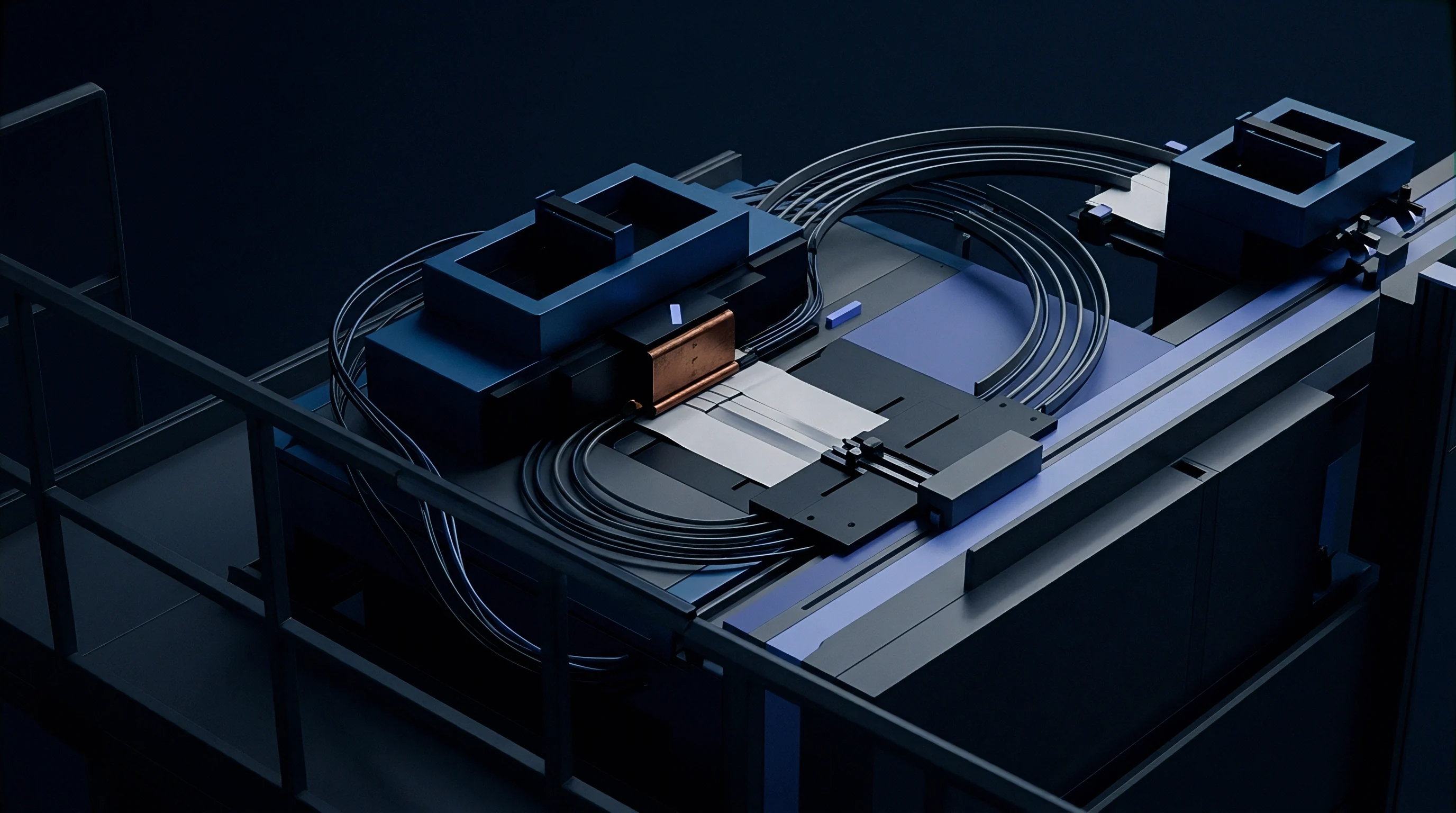
Absorption profiles between 900 and 1700 nanometers differentiate cellulose fibers from synthetic polymers such as polyethylene film and hot-melt adhesives. Polypropylene tape shows distinct absorption features at 1195 nm and 1395 nm, whereas virgin unbleached kraft cellulose displays strong hydrogen bonding bands around 1480 nm and 1580 nm. Inorganic fillers like calcium carbonate and kaolin clay alter baseline reflectance curves in the visible spectrum, yielding quantitative ash estimates prior to slushing.
- Optical window blinding occurs when fine paper dust, stickies, and atmospheric moisture form an opaque film across sensor glass assemblies.
- Bale shadows and depth variation generate false reflectance readings due to light source inverse-square intensity falloff across uneven bale surfaces.
- Black plastic absorption prevents NIR signal return because carbon black pigments absorb infrared radiation across all practical sensor wavelengths.
- Moisture attenuation interference dampens cellulose absorption peaks, masking synthetic polymer signatures when bale moisture exceeds fifteen percent dry basis.
The primary sorting challenge lies in distinguishing acceptable wet-strength packaging from non-recyclable polymer-laminated board. Multi-channel sensor arrays cross-reference surface gloss, NIR absorption, and microwave attenuation to calculate a composite purity metric for every discrete bale passing the sensor threshold.
| Spectroscopic Band (nm) | Target Chemical Constituent | Detection Limit (% mass) | Measurement Latency (ms) |
|---|---|---|---|
| 400 to 700 | Printed inks and dyes | 0.10 | 12 |
| 1195 to 1395 | Polypropylene and polyethylene packaging tape | 0.05 | 15 |
| 1450 to 1940 | Moisture state in cellulose fibers | 0.20 | 8 |
| 2100 to 2300 | Hot-melt adhesives and synthetic wax | 0.15 | 20 |
| Conditioned at 23 C and 50% relative humidity; baseline reflectance calibrated against spectral grade PTFE standard. | |||
Optical reflectance distinguishes non-paper impurities in dry furnish, but damp bales of OCC blind optical heads within two operating hours.


Threshold
Mathematical algorithms process continuous sensor telemetry to determine when raw material composition strays outside allowable bounds. Raw data points undergo digital filtering, background subtraction, and fast Fourier transform analysis to isolate true material signatures from belt vibration. Decision logic applies moving probability windows to evaluate chemical and physical variance over short intervals.
Algorithms trigger reject mechanisms when measured parameters breach safety thresholds for more than three consecutive sensor clock cycles, preventing transient glitches from ejecting compliant fiber.

Mathematical Signal Filtering and Classification
Raw analytical readings exhibit substantial noise caused by uneven bale density and variable surface moisture. Finite impulse response filters smooth high-frequency spikes, while adaptive Kalman filtering updates background state estimates continuously. Bayesian classification models calculate the probability of a material sample belonging to pre-defined quality categories based on multi-spectral features.
Neural network classifiers trained on thousands of recovered paper samples evaluate real-time data matrices, assigning confidence scores to detected contaminants in under ten milliseconds.
High ash content above eighteen percent degrades mechanical strength faster than minor fiber shortening across successive recycling loops.
Threshold adjustments balancing false rejections against false acceptances determine overall sorting efficiency. Setting threshold sensitivities too high ejects acceptable recovered paper, raising raw furnish acquisition costs and creating excessive reject tonnage. Conversely, loose threshold limits admit prohibitive quantities of stickies, plastics, and non-fibrous fillers into pulping circuits, impairing paper machine runnability and finished sheet strength.

Algorithmic Decision Architecture
Real-time software pipelines convert filtered moisture, ash, and fiber purity vectors into binary control signals. The core algorithm calculates a weighted composite defect index where synthetic stickies carry higher severity penalties than inert inorganic fillers. When this composite index exceeds the grade specification limit, the system schedules gate actuation matched to belt velocity and spatial tracking.
- Sample optical reflectance data across six spectral channels at a frequency of one kilohertz.
- Apply spatial smoothing to eliminate border artifacts generated by bale wires and loose strapping.
- Calculate moisture-corrected cellulose absorption ratios to isolate true synthetic polymer signatures.
- Compare real-time chemical composition vector against target grade specification matrices.
- Pass binary reject flag and conveyor spatial coordinates to the mechanical gate motion controller.
System designers tune algorithmic setpoints using empirical mill trials matched to specific target grades like corrugated medium, testliner, or folding boxboard. Edge computing hardware located adjacent to sensor frames processes raw data, holding network transmission latency below five milliseconds to ensure synchronized divert gate response.
The unaddressed mathematical challenge remains whether multi-spectral array data can isolate wet-strength resin binders before the slurry enters the primary refiner disc.


Flume
Diverting non-compliant recovered fiber requires high-speed mechanical gates operating at the discharge point of the conveyor system. Fast-acting pneumatic cylinders, servo-driven divert flaps, and sliding trapdoors constitute the primary rejection mechanisms on mill-scale feed lines. Actuation speed, mechanical durability, and directional precision determine whether an automated system purges off-spec furnish without dropping compliant material around it.
Gate response times measured in milliseconds match conveyor belt speeds ranging from two to five meters per second.

Pneumatic Gate Actuation Mechanisms
Rapid divert valves use pressurized air cylinders to shift deflector plates across the material stream in less than two hundred milliseconds. High-flow solenoid valves operating at six bar pneumatic pressure provide the quick response needed to intercept fast-moving furnish on wide belts. Deflector plates constructed from high-molecular-weight polyethylene or stainless steel resist impact wear from heavy, high-density paper bales, with slurry flow rates setting the required gate response profile.
EN 643 European Standard for Paper and Board Recycled Grades restricts non-paper components to a maximum threshold of 1.5 percent by dry weight.
Matching gate width to conveyor belt zoning enables localized rejection across broad material streams. Modular multi-segment flap gates open only the specific section of the belt where sensors detected non-compliant material, letting adjacent compliant fiber pass unhindered into the pulper. This spatial targeting reduces unnecessary good fiber loss by up to seventy percent compared to full-width divert mechanisms.

When Does Actuation Delay Cause Contamination Drift?
Lags in signal transmission or valve movement allow out-of-spec fiber to pass beyond the reject zone into the primary hydrapulper. A twenty-millisecond delay at a belt speed of four meters per second moves the targeted contaminant eighty millimeters downstream, missing the mechanical catch hopper entirely. Regular mechanical audits calibrate gate travel times against encoder position telemetry to correct for pneumatic pressure drops, seal friction, and pivot wear.
- Pneumatic cylinder pressure drop reduces stroke speed, causing partial gate opening and incomplete material deflection.
- Mechanical pivot point binding from fine paper dust accumulation increases friction and delays gate movement cycles.
- Position sensor drift misaligns mechanical stroke limits with conveyor position encoders, causing timing mismatch.
- Hopper chute plugging occurs when high-volume reject diverts jam discharge chutes, locking mechanical gates in open positions.
Diverter design must incorporate safety returns that spring-load gates into an accept position upon total loss of electrical or pneumatic power, preventing catastrophic blockage of pulper feed lines during utility failures.
| Conveyor Speed (m/s) | Gate Travel Time (ms) | Purge Efficiency (% mass) | Acceptable Fiber Loss (% mass) |
|---|---|---|---|
| 2.0 | 120 | 98.5 | 1.2 |
| 3.0 | 150 | 96.2 | 2.1 |
| 4.0 | 180 | 92.4 | 3.8 |
| 5.0 | 220 | 85.1 | 6.4 |
Misaligned divert timing allows off-spec plastic fragments into the hydrapulper, fouling the extraction plate and forcing a six-hour washdown cycle.


Variance
Fluctuations in fiber length distributions and ash content directly affect the physical properties of finished containerboard. High ash levels weaken inter-fiber hydrogen bonding, reducing bursting strength and ring crush test performance in corrugated fluting and linerboard. Uncontrolled moisture spikes alter refining response, yielding inconsistent stock freeness at the headbox.
Automated rejection gates act as physical quality filters, maintaining raw material uniformity before furnish enters wet-end stock preparation systems.

Impact on Paper Machine Runnability
Excessive fines and non-fibrous fillers reduce drainage speed on the forming wire, forcing operators to slow the machine. When ash content varies by more than four percent within a single batch run, wet-end chemical demand fluctuates, destabilizing retention aid efficiency, internal sizing, and lowering tensile strength while polymer contaminants blind refiner plates.
Sourcing low-grade mixed paper without automated gate rejection increases wet-end chemical additive costs by twelve percent at the paper machine.
Stickies passing through pulping screening systems deposit onto forming fabrics, press felts, and drying cylinders, causing pinholes and sheet breaks. Automated divert gates set to stringent polymer reject limits remove macro-stickies before mechanical shearing breaks them down into micro-stickies that slip past downstream cleaners.

Converting Strength and Structural Bounds
Box plants require consistent burst resistance and ring crush performance to prevent box collapse during stacking. Furnish with high fractions of newsprint or heavily filled printing papers drops average fiber length below 0.8 millimeters under ISO 16065-1 testing. Automated rejection algorithms monitor blend proportions to reject lots that fall below critical structural thresholds.
- Burst index floor requirements mandate minimum unbleached kraft ratios to hold Mullen burst strength above 350 kilopascals under ISO 2759.
- Ash content ceiling limits cap non-fibrous calcium carbonate filler at twelve percent dry weight per ISO 2144 testing.
- Freeness stability targets maintain Canadian Standard Freeness between 350 ml and 450 ml to protect wire drainage capacity.
- Moisture consistency boundaries restrict bale moisture variance to within plus or minus two percent to prevent pulper consistency shifts.
Controlling incoming raw material variance preserves converting headroom, protecting board strength while limiting starch consumption, wet-end strength resins, and virgin kraft pulp additions.
Balancing furnish consistency against reject waste requires keeping the automated gate rejection threshold tuned strictly to the bursting strength floor of the finished linerboard grade.


Dispute
Commercial contracts governing recovered paper purchases tie real-time rejection telemetry directly to raw material settlement frameworks. Manual core sampling often misses internal bale contamination, generating disputes between mills and recovered paper brokers. Automated gate logs provide digital records of moisture levels, non-paper contaminant percentages, and ash content for every delivered lot.
Landed tonnage pricing adjusts automatically based on gate rejection data, eliminating manual audit delays and administrative overhead.
Settlement Protocols and Audit Trails
Automated gate event logs create a digital record of rejected tonnage, bale timestamps, and specific contaminant metrics. Systems link sensor telemetry directly to supplier bale barcodes, establishing traceability back to individual recycling yards. When incoming lots breach agreed non-paper impurity limits, software flags invoices for weight deductions or full lot rejections based on contract terms.
Assume a 500-tonne containerboard batch of EN 643 Grade 1.05 OCC delivered at $180 per tonne landed cost. Assume the automated gate setpoint rejects stock exceeding 12 percent ash content or 4 percent moisture deviation. Under a measured 4.2 percent gate reject rate, 21 tonnes of off-spec stock divert into the bypass hopper.
Processing this off-spec material would have consumed an additional $14 per tonne in wet-end starch and retention chemicals, totaling $6,706 in added converting expenditure across the remaining 479 tonnes of accepts. Direct financial reconciliation applies a chargeback equal to the 21 rejected tonnes at $180 per tonne ($3,780), plus a $25 per tonne disposal fee ($525), yielding a net landed cost reduction of $4,305 on the batch delivery.
Contract clauses define arbitration thresholds for disputed rejections, specifying secondary independent laboratory testing procedures using ISO 1762 for ash determination and TAPPI T 559 for grease resistance coatings. Digital records containing high-resolution optical images of rejected bales serve as key evidence during commercial arbitration meetings.

Yield Adjustment and Financial Reconciliation
Landed stock costs shift substantially when raw furnish contains high proportions of non-usable filler or unpulpeable debris. Automated reject systems shift procurement pricing from gross delivered weight to net usable fiber weight. Suppliers delivering consistently high-purity stock earn price premiums, whereas vendors shipping wet or contaminated bales face automatic penalty deductions.
| Ash Setpoint Upper Bound (% ISO 2144) | Gate Rejection Rate (% tonnage) | Finished Linerboard Burst Index (kPa m2/g) | Net Landed Cost Variance ($/tonne) |
|---|---|---|---|
| 8.0 | 8.5 | 2.85 | +14.20 |
| 10.0 | 5.2 | 2.65 | +6.50 |
| 12.0 | 2.1 | 2.40 | 0.00 |
| 14.0 | 0.6 | 2.10 | -8.80 |
Standard mill procurement contracts specify that reject volumes exceeding three percent of total delivered lot weight trigger automatic price deductions equivalent to double the tonnage difference.