In Line Ultrasonic Wave Testing for Paperboard Scoring
Inline ultrasonic testing verifies internal score delamination and folding resistance in real time, preventing visual surface cracking and high-speed erect jams.

Contact

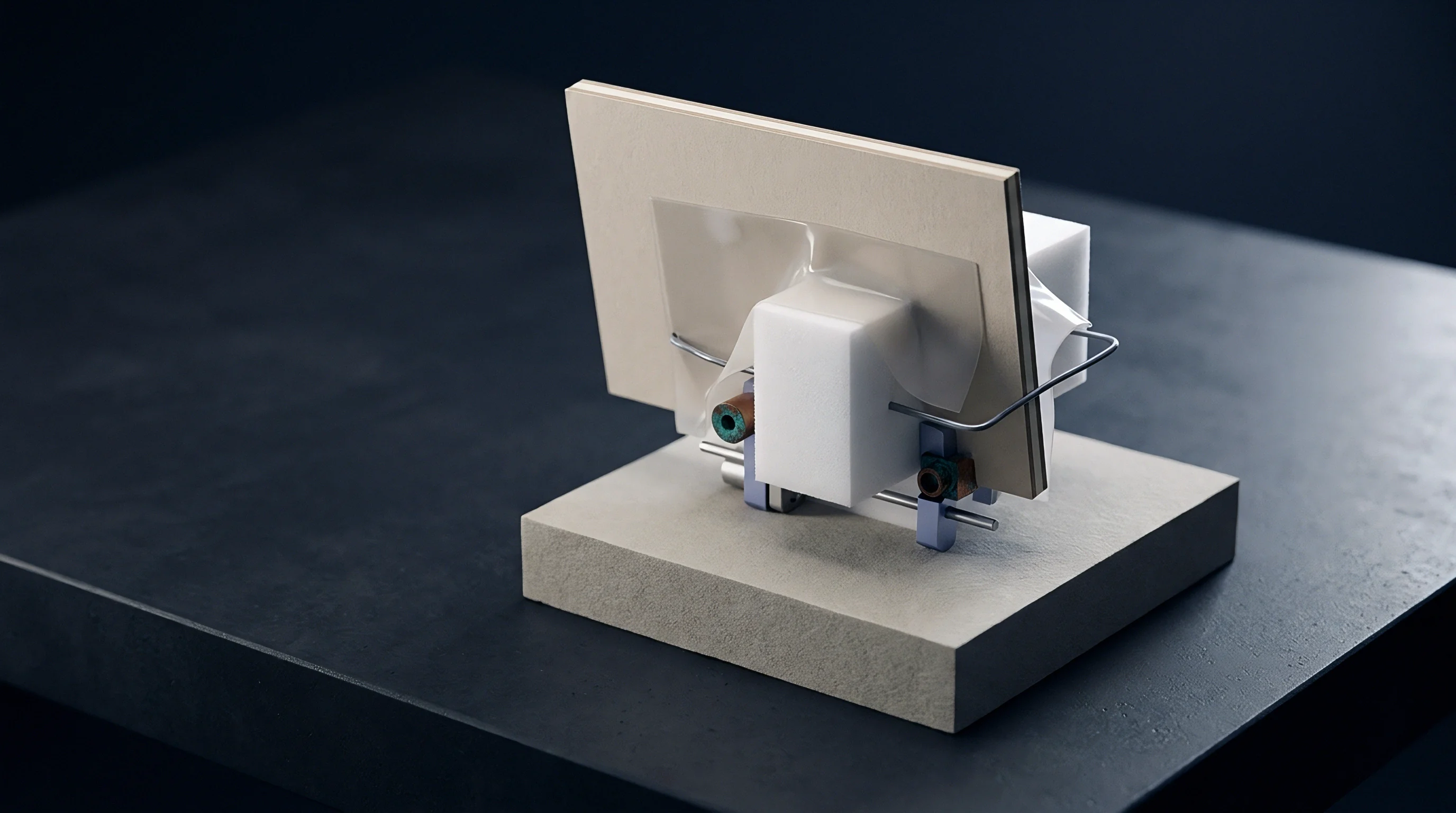
Transducer Wheels and High Speed Web Coupling
Mechanical dry contact testing on high-speed converting webs uses specialized wheel transducers instead of fluid immersion baths or couplant gels. Cast from vulcanized polyurethane or silicone, an elastomeric tyre with acoustic impedance matched to dense fibrous webs forms the contact interface under regulated pneumatic downforce. The nip load holds between 0.15 and 0.40 megapascals across the score profile.
The ultrasonic pulse propagates through the tyre wall, traverses the compressed paperboard matrix at web velocities exceeding 300 meters per minute, and reaches a receiving wheel mounted directly beneath the score line.
Carton conversion lines running solid bleached sulphate (SBS) or folding boxboard (FBB) generate mechanical chatter that corrupts high-frequency signal reception. Gate delay calibration isolates the true structural arrival wave from web vibration modes. When converting bleached virgin fibre at grammages between 200 and 450 grams per square meter, the primary longitudinal pulse operates within a center frequency range of 1.0 to 2.25 megahertz.
Frequencies above 3 megahertz attenuate heavily in multi-ply recycled grades containing unrefined thermo-mechanical pulp or mechanical rejects.
A pneumatic shoe pressure drifting below 0.12 megapascals introduces acoustic coupling dropouts that register as false delamination readings on web runs moving past 250 meters per minute.
Acoustic velocity along the z-axis (ZD) directly tracks internal fiber bonding, density variations, and transverse elastic stiffness. In uncreased solid bleached kraft boards, longitudinal ZD wave velocity ranges from 800 to 1400 meters per second, depending on furnish composition, wet pressing intensity, and internal sizing. When a scoring rule strikes the sheet, compressive stress crushes fiber walls while transverse shear breaks the internal starch and hydrogen bonds between plies.
This structural disruption slows wave propagation and scatters acoustic energy.

Acoustic Time of Flight through Residual Scores
Direct time-of-flight measurements quantify residual caliper beneath the crease rule. Propagation delay through the compressed score zone increases over the uncreased baseline board because the acoustic path traverses micro-fissured plies filled with air voids. Effective sound velocity through fractured cellulose interfaces drops 30 to 65 percent compared to native parent stock.
Comparing transit time differentials between adjacent measuring heads ~ one on the flat sheet and one inside the score channel ~ delivers an automated profile of score depth uniformity.
Variations in moisture content across the parent reel complicate velocity readings. Shifts between 5 percent and 8 percent relative humidity at converting feed points change sound velocity by roughly 12 meters per second per percentage point of moisture regain. Inline systems handle this drift with differential sensor pairs: one wheel records the unworked board property while a downstream transducer checks the scored crease.
Subtracting the parent web transit time isolates tooling penetration from moisture changes.
High-speed analog-to-digital hardware digitizes the wave train at sampling rates of 100 megahertz or higher. Peak detection algorithms compute the first zero-crossing or envelope maximum within 15 microseconds of signal reception. If the score rule cuts too deep ~ slicing surface liners instead of creating controlled internal delamination ~ transmitted acoustic amplitude drops below 10 percent of baseline values.
A line operator tracking this attenuation trace in real time catches misaligned scoring collars before sending hundreds of off-spec cartons into the gluer-folder.
Tool wear on rotary creasing cylinders alters the contact nip profile, widening the score root and reducing local shear gradients. Mechanical contact transducers track these changes by recording the full waveform energy envelope. A worn rule blade increases contact area, lowering the specific compression stress transferred to internal plies.
As delamination efficiency drops, sound travels through the score at an unnaturally high speed, warning operators of an incomplete crease long before downstream folding arms jam.
Damage

Delamination Mechanics and Shear Plane Fracture
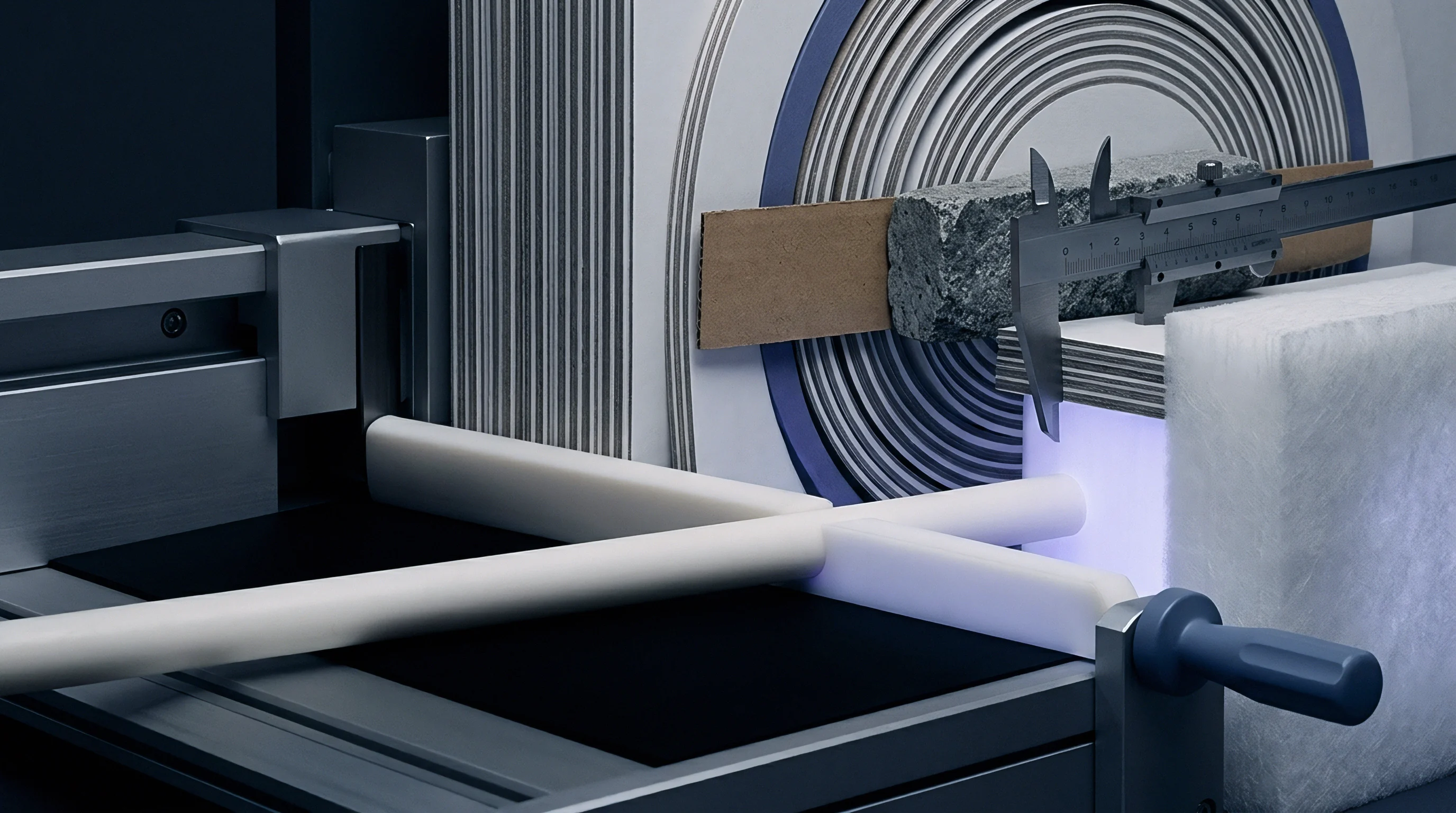
Proper carton creasing requires intentional shear delamination across central plies without tensile fracture of the outer liners. When the male creasing rule forces board into the female counter matrix, transverse shear stresses peak along the neutral axis of the sheet. High-performance cartonboard separates along these shear planes into independent lamellae.
During subsequent 90-degree or 180-degree folding on high-speed cartoners, these thin lamellae buckle inward independently, relieving outer surface strain that would otherwise peel ink or split the liner.
Ultrasonic waves detect this internal lamellar splitting through reflection and impedance mismatches. Air pockets inside the shear delaminations have an acoustic impedance of roughly 0.0004 megapascals-seconds per meter, compared to around 2.5 megapascals-seconds per meter for solid cellulose fibers. This steep impedance step reflects incident acoustic energy, attenuating the transmitted compression wave.
Inline transducers record this transmission loss as a direct index of crease formation.
| Substrate Classification | Nominal Caliper (microns) | Crease Depth Penetration (percent) | Transmitted Wave Amplitude (millivolts) | Effective ZD Velocity (meters per second) | Lamination Layer Integrity Status |
|---|---|---|---|---|---|
| Solid Bleached Sulphate (SBS) | 350 | 0 (Unscored) | 850 | 1120 | Continuous Parent Matrix |
| Solid Bleached Sulphate (SBS) | 350 | 35 (Under-creased) | 520 | 940 | Initial Micro-voids |
| Solid Bleached Sulphate (SBS) | 350 | 50 (Nominal Target) | 210 | 610 | Clean Inter-ply Cleavage |
| Solid Bleached Sulphate (SBS) | 350 | 65 (Over-creased) | 35 | 320 | Liner Tensile Fracture |
| Folding Boxboard (FBB) | 450 | 0 (Unscored) | 680 | 910 | Continuous Parent Matrix |
| Folding Boxboard (FBB) | 450 | 40 (Nominal Target) | 140 | 480 | Mechanical Core Separation |
| Coated Recycled Board (CRB) | 400 | 0 (Unscored) | 420 | 760 | Continuous Parent Matrix |
| Coated Recycled Board (CRB) | 400 | 50 (Nominal Target) | 85 | 390 | Diffuse Internal Rupture |
Over-creasing damages outer liner surfaces, degrading both appearance and barrier performance. If the female counter matrix channel is set too narrow or the rule depth advances excessively, outer tensile strain exceeds the ultimate strain limit of the bleached chemical liner, causing the top surface to snap. High-frequency ultrasonic surface acoustic waves (SAWs) directed along the board plane capture this failure mode.
A surface crack interrupts the Rayleigh wave path, producing an abrupt transit time delay that distinguishes internal delamination from face-liner rupture.
Internal mechanical plies behave differently depending on pulping chemistry. The bulky groundwood or thermo-mechanical pulp (TMP) cores typical of multi-ply folding boxboard (FBB) collapse under lower shear than the long-fiber chemical pulps of solid bleached sulphate. Recycled boards containing mixed post-consumer waste carry short, brittle fibers bound by residual starches.
Under scoring rules, these recycled layers yield diffuse internal ruptures rather than clean lamellar splits, producing an acoustic signature marked by chaotic multi-path scattering and rapid signal decay.

Distinguishing Controlled Hinge Yield from Matrix Crushing
A clean folding hinge requires distinct spatial boundaries along the score edge. If compressive damage spreads into the score shoulders, the fold loses dimensional definition, causing sizing variations on packaging lines. Ultrasonic array sensors positioned across the score profile evaluate the geometric sharpness of this damage gradient.
A sharp acoustic transition between the unworked shoulder and the fractured groove confirms proper alignment between male and female die elements.
Improper die make-ready frequently produces asymmetrical ply separation. If a matrix channel shifts laterally by as little as 0.05 millimeters, one shoulder absorbs excessive shear while the other remains untouched. Dual-beam ultrasonic scanning systems fire parallel acoustic pulses through both score flanks simultaneously.
Differences in returned root-mean-square amplitude between left and right flanks reveal channel misalignment immediately, so operators can adjust pneumatic register before generating scrap.
Extensive matrix crushing destroys the elastic recovery needed for reliable carton erecting. While internal plies must separate, outer liners have to retain enough flexural rigidity to act as stable hinges. Pushing rule depth too far pulverizes cell walls through the board thickness, leaving a limp, weak score.
The ultrasonic waveform reflects this loss through the absence of trailing resonance peaks ~ stiffness disappears, leaving the deadened acoustic signature of a collapsed fiber network.
Mineral pigment coatings also introduce distinct acoustic signatures. Double or triple blade-applied coatings containing ground calcium carbonate, kaolin clay, and styrene-butadiene latex form a brittle shell over the fibrous substrate. When a scoring rule enters the sheet, this mineral shell shatters into micro-fragments unless the top liner stretches smoothly beneath it.
Ultrasonic surface wave attenuation tracks coating micro-fracture long before topcoat crazing shows up on optical cameras.


Air
Non Contact Acoustic Transduction via Piezoelectric Ceramic Emitters
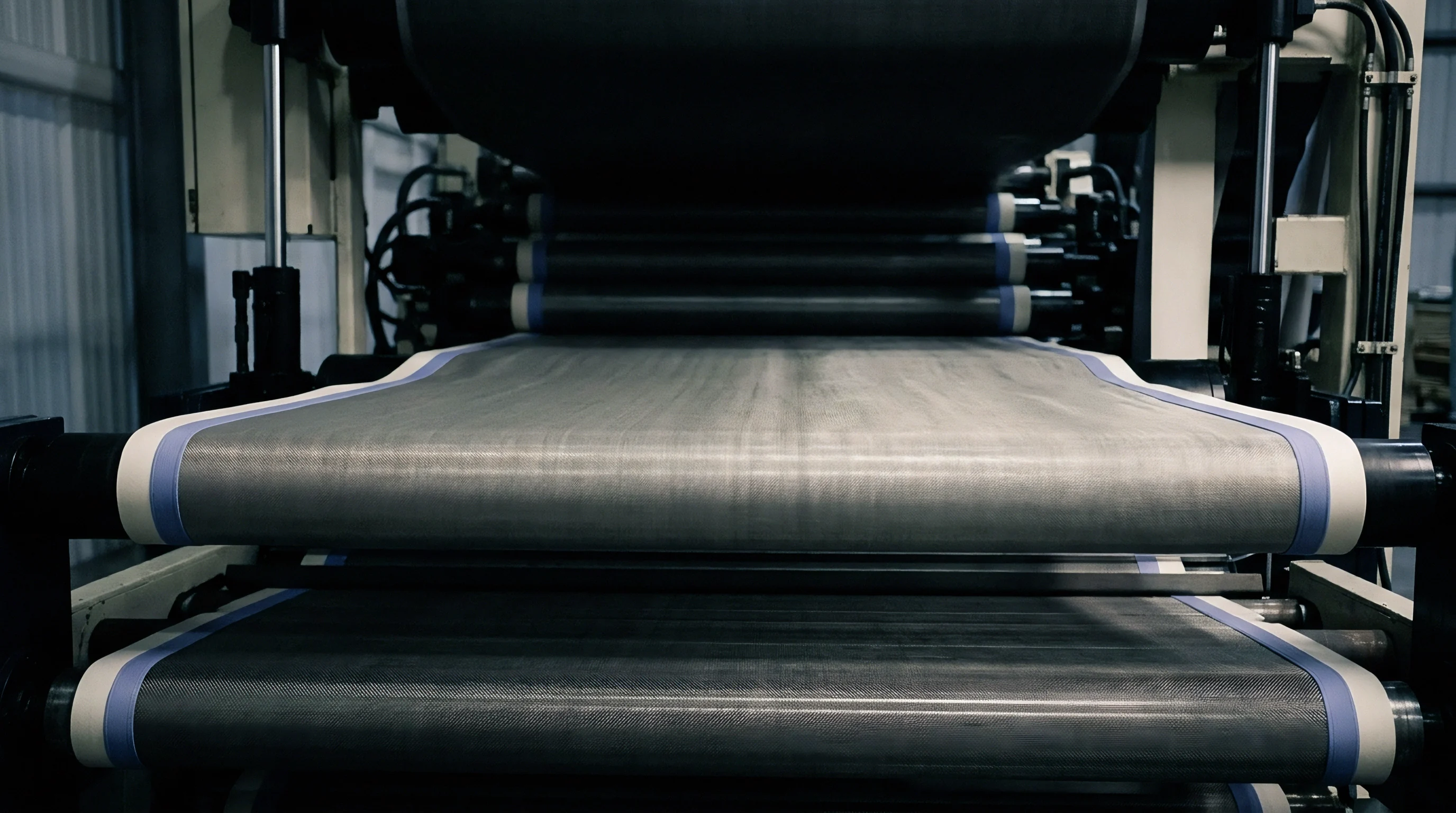
Eliminating direct mechanical contact prevents surface marking on delicate barrier-coated or high-gloss metallized boards. Non-contact air-coupled ultrasonic testing (ACUT) transmits acoustic pulses across an air gap between transmitter and board surface. This requires specialized piezoelectric ceramic elements ~ typically lead zirconate titanate (PZT) composites ~ paired with quarter-wave matching layers that bridge the steep impedance gap between dense ceramics and air.
Atmospheric air has an acoustic impedance near 0.0004 megapascals-seconds per meter, whereas standard PZT piezoceramics exceed 30 megapascals-seconds per meter. Without matching layers, more than 99.9 percent of the energy reflects straight back off the transducer face. Low-density aerogels, microporous syntactic foams, and hollow glass sphere composites reduce transfer losses to workable levels.
Transducers operate between 200 and 500 kilohertz, balancing air attenuation against spatial flaw resolution.
Air-coupled transmitters generate focused beams to inspect narrow score profiles. Cylindrical or spherical concave faces concentrate the acoustic footprint to a spot diameter under 1.5 millimeters at focal distances of 20 to 50 millimeters. This focal zone covers the typical width of scoring impressions, which range from 0.7 to 2.0 millimeters on structural packaging boards.
The signal penetrates the web and hits a matched receiving transducer mounted directly beneath the sheet.
Air currents and boundary layer turbulence introduce significant phase noise. As a paperboard web travels at high speed, it drags a layer of turbulent air along its surface. This shearing air disperses acoustic beams, causing random amplitude fluctuations up to 15 decibels.
Stabilizing the measurement zone requires micro-perforated air baffles and laminar flow shrouds that shield the acoustic beam from eddies without touching the sheet.

Signal Loss and Signal to Noise Enhancement
Receiving signals across air gaps requires high-gain, low-noise preamplifiers that can pull sub-millivolt signals out of ambient electromagnetic noise. Converting plants produce heavy electrical interference from variable frequency drives, static discharges, and servo motors. Differential preamplifiers inside the receiver housing add 40 to 60 decibels of analog gain right next to the sensor crystal, preserving signal-to-noise margins.
Digital signal averaging across sequential pulses improves signal clarity on continuous web lines. Emitting pulses at pulse repetition frequencies (PRF) up to 50 kilohertz allows the processor to average multiple bursts over fractional millisecond intervals. At a web speed of 300 meters per minute, a 10-pulse moving average yields a spatial resolution of one millimeter along the run direction, keeping the system responsive to rapid changes in score quality.
DIN 55437 defines testing parameters for evaluating the folding force of paperboard creases, providing the comparative laboratory baseline against which continuous inline ultrasonic energy metrics are validated.
Averaging algorithms must avoid blurring discrete defects like score ruptures or embedded foreign particles. Finite impulse response (FIR) bandpass filtering tuned strictly to the transducer center frequency strips out mechanical rumble and high-frequency static. Dynamic threshold gating then extracts the primary wave envelope, ignoring late reflections bouncing between the board surface and transducer housing.
Chirp excitation techniques paired with pulse compression cross-correlation raise signal-to-noise ratios further without requiring extreme driver voltages. By sweeping the excitation signal linearly from 250 to 450 kilohertz over a 50-microsecond pulse, the emitter distributes energy over time. Cross-correlating the received signal against the reference chirp compresses that energy into a narrow pulse, achieving deep penetration and sub-millimeter axial resolution through heavy virgin cartonboard.

Stiffness
Translating Wave Attenuation into Bending Resistance
The main goal of creasing is a controlled reduction in carton folding resistance. High-speed cartoners and filling lines rely on consistent bending moments when forming blanks around mandrels. If residual bending resistance stays too high, vacuum arms fail to open blanks cleanly, causing trips and stoppages.
If the score is broken down too much, carton panels lose bulging resistance and yield soft, unstable corners.
Acoustic attenuation correlates directly with standard two-point folding stiffness measured under ISO 2493 or TAPPI T 543. As the creasing matrix separates plies along internal shear planes, the board’s effective section modulus across the score drops. The reduction in transmitted ultrasonic amplitude mirrors this loss of flexural rigidity, allowing inline systems to output calculated bending resistance values continuously throughout a run.
The acoustic transmission coefficient ~ the ratio of transmitted wave energy through the crease to the energy through adjacent uncreased stock ~ serves as the primary measurement parameter. A calibration curve converts this dimensionless ratio into predicted folding force in millinewtons. Because ultrasonic testing catches both interlaminar bond failure and compressive fiber damage, it tracks physical carton behavior more accurately than optical depth measurements.
Inline validation protocols require regular checks against off-line physical testing instruments. Each shift, operators verify acoustic readings by pulling blanks and measuring score bending force on laboratory devices like the L&W Crease Tester or Marbach Creasemate. These instruments clamp the uncreased board, bend the hinge through a 90-degree arc at set cycle times, and record the peak resisting moment.
That laboratory data continually refines the transfer functions used by inline acoustic processors.
Can Resonant Elastic Moduli Predict Finished Corner Integrity?
The relationship between acoustic transmission and finished carton performance depends on directional elastic constants. Paperboard is orthotropic, with three principal axes: machine direction (MD), cross direction (CD), and thickness direction (ZD). Scores running parallel to the machine direction require different energy inputs to achieve target bending reductions than scores running across fiber orientation.
Inline ultrasonic testing monitors elastic stiffness constants along these axes in real time.
Ultrasonic time-of-flight measurements yield direct calculations of the specific out-of-plane elastic modulus, often termed C33. The mathematical formulation relates sound speed to density and dynamic stiffness:
C33 = Velocity_ZD^2 Density
This dynamic modulus serves as a reliable proxy for internal bonding strength, traditionally measured by the destructive Scott Bond test (TAPPI T 569). Tracking C33 values along the web before it reaches the creasing rules lets the system anticipate shifts in delamination resistance, alerting operators to tension or moisture variations in incoming stock.
A second indicator, the out-of-plane shear modulus (G13 in MD, G23 in CD), governs how smoothly lamellae slip past one another during folding. Multi-element acoustic arrays launch shear-polarized waves at oblique angles into the score zone. Tracking changes in shear wave transmission predicts whether a folded corner will form a crisp hinge or buckle into a bulging, crushed score.
Combining C33 and out-of-plane shear metrics yields an instantaneous score ratio index, expressed as the percentage reduction in bending moment between scored and unscored board. If this score ratio drifts outside the target window of 40 to 60 percent, servo-driven creasing collars receive automated depth adjustments, maintaining corner integrity across long runs without stopping the machine.


Register

Transverse Mechanical Tracking on High Speed Conversion Lines
Inline score measurement requires precise alignment between acoustic sensors and narrow crease tracks. A standard cartonboard score rarely exceeds 1.5 millimeters in width, while web widths on high-speed gravure or flexographic presses reach up to 1600 millimeters. Transducer arrays must stay centered over moving score lines despite cross-directional web weave from mechanical runout, tension transients, or web guide drift.
Active tracking carriages adjust sensor positions as the web moves. High-resolution optical sensors detect printed register marks or physical score edges upstream of the acoustic heads. These optical signals feed closed-loop digital servos that shift the ultrasonic transducer mount laterally along linear ball-screw rails, holding alignment within a positional tolerance of plus or minus 0.1 millimeters at maximum line speed.
Complex carton layouts present staggered or angled score lines that complicate continuous tracking. Where fixed wheels track straight lines, multi-element phased arrays in air-coupled setups handle non-linear profiles. Phased arrays steer acoustic beams electronically across a 20 to 50 millimeter swath, switching scan angles in microseconds.
This electronic steering monitors moving scores without physical carriage movement, covering irregular carton geometries.
Web tension dynamics affect both acoustic coupling efficiency and score geometry. Insufficient tension causes sheet flutter between idler rolls, disrupting sensor nip geometry and scattering air-coupled beams. Converting lines install vacuum transfer beds or pressurized air-cushion tables beneath the testing zone to hold the web flat.
This stabilization keeps the sheet within a vertical travel window of plus or minus 0.05 millimeters, eliminating signal noise from flutter.
Phased Array Beam Steering and Edge Resolution
Linear phased array probes apply precise time delays across individual piezocomposite elements to steer and focus the beam within the board plane. By sweeping the acoustic focus through the crease cross-section, the array captures the full geometry of both the male penetration groove and the female matrix impressions, distinguishing balanced symmetric scores from tilted profiles caused by eccentric die cylinders.
Resolving fine edges demands high spatial resolution across the score cross-section. Phased array transducers operating at 1.5 megahertz achieve lateral resolutions near 0.5 millimeters when paired with digital beam-forming algorithms. Mapping wave attenuation point by point across the score width generates an acoustic density map that shows unworked liner zones, sheared boundaries, and crushed matrix areas in high contrast.
| Operational Parameter | Mechanical Limit | Ultrasonic Array Requirement | Calibration Standard Reference | Corrective Actuation Mechanism |
|---|---|---|---|---|
| Transverse Web Weave | +/- 3.0 mm total travel | Electronic Steering +/- 15 mm | ISO 12647-2 Register Bands | Optical Sensor Closed-loop Rail |
| Vertical Web Flutter | +/- 0.8 mm undamped | Depth of Field > 2.5 mm | DIN 53120 Board Caliper | Pneumatic Vacuum Table Hold-down |
| Score Center Alignment | 0.08 mm maximum offset | Transverse Sampling 0.05 mm | TAPPI T 472 Score Definition | High-torque Piezo-stepper Motor |
| Acoustic Coupling Load | 0.15 – 0.40 MPa nip | Feedback Variance < 0.02 MPa | ISO 187 Laboratory Calibration | Pneumatic Air Cylinder Regulator |
Acoustic edge scattering patterns warn operators when micro-cracks propagate from cut blank edges into primary scores. As rotary die knives dull, they tear rather than slice through board edges, generating micro-delaminations that connect with adjacent score tracks. Phased arrays sweep acoustic energy into these intersections, identifying tears that optical inspection systems miss and preventing blank jams during high-speed folding.
The signal architecture aggregates edge and score readings to build a continuous digital fingerprint of die wear. As counter channels pack with paper dust, coating flakes, and adhesive overspray, effective channel depth diminishes. The phased array tracks this shallowing through the widening acoustic transition zone, allowing maintenance to schedule counter plate cleanouts during planned reel changes rather than forced line shutdowns.


Finishes
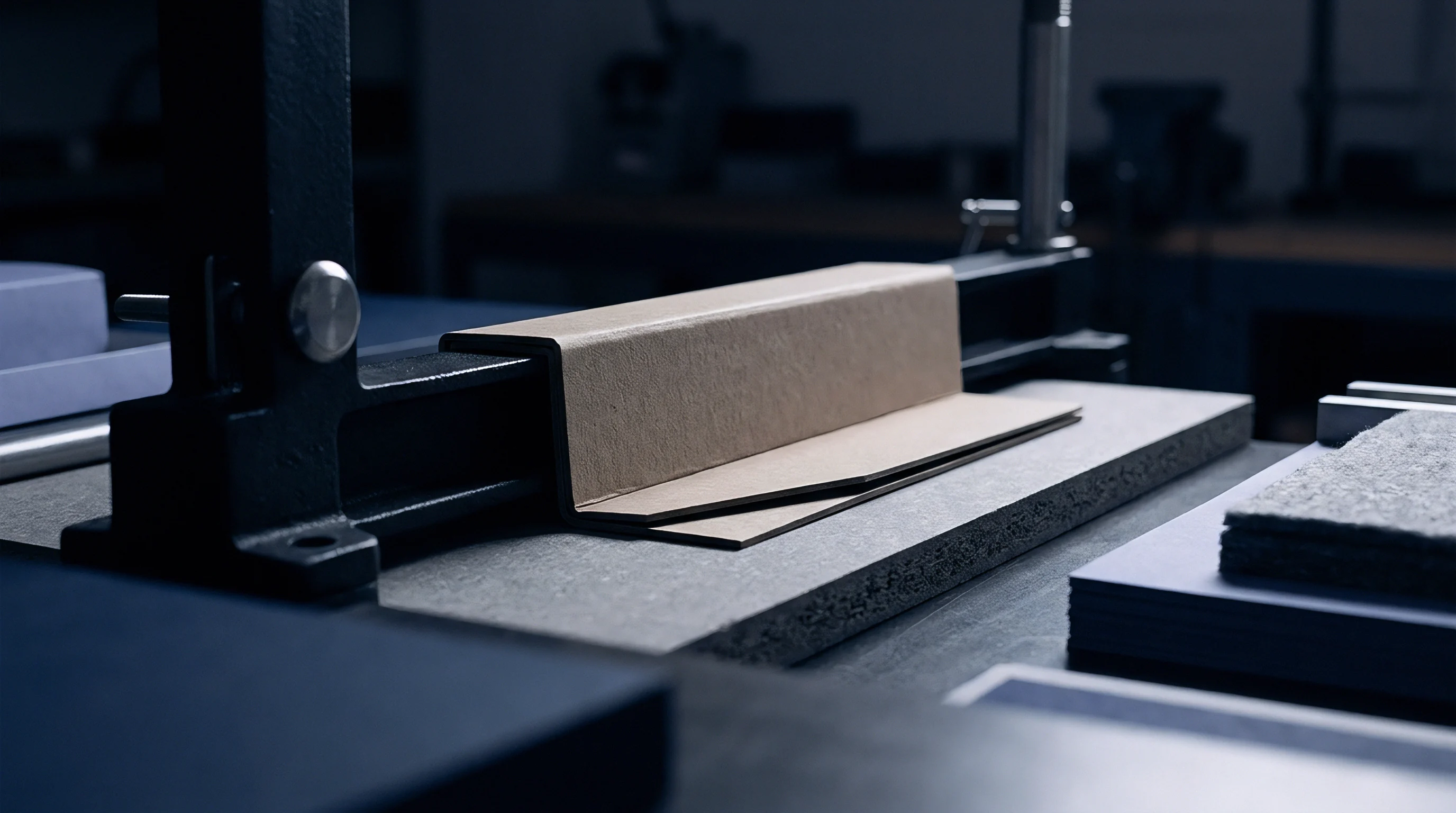
Acoustic Damping through Lamination Films and Barrier Foils
Barrier films, laminates, and metallized finishes change how acoustic waves traverse the board. Extrusion-coated polyethylene (PE), polyethylene terephthalate (PET) films, and ultra-thin aluminum foils act as distinct acoustic boundaries with their own mechanical properties. These added layers introduce viscoelastic damping and sharp impedance steps that attenuate through-thickness wave energy before it reaches the core paperboard matrix.
Oriented polypropylene (OPP) or PET lamination films exhibit high internal mechanical loss factors, absorbing high-frequency compression energy through polymer relaxation. On a clear glossy 15-micron BOPP film laminated with solventless polyurethane adhesive, acoustic transmission losses increase by 4 to 8 decibels compared to bare board. The adhesive layer also acts as a compliant cushion, spreading the point load of the scoring rule and reducing shear stresses in the underlying board plies.
Evaluating score damage in foil-laminated cartons requires lower frequencies. Aluminum barrier foils, typically 6 to 9 microns thick, create sharp impedance mismatches that reflect acoustic energy away from the receiver. Dropping transducer frequency to roughly 800 kilohertz maintains enough penetration through the metal layer to inspect internal delamination beneath the foil.
Specialized functional coatings present distinct acoustic challenges on modern converting lines. Water-based dispersion barrier coatings designed to replace poly-coatings carry high loadings of inorganic pigments like talc or engineered kaolins. These mineral-rich layers stiffen the surface skin, making it prone to stress cracking under the scoring rule.
Ultrasonic surface waves detect these micro-failures to verify that the water vapor barrier remains intact after scoring.

Do Soft Touch Varnishes Mask Structural Score Fractures?
Curable soft-touch polyurethane dispersions and tactile UV matte varnishes possess mechanical properties that alter wave transmission. These coatings contain elastomeric polyurethane beads or micro-matting silica particles that deform elastically under load. When struck by a scoring rule, a soft-touch coating compresses elastically ~ masking underlying liner cracks from optical cameras while absorbing acoustic energy.
The high viscoelastic damping of soft-touch varnishes shifts the phase angle of transmitted ultrasonic signals. Across an undamaged soft-touch coated board, phase delay exceeds that of uncoated board by 10 to 25 degrees. When the fibrous liner beneath the varnish cracks, this phase delay drops abruptly as acoustic waves take secondary paths around the fracture.
Catching this phase shift alerts operators to structural failure hidden beneath a visually pristine surface.
Thermal hot-stamping foils introduce localized stiffening across score intersections. The micro-crystalline wax sizing, vapor-deposited aluminum, and crosslinked polyester topcoats used in stamping foils form brittle surface films. Where a score intersects a stamped graphic, the foil film can flake or bridge across the crease, causing peeling during 180-degree pre-breaks.
High-frequency surface sweeps track foil detachment along score shoulders, catching debonding before cartons reach the folder-gluer.
Coating formulation shifts change score acoustic profiles across production runs. Switching from high-solids solventless adhesives to water-based laminating emulsions alters moisture in the top plies, lowering internal shear delamination thresholds. Inline ultrasonic arrays map these moisture-driven shifts continuously, prompting operators to adjust counter-channel widths to preserve score integrity without damaging decorative finishes.


Waste

Spoilage Arithmetic across Tool Wear and Substrate Shifts
Creasing defects account for substantial financial scrap on large packaging runs. Uncorrected score deviations ~ whether under-creased board causing carton erection jams or over-creased lines rupturing decorative surfaces ~ produce thousands of unfillable blanks in minutes at line speed. Continuous inline ultrasonic verification catches these structural drifts before defective blanks reach automated palletizers.
Consider a typical commercial production run to evaluate scrap economics:
- Total Production Run scales to 1,500,000 finished cartons processed on a rotary converting line running at 300 meters per minute.
- Substrate Material comprises 350-micron folding boxboard with an off-machine valuation of 1,450 dollars per metric ton.
- Finishing Passes include full-coverage process printing, a spot water-based barrier varnish pass, and specialized tactile matte lamination.
- Tooling Wear Drift typically forces a 2.5 percent unspotted defect rate across long runs when using manual quality checks at pallet drop points.
- Inline Monitoring Reduction lowers total scoring-related scrap down to 0.4 percent by automating make-ready and tracking rule wear in real time.
Running this production scenario demonstrates significant material savings:
Total raw board throughput for the run equals 78.5 metric tons. At a scrap rate of 2.5 percent, undetected score defects waste 1.96 metric tons of printed and laminated stock. This loss represents 2,842 dollars in raw substrate cost alone, excluding wasted ink, energy, laminating film, and machine time.
At a converted blank valuation of 72 dollars per thousand units, that scrap represents 2,700 dollars in lost value per shift.
With inline ultrasonic systems alerting operators to channel packing and die wear, scrap drops to 0.4 percent, saving 31,500 cartons. Net economic recovery on this single run exceeds 2,260 dollars in direct finished-good value. Across an annual volume of 45 million cartons, recovered value exceeds 67,000 dollars, paying off a dual-head ultrasonic monitoring array within its first year of operation.
Tool make-ready durations drop sharply when acoustic feedback guides mechanical setup. Traditional press make-ready demands multiple hand-pulled sheets, caliper checks, and destructive lab bend testing, consuming 35 to 50 minutes of idle press time. Inline acoustic arrays reduce setup to under 12 minutes by providing live stiffness-reduction feedback as the operator adjusts rule penetration, saving machine time on every changeover.
Fewer downstream quality issues further justify the investment. When defective cartons with erratic score stiffness enter automated packaging lines, jams cost packagers thousands of dollars per minute in downtime. Documenting score compliance with continuous acoustic datasets protects converting mills from customer rejection claims and line-stoppage chargebacks.
Folding failures are frequently attributed to board furnish moisture swings rather than scoring variability. Installing continuous inline acoustic monitoring settles the issue by recording both baseline board stiffness and the achieved score ratio across every roll in the run.