Quantifying Time Dependent Viscoelastic Creep and Moisture Recovery in Heat Embossed Recycled Paperboard Blanks
Heat embossing above lignin glass transition temperature locks paperboard relief depth, while controlled dwell time minimizes post-press viscoelastic creep.

Deformation
Platen temperatures between 110 and 140 degrees Celsius temporarily disrupt amorphous hydrogen bonds within the cellulose matrix of recycled paperboard. During heat embossing, mechanical force reconfigures the bulk structure, driving fiber compaction along male die ridges. Because recycled furnish contains shorter fibers and higher ash content than virgin stock, its internal network stores elastic energy differently during impression.
As hot platens compress the board, cellulose microfibrils shift into new spatial arrangements while residual internal stresses concentrate along stamped margins.

Thermal Softening of Lignin and Hemicellulose
Native polymers within recycled furnish transition from a rigid glassy state into a rubbery regime when press temperatures exceed eighty degrees Celsius. Amorphous hemicellulose components achieve thermal mobility at lower energy thresholds when bound moisture acts as a plasticizer. Heat transfer through recycled multi-ply board depends on sheet density, Z-direction thermal conductivity, and initial moisture distribution across internal plies; higher press temperatures accelerate heat transfer to the sheet center, allowing fibers to slide without wall fracture.
If thermal energy during pressing is insufficient, amorphous regions remain rigid and the fiber network retains its elastic memory, causing stamped impressions to spring back immediately upon die clearance. Elevated temperatures disrupt inter-fiber bonds while forming new secondary bonds in the compressed configuration, though excessive heat drives off structural water, rendering recycled fibers brittle and triggering micro-fractures along deep embossing contours.
Permanent depth retention depends directly on thermal dwell duration above the secondary transition point of amorphous cellulose.
Post-embossing relief degradation can stem from improper ambient storage conditions as well as inconsistent fiber refine levels or inadequate binder distribution in the recycled stock.
Swell
Exposing converted paperboard blanks to relative humidity levels above fifty percent triggers rapid moisture absorption across unsealed fiber interfaces. Water breaks the inter-fiber hydrogen bonds created during hot pressing, releasing frozen internal strains within the crushed fiber network where viscoelastic flow dominates early on. Recycled fibers absorb water faster than virgin softwood fibers because repeated pulping cycles increase lumen collapse and surface hornification.
The resulting dimensional change alters surface topography, causing stamped relief crests to flatten gradually during warehouse storage.

Moisture Regain and Hygroexpansive Springback
Cellulose polymers attract atmospheric water through polar hydroxyl sites, allowing water molecules to penetrate amorphous regions and push adjacent microfibrils apart, which drives volumetric expansion primarily perpendicular to the fiber alignment axis. In heat-embossed areas where fibers were compressed into dense ribbons, moisture absorption causes preferential thickness swelling as the board attempts to recover its uncompressed caliper, systematically reducing embossing depth.
| Furnish Type | Recycled Content (%) | Moisture Regain Rate (% RH/hr) | Transverse Hygroexpansion Coefficient | Relief Depth Loss at 75% RH (72 hr) |
|---|---|---|---|---|
| Coated Recycled Board (CRB) | 100 | 0.42 | 0.0028 | 38.5% |
| Folding Boxboard (FBB) | 35 | 0.28 | 0.0019 | 22.1% |
| Solid Bleached Board (SBB) | 0 | 0.18 | 0.0012 | 11.4% |
| Uncoated Recycled Chipboard | 100 | 0.51 | 0.0034 | 46.2% |
| Data measured at 23 degrees Celsius following conditioning transitions from 50% to 75% relative humidity per ISO 187 standard environment. | ||||
Structural failure in converted cartons manifests through distinct physical mechanisms when relative humidity fluctuates during transit:
- Embossed Crest Flattening diminishes tactile sharpness when moisture content rises above nine percent by weight during transit.
- Delamination Along Sunk Boundaries occurs as differential hygroexpansion generates transverse shear forces across densified zone margins.
- Panel Bowing And Stacking Instability develops when single-sided relief designs absorb water non-uniformly across carton faces.
- Varnish Micro-Cracking manifests along compressed embossing edges as underlying fibers expand beneath brittle surface coatings.
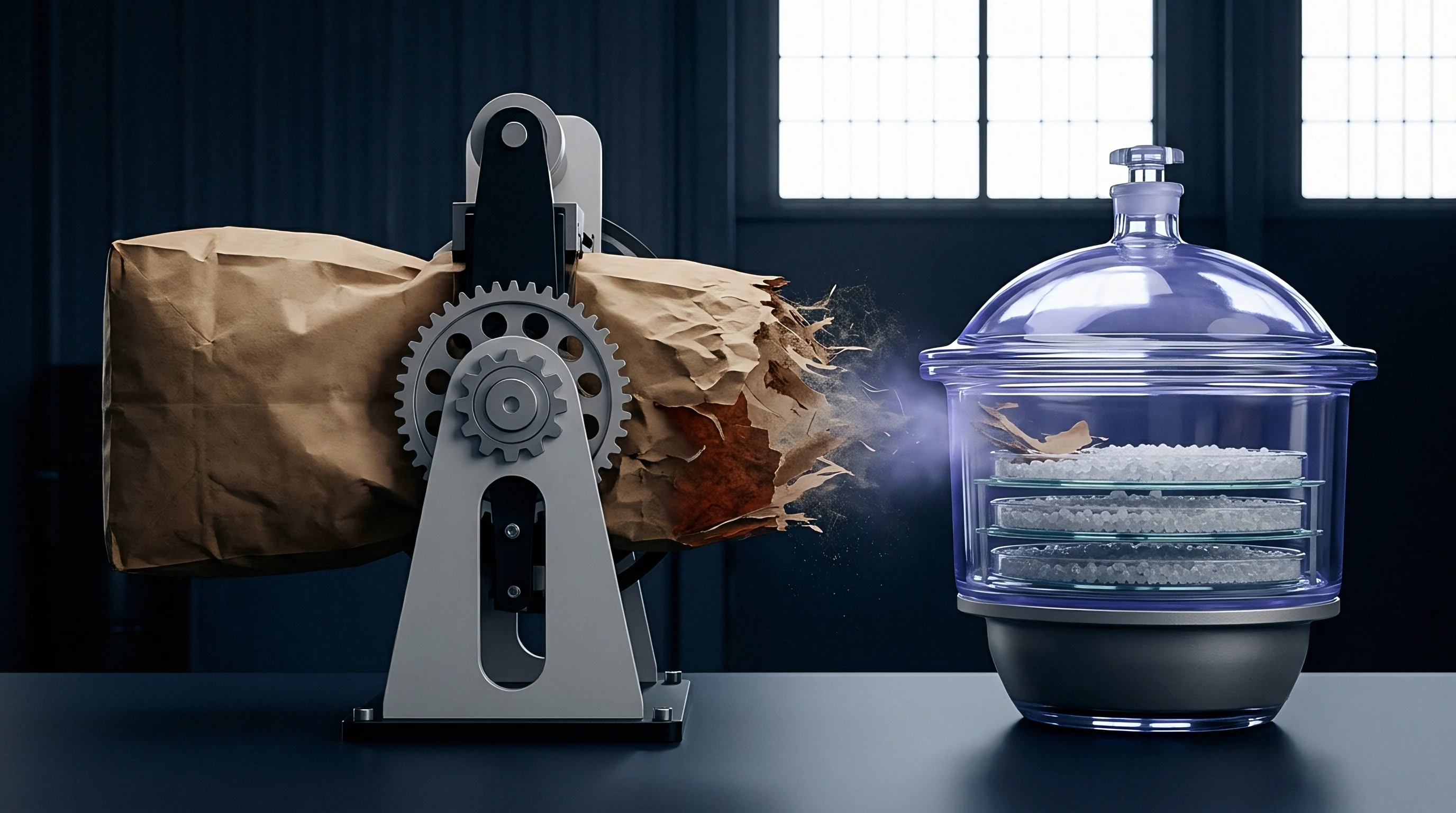
Holding converting blanks in vapor-sealed wrapping until die cutting prevents atmospheric humidity from reversing the structural work accomplished at the hot press.
Compliance
Viscoelastic behavior in paperboard manifests as time-dependent mechanical strain under constant internal stress. Compressed fiber zones within heat-embossed blanks remain under severe localized stress after exiting the die nip, and these residual forces drive delayed dimensional deformation over hours and weeks without external loading. Quantifying creep compliance allows packaging engineers to predict relief retention over a product’s shelf life.
Four Element Mechanical Analogues for Paperboard
Burgers constitutive models combine elastic springs and viscous dashpots in series and parallel configurations to capture instantaneous and delayed material responses. Maxwell units model rapid elastic strain recovery and unconstrained viscous flow, while Kelvin-Voigt units capture delayed elastic responses where dashpots retard spring movement. Recycled board requires modified compliance parameters to account for damaged fiber walls and irregular bonding networks.
Burgers Compliance Equation for Relief Loss
Mathematical modeling of depth retention uses an instantaneous elastic modulus coupled with retardational strain mechanisms. Total creep compliance as a function of time follows the standard formulation:
J(t) = J_0 + J_1 (1 – exp(-t / tau)) + t / eta_0
Where J_0 represents instantaneous elastic compliance, J_1 represents retarded elastic compliance, tau represents retardation time, and eta_0 represents long-term viscous viscosity. Consider a worked comparative scenario. A 100% recycled chipboard blank carries an initial residual embossing stress of 12 MPa.
Its material parameters under standard laboratory conditions are J_0 = 0.00012 MPa^-1, J_1 = 0.00028 MPa^-1, tau = 18 hours, and eta_0 = 850,000 MPa hr. Over a storage period t = 168 hours (7 days), total compliance evaluates as:
J(168) = 0.00012 + 0.00028 (1 – exp(-168 / 18)) + 168 / 850000 = 0.0005976 MPa^-1
Total strain reaches epsilon(168) = 12 × 0.0005976 = 0.00717 (0.717%). For an initial embossed relief depth d_0 = 450 micrometers, this strain translates to a depth loss of 143.2 micrometers ~ a 31.8% loss of original relief depth. By comparison, a virgin bleached softwood kraft board tested under identical conditions exhibits J_0 = 0.00008 MPa^-1, J_1 = 0.00014 MPa^-1, tau = 32 hours, and eta_0 = 2,100,000 MPa hr.
Over 168 hours, its total compliance reaches 0.000300 MPa^-1, resulting in a strain of 0.00360 and a relief depth loss of only 72.9 micrometers (16.2%). Recycled board undergoes nearly double the creep deformation under identical residual stress.
A residual embossing stress of twelve megapascals yields a thirty-two percent reduction in relief height over one hundred sixty-eight hours under standard testing conditions.
Whether chemical cross-linking agents applied during stock preparation can permanently lock viscoelastic strain without compromising post-consumer repulpability remains an open question for industrial validation.
Die
Brass and hardened steel tooling configurations determine the physical boundary conditions imposed on processed paperboard sheets. Male die draft angles, punch depth, and female cavity clearance directly govern the stress magnitude inside crushed fiber zones. Insufficient clearance fractures surface liners, while excessive clearance fails to set permanent fiber deformation, accelerating springback.

Thermal Dwell Calibration on High Speed Presses
Platen contact time governs heat penetration depth through thick multi-ply recycled substrates. Running presses at high speeds reduces dwell duration below thirty milliseconds, leaving central plies cold. These cold inner plies act as elastic springs, driving rapid recovery once pressure is released.
A rigorous thermal make-ready sequence establishes stable converting conditions:
- Position thermocouple sensors across male and female metal platens to audit temperature uniformity prior to load application.
- Adjust male tooling clearance to precisely eighty-five percent of measured stock caliper to balance impression relief against fiber tearing.
- Set press operational velocity to maintain a minimum thermal dwell duration of forty-five milliseconds inside the compression nip.
- Measure first-off relief profile depth using high-resolution optical gauges within two minutes of sheet delivery.
- Store initial production blanks in environmentally sealed chambers maintained at twenty-three degrees Celsius for twenty-four hours before secondary finishing passes.
Including a mandatory post-press relaxation tolerance clause based on ISO 287 moisture testing in conversion contracts shifts liability for dimensional springback from the pressroom operator to the raw material supplier.
Bench
Accurate measurement of microscopic topography across embossed paperboard surfaces requires non-contact metrology instrumentation. Stylus profilometers drag physical diamond tips across sheets, gouging compressed fibers and distorting creep measurement data, whereas optical methods deliver precise surface maps across environmental conditioning cycles.

Profilometry and Mechanical Analysis
Laser confocal scanning instruments generate three-dimensional elevation maps of compressed crests and valleys without touching delicate fiber structures. Dynamic mechanical analysis isolates temperature-dependent viscoelastic transition points under controlled oscillation frequencies. Placing board samples inside humidity-controlled environmental chambers during profilometric scans exposes real-time creep and recovery coupling.
Where Standard Conditioning Fails High Recycled Content Packaging?
Test methods operating under standard atmospheres of twenty-three degrees Celsius and fifty percent relative humidity overlook severe ambient spikes experienced during transoceanic shipping. Standard laboratory testing protocols record equilibrium values that fail to capture rapid moisture adsorption dynamics in tropical ports. Recycled packaging subjected to cyclic relative humidity shifts between 50% and 90% undergoes accelerated mechanical fatigue, losing relief depth twice as fast as static climate test predictions suggest.
| Test Standard | Target Variable | Instrument Type | Typical Measured Range | Error Margin |
|---|---|---|---|---|
| ISO 187 | Paper Atmosphere Conditioning | Environmental Chamber | 23°C / 50% RH | ± 1.0°C / ± 2.0% RH |
| TAPPI T 541 | Z-Direction Tensile Strength | ZDT Tester | 200 – 800 kPa | ± 3.5% |
| ISO 25178-602 | 3D Surface Topography | Laser Confocal Profilometer | 0.1 – 2000 µm depth | ± 0.05 µm |
| ASTM E1356 | Glass Transition Temperature | Differential Scanning Calorimeter | 50 – 200°C | ± 0.8°C |
Failure to enforce environmental conditioning during relief measurement generates up to twenty-five percent error in predicted carton shelf life.
Skipping dynamic mechanical analysis during board qualification can lead directly to structural carton collapse in humid retail environments and costly product recall claims.

Recovery
Financial exposure in commercial carton converting originates from unpredicted dimensional springback across finished production batches. When embossed relief drops below visual visibility thresholds during transit, retail buyers reject whole production lots, leaving converter margins eroded by scrap fees, repulping costs, and line downtime.
Stack Compression and Structural Degradation
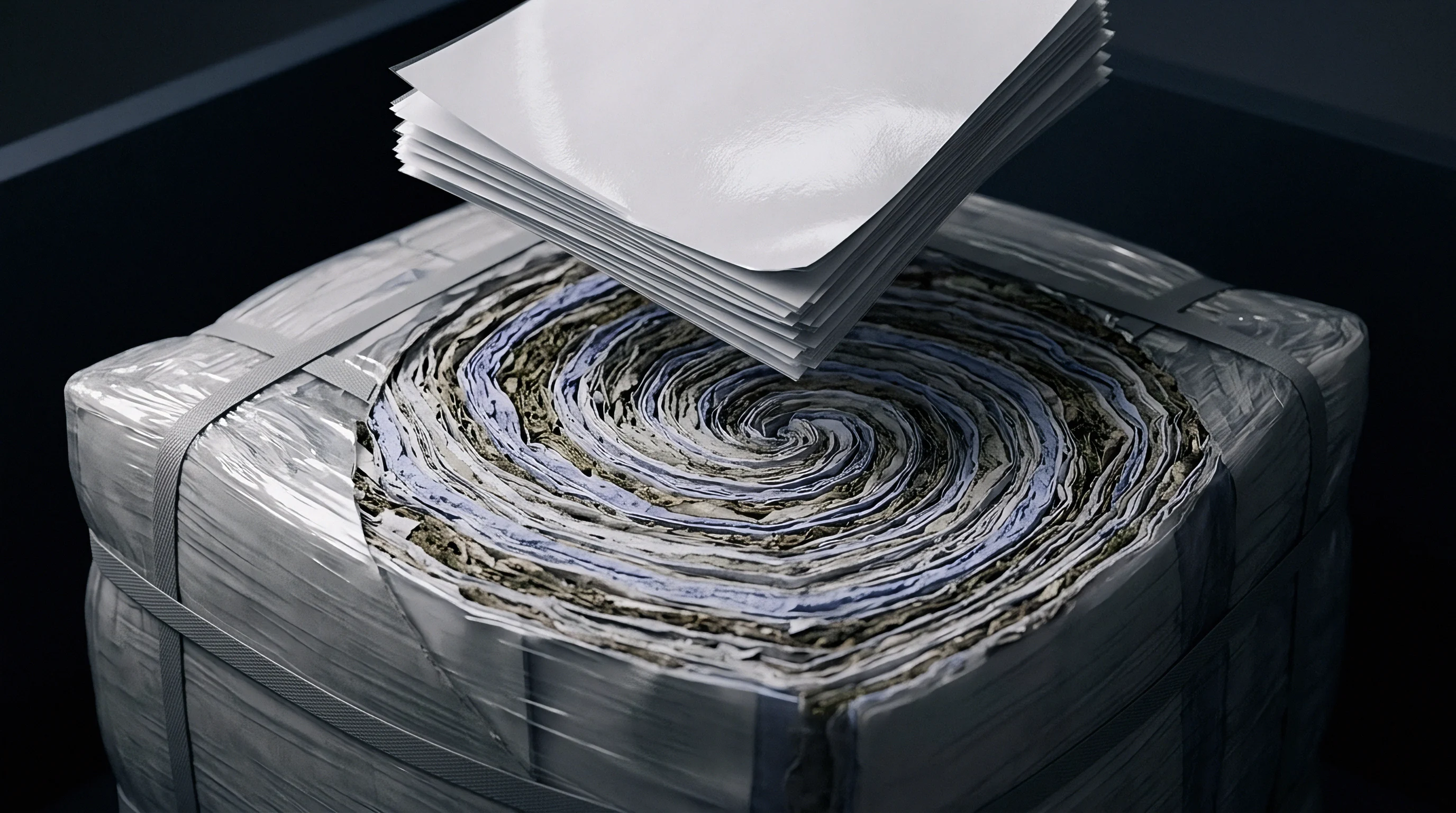
Palletized packaging blanks experience static overburden loads that accelerate creep relaxation in lower carton layers. Bottom pallets carry compressive loads up to eight hundred kilograms per square meter, where static pressure flattens heat-embossed features and accelerates moisture-driven fiber collapse in humid storage facilities.
| Dwell Time (ms) | Line Speed (sheets/hr) | Relief Retained (30 Days, %) | Waste Rate (%) | Landed Cost per 1,000 Blanks (USD) |
|---|---|---|---|---|
| 20 | 6,500 | 52.4 | 8.5 | 42.10 |
| 35 | 5,200 | 68.1 | 4.2 | 39.80 |
| 50 | 4,000 | 84.7 | 1.8 | 38.50 |
| 70 | 3,100 | 91.2 | 1.1 | 40.20 |
Procurement agreements incorporate rigorous dimensional recovery parameters to defend converting economics:
- Creep Resistance Thresholds define maximum allowable relief height loss over a thirty-day storage window under forty-degree climate testing.
- Furnish Fiber Composition Limits mandate minimum long-fiber softwood ratios in recycled stock to limit hygroexpansive swelling.
- Thermal Make-Ready Log Documentation obligates converting lines to record continuous platen temperature readings across every production shift.
- Moisture Barrier Packaging Mandates require pallet shipments to utilize polyethylene stretch wrapping with desiccants during ocean transport.
Calculating the total financial return of increased thermal press dwell involves balancing slightly lower sheet throughput against significant reductions in customer rejection claims.