Mechano Sorptive Creep Testing Protocols for Recycled Corrugated Packaging Substrates
Dynamic relative humidity cycling accelerates compressive creep in recycled corrugated substrates, requiring specific safety factor derating to prevent failure.

Rig
Relative humidity in commercial supply chains is rarely stable. Standard mechanical testing at 23 degrees Celsius and 50 percent relative humidity masks the structural degradation that occurs under dynamic humidity cycling. Mechano-sorptive creep refers to this accelerated deformation in paper and board subjected to mechanical loads during transient moisture sorption.
Where static moisture levels lead to predictable creep, continuous adsorption and desorption cycles produce cumulative structural damage at stress levels far below the material’s nominal yield point.
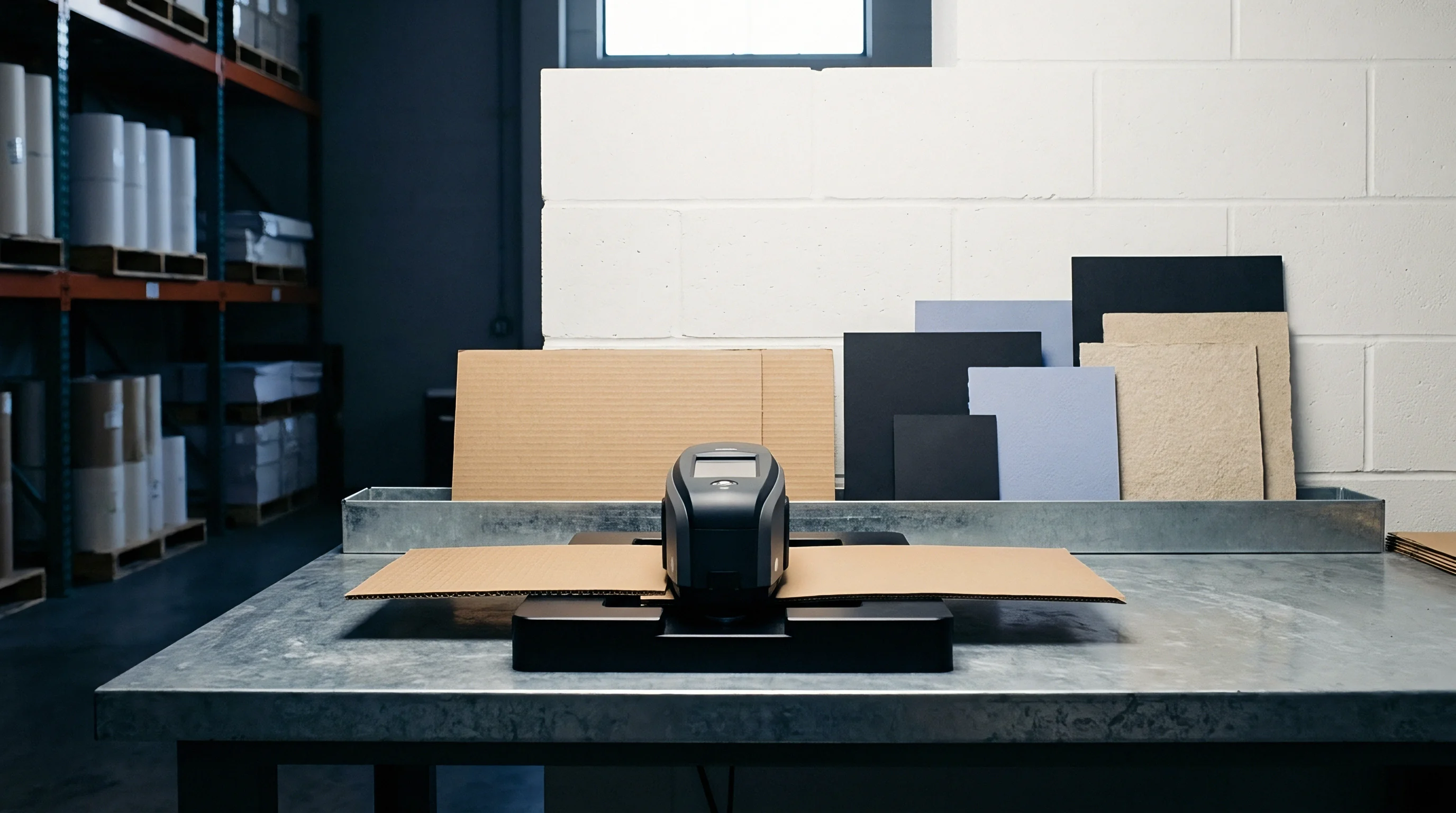
Quantifying this behavior at bench scale requires environmental chambers capable of rapid, repeatable relative humidity transitions at a uniform specimen temperature. Testing frames use high-precision Linear Variable Differential Transformers and calibrated S-type load cells to track micro-strain deflection over multi-day runs. Short-span Compressive Strength pieces and miniature edge crush specimens are mounted in pneumatically driven fixtures within the dynamic humidity envelope.
Fixtures rely on open-sided clamping geometries so circulating air reaches the substrate edge, preventing stagnant micro-climates in the test zone.
| Parameter | Standard Static Reference | Standard Cyclic Profile | Accelerated Cycling Profile |
|---|---|---|---|
| Relative Humidity Range | 50 percent fixed | 30 percent to 80 percent | 35 percent to 90 percent |
| Cycle Period Duration | Constant | 12 hours per cycle | 2 hours per cycle |
| Temperature Control | 23.0 degrees Celsius | 23.0 degrees Celsius | 38.0 degrees Celsius |
| Transition Rate | Zero | 2.0 percent RH per minute | 5.0 percent RH per minute |
| Applied Static Load | 50 percent of 23C/50RH SCT | 30 percent of 23C/50RH SCT | 40 percent of 23C/50RH SCT |
Specimen dimensions directly influence moisture equilibrium rates and creep magnitude. Edge crush test pieces cut to 50 millimeters by 50 millimeters undergo rapid moisture flux through exposed flutes, while solid containerboard strips take longer to achieve equilibrium. Precision humidity sensors mounted within 10 millimeters of the sample surface monitor conditions during rapid transitions.
Airflow inside the chamber is held between 0.5 and 1.0 meters per second to drive boundary layer vapor exchange without causing mechanical vibration in displacement sensors.
Dynamic humidity cycling produces disproportionate displacement during moisture adsorption. Tensile and compressive loads behave differently under moisture uptake: compression samples exhibit up to four times the mechano-sorptive creep strain of equivalent tensile samples under identical cycling regimes. Test setups account for this asymmetry by emphasizing compression-loaded short-span and edge-wise compressive fixtures for corrugated board evaluations.
Relative humidity fluctuations between 35 percent and 90 percent at 23 degrees Celsius reduce the load-bearing life of recycled containerboard by 70 percent compared to static 80 percent humidity exposure.
Clamping pressure on the substrate must avoid end-crushing while allowing free hygroexpansional movement across the sheet. Hydraulic or pneumatic grips with serrated anvil inserts hold a steady clamping force of 2.5 Kilonewtons to prevent slippage during moisture cycles. Positioning load cells directly under the lower specimen platen isolates structural deflection from thermal and moisture expansion in the frame.
Calibration runs with invar dummy samples establish the apparatus’s thermal-hygrometric expansion coefficient, enabling sub-micron correction of raw creep datasets.
Standard static short-span compression values and equilibrium moisture isotherms are often relied on for hot and humid export routes, though static metrics fail to capture the additional deformation that occurs under dynamic relative humidity cycling.
Sorption
Transient moisture transport through cellulosic fiber walls alters the matrix’s molecular stiffness. Cellulose, hemicellulose, and lignin form a partially crystalline structure held by inter-molecular hydrogen bonds. Water entering amorphous zones during sorption breaks these bonds between cellulose chains.
Under mechanical stress, microfibrils slide past one another before new hydrogen bonds can form at adjacent sites during desorption.

Microstructural Stress Redistribution during Vapor Flux
Moisture gradients across a sheet create steep localized internal stresses. When relative humidity rises, outer fiber layers adsorb moisture and expand quickly while the drier core resists deformation. This differential expansion generates shear stress profiles through the linerboard or fluting thickness.
Desorption reverses the stress pattern, pulling outer surfaces into tension while compressing the core. Repeated humidity cycles redistribute these stress peaks continuously, accelerating cumulative plastic strain.
Recycled fibers compound microstructural stress because of repeated wetting and drying in earlier processing cycles. Hornification lowers the swelling capacity of recycled pulp cell walls, forming a denser, less flexible network that concentrates mechano-sorptive strain in residual amorphous hemicellulose regions. Consequently, creep deformation increases markedly in grades with high proportions of recycled Old Corrugated Containers due to lost inter-fiber bonding area and higher fine fractions.
A substrate under constant physical load deforms significantly faster during active moisture transport than when fully saturated at a static higher moisture content.
Chemical composition determines how readily a sheet softens under moisture. Hemicellulose absorbs more moisture than crystalline cellulose, making up the main site for water uptake within the fiber wall. Recycled grades made with unbleached kraft pulps retain high hemicellulose ratios and remain susceptible to mechano-sorptive failure.
Lignin provides some hydrophobic resistance, yet residual lignin in neutral sulfite semi-chemical mediums and recycled fluting does not prevent bond slippage during rapid moisture changes.
Static isotherms miss the kinetic hysteresis that occurs during dynamic environmental cycling. In sorption, moisture content lags behind ambient relative humidity because of diffusion resistance through the porous web. In desorption, structural shifts in the pore network retain water, shifting the equilibrium point.
Because the sheet’s mechanical response depends on its path along this hysteresis loop, the relationship between moisture flux and creep deflection rate is non-linear.
What fundamental molecular mechanism governs the irreversible slip limit between hornified recycled fibers during the transition from 80 percent down to 35 percent relative humidity under high compressive load?

Fiber
Secondary fibers from recycled streams undergo mechanical beating, chemical contamination, and thermal drying cycles that shorten average fiber length and generate high proportions of fine material. This repulping alters the physical architecture of recycled containerboard, reducing tear strength and compressive stiffness. Losing intact, long softwood fibers impairs the matrix’s capacity to distribute concentrated loads during moisture flux.
Recycled Grade Compressive Derating Calculation
Quantifying mechano-sorptive performance requires establishing baseline mechanical losses across recycling passes. Consider a packaging evaluation comparing a virgin kraftliner substrate with a 100 percent recycled testliner substrate under cyclic conditions. The virgin kraftliner has an initial Short-span Compressive Strength of 3.2 Kilonewtons per meter under standard conditioning.
The recycled testliner, made from multiply re-pulped Old Corrugated Containers, shows an initial static SCT of 2.4 Kilonewtons per meter under identical laboratory conditions.
Applying a static load equal to 35 percent of standard SCT places an absolute load of 1.12 Kilonewtons per meter on the virgin sheet and 0.84 Kilonewtons per meter on the recycled sheet. Subjecting both samples to 48 hours of dynamic relative humidity cycling between 35 percent and 90 percent RH at 23 degrees Celsius induces mechano-sorptive strain. Virgin kraftliner exhibits a creep rate factor of 1.8 relative to static baseline creep, reaching a total strain of 1.2 percent before stabilizing.
Recycled testliner experiences a creep rate factor of 4.2 under the same conditions, resulting in 3.8 percent total creep strain and accelerating into tertiary structural failure.
Mathematical derating models express the final residual compressive strength using the following formulation:
S_residual = S_initial (1 – Alpha_recycled) (1 – Beta_ms)
Where S_initial represents standard initial compressive strength, Alpha_recycled is the structural fiber damage coefficient assigned to secondary fiber fractions, and Beta_ms is the mechano-sorptive creep loss factor derived from dynamic relative humidity testing. For virgin kraftliner, Alpha_recycled equals 0.00 and Beta_ms equals 0.25. For 100 percent recycled testliner, Alpha_recycled equals 0.25 and Beta_ms reaches 0.58.
Standard ISO 12048 compression testing under fixed humidity overestimates the real-world stacking capacity of recycled corrugated boxes by up to 50 percent in variable-humidity shipping routes.
- Cut test specimens to dimensions of 15 millimeters width by 100 millimeters length using a dual-blade precision cutter to prevent edge cracking.
- Condition cut specimens in a desiccated environment at 20 percent relative humidity and 40 degrees Celsius for 24 hours to remove prior moisture history.
- Transfer specimens to a standardized atmosphere of 23 degrees Celsius and 50 percent relative humidity for at least 12 hours until reaching mass equilibrium.
- Mount the pre-conditioned specimen in the short-span compression fixture, applying a torque of 5.0 Newton-meters to lateral clamping blocks.
- Apply designated static pre-load within 3 seconds, avoiding initial overshoot on the primary load transducer.
- Initiate the dynamic relative humidity cycling program, recording strain displacement at 1.0 second intervals throughout the test.
Hornified recycled fibers lose intrinsic flexibility, concentrating stress at inter-fiber bonding nodes rather than distributing strain across the sheet. While starch or synthetic dry-strength resins compensate for initial static compression losses, these additives degrade quickly under moisture flux and provide little long-term resistance to mechano-sorptive displacement.
Higher recycled content demands larger structural safety factors in humid supply chain applications.

Standard
Static compression standards like ISO 12048 and ASTM D642 measure top-to-bottom box compression under short-term constant loading. These methods perform crushing tests at fixed deformation rates or evaluate static load retention under constant conditioning. They fail to reflect the coupling of mechanical stress and moisture transport that drives field failures in transit.
Realistic assessments require continuous dynamic humidity cycling combined with static dead-weight loading.

Why Does Static Creep Fail to Predict Cyclic Performance?
Static creep test protocols maintain fixed relative humidity, typically 50 percent, 85 percent, or 90 percent. At constant high humidity, paper fibers adsorb water until reaching equilibrium, and deformation stabilizes into a predictable secondary creep plateau driven by viscoelastic relaxation. Cyclic humidity protocols instead force continuous moisture flux through fiber cell walls.
This flux disrupts transient hydrogen bonds, accelerating creep rates well beyond static expectations.
| Standard Standard ID | Primary Measurement Focus | Environmental Condition | Applicability to Recycled Creep |
|---|---|---|---|
| ISO 12048 | Box Compression Test (BCT) | Static 23C / 50% RH | Inadequate for variable humidity storage |
| ASTM D642 | Compressive Resistance of Containers | Static 23C / 50% RH | Measures initial structural stiffness only |
| TAPPI T 843 | Short-span Compressive Strength | Static 23C / 50% RH | Fails to capture dynamic bond slippage |
| ISO 2247 | Static Load Stacking Test | Static high humidity optional | Underestimates creep in recycled liners |
| Modified Dynamic Protocol | Mechano-Sorptive Creep Factor | Cyclic 35% to 90% RH | Directly quantifies dynamic failure point |
Modified laboratory protocols introduce standardized humidity cycling steps for corrugated materials. A continuous compressive dead load equal to 30 percent of the material’s unaged dry short-span compressive strength is applied while ambient relative humidity cycles between 35 percent and 90 percent every 120 minutes at 23 degrees Celsius. Displacement sensors track total deformation over at least 72 hours or until structural collapse.
Evaluating recycled containerboard substrates solely with static test methods overestimates box performance, contributing to warehouse stack collapses during seasonal humidity swings.
- Creep Buckling Failure occurs when localized panel deflection exceeds critical stability thresholds from continuous mechano-sorptive strain under load.
- Inter-Flute Delamination develops when differential moisture expansion between the fluting medium and outer linerboards breaks the adhesive bond line during rapid drying.
- Corner Post Crushing emerges as moisture gradients soften high-stress vertical folds, shifting weight onto unsupported side panels.
- Scoreline Fracture results from repeated hygroexpansional cycling along pre-creased board areas, severing secondary fibers along the hinge axis.
Specifying packaging substrates based solely on standard static TAPPI or ISO test sheets leaves supply chains vulnerable to failure when shipments pass through tropical maritime zones.

Rating
Translating laboratory creep parameters into commercial box specifications requires adjusting standard engineering safety factors. Packaging calculations typically use Billerud or Kellicutt formulas to derive ultimate Box Compression Test performance from liner and medium strength values. Safety factors usually range from 1.5 to 2.0 for benign, temperature-controlled routes, but dynamic humidity conditions require additional safety factor derating to prevent creep failure.
| Substrate Composition | Controlled Static Environment | Moderate Variable RH (40-75%) | Severe Variable RH (35-90%) |
|---|---|---|---|
| 100% Virgin Kraftliner | 1.50 | 2.10 | 3.00 |
| 50% Recycled Testliner Blend | 1.75 | 2.60 | 3.80 |
| 100% Recycled OCC Containerboard | 2.00 | 3.20 | 5.20 |
| High-Fines Semi-Chemical Medium | 1.85 | 2.90 | 4.50 |
Substrate derating models incorporate a specific mechano-sorptive coefficient into the denominator of the maximum safe load formula. As recycled fiber content increases, the derating multiplier rises non-linearly due to fiber shortening, fines accumulation, and reduced inter-fiber bond area. A box made from 100 percent recycled testliner exposed to severe tropical humidity cycling requires a total safety factor exceeding 5.0 to survive 90 days in storage.
Incorporating a verified mechano-sorptive derating factor into container design models prevents stack failure during extended humid transit without over-specifying paper grammages across dry routes.
- Fiber Origin Traceability Verification requires chain-of-custody documentation establishing the proportion of post-consumer secondary fiber versus virgin kraft pulp in the linerboard profile.
- Dynamic Creep Test Report Validation confirms that substrate testing under dynamic humidity cycling profiles matches the destination transport climate.
- Adhesive Water Resistance Proof establishes that starch additives maintain bond integrity under relative humidity flux up to 90 percent.
- PPWR Recyclability Certification Assessment verifies that functional barrier coatings applied for wet strength do not impair repulpability under EU standards.
- Batch-Level Edge Crush Testing Audit cross-references delivered pallet lot quality against certified sample properties from packaging qualification testing.
European Packaging and Packaging Waste Regulation provisions mandate that packaging remain minimal in weight while ensuring structural safety. Over-designing to compensate for unquantified creep risks violating PPWR source reduction mandates, while under-designing leads to damage during transit. Quantifying mechano-sorptive behavior provides the technical file evidence required to justify paper weights to compliance authorities.
Under standard purchase specification clause 14.2, containerboard lots delivered with dynamic mechano-sorptive creep rates exceeding verified baseline tolerances by more than 8 percent are subject to rejection at the receiving dock.

Clause
Commercial procurement contracts for corrugated packaging frequently omit dynamic mechano-sorptive performance criteria, relying instead on static burst strength, edge crush resistance, and grammage declarations. Static metrics fail to protect buyers when recycled containerboard boxes collapse during transit through high-humidity corridors. Incorporating mechano-sorptive creep testing into technical delivery conditions shifts structural risk back to the paper mill and converter.
Mandating certified dynamic creep limits alongside static strength metrics helps secure supply chain performance.
Substrate purchase agreements require explicit clauses defining maximum allowable creep strain under cyclic environmental conditions. Specifications must outline the test protocol ~ including relative humidity limits, cycling frequency, applied static load percentage, and allowable deflection over the test window. Converters supplying 100 percent recycled testliner or fluting mediums must present accredited third-party test reports validating compliance.
Failure to meet mechano-sorptive thresholds constitutes a non-conformity, allowing buyers to reject non-compliant substrate lots before converting.
Warranty claims arising from transit stack collapses depend on how container performance is defined in supply agreements. When contracts specify static compression strength exclusively, converters can defend against claims by showing that delivered boxes met baseline Box Compression Test standards prior to shipment. Including explicit dynamic mechano-sorptive criteria establishes that the packaging was specified to withstand ambient moisture flux, closing off defenses based on post-delivery environmental exposure.
Supply chains crossing multiple climate zones require compliance documentation linking paper mill technical datasheets directly to converted box performance files. Packaging engineers should integrate certified substrate creep data into container compliance files to maintain audit readiness under transport regulations and packaging waste reduction mandates. This documentation protects brand owners against unexpected product damage liabilities while satisfying regulatory demands for optimized material usage.