Mineral Oil Analysis in Recycled Fibre Food Packaging
Verify MOSH and MOAH compliance in recycled fibre packaging using accredited HPLC-GC-FID testing, validated functional barriers, and complete declarations of compliance.

Mass
Analytical testing of mineral oil hydrocarbons in recovered paper and packaging divides them into two main chemical families: Mineral Oil Saturated Hydrocarbons (MOSH) and Mineral Oil Aromatic Hydrocarbons (MOAH). MOSH includes straight-chain, branched, and alkyl-substituted cyclic alkanes. MOAH comprises mono- and poly-aromatic ring systems, usually with heavy alkylation across several sites.
For packaging migration, the critical molecular weight range spans C10 to C50, though volatile and semi-volatile fractions between C10 and C25 drive most vapor-phase transfer into dry foods at room temperature.
Quantifying these mixtures requires separating structural sub-classes with distinct toxicological profiles. Linear (n-alkanes) and branched alkanes (iso-alkanes) clear from mammalian tissue far more readily than complex cyclic paraffins. This cyclic MOSH fraction ~ often called naphthenic hydrocarbons ~ tends to accumulate in human tissues, particularly the lymph nodes, liver, and spleen, where chain lengths between C16 and C35 can form microgranulomas.
Above C45, hydrocarbons show negligible bio-accessibility because intestinal absorption is physically limited.

Distinguishing Hydrocarbon Ring Fractions
Aromatic ring distribution within the MOAH fraction dictates its mutagenic and carcinogenic potential. Unsubstituted or lightly alkylated polycyclic aromatic hydrocarbons with three to seven fused rings pose the main toxicological risk. By contrast, industrial mineral oils in offset inks typically contain mono- and di-aromatic ring systems with heavy alkyl side chains.
While these alkylated species show lower direct genotoxicity than unsubstituted polycyclic aromatics, regulators monitor the entire MOAH fraction because routine chromatography cannot easily isolate individual ring counts.
Non-mineral sources of saturated hydrocarbons frequently distort mass spectrometry results. Polyolefin oligomeric saturated hydrocarbons (POSH) migrate from polyethylene and polypropylene films or hot-melt adhesives, while synthetic poly-alpha-olefin (PAO) oligomers enter from food-grade lubricants. Natural plant waxes in fresh wood fibers ~ mostly odd-numbered n-alkanes like C27, C29, C31, and C33 ~ also produce false-positive signals in MOSH chromatograms.
Standard prep protocols therefore incorporate specific cleanup steps to separate mineral oil signals from these natural or film-derived interferences.
Carbon Number Ranges and Migration Potential
Hydrocarbon transfer from paperboard to food is driven largely by vapor pressure and temperature. Fractions below C16 carry high vapor pressures, evaporating quickly through the internal air gaps of paper packaging without needing direct contact between the fiber wall and the food. The intermediate C16 to C24 range moves through a combination of gas-phase diffusion and direct contact, while heavier fractions between C25 and C35 migrate almost entirely through contact with fatty foods or dry foods rich in surface lipids.
Hydrocarbon migration from recycled board stored at 20 degrees Celsius reaches 90 percent of equilibrium within 180 days across paperboard thicknesses up to 450 micrometers.
Chromatographic interferences can easily distort results.
Applying aqueous dispersion barriers cuts MOAH migration by around 35 percent. Mapping the exact carbon chain distribution in recycled board establishes the baseline exposure risk. When a mill runs newsprint or graphic waste with unrefined mineral-oil inks, the MOSH/MOAH profile skews heavily toward C14-C28.
Board made from high-grade office waste or thermo-mechanical pulp carries lower total hydrocarbon loads, with residual peaks shifting to the C28-C40 range from process fats and machinery defoamers.
Partition coefficients between paperboard and food simulants shift dramatically with carbon number. A C14 hydrocarbon reaches equilibrium across an air gap in days, whereas a C28 hydrocarbon takes months under ambient conditions to achieve the same thermodynamic balance. Testing protocols that do not resolve distinct carbon windows fail to capture the shift from fast gas-phase migration to slow contact transfer, yielding flawed exposure models.
Standardizing aromatic ring distributions across molecular weights remains difficult when raw recycling streams fluctuate by season and region.


Bench
Measuring MOSH and MOAH in paperboard and food relies on high-performance liquid chromatography coupled online to gas chromatography with flame ionization detection (HPLC-GC-FID). Direct GC analysis of raw solvent extracts yields unresolved complex mixtures (UCM) that appear as broad humps along the baseline, hiding individual peaks. The initial HPLC step separates the raw extract into clean MOSH and MOAH fractions over a silica gel column, sending each via automated transfer into dedicated GC capillary channels.
Extraction settings govern recovery rates from porous paper matrices. Recovering mineral oils completely from paperboard requires a balanced polar-nonpolar solvent mix that can wet cellulose fibers while dissolving heavy hydrocarbons. Standard protocols call for rapid room-temperature extraction with 1:1 ethanol and hexane, or extended extraction in dichloromethane.
Dry food samples must first be swollen with water or polar solvents to open matrix pores before non-polar extraction, releasing trapped hydrocarbons into the liquid phase.

Pre-Separation and Interference Cleanup
Interference from vegetable fats, natural waxes, and synthetic oligomers requires targeted cleanup before injection. Standard saponification with potassium hydroxide converts triglycerides into fatty acid salts, preventing column overload and ester interference in the MOAH window. Epoxidation using meta-chloroperbenzoic acid (mCPBA) converts unsaturated compounds ~ like squalene from food or double-bonded POSH oligomers ~ into polar epoxides.
These derivatives lock onto the HPLC silica column, keeping them from co-eluting into the MOAH gas chromatography channel.
Silica gel columns impregnated with silver nitrate offer secondary cleanup when resolving complex aromatic mixtures. Silver ions form reversible pi-complexes with unsaturated aromatic bonds, retarding MOAH retention compared to saturated MOSH molecules. Careful tuning of silver nitrate loading and solvent gradients yields sharp separation between mono-aromatic species and any non-mineral saturated hydrocarbons that bypassed initial HPLC fractionation.
| Parameter | MOSH Phase Settings | MOAH Phase Settings | Validation Tolerance |
|---|---|---|---|
| HPLC Stationary Phase | Silica gel 5 micrometers (250 mm x 2 mm) | Silica gel 5 micrometers (250 mm x 2 mm) | Base resolution R > 1.5 |
| Mobile Phase Gradient | n-Hexane 100% (0.3 mL/min) | Dichloromethane/n-Hexane gradient | Flow rate stability +/- 2% |
| GC Injection Volume | 80 to 100 microliters (Concurrent Eluent Transfer) | 80 to 100 microliters (Concurrent Eluent Transfer) | Transfer yield > 95% |
| Capillary Column | Non-polar 100% dimethylpolysiloxane (15 m x 0.32 mm) | Mid-polar 50% phenylpolysiloxane (15 m x 0.32 mm) | Thermal stability to 350 C |
| FID Temperature | 350 degrees Celsius | 350 degrees Celsius | Linearity r2 > 0.998 |
Quantifying unresolved complex mixtures depends on consistent baseline integration. Instead of measuring discrete peaks, the analyst draws a baseline linking the low-signal regions before C10 and after C50, integrating the entire hump area above it. Internal standards spiked into the sample before extraction compensate for volume loss and instrument drift.
Typical internal standard sets include bicyclohexyl (BCh), cholestane (Cho), n-C11, n-C13, pentylbenzene (55B), 1-methylnaphthalene (1-MN), 2-methylnaphthalene (2-MN), and tri-tert-butylbenzene (TBB).
- Internal Standard Addition takes priority, requiring gravimetric dosing into the solvent before fiber contact to correct for recovery losses.
- Epoxidation Yield Verification confirms complete conversion of interfering olefins by tracking cholestadiene standards added during cleanup.
- Blank Matrix Baseline Control prevents false positives stemming from solvent impurities, dirty glassware, or ambient lab air.
- Retention Time Window Calibration sets clear integration boundaries from n-C10 to n-C50 using calibrated linear alkane references.
Laboratory Inter-Laboratory Reproducibility
Solvent purity is critical.
Inter-laboratory variability remains a headache across accredited testing facilities. Differences in baseline placement during manual or automated integration can cause reported concentrations to vary by up to 40 percent on the exact same board sample. Automated software regularly mistakes tailing solvent peaks or leftover epoxidation reagents for MOAH humps, pushing reported mineral oil values over regulatory thresholds.
Clean extracts are essential to protect GC columns.
Method validation under EN 16995 sets formal performance benchmarks. The limit of quantification (LOQ) for total MOSH and total MOAH in paper and board sits at 0.5 mg/kg per fraction, though sensitive systems reach LOQs of 0.1 mg/kg. Reports must specify the integrated carbon range and state whether POSH or natural wax subtractions were performed on the raw chromatograms.
Systematic error drops significantly when labs maintain internal standard recoveries within a tight ninety-to-one-hundred-ten percent window for every batch.

Shield
Preventing hydrocarbon migration from recycled board into dry food depends on functional barriers built into the packaging structure. Article 13 of European Regulation 1935/2004 defines a functional barrier as any layer that blocks the transfer of substances behind it into food, keeping exposures within safety limits. In recycled fiber applications, these barriers take the form of internal pouch liners, interior board coatings, or co-extruded layers inside the board itself.
Migration through polymer layers follows Fickian diffusion dynamics. Transport rates depend on the hydrocarbon solute’s diffusion coefficient within the polymer, the board-to-barrier partition coefficient, ambient temperature, and layer thickness. Breakthrough time ~ or lag time ~ measures how long the barrier blocks detectable migration under set storage conditions.
Lag Time and Diffusion Kinetics
Lag time calculations allow engineers to estimate barrier performance over a product’s intended shelf life. Mathematically, lag time equals the square of the layer thickness divided by six times the diffusion coefficient of the migrating compound in that polymer. If calculated lag time exceeds commercial shelf life, the barrier holds, keeping migration below analytical detection limits.
Vapor-phase transport drives most migration.
Polyethylene (PE) films, commonly used for moisture protection and heat sealing, offer virtually no barrier against mineral oil hydrocarbons. Both low-density (LDPE) and high-density polyethylene (HDPE) contain high free volume in their amorphous regions, allowing rapid diffusion of C10 to C35 MOSH and MOAH. A 30-micrometer LDPE film has a lag time of less than 48 hours for C14 hydrocarbons at 20 degrees Celsius, making plain polyolefin films ineffective for hydrocarbon control.
Which Barrier Polymers Prevent Long Chain Migration?
Dense polymers with tight intermolecular structures and polar functional groups show far better barrier performance. Polyethylene terephthalate (PET), ethylene vinyl alcohol (EVOH), polyamide (PA), and polyvinyl alcohol (PVOH) feature low diffusion coefficients for non-polar hydrocarbons. A 12-micrometer biaxially oriented PET film offers a lag time exceeding two years at room temperature, making it a reliable barrier for long-shelf-life dry foods.
| Barrier Material Type | Standard Layer Thickness | C16 MOSH Lag Time (20 C) | C24 MOAH Lag Time (20 C) | Primary Failure Mechanism |
|---|---|---|---|---|
| Low-Density Polyethylene (LDPE) | 30 micrometers | 1.5 days | 4.2 days | High free volume non-polar diffusion |
| High-Density Polyethylene (HDPE) | 40 micrometers | 8.0 days | 22.0 days | Sufficient for short shelf life only |
| Biaxially Oriented PET (BOPET) | 12 micrometers | 850 days | > 1200 days | Pinholes or mechanical flex cracking |
| Ethylene Vinyl Alcohol (EVOH 32% mole) | 5 micrometers | > 1000 days | > 1500 days | High relative humidity plastification |
| Aqueous Acrylic Dispersion Coating | 8 grams/square meter | 180 days | 360 days | Coating pinholes and fold cracking |
| Activated Carbon Adsorbent Layer | 15 grams/square meter | Retention based | Retention based | Adsorption site saturation over time |
Aqueous dispersion coatings applied on the paper machine or converting line are becoming a popular alternative to extruded films. These water-based systems generally rely on acrylic copolymers, styrene-butadiene lattices, or bio-based polymers like starch derivatives and microfibrillated cellulose. Barrier integrity hinges on complete film continuity: microscopic pinholes, incomplete drying, or cracking along carton scores create pathways that quickly undermine performance.
Barrier performance scales with molecular weight density, leaving thin polyolefin coatings vulnerable to vapor phase hydrocarbon transport.
Activated carbon technology relies on retention rather than physical blockage. Powdered activated carbon blended into the inner liner of multi-ply board ~ or coated on its interior surface ~ provides a massive internal surface area with high affinity for non-polar hydrocarbon vapors. Hydrocarbons migrating from recycled outer plies get trapped inside the carbon micropores before reaching the food.
However, adsorption capacity drops as high-boiling volatiles saturate binding sites over extended storage.
Lag times drop sharply as temperature rises.
Temperature accelerates diffusion kinetics non-linearly following Arrhenius relationships. Storing packaging at elevated temperatures ~ such as 40 degrees Celsius in transit or warehousing ~ cuts effective lag times by a factor of five to ten compared to room temperature. Accelerated testing must balance conditioning temperatures carefully: excessive heat can soften aqueous coatings or alter polymer morphology, generating artificial migration patterns that do not reflect ambient conditions.
Choosing a barrier polymer without verifying its mechanical integrity along score lines leads to immediate migration failures along folded carton edges.
Ink
Recycled pulp streams carry heavy hydrocarbon loads inherited from graphic and commercial print. Traditional newspaper printing used coldset offset inks formulated with non-food-grade mineral oil distillates as carrier solvents. These distillates, boiling between 240 and 380 degrees Celsius, contain large fractions of C14 to C30 MOSH and up to 35 percent MOAH.
Standard de-inking systems remove pigment particles effectively during recycling but leave absorbed mineral oil hydrocarbons tightly bound within the cellulose matrix.
Offset printing on packaging converting lines historically added to this hydrocarbon load. Sheetfed offset inks used mineral oil solvents to adjust viscosity and speed ink setting on coated board. While vegetable-oil inks (like soy or linseed formulations) have largely replaced mineral-oil inks for package printing across Europe, residual contamination persists in shared recycling streams fed by imported waste or non-compliant commercial print.

Pulp Loop Contamination Routes
Paper recycling repulps recovered paper in water, followed by mechanical screening, flotation de-inking, washing, and bleaching. Because mineral oil molecules are highly lipophilic and poorly soluble in water, they adsorb onto organic fines and cellulose fibers rather than washing out in the water stream. Standard de-inking washes remove over 90 percent of pigments but cut mineral oil levels by only 20 to 40 percent.
Recycled fiber is not the only source of contamination.
Secondary contamination occurs during corrugated box manufacturing and converting. Machinery lubricants, starch adhesive defoamers, belt release agents, and wash-down solvents frequently contain mineral oils. Direct contact between outer shipping cases and primary folding cartons allows cross-migration: volatile mineral oil compounds evaporate from corrugated box walls and adsorb into the unprinted interior board of inner cartons during pallet storage.
- Gravimetric sampling of incoming paper bales establishes baseline contamination levels before pulping.
- Segregated pulping loops for food-grade board keep post-consumer graphic waste separate from clean post-industrial cuttings.
- Solvent extraction checks on de-inking flotation cells track oil removal efficiency across different surfactants and retention aids.
- Continuous vapor extraction during cylinder drying strips low-boiling MOSH fractions directly from the wet web.
- Batch chemical audits verify that defoamers, sizing agents, and wet-strength resins added at the wet end are completely mineral-oil-free.
De-Inking and Process Limitations
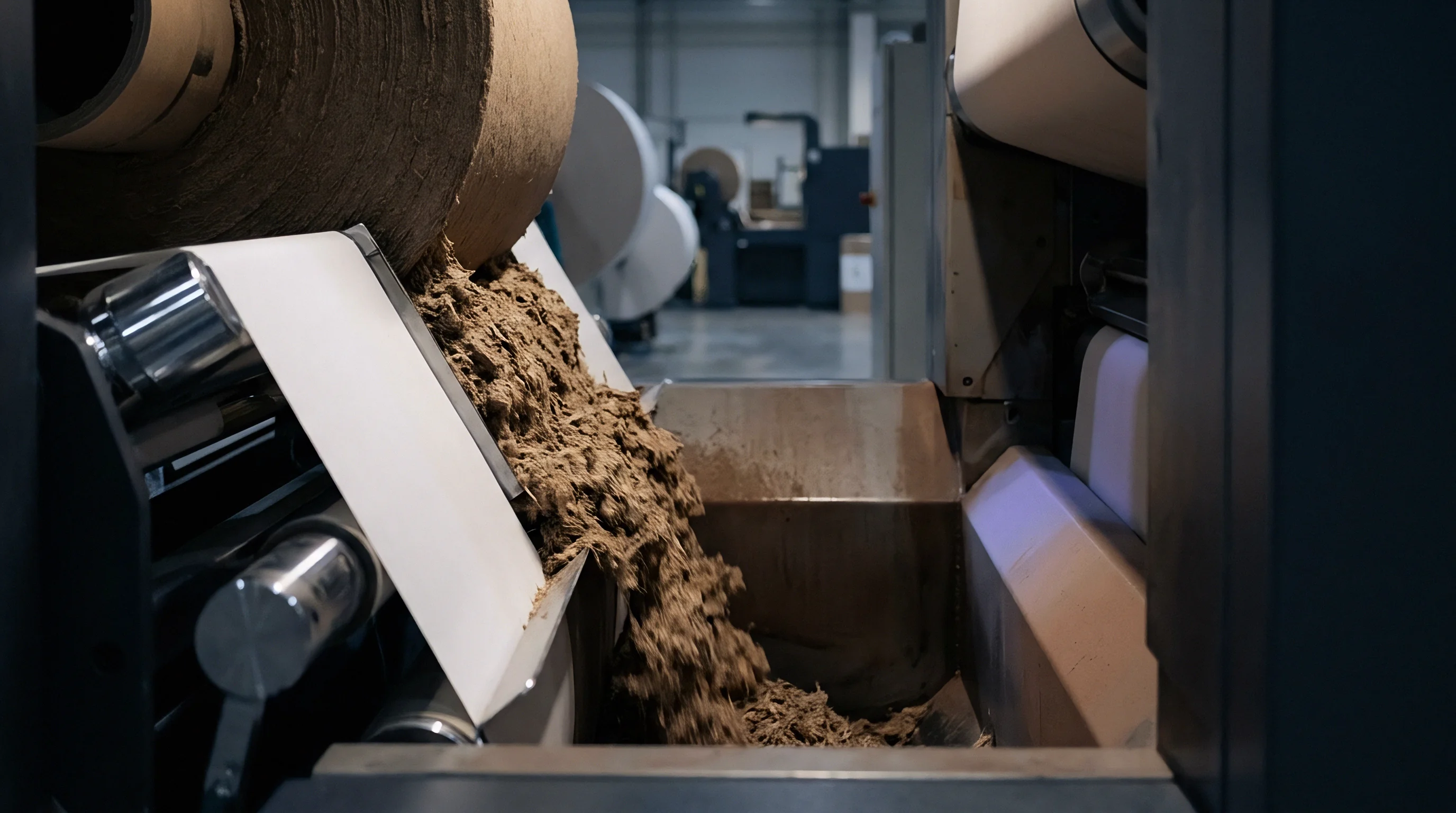
Process water recycling in modern closed-loop mills can inadvertently concentrate organic contaminants. As mills tighten freshwater intake to meet environmental permits, volatile and semi-volatile hydrocarbons build up in recirculated process water. These accumulated compounds re-deposit onto fibers during web formation on the Fourdrinier wire, raising background MOSH baselines even in mills with dedicated de-inking systems.
Converting operations introduce non-ink hydrocarbon risks of their own. Press blanket washes, anti-setoff powders with oily coatings, and hot-melt adhesives used in carton gluing create localized contamination. Ethylene-vinyl acetate (EVA) and synthetic block copolymer hot-melts frequently contain mineral oil tackifiers and paraffinic wax extenders that migrate straight into adjacent board edges after sealing.
Converters sometimes assume that switching to mineral-oil-free inks on the outer carton guarantees compliance, overlooking the heavy hydrocarbon burden already residing inside the recycled substrate.

Threshold
Regulatory frameworks governing mineral oil hydrocarbons in paper packaging are shifting from voluntary regional guidance to strict statutory limits across Europe. Framework Regulation EC 1935/2004 requires that food-contact materials transfer no constituents to food in amounts that threaten human health. Because harmonized EU-wide limits for MOSH and MOAH in paperboard have been slow to materialize, individual member states have introduced their own enforcement measures.
Updated scientific opinions from the European Food Safety Authority (EFSA) re-examined the toxicological risks of mineral oils in food. EFSA reaffirmed that while MOSH accumulates in human tissue, its acute toxicity remains low; by contrast, MOAH fractions with three or more aromatic rings pose potential genotoxic and carcinogenic risks. EFSA concluded that dietary MOAH exposure across European populations is a public health concern, accelerating momentum for mandatory limits.

National Enactments and Mandatory Limits
France set binding restrictions through its AGEC law (Loi Anti-Gaspillage pour une Économie Circulaire) and the implementing Decree of 13 April 2022. The French rules limit mineral oils in packaging and commercial printing inks under a phased reduction plan targeting specific chemical fractions. The decree explicitly bans mineral oils containing substances that hamper recycling or limit recycled packaging use due to toxicity risks.
Customs authorities actively enforce these limits.
French thresholds distinguish total MOAH content from specific ring counts. Effective January 2023, inks applied to packaging could not exceed 1 percent (10,000 mg/kg) total MOAH. From 1 January 2025, that limit drops to 0.1 percent (1,000 mg/kg), with a strict 1 ppm (0.1 mg/kg) cap on MOAH structures containing 1 to 7 aromatic rings.
Inks must also meet a 0.1 percent limit for MOSH compounds spanning C16 to C35.
| Jurisdiction / Framework | Regulated Substrate / Medium | MOSH Limit / Threshold | MOAH Limit / Threshold | Legal Basis / Enforcement Status |
|---|---|---|---|---|
| France (AGEC Decree 2022) | Printing inks on packaging | 0.1% (C16-C35) in ink | 0.1% total / 1 ppm (1-7 rings) | Statutory mandatory ban in force |
| Germany (Draft Mineral Oil Ordinance) | Paperboard packaging (recycled) | Not specified in draft | 0.5 mg/kg in paperboard (LOQ) | Draft national law pending EU notification |
| Germany (BfR Recommendation XXXVI) | Paper and board for food contact | Migration < 0.5 mg/kg food | No migration detectable (LOQ 0.01 mg/kg) | Industry reference guidance standard |
| EU Action Limits (SCoPAFF 2022) | Foodstuff matrices (direct) | Not specified | 0.5 to 2.0 mg/kg food (by fat content) | Harmonized market withdrawal trigger |
Germany drafted national legislation through its proposed Mineral Oil Ordinance (Mineralölverordnung). The draft centers on requiring functional barriers for recycled paperboard packaging so that no detectable MOAH migrates into food. The proposed detection limit is set at 0.5 mg/kg of food for total MOAH, or 0.1 mg/kg for volatile MOAH fractions analyzed by accredited HPLC-GC-FID methods.
Declarations of compliance that omit specific simulant contact times transfer full customs rejection risk directly to the importer of record.
The Standing Committee on Plants, Animals, Food and Feed (SCoPAFF) established EU-wide enforcement action limits for MOAH in foodstuffs. These guidelines trigger market withdrawals across EU member states whenever MOAH in food exceeds set thresholds: 0.5 mg/kg for dry foods with low fat content, 1.0 mg/kg for higher-fat foods, and 2.0 mg/kg for fats and oils. Packaging that drives food concentrations past these levels risks product seizure and retail delisting.
- Unfunctionalized Polyolefin Internal Liners fail when thin LDPE pouches allow complete vapor-phase MOAH transfer into dry cereal within 30 days.
- Missing Migration Testing on Creased Scoring Lines leads to structural failure when aqueous coatings crack along high-stress carton folds.
- Uncontrolled Secondary Recycling Sourcing introduces un-deinked graphic waste into paperboard intended for direct food contact.
- Inadequate Simulant Match Selection invalidates compliance dossiers when labs choose aqueous simulants instead of modified polyphenylene oxide (Tenax) for dry food testing.
- Omission of Adhesive Contribution Audits leads to border rejections when mineral-oil hot-melts bleed hydrocarbons through carton corners.

Testing Conditions and Simulant Selection
Migration testing relies on standardized solid adsorbents.
Standard testing protocols for dry food packaging use modified polyphenylene oxide (MPPO, commercially sold as Tenax) as the official solid food simulant under EN 14338. Tenax acts as a high-capacity adsorbent for volatile and semi-volatile organics, mimicking migration into dry, fatty foods. Standard conditions call for 10 days at 40 degrees Celsius to simulate shelf-life storage, or 10 days at 60 degrees Celsius for hot-fill processes.
Compliance dossiers that rely solely on total solvent extraction of raw board without testing migration into food simulants overestimate risk for barrier-coated boards while underestimating risk for uncoated cartons stored in warm environments.
Supply contracts routinely stipulate that packaging lots yielding MOAH migration above 0.1 mg/kg onto Tenax simulant under EN 14338 conditions (10 days at 40 degrees Celsius) are non-conforming and subject to immediate return at the converter’s expense.


Proof
Verifying recycled paperboard compliance requires a chain of documentary evidence tying paper mill fiber sourcing and chemical additive declarations to barrier testing and final converter production lots. A blanket statement of compliance on a delivery slip holds no weight during market surveillance audits or border inspections. Compliance dossiers must contain formal test reports from ISO/IEC 17025 accredited laboratories using validated analytical methods.
The Declaration of Compliance (DoC) serves as the core document verifying food contact safety across the supply chain. A proper DoC must identify the packaging manufacturer, state the issue date, confirm compliance with Regulation EC 1935/2004 and BfR Recommendation XXXVI, and set out clear operating parameters and boundaries for the material.

Documentary Auditing Protocols
Auditing a supplier dossier begins with checking the scope and validity of lab test reports. Reports must match the exact board grammage, ply structure, barrier coat weight, and carton design detailed in the purchase contract. A report written for a 300 g/m² virgin board cannot defend a 400 g/m² recycled formulation made on a different machine.
Importers bear full border liability.
Traceability systems must connect individual finished lots to specific raw paperboard reels and chemical additive batches. European Regulation EC 2023/2006 on Good Manufacturing Practice (GMP) requires converters to maintain detailed documentation of process control, hygiene, and contaminant tracking. If a lot fails surveillance testing, records must allow rapid identification and isolation of all affected runs from that production window.
- Scope Matching Verification confirms that lab reports explicitly reference the exact board trade name, caliper, and barrier specification being purchased.
- Simulant and Exposure Validation verifies that migration tests used Tenax simulant for contact times and temperatures matching real product shelf life.
- Limit of Quantification Review checks that lab instruments met sensitivity targets down to 0.1 mg/kg for MOAH and 0.5 mg/kg for MOSH.
- Substance List Screening verifies that all papermaking additives appear on authorized positive lists under BfR XXXVI or Swiss Ordinance 817.023.21.
- Chain of Custody Certificate Audit confirms that FSC or PEFC recycled claims match credit balance ledgers at the originating mill.

Batch Acceptance Sampling
Receiving-dock quality control sampling must account for hydrocarbon variation across paperboard reels. Mineral oil content in recycled pulp fluctuates depending on the post-consumer waste mix processed during a given shift. Composite sampling protocols therefore require taking swatches across the full web width at the start, middle, and end of each master reel.
Barrier integrity breaks down at higher temperatures.
Quality control teams screen incoming board shipments for baseline MOSH/MOAH via rapid solvent extraction before releasing stock to converting. If screening levels cross internal control limits, samples trigger full HPLC-GC-FID verification and Tenax migration testing. Any batch failing migration criteria is quarantined immediately.
European enforcement testing focuses primarily on finished packaged foods sampled off retail shelves. When shelf testing reveals MOAH above action limits, authorities trace liability through the brand owner back to the packaging importer. Keeping a complete compliance dossier ~ with raw material tracking, lab migration reports, and barrier lag-time calculations ~ provides the necessary legal defense against recalls, retail delisting, and fines.
Analytical test reports generated on pristine mill swatches fail to prove lot compliance for converted cartons printed with heavy solvent inks.
Verification protocols must also audit converter operations for secondary contamination. Clean board from a certified mill can easily pick up hydrocarbon residues during printing, folding, gluing, or pallet storage. Plant air monitoring, ink solvent purity checks, and temperature control on hot-melt units ensure converted packaging stays compliant.
Dossiers require annual updates to reflect changes in recycling inputs, regulations, and analytical standards. A compliance file relying on three-year-old test data will fail audit scrutiny when limits tighten or mills adjust their fiber furnishes.
A verification dossier is complete only when every converting batch maps directly to a mill reel certificate, an accredited HPLC-GC-FID migration report, and a signed manufacturer declaration of compliance.