Subtractive Chromatographic Baseline Standard Harmonization for Complex Biogenic Hydrocarbon Matrix Analysis
Subtractive baseline harmonization removes biogenic hydrocarbon noise, preventing false MOAH failures in recycled paper food packaging compliance.

Background
Recycled paper and board substrates contain native lipophilic components that overlap directly with saturated and aromatic mineral oil hydrocarbon fractions during gas chromatography. Saturated mineral oil hydrocarbons ranging from C10 to C50 and aromatic mineral oil hydrocarbons present analytical challenges when extracted from complex cellulose fiber matrices. Laboratory solvent extractions using n-hexane and ethanol release non-synthetic biogenic compounds alongside synthetic oil residues.
These naturally occurring biogenic constituents include plant waxes, terpenes, resin acids, fatty acid esters, and squalene derived from wood pulps, agricultural fibers, and recycled cotton rags.
When gas chromatography with flame ionization detection processes these crude extracts, biogenic matrix interferences disrupt baseline stability, generating broad, unresolved signal humps that mirror petroleum distillate profiles. Uncorrected integration of these chromatographic humps inflates calculated mineral oil concentrations, creating systemic compliance failures for food contact packaging materials.

Lipophilic Interference Species in Paper Substrates
Trees synthesize terpenes, resins, and waxes during growth, leaving persistent organic residues in virgin and recovered pulps. Coniferous softwood fibers contribute substantial quantities of abietic acid derivatives and pimaric resins, while deciduous hardwood pulps carry high concentrations of sitosterol, betulin, and long-chain aliphatic alcohols. Recycled pulps accumulate secondary biogenic interference from vegetable-based printing inks, natural starch binders, and rosin sizing agents applied during board converting.
Because rosin acids co-elute with aromatics and squalene mimics heavy alkane signals, baseline resolution degrades across multiple target bands. Squalene, a triterpene hydrocarbon present in human skin lipids and cotton fibers, elutes within the carbon retention window between C25 and C30, generating a distinct peak cluster directly within the saturated hydrocarbon measurement range on single-dimension columns. Aliphatic plant waxes ranging from C21 to C35 present odd-numbered carbon chain distributions that distort baseline integration thresholds.
An uncorrected biogenic terpene load adds up to 4.2 mg/kg of false aromatic hydrocarbons under standard EN 16995 extraction conditions at 60 degrees Celsius.

Mineral Oil Fractionation and Overlapping Envelopes
Gas chromatography with flame ionization detection separates saturated hydrocarbons from aromatic structures based on boiling range and polarity differences. Saturated fractions contain linear alkanes, branched iso-alkanes, and cyclo-alkanes, whereas aromatic fractions comprise alkylated polycyclic aromatic compounds alongside mono- and di-aromatic ring structures. During silica gel clean-up, double bonds in biogenic alkenes exhibit polar retention behavior identical to mono-aromatic petroleum hydrocarbons.
Analytical protocols specify total migration limits for food contact paperboard under national regulations and regional guidelines. Draft European Union regulations and German BfR Recommendation XXXVI specify a maximum concentration of 0.5 mg/kg for aromatic mineral oil hydrocarbons in the carbon chain range of C16 to C35. The 0.5 mg/kg target limit rests on gas chromatography baseline integration precision.
Interference from biogenic terpene oligomers and resin esters elevates the observed baseline signal by 1.0 to 4.5 mg/kg in unrefined recycled fiber extracts, exceeding statutory compliance thresholds even when petroleum-based mineral oil contamination is entirely absent.
- Natural terpene oligomers co-elute with saturated mineral oil fractions between C15 and C25, elevating reported peak areas.
- Rosin sizing constituents generate broad unresolved humps in the aromatic hydrocarbon channel, mimicking mineral oil aromatics.
- Plant wax esters breakdown during thermal extraction, yielding long-chain alkanes that distort chromatographic baselines.
- Squalene residues from cotton fibers produce distinct response bands within the C25 to C35 retention window.
Detection thresholds depend on solvent purity and fraction isolation. Standard analytical methods rely on silica gel column chromatography to isolate saturated and aromatic fractions before injection, but standard silica gel retention fails to differentiate biogenic alkenes from mineral oil aromatics due to similar pi-electron interactions with the solid phase, yielding complex humps in hexane extracts.
| Biogenic Interference Type | Primary Chemical Source | Retention Index Range | Target Mineral Fraction | Co-Elution Impact |
|---|---|---|---|---|
| Squalene and Derivatives | Cotton Fibers, Rags, Skin Lipids | C26 to C30 Alkanes | MOSH Window | Sharp Peak Cluster on Baseline |
| Abietic and Pimaric Acids | Coniferous Softwood Rosin | C18 to C24 Aromatics | MOAH Window | Broad Unresolved Hump Elevation |
| Odd-Chain n-Alkanes | Epicuticular Plant Waxes | C23 to C35 Alkanes | MOSH Window | Dominant Intermittent Spike Envelope |
| Terpene Dimers | Citrus Inks, Resins | C15 to C22 Aromatics | MOAH Window | Base Elevation in Low-Boiling Range |
Unadjusted chromatographic baselines lead laboratories to report compliant packaging paperboard as contaminated, triggering unnecessary supply chain rejections and mill disputes.


Foil
Sample preparation protocols isolate mineral oil fractions from interfering plant matrix components prior to chromatographic analysis. Raw paperboard extracts undergo pre-separation steps to eliminate polar lipids, pigments, and high molecular weight polymers that contaminate gas chromatography injection ports. Physical barriers and chemical sorbents remove high-polarity interfering species, protecting sensitive chromatographic columns from rapid degradation.

Chemical Extraction and Clean up Workflows
Hexane solvent mixtures strip non-polar compounds from paperboard fibers during wrist-action shaking or microwave-assisted processing, while ethanol additions break hydrogen bonds within cellulose networks to accelerate non-polar analyte release. Solid-phase extraction cartridges loaded with aluminum oxide capture polar triglycerides, free fatty acids, and sterols. Aluminum oxide clean-up removes high-polarity natural fats, but passes non-polar biogenic hydrocarbons directly into the analytical eluate.
While silica gel columns retain polar species, isolating olefinic compounds requires metal-modified sorbents operating on complexation chemistry or epoxide formation reactions that convert unsaturated biogenic alkenes into highly polar derivatives.

Silver Nitrate Column Fractionation Mechanics
Silicone-based stationary phases modified with active silver ions bind unsaturated biogenic alkenes while allowing saturated alkanes to pass unhindered. Silver nitrate impregnated silica gel utilizes silver cation interactions with double bonds to retain squalene, stigmastadienes, and terpene oligomers, forming reversible pi-complexes that retard alkene migration through the liquid chromatography column.
Separation efficiency depends on silver loading, solvent polarity, and column temperature. Standard silver nitrate silica gel columns operating under online coupled high-performance liquid chromatography gas chromatography conditions achieve complete retention of mono-alkenes and poly-alkenes up to 20 grams of lipid sample loading per gram of sorbent. Saponification treatment using potassium hydroxide in ethanol hydrolyzes interfering wax esters and triglycerides into soap salts and glycerol, which remain in the aqueous phase during hexane partitioning.
- Extract 5 grams of shredded paperboard sample with 20 milliliters of n-hexane containing internal standards for two hours at room temperature.
- Transfer the liquid extract through an aluminum oxide column to remove polar lipids and pigments.
- Pass the concentrated eluate through a silver nitrate impregnated silica gel column to isolate saturated hydrocarbons from aromatic species.
- Inject the separated fractions into an online coupled high-performance liquid chromatography gas chromatography system for baseline recording.
Incorporating DIN EN 17498 Clause 6.3 into converter supply contracts obligates raw material suppliers to provide raw chromatographic baseline data alongside batch certificate declarations.
Chromatogram
Detector signals recorded over retention time form complex signal envelopes containing sharp compound peaks superimposed on broad baseline humps. Flame ionization detection generates universal response factors proportional to hydrocarbon carbon content. Gas chromatography signals reflect total organic mass passing through the flame detector, making signal interpretation entirely dependent on mathematical baseline modeling and integration software calibration.

Baseline Drift and Unresolved Complex Mixtures
Thermal column ramp profiles during high-temperature gas separations cause baseline rise due to stationary phase bleed. Siloxane column bleed creates an ascending baseline offset above 300 degrees Celsius, matching the elution window of C30 to C50 hydrocarbons. Unresolved complex mixtures of synthetic mineral oil hydrocarbons produce continuous broad signals without defined individual compound resolution.
Baseline drift corrupts integration integrals when standard software draws straight lines between manual anchor points, incorrectly cutting through biogenic signal humps or adding column bleed area to analyte totals. Standard additions confirm peak assignments, blank runs establish detector noise limits, and retention indices guide fraction cut points so that mathematical harmonization can establish dynamic baseline curves accounting for instrument bleed, solvent background, and residual matrix noise.
Proper baseline harmonization requires evaluating blank solvent runs under identical column temperature ramps before integrating sample peaks.
Does Saponification Remove Squalene Interferences Completely?
Alkaline hydrolysis breaks down fatty acid esters and triglyceride lipids efficiently but leaves non-saponifiable triterpenes intact within the hexane extract. Squalene lacks ester linkages, rendering it completely resistant to saponification clean-up; it survives potassium hydroxide treatment and passes directly into the saturated hydrocarbon fraction during solid-phase extraction.
Removing squalene demands secondary clean-up via silver nitrate column chromatography or epoxidation with meta-chloroperoxybenzoic acid. Epoxidation converts squalene double bonds into oxirane rings, increasing compound polarity dramatically so that the resulting squalene hexepoxide remains bound to silica gel during hexane elution, clearing the saturated hydrocarbon retention window between C25 and C30. Epoxidation reagents will react with unsaturated mineral oil aromatic constituents if reaction time, temperature, and reagent concentrations exceed precise analytical boundaries.
During the transition from off-line solid-phase extraction to automated online liquid-gas chromatography systems across European enforcement laboratories in the late 2010s, measurement throughput increased while baseline assignment variances surfaced. Testing laboratories recorded significant quantitative discrepancies when measuring identical recycled packaging boards. Inter-laboratory round-robin studies revealed that absolute recovery variance of aromatic mineral oil fractions between 10 mg/kg and 50 mg/kg in high-wax recycled fluting ranges from 12 percent to 41 percent due to inconsistent baseline modeling assumptions.
Under this measurement uncertainty, a packaging buyer specifies dual-column comprehensive two-dimensional gas chromatography clean-up alongside subtractive harmonization in the formal purchase order contract.
- Blank signal subtraction establishes the electronic baseline and column bleed contribution across the entire retention temperature profile.
- Retention time windowing defines strict cut points between volatile and non-volatile hydrocarbon fractions relative to n-alkane standards.
- Tangent skim integration separates sharp biogenic terpene peaks resting on top of the unresolved mineral oil hump.
- Valley to valley baseline fitting establishes lower integration boundaries when analyzing low-wax recycled paperboard substrates.
| Integration Parameter | Harmonized Test Setting | BfR Method Alignment | EN 16995 Specification | Inter-Lab Coefficient of Variation |
|---|---|---|---|---|
| Blank Subtraction Mode | Dynamic Polynomial Fit | Mandatory | Optional | 8.4% |
| Retention Cut C16/C25 | n-Alkane Index Standard | Fixed (+/- 0.1 min) | Fixed (+/- 0.2 min) | 3.1% |
| Squalene Removal Gate | AgNO3 / Epoxidation | Mandatory Verification | Recommended | 14.2% |
| Tangent Skim Threshold | 5% Peak Height Delta | Standardized | Manual Entry | 19.6% |
| Data compiled from European Union reference laboratory inter-comparison studies on recycled paperboard food packaging matrices. | ||||
Native biogenic humps represent natural wood components rather than toxic petroleum fractions, though uncorrected integration still records them as elevated hydrocarbon totals.


Subtraction
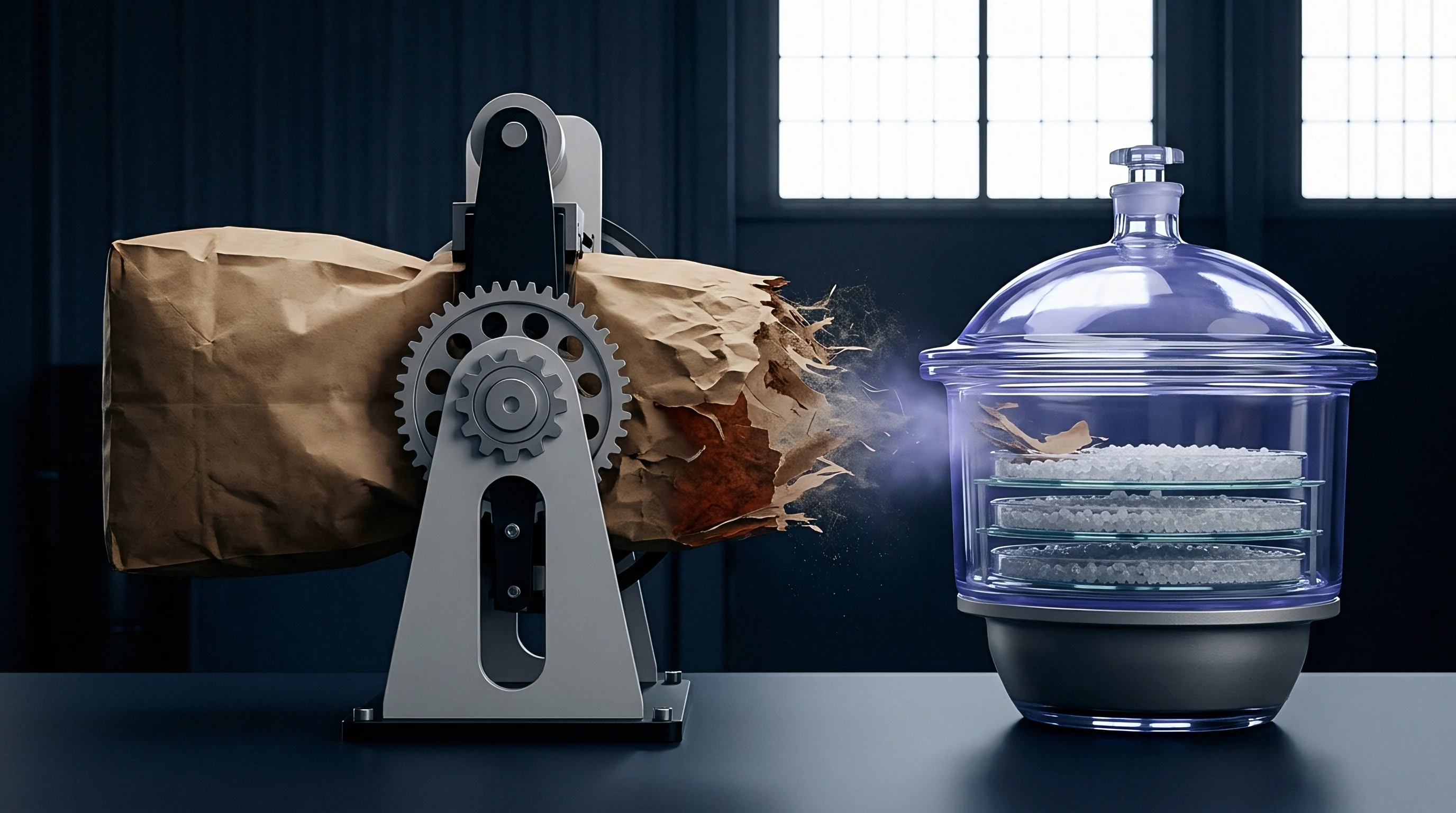
Mathematical modeling algorithms calculate true hydrocarbon signals by subtracting blank baselines and native matrix profiles from raw analytical chromatograms. Digital signal processing isolates genuine petroleum contaminant envelopes from background detector noise and residual biogenic species. Subtractive algorithms process raw chromatographic data points, applying point-by-point matrix offset corrections prior to area integration.
Mathematical Signal Decoupling Calculations
Raw intensity values recorded at specific retention time intervals contain combined signal contributions from four distinct sources. Detector response equals the sum of target mineral oil hydrocarbons, background column bleed, solvent trace noise, and co-eluting biogenic molecules. A blank run yields the instrument baseline offset, while chromatographic runs of pure matrix blanks or chemically characterized reference pulps define native biogenic matrix contributions.
Subtracting instrument blank arrays from sample arrays isolates sample-derived organic mass. Applying secondary subtractive baseline harmonization removes the broad biogenic matrix envelope. A subtractive baseline correction factor resting on comprehensive two-dimensional gas chromatography silver nitrate separation deducts 0.35 mg/kg of biogenic alkene delta within C20 to C35 recycled boxboard extracts.
Uncorrected reporting frequently produces false non-compliance calls. In a 500-gram sample lot of recycled folding boxboard analyzed via gas chromatography with flame ionization detection, raw integration of the aromatic hydrocarbon channel yields a total peak area corresponding to 3.8 mg/kg of C16 to C35 hydrocarbons. Offline silver nitrate liquid chromatography separation and high-resolution time-of-flight mass spectrometry confirm that squalene, terpene dimers, and residual rosin esters account for 1.2 mg/kg of signal area within the C25 to C30 retention window, while instrument column bleed and solvent background account for 0.4 mg/kg across the total thermal ramp.
Subtractive baseline harmonization deducts 1.6 mg/kg total background (1.2 mg/kg biogenic interferences plus 0.4 mg/kg instrument offset), leaving a corrected aromatic mineral oil concentration of 2.2 mg/kg. Where raw integration reported 3.8 mg/kg against a 2.0 mg/kg buyer limit, subtractive harmonization isolates true contamination from natural matrix interference.
| Paperboard Sample Grade | Raw Uncorrected MOAH (mg/kg) | Biogenic Subtraction (mg/kg) | Instrument Subtraction (mg/kg) | Harmonized MOAH (mg/kg) | Compliance Status (2.0 mg/kg Cap) |
|---|---|---|---|---|---|
| Recycled Clay-Coated GD2 | 3.80 | 1.20 | 0.40 | 2.20 | Non-Compliant (True Excess) |
| Uncoated Recycled Linerboard | 2.95 | 1.15 | 0.35 | 1.45 | Compliant (False Positive Cleared) |
| Virgin Kraft Fluting | 1.10 | 0.70 | 0.30 | 0.10 | Compliant (Natural Resins Removed) |
| De-Inked Food Grade Packaging | 2.15 | 0.85 | 0.30 | 1.00 | Compliant (False Positive Cleared) |

Quality Assurance and Dossier Requirements
Documenting subtractive baseline harmonization requires detailed analytical records within packaging compliance dossiers. Qualified testing laboratories supply raw data files alongside calculated summary concentrations so regulatory auditors can review integration baseline assignments and verify that mathematical subtractions reflect physical biogenic interferences rather than arbitrary signal reduction.
- Raw chromatogram overlays showing the sample trace directly superimposed on the solvent blank baseline.
- Internal standard recovery data demonstrating retention and response factor consistency across all mass fraction windows.
- Silver nitrate fraction logs confirming the complete separation of biogenic olefins prior to detector evaluation.
- Subtractive algorithm calculation sheets detailing the precise area deductions applied to unresolved complex mixture humps.
Adhering to BfR Recommendation XXXVI analytical protocols ensures that baseline correction methodologies survive regulatory scrutiny at European customs entry points.
Whether European regulatory bodies will formally establish standardized digital baseline subtraction algorithms across all national accredited laboratories remains unresolved as testing procedures continue to evolve.


Exposure
Commercial risk at the customs frontier increases when paperboard shipments carry unharmonized mineral oil analytical certificates. Because customs authorities test incoming board lots against strict BfR migration caps and assess rejection penalties against the importer, food contact packaging requires verifiable analytical proof capable of withstanding national enforcement checks.
Customs Rejections and False Positive MOAH Flags
Border inspection authorities sample incoming paperboard packaging lots to verify compliance with national food contact regulations. German, French, and Italian customs laboratories employ automated online high-performance liquid chromatography gas chromatography testing systems. When a customs laboratory uses aggressive tangent baseline integration while a mill certificate uses manual subtractive baseline fitting, reported aromatic mineral oil values diverge significantly.
A false-positive aromatic hydrocarbon report triggers immediate customs holds under European market surveillance rules. Border authorities quarantine non-compliant paperboard pallets, issuing formal alerts through rapid alert systems for food and feed. Demurrage charges at port terminals accumulate rapidly, averaging 150 to 350 Euros per container per day.
Warehouse demurrage, secondary testing fees, and administrative delays quickly exceed the net commercial margin of the paperboard shipment. Contract clauses must define which party carries financial loss when customs laboratory testing contradicts origin certificates due to baseline integration differences.
Discrepancies between mill certificates and border laboratory test reports stem primarily from unharmonized chromatographic baseline integration techniques.

Contractual Allocation of Testing and Compliance Risk
Purchase agreements for food-grade paperboard assign clear financial liability for shipment holds caused by inconsistent laboratory testing methods. Experienced brand buyers write strict analytical testing specifications directly into procurement agreements, defining exact test standards, extraction temperatures, sorbent clean-up steps, and baseline subtraction algorithms required for batch release certificates.
Defining testing protocols in procurement contracts prevents disputes regarding certificate validity. Contracts specify that accredited third-party laboratories must perform testing according to EN 16995 with mandatory silver nitrate clean-up and dynamic baseline subtraction. Including explicit laboratory testing protocols inside supply agreements shifts financial liability for false-positive rejections back to converting mills when delivered board fails agreed baseline parameters.
Validating chromatographic baseline correction methods before signing mill supply contracts protects buyers from costly border holds and batch rejections.