Parent Sheet Layout Optimization and Deckle Trim Yield Analysis
Optimal parent sheet layout selection balances master machine deckle coverage against converting gripper margins and fiber grain orientation to lower total package expense.


Deckle
Paper machine geometry sets sheet procurement economics long before stock reaches a press. At the wet end of a Fourdrinier or multi-ply former, a continuous slurry of refined cellulose fibers hits the forming wire at target consistency, fixing structural web width for the entire run. Master rolls off the reel drum often span five to nine metres across, whereas converting equipment processes individual sheet formats between 700 and 1400 millimetres wide.
Slitting master rolls into narrower coils or parent sheet pallets leaves unallocated edge trim along the drum ~ wasted material unless paired with a parallel production run.
At the master winder, shear knife assemblies slit the moving web to specified roll diameters or sheet lengths. Pneumatic hoods continuously pull off the outer edges ~ the web trim ~ to be shredded and pumped back to the wet-end stock chest as wet broke. Reprocessing fiber this way subjects it to repeated pumping, refining, and drying, consuming energy and shortening virgin wood fibers.
Regardless of how much usable board makes it onto the customer’s pallet, the mill bills for the full gross web width across the slitter knives.

Machine Width and Reel Slitting Architecture
Primary board mills run machines with fixed trim widths built for high-speed efficiency. A typical triple-coat solid bleached sulfate machine might operate at a maximum trimmed wire width of 5400 millimetres. If an order of sheets requires 4800 millimetres of slitting capacity, a 600 millimetre gap remains on the slitter bar.
Schedulers treat this unassigned margin as open web volume; unless a concurrent job fills those 600 millimetres with identical grammage, caliper, and surface finish, the buyer covers the empty space through an elevated net tonnage rate.
On the winder floor, web tension shifts across master rolls create practical limits. Edge trim cannot be cut to zero because high-speed winders demand web stability, and outer blades need a minimum scrap strip to prevent tearing, side-slip, and excessive slitting dust. As shear slitters wear, they fracture fibers along the edge, leaving micro-cracks that propagate under clamp pressure during downstream guillotine trimming.

Edge Trim Allowance and Slitter Knife Physics
Slitter winder knife alignment governs edge quality and dimensional stability in delivered sheet stock. Lower knife rings and upper dish blades require continuous contact under controlled axial spring pressure to cut heavy paperboard without burrs. Excessive blade overlap compresses the sheet margin, producing edge flare where caliper spikes three to eight percent above center-web thickness.
Insufficient pressure tears fibers instead of shearing them, generating slitting dust that fouls press blankets during offset printing.
Side-trim allowances at the winder vary with machine speed and fiber orientation density. Fast multi-ply cartonboard winders running above 1500 metres per minute require 50 to 75 millimetres of trim per side, whereas slower specialty winders handling heavy unbleached kraft can hold margins near 30 millimetres. Because the web shrinks unevenly as it passes over heated drying cylinders, outer margins vary in caliper and basis weight, rendering the extreme outer edges unfit for precision press feeding.
Because unprinted edge trim yields no finished product, tonnage pricing penalizes partial deckles, while uneven slitter blade wear further compromises usable margin width.
Overall fiber cost comes down to balancing master web coverage against mechanical trim limits. Buyers familiar with winder constraints align sheet purchase specifications directly with machine trim capabilities, squeezing maximum printed surface area out of every tonne.
| Substrate Grade Class | Standard Wire Width (mm) | Minimum Side Trim (mm) | Slitter Edge Caliper Flare (%) | Max Slitting Dust Allowance (mg/m2) |
|---|---|---|---|---|
| Solid Bleached Sulfate (SBS) | 5400 | 50 | +3.5 | 12.0 |
| Folding Boxboard (FBB) | 4200 | 45 | +4.2 | 15.0 |
| Coated Unbleached Kraft (CUK) | 6200 | 60 | +5.0 | 18.0 |
| Coated Fine Paper (Art Paper) | 3800 | 30 | +2.1 | 8.0 |
Slitting limits force papermakers to establish minimum web width requirements for custom sheet sizes. When an order leaves open reel gaps, the mill mounts filler rolls on the winder and dumps the off-spec production at pulp-discounted spot prices ~ a cost passed to the buyer through direct markups or elevated base rates.
Edge variance across the master roll often stems from thermal expansion along the winder shaft during high-speed slitting runs.
- Edge slit dust generation accelerates blanket contamination on press and forces frequent stops for cleaning during long runs.
- Caliper flare on edge trim creates uneven pallet stacks, leading to vacuum suction failures on the press feeder.
- Thermal winder expansion shifts blade spacing during continuous runs, altering sheet width by several millimetres across a single roll.
- Cross-machine profile drift leaves outer reel sections with a slightly lower basis weight than the center of the sheet.


Imposition
Layout geometry maps package blank shapes onto parent sheets to balance structural strength against board yield. Because cellulose fibers align largely parallel to the moving wire at the wet end, finished paperboard is strongly anisotropic: machine direction offers roughly twice the tensile modulus and bending stiffness of cross direction. Designers must position major structural score lines relative to this grain based on intended carton geometry.
Fiber alignment governs fold strength, and while ganging layouts reduces unit expense, ambient moisture causes board to expand predictably across the grain.
Nesting carton blanks on a parent sheet forces a trade-off between structural performance and raw yield. Rotating a folding box blank ninety degrees may increase sheet yield by five percent while compromising top-to-bottom compression strength. Compression resistance relies heavily on machine-direction stiffness running vertically along side panels; orienting structural panels in the cross-machine direction risks bulging walls under stack loads in storage.

Grain Alignment and Anisotropic Bending Stiffness
Bending stiffness testing under ISO 2493 shows how stark the trade-offs in fiber orientation really are. A 300 gsm folding boxboard sample typically measures 24 millinewtons of bending resistance in the machine direction, but only 11 millinewtons in the cross direction. Cartons intended for high-speed automated packaging lines need predictable stiffness across tuck flaps to prevent jams during rapid insertion.
Bending stiffness parallel to the paper machine direction provides the structural resistance needed to stop tall folded cartons from bowing.
Carton converters frequently lay out main display panels against the grain to shave off sheet waste. That layout choice often backfires when shipping containers encounter shifts in humidity. Paperboard absorbs moisture through its pore structure, swelling four times faster across the fiber diameter than along its length under changing relative humidity.
Nesting Geometry for Complex Die Lines
Irregular shapes ~ like tapered beverage sleeves or display components ~ benefit from interlocking layouts that cut down on skeleton waste. Straight rectangular blanks need little clearance on die-cutting forms, but curved contours require room for bridge connections and ejection rubber. Operators need at least 3 to 6 millimetres of skeleton width between adjacent blanks to keep the web intact as sheets pull through automatic stripping and blanking stations.
Nesting software calculates optimal layouts by testing rotation angles against standard sheet sizes. A 700 x 1000 millimetre sheet fits certain matrix patterns, but stepping up to 720 x 1020 millimetres often yields higher density for complex die shapes. Clearance reserved for steel rule dies, creasing matrix channels, and nicks directly reduces total yield per sheet.
Structural integrity must take precedence over pure nesting density when establishing parent sheet imposition.
- Verification of structural grain orientation ensures load-bearing panels run parallel to the machine direction before committing to a sheet layout.
- Bridge clearance mapping leaves enough skeleton thickness between nested blanks to prevent web breaks during automatic die stripping.
- Gripper strip reservation clears press leading edges from the printable area before placing cutting rules.
- Bleed area assignment extends color between adjacent blanks so unprinted white edges don’t show after blanking.

Margin
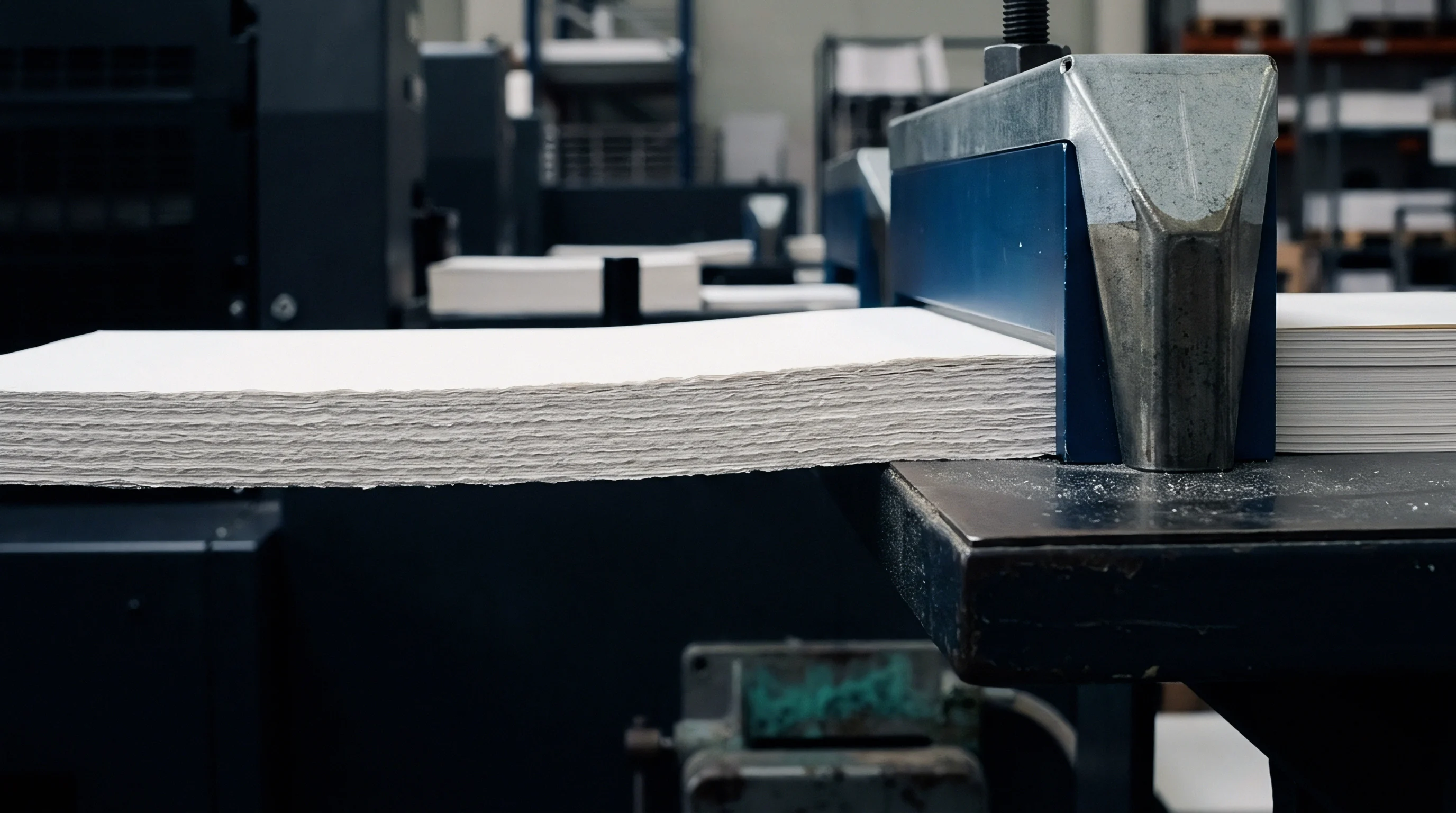
Press feed mechanisms and converting equipment demand unprinted margins around every sheet format. Sheetfed offset presses use mechanical gripper fingers to pull sheets off the feeder board and carry them through the printing units. This creates a non-printable strip along the leading edge ~ typically 10 to 15 millimetres wide ~ where plates and blankets cannot transfer ink over the mechanical clamps.
Guillotine trimming and cross-cutting add further perimeter requirements. Under hydraulic clamping pressure, guillotine knives shear down into paper stacks, where slight movement during penetration can throw off cut dimensions on lower sheets. Converting plants allow extra perimeter edge trim to absorb that shift and ensure clean, square corners.

Press Clearance and Gripper Allocation
Side-guide registration systems on high-speed presses align sheets laterally before they enter the impression cylinder. Mechanical pull-guides or vacuum aligners draw each sheet against registration stops, which requires a clean edge free of die-cut indentations or knife burrs. Color bars, registration crosshairs, and target marks sit in dedicated gutters along the trailing edge or side margins, taking up another 12 to 20 millimetres of unusable area across the sheet.
Standard mill contract terms under ISO 187 set target moisture at seven percent, leaving buyers vulnerable to dimensional shifts whenever ambient humidity strays beyond five percent limits.
Press grippers require dedicated clearance, inter-blank gapping protects printed borders from trim variance, and caliper shifts across the web complicate perimeter planning.
Press dimensions rarely match mill parent sheet formats, so large parent sheets are often cut down before printing. A 1000 x 1400 millimetre parent sheet, for instance, might yield four 500 x 700 millimetre press sheets. Every internal cut removes material through knife displacement, forcing operators to recalculate perimeter waste for every sub-sheet cut from master pallets.

Is Grain Direction Negotiable When Nesting Gang Runs?
Ganging multiple packaging SKUs on a single parent sheet improves press efficiency, but it creates sharp grain alignment conflicts. When small box blanks sit next to large display headers on the same layout, maintaining ideal machine-direction grain across every item is impossible. Less critical components can accept cross-grain orientation if their main job is containment rather than structural load bearing.
Running mixed substrate grades on ganged layouts brings extra complications. Differences in fiber stiffness, ink absorption, and surface roughness compromise print quality and creasing performance. When heavy board runs alongside lighter stock, impression cylinder pressure becomes an uncomfortable compromise, leading to premature plate wear or incomplete ink transfer on thicker areas.
| Equipment Category | Leading Edge Clearance (mm) | Trailing Edge Margin (mm) | Side Guide Allowance (mm) | Inter-Blank Skeleton Gap (mm) |
|---|---|---|---|---|
| Sheetfed Offset Press | 12.0 to 15.0 | 8.0 to 10.0 | 5.0 to 8.0 | N/A |
| Flatbed Platen Die-Cutter | 15.0 to 18.0 | 10.0 to 12.0 | 8.0 to 10.0 | 4.0 to 6.0 |
| Rotary Die-Cutter | 20.0 to 25.0 | 12.0 to 15.0 | 10.0 to 12.0 | 6.0 to 8.0 |
| High-Speed Guillotine Trimmer | 5.0 to 8.0 per cut | 5.0 to 8.0 per cut | 5.0 to 8.0 per cut | 3.0 to 5.0 per slit |
- Calculate total press feeder gripper clearance from mechanical press cylinder specs.
- Set minimum inter-blank clearances to handle steel rule thickness and ejection rubber displacement.
- Include side-guide registration channels along lateral edges for high-speed alignment checks.
- Add cut-to-print trim margins around outer borders to absorb mechanical registration drift in post-press converting.
How much dimensional shift across master sheets can a high-speed converter absorb before trim errors cause jams on automated cartoning lines?

Arithmetic
Yield calculations form the financial foundation of commercial print sourcing. Mills invoice paperboard by the metric tonne, but finished packages sell by the piece or by the thousand. Converting bulk weight pricing into per-unit material cost requires equations that account for surface area, basis weight targets, moisture corrections, and cumulative spoilage.
Accurate yield calculations depend on precise surface measurement, as unrecovered waste streams and deckle losses directly inflate landed unit costs.
Basis weight, measured in grams per square metre under ISO 536, defines the mass density of the substrate, while caliper (ISO 534) measures physical thickness. A bulkier sheet provides equal flexural stiffness at lower total grammage, producing more surface area per metric tonne. Finding the point where reducing grammage starts undermining stack performance requires testing both the physical limits and the financial trade-offs.

Tonnage Costing and Master Sheet Yield Equations
Landed unit cost starts with surface area per metric tonne of paperboard. Total yield per tonne equals 1,000,000 divided by substrate grammage in grams per square metre ~ so a 350 gsm board yields 2,857.14 square metres per tonne. Multiplying that figure by the percentage of usable sheet area left after trim removals gives the net usable yield for the order.
A 350 gsm solid bleached sulfate sheet measured at 23 C and 50 percent relative humidity measures 450 micrometres thick under ISO 534 testing.
Total job waste stacks up across deckle edge trim, make-ready spoilage, guillotine trim, and die-cutting skeleton remnants. Net usable yield is what fiber actually ends up in finished cartons. If parent sheets suffer eight percent deckle trim loss, four percent make-ready waste, and six percent skeleton scrap, net yield falls to 82.8 percent of purchased paperboard mass.

Worked Sensitivity Case for Three Parent Sheet Formats
Consider a run of 500,000 folding cartons with a blank size of 180 x 250 millimetres. The board is 350 gsm Solid Bleached Sulfate priced at 1,450 EUR per metric tonne delivered. Comparing three procurement scenarios reveals the financial impact of parent sheet choice: Standard Parent Sheet A (700 x 1000 mm), Standard Parent Sheet B (720 x 1020 mm), and Custom Mill Trim Sheet C (740 x 1040 mm).
With Parent Sheet A (700 x 1000 mm), a 3 x 4 matrix yields 12 blanks per sheet. Gross sheet area is 0.700 square metres, with the 12 blanks using 0.540 square metres and leaving 0.160 square metres in scrap ~ a layout efficiency of 77.14 percent. Producing 500,000 cartons requires 41,667 parent sheets, or 29,166.9 square metres of board.
At 350 gsm, total mass comes to 10.208 metric tonnes. Material cost totals 14,801.60 EUR, or 29.60 EUR per thousand cartons.
Parent Sheet B (720 x 1020 mm) fits 15 blanks in a 3 x 5 matrix by optimizing die clearances and orientation. Gross sheet area is 0.7344 square metres, and the 15 blanks consume 0.675 square metres, driving efficiency up to 91.91 percent. The run requires 33,334 parent sheets (24,480.5 square metres), bringing substrate mass down to 8.568 metric tonnes.
Raw material cost drops to 12,423.60 EUR, or 24.85 EUR per thousand cartons.
For Custom Mill Trim Sheet C (740 x 1040 mm), the mill adds an 80 EUR per tonne surcharge for custom sizing, raising the board price to 1,530 EUR per tonne. The sheet yields 16 blanks in a 4 x 4 matrix. Gross sheet area is 0.7696 square metres, with the blanks taking 0.720 square metres for an efficiency of 93.55 percent.
The order needs 31,250 sheets (24,050.0 square metres), or 8.418 metric tonnes. Total material cost comes out to 12,879.54 EUR, or 25.76 EUR per thousand cartons.
Switching to a custom 740 millimetre deckle scheme shaved three percent off total job expenditure.
| Option Parameter | Parent Sheet A | Parent Sheet B | Parent Sheet C |
|---|---|---|---|
| Sheet Dimensions (mm) | 700 x 1000 | 720 x 1020 | 740 x 1040 |
| Blanks per Sheet | 12 | 15 | 16 |
| Layout Efficiency (%) | 77.14 | 91.91 | 93.55 |
| Total Sheets Required | 41,667 | 33,334 | 31,250 |
| Substrate Mass (tonnes) | 10.208 | 8.568 | 8.418 |
| Base Substrate Price (EUR/tonne) | 1,450 | 1,450 | 1,530 |
| Total Material Expense (EUR) | 14,801.60 | 12,423.60 | 12,879.54 |
| Landed Cost per 1,000 Cartons (EUR) | 29.60 | 24.85 | 25.76 |
Comparing Parent Sheet B and Parent Sheet C highlights a standard commercial trade-off. Sheet C offers better layout efficiency, but the mill’s custom-size surcharge wipes out the material savings, leaving Sheet B as the cheaper option. Buyers have to balance pure layout yield against mill penalty fees before locking in paper specs.
1. Determine master parent sheet dimensions and calculate total surface area per sheet in square metres.
2. Calculate individual blank area, adding inter-blank skeleton and edge trim clearances.
3. Divide total sheet surface area by blank area to find maximum theoretical yield per sheet.
4. Multiply sheet count by substrate grammage to get total metric tonnage for the run.
5. Apply mill surcharges and trim scrap credits to arrive at landed cost per thousand finished units.
An unverified yield calculation that omitted press gripper margins on a custom mill order resulted in a twelve thousand euro loss on a single pharmaceutical carton run.

Contract
Commercial paperboard agreements set the financial and legal rules for procurement, trim allocations, and quality disputes. Mill sales terms enforce strict minimum order quantities on custom sheet formats, requiring buyers to fill the full web width or absorb excess trim inventory. Standard contracts also define tolerances for grammage drift, moisture content, caliper variation, and sheet squareness.
Mill minimums shape production schedules, quality claims demand documented lab proof, and ambient moisture shifts distort finished stock.
Contracts include deckle fill clauses that penalize buyers for unallocated web space. If an order uses only 85 percent of a paper machine’s minimum reel width, the mill can charge for the missing 15 percent at pulp index rates or hold production until another order fills the gap. Those delays disrupt packaging schedules and build up warehouse holding costs.

Commercial Trim Penalties and Mill Filling
Waste buyback agreements let converters recover part of their material expenditure by shipping clean, unprinted edge trim back to primary mills. Unprinted broke fetches higher prices than post-print scrap because it has no inks, lacquers, or plastic laminates. Recovery values track regional secondary fiber indices, such as official recovered paper benchmarks.
Mill surcharges on custom sheet sizes frequently cost more than carrying higher trim waste on standard stock sizes.
Surcharge structures differ markedly between primary mills and merchant distributors. Mills penalize orders below tonnage minimums, while merchants hold standard sheet sizes in regional warehouses and build storage costs into their sheet pricing. Sourcing engineers must balance higher unit prices from merchants against the heavy capital commitment of direct mill orders.

Specification Clauses for Custom Web Slitting
Purchase specifications need clear, binding clauses covering physical tolerances for delivered sheet pallets. Specs should mandate compliance with ISO 187 conditioning standards, set limits on edge burr height from slitting knives, and enforce tight dimensional cut limits. Out-of-square tolerances cannot exceed 1.5 millimetres across master sheet diagonals without risking crashes on high-speed presses and die-cutters.
Web width tolerances should always be stated directly in master purchase orders.
Dispute resolution clauses set out mandatory testing procedures for contested paperboard. If a delivered pallet shows edge curl, surface picking, or caliper variance outside spec, formal claims require third-party lab testing under TAPPI or ISO standards. Because standard trade terms expire thirty days after delivery, receiving inspection is essential upon arrival.
Under Section 14.2 of standard international paper trade rules, dimensional variations within plus or minus one millimetre of ordered length are not grounds for rejection or price renegotiation.