Contact Angle Analysis for Surface Decay in Polyurethane Film
Contact angle analysis detects hydrophobic recovery and additive blooming in polyurethane films before lamination failure occurs on high-speed converting lines.
Polarity
Polyurethane films present complex macromolecular surface states governed by the thermodynamic distribution of hard and soft segments. Thermoplastic polyurethane (TPU) backbones consist of alternating flexible polyol chains and rigid isocyanate-cured segments. At the immediate solid-air interface, these chains orient dynamically to minimize total interfacial free energy.
The balance between dispersive forces, arising from London van der Waals interactions, and polar forces, driven by dipole-dipole interactions and hydrogen bonding, dictates substrate rewetting and ink adhesion. When a polyurethane surface decays through environmental exposure or additive segregation, the ratio of polar to dispersive components shifts measurably long before macro-level delamination or print voiding occurs.

Surface Energy Components and Segment Orientation
The total surface free energy of a polyurethane film comprises additive dispersive and polar constituents. In fresh, unaged aliphatic polyether TPU, the dispersive component dominates due to clean hydrocarbon chains extending along the surface layer. Contact angle measurements using the Owens-Wendt-Rabel-Kaelble (OWRK) approach resolve these discrete vector forces by deploying probe liquids with known polar and dispersive surface tension parameters.
Surface energy governs wetout. Water droplets reflect surface chemistry. Diiodomethane isolates dispersive energy.
High polar surface energy correlates directly with strong functional group presentation, such as hydroxyl, urethane, and carboxyl groups. As polyurethane films undergo thermal or atmospheric aging, soft segments containing ether or ester bonds migrate inward or undergo chemical modification. This structural reorientation alters the local electron donor-acceptor balance at the interface.
The surface free energy of aliphatic polyether polyurethane films drops below 34 mN/m when soft segments reorient away from the interface.
Calculating surface energy parameters requires contact angle data from at least two liquid probes with distinct polar-dispersive ratios. The Young-Dupré equation relates the contact angle of a liquid drop on a flat solid surface to the surface free energy of the solid, the liquid surface tension, and the interfacial tension between solid and liquid.
| Substrate or Probe Liquid | Total Energy (mN/m) | Dispersive Component (mN/m) | Polar Component (mN/m) | Water Contact Angle (Degrees) |
|---|---|---|---|---|
| Fresh Polyester TPU Film | 42.5 | 31.2 | 11.3 | 68.4 |
| Aged Polyester TPU Film (60 Days) | 33.1 | 28.4 | 4.7 | 84.2 |
| Fresh Polyether TPU Film | 39.8 | 32.0 | 7.8 | 73.5 |
| Aged Polyether TPU Film (60 Days) | 31.6 | 27.9 | 3.7 | 88.1 |
| Deionized Water (Probe) | 72.8 | 21.8 | 51.0 | N/A |
| Diiodomethane (Probe) | 50.8 | 50.8 | 0.0 | N/A |
When the polar contribution falls below 5 mN/m, solvent-based polyurethane inks and solventless lamination adhesives fail to wet the film uniformly. Droplet bead-up increases during coating operations, generating reticulated patterns, pinholes, and reduced T-peel bond strength across the finished web.
Drop
Optical goniometry measures the contact boundary where liquid, vapor, and solid interfaces meet. Sessile drop analysis places a precise micro-volume liquid droplet onto the polyurethane surface, recording high-resolution silhouette profiles. Automated edge-detection algorithms fit mathematical curves, such as polynomial, Young-Laplace, or ellipse equations, to calculate the contact angle at the three-phase contact line.
Precision optics and pulse-free automated liquid dispensers eliminate vibration artifacts that otherwise skew readings by several degrees.
Goniometric Measurement Precision and Baseline Geometry
Inconsistent drop volumes alter the internal Laplace pressure of the liquid droplet, distorting the apparent contact angle. Standardized protocols specify micro-syringe delivery systems capable of metering liquid volumes between 1.0 and 3.0 microliters. Smaller drops suffer from rapid ambient evaporation, which artificially increases liquid concentration and depresses temperature, whereas larger drops deform under gravitational forces, invalidating Young-Laplace spherical approximations.
ISO 19403-2 specifies sessile drop volume control within 2.0 plus or minus 0.2 microliters to prevent gravitational drop profile distortion during optical goniometry.
Contact angle hysteresis provides insight into molecular heterogeneity and topographic surface roughness. Advancing contact angles represent the maximum stable angle achieved while expanding droplet volume over a fresh film region, whereas receding contact angles capture the minimum angle observed during droplet volume contraction. A wide hysteresis band indicates localized degradation, uneven additive blooming, or mechanical micro-pitting caused by web handling rolls.
- Mount the polyurethane film flat on a temperature-controlled stage maintained at 23°C and 50% relative humidity according to ISO 187 conditioning guidelines.
- Clean the test needle with HPLC-grade isopropyl alcohol and flush the fluid lines with deionized water having a conductivity below 0.1 microsiemens per centimeter.
- Dispense a 2.0 microliter droplet at a controlled speed of 0.5 microliters per second until the drop suspends cleanly from the tip.
- Lower the syringe assembly until the droplet touches the film, gently retracting the needle upwards to avoid mechanical vibration.
- Capture high-speed digital images within 500 milliseconds of interface contact to minimize solvent evaporation and substrate swelling dynamics.
- Apply a Young-Laplace boundary fitting algorithm across both left and right contact points, averaging the baseline angles across five distinct sample locations.
Static contact angle measurements taken without dynamic advancing and receding cycles mask micro-scale surface degradation. Single-point static angles miss microscopic variations in chemical oxidation, allowing defective film rolls to pass incoming material verification passes. A contract specification referencing ISO 19403-2 forces suppliers to document droplet volume, probe purity, and fitting algorithms on every certificate of analysis.

Exudation
Low-molecular-weight additives migrate continuously from the bulk polymer matrix toward the film surface during storage. Slip agents such as erucamide and oleamide, along with plasticizers, antioxidants, and anti-blocking silica particles, lower internal friction during web converting. Over time, these unreacted compounds concentrate at the solid-air boundary, forming an amorphous, low-surface-energy weak boundary layer.
Contact angle measurements capture this chemical alteration as a rapid increase in water contact angles, masking the true surface energy of the underlying polyurethane resin.
How Does Additive Blooming Displace Polyurethane Surface Energy?
Additive blooming occurs when internal species exceed their solubility limit within the amorphous polyurethane phase. Soft-segment polyethers exhibit higher additive solubility than rigid ester segments, causing ester-based TPUs to bloom slip additives rapidly under standard warehouse conditions. As erucamide molecules accumulate at the surface, hydrocarbon tails point outward, depressing surface energy from 40 mN/m down to 28 mN/m within 14 days of extrusion.
Sessile drop testing on bloomed surfaces yields artificially elevated water contact angles above 90 degrees. Solvents used in downstream coating passes dissolve this weak boundary layer, exposing unbonded resin beneath and causing immediate adhesive failure during flexographic ink transfer or dry-bond lamination passes.
- Uncontrolled Slip Migration creates unpredictable hydrophobic patches that drive ink repellency, pinholing, and uneven laydown across the converting web.
- Plasticizer Exudation softens the immediate interfacial zone, lowering glass transition temperatures and causing severe web blocking inside stored roll cores.
- Antioxidant Segregation interferes with corona-induced functionalization by consuming active free radicals before stable carbonyl or hydroxyl groups form.
- Surfactant Concentration lowers interfacial tension temporarily but creates water-sensitive weak boundary layers that fail during wet bond strength testing.
Suppliers frequently attribute low lamination bond strengths to customer storage temperature variations or improper adhesive mixing ratios. A surface solvent wash using high-purity hexane removes bloomed organic waxes without degrading the polyurethane backbone. Re-testing the contact angle after a solvent wipe confirms additive exudation when water contact angles drop back to baseline levels, placing commercial liability for unbonded rolls back on the film extruder.

Scission
Atmospheric moisture and ultraviolet radiation break polymer backbones in elastomeric urethanes over extended shelf storage. Polyester-based polyurethanes suffer hydrolytic cleavage at ester linkages, yielding carboxylic acid groups and short-chain hydroxyl species. Polyether variants resist water attack but undergo photo-oxidative degradation when exposed to indirect daylight or fluorinated warehouse lighting.
Both degradation paths alter surface chemistry, changing contact angles and destroying the structural integrity of converted laminates.
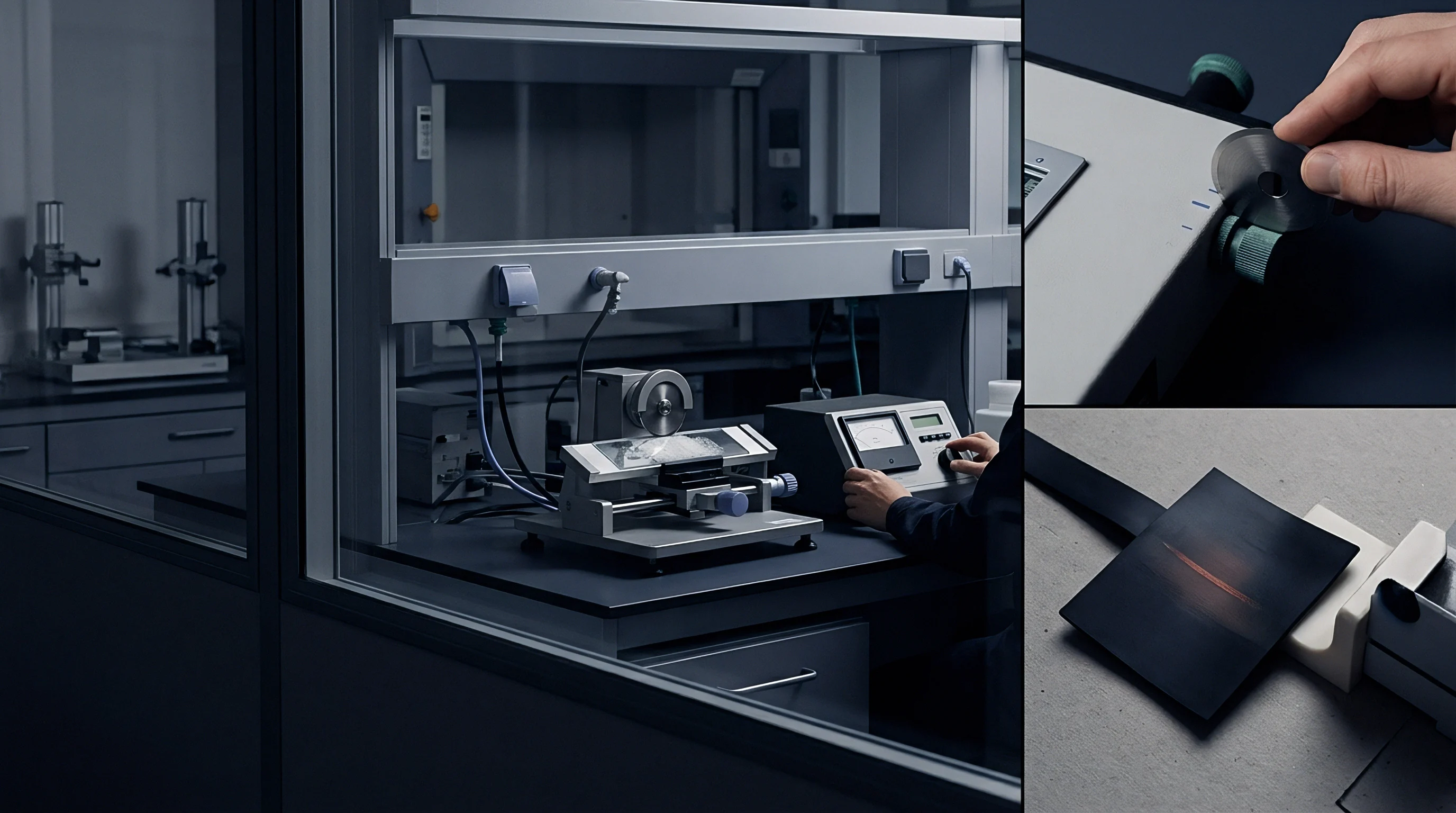
Hydrolytic and Photo-Oxidative Degradation Dynamics
Hydrolysis increases the concentration of polar end-groups on the film surface during early degradation stages, temporarily dropping water contact angles. Continuous polymer degradation cleaves long macromolecules into water-soluble oligomers that wash away or cluster into isolated hydrophilic domains. Hydrolysis destroys polymer chains.
Hydrophobic decay follows as the mechanical cohesion of the surface layer disintegrates under web tension.
A 12 mN/m drop in polar surface energy occurs after 30 days of storage at 40°C and 85% relative humidity for un-stabilized polyester polyurethane films.
Photo-oxidation generates hydroperoxides along the polyether backbone, leading to cross-linking or radical cleavage. Contact angle analysis tracks these structural changes through dynamic surface energy shifts. Dispersive forces remain stable.
Polar components fluctuate widely, signaling chemical instability before yellowing or micro-cracking becomes visible under optical microscopy.
| Polyurethane Resin Type | Exposure Condition | Initial Water Contact Angle (Deg) | Aged Water Contact Angle (Deg) | Initial Polar Energy (mN/m) | Aged Polar Energy (mN/m) |
|---|---|---|---|---|---|
| Polyester TPU (No Stabilizer) | 40°C / 85% RH (30 Days) | 68.0 | 86.5 | 11.5 | 2.8 |
| Polyester TPU (Carbodiimide Stabilized) | 40°C / 85% RH (30 Days) | 68.5 | 71.2 | 11.2 | 9.8 |
| Polyether TPU (Standard) | 40°C / 85% RH (30 Days) | 73.0 | 74.8 | 8.1 | 7.2 |
| Polyether TPU (Standard) | UV-A 340 nm (100 Hours) | 73.0 | 58.2 | 8.1 | 18.4 |
| Aliphatic Polyether TPU | UV-A 340 nm (100 Hours) | 72.5 | 71.0 | 8.3 | 8.0 |
Allowing degraded film onto a high-speed lamination line causes catastrophic web breaks and batch rejections. Re-running ten thousand meters of clear TPU barrier laminate with hydrolytically damaged film costs approximately 14,000 euros in wasted substrate, solventless adhesive, and machine line time. Sourcing carbodiimide-stabilized polyester resins or UV-stabilized aliphatic polyether grades protects converting margins against environmental surface decay.
Treatment
Dielectric barrier discharge generates high-energy oxygenated radical species on inert polyolefin and polyurethane web surfaces. High-voltage discharge units, operating at frequencies between 10 kHz and 40 kHz, convert ambient oxygen into ozone, atomic oxygen, and hydroxyl radicals. These reactive species strike the moving film web, breaking carbon-hydrogen bonds and grafting high-energy polar functional groups onto the polymer backbone.
Hydrophobic recovery begins immediately after treatment, reducing surface energy during storage.
Hydrophobic Recovery and Corona Decay Kinetics
Hydrophobic recovery describes the thermodynamically driven movement of newly formed polar functional groups away from the air interface into the bulk polymer matrix. Flexible polyether soft segments rotate freely at room temperature because their glass transition point sits well below 0°C. Highly mobile polymer chains bury hydrophilic carbonyl, carboxyl, and hydroxyl groups deep within the film matrix to minimize interfacial free energy.
Storage temperature accelerates decay. Flame treating restores oxidation. High humidity environments accelerate this molecular migration, causing treated films to lose up to 80 percent of their treatment boost within 72 hours of exposure.
A film treated to 52 mN/m at the extrusion mill can drop to 38 mN/m before reaching the converter’s unwind station.
- Immediate Post-Treatment State exhibits high polar surface energy, low water contact angles below 45 degrees, and maximum wettability for water-based flexographic inks.
- Short-Term Relaxation Phase involves rotation of short-chain segment ends during the first 24 hours, increasing water contact angles by 8 to 12 degrees.
- Long-Term Equilibrium State stabilizes after 14 days, dictated by bulk polymer mobility, additive exudation, and storage temperatures.
As a practical rule of thumb for web converters, surface energy checks belong directly at the unwind stand immediately before coating application rather than relying on mill certificates generated weeks prior to conversion.


Audit
Quality control frameworks on high-speed lamination lines rely on incoming raw material qualification protocols. Relying exclusively on dyne test pens introduces operator bias, solvent contamination, and surface-damaging chemical interactions. Optical contact angle analysis provides precise, non-destructive, repeatable surface energy verification, allowing converting engineers to establish statistical process control limits for incoming polyurethane film rolls.

Establishing Audit Gateways and Cost Mechanics
Constructing a robust incoming inspection protocol requires defining clear acceptance, warning, and rejection contact angle thresholds linked directly to finished product performance. Consider an operational scenario converting 50,000 square meters of 50-micron TPU film per month into flexible medical packaging laminates using a solventless two-component polyurethane adhesive.
Baseline parameters establish that incoming film rolls must demonstrate a water contact angle between 62 and 68 degrees, corresponding to a total surface energy above 40 mN/m with a polar component exceeding 10 mN/m. Rolls exhibiting water contact angles between 69 and 75 degrees enter a quarantine holding area for secondary corona treatment pass evaluation. Rolls exceeding 75 degrees suffer severe additive blooming or hydrolytic decay and undergo immediate supplier rejection.
| Quality Gate Level | Water Contact Angle Range | Polar Surface Energy (mN/m) | Action Required on Unwind Floor | Financial Risk Exposure |
|---|---|---|---|---|
| Pass (Optimal) | 60.0 to 68.0 Degrees | Greater than 10.0 | Direct release to lamination line | Standard job run cost |
| Warning (Marginal) | 68.1 to 75.0 Degrees | 5.0 to 10.0 | In-line corona boost pass required | Adds 0.03 EUR/m2 processing cost |
| Reject (Defective) | Greater than 75.0 Degrees | Less than 5.0 | Quarantine roll and issue supplier reject | Replaces full lot or faces scrap loss |
In-line re-corona treatment adds equipment amortisation, electricity consumption, and line speed reduction costs. Running an secondary bump treatment pass costs approximately 0.03 euros per square meter. Across a 50,000 square meter production lot, secondary processing adds 1,500 euros in unrecoverable operating cost.
Accepting un-treated, degraded film that fails in-field peel testing exposes the converter to batch recall liabilities exceeding 100,000 euros.
Which specific thermodynamic threshold separates permanent chemical chain degradation from reversible molecular reorientation when polyether films undergo long-term storage under tropical shipping conditions?