Polypropylene Surface Lamination Crease Failure Mechanics in Folding Carton Converting
Polypropylene lamination crease failure is prevented by expanding female matrix channel width to one point seven times board caliper plus rule thickness.
Substrate
How well a folding carton performs depends on how internal paperboard layers hold together around a sharp bend. Whether built from virgin chemical pulp, mechanical fibers, or post-consumer waste, paperboard plies are arranged to absorb compression along the inside fold while enduring tensile strain on the outer radius. In unlaminated creasing, a male rule forces the board into a female matrix channel, intentionally breaking internal fiber bonds to form a controlled hinge.
This delamination dissipates bending energy so the top liner doesn’t fracture erratically. Adding a solid synthetic film to that top liner changes the mechanics. A biaxially oriented polypropylene film acts as an unyielding membrane anchored to the upper fiber layer, restricting normal z-axis relief during scoring and shifting shear stress directly across the fiber-adhesive boundary.
Fiber length and ply arrangement dictate how well paperboard handles the extra strain of surface lamination. Solid Bleached Sulfate (SBS), made from long-fiber softwood kraft, offers high internal tear strength and stretch, spreading bending loads evenly along the crease line. Folding Boxboard (FBB), which sandwiches a mechanical pulp core between bleached chemical pulp liners, gives high rigidity but has lower internal shear resistance.
Recycled grades carry shorter fibers, higher ash content, and erratic Z-directional tensile strength, making them far less capable of absorbing delamination shear beneath polypropylene film. Under the compressive stroke of a male scoring rule, weak internal plies in recycled board either collapse early or refuse to shear cleanly, concentrating strain right at the film-paper interface.
Fiber Orientation Mechanics under Tensile Strain
Machine direction aligns fibers along the path of the paper machine wire, whereas cross-machine fibers lie perpendicular to sheet travel, leaving fewer continuous filaments across a fold. Scoring parallel to the machine direction forces the crease to bend across aligned fibers, stiffening the fold and raising outer-face tensile stress. Scoring perpendicular to machine direction lets fibers slide past each other more easily, though the lower cross-direction tensile strength raises the odds of liner cracking beneath the lamination.
Board caliper governs both bending radius and the strain placed on the outer lamination layer. Heavy board creates a substantial neutral-axis offset during a ninety-degree bend: the distance from score axis to film surface grows with caliper, magnifying localized elongation. Across typical calipers from three hundred to over seven hundred micrometers, thicker stock demands that the film stretch much farther to cover the outer fold without snapping or pulling away from the top coat.
Top-liner sizing and clay coatings set the foundation for film adhesion. Standard coatings use calcium carbonate, kaolin clay, and latex binders to smooth the sheet for printing, but low binder levels inside the pigment layer leave a fragile boundary. If the adhesive bond to the film is stronger than the internal cohesive strength of the clay coating, creasing strain shears the coating straight off the underlying fibers.
The film stays intact, peeling away with a thin skin of mineral coating stuck to the adhesive.
Caliper Variations in Coated Board Grades
Delamination depth during scoring determines whether a carton folds with crisp lines or split edges. Deep internal shear lets inner plies buckle inward cleanly, taking tension off the outer face. Shallow scoring leaves internal ply bonds intact, forcing the polypropylene layer to absorb the full bending force.
Because surface lamination stiffens the sheet, higher creasing pressure is needed to get the same ply separation inside the core.
| Board Grade Specification | Caliper (µm) | Taber Stiffness MD (mN·m) | Tensile Energy Absorption CD (J/m²) | Z-Directional Bond Strength (kPa) | Crease Delamination Behavior |
|---|---|---|---|---|---|
| Solid Bleached Sulfate (SBS) | 350 | 10.5 | 85 | 410 | Controlled internal delamination without surface shear failure |
| Solid Bleached Sulfate (SBS) | 550 | 28.0 | 110 | 395 | Uniform internal ply separation; film remains anchored |
| Folding Boxboard (FBB) | 400 | 14.2 | 62 | 280 | Middle mechanical layer collapses; slight film strain whitening |
| Folding Boxboard (FBB) | 600 | 38.5 | 78 | 265 | Core delamination spreads laterally; high outer liner tension |
| Coated Recycled Board (CRB) | 450 | 12.8 | 45 | 190 | Clay coat separation under film; erratic score line crack distribution |
| Coated Recycled Board (CRB) | 650 | 31.0 | 58 | 175 | Severe ply fracture; film peeling along score bead edge |
Moisture content shapes paperboard flexibility and fiber elongation on the converting line. Conditioned to standard ambient conditions, board retains six to eight percent equilibrium moisture. When pressroom humidity drops and moisture slips below five percent, cellulose fibers turn brittle and resist plastic deformation.
As dry laminated board passes the creasing station, stiff fibers snap rather than yield, driving localized stress straight into the adhesive.
Moisture variation across a reel creates unpredictable behavior on high-speed die-cutters. Outer roll edges dry out quickly in unconditioned storage, creating a moisture gradient across the web. When laminated sheets hit the platen, dry zones show elevated score stiffness and frequent micro-cracking along the outer film.
Wet zones form soft score beads that collapse under folder-gluer belts, preventing the carton from squaring properly during final assembly.
Surface sizing compensates for cross-direction fiber weakness during ninety-degree scoring operations.

Strain
Biaxially oriented polypropylene (BOPP) behaves as a semicrystalline polymer with distinct elastic, plastic, and viscoelastic zones. Extruding and stretching the film along machine and transverse axes locks molecules into an ordered grid, giving it high clarity and moisture resistance alongside directional yield boundaries. Under creasing force, the film deforms elastically at first, snapping back if stress stays below its yield point.
Pushing past yield causes plastic deformation, permanently aligning polymer chains along the stress vector.
Elongation at break marks the maximum stretch film endures before failing completely. Standard wet and thermal laminating polypropylene films stretch between eighty and over one hundred and sixty percent depending on orientation ratios and additives. Yet performance on a folded score line hinges on yield strain rather than ultimate elongation.
The moment strain exceeds the yield point, polymer necking thins the film cross-section directly along the score axis.
Viscoelastic Behavior of Biaxially Oriented Polypropylene
Strain rate sensitivity changes how ductile a film acts during fast converting passes. Platen die-cutters drive creasing rules into paperboard in under twenty milliseconds. At speeds that high, polymer chains cannot slide past each other through viscoelastic relaxation.
Rapid dynamic strain raises effective yield stress, causing the film to snap brittly instead of yielding quietly. Film that bends fine by hand can crack instantly under high-speed mechanical folding.
Thermal conditions during lamination trap residual stress inside the applied film. Thermal lamination runs heated nip rollers at ninety to one hundred and twenty degrees Celsius to melt an ethylene-vinyl acetate backing into the board face. Quick cooling right after the nip locks thermal stress into the film, cutting down its remaining elongation capacity before it ever reaches a creasing die.
At twenty-three degrees Celsius and fifty percent relative humidity, orienting polypropylene film under four percent strain generates an internal tensile stress of eighteen megapascals along the primary machine axis.
Film thickness dictates how stiff the surface lamination feels. Standard packaging uses films between twelve and thirty micrometers. While thicker films boost gloss and barrier performance, they increase cross-sectional shear stress along the adhesive boundary during scoring.
A thin twelve-micrometer film flexes easily over tight radii with lower tensile force, whereas twenty-four-micrometer film creates a rigid shell that resists bending.

Surface Corona Decay and Cohesive Polymer Failure
Polypropylene is inherently non-polar, carrying low surface energy around thirty-two dynes per centimeter. To achieve a strong adhesive bond, electrical corona discharge treatment introduces polar functional groups ~ hydroxyl, carbonyl, and carboxyl ~ raising surface energy above forty dynes. That treatment decays over storage time as polymer chains relax and internal additives migrate surface-ward.
Loss of polar sites weakens the molecular bond between film and adhesive.
Matte polypropylene films rely on synthetic silica or blended polymers like polyethylene to break up surface gloss, creating deliberate micro-roughness. Under creasing strain, silica particles act as internal stress points within the matrix. Tension concentrated at the boundary between polymer and rigid silica opens micro-voids, splitting matte film along score lines where glossy film would stretch without issue.
- Delamination Shear Peeling happens when interfacial bond strength cannot match the bending stress of the stretching film layer during folding.
- Brittle Skin Micro-Cracking shows up as fine, parallel fissures along the fold line when fast strain rates push past the polymer yield threshold.
- Stress-Induced Cavitation forms around inorganic matting additives in matte film, opening micro-voids that show up as opaque streaks.
- Thermal Adhesive Cleavage occurs when residual thermal shrinkage combines with creasing stress to snap the ethylene-vinyl acetate layer off the board coating.
Soft-touch films rely on specialized polyurethane or modified elastomeric topcoats for their velvety feel, but these soft finishes offer little tear resistance under direct mechanical force. When a male rule forces soft-touch stock into a female channel, the surface coating deforms along the edges, leaving shear scars that tear outward during carton folding to leave ragged score lines.
Orientation ratios dictate how film responds to directional strain during converting. Balanced films feature equal stretch ratios in machine and transverse directions, offering uniform tensile resistance across any fold angle. Unbalanced films carry higher machine-direction strength but lower transverse stretch.
Creasing an unbalanced film along its high-orientation axis risks rapid splitting, as the film cannot stretch sideways across the widening score channel.
Thicker film structures add stiffness, but they break down faster around tight fold radii.


Interface
Bonding polypropylene film to paperboard relies on physical anchoring, chemical adhesion, and continuous contact across the surface topology. Solventless thermal lamination uses an ethylene-vinyl acetate (EVA) copolymer pre-coated onto the film. Heat from the cylinder melts the copolymer, lowering its viscosity so nip pressure drives it into the micro-pores of the board’s clay coating; cooling locks it mechanically in place.
Wet lamination applies liquid acrylic or polyurethane adhesives to the film, which dry or cure after passing through an inline press nip.
Vinyl acetate content in EVA copolymer dictates adhesive ductility and thermal stability on the crease line. Lower vinyl acetate ratios yield hard, crystalline adhesives with strong room-temperature shear strength that shatter under sudden bending impact. Higher vinyl acetate ratios increase flexibility and dynamic elongation, letting the adhesive layer deform plastically alongside the creasing rule without snapping at the bond line.

Thermal Polyethylene Vinyl Acetate Adhesion Dynamics
Coat weight sets the thickness and shock-absorption capacity of the adhesive layer. Thermal laminating films typically carry eight to fifteen grams per square meter. Applying less than six grams leaves air voids across rough board surfaces, creating weak spots where tension from creasing rules causes delamination to spread.
Applying more than twenty grams leaves a soft, thick cushion that deforms sideways under nip pressure, forcing adhesive out at the edges during die-cutting.
Nip pressure and drum temperature establish baseline bond strength before converting ever starts. If cylinder heat stays too low, thermal adhesive cannot reach the melt viscosity needed to wet the clay coating thoroughly. Insufficient nip pressure traps micro-pockets of air along the board face.
Both flaws degrade peel strength, so when a creasing rule strikes from behind, localized shear strips the film cleanly off the board.
Ink Solvent Trapping and Dyne Degradation
Heavy ink coverage under lamination puts interfacial bond strength at risk. Offset inks made with vegetable oils, alkyd resins, and hydrocarbon solvents need full oxidative curing before lamination. Residual solvents bleed into the adhesive over time, plasticizing the polymer network and lowering its cohesive strength.
When folder-gluer belts subject contaminated adhesive to bending strain, the softened layer shears internally, peeling film off heavy solids while unprinted board margins stay tight.
UV-cured inks and coatings create smooth, densely cross-linked acrylic surfaces that resist wetting. Standard lamination adhesives cannot grip fully cured UV films without targeted adhesion promoters. Lamination placed directly over un-degassed UV inks or over-cured varnishes produces weak bonds; creasing tools easily pop the film off printed areas, exposing glossy ink panels underneath.
| Lamination Adhesive Technology | Applied Coat Weight (g/m²) | Initial Film Surface Dyne (dynes/cm) | 180-Degree Peel Force (N/15mm) | Retained Peel Force Post-180° Fold (N/15mm) | Interfacial Failure Mode at Crease Axis |
|---|---|---|---|---|---|
| Thermal Ethylene-Vinyl Acetate (Standard) | 10 | 42 | 4.2 | 1.8 | Adhesive-clay coat interface shear separation |
| Thermal Ethylene-Vinyl Acetate (High-VA) | 14 | 44 | 5.8 | 3.5 | Cohesive elongation; film stays fully anchored |
| Wet Water-Based Acrylic Emulsion | 4 | 38 | 2.1 | 0.6 | Complete delamination along printed solid zones |
| Wet Polyurethane 2-Component (Solventless) | 3 | 40 | 6.5 | 5.2 | Paperboard core fiber tear; bond line intact |
| Thermal EVA over Un-cured Offset Ink | 12 | 42 | 1.5 | 0.3 | Solvent-softened adhesive cohesive failure |
Anti-setoff powder applied during offset printing creates widespread micro-separation along the adhesive boundary. Starch and calcium carbonate particles dusted across wet ink prevent sheets from blocking in the delivery stack, but if left uncleaned before lamination, they act as physical barriers between molten adhesive and board. Creasing strain causes micro-delaminations around these powder nodes, which quickly merge into full film separation along the score line.
Per ISO 21898 testing protocols, laminated board assemblies failing dyne retention thresholds below thirty-eight dynes per centimeter automatically forfeit high-speed gluer runnability guarantees.
Dyne level retention on the inside film surface dictates long-term bond stability. Freshly treated polypropylene carries a surface energy of forty-two to forty-four dynes per centimeter. High storage temperatures or long shelf delays allow slip additives like erucamide or oleamide to migrate outward, dragging active surface energy below thirty-six dynes.
Laminating low-dyne film yields weak initial bonds that degrade further in storage, causing unexpected score failures weeks after converting.
The pressroom absorbed sixteen thousand dollars in rejected converter stock when an unvented UV ink vehicle degraded the EVA thermal bond line after forty-eight hours of pallet storage.
Clearance
Convertibility during scoring depends on the geometry between the male rule, female channel width, channel depth, and combined board-and-film caliper. Unlaminated board follows standard sizing guidelines based on caliper alone, but adding polypropylene film increases total thickness and alters how the substrate deforms. Male rules use rounded steel edges ~ typically two-point, three-point, or four-point widths with specific tip radii ~ to push fibers smoothly into the matrix without cutting top-liner fibers.
Female channel width sets the volume available to accept displaced board during scoring. If the channel is too narrow, the male rule pinches the sheet against rigid matrix walls, crushing the paperboard core and over-stretching the film past its yield point to cause micro-cracks along score edges. If the channel is too wide, it fails to generate enough localized shear within the core, producing weak delamination and loose fold beads that bow under folder-gluer compression.

Male Creasing Rule Geometry and Penetration Depth
Penetration depth dictates how far the board is driven into the matrix. The rule must descend deep enough to fracture internal board bonds without pinching the sheet against the bottom of the channel. In a correct setup, penetration depth equals total sheet caliper plus channel depth minus platen clearance.
Over-penetration slices through film and top-liner fibers, acting like a shear blade instead of a scoring tool.
Sizing female channel width for film-laminated board requires adjusting standard formulas. Unlaminated rules use channel widths equal to male rule thickness plus one point five times total caliper. Laminated stock requires a multiplier of one point seven or one point eight.
This added clearance accommodates the unyielding synthetic film, giving it room to roll smoothly around the score radius without excessive strain on the shoulders.

Can Female Groove Width Compensate for Higher Film Elongation?
Adjusting channel depth helps balance score formation against film deformation. Depth usually matches board caliper so the score bead forms cleanly. On heavy-caliper stock over five hundred micrometers, matrix channels slightly deeper than nominal caliper give fibers room to displace without pinching surface lamination against the matrix shoulders.
Relieving shoulder compression keeps the outer film skin intact.
- Measure combined board and film caliper with a digital micrometer calibrated to ISO 534 standards.
- Calculate required female channel width by adding male rule thickness to total board caliper multiplied by one point seven.
- Mount precision-ground phenolic matrix channels or steel counter-dies on the platen base, aligning them centered relative to the creasing rules.
- Adjust press platen impression depth in five-micrometer steps until internal ply separation begins without scoring the film surface.
- Inspect the creased sheet under twenty-times magnification to check for micro-necking, surface cracking, or adhesive detachment along score edges.
Counter-die materials dictate creasing consistency over long runs. Press-on matrix made of vulcanized fiber or plastic mounted on steel bases speeds up make-ready, but channel edges wear under repeated platen strikes, rounding shoulders and widening width. Phenolic counter-dies or milled steel plates maintain tight channel geometry over hundreds of thousands of impressions, keeping creasing clearance stable and preventing film cracking caused by worn matrix channels.
Increasing female channel width past mechanical equilibrium reduces board delamination depth while increasing the probability of film strain fracture on the outer fold bead.
Balancing make-ready pressure across the die platen prevents localized over-impression. Platen flex, uneven plate wear, or sloppy patching creates pressure spikes that crush the film against matrix walls and slice the polypropylene layer. Meticulous patching levels platen pressure, keeping creasing depth uniform across every score on the layout.
Contractual specifications mandating DIN 55437 compliance permit a maximum dimensional deviation of zero point zero five millimeters on creasing matrix channel centers before die tooling acceptance is revoked.
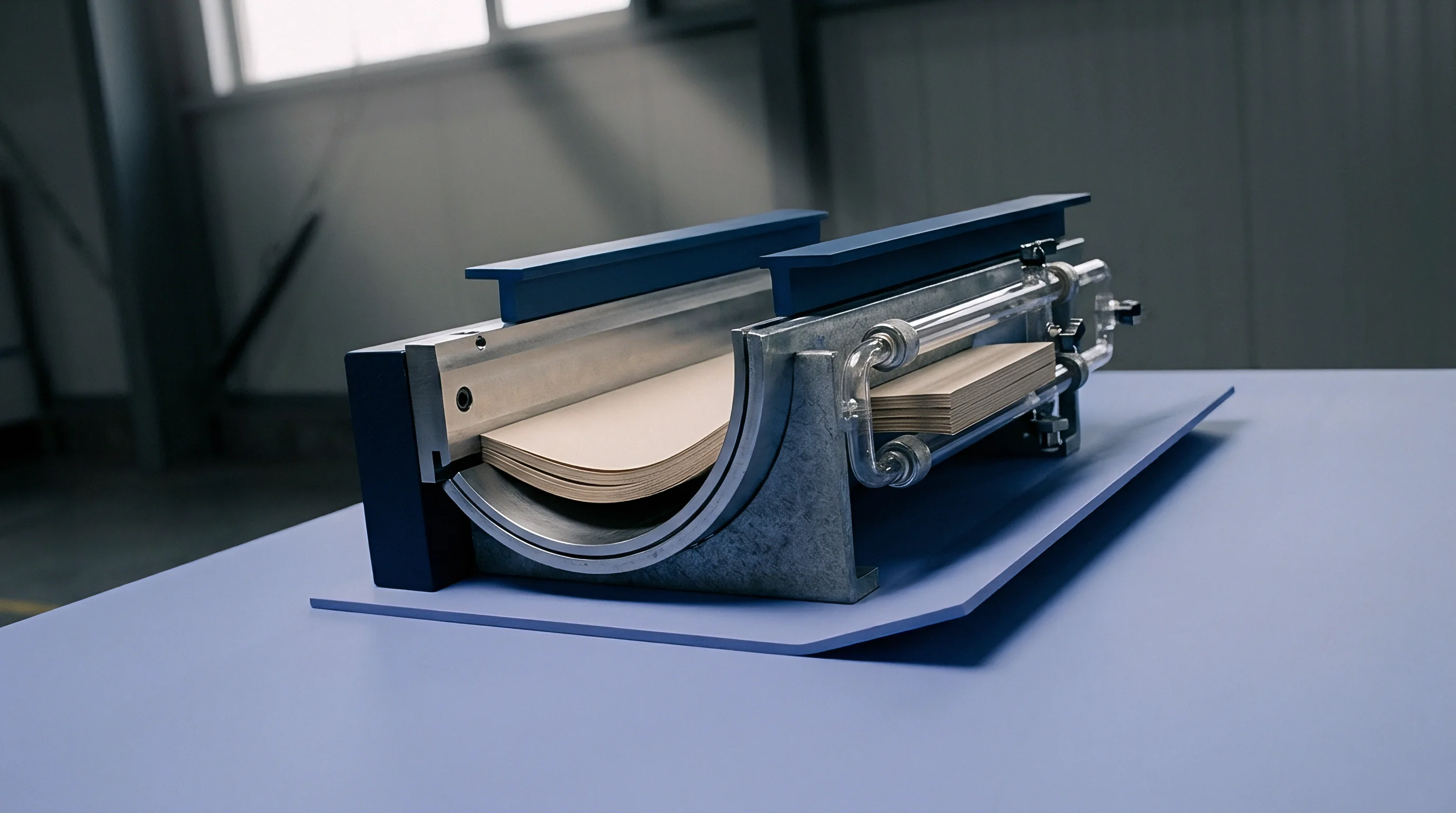
Delamination
High-speed folder-gluers subject scores to severe dynamic stress. As blank panels rotate ninety to one hundred eighty degrees at belt speeds over three hundred meters per minute, the outer laminated surface faces rapid tensile acceleration while the inner bead compresses into the fold crease. If die-cutting established clean internal delamination, the core buckles inward smoothly to relieve tension on the outer polypropylene skin.
If internal delamination was incomplete, bending strain centers directly on the outer film and adhesive layers.
Outer fold line failures follow distinct mechanical paths. The most common is tensile film fracture, where the polypropylene layer splits along the main fold line to reveal raw white paperboard fibers. Another is interfacial delamination, where intact film lifts off the board surface, creating an unbonded bubble along the score.
A third is clay coat separation, where the film remains attached to the adhesive and coating layer, but the coating itself shears off the board fiber matrix.
Shear Plane Propagation and Core Separation
Micro-whitening along score shoulders signals plastic strain and micro-cavitation within the film prior to fracture. As polypropylene stretches past its elastic yield point, rapidly aligning polymer chains open microscopic voids that refract light, turning clear film hazy or white. On dark print, this whitening shows up along every carton edge as an immediate warning that the film is nearing tensile fracture.
Folder-gluer belts, hooks, and folding shoes apply sharp shear forces directly to moving scores. Uneven belt tension or harsh guide angles scrape the stretched polypropylene surface, creating micro-notches along the tensioned fold line. These small abrasions act as stress concentrators, causing longitudinal cracks to snap open down the entire score during final panel folding.
| Male Rule Width (pt) | Female Channel Width (mm) | Channel Depth (mm) | Total Caliper Ratio (%) | Observed Failure Rate per 10,000 Blanks | Primary Mechanical Failure Classification |
|---|---|---|---|---|---|
| 2.0 | 1.20 | 0.40 | 140 | 12.4% | Direct outer film tensile fracture along score center line |
| 2.0 | 1.45 | 0.40 | 170 | 0.2% | Controlled core delamination; zero film surface cracking |
| 3.0 | 1.50 | 0.50 | 150 | 6.8% | Interfacial adhesive shear separation along fold shoulders |
| 3.0 | 1.80 | 0.50 | 180 | 0.0% | Clean inward folding; full adhesive and film retention |
| 4.0 | 1.90 | 0.60 | 160 | 3.1% | Clay coat separation under film; loose outer score bead |
| 4.0 | 2.30 | 0.60 | 190 | 0.1% | Uniform score bead collapse; stable outer film layer |
High line speeds accelerate score failure by elevating dynamic strain rates. Hand-folding gives polymer chains time for slow stress relaxation, letting molecules slide past each other during bending. At full production speeds, that time window shrinks to milliseconds, forcing the film to react as a brittle solid.
As a result, operations running at top speed often encounter sudden film cracking on carton lots that passed manual folding checks during make-ready.

High-Speed Gluer-Folder Dynamic Stress Impact
Ambient temperature in the finishing department dictates film ductility during dynamic folding. In cold pressrooms below eighteen degrees Celsius, polypropylene approaches its glass transition temperature, dropping impact resistance and elongation capacity. Maintaining twenty-two to twenty-five degrees keeps polymers flexible enough to absorb dynamic folding impacts without splitting along score lines.
Outer polypropylene film layers split when internal strain rates exceed the elastic yield threshold during rapid ninety-degree folding passes.
Post-folding spring-back places constant peel stress on the adhesive after cartons leave the compression belt. Stiff board fibers push against the glued joint to flatten the carton, applying ninety-degree peel stress to the film along the creased seam. Weak adhesives yield under this sustained outward force, causing film to delaminate days later while finished cartons sit packed in shipping cases.
Whether nano-cellulose surface coatings can substitute for biaxially oriented film layers without sacrificing fold endurance on heavy caliper cartonboard remains open for pressroom validation.

Penalties
Lamination decisions directly affect extended producer responsibility (EPR) fees, recyclability ratings, and unit production costs. European directives and global sustainability rules apply modulated eco-tariffs to fiber packaging carrying non-separable plastic films. Anything exceeding five percent non-repulpable plastic by weight incurs steep surcharges, shifting convertibility decisions from technical performance alone to full life-cycle financial analysis.
Recyclability frameworks like PTS-RH 021/97 and CEPI protocols evaluate how laminated cartons behave in standard hydrapulpers, where fibers must separate cleanly from plastic film to pass screening filters. Polypropylene film resists fragmenting into tiny bits during pulping, remaining in large sheets that coarse screens easily remove ~ a positive for fiber recovery. However, if the adhesive relies on soft, non-water-soluble hot melts, it breaks down into tacky micro-stickies that contaminate recycled paper stock, causing major recyclability failures.
Extended Producer Responsibility Tiers and Waste Arithmetic
EPR fee structures penalize multi-material designs that complicate recycling. Monomaterial fiber packaging incurs baseline eco-modulation fees per metric ton, but adding polypropylene film reclassifies the carton as a composite plastic-paper structure. In strict regulatory regions, that reclassification raises municipal recycling fees by three hundred to five hundred percent per ton ~ surcharges that often surpass the purchase price of the film itself.
Calculating converting waste requires accounting for extra process passes, setup spoilage, and scrapped volume. Running an offline lamination pass consumes operator time, electricity, and setup sheets ~ typically one hundred to three hundred board sheets per job change, plus running waste allowances of one to two percent. If a scoring issue causes film cracking at the folder-gluer, the entire job value is lost: press time, ink, lamination film, and die-cutting passes included.
Repulpability Certification and Sorting Infrastructure Mechanics
Water-based barrier coatings and dispersion varnishes offer alternatives to film lamination in certain applications. Dispersion coatings provide moderate rub resistance and moisture protection while remaining fully repulpable under standard mill conditions, avoiding plastic surcharges altogether. Yet coatings cannot match the gloss, tensile strength, barrier performance, or burst resistance of a continuous BOPP film.
Substituting a coating on heavy-caliper cartons carrying substantial weight often leads to corner bursts and surface scuffing in transit.
Evaluating alternative surface finishes requires looking at total cost per thousand units, including tooling, extra passes, eco-surcharges, and scrap rates. Spot UV varnish over coatable primer delivers high gloss at low coat weights without eco-penalties, but offers zero structural reinforcement across score lines. Lamination carries higher material costs and surcharges, yet its continuous membrane binds cracked fibers on lower-grade recycled board, allowing converters to use cheaper substrates without visible surface cracking.
- Substrate Fiber Verification requires checking Z-directional tensile strength and moisture content to ensure proper internal ply separation under heavy scoring pressure.
- Adhesive Dyne Assessment calls for measuring surface energy on both film and board before laminating to guarantee long-term bond strength.
- EPR Surcharge Audit calculates plastic content by weight to estimate eco-modulation penalties before finalizing board specifications.
- Tooling Clearance Calibration requires sizing female matrix channel width to one point seven times board caliper plus male rule thickness for laminated stock.
Minimum order quantities and lead times heavily influence film purchasing. Standard thermal polypropylene comes readily available in split-width rolls, whereas specialized soft-touch, anti-scratch, or compostable polylactic acid (PLA) films demand high mill minimums and long lead times. Ordering specialty films for short-run jobs inflates inventory holding costs and magnifies the financial loss of any converting scrap.
Switching a high-volume cosmetic packaging run from twenty-micrometer gloss polypropylene thermal lamination to a repulpable water-based dispersion varnish eliminated sixty-two thousand dollars in annual eco-surcharges while reducing total line scrap from four point two percent to under zero point eight percent.
Substrate and film specification changes demand comprehensive dossier documentation to prove food contact compliance under Regulation 1935/2004 and Regulation 10/2011. For food packaging, migration testing must confirm that overall migration stays below ten milligrams per square decimeter under specific storage temperatures and timeframes. Changing adhesives or film suppliers invalidates existing compliance records, requiring fresh testing before converted cartons can enter commercial distribution.