Surface Energy Alteration Mechanics in Polyolefin Films under Friction Cycles
Friction cycles mechanically strip oxidized surface layers and accelerate polar group reorientation, causing rapid dyne loss across polyolefin films.
Scuff
Corona discharge and atmospheric plasma create functional polar sites across biaxially oriented polypropylene and polyethylene surfaces. Carxyl, carbonyl, and hydroxyl groups establish the wettability required for solventless lamination adhesives and radiation-cured inks. Mechanical contact across idler rolls, nip stations, and slitting bars exerts continuous shear across this modified boundary layer.
The oxidized polymer skin possesses a lower cohesive strength than the underlying bulk matrix. Repeated rubbing action physically strips these low molecular weight oxidized materials from the outer nanometers of the film.
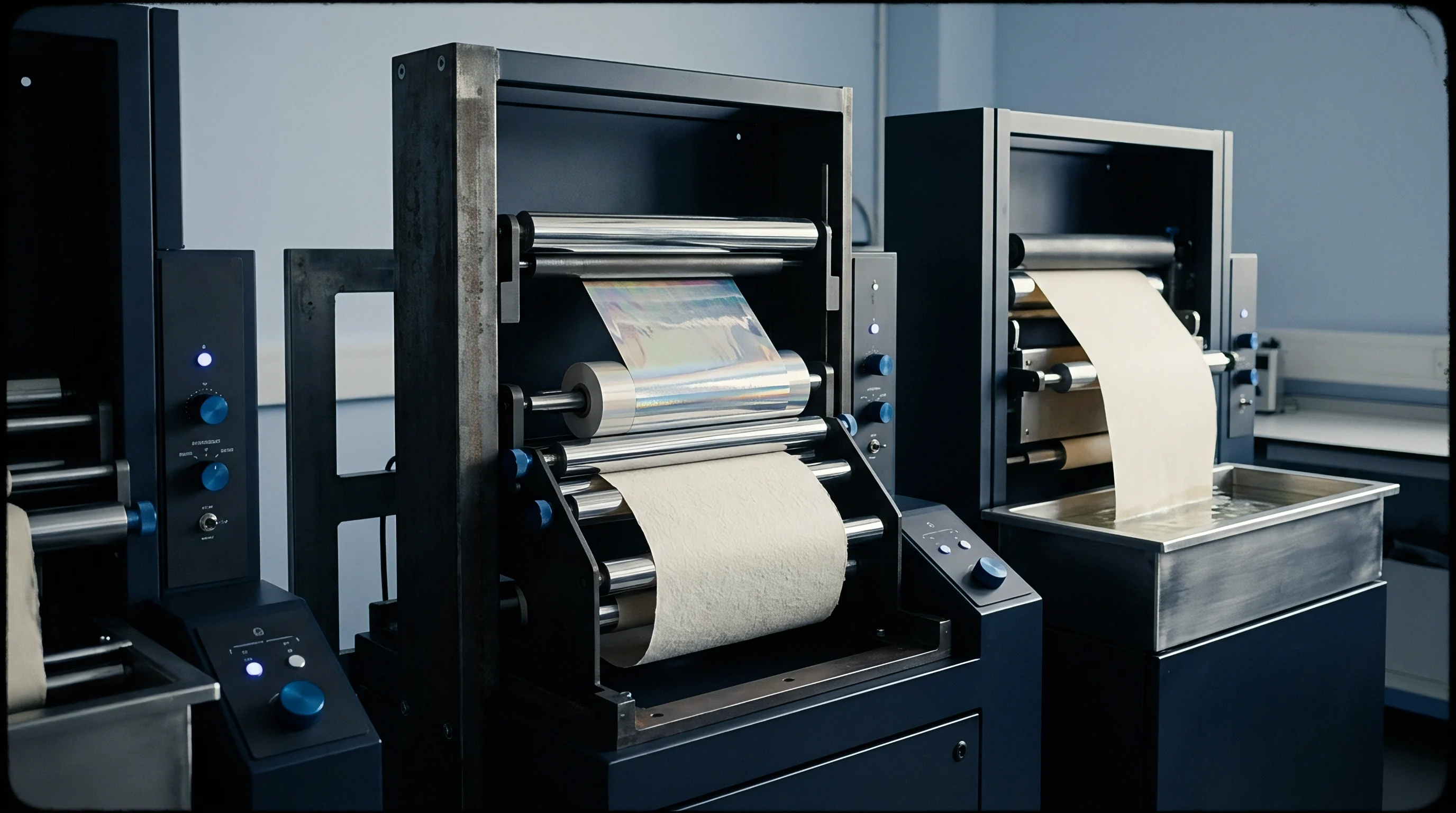
Frictional abrasion during high-speed converting redistributes fragile surface fragments across the web path. When web tension fluctuates across unsupported spans, micro-slippage occurs between the polyolefin backing and stationary metal guides. This contact generates localized shear stresses exceeding the yield point of the functionalized surface layer.
The mechanical removal of polar fragments leaves unoxidized, non-polar hydrocarbon polymer chains exposed to the air interface.
Peak shear forces generated across unaligned idlers strip functionalized low molecular weight polymer chains within three consecutive roller passes at 350 meters per minute.
Dry contact dynamics accelerate the loss of wettability. In a standard converting line running at 400 meters per minute, friction cycles occur at every wrap angle where roller bearing drag creates a speed differential. Web surface temperature rises locally during high-slip contact.
This frictional heat softens the amorphous polyolefin zones, allowing sheared polar chain ends to turn inward away from the contacting atmosphere.
Converters routinely observe dyne level loss without chemical degradation of the bulk substrate. The physical loss of the oxidized boundary layer accounts for the immediate drop in dyne measurements taken directly after slitter-rewinder stations. Friction cycles mechanically wear away the active sites created during extrusion or offline treatment passes.
Resin suppliers attribute post-slit dyne drops to natural atmospheric aging rather than mechanical boundary stripping on the converting line.
Polarity
Wettability rests on the thermodynamic balance between dispersive Lifshitz-van der Waals forces and acid-base polar interactions. Untreated polyolefins exhibit total surface energy values between 29 and 31 mN/m, dominated almost entirely by non-polar dispersive forces. Corona and flame treatments introduce polar components that lift total surface energy to 40 or 44 mN/m.
Friction cycles selectively suppress this acid-base contribution while leaving the dispersive baseline virtually unchanged.
Why Do Treated Webs Lose Polar Adhesion during Rewind?
Mechanical shear forces the macromolecular chains within the top 5 to 10 nanometers of the film to rotate around their carbon backbones. This frictionally driven chain relaxation allows oxygen-containing functional groups to bury themselves within the bulk matrix. The thermodynamic driving force behind this rotation minimizes interfacial free energy against ambient air or neighboring film layers in a wound roll.
Mechanical cycling accelerates this hydrophobic recovery. A treated film stored statically in an ambient warehouse experiences gradual dyne decay over months. Subjecting that same web to twenty friction cycles against chrome-plated steel rolls compresses that decay timeline into seconds.
Frictional shear provides the mechanical activation energy necessary for rapid macromolecular reorientation.
| Friction Cycle Count | Dispersive Energy (mN/m) | Polar Component (mN/m) | Total Surface Energy (mN/m) | Water Contact Angle (Degrees) |
|---|---|---|---|---|
| 0 (Initial Treatment) | 30.8 | 12.4 | 43.2 | 64.2 |
| 5 Cycles | 30.6 | 9.1 | 39.7 | 71.8 |
| 15 Cycles | 30.4 | 5.3 | 35.7 | 81.4 |
| 30 Cycles | 30.2 | 2.1 | 32.3 | 89.6 |
| 50 Cycles | 30.1 | 1.2 | 31.3 | 93.1 |
Contact angle goniometry confirms the selective collapse of the polar component. When tested using diiodomethane and pure deionized water under the Owens-Wendt-Rabel-Kaelble method, the contact angle of water climbs steeply with every friction cycle. The diiodomethane contact angle remains nearly flat across the entire test series.
The physical rubbing action destroys polar functionality while leaving non-polar backbone interactions intact.
Polar bonds always rotate away from air contact when mechanical energy softens the polyolefin surface.
Migration
Erucamide and oleamide additives are incorporated into polyolefin masterbatches to lower the kinetic coefficient of friction for packaging machinery. These primary fatty acid amides possess limited compatibility with the semicrystalline polymer matrix. Molecules slowly diffuse outward from the amorphous bulk toward the film surface, forming an unbound lubricating overlayer.
Frictional contact dramatically alters the rate and physical distribution of this migratory process.
Frictional rubbing sweeps the initial slip additive layer across the web, forming irregular streaks and localized agglomerations. This mechanical plowing action shears the thin crystalline platelets of fatty amide. The localized shear heat generated during slippage lowers the local matrix viscosity, triggering an accelerated secondary migration of additive molecules from the film core to replenish the sheared surface.
ASTM D2578 dyne solutions bead instantly on film regions where frictional shear forces fatty amide blooms into continuous micron-thick barrier patches.
Excessive surface additive concentrations directly inhibit wetting and adhesive bonding. The fatty amide overlayer presents a low-energy hydrocarbon tail orientation to incoming inks and laminating adhesives. Friction cycles that generate high nip temperatures force excessive additive diffusion within hours of winding, destroying the receptive surface created during treatment passes.
- Interfacial Delamination occurs when fatty amide layers prevent reactive polyurethane laminating adhesives from contacting functionalized polyolefin chains.
- Ink Setoff Defects arise when migratory slip layers prevent solvent-based or radiation-cured inks from keying into the oxidized polymer base.
- Tension Fluctuations develop inside printing presses as uneven additive blooms cause sudden coefficient of friction spikes across web sections.
- Heat Seal Contamination takes place when concentrated amide blooms raise the seal initiation temperature by twenty degrees Celsius.
| Slip Additive Loading (PPM) | Pre-Friction COF | Post-Friction COF (20 Passes) | Initial Dyne Level (mN/m) | Retained Dyne Level (mN/m) |
|---|---|---|---|---|
| 500 (Low Erucamide) | 0.32 | 0.38 | 44 | 39 |
| 1200 (Standard BOPP) | 0.21 | 0.29 | 44 | 34 |
| 2500 (High-Slip LLDPE) | 0.14 | 0.22 | 42 | 30 |
| 0 (Non-Slip Grade) | 0.58 | 0.64 | 44 | 38 |
Applying high unwinding tension to films containing over one thousand parts per million of amide additive causes widespread adhesion failure on subsequent laminating passes.
Spectrometry
X-ray photoelectron analysis tracks elemental composition across the initial ten nanometers of polyolefin film webs. Untreated virgin polypropylene presents an oxygen-to-carbon atomic ratio below 0.01. Effective corona treatment elevates this ratio to values between 0.12 and 0.18, introducing key carbon-oxygen single bonds, carbonyl groups, and ester linkages.
Subjecting the film to controlled friction cycles produces a measurable reduction in surface oxygen concentration.
High-resolution carbon 1s core level spectra reveal the rapid loss of high-binding-energy shoulders corresponding to carboxyl and carbonyl groups. After twenty abrasive cycles against an anodized aluminum roller under 50 Newtons of web tension, the overall oxygen-to-carbon ratio drops from 0.16 to 0.04. The binding energy profiles revert toward the single unfunctionalized hydrocarbon peak centered at 284.8 electron volts.
Attenuated total reflectance infrared spectrometry confirms that bulk polyolefin chemistry remains unchanged while surface reflection peaks for ester carbonyl bonds diminish after continuous friction cycles.
Calculations show the operational sensitivity of dyne decay across commercial web handling equipment. A standard 1.2-meter wide converting line running at 300 meters per minute with fifteen unpowered idler rollers imparts specific frictional shear energy across the web. If roller drag induces a velocity slip of 0.8 percent across each wrap angle of 90 degrees, total cumulative frictional work equals 42 Joules per square meter.
This work input strips the fragile boundary layer sufficiently to drop surface energy from 42 mN/m to 35 mN/m within 2,500 linear meters of web travel.
- Mount the Test Specimen securely onto the moving bed of a standardized friction sled apparatus compliant with ISO 8295.
- Apply Controlled Normal Load using a calibrated 200-gram sled wrapped with clean, polished chrome-plated steel shim.
- Execute Designated Rub Cycles at a constant traverse speed of 100 millimeters per minute for 25 complete oscillating passes.
- Condition the Abraded Film in an environmental chamber at 23 degrees Celsius and 50 percent relative humidity according to ISO 187.
- Measure Contact Angles within ten minutes of abrasion using standardized test liquids to prevent ambient contamination errors.
Purchase contracts specifying dyne retention must reference ASTM D2578 test execution immediately following slitting rather than at mill dispatch gates.
Yield
Converting lines suffer substantial financial losses when friction cycles lower dyne levels below the operational wetting threshold of laminating adhesives. Solventless polyurethane systems typically require a minimum substrate surface energy of 38 mN/m for uniform spreading. When roll friction on slitter-rewinders reduces film energy to 32 mN/m, adhesive coverage becomes discontinuous, forming microscopic voids that lead to optical haze and complete bond failure.
Make-ready operations on wide-web printing presses frequently generate running waste when friction-induced dyne decay forces emergency offline corona boosting. Running an additional inline treatment station draws electrical power, generates ozone, and risks reverse-side pinhole treatment that causes web blocking inside finished rolls. The added heat input can also warp thin polyolefin gauges, throwing color-to-color print register out of commercial tolerance.
Line speed must often be curtailed to prevent web flutter and idler slippage. Reducing converting line speed from 450 meters per minute to 250 meters per minute preserves dyne levels but cuts output by 44 percent across an eight-hour shift. This operational throttle inflates machine-hour production costs, turning a profitable high-volume run into an unrecoverable commercial loss.
The boundary between reversible molecular reorientation and permanent mechanical stripping under varying web tensions remains an active subject of line investigation.