Predicting Multi Layer Board Shear Fracture Mechanics under High Strain Rate Creasing Protocols
High strain rate board creasing requires matching tool clearance to middle-ply shear yield to prevent surface fracture.
Substrate
Multi-layer paperboard relies on z-directional ply differentiation to retain bending stiffness under severe folding. In folding boxboard (FBB), solid bleached board (SBB), and coated recycled board (CRB), each ply handles a distinct mechanical task. Outer cover plies use highly beaten chemical fibers (bleached Kraft pulp) or recycled de-inked stock to provide tensile strength, surface smoothness, and ink holdout.
Middle plies rely on mechanical pulps such as chemithermomechanical pulp (CTMP) or mixed recycled paper to maximize bulk and bending stiffness per unit mass. This cross-sectional density gradient creates a complex shear stress distribution through the sheet under localized compression and bending during converting.
How these multi-ply fiber networks perform under out-of-plane loading depends directly on cohesion between adjacent webs. Z-directional tensile strength (TAPPI T 541 or ISO 15754) measures internal bond strength perpendicular to the sheet plane. Energy-based bond tests like Scott Bond (TAPPI T 569 or ISO 16260) measure the total strain energy absorbed during rapid z-directional delamination, expressed in Joules per square meter.
A standard 350-micrometer FBB grade at 250 grams per square meter typically yields a Scott Bond value between 130 and 180 J/m². Solid bleached board of equivalent grammage reaches higher internal cohesion, often between 200 and 300 J/m², driven by extensive inter-fiber hydrogen bonding throughout its chemical pulp network.
Internal bond metrics measured at quasi-static or low test speeds do not reflect behavior during high-speed creasing. High strain rates alter how the fiber matrix deforms at the micro scale. Under standard conditioning (ISO 187: 23 degrees Celsius and 50 percent relative humidity), individual wood fibers show viscoelastic and viscoplastic behavior, with amorphous cellulose, hemicellulose, and residual lignin yielding in a rate-dependent manner.
When out-of-plane compression forces the creasing rule into the sheet, the resulting displacement generates severe out-of-plane shear along inter-ply interfaces. Controlled delamination across these internal layers is what allows paperboard to fold without splitting its outer coating.

Ply Architecture and Density Distribution
The arrangement of plies through the sheet thickness determines how compressive and shear forces transfer from the contact point down to the counter-die. Solid bleached board maintains a fairly uniform density across its caliper, usually sitting between 0.85 and 0.95 grams per cubic centimeter. Folding boxboard uses a classic sandwich structure: dense outer plies run near 1.0 to 1.1 grams per cubic centimeter, while the bulky CTMP core sits at 0.45 to 0.60 grams per cubic centimeter.
This contrast creates an asymmetric out-of-plane shear modulus gradient across the sheet profile.
Shear modulus values for single plies depend on fiber species, refining degree, and filler content. Chemical pulp plies exhibit in-plane shear moduli between 1.2 and 2.5 GPa in quasi-static tests, whereas out-of-plane (interlaminar) shear modulus drops tenfold to between 50 and 150 MPa. In mechanical pulp core plies, limited inter-fiber bonding lowers the out-of-plane shear modulus to 15 ~ 45 MPa.
Under localized indentation, deformation concentrates inside these low-modulus middle layers, starting with micro-scale fiber slip before full macro-delamination takes over.
Recycled boards (CRB) show variable ply density and shear modulus because of short fiber fractions, fluctuating ash content, and uneven starch distribution. Clay and calcium carbonate fillers improve smoothness but reduce specific bond area between fibers. A recycled board with 15 percent total ash content exhibits a dynamic shear yield stress up to 30 percent lower than a virgin chemical board of identical grammage.
Internal shear deformation in recycled furnish begins under lower compressive loads, though the matrix frequently lacks the cohesive toughness needed to prevent complete shear failure through the caliper.
Fiber Alignment and Interlaminar Cohesion
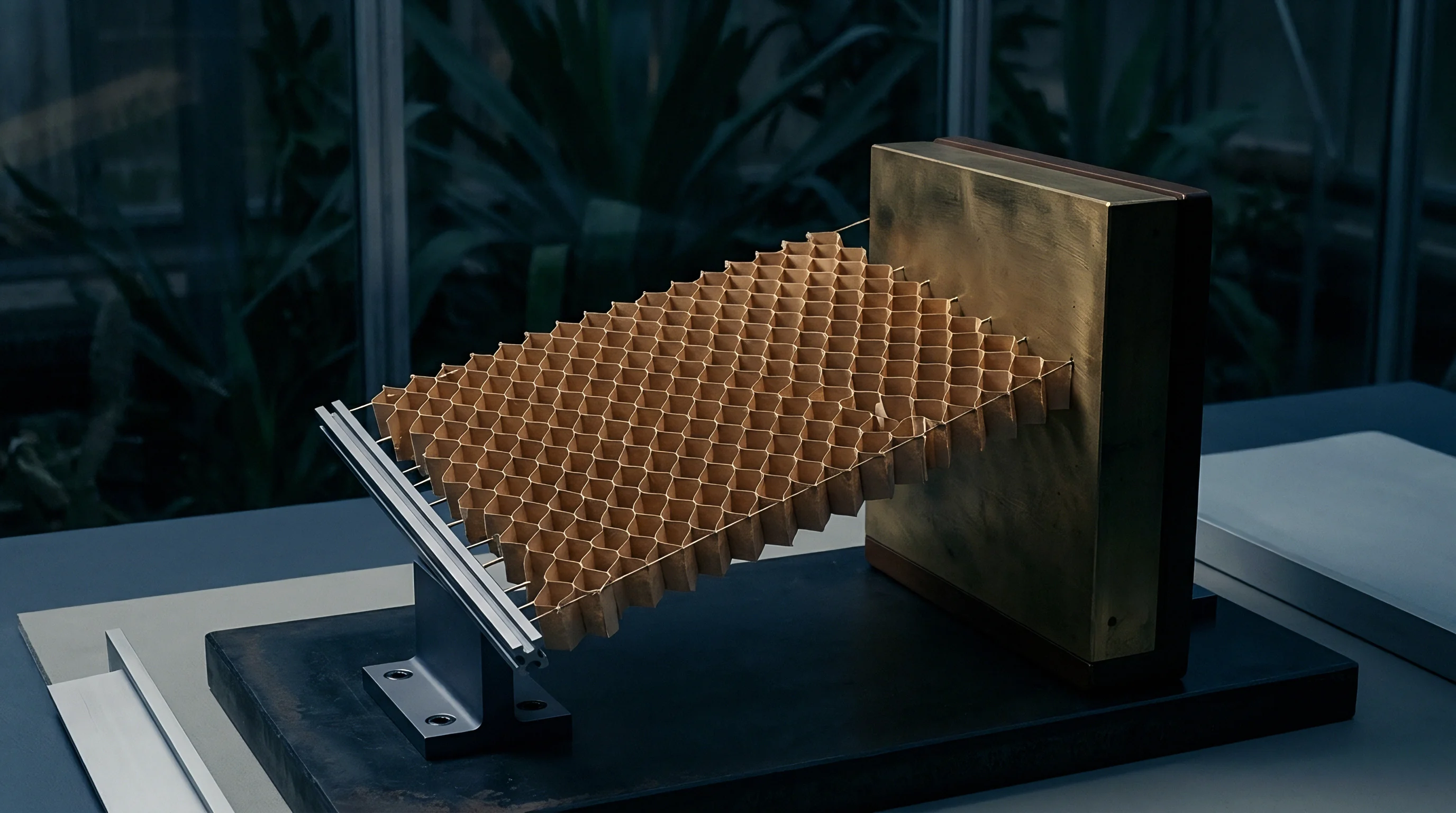
Paper machine hydraulics and wire speeds align cellulose fibers preferentially in the machine direction (MD), creating pronounced mechanical anisotropy. The ratio of tensile stiffness between MD and cross direction (CD) usually ranges from 1.8 to 3.0 in multi-layer boards. Fiber alignment dictates both in-plane stiffness and out-of-plane shear crack trajectories.
Creases parallel to the machine direction drive shear delamination along fibers oriented with the score path, whereas cross-direction creases force delamination across the primary fiber alignment.
Interlaminar cohesion relies on inter-ply hydrogen bonding, wet-end starch spraying, and couch roll pressing during web consolidation. Starch sprayed between plies raises local shear strength, creating distinct boundary planes with elevated shear yield thresholds. If inter-ply bond strength exceeds the shear yield strength of the adjacent bulk ply, shear fracture skips the interface and splits through the middle-ply network instead.
Poor inter-ply adhesion, conversely, triggers early, widespread delamination at low creasing force, weakening the final folded container corner.
Increasing middle-ply bulk preserves internal shear delamination without tearing top clay coatings.
Fibers in the middle plies experience combined compression and shear during rule penetration. CTMP fibers retain stiff, open lumens that resist out-of-plane collapse far better than flattened chemical fibers. Under rapid indentation, CTMP fibers act like micro-struts, storing strain energy until inter-fiber shear slip begins.
This energy storage distributes internal delamination across the creasing zone instead of concentrating it into a sharp crack through the thickness. High moisture content lowers the glass transition temperature of hemicellulose and lignin, softening the fiber network and reducing dynamic shear yield stress.
Evaluating incoming raw material by measuring the ratio of z-directional tensile strength to out-of-plane shear strength identifies susceptibility to crease cracking. Board samples with disproportionately high z-directional tensile strength relative to planar shear resistance often fail to initiate internal delamination promptly during fast creasing. When internal delamination stalls, shear stresses shift upward into the outer clay coating, micro-cracking the fold line.
Matching ply design to converting speed requires reviewing both quasi-static bond values and dynamic shear failure limits across expected moisture ranges.
Fibers with lower cell-wall flexibility resist localized shear yielding and shift stress directly into the inter-ply starch boundaries.

Kinematics
Industrial converting equipment operates at high speeds, driving flatbed die-cutters at up to 12,000 sheets per hour and rotary creasers past 8.5 meters per second web speed. At these rates, a creasing rule penetrates the board for only 0.5 to 5.0 milliseconds. Local strain rates in the crease routinely exceed 1,000 per second (103 s-1).
This pushes board deformation into high strain rate mechanics, where viscoplastic rate hardening alters material behavior compared to standard lab tests conducted at 10-3 s-1.
Kinematic analysis of rule entry into the matrix channel reveals sharp velocity gradients through the sheet thickness. As the male rule contacts the coated surface, the board accelerates into the channel groove. Thickness compression coincides with out-of-plane shear along the rule shoulder radii.
Local shear strain rate (dotγ) in the core ply scales inversely with contact duration and ply thickness. Brief impact times create intense shear stress peaks that exceed the static shear yield stress of the fiber matrix before general sheet displacement can clear the energy.
Cellulose polymers exhibit time-dependent viscoelasticity governed by molecular relaxation spectra. Under rapid deformation, amorphous polymer chains lack time for thermal relaxation or conformational sliding. This raises the effective elastic modulus of the fiber network and increases apparent yield stress along a logarithmic rate dependence.
Dynamic testing shows that a tenfold increase in strain rate raises peak yield stress by 5 to 12 percent, depending on furnish composition and humidity. High strain rate creasing elevates local shear stress, increasing brittle shear fracture risk if plies cannot delaminate fast enough.

Dynamic Impact Velocities and Contact Windows
High-speed rotary creasers apply force through rolling contact between male cylinders and female anvil sleeves. Contact length between the rule apex and the board, together with tangential web speed, determines the dwell time. On a cylinder running at 400 meters per minute with a 0.71-millimeter rule tip, effective contact remains under 1.2 milliseconds.
Flatbed platen presses produce flat impact profiles where vertical acceleration peaks at bottom dead center, keeping dwell times below 3.0 milliseconds at full operating speed.
Impact velocity governs stress wave propagation through the board thickness. Sound travels through dense chemical pulp board at 1,500 to 2,800 meters per second along the plane, but slows to 200 ~ 500 meters per second in the z-direction because of lower out-of-plane stiffness and porous ply interfaces. A compressive stress wave traverses a 400-micrometer caliper in roughly 0.8 to 2.0 microseconds.
Reflections off the rigid female counter-die produce standing stress waves that amplify out-of-plane shear along internal boundaries before significant physical displacement of the rule occurs.
Fast energy transfer during initial contact causes a sudden thermal pulse in high-shear zones. Adiabatic heating takes place because deformation generates heat faster than the low-conductivity paperboard matrix can conduct it away (thermal conductivity λ ≈ 0.05 to 0.12 W/m K). Local temperatures rise 5 to 15 degrees Celsius inside narrow shear bands within milliseconds.
This temporary thermal softening partially offsets strain-rate hardening in the amorphous cellulose, opening a narrow window where shear yielding can occur before the top ply fractures in a brittle mode.

Strain Rate Dependence of Cellulose Fiber Networks
Constitutive modeling of multi-ply board mechanics under high strain rates uses rate-dependent yield criteria, such as modified Johnson-Cook or rate-sensitive Drucker-Prager cap models calibrated for compressible media. The initial yield surface expands under high deformation rates. Yield stress in out-of-plane shear (τy) at dynamic rate dotγ follows a power-law formulation:
τy(dotγ) = τ0 · left(1 + C · lnleft(fracdotγdotγ0right)right)
Where τ0 is the reference quasi-static out-of-plane shear yield stress, dotγ0 is the reference static strain rate (10-3 s-1), and C is the strain-rate sensitivity parameter, typically between 0.035 and 0.080 for paperboard furnishes. Higher values of C indicate boards that harden substantially under rapid impact, requiring higher force to start inter-ply delamination.
Starch additives used at ply boundaries show strong strain-rate sensitivity. Retained native or cationic starches transition from ductile plastic deformation at low speeds to brittle fracture at high strain rates. If the dynamic strain rate exceeds the critical limit of the inter-ply starch layer, shear failure changes from progressive plastic slip to rapid micro-cleavage.
This shift reduces energy absorption during creasing, leaving narrow, overly localized delamination zones that fail to relieve bending stress when cartons are folded later.
Does Creasing Speed Alter the Out-of-Plane Shear Yield Threshold?
Creasing velocity alters the effective shear yield threshold by suppressing stress relaxation inside individual fiber walls. Under slow indentation, cellulose microfibrils realign within the amorphous matrix, spreading stress across neighboring inter-fiber bonds. Under high-velocity impact, microfibrillar movement is kinetically limited.
Stress accumulates at fiber contact points, raising the yield point of the bulk ply and shifting failure from ductile inter-fiber sliding to localized shear fracture of single fibers.
High indentation speeds force shear deformation into narrower zones along the shoulders of the creasing rule. Instead of spreading shear strain across the full width of the female channel, high strain rates concentrate it into narrow bands between the rule edge and matrix radius. Because less material deforms, local strain magnitudes spike.
If local shear strain exceeds the ultimate shear strain of the fiber network (γu ≈ 0.08 to 0.15), a macro shear crack forms through the board thickness.
High-speed optical videography above 100,000 frames per second shows that crease propagation patterns change fundamentally as rule velocity rises from 0.1 to 5.0 meters per second. At low speeds, internal delamination moves ahead of the rule tip, creating smooth, continuous horizontal splits between plies. At high speeds, delamination lags behind rule entry and occurs abruptly only after out-of-plane compression peaks.
This delay alters stress field symmetry, raising outer ply strain and top-layer cracking risks.
Mills often attribute high-speed creasing failures to board dryness when the real driver is strain-rate hardening of the middle-ply furnish.


Delamination
Predicting shear fracture mechanics in multi-layer board requires analyzing the stress fields created inside the matrix cavity during rule penetration. Creasing does not aim to break the paperboard; its goal is to introduce controlled, local micro-damage that permanently lowers out-of-plane bending stiffness along the score line. This damage appears mainly as inter-ply delamination (Mode II shear fracture) combined with out-of-plane compression (Mode I crushing).
When the board is later folded 90 or 180 degrees on packaging lines, the delaminated plies split into thin individual lamina, shifting the neutral axis and keeping outer face bending strain below the tensile rupture threshold of the clay coating.
Cohesive Zone Modeling (CZM) provides a mathematical framework for simulating out-of-plane shear fracture in multi-ply paperboard. CZM applies traction-separation laws along predefined inter-ply interfaces, governing the progression from linear elastic behavior to irreversible damage initiation and full separation. The Mode II energy release rate (GIIc), in Joules per square meter, defines the work needed to drive a shear crack along an internal interface.
Under dynamic creasing, GIIc becomes rate-dependent, rising with indentation speed due to micro-mechanical damping and rate-sensitive fiber pull-out.
Shear fracture occurs when out-of-plane shear stress (τzx) on a plane exceeds the dynamic shear yield strength, or when the cumulative Mode II strain energy release rate (GII) reaches dynamic fracture toughness (GIIc(dotγ)). If internal interfaces have a high GIIc relative to the shear strength of the outer top ply, the internal layers resist delamination. Stress then builds at the outer surface, causing transverse shear fracture or tensile cracking through the top coating during both score penetration and folding.

Stress Fields inside Matrix Channels
Rule entry generates a triaxial stress field inside the female channel bounded by the rule edge, counter-die shoulder, and anvil base. The board experiences out-of-plane compression (σz 0) on the bottom ply spanning the channel gap, along with high transverse shear stresses (τzx) between the male rule edge and female matrix corner. These shear stresses scale with the clearance between male rule width (w) and female channel width (W), normalized by board caliper (t).
Analytical models derived from beam theory on elastic foundations show that maximum out-of-plane shear stress (τzx,max) occurs near the mid-plane caliper axis, shifted toward the rule edge radius. The theoretical peak out-of-plane shear stress under creasing load P per unit crease length is expressed as:
τzx,max = ks · fracPb · t · left
Where b is the length of the score line, z is the out-of-plane coordinate measured from the neutral axis, and ks is a dimensionless stress concentration factor ($1.2
Shear stress fields vary across paperboard grades because of anisotropic shear modulus distribution. Solid bleached board transmits shear stress uniformly through its caliper, forming wide, symmetric delamination zones. Folding boxboard, with its soft CTMP core, concentrates shear strain inside the low-modulus middle ply, protecting the top ply from severe shear.
Coated recycled board shows uneven shear stress profiles from density fluctuations and local bonding variations, causing irregular shear splits that jump unpredictably across interfaces.
Cohesive Zone Formulations for Interlaminar Shear
Simulating delamination mechanics requires defining bilinear or exponential traction-separation laws for each inter-ply interface in a multi-layer finite element model. The linear elastic regime is governed by interface stiffness Kz (out-of-plane normal) and Ks (out-of-plane shear), typically set to high penalty values (104 to 106 MPa/mm) to prevent interpenetration before damage starts. Damage begins when a quadratic stress criterion is met:
left(fraclangleσzrangletn0right)2 + left(fracτzxts0right)2 + left(fracτzytt0right)2 = 1
Where langleσzrangle represents the Macaulay bracket (showing that purely compressive normal stress does not cause interface damage), tn0 is the uncoupled normal interface strength, and ts0 and tt0 are uncoupled shear strengths in the longitudinal and transverse directions. For paperboard interfaces, ts0 ranges from 1.5 to 4.5 MPa in quasi-static testing, but reaches 6.0 to 9.0 MPa under high strain rate creasing.
After damage begins, the interface softens according to critical strain energy release rates GIc (Mode I) and GIIc (Mode II). Mixed-mode fracture propagation follows the Benzeggagh-Kenane (BK) criterion:
GIc + (GIIc – GIc)left(fracGIIGI + GIIright)η = Gc
Where η is a material-specific mixed-mode exponent, typically calibrated between 1.2 and 2.2 for cellulose fiber interfaces. High strain rate testing shows that GIIc rises significantly with loading velocity, whereas GIc shows minimal rate sensitivity. Dynamic creasing therefore demands more total mechanical energy to drive inter-ply shear crack growth than static bench tests predict.
Shear Failure Criteria across Coated Interfaces
The top surface of premium folding boxboard and solid bleached board carries single, double, or triple pigment coatings made of mineral pigments (calcium carbonate, kaolin clay) bound with synthetic latex (styrene-butadiene or styrene-acrylic). These coating layers have lower strain capacity (εu ≈ 0.015 to 0.030) than the underlying fibrous substrate (εu ≈ 0.05 to 0.10). High strain rate creasing subjects the coating layer to steep shear strain gradients along outer bend radii.
If internal delamination in the core plies fails to start because of rate hardening, stress relieves through surface shear fracture. Coating failure starts as micro-voids at pigment-binder boundaries, which merge into visible top-layer cracks upon 90-degree folding. Preventing surface cracking requires peak out-of-plane shear stress in the middle plies to hit the inter-ply damage threshold (ts0) before outer coating strain reaches its ultimate tensile limit (εu).
| Paperboard Grade Type | Caliper (µm) | Grammage (g/m²) | Scott Bond (J/m²) | Static Mode II GIIc (J/m²) | Dynamic Mode II GIIc at 103 s-1 (J/m²) | Critical Dynamic Shear Strain Rate (s-1) |
|---|---|---|---|---|---|---|
| Folding Boxboard (FBB – GC1) | 350 | 240 | 145 | 180 | 265 | 1,450 |
| Folding Boxboard (FBB – GC2) | 400 | 270 | 130 | 165 | 240 | 1,600 |
| Solid Bleached Board (SBB – GZ) | 320 | 260 | 240 | 310 | 440 | 950 |
| Coated Recycled Board (CRB – GD2) | 450 | 320 | 110 | 140 | 205 | 1,850 |
| Coated Recycled Board (CRB – GT) | 380 | 290 | 125 | 155 | 225 | 1,700 |
Data in Table 1 underscores how chemical, mechanical, and recycled furnish blends respond differently. Solid bleached board shows high dynamic fracture toughness (GIIc = 440 J/m2), requiring higher force to trigger inter-ply delamination. Its lower critical dynamic shear strain rate (950 s-1) means SBB shifts into surface cracking at lower converting speeds than FBB unless counter-die geometry is adjusted to compensate for dynamic rate effects.
ISO 187 conditioning at 23 degrees Celsius and 50 percent relative humidity yields a dynamic Mode II fracture energy of 265 Joules per square meter for GC1 folding boxboard at high strain rates.
Surface cracking along the score line is a tricky defect because small changes in pigment latex binder ratios alter coating elasticity without affecting standard board stiffness metrics.
Does the rate-dependent increase in dynamic Mode II fracture energy stem primarily from viscoelastic binder dissipation or structural micro-fibril entanglement across the inter-ply boundary?
Anvil
Tooling configurations set the strain rate profiles imposed on multi-layer board. The creasing unit consists of a male creasing rule with a rounded steel tip and a female matrix (or anvil channel) formed by parallel shoulders. Counter-dies use either pre-formed vulcanized resin matrix strips on a steel plate or channels cut directly into phenolic counter-board.
Machining tolerances, channel width (W), channel depth (h), male rule thickness (tr), and rule tip radius (rm) form the geometric parameters governing shear fracture mechanics.
Clearance ratio defines the geometric room available for board displacement during rule penetration. Relative clearance (Cr) is expressed as:
Cr = fracW – tr2t
Where W is female channel width, tr is male rule width, and t is uncompressed board caliper. In standard converting practice, Cr targets values between 1.0 and 1.5. A relative clearance below 1.0 forces severe out-of-plane crushing, compressing board beyond its plastic density limit and triggering transverse shear fracture across all plies.
A relative clearance above 1.7 allows the board to sag into the channel, generating too little out-of-plane shear stress to start delamination, resulting in high fold stiffness during carton assembly.
High strain rate creasing accentuates tooling deflection and dynamic vibration. Shock loads on die-cutting platens running at 10,000 sheets per hour cause micro-scale deflections in both male bed and female counter-plate. A bed deflection of just 30 micrometers during peak impact alters effective penetration depth (hp) by nearly 10 percent on a 350-micrometer board, drastically altering local strain rates and shifting behavior from controlled delamination to surface rupture.

Penetration Depth and Die Clearance Margins
Male rule penetration depth governs out-of-plane shear displacement forced into the board. Penetration depth (hp) is defined relative to female channel depth (hd) and board caliper (t). Operating setups typically position the male rule tip to extend below the matrix surface by 70 to 90 percent of original board caliper.
Insufficient penetration depth fails to compress the board enough to reach the critical out-of-plane shear stress (τzx,max) required for damage initiation (ts0). The board bends elastically without delaminating. When the crease is later folded on high-speed lines, intact outer plies face extreme tensile strains, leading to surface cracking, graphic tearing, and high opening resistance that jams packaging machinery.
Excessive penetration depth drives the male rule tip too close to the rigid bottom of the channel, pinching the board. Shear stresses spike sharply under this confinement, initiating shear fractures that sever the bottom ply or cut through the entire caliper. Controlling penetration depth requires dynamic press leveling and calibration with sensor arrays to monitor force profiles across the platen bed during high-speed runs.
Tooling Material Deformations under High Strain Impacts
Counter-die matrix materials show rate-dependent compliance under high strain. Polyurethane and phenolic channels deform elastically during rule entry, widening effective channel width (Weff) under peak force. At high operating speeds, dynamic stiffness of rubber matrix strips rises 20 to 40 percent over static values, altering channel geometry mid-run.
This dynamic stiffening reduces effective clearance, elevating out-of-plane shear stress and triggering unexpected shear fractures on long production runs.
Steel counter-plates milled with high precision eliminate matrix compliance issues, keeping geometric boundaries rigid during creasing. Steel anvils require exact alignment between male rules and female grooves. Dynamic misalignment over 50 micrometers pushes the rule off-center, creating asymmetric shear stress.
The narrow side suffers excessive shear stress and board cutting, while the wide side fails to initiate delamination, producing uneven, twisted folds.
High-speed rotary creasers use hardened steel anvil sleeves or sleeve inserts engineered to endure high impact cycles. The shoulder radius of the female channel (rf) plays a major role in governing shear crack paths. A sharp channel shoulder ($r_f
The following failure modes detail mechanical breakdowns when multi-layer board undergoes high strain rate creasing with improper tooling settings:
- Top Coating Rupture occurs when dynamic inter-ply shear yield stress exceeds outer coating tensile strength, creating micro-cracks along printed fold lines.
- Through-Thickness Shear Fracture arises when relative clearance drops below critical thresholds, causing the male rule to cut directly through all plies.
- Incomplete Interlaminar Delamination develops when penetration depth falls short of damage initiation requirements, resulting in high fold stiffness and carton bulge.
- Asymmetric Crease Shear Splitting stems from dynamic rule misalignment, causing board cutting on one shoulder and un-delaminated board on the opposite shoulder.
- Back Ply Tension Splitting occurs when female channel width is excessively wide, subjecting un-delaminated bottom plies to extreme flexural tensile strain during indentation.
Mismatched tool clearance ratios and dynamic board properties cause surface shear fractures that ruin printed graphics and force line stoppages.
Dossier
Standard quality control protocols used by converters fail to evaluate dynamic shear mechanics under conditions reflecting high-speed die-cutting operations. Standard laboratory testing procedures, such as ISO 2493 for bending resistance or ISO 1924 for tensile properties, apply deformation at Quasi-static rates ($
Dynamic Mechanical Analysis (DMA) and modified Split Hopkinson Pressure Bar (SHPB) setups adapted for fibrous laminates provide empirical data on rate-dependent shear moduli and dynamic fracture toughness. An electro-hydraulic testing frame fitted with custom creasing rules and matrix inserts enables controlled impacts from 0.5 to 10.0 meters per second. Piezoelectric load cells mounted beneath the anvil record force-displacement profiles at sampling frequencies up to 5 MHz, resolving microsecond force oscillations during damage initiation.
Verification dossiers for incoming board stock must combine physical property measurements with dynamic converting indices. Grammage (ISO 536), caliper (ISO 534), and moisture content (ISO 287) establish essential physical baselines. Linking these metrics to dynamic shear failure thresholds requires empirical correlation matrices tailored to specific furnish types, coating formulations, and mill production lines.
Defining these limits protects converters from line stoppages and packaging failures.

Laboratory Protocols for Dynamic Out-of-Plane Shear Testing
Dynamic out-of-plane shear testing starts with specimen conditioning under ISO 187 (23 degrees Celsius, 50 percent relative humidity). Moisture content strongly affects viscoelasticity; an unconditioned drop in board moisture from 7.5 to 5.0 percent increases out-of-plane shear yield stress by 25 to 40 percent, raising dynamic fracture susceptibility. Samples must be cut cleanly on CNC sample cutters to prevent edge damage or pre-delamination.
The high-speed creasing test apparatus measures dynamic force-indentation curves during rule impact. Key values extracted from the trace include peak impact force (Fmax), work of creasing (Wcrease = int F , dh), and dynamic structural recovery upon unloading. The dynamic creasing index (DIc) is calculated as:
DIc = fracWdelamWtotal = fracinthinithmax F , dhint0hmax F , dh
Where hinit represents the indentation depth at inter-ply damage initiation (identified by a sharp drop in dynamic stiffness), and hmax is maximum penetration depth. High values of DIc (> 0.65) indicate efficient conversion of kinetic energy into controlled internal delamination, whereas low values ($
High-speed optical imaging synchronized with force acquisition records out-of-plane deformation in real time. Frame rates above 250,000 frames per second at spatial resolutions under 5 micrometers per pixel allow direct measurement of crack speeds. Dynamic Mode II crack propagation in folding boxboard runs between 80 and 350 meters per second.
Analyzing these frames reveals whether crack initiation occurs at inter-ply starch lines or within the mechanical core ply, validating numerical models.
Verification Protocols for Incoming Board Batches
Receiving inspection at converting plants requires reliable verification routines to qualify delivered board pallets before loading onto production lines. A practical goods-in verification protocol combines standard lab bench checks with dynamic scoring trials to ensure batch consistency across shipments.
| Paperboard Specification Parameter | Standard Test Method | Folding Boxboard (FBB – GC1) | Solid Bleached Board (SBB – GZ) | Coated Recycled Board (CRB – GD2) |
|---|---|---|---|---|
| Grammage Tolerance Band (%) | ISO 536 | ± 3.0 | ± 2.5 | ± 4.0 |
| Caliper Tolerance Band (%) | ISO 534 | ± 4.0 | ± 3.0 | ± 5.0 |
| Scott Bond Range (J/m²) | ISO 16260 | 130 – 175 | 210 – 280 | 100 – 145 |
| Min Dynamic Shear Index (DIc) | High-Speed Impact | 0.62 | 0.55 | 0.48 |
| Max Allowable Surface Strain (%) | Digital Image Correlation | 2.8 | 4.2 | 2.1 |
| Target Crease Stiffness Ratio (Sc / Su) | ISO 2493 / Crease Tester | 0.30 – 0.42 | 0.25 – 0.38 | 0.35 – 0.48 |
Data in Table 2 establishes acceptance criteria for converting plants. Solid bleached board accommodates higher surface strains (up to 4.2 percent) before coating failure occurs, thanks to the high tensile strength of its chemical pulp top ply. Recycled board operates within tighter margins; its low dynamic shear index (DIc = 0.48) and restricted surface strain (2.1 percent) require careful counter-die channel selection to avoid line failures.
Executing an incoming goods qualification protocol involves running through these verification steps to confirm board compliance:
- Sample five sheets from three separate pallets per mill reel lot following ISO 186 sampling procedures.
- Condition all test specimens for 24 hours in a climate chamber kept strictly to ISO 187 standards (23°C ± 1°C, 50% ± 2% RH).
- Measure grammage (ISO 536) and caliper (ISO 534) across ten points per sheet, checking that variations stay within specified mill tolerance bands.
- Perform z-directional internal bond testing via Scott Bond (ISO 16260) to confirm baseline inter-ply cohesion.
- Mount specimens in a dynamic creasing apparatus operating at a minimum velocity of 3.0 meters per second, using target production rule and matrix dimensions.
- Measure the bending moment of creased and uncreased samples with an ISO 2493 compliant crease stiffness tester to compute the crease stiffness ratio (Sc / Su).
- Inspect folded crease lines under 50x optical magnification to verify the absence of clay coating micro-cracks along outer corners.
Incorporating ISO 2493 crease stiffness ratio tolerances into mill supply contracts binds suppliers to strict out-of-plane shear performance windows.
Technical purchase specifications must include dynamic shear index thresholds alongside traditional static stiffness figures to guarantee runnability.
Contractual agreements specifying ISO 187 conditioning compliance invalidate mill warranty claims if converter storage facilities fail to maintain relative humidity between 45 and 55 percent prior to processing.
Settlement
Material specification decisions carry high commercial consequences across folding carton converting lines. Paperboard procurement represents 50 to 70 percent of total landed packaging unit costs. Sourcing engineers face continuous pressure to downgauge board caliper or replace virgin furnish grades (FBB/SBB) with lower-cost recycled substrates (CRB).
However, downgauging or swapping furnish alters internal shear fracture mechanics during high strain rate creasing, introducing operational risks that can erase raw material savings.
Converting efficiency depends on high-speed runnability without press stoppages or rejections. A line running at 10,000 sheets per hour produces thousands of cartons per minute. Micro-cracks along score lines ruin brand aesthetics, prompting rejections in pharmaceutical, cosmetic, and beverage packaging.
Gross shear fracture along creases tears cartons during automated erection, packing, and gluing, triggering jams and costly downtime.
Evaluating raw material cost savings against converting failure risk requires a solid yield and spoilage model. Substituting a 350-micrometer FBB grade (240 g/m²) with a 350-micrometer CRB grade (300 g/m²) might show a 12 percent drop in price per metric tonne. But because CRB is denser and has lower dynamic fracture toughness (GIIc), converting spoilage can jump from a baseline of 0.5 percent to over 4.0 percent at full press speed.
Additionally, CRB’s higher basis weight increases freight costs and end-of-life packaging liabilities in regions enforcing weight-based Extended Producer Responsibility (EPR) tariffs.

Commercial Trade-Offs in Furnish Selection
Selecting multi-layer board grades requires balancing structural performance, converting headroom, and landed cost per unit area. SBB delivers high strength and surface elasticity, offering wide converting windows at a premium cost per tonne. FBB uses bulky CTMP core plies to achieve bending stiffness at lower basis weights, giving high yield in square meters per metric tonne.
CRB has the lowest price per tonne, but demands precise tooling and lower press speeds to prevent dynamic shear fracture.
Trim waste and parent-sheet yield calculations determine whether grade substitutions actually save money. Multi-ply boards with uneven cross-direction caliper force converters to run wider side trims to prevent edge splitting on press. A 10-millimeter increase in required trim width on a 1.4-meter web represents a direct 0.7 percent material loss.
Over a 500-tonne run, that trim waste can cancel out minor pricing discounts from secondary mills.
EPR fee structures in major European and Asian markets penalize heavy packaging and non-recyclable multi-layer barrier constructions. Recycled boards often receive favorable rates, but if lower-grade recycled stock requires heavier starch loading or film lamination to survive creasing without cracking, the finished carton moves into a higher fee bracket. Sourcing decisions must account for landed cost inclusive of conversion spoilage, freight mass, and recycling tariffs.

Unit Cost Calculations for Converting Spoilage
Quantifying the financial impact of creasing failures requires calculating unit costs per thousand delivered cartons. Consider a production run of 2,000,000 pharmaceutical cartons made from 350-micrometer folding boxboard versus a proposed recycled substitution. The baseline model combines substrate purchase price, web conversion costs, press downtime rates, and customer scrap penalties.
| Cost and Operational Parameter | Virgin Folding Boxboard (FBB – GC1) | Coated Recycled Board (CRB – GD2) | Variance / Impact Notes |
|---|---|---|---|
| Board Basis Weight (g/m²) | 240 | 300 | CRB is 25% heavier for equivalent caliper |
| Substrate Price per Metric Tonne ($) | 1,450 | 1,150 | CRB carries 20.7% lower price per tonne |
| Substrate Cost per 1,000 Cartons ($) | 34.80 | 34.50 | Mass offset cancels base price per tonne savings |
| Max Converting Line Speed (sheets/hr) | 11,500 | 8,500 | CRB restricted by dynamic shear fracture limits |
| Baseline Converting Spoilage Rate (%) | 0.45 | 3.80 | CRB experiences high score-line cracking scrap |
| EPR Recycling Fee per 1,000 Cartons ($) | 2.16 | 3.60 | Weight penalty increases EPR fee liability by 66% |
| Net Landed Cost per 1,000 Cartons ($) | 48.20 | 51.40 | Recycled substitution increases net cost by 6.6% |
The calculation in Table 3 shows the risk of assessing substrate selection on purchase price per tonne alone. Although CRB offers a 20.7 percent price discount per metric tonne, its higher density (300 g/m² vs 240 g/m²) results in virtually identical raw board cost per thousand sheets. When factoring in lower press speeds (down 26 percent to avoid dynamic shear failure), higher spoilage (3.80 percent vs 0.45 percent), and increased weight-based EPR fees, the recycled substitution increases total landed cost by $3.20 per thousand units ~ a net loss of $6,400 on a 2-million carton order.
The following procurement checklist guides sourcing engineers through qualifying substrate changes for high strain rate converting environments:
- Density and Caliper Parity Evaluation verifies whether candidate grade substitutions maintain equal bending stiffness without increasing basis weight.
- Dynamic Fracture Toughness Verification confirms that the substrate’s Scott Bond and Mode II shear release rates (GIIc) meet minimum press speed requirements.
- Moisture Sensitivity Mapping establishes acceptable climate storage bands to prevent out-of-plane shear yield hardening during dry winter months.
- Tooling Clearance Recalibration assesses whether female matrix geometry must be changed when shifting between chemical and mechanical pulp furnish types.
- Full Landed Unit Cost Modeling calculates total packaging costs inclusive of press runnability rates, conversion spoilage, freight mass, and recycling tariffs.
Successful paperboard procurement requires balancing physical ply mechanics, high strain rate tooling kinematics, and total unit cost economics. Sourcing engineers who evaluate substrates strictly through static bench metrics risk severe operational failures on high-speed die-cutting presses. Achieving reliable converting performance demands checking dynamic out-of-plane shear mechanics at the reel, setting precise tool clearances on press, and auditing landed cost per delivered carton.