Quantifying Mechanical Core Shear Modulus Shifts during Ultra High Speed Platen Converting Passes
Dynamic platen converting above 7,500 sph degrades board core shear modulus by up to 60 percent, demanding calibrated matrix tooling to prevent carton collapse.


Shock
Modern flatbed die-cutting units operating between 7,500 and 11,000 sheets per hour generate severe through-thickness compression cycles lasting under twenty-five milliseconds. When the reciprocating upper beam drives steel rules into solid bleached sulphate or folding boxboard, the kinetic energy transfers through the surface coating into the interior fiber network. Platen nip dwell lasts twenty milliseconds.
The instantaneous normal pressure routinely exceeds 12 MPa along creasing rules and 25 MPa along cutting knives. This rapid displacement produces out-of-plane shear strains that force the middle plies into transverse deformation before the board can distribute the mechanical load laterally.

Platen Impact Rates and Transient Stress Fields
Mechanical response in paperboard changes drastically under microsecond loading regimes. At static or standard testing speeds, cellulose fibers flex, reorient, and distribute strain through intact interfiber hydrogen bonds. When strain rates surpass 100 per second during high-velocity converting strokes, the viscoelastic amorphous regions of hemicellulose and lignin exhibit pronounced glass-like stiffness.
Transient shear strain peaks immediately. The material cannot relax quickly enough to accommodate the tooling displacement, generating intense localized shear stresses (denoted as tau-xz and tau-yz) across the central furnish layers.
Platen deceleration from nine thousand sheets per hour compresses middle-ply fiber networks beyond their elastic recovery threshold within fifteen milliseconds.
The resulting stress concentration initiates micro-cracking within the fiber cell walls before the crease rule completes its downward stroke. The interior furnish absorbs the kinetic energy through localized fiber debonding. Top liners tear under shear.
Because the outer plies usually contain high-strength bleached chemical pulp with high tensile stiffness, the softer middle plies consisting of mechanical pulp or recycled fibers take the brunt of the transverse shear displacement. This localized deformation permanently alters the internal shear stiffness of the board structure.

What Shifts Core Shear under Flatbed Platens?
Several converting parameters govern the magnitude of the interior structural breakdown during an impression pass. Board moisture content, platen parallelism, anvil hardness, rule profile, and line velocity determine the mechanical degradation curve. Elevated conversion velocities compress the contact time, elevating peak shear stresses and forcing internal failure planes to form parallel to the board surface.
When multi-ply board undergoes repeated converting passes, such as a dedicated hot foil stamping run followed by flatbed die-cutting, the initial thermal and compressive load softens and fractures internal bonds, lowering the transverse shear modulus before the cutting knife contacts the sheet. Fibers debond under transverse strain. Subsequent passes strike an internally weakened structure, accelerating interlaminar shear breakdown and causing erratic crease formation, liner delamination, and lost carton rigidity.
Every increase in running speed reduces the mechanical recovery window of the sheet interior.

Torsion
Evaluating out-of-plane shear modulus (Gxz and Gyz) across multi-ply cartonboard requires tracking the degradation of interlaminar shear stiffness as the material moves through finishing passes. The initial uncompressed sheet possesses an out-of-plane shear modulus governed by fiber orientation, refining degree, and density distribution across plies. During rapid compression, the middle ply experiences severe shear stresses that rupture fiber-to-fiber bonds, degrading Scott internal bond strength by 15 to 40 percent.
Cellulose Network Failure and Lamination Nip Compounding
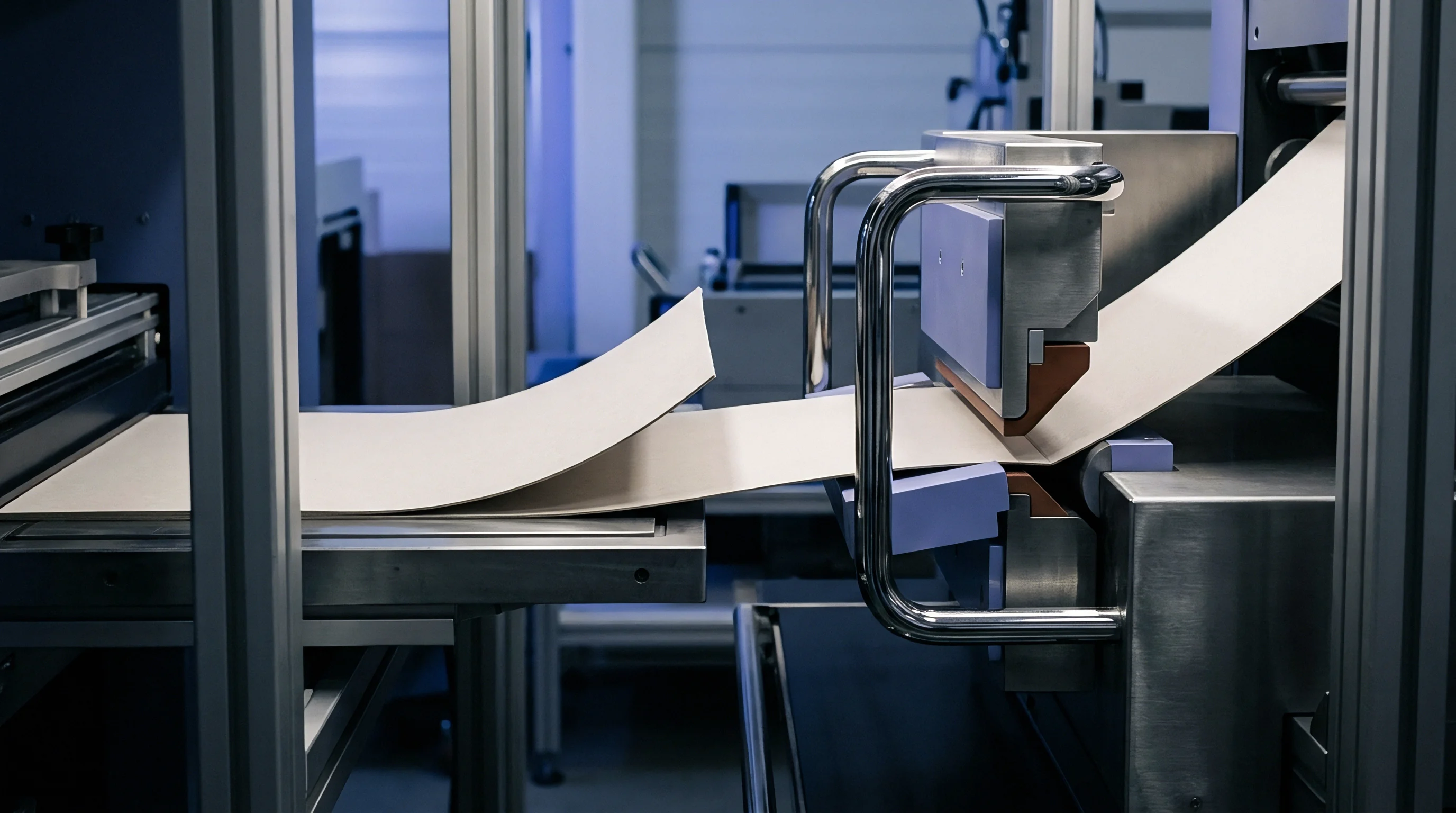
Applying a film lamination prior to die-cutting changes the mechanical equilibrium of the sheet. The polymeric film creates a stiff, high-tensile skin on one side of the board. When the heated lamination nip applies pressure at speeds exceeding 120 meters per minute, the thermal gradient and compressive force compress the bulk of the furnish.
The adhesive layer pulls tension. Upon cooling, the differential thermal contraction between the oriented polypropylene or polyethylene terephthalate film and the fibrous web induces persistent residual out-of-plane shear stresses.
When this pre-stressed composite enters the high-velocity platen press, the cutting and creasing rules impose supplementary transverse shear loads. The stiff film layer resists out-of-plane bending, forcing the weaker middle plies to absorb disproportionate shear displacement. The internal shear modulus drops abruptly as microbuckling spreads through the mechanical pulp core.
| Substrate Grade and Caliper | Virgin State Gxz (MPa) | Post-Lamination Gxz (MPa) | Post-Foil Stamping Gxz (MPa) | Post-Die-Cut Gxz (MPa) | Total Core Modulus Retention |
|---|---|---|---|---|---|
| Solid Bleached Sulphate (SBS) 350 µm | 112 | 104 | 96 | 78 | 69.6% |
| Folding Boxboard (FBB) 450 µm | 84 | 76 | 62 | 44 | 52.4% |
| White Lined Chipboard (WLC) 400 µm | 68 | 58 | 46 | 29 | 42.6% |
| Coated Kraft Back (CKB) 380 µm | 98 | 91 | 82 | 65 | 66.3% |
Thermal Softening during Tool Impression Dwell
Hot foil stamping stations subject cartonboard to platen temperatures between 105 and 135 degrees Celsius under dwell pressures exceeding 15 MPa. Heat conducts rapidly through the clay coating and print layers into the top fiber plies. Board caliper drops three percent.
As temperature rises above the glass transition point of wet or conditioned lignin (typically 65 to 90 degrees Celsius depending on moisture content), the mechanical pulp core softens.
Under platen pressure, this softened middle layer undergoes plastic deformation. Hot foil stamps soften lignin. Fiber-to-fiber contacts slip irreversibly.
When the sheet exits the heated stamping station and cools, the reformed hydrogen bonds freeze in a distorted, micro-fractured state. Subsequent cold die-cutting passes strike a core that has lost its structural elasticity, causing severe shear collapse instead of clean hinge creasing.
Supply agreements conforming to DIN 55437 specify that transverse core shear retention must remain within agreed tolerances or the converter bears financial responsibility for automated packing line jams.


Transducer
Direct quantification of out-of-plane shear modulus shifts during microsecond platen impacts demands specialized laboratory and in-line instrumentation. Standard tensile or ring crush tests fail to capture the high-rate, multi-axial stress conditions present inside an operational die-cutter. Advanced non-destructive and destructive measurement methods isolate the shear components from pure compression.

High-Rate Arcan and Polar Ultrasonic Evaluation
Modified Arcan shear test rigs equipped with piezoelectric load cells and high-speed digital image correlation capture the real-time load-displacement curves of board samples deformed at strain rates up to 500 per second. Ultrasonic sound waves trace voids. By securing the outer liners to rigid fixture plates with rapid-curing cyanoacrylate adhesive, the test isolates the transverse shear stress tau-xz from normal compressive stresses.
An out-of-plane shear stiffness drop exceeding thirty percent under ISO 5628 testing indicates severe internal ply fracturing that invalidates standard carton stacking calculations.
Non-destructive tracking relies on polar ultrasonic immersion spectroscopy. High-frequency acoustic transducers (typically 2.25 MHz to 5.0 MHz) emit focused longitudinal and shear waves through the thickness of the board before and after converting passes. The time-of-flight and phase velocity shift of the transverse acoustic wave map directly to the out-of-plane elastic stiffness matrix coefficients C44 and C55, from which the shear moduli Gyz and Gxz are derived.
Micro-voids and ruptured fiber networks attenuate the acoustic energy, generating an accurate spatial map of core structural breakdown.
Where Do Microbuckling Faults Threaten Conversion Integrity?
Structural shear degradation manifests in distinct physical failure modes during subsequent automated carton packing and stacking operations:
- Interlaminar core delamination creates hollow internal voids along score lines that prevent square folding at folder-gluer speeds exceeding 40,000 cartons per hour.
- Asymmetrical crease roll-over occurs when the crushed interior fibers slide laterally, generating bulging carton panels and skewed closure flaps.
- Premature top-to-bottom compression collapse results from the loss of shear-web support in the vertical panel walls, lowering BCT values by up to 28 percent.
- Scoreline liner burst develops when an excessively sheared core fails to absorb bending strain, transferring all tensile forces directly into the outer printed or laminated liner.
The unresolved question remains whether high-frequency ultrasonic monitoring can be integrated directly into the steel chase of commercial platen presses without suffering acoustic signal distortion from machine mechanical vibrations.
Rig
Tooling layout and platen setup directly determine the rate and severity of shear modulus degradation across the converted sheet. Flatbed dies utilize hardened steel rules embedded in laser-cut birch plywood chases, operating against steel counter plates or phenolic matrix channels. Tool deflection widens the score.
Variations in make-ready patch tape thickness, rule profile geometry, and platen parallelism create uneven shear stress fields across the carton blank.

Counter Matrix Positioning and Rule Geometry Calibrations
The channel width and depth of the counter matrix govern the degree of shear deformation inflicted on the board during crease formation. Crease channels guide rule displacement. A narrow matrix channel forces sharp shear cleavage through the middle plies, while an overly wide channel allows uncontrolled fiber buckling.
Using a 2-point creasing rule (0.71 mm thickness) with a rounded or double-bevel profile reduces peak shear concentration compared to standard flat-faced rules.
Calibrating platen make-ready with 0.02 mm tissue patches balances transverse shear distribution across the chase and preserves core integrity.
Patch tape modifies local pressure. When make-ready technicians apply excessive localized patch tape to compensate for a worn platen bed, the localized peak pressure drives the core shear strain past the yield point of the furnish, destroying out-of-plane stiffness in isolated zones across the layout.
| Converting Configuration | Platen Speed (Sheets/Hour) | Impression Dwell Time (ms) | Rule Tip Profile | Matrix Channel Width (mm) | Retained Shear Modulus Gxz |
|---|---|---|---|---|---|
| Single Pass Cold Die-Cut | 6,000 | 32 | 2 pt Center Bevel | 1.40 | 74% |
| Single Pass Cold Die-Cut | 9,500 | 18 | 2 pt Center Bevel | 1.40 | 58% |
| Foil Stamp + Die-Cut | 9,500 | 18 | 2 pt Round Bevel | 1.50 | 46% |
| Laminate + Foil + Die-Cut | 10,500 | 14 | 2 pt Flat Bevel | 1.35 | 31% |
Worked Case for Sequential Stamping and Creasing
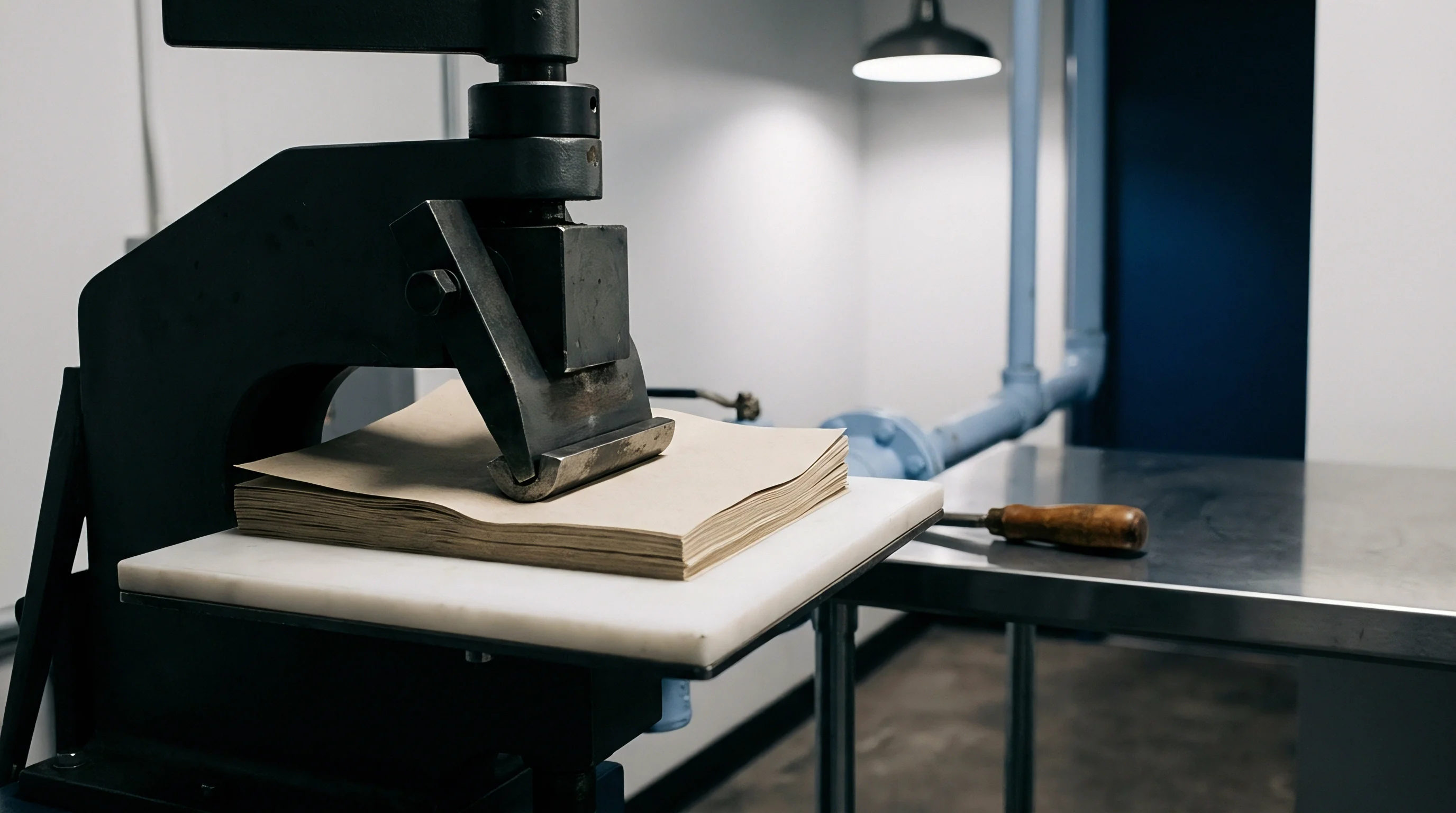
A typical production setup illustrates the cumulative loss of core shear stiffness. Assume a job running 50,000 sheets of 380 µm Folding Boxboard with an initial uncompressed core shear modulus Gxz of 88 MPa. The packaging specification requires a two-pass finishing process: Pass 1 executes full-coverage hot foil stamping at 115 degrees Celsius and 8,000 sheets per hour; Pass 2 executes high-speed cutting, creasing, and embossing at 9,500 sheets per hour.
During Pass 1, thermal softening combined with 14 MPa platen impression pressure degrades Gxz from 88 MPa down to 64 MPa, representing a 27.3 percent modulus reduction. Caliper compresses from 380 µm to 368 µm. During Pass 2, the pre-damaged furnish enters the creasing section.
The high velocity stroke drives transverse shear strain rates past 250 per second. The remaining intact fiber bonds in the central mechanical pulp layer shear off under the counter matrix rules. The final post-converting shear modulus Gxz measures 39 MPa, representing an overall loss of 55.7 percent from the raw board state.
- Verify raw material internal bond strength using Scott bond testing prior to loading pallets onto the feeder.
- Establish platen leveling across all four quadrants using electronic displacement transducers before locking the chase.
- Select counter matrix channel dimensions based on post-finishing caliper rather than nominal virgin caliper.
- Monitor surface temperature decay on foiled sheets before feeding them into the secondary cutting pass.
Tooling suppliers routinely assert that increasing matrix channel clearance solves scoreline cracking without acknowledging that it simultaneously degrades panel shear stiffness.

Margin
The mechanical degradation of core shear modulus carries direct financial consequences across the packaging supply chain. When interior plies lose shear stiffness, finished cartons exhibit lower edge crush resistance (ECT) and reduced box compression test (BCT) performance. Recycled fibers fracture sooner.
Brand owners facing warehouse stacking failures frequently reject entire production runs, returning the financial liability to the converter.

Board Grade Selection and Yield Waste Penalties
Choosing between virgin fiber substrates like Solid Bleached Sulphate (SBS) and multi-ply grades like Folding Boxboard (FBB) or White Lined Chipboard (WLC) involves balancing substrate cost against converting resilience. SBS maintains higher core shear retention under multi-pass converting due to its uniform, long-fiber chemical furnish. However, SBS carries a higher price per ton and lower bulk yield compared to FBB.
When high-speed platen passes degrade the shear modulus of a lower-cost FBB or WLC core below 40 MPa, automated erecting lines experience jamming rates exceeding three percent. Line speed governs carton integrity. The resulting machine downtime, carton waste, and repacking labor quickly erase the initial material savings achieved by specifying the cheaper board grade.
Substrate selection based strictly on virgin caliper without accounting for multi-pass shear degradation leads directly to warehouse stack collapse.

Run Speeds and Stacking Strength Decay
Converters operating under tight production schedules tend to maximize machine velocity, pushing platen presses to 10,000 sheets per hour. Waste rates escalate rapidly. This operational decision elevates dynamic shear strain rates, compounding core breakdown and reducing carton stacking strength by up to twenty-five percent.
When finished pallets fail in refrigerated or high-humidity supply chain environments, the structural collapse traces directly back to the microbuckled core created during the ultra-high-speed converting pass.
- Virgin fiber SBS retains 65 to 75 percent core shear modulus through multiple converting passes, providing predictable performance for luxury packaging.
- Mechanical pulp FBB provides superior initial bulk but loses 45 to 60 percent core shear modulus under aggressive high-speed tooling impacts.
- Recycled WLC exhibits rapid shear decay exceeding 60 percent, requiring wider matrix channels and reduced platen speeds to prevent total delamination.
- Film laminated composites concentrate out-of-plane shear in the sub-surface plies, demanding reduced make-ready impression pressures to preserve panel rigidity.
Ignoring dynamic shear modulus degradation during platen make-ready produces packaging that passes static visual inspection on the converting floor but collapses under real-world logistics stacking loads.