Transverse Shear Deformation Limits in Structural Foamed High Yield Packaging Substrates
Low transverse shear modulus in foamed cores reduces effective bending stiffness and causes early compression collapse on short spans.


Voids
Entraining gas during wet-end sheet formation converts a solid fibrous furnish into a cellular network. Micro-foaming high-yield pulp ~ whether by mechanical gas injection or chemical foaming agents mixed with chemithermomechanical pulp ~ raises bulk to between 2.2 cm3/g and 3.8 cm3/g. The goal is to build caliper without adding fiber mass, maximizing bending stiffness per unit weight.
Expanding the core changes the internal stress distribution under flexure: outer solid plies take the tensile and compressive loads, while the porous middle core carries the transverse shear generated across short spans.

Density Scaling Laws
Cellular solids theory shows that structural response depends directly on solid fraction ratios. When the apparent density of a foamed middle ply drops below 350 kg/m3, its transverse shear modulus falls with the square of core density. Dropping core density from 600 kg/m3 to 200 kg/m3 cuts transverse shear stiffness by roughly 85 percent, even as long-span bending stiffness increases from the added overall sheet thickness.
Quality control protocols that track only grammage and caliper miss this loss of internal core integrity.
Evaluating transverse shear parameters requires flatwise shear testing under ASTM C273 or double-lap shear configurations. Testing conditioned samples at 23 C and 50 percent relative humidity under ISO 187 isolates core response from skin stiffness. A 2.0 mm structural foamed board with a 250 kg/m3 core exhibits a transverse shear modulus around 12 MPa, whereas an unfoamed solid bleached sulfate core of identical caliper holds a shear modulus exceeding 65 MPa.
| Core Density Grade | Apparent Density (kg/m3) | Caliper (mm) | Transverse Shear Modulus Gxz (MPa) | Flatwise Shear Strength (kPa) | Long-Span Bending Stiffness (mNm) |
|---|---|---|---|---|---|
| Solid Reference | 680 | 0.80 | 68.5 | 820 | 18.5 |
| Low Foam CTMP | 450 | 1.20 | 34.0 | 460 | 42.1 |
| Medium Foam BCTMP | 300 | 1.75 | 14.2 | 210 | 85.4 |
| High Foam Structural | 190 | 2.40 | 5.8 | 85 | 122.0 |
Flatwise shear strength dictates the mechanical limit before internal cell walls collapse. High-yield mechanical fibers have rigid, lignin-rich cell walls that resist compaction during pressing, but they undergo brittle shear rupture once local shear strain exceeds critical thresholds. Scanning electron microscopy shows that foamed core shear failure begins at micro-void cell boundaries and propagates along fiber-gas interfaces rather than tearing individual fibers.
This internal damage stays hidden beneath solid outer liners until the structure fails.
What cell wall distribution limits can papermakers achieve to prevent transverse core rupture when the gas volume fraction exceeds seventy percent?


Compliance
Boxboard panels subjected to bending undergo both flexural stretching and transverse displacement. Classical Euler-Bernoulli beam equations assume zero transverse shear deformation, treating cross-sections as remaining strictly perpendicular to the neutral axis during bending. Thin solid paper grades fit this model with minimal error.
High-yield foamed cores violate it because their low shear modulus allows substantial transverse shear strain under load. Mindlin-Reissner plate theory accounts for this extra displacement by splitting total panel deflection into bending and shear components.
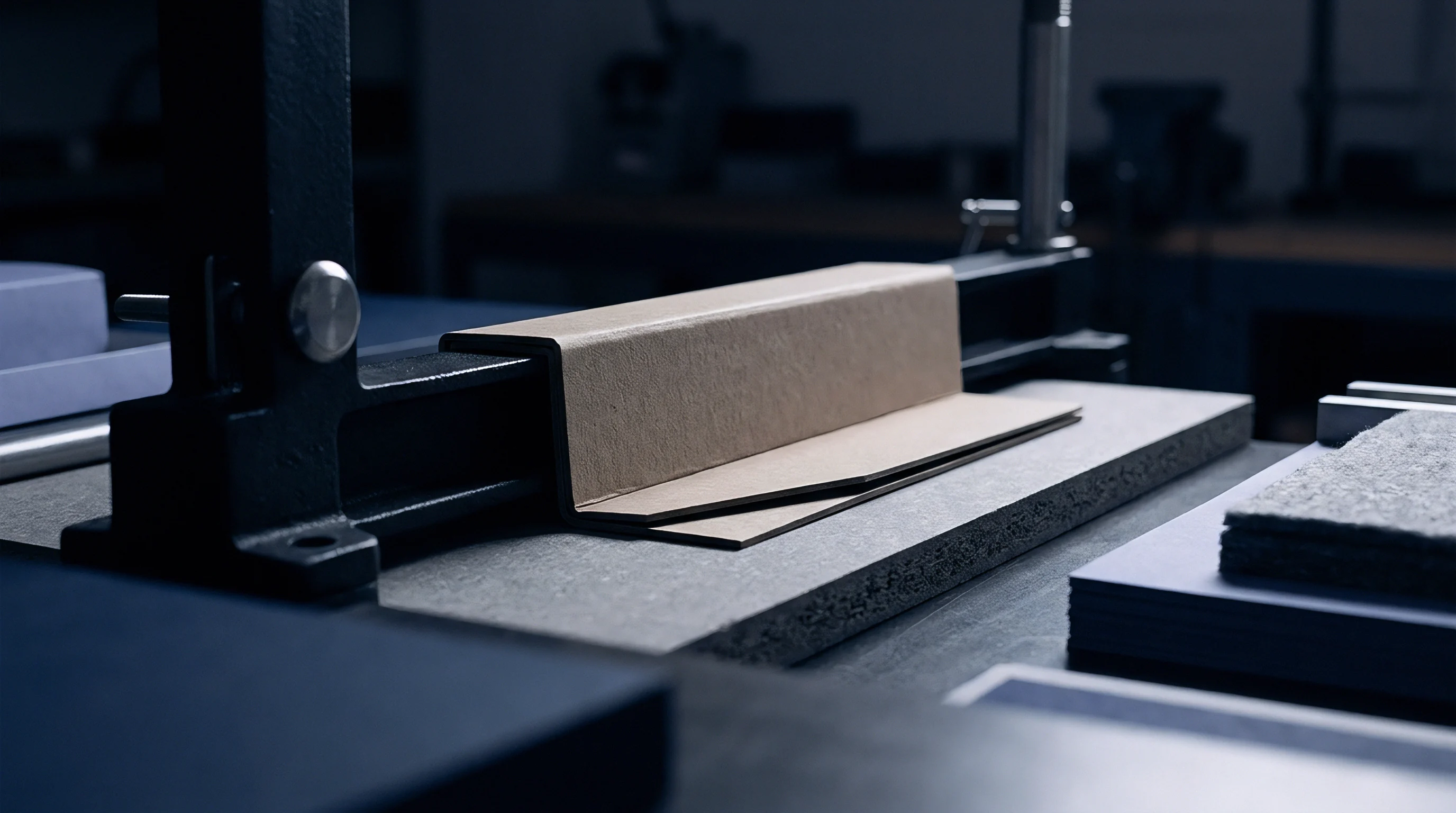
Mindlin Beam Kinematics
Total deflection calculated under three-point bending includes a correction factor inversely proportional to the transverse shear modulus. Total beam deflection equals flexural deflection plus shear deformation. Flexural deflection scales with span length cubed divided by bending stiffness, whereas shear deflection scales linearly with span length and inversely with shear core stiffness.
Short bending spans ~ such as box corners, score edges, and small container panels ~ operate in a regime dominated by transverse shear strain.
A high ratio of overall board caliper to bending span length amplifies transverse shear displacement, reducing effective panel stiffness below values predicted by Euler-Bernoulli beam models.
Calculations show the scale of this discrepancy. Consider a three-ply foamed packaging board with a caliper of 1.8 mm, an effective bending stiffness of 95 mNm, and a transverse shear modulus of 8.5 MPa loaded across a 50 mm span in three-point bending. Elastic beam theory without shear correction predicts a center-point deflection of 0.42 mm.
Adding the transverse shear correction increases calculated deflection to 0.61 mm ~ a 45 percent increase in load displacement. Effective panel stiffness drops by the same margin.
Why Do High Yield Foamed Cores Instantly Shear under Dynamic Loading?
Rotational inertial forces during transit drop the effective stiffness threshold of lightweight cellular structures. High-frequency impacts and dynamic stacking loads generate shear stress waves that exceed the static elastic limit of low-density foamed cores. Fiber-to-fiber bonded nodes within a foamed BCTMP matrix possess high rotational stiffness but low transverse ductility.
Dynamic lateral shear forces drive these rigid nodes into localized rotational failure, forming immediate shear bands across the core width.
Box compression testing under ISO 12048 highlights this failure mechanism clearly. Standard panel stability models rely on McKee formula variants that project top-to-bottom compression capacity using flexural stiffness and edge crush resistance. Foamed core substrates break this formula because panel edges yield in transverse shear before reaching peak edge crush force.
The outer skins remain intact while the foamed middle core shears horizontally, causing container walls to buckle outward at loads far below design safety margins.
Flexural test spans must exceed twenty times the substrate caliper to eliminate transverse shear errors during core stiffness qualifications.

Crease
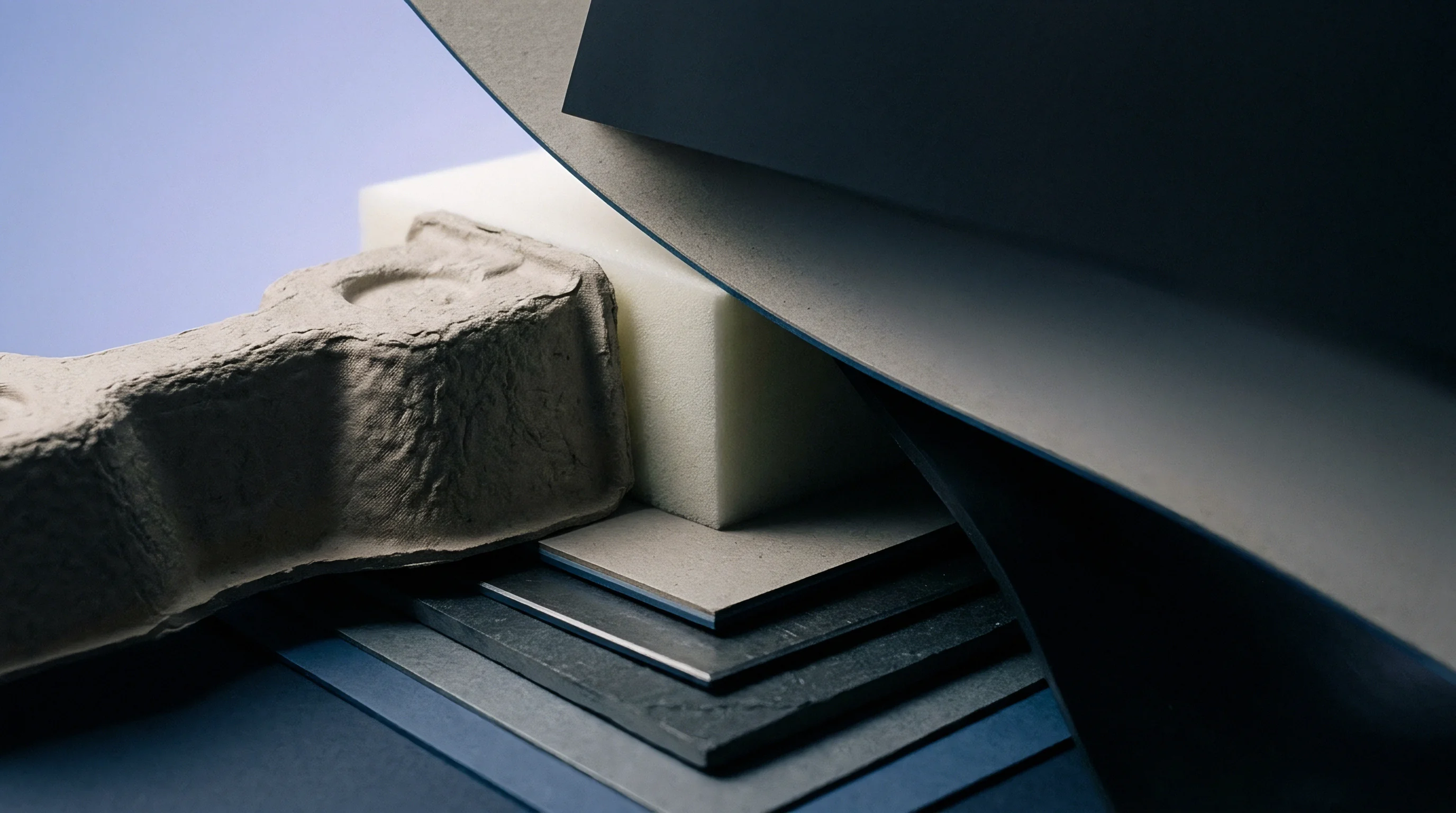
Converting high-bulk board into folding cartons forces localized compression across the substrate thickness. Standard solid paperboard creates clean hinge structures through controlled internal delamination along predefined ply boundaries during matrix engagement. Structural foamed substrates respond differently to scoring tools.
Their low transverse shear modulus allows broad lateral core displacement under the male rule, spreading deformation beyond the intended score width so the core crushes flat rather than delaminating into discrete shear plies.
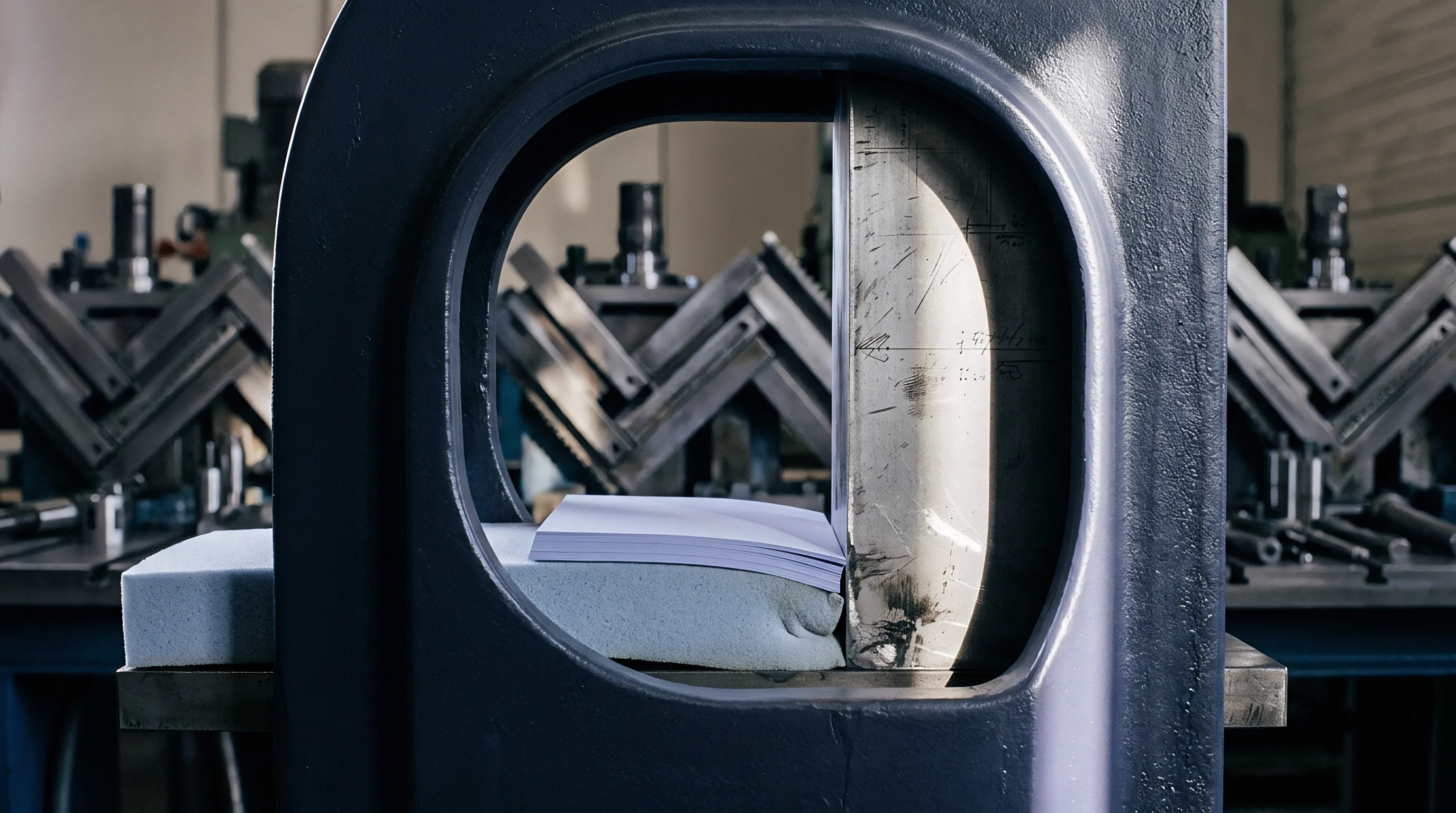
Scoring Mechanics
Male scoring rules push paperboard into female channels to form distinct hinge lines. This mechanical action requires severe transverse shear deformation confined to the creasing zone. Foamed cores with shear modulus values below 12 MPa yield prematurely, absorbing rule impact through cellular collapse rather than uniform interlaminar shear.
The resulting crease exhibits poor folding memory, elevated initial folding torque on high-speed packaging lines, and a high risk of cracking along the outer liner tensile zone during ninety-degree folds.
- Channel Width Selection requires expanding female groove dimensions by fifteen to twenty percent beyond standard caliper ratios to accommodate lateral foam compaction without tearing outer plies.
- Rule Penetration Depth demands precision setting within a ten-micrometer tolerance band to avoid punching through the lightweight outer liners into the weakened foamed core structure.
- Anvil Clearance Calibration controls the residual compression state of the foamed middle ply, preserving enough density to maintain hinge strength during carton erecting.
- Liner Elasticity Balance aligns surface sizing treatment with core bulk to prevent high-tensile outer skins from snapping low-density core fibers during folding.
Mechanical pulps used in foamed middle plies contain short, rigid fibers with high coarseness, offering little stretch capacity under shear loading. When creasing tooling compresses the sheet, these short fibers detach from the micro-foamed matrix and leave loose debris inside the core. The damaged creasing zone loses structural continuity, leading to cracked corners on filled cartons during stacking.
Converting specifications that neglect transverse core shear values result in score fracture rates exceeding four percent on high-speed folding carton lines.
Incorrect tooling parameters lead directly to web breaks on the converter, misaligned carton panels, reduced production speeds, and rejected packaging lots.

Interface
Multi-ply packaging substrates rely on strong bonding between outer solid skins and lightweight inner furnish. Solid linerboard plies, typically made from unbleached or bleached kraft chemical pulp, feature high density and strong inter-fiber hydrogen bonding. The boundary where these dense skins meet a micro-foamed middle ply forms a mechanical discontinuity where transverse shear stress concentrates under flexural loads.
Fiber entanglement and adhesive penetration across this interface dictate whether the composite sheet operates as a unified structure or splits into independent layers.
Bond Testing
Internal ply cohesion evaluations measure energy dissipation during normal Z-direction separation. ISO 16260 and TAPPI T 541 Scott Bond tests apply pure tensile forces perpendicular to the sheet plane. These tests fail to predict substrate survival under transverse shear because Scott Bond stress states do not induce interlaminar sliding strain.
A substrate showing high Scott Bond values above 200 J/m2 can still suffer early transverse shear failure if the foam-to-liner transition zone lacks structural stiffness.
- Cut ten test strips measuring 25 mm by 150 mm along the machine direction, conditioning all samples at 23 C and 50 percent relative humidity for twenty-four hours under ISO 187.
- Mount the sample in a dual-lap flatwise shear fixture under ASTM C273, securing both outer liners to rigid steel adapter plates using high-tack cyanoacrylate adhesive.
- Apply a monotonic tensile load at a crosshead speed of 0.5 mm per minute until the inner foamed ply experiences shear fracture or interfacial delamination.
- Record the peak load, the shear strain at failure, and the ultimate transverse shear modulus derived from the initial linear slope of the force-displacement curve.
- Inspect the failed specimen surfaces visually to categorize the fracture mode as middle-ply foam cohesion failure, interfacial bond separation, or liner delamination.
Wet-end application of cationic starch or microfibrillated cellulose at the ply-combining station strengthens the interface. However, excessive foam generation at the boundary prevents liquid starch from penetrating into the core ply, creating dry zones with low shear resistance. Chemical binder selection must balance foam stability during sheet formation with interface wet-bond development.
| Binder Chemistry | Starch Rate (g/m2) | Interface Shear Strength (kPa) | Scott Bond (J/m2) | Failure Mode |
|---|---|---|---|---|
| Native Corn Starch | 1.2 | 140 | 110 | Interfacial Delamination |
| Cationic Potato Starch | 2.5 | 290 | 215 | Middle Ply Foam Rupture |
| PVOH Modified Foam | 1.8 | 410 | 280 | Middle Ply Foam Rupture |
| Microfibrillated Cellulose | 3.0 | 520 | 340 | Solid Liner Tensile Failure |
Low internal bond numbers can stem from converted box machine setup issues as well as fundamental core furnish weakness.
Transit
Container shipping exposes stacked packaging to continuous low-frequency dynamic vibration and environmental humidity fluctuations. Pallets stacked three-high in warehouse environments subject bottom-tier cartons to sustained static compression combined with dynamic shear inputs from material handling equipment. Foamed high-yield substrates lose transverse shear capacity rapidly as atmospheric moisture rises, because mechanical fibers absorb water quickly and soften the lignin-rich matrix holding the cellular foam walls together.

Environmental Degradation
High-yield pulps absorb atmospheric moisture quickly in humid conditions. Conditioning foamed substrates at 85 percent relative humidity and 28 C under tropical transport simulation reduces transverse shear modulus by up to 55 percent compared to standard laboratory conditions. Moisture relaxes the hydrogen bonds within micro-foamed cell walls, driving localized viscoelastic creep even under low loads.
As the core compresses and overall caliper drops, the structural advantage of the foamed core vanishes.
- Core Creep Buckling occurs when sustained static loads cause the foamed middle ply to deform plastically over time, resulting in container wall creasing and structural collapse.
- Vibrational Shear Fatigue develops under long-distance truck transport, where continuous vertical oscillations induce micro-cracks inside the low-density BCTMP cell matrix.
- Corner Column Shear Flaring manifests when vertical loading causes the four corners of a folding carton to split laterally along low-shear score lines.
- Humidity-Induced Delamination arises when moisture gradients between outer solid skins and inner foamed cores generate internal shear stresses that rupture interfacial bonds.
Choosing a foamed substrate solely based on long-span bending stiffness specifications guarantees shipping damage when transit environments expose packaging to shear forces.
Transverse shear modulus testing performed under tropical conditioning shows an average loss of fifty-two percent in structural core rigidity compared to standard laboratory testing states.
Purchasing agreements that incorporate ISO 12048 box compression minimums must explicitly specify that compliance targets hold across the full operating range of environmental humidity and transverse shear strain limits.