Mechanical Shear Deformation Boundaries of Recycled Coated Board in High Speed Counter Plates
Recycled board requires 15 to 25 percent wider counter channels with radiused shoulders to absorb dynamic shear without splitting mineral coatings at speed.
Platen
Bed pressure on high-speed flatbed die-cutters delivers severe mechanical shocks to multi-ply recycled substrates during every stroke. When an automatic platen press operates at eight thousand sheets per hour, the effective dwell time where the creasing rule forces the cartonboard into the counter channel drops below twenty-five milliseconds. Within this narrow window, the substrate experiences a complex stress field combining out-of-plane compression, transverse shear, and in-plane tension.
Recycled coated board, designated commercially as White Lined Chipboard or GD2 and GD3 grades, possesses a structural morphology distinct from virgin fiber cartonboards. The core plies consist of mixed secondary fibers, high mineral filler loadings, and residual starches from previous papermaking cycles. These constituents reduce interlaminar shear strength and lower the ultimate strain capacity before mechanical failure occurs.
The platen strikes hard.
In high-speed flatbed die-cutting, the steel rule creasing edge penetrates the top coated surface and drives the board into a precision-milled channel in the counter plate. This counter plate, historically fabricated from vulcanized fiber or pressboard and now predominantly machined from epoxy-glass laminate sheets known as pertinax, defines the female contour of the scoring geometry. The mechanical shear deformation boundary marks the precise operational envelope where the cartonboard bends into the counter groove through controlled internal delamination without rupturing the top coating layer or cleaving the bottom liner ply.
Exceeding this boundary produces severe packaging defects: fractured mineral coatings that expose raw gray fibers, split back liners that tear during carton erection, or asymmetric crease profiles that skew automatic high-speed cartoning machines running at four hundred packs per minute.
Dynamic Stroke Kinetics across Converting Presses
Machine speeds reaching nine thousand sheets per hour compress the mechanical contact cycle to twenty milliseconds. During this impact, the kinetic energy of the moving lower beam transfers through the cutting chase and dies into the sheet. Virgin folding boxboards composed of long-fiber chemical pulp liners and mechanical pulp centers dissipate this localized strain energy through controlled micro-delamination across well-defined ply boundaries.
Recycled coated boards exhibit markedly different kinetic responses. The reclaimed fibers in the middle plies have undergone repeated drying and re-wetting cycles, creating irreversible fiber hornification. Hornified secondary fibers display reduced cell-wall flexibility and diminished hydrogen bonding capacity.
Impact velocity dictates shear strain.
When the scoring rule strikes the sheet at high velocity, the shear strain rate in the thickness direction climbs above three hundred reciprocal seconds. At these strain rates, the viscoelastic relaxation of the cellulose network diminishes. The material behaves in a brittle, linear-elastic manner.
If the counter plate channel profile does not provide adequate volumetric clearance, the board experiences extreme transverse hydrostatic compression coupled with severe shear along the channel shoulders. The resulting stress concentration exceeds the shear yield limit of the recycled core before the board can deflect into the groove recess.
| Press Speed (Sheets/Hour) | Contact Time (ms) | Effective Platen Force (kN) | Transverse Shear Rate (s⁻¹) | Interlaminar Failure Mode |
|---|---|---|---|---|
| 4,500 | 42.0 | 1,850 | 115 | Controlled core delamination |
| 6,000 | 31.5 | 2,100 | 185 | Stable delamination with micro-checks |
| 7,500 | 25.2 | 2,450 | 265 | Shear plane slippage at coating interface |
| 9,000 | 21.0 | 2,800 | 340 | Uncontrolled core shear cracking and coating rupture |
Die tonnage climbs rapidly.
Higher converting velocities necessitate higher total press tonnages to overcome dynamic system inertia and achieve simultaneous cut-and-crease separation across eighty-up carton layouts. The elevated tonnage deepens the penetration of the rule into the counter plate channel. On recycled boards with high caliper variations, this increased force pushes the localized shear stress past the critical failure envelope.
Converting plants running high-speed packaging lines routinely observe scoreline cracking on Monday mornings when the machinery runs cold and dynamic clearances have not reached thermal equilibrium.
Incorrect platen leveling splits top coatings, crumbles inner filler networks, and generates unglued cartons that jam downstream folder-gluers at full operating pace.
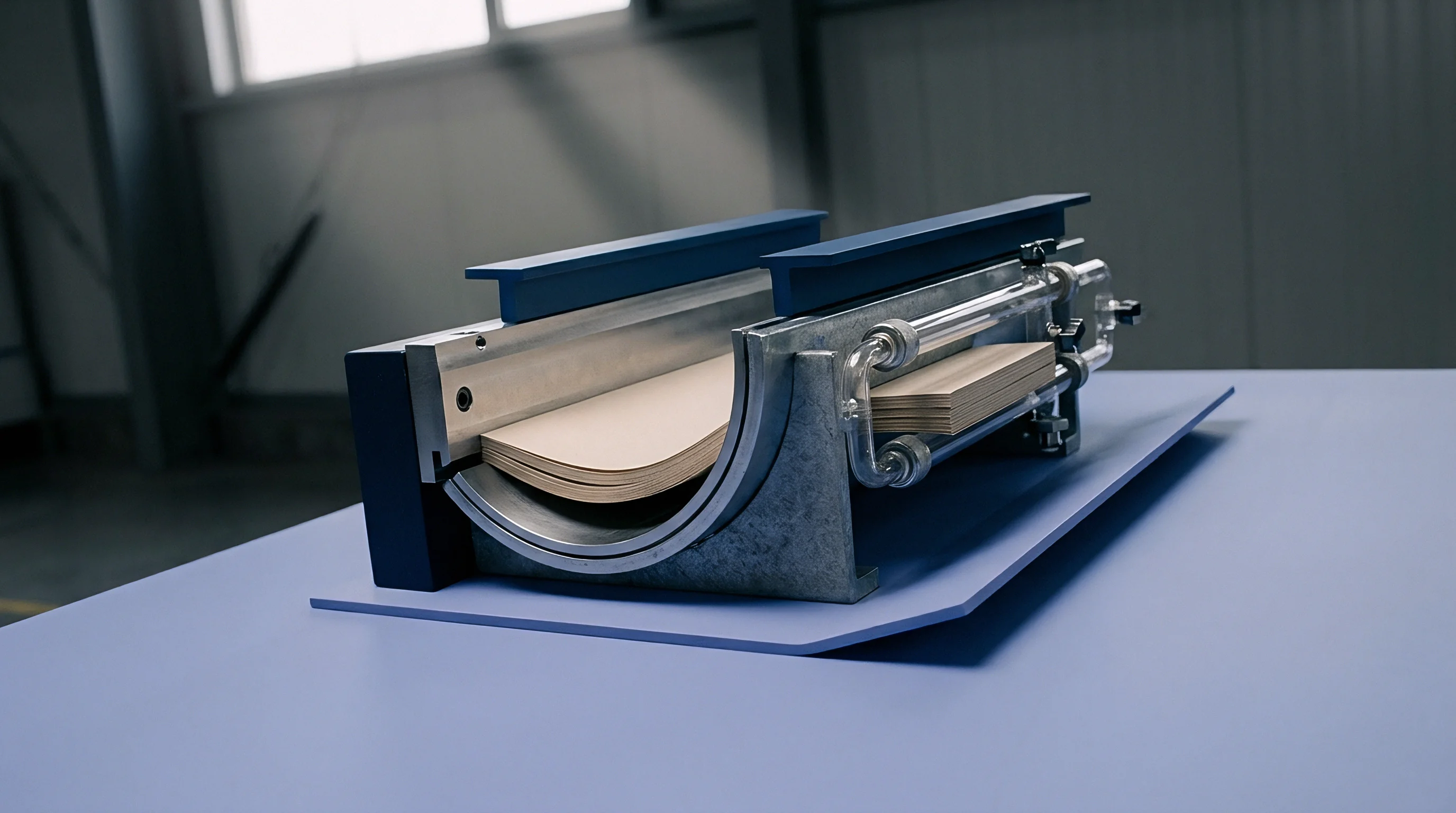
Ply
White lined chipboard combines post-consumer fiber cores with bleached chemical pulp tops and mineral pigment formulations. A typical 350 gram per square meter GD2 grade features four distinct functional layers: a double or triple kaolin and calcium carbonate blade coating, a bleached chemical kraft top liner, an under-liner derived from selected ledger or office waste, a thick bulk center of mixed municipal waste papers, and a back liner of mechanical or sorted unbleached furnish. The ash content of the middle plies routinely exceeds eighteen percent by dry weight, introducing inert calcium carbonate and talc particles directly into the fiber network.
These mineral fillers reduce raw material expenses, yet they disrupt fiber-to-fiber entanglement and create localized stress concentrations under shear load.
Short fibers resist elongation.
When an external creasing rule exerts downward displacement, the board must undergo internal delamination into multiple thin lamellae. This delamination allows the sheet to bend without developing destructive tensile strains on the convex outer face. In virgin boards, long softwood fibers pull away from one another while maintaining frictional bridges that preserve tensile continuity.
In recycled board plies, the short, stiffened secondary fibers fracture cleanly or debond catastrophically along starch-filler interfaces. Instead of forming smooth, concentric delamination bubbles under the creasing line, the core plies shatter into jagged shear bands that compromise the structural rigidity of the formed crease.
A thirty-millisecond contact duration at sixty-five bar creates eight percent higher interlaminar shear stress in board conditioned at forty percent relative humidity than in board conditioned at fifty percent.

Where Does Core Failure Initiate across Fiber Networks?
Transverse load displacement curves indicate separation along the starch-spray boundary between the middle reclaimed layers. Paper mills producing multi-ply chipboard spray native or cationic potato starch between plies on the cylinder mould or Fourdrinier forming section to cement the wet fiber mats together. In high-speed die-cutting, this starch interface acts as a shear plane.
Because the recycled core possesses a low z-directional tensile strength, measured via ISO 15754 at values between one hundred twenty and two hundred kilopascals, the rapid introduction of transverse shear drives crack propagation directly along the ply interfaces.
Starch distribution governs inter-ply cohesion.
When the creasing rule descends, the shear stress distribution across the sheet thickness exhibits twin maxima near the neutral axis, shifted toward the softer recycled filler plies. The top coating layer, formulated with styrene-butadiene or styrene-acrylate latex binders and mineral clays, possesses an ultimate tensile elongation of less than two percent. If the internal plies fail to delaminate cleanly, the outer top layer absorbs the full bending strain.
The mineral coating fractures along the rule edge, producing chalking, flaking, and visual fiber exposure along the carton fold.
- Liner Delamination Shear splits the boundary between the bleached chemical top liner and the post-consumer under-liner when dynamic tool penetration exceeds twenty percent of total sheet caliper.
- Coating Flake Cleavage detaches the brittle pigment-latex matrix from the fibrous base paper through excessive bending tension along narrow counter channel shoulders.
- Hinge Tensile Rupture severs the tension-bearing bottom liner on reverse scores when channel depth clearances compress the board past its densification threshold.
- Internal Core Compression Collapse crushes the short-fiber filler plies into dense, inelastic wedges that prevent clean ninety-degree carton fold angles.
Secondary fibers stiffen rapidly.
The cross-directional shear modulus of recycled board drops sharply relative to virgin kraft boards. In standard machine-direction creasing, the scoring rule runs parallel to the predominant fiber alignment, forcing the cross-direction fibers to stretch around the rule radius. Because cross-directional elongation to break on GD2 board sits between 1.5 and 2.2 percent, compared to 3.5 to 5.0 percent on solid bleached sulfate, the window of permissible shear deformation before catastrophic fracture remains exceptionally narrow.
| Property Metric and Standard Method | Virgin FBB (GC2 300 gsm) | Virgin FBB (GC1 350 gsm) | Recycled WLC (GD2 350 gsm) | Recycled WLC (GT2 400 gsm) |
|---|---|---|---|---|
| Z-Direction Tensile Strength (ISO 15754, kPa) | 380 to 440 | 350 to 410 | 140 to 190 | 160 to 210 |
| In-Plane Shear Modulus G_xy (MPa) | 1,450 to 1,600 | 1,380 to 1,520 | 920 to 1,080 | 980 to 1,150 |
| Bending Resistance MD (ISO 2493, mN) | 280 | 420 | 290 | 460 |
| Bending Resistance CD (ISO 2493, mN) | 135 | 210 | 120 | 195 |
| Ash Content Middle Plies (ISO 1762, %) | 0.8 to 1.5 | 1.0 to 2.2 | 16.5 to 22.0 | 14.0 to 19.5 |
| Critical Shear Delamination Strain (%) | 4.8 to 6.2 | 4.5 to 5.8 | 2.1 to 3.0 | 2.4 to 3.2 |
Crease depth determines delamination.
Converting recycled board requires deliberate management of the ratio between rule width, board thickness, and counter channel geometry. When converters attempt to run recycled grades using identical tooling layouts designed for virgin folding boxboards, immediate core fracture occurs. The lower z-directional strength of the recycled board demands shallower rule penetration combined with wider counter channels to distribute shear stresses over a broader fiber volume.
Mill technical service managers routinely attribute scoreline flaking to excessive press tonnage rather than admitting recycled furnish heterogeneity or low surface sizing levels.
Relief
Counter matrices machined from epoxy-glass laminate establish the exact boundaries for crease formation under high-speed rules. The counter plate must maintain absolute dimensional stability across production runs exceeding one million impressions. On flatbed cutting presses, glass-epoxy pertinax plates measuring between 0.30 and 1.20 millimeters in thickness are mounted onto dynamic steel base plates or directly to the lower cutting platen.
The channel geometry cut into the pertinax must match the physical behavior of the board furnish. Standard rule-and-channel formulas derived for virgin fibers fail on recycled stock because they do not account for the inelastic shear deformation and low transverse recovery of recycled pulp.
Mineral coatings snap cleanly.
The standard channel width formula states that width equals the rule thickness plus 1.5 times the board caliper for virgin substrates. For coated recycled board, this formula induces severe shear pinching along the channel shoulders. The multiplier must increase to 1.7 or 1.85 times the measured sheet thickness.
Expanding the channel width reduces the shear strain rate along the shoulder and prevents premature rupture of the outer bleached liner. However, expanding the channel excessively produces an ill-defined, sprawling crease profile with low folding torque resistance, destabilizing high-speed packaging equipment.
Channel shoulders milled without an entry radius shear the liner before the score can seat.
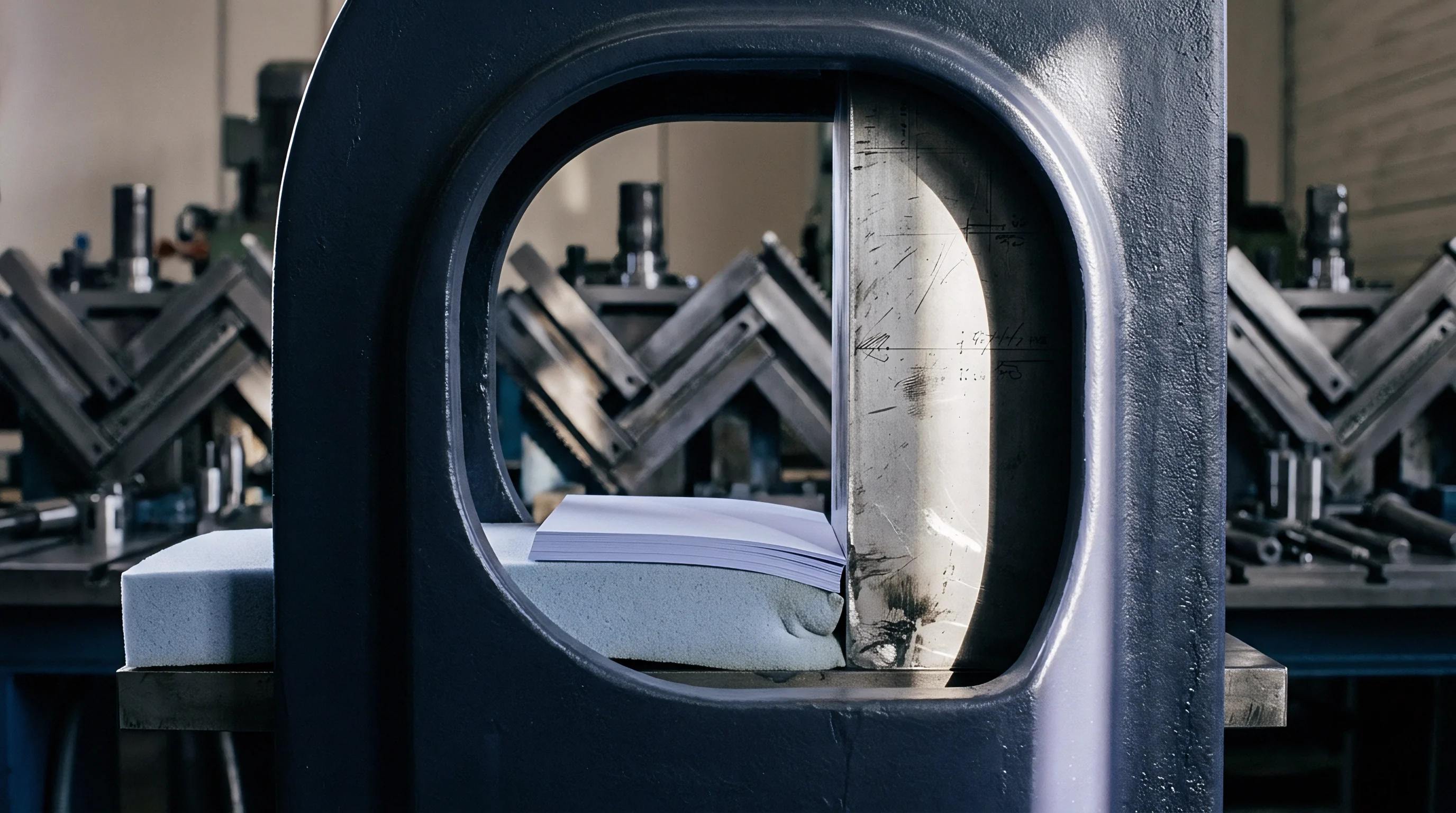
When Do Channel Geometries Cause Coating Fractures?
Creasing rules driven into milled counter grooves displace top mineral layers into a sharp radius. Standard counter plate manufacturing employs end mills running on CNC high-frequency spindles at sixty thousand revolutions per minute. A standard square end mill leaves a sharp ninety-degree vertical shoulder at the channel entrance.
As the sheet is forced down into the channel, this square shoulder acts as an anvil, concentrating shear stress across a minuscule contact surface. The mineral coating fractures precisely at this contact edge.
Groove walls endure abrasive scouring.
To eliminate this failure mode, advanced counter tooling incorporates chamfered or radiused channel shoulders. Introducing an entry chamfer of fifteen to thirty degrees, or a rounded shoulder radius of 0.10 millimeters, distributes the transverse shear load across an extended perimeter. This chamfer softens the mechanical transition as the board enters the pertinax pocket.
The reduced peak stress preserves the continuity of the chalk-loaded coating layers, allowing the inner recycled plies to delaminate smoothly along their starch planes without surface flaking.
- Substrate Caliper Profiling establishes baseline thickness variations across three random sheets before committing the counter layout to the milling spindle.
- Channel Width Calculation fixes the clearance boundaries using the exact rule thickness and verified board caliper to prevent liner crushing.
- Spindle Tooling Calibration removes runout errors on the flatbed engraving table to prevent unequal channel wall depths that trigger carton skew.
- Optical Register Verification locks the milled plate to the cutting chase pins before the first press impression strikes the sheet.
- Impression Load Calibration increases tonnage in two-bar increments until the score achieves full hinge flexibility without cracking the mineral top coat.
Milling tolerances remain narrow.
The choice of creasing rule profile interacts directly with counter plate geometry. High-speed converting of recycled boards demands fully rounded or double-radius rule tips, categorized as 2-pt or 3-pt rules with precision-ground tip contours. Flat-faced or chamfered rules concentrate shear stress directly beneath the tool center, crushing the weak recycled core into a pulverized zone of disconnected fiber fines.
A round rule tip provides uniform radial displacement, distributing compressive and shear stresses symmetrically into the counter channel walls.
A counter plate milled too narrow tears the outer liner, while a counter plate milled too wide produces a loose fold that wanders down the packaging line.
Dwell
Contact duration between steel rules and counter grooves contracts sharply as line speed accelerates toward press capacity. On modern flatbed converting machinery running nine thousand sheets per hour, dynamic platen acceleration shortens the dwell window to under fifteen milliseconds. Within this brief pulse, the board plies must undergo both elastic strain and permanent plastic deformation.
Recycled fibers, having lost their primary amorphous cell-wall water during initial mill conversion, exhibit elevated dynamic stiffness and retarded viscoelastic flow. The fibers cannot redistribute localized stresses within milliseconds, driving shear cracks through the sheet.
Moisture drops embrittle paperboard.
The physical environment on the converting floor directly shifts these shear deformation boundaries. Recycled coated board is hygroscopic. Its mechanical properties follow relative humidity according to classic sorption isotherms.
Standard testing protocols under ISO 187 specify testing at twenty-three degrees Celsius and fifty percent relative humidity, where commercial GD2 board achieves an equilibrium moisture content between 6.5 and 7.5 percent. Under these conditions, the internal starch binders and hemicelluloses maintain sufficient plastic ductility to permit shear displacement without micro-cracking.
Recycled pulp fractions generate uneven density profiles that displace the shear zone away from the crease center.
Hygrothermal Mechanics on the Die Floor
Ambient humidity swings shift the equilibrium water content within cellulosic networks within hours of unpalletizing. In winter operating conditions across unconditioned converting facilities, indoor relative humidity drops to thirty percent. When board moisture falls below 5.5 percent, the hydrogen bonds between secondary fibers become rigid and brittle.
The critical shear strain threshold of the recycled core declines by more than twenty-five percent. When the scoring rule strikes the dehydrated sheet at high velocity, the core plies shatter immediately instead of undergoing progressive delamination.
High speed magnifies registration drift.
Press speed and moisture loss combine synergistically to degrade converting outcomes. As press speed climbs from five thousand to eight thousand sheets per hour, the dynamic temperature of the cutting chase and counter base plate rises by fifteen degrees Celsius through mechanical friction. This localized heating dries the board further at the exact moment of tool contact.
Simultaneously, dynamic sheet bounce and register variation displace the sheet slightly off-center relative to the pertinax channels. An eccentricity of just 0.05 millimeters concentrates the entire platen shear load onto one side of the channel, initiating catastrophic liner split.
- Equilibrium Moisture Verification confirms board moisture sits strictly between six and eight percent before running high-speed dies.
- Platen Speed Modulation matches press stroke frequency to board delamination resistance during cold morning shifts.
- Crease Rule Profile Selection pairs round-edge steel scoring rules with high-ash recycled stocks to soften shear impact.
- Air Knife Extraction Check clears fine mineral coating debris from counter channels to avert abrasive grooving.
| Board Moisture Content (%) | Ambient RH at 23°C (%) | Max Crack-Free Press Speed (sph) | Tensile Energy Absorption MD (J/m²) | Visual Flaking Rating at 90° Fold |
|---|---|---|---|---|
| 4.8 | 28 | 4,200 | 145 | Severe continuous coating split |
| 5.8 | 38 | 5,800 | 185 | Intermittent micro-cracking at edges |
| 6.8 | 50 | 7,800 | 230 | Clean crease with zero fiber pull |
| 7.8 | 62 | 8,500 | 265 | Clean crease, slight bead roll |
| 8.8 | 75 | 7,200 | 220 | Crease swelling, spongy carton corners |
Tooling wear shifts crease resistance.
Pertinax channels subjected to abrasive recycled board wear down progressively over long production runs. Recycled furnish contains abrasive contaminants, including residual sand, titanium dioxide, and calcium carbonate pigments. These particulates scour the phenolic counter shoulders.
After three hundred thousand impressions, the channel width widens by up to 0.08 millimeters while the channel shoulder radius sharpens into an irregular burr. This abrasive wear lowers the effective shear resistance of the tooling system, requiring press operators to continually adjust platen tonnage to compensate for degrading crease definition.
Whether progressive fiber hornification during repeated repulping cycles sets a hard ceiling on high-speed crease integrity remains an open question across European converting plants.

Outlay
Tooling investments for multi-up folding boxboard dies dictate the financial threshold between commercial profit and scrap penalties. A fifty-up carton die for pharmaceutical or food packaging requires matching precision counter plates. High-speed converters choose between milled pertinax plates, steel counter plates, and milled steel matrices.
A precision-milled pertinax counter plate costs between two hundred and four hundred euros, delivering an operational life of three hundred thousand to five hundred thousand impressions on virgin stock. On recycled GD2 board, abrasive mineral fillers cut pertinax tooling longevity by half.
Steel counter dies outlast pertinax.
Direct-milled steel counter plates, fabricated from hardened 1.4104 or 1.2312 tool steels, cost between one thousand five hundred and three thousand euros per set. While the initial capital expenditure is ten times higher than phenolic pertinax, steel plates eliminate channel erosion. Steel tooling preserves precise shoulder radii across production volumes exceeding five million cartons.
On massive continuous runs for detergent, dry food, or consumer commodity cartons, steel counter plates eliminate make-ready adjustments caused by pertinax groove breakdown.
Technical delivery specification clause DIN 19303 specifies board stiffness tolerances that allow up to fifteen percent stiffness variance between mill lots without triggering commercial rejection rights.

Commercial Balance of Production Waste and Make-Ready Downtime
A typical high-volume production scenario demonstrates the economic boundaries governing counter plate specification. Take an order of two million folding cartons produced on 350 gsm GD2 recycled board, running fifty-up on an automatic flatbed press at seven thousand sheets per hour. Total net run volume equals forty thousand sheets.
Running this job on standard square-shoulder pertinax counters generates an average running waste rate of 3.8 percent due to intermittent scoreline cracking and coating flaking during press acceleration cycles. This waste volume represents 1,520 discarded sheets, equivalent to 2.45 metric tonnes of board stock.
Spoilage compounds with every stoppage.
At a prevailing recycled board cost of 950 euros per metric tonne, material waste alone burns 2,327 euros. Furthermore, each pallet stoppage to adjust make-ready tape behind the pertinax counter plate consumes twenty-five minutes of press time, billed at an hourly rate of 280 euros. Three make-ready adjustments per shift across five shifts add 933 euros in machine downtime costs.
Total conversion scrap and labor loss reaches 3,260 euros, completely obliterating the initial savings achieved by purchasing low-cost tooling.
Waste margins erode converter profitability.
Investing in a high-grade chamfered pertinax counter plate carrying micro-machined shoulder reliefs adds two hundred fifty euros to the tooling invoice. That modification expands the dynamic shear deformation boundary of the recycled board, reducing running waste to 0.9 percent and eliminating in-run patch sheet adjustments. The resulting material waste drops to 551 euros, delivering a net cash savings of 2,459 euros on a single production lot.
European Extended Producer Responsibility fee structures under the revised Packaging and Packaging Waste Regulation penalize virgin-only conversion models, forcing brand owners toward higher recycled content. Converters who calibrate their counter plate geometry to the physical shear limits of recycled board protect their operating margins against escalating fiber costs.
Standard tooling warranty provisions in European die-making agreements exclude wear claims arising from abrasive recycled furnish unless the converter proves board ash contents remained below twelve percent across the entire production run.