Optimizing Crease Score Geometry for Coated Packaging Board
Optimize crease score geometry by matching rule width and counter depth to caliper while sizing channel width to induce core shear delamination without coating cracks.
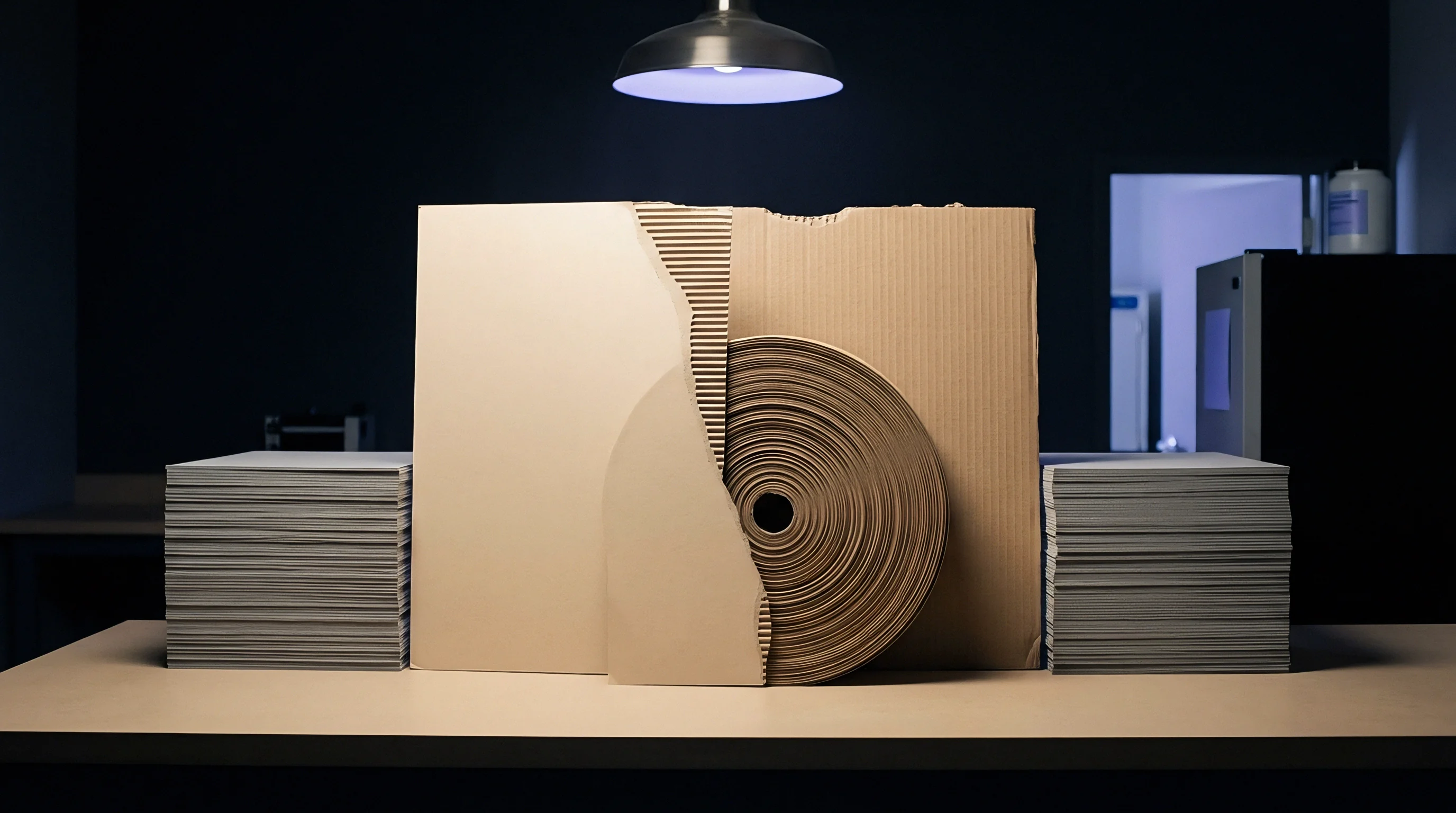

Delamination
Coated folding boxboard and solid bleached sulphate behave under scoring dies as multi-ply laminar structures designed to shear internally without surface rupture. The mineral coating formulation carries pigment volume concentrations between sixty and seventy-five percent, bound with styrene-butadiene or styrene-acrylic latexes. When the scoring rule drives the coated sheet into a female counter matrix, tensile strain develops across the convex top surface.
Compressive forces consolidate the bottom liner against the die channel. Internal shear failure separates individual fibre plies within the core, forming a controlled internal pocket or hinge. Successful creasing creates this delamination deliberately along the z-directional plane.
Absent this internal separation, the outer coating layer absorbs the entire bending tension during ninety-degree or one-hundred-and-eighty-degree folding on high-speed folder-gluers.
Fibre morphology determines the width and stability of this internal delamination zone. Virgin chemical kraft plies in solid bleached sulphate grades distribute shear stress across long softwood and hardwood fibres, yielding a wide delamination zone with low bending moment. Folding boxboard grades with mechanical pulp cores rely on the stiffness of groundwood or thermomechanical pulp to resist through-thickness collapse while allowing middle-ply fracture.
The score line fails when tension exceeds the stretch limit of the mineral coating. Coated surfaces accommodate between 1.5 percent and 2.8 percent elongation before micro-fissuring appears across the score ridge.
ISO 5628 specifies the two-point loading geometry that links carton panel bending stiffness directly to score line springback force.
Laminating plastic films or applying heavy aqueous coatings shifts the neutral axis of the composite board outward. This repositioning increases the strain on outer plies during carton erection. Tooling geometry balances penetration depth against channel width to isolate the shear fracture strictly between the pigment layer and the backing plies.
- Tear shear rupture occurs along the score boundary when excessive male rule penetration shears all plies simultaneously, destroying carton panel rigidity.
- Coating craze cracking appears on the outer surface when insufficient internal delamination forces the pigment layer to carry full tensile elongation during carton folding.
- Liner bead rollover develops when excessive channel width allows the board to buckle sideways rather than seating into the matrix cavity.
- Flaking coating pick takes place on high-speed gluer pre-breakers when brittle binder polymers detach from unyielding base sheet fibres under rapid deflection.
Inadequate core shear during initial scoring produces uneven panel deflection during final glue seam compression, causing skewed glued joints and rejected cartons at the filling station.

Channel
Crease calculation protocols translate caliper into tooling dimensions for flatbed and rotary die-cutting platens. The male rule thickness corresponds to point sizes, where one point equals 0.353 millimetres or 0.014 inches. Standard folding carton conversions between 300 and 600 micrometres caliper rely on two-point rules measuring 0.71 millimetres wide.
The female matrix channel width derives from the sum of the rule thickness plus twice the board caliper, modified by a substrate-specific compaction coefficient. Virgin chemical boards tolerate tighter channel widths due to higher ply stretch. Recycled lined chipboards demand wider channels to prevent brittle middle plies from bursting under vertical tool loads.
Channel depth matches the uncompressed board thickness in standard carton die layouts. Deep channel settings compress the board shoulders without driving sufficient fibre delamination into the core. Shallow channel matrices crush the central bead, cutting through the liners.
| Board Grade | Caliper (µm) | Rule Width (pt / mm) | Channel Width (mm) | Channel Depth (mm) | Penetration (mm) |
|---|---|---|---|---|---|
| Solid Bleached Sulfate | 350 | 2 pt / 0.71 mm | 1.25 | 0.35 | 0.12 |
| Solid Bleached Sulfate | 450 | 2 pt / 0.71 mm | 1.45 | 0.45 | 0.18 |
| Folding Boxboard | 400 | 2 pt / 0.71 mm | 1.40 | 0.40 | 0.15 |
| Folding Boxboard | 550 | 3 pt / 1.05 mm | 1.95 | 0.55 | 0.22 |
| Coated Recycled Board | 450 | 2 pt / 0.71 mm | 1.55 | 0.45 | 0.16 |
| Coated Recycled Board | 600 | 3 pt / 1.05 mm | 2.10 | 0.60 | 0.24 |
Matrix selection separates steel counter plates from milled pertinax counters and phenolic composite channels. Pertinax counters maintain positional accuracy within five micrometres across large format dies. Milled channel profiles incorporate chamfered entry shoulders with radius curves between 0.10 and 0.15 millimetres.
Sharp metal edges cut the backing liner during rapid impression cycles. Flatbed platen pressure settings target a penetration depth equal to the counter depth minus board caliper compression allowance. Makeready tape adjustments beneath the cutting plate level local variations in machine bed deflection.
A 400 micrometre solid bleached sheet evaluated under TAPPI T 829 produces a crease stiffness ratio below 0.45 when rule penetration reaches 0.15 millimetres.
Rotary die-cutting operations require wider channel matrices than flatbed cutting presses. Rotary nips create tangential shear stresses as the curved cylinder contacts the sheet. The leading edge of the score channel receives impact forces before the trailing edge seats completely.
Compensating for rotary sweep requires broadening the counter channel by ten to fifteen percent over flatbed configurations.
- Rule height verification confirms that cutting rules measure 23.80 millimetres while crease rules measure between 23.25 and 23.45 millimetres on standard 18 millimetre dieboards.
- Channel alignment scanning detects lateral offset between the male rule centreline and the female matrix groove below twenty-five micrometres.
- Counter channel depth micrometer checks measure matrix floor wear across high-run production batches exceeding two hundred thousand impressions.
- Penetration pressure recording tracks tonnage across the platen to avoid over-compressing board shoulders while maintaining clean ply separation.
Contractual supply agreements specifying DIN 55437 crease quality levels bind converters to specific torque limits across delivery lots, invalidating warranty claims when tooling records prove improper matrix channel matching.

Moisture
Equilibrium moisture content governs the viscoelastic response of paperboard during scoring. Wood fibres plasticize when bound moisture lubricates internal hydrogen bonds within amorphous cellulose regions. Board conditioned to standard laboratory atmospheres of 23 degrees Celsius and 50 percent relative humidity contains between six and eight percent moisture by weight.
Storing pallets in unconditioned pressrooms causes outer sheet edges to lose or gain water rapidly. Dry sheets below five percent moisture lose ply shear compliance. The fibres become brittle, resisting delamination and cracking across the outer coating layer during rule impact.
Relative humidity shifts inside converting plants alter the physical dimensions of the board and change its mechanical properties. High moisture levels exceeding 9.5 percent soften the fibre matrix excessively. The board yields beneath the crease rule without generating localized shear delamination.
This produces a soft, indistinct score with excessive bending resistance.
Dry packaging board loses fibre ductility and cracks along outer coated surfaces under standard folder-gluer bending angles.
Mineral coating binders exhibit glass transition temperatures that interact with environmental thermal conditions. Styrene-butadiene latexes formulated for gravure or offset printability stiffen in cold plant conditions. When ambient plant temperatures fall below sixteen degrees Celsius, coating flexibility drops significantly.
Scoring cold pallets directly from freight docks guarantees micro-fissuring along the carton main creases.
| Relative Humidity (%) | Sheet Moisture (%) | Tensile Stretch (%) | Outer Coating Crack Risk | Delamination Efficiency |
|---|---|---|---|---|
| 30 | 4.2 | 1.2 | Severe | Low |
| 40 | 5.5 | 1.8 | Moderate | Acceptable |
| 50 | 6.8 | 2.4 | Low | Optimal |
| 65 | 8.4 | 3.1 | Minimal | Optimal |
| 80 | 10.2 | 3.6 | None | Poor |
Paperboard mills package reels and sheets inside moisture-barrier polyethylene wrap to preserve reel moisture targets. Opening skid wraps forty-eight hours before converting without environmental climate control exposes the material to seasonal hygroscopic drift. Conditioning lots within enclosed production halls stabilizes core moisture before the material meets the die platen.
Converters frequently claim that hard coating polymers cause carton flaking, while laboratory hygrometer testing reveals the warehouse stored the board at twenty-two percent relative humidity before die-cutting.

Recovery
Score performance directly dictates packaging line efficiency on automated high-speed cartoning machines. Modern packaging equipment erects, loads, and seals carton sleeves at speeds between three hundred and one thousand units per minute. Carton blanks travel through feeder belts where mechanical fingers or vacuum suction cups open the flattened sleeve across ninety degrees.
The crease line acts as a mechanical hinge whose stiffness must drop predictably after pre-breaking.
Bending moment measurements quantify this resistance. Unbroken board stiffness measured under ISO 2493 establishes baseline board rigidity. Crease bending resistance, measured according to ISO 5628 or TAPPI T 829, quantifies the force opposing folding at a ninety-degree angle.
The crease-to-board stiffness ratio defines score efficiency. An uncreased board possesses a ratio of 1.0. A properly scored and pre-broken packaging blank displays a ratio between 0.30 and 0.50.
Values above 0.55 cause cartons to resist square opening, jamming feeder tracks. Ratios below 0.25 indicate fractured liner plies, resulting in rounded cartons that jam downstream checkweighers and case packers.
Balanced score delamination yields square carton corners without bow on high-speed erection belts.
Pre-breaking stations inside the folder-gluer fold carton scores through one hundred and eighty degrees before releasing them back to the flat position. This folding sequence breaks residual hydrogen bonds within the delaminated hinge zone. Without pre-breaking, residual elastic memory creates outward springback force.
High springback pushes against cartoning guide rails, causing open flaps to foul automatic product inserters.
- Crease resistance ratio validation confirms that the force required to bend the score line remains below forty-five percent of base board stiffness.
- Pre-break angle inspection verifies that first and third crease scores undergo folding to one hundred and eighty degrees during gluer runs.
- Sleeve opening force tracking records the peak vacuum load needed to erect blanks inside cartoning magazines within forty milliseconds.
- Flap springback monitoring evaluates closure panel return angles following ninety-degree folding under hot-melt adhesive compression belts.
Increasing the width of the female matrix counter channel reduces the crease bending moment while widening the outer fold radius.