Non-Destructive In-Line Acoustic Wave Profiling of Polymer Laminated Score Delamination Dynamics
In-line acoustic wave profiling detects sub-surface polymer score delamination instantaneously at 300 m/min by measuring ultrasonic attenuation and phase shifts.
Pulse
Managing stress concentrations along a score line on polymer-laminated folding boxboard is a central structural challenge in high-speed packaging conversion. As male and female creasing dies compress the multilayer sheet, the primary mechanical goal is to force controlled shear failure within the fibrous core while keeping the outer polymeric barrier film intact. Standard destructive testing relies on off-line springback checks or cross-sectional optical microscopy after carton blanking.
These manual sampling methods miss the transient micro-delamination occurring dynamically at web speeds over two hundred meters per minute. High-frequency acoustic wave profiling addresses this blind spot by measuring real-time ultrasonic energy propagation directly across the scored hinge during production.
Transient mechanical excitation creates elastic waves that traverse the laminated structure. In a pristine polymer-laminated board, an acoustic pulse generated on one side of the score line travels through the compressed matrix, the adhesive interlayer, and the continuous extruded polymer film with predictable velocity and attenuation. Internal physical disruptions alter this path instantly.
Delamination between the polyethylene terephthalate barrier film and the top linerboard forms an air interface with extreme acoustic impedance mismatch. This microscopic boundary reflects elastic wave energy, shifts the spectral frequency distribution, and delays phase transit times. In-line acoustic wave profiling tracks these structural changes without stopping the web or damaging the barrier film.
Elastic wave propagation through a scored board laminate involves distinct acoustic modes. Surface Rayleigh waves travel along the immediate outer layer of the polymer film, directly probing film continuity, surface tension micro-fissures, and localized necking. Guided Lamb waves penetrate deeper, setting up symmetric and antisymmetric vibrational modes through the full thickness of the board.
Symmetric modes compress and expand the sheet across its caliper, making them highly sensitive to core crushing and fiber matrix splitting. Antisymmetric modes induce shear stress along the adhesive interface, which isolates sub-surface polymer film debonding before catastrophic tearing takes place.
Exciting these acoustic modes on an active converting line requires non-contact methods. Traditional contact transducers require liquid couplants or physical pressure probes that ruin surface coatings, leave oily residue on food-grade packaging, or tear thin polymer films at high line speeds. Non-contact setup uses focused thermoelastic laser pulses or air-coupled piezoceramic transducers.
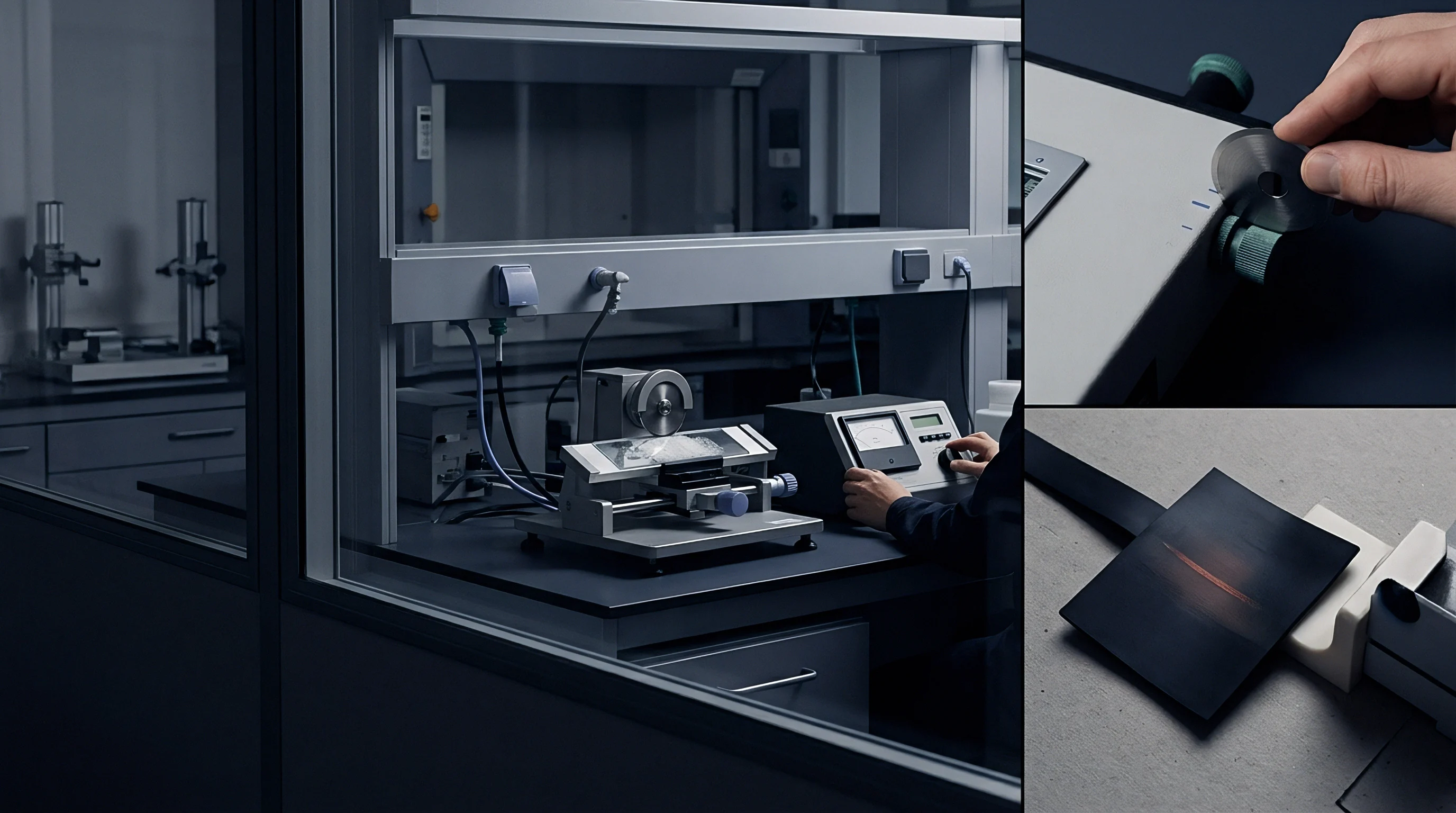
Thermoelastic excitation uses a low-power pulsed laser to induce localized thermal expansion on the board surface without optical ablation or thermal burning. This rapid expansion launches broadband ultrasonic acoustic pulses across the score geometry toward receiver sensors downstream.
Score delamination dynamics depend heavily on the viscoelastic relaxation profile of the polymer laminate. Extruded low-density polyethylene responds differently under rapid impact than oriented polypropylene or metalized PET films. High line speeds decrease effective loading time during die impact, pushing the polymer toward brittle fracture mechanics rather than ductile elongation.
As the scoring rule strikes the sheet, stress moves through the fibrous plies to the polymer interface. If the bond lacks sufficient strength or the adhesive shear modulus fails under high strain rates, interfacial delamination forms micro-cracks that run along the score axis.
25 megahertz air-coupled transducers detect interfacial debonding voids down to forty micrometers under controlled conditioning of 23 degrees Celsius and 50 percent relative humidity.
Fiber alignment relative to the machine direction shifts the acoustic energy path across the score. When scoring runs parallel to the grain, wave attenuation along the hinge increases noticeably because of the looser fiber matrix geometry. Scoring perpendicular to the grain maintains tighter fiber compaction, allowing higher acoustic energy transmission across the fold.
In-line acoustic profiling systems continuously normalize frequency spectrum signals against fiber direction data, confirming that changes in attenuation stem from actual polymer debonding rather than baseline density variations in anisotropic board.
Capturing these dynamic acoustic signatures in real time demands fast processing. Digital signal processing units collect high-frequency voltage traces from optical interferometric receivers, running windowed Fast Fourier Transforms to convert temporal wave signals into spectral energy distributions. Intact score lines maintain stable energy transmission across higher harmonic frequencies.
Scores with sub-surface polymer delamination show rapid attenuation above two megahertz, along with secondary arrival pulses caused by wave reflections off internal air pockets within the debonded layer.
Installing acoustic profiling hardware directly on creasing and packaging lines turns monitoring from a post-run failure log into active process correction. Scored blanks moving through high-speed folder-gluers undergo continuous acoustic evaluation, allowing automated ejection gates to clear defective cartons before filling operations. The physical interaction between acoustic wave mechanics and score delamination dynamics offers a precise record of sheet performance under operational strain rates.
Continuous monitoring of these acoustic frequency shifts determines the exact threshold where acceptable core ply splitting transforms into unacceptably loose barrier film separation. What absolute mechanical energy limit separates stable micro-flexing of the polymer film from micro-delamination that degrades shelf-life barrier performance across long-term packaging storage?
Transducer
In-line transducer deployment on a continuous converting press requires hardware built to extract faint acoustic signals from significant background noise. The area around a rotary or flatbed die cutter experiences heavy low-frequency vibration, hydraulic noise, and turbulent air boundary layers driven by web speeds over three hundred meters per minute. Picking up megahertz-range acoustic waves emitted through a moving polymer-laminated board takes sensor geometries designed specifically for non-contact, high-frequency capture.
Air-coupled piezoceramic transducers offer a practical non-contact option for score profiling. These transducers use specialized acoustic impedance matching layers ~ built from low-density foam or porous silicone matrices ~ to bridge the large impedance gap between the ceramic active element and ambient air. Standard piezoceramic materials show acoustic impedance values near thirty megarayls, whereas ambient air sits near four hundred rayls.
Without matching layers, over ninety-nine percent of the acoustic wave energy reflects back into the transducer face. Composite matching layers minimize these reflection losses so enough ultrasonic energy couples into ambient air, passes through the moving board score, and reaches the receiver sensor face.
Optical acoustic sensors provide an alternative that avoids air-based acoustic attenuation entirely. Laser Doppler vibrometers and optical microphone interferometers measure surface displacement caused by arriving acoustic waves directly on the polymer film. A low-power laser beam focuses on the moving web along the score shoulder.
As elastic waves pass underneath, surface displacements down to the sub-nanometer scale induce phase shifts in the reflected laser light. The optical microphone reads these phase shifts against an internal reference path, converting mechanical surface motion into clear high-frequency electric signals without touching the board.
| Sensing Technology | Operating Bandwidth | Signal-to-Noise Ratio at 250 m/min | Stand-Off Distance | Capital Cost per Line |
|---|---|---|---|---|
| Air-Coupled Piezoelectric Array | 100 kHz to 2.5 MHz | 18 dB | 5 mm to 15 mm | Low to Moderate |
| Laser Thermoelastic Generation with Optical Microphone | 500 kHz to 20 MHz | 34 dB | 20 mm to 100 mm | High |
| Electromagnetic Acoustic Transducer (EMAT) | 250 kHz to 5 MHz | 12 dB | 1 mm to 3 mm | Moderate |
| Focused Gas-Coupled Laser Interferometry | 1 MHz to 15 MHz | 28 dB | 10 mm to 50 mm | High |
Optimizing the signal-to-noise ratio depends on narrow-band pitch-catch sensor geometries aligned across the score line. Transmitters sit on the inner face of the crease at an angle chosen relative to the sheet normal, matching the phase velocity of Lamb waves within the board caliper. Angle selection uses Snell’s Law for acoustic refraction across the air-polymer interface.
Precise alignment maximizes guided wave excitation while suppressing airborne acoustic signals that bypass the sheet and hit the receiver sensor directly.
Transient line noise requires dedicated hardware and software filtering. Continuous web movement builds up electrostatic charge on the polymer film, inducing electrical noise in unshielded transducer cables. Solid Faraday shielding, differential signal amplifiers, and optical transmission lines protect micro-volt acoustic signals from electromagnetic interference driven by nearby high-power press drive motors.
Spatial signal averaging across consecutive board scores filters out transient noise caused by localized web flutter or air pressure drops.
Score failure modes alter acoustic signatures in predictable ways during high-speed runs. Analyzing these attributes involves dynamic classification based on spectral content, arrival times, and overall wave attenuation across the crease axis.
- Micro-debonding at polymer interface manifests as localized high-frequency amplitude loss above 3 MHz without altering low-frequency baseline transmission velocity across the score.
- Deep fiber shear cracking causes pronounced phase delays in symmetric Lamb wave modes and shifts the primary spectral peak toward lower frequency bands.
- Polymer film necking and pinholing introduces high-frequency dispersion patterns and creates asymmetrical acoustic wave propagation vectors relative to the fold axis.
- Adhesive layer shear rupture produces complete loss of high-frequency signal coherence accompanied by secondary reflection signals occurring within a 0.5 microsecond window.
Standard ISO 12647 converting tolerances drop to zero when unrecorded score delamination leads to barrier breakdown on automated liquid filling lines.
Signal acquisition hardware connects to field-programmable gate arrays running real-time signal classification. Waveform envelopes are checked continuously against reference baselines recorded during press make-ready. When a score line suffers structural debonding, the acoustic wave peak-to-peak voltage drops past pre-programmed threshold limits, telling the control system to log the fault coordinate or activate physical rejection gates.
Positioning sensors relative to the creasing die unit comes with trade-offs. Mounting acoustic transducers directly inside the rotary die cylinder gives immediate feedback, but exposes delicate optical alignment mirrors to dust created during board shearing. Placing sensors thirty centimeters downstream allows dust extraction hoods to clear the sheet surface, though it adds a slight transport delay to the rejection loop.
Modern high-speed air-coupled sensors are engineered to function despite substrate dust, press vibration, and web instability. In practice on the converting floor, fine cellulose dust settling on transducer matching layers slowly degrades acoustic sensitivity over an eight-hour shift, requiring periodic automated compressed air purges to hold calibration.
Interface
The boundary where an extruded polymer film meets the board substrate determines whether a score hinge flexes smoothly or delaminates under mechanical strain. Scoring forces the board into a male-female channel, stretching the outer polymer film while compressing the inner board plies. This strain causes rapid elongation in the polymer film.
If the bond between the polymer layer and the top linerboard fails to distribute these shear forces evenly, localized debonding forms along the score shoulder.
Interfacial bond strength depends heavily on surface energy preparation during extrusion coating or film lamination. Corona treatment, flame treatment, or chemical primers boost the surface energy of polyolefin films like polyethylene or polypropylene, taking it from a baseline thirty-two dynes per centimeter up to forty-four dynes per centimeter or higher. Over extended storage, surface energy drops due to additive migration and ambient moisture absorption.
Lower surface energy reduces mechanical keying and hydrogen bonding between the molten polymer and cellulose fibers, creating weak spots vulnerable to delamination under creasing dies.
| Material Layer | Density (kg/m³) | Longitudinal Wave Velocity (m/s) | Calculated Acoustic Impedance (MRayl) | Thickness Range (µm) |
|---|---|---|---|---|
| Low-Density Polyethylene (LDPE) | 920 | 1950 | 1.79 | 15 to 30 |
| Oriented Polyethylene Terephthalate (OPET) | 1400 | 2250 | 3.15 | 12 to 25 |
| Solventless Polyurethane Adhesive Layer | 1150 | 1680 | 1.93 | 2 to 5 |
| Bleached Hardwood Top Linerboard | 850 | 2800 | 2.38 | 40 to 80 |
| Unbleached Softwood Core Plies | 620 | 1850 | 1.15 | 200 to 400 |
| Delamination Air Void Interface | 1.2 | 343 | 0.00041 | 1 to 50 |
Acoustic wave propagation across this multilayer structure reveals how interfacial stress is distributed. Sound waves move at different speeds through each layer, governed by material density and elastic moduli. When an acoustic pulse moves from the top linerboard into the polymer film, part of the wave energy passes through the boundary while part reflects back into the board layer.
The reflection coefficient depends on the acoustic impedance difference between adjacent materials.
A clean interface with proper chemical bonding and continuous contact transfers acoustic wave energy efficiently with minor reflection loss. When creasing forces cause micro-delamination, a thin pocket of air separates the polymer film from the paperboard fibers. Because the acoustic impedance of air is orders of magnitude lower than that of polymer or paperboard, the reflection coefficient at the debonded interface jumps close to one hundred percent.
The acoustic wave stays trapped inside the paperboard or polymer layer, blocking signal transmission across the score hinge and casting an acoustic shadow onto downstream receivers.
Are In-Line High-Frequency Acoustic Sensors Operational at Three Hundred Meters per Minute?
Operating at high web speeds requires sub-millisecond signal acquisition and processing routines capable of isolating score signals within tight spatial windows. At three hundred meters per minute, a scored carton blank travels five millimeters every millisecond. To hold a spatial sampling resolution of one millimeter along the score axis, the acoustic emitter must fire at pulse repetition frequencies above five kilohertz.
Laser thermoelastic systems comfortably hit these repetition rates, whereas high-power piezoceramic pulser circuits need dedicated cooling and fast discharge electronics to perform consistently at high speed.
Creasing matrix alignment directly influences interfacial stress concentrations. Excess creasing rule width crushes the core without forming clean outer fold shoulders, forcing the polymer film to stretch over too wide a radius. Insufficient die channel depth creates extreme physical pinching that shears the polymer film along the score axis.
In-line acoustic profiling catches both issues: incorrect channel width causes broad signal attenuation across a wide spatial band, while excessive die depth produces sharp, localized dropouts in surface Rayleigh wave transmission.
A two-dyne drop in film surface energy below forty-two dynes per centimeter triples the rate of micro-delamination along score shoulders on high-speed packaging lines.
Sensor gating parameters are adjusted using web encoder pulses to ensure signal sampling occurs right as the score line passes the measurement zone. Windows that open early read uncompressed sheet noise, while late windows miss the score shoulder region where delamination starts.
Skipping routine calibration of scoring rule depth and matrix width allows progressive interfacial debonding to go unnoticed during converting, leading to pallet returns when end users open ruptured package corners on shelf.
Attenuation
Evaluating score integrity relies on tracking changes in acoustic wave attenuation and phase spectrum distributions. As an elastic wave travels through a porous, viscoelastic medium like paperboard, material damping turns mechanical vibrational energy into minor local heat. Polymer laminates add noticeable frequency-dependent viscoelastic damping, with higher frequencies undergoing steeper attenuation than lower ones.
Scored board shows even higher attenuation due to localized structural damage, broken fibers, and micro-voids across the crease radius.
Modeling wave attenuation across a score hinge uses the spatial decay coefficient, written in decibels per millimeter. By comparing attenuation across a compressed, intact score line against a baseline unscored sheet, processing software calculates a normalized acoustic integrity index. An intact score shows a small increase in attenuation from localized fiber compaction.
A score with sub-surface polymer delamination exhibits a large spike in attenuation caused by wave scattering off internal air voids and lost interfacial coupling.
Calibrating in-line profiling systems requires setting accurate baseline parameters on production machinery before running main commercial volumes. The commissioning process uses reference standards to train digital signal processing units on acceptable thresholds.
- Mount high-frequency acoustic transmitters and optical receiver probes on rigid, vibration-isolated cross-members immediately following the creasing matrix unit.
- Connect master rotary shaft encoders to the acoustic trigger control module to synchronize acoustic pulse firing with precise web positions down to fifty micrometers.
- Pass an unlaminated baseline paperboard sheet through the line at low speed to establish raw substrate acoustic wave velocity and bulk attenuation curves.
- Run a fully laminated reference roll with known optimal surface dyne levels and verified adhesive bond strength to record clean, intact score acoustic envelopes.
- Induce controlled score delamination defects by progressively lowering creasing rule depth in steps of twenty micrometers, capturing defect signature spectra across all working line speeds.
- Program real-time Fast Fourier Transform filters to set automated drop-out thresholds based on specific high-frequency spectral attenuation bands between two and ten megahertz.
Phase velocity measurements add detail to amplitude attenuation data. As acoustic waves pass through a delaminated zone, the wave energy must detour around internal air gaps or shift into slower surface wave modes along the separated polymer layer. This extra distance and mode shift delays the acoustic wave’s arrival time at the receiver sensor.
Tracking phase delay down to nanosecond precision allows processing systems to calculate the physical width of the internal delamination zone across the score.
Signal attenuation spikes exceeding fourteen decibels per millimeter at five megahertz indicate complete interfacial debonding across the scored polymer layer.
Viscoelastic damping within the adhesive layer between the barrier film and the paperboard core changes the acoustic decay profile as temperatures fluctuate. On warm summer converting floors where press temperatures reach thirty-five degrees Celsius, the adhesive layer softens, increasing acoustic wave damping independent of structural delamination. Profiling software compensates for ambient temperature shifts using thermal sensors positioned directly above the web, dynamically adjusting signal acceptance thresholds relative to live ambient temperature readings.
Quality assurance standards increasingly require traceable, continuous non-destructive monitoring data for high-barrier packaging runs. Contracts for foil-and-polymer laminated liquid packaging board regularly include explicit terms requiring every square meter of converted material to undergo continuous acoustic profiling, with automatic ejection for any batch showing acoustic attenuation dropouts past sixteen decibels sustained over five consecutive score centimeters.

Damping
Environmental conditions and material moisture regain strongly affect board flexural stiffness, polymer ductility, and acoustic wave damping profiles. Cellulose fibers are naturally hygroscopic, exchanging water vapor with ambient air until reaching equilibrium moisture content. Standard laboratory conditioning under ISO 187 calls for testing at twenty-three degrees Celsius and fifty percent relative humidity, giving a stable board moisture content around six to seven percent by weight.
Converting plants rarely maintain controlled conditions year-round, with plant humidity shifting between twenty percent in winter heating conditions and eighty percent during summer months.
When relative humidity rises, paperboard absorbs water into its amorphous cellulose zones, breaking hydrogen bonds between fibers. This plasticization reduces the elastic modulus of the paperboard while increasing its viscoelastic damping loss factor. An acoustic wave passing through high-moisture paperboard loses energy rapidly to internal friction between loosely bound fibers, producing attenuation profiles that closely mirror structural score delamination defects.
| Substrate Moisture Content (%) | Crease Rule Compression Depth (mm) | Bulk Board Elastic Modulus (GPa) | Baseline Wave Attenuation (dB/mm at 2 MHz) | Delamination Signal Attenuation Spike (dB/mm) |
|---|---|---|---|---|
| 4.5 (Dry / Winter) | 0.35 | 6.8 | 4.2 | +18.5 |
| 6.5 (Standard ISO) | 0.35 | 5.4 | 5.8 | +15.2 |
| 8.5 (Humid / Summer) | 0.35 | 3.9 | 8.9 | +11.1 |
| 4.5 (Dry / Winter) | 0.50 | 6.8 | 6.1 | +22.1 |
| 6.5 (Standard ISO) | 0.50 | 5.4 | 7.9 | +17.8 |
| 8.5 (Humid / Summer) | 0.50 | 3.9 | 11.4 | +12.4 |
In low humidity, paperboard loses moisture and becomes stiff and brittle. Under scoring dies, dry fiber matrices cannot undergo smooth plastic deformation, leading to severe fiber fracture and micro-cracking along the fold hinge. Dry polymer films also exhibit reduced impact resistance, raising the risk of interfacial shear delamination.
Acoustic profiling systems running in dry plants detect sharp, sudden dropouts in wave transmission corresponding to brittle structural cracking along the score axis.
Distinguishing moisture-induced acoustic damping from true interfacial polymer delamination requires multi-frequency wave analysis. Higher moisture content raises baseline attenuation evenly across frequency bands, shifting the overall response curve downward without introducing localized phase distortion. Mechanical delamination creates sharp, frequency-selective dropouts that scatter specific short-wavelength high frequencies while leaving longer-wavelength low frequencies relatively unaffected.
In-line profiling software uses multi-frequency algorithm ratios to isolate physical debonding signals from ambient moisture variations.
Polymer film glass transition temperature is another factor controlling damping behavior during scoring passes. Polyethylene has a low glass transition temperature well below zero degrees Celsius, remaining flexible under ambient plant conditions. Polyethylene terephthalate and oriented polypropylene have glass transition temperatures significantly above ambient room levels, making their acoustic damping profiles sensitive to press temperatures and high strain rates.
During high-speed scoring on PET laminates, friction from rapid die impact warms the polymer layer locally, temporarily lowering its storage modulus and altering wave propagation velocity.
Automated decision matrix checklists at the press verify whether an acoustic attenuation alarm stems from substrate moisture shifts or true interfacial bond failure.
- Check ambient environmental sensors to confirm that converting plant relative humidity stays strictly within thirty-five percent to sixty-five percent working parameters.
- Verify board surface moisture using non-contact infrared moisture meters positioned immediately upstream of the creasing rule station.
- Evaluate multi-frequency attenuation ratios to confirm that signal dropouts concentrate above three megahertz rather than across the broad acoustic spectrum.
- Inspect high-speed optical camera snapshots of score shoulders to cross-examine surface Rayleigh wave attenuation against visible polymer film necking or surface pinholes.
- Validate creasing matrix depth settings against caliper gauges to ensure tool wear has not altered compression geometry during long production runs.
Substrate moisture shifts above eight percent attenuate broad-spectrum acoustic signals uniformly, whereas physical interface delamination creates sharp frequency-selective dropouts above three megahertz.
Understanding these environmental and material interactions allows plant engineers to adjust line controls dynamically. When processing dry board rolls during winter production runs, operators can increase scoring matrix width slightly and engage local web humidifiers, preventing brittle fiber fracture while keeping acoustic monitoring baselines stable.
A reliable operational benchmark is that any sharp acoustic attenuation change occurring over less than two meters of web travel reflects physical tool damage or interfacial delamination, whereas gradual signal shifts over hundreds of meters stem from ambient moisture drift across the master board roll.

Margin
Implementing non-destructive in-line acoustic wave profiling on continuous converting lines is a significant capital decision evaluated through scrap reduction, avoided customer claims, and material yield optimization. High-barrier packaging ~ especially for liquid food, pharmaceuticals, and sensitive cosmetics ~ requires absolute polymer barrier continuity across every scored carton edge. A single undetected micro-delamination defect along a score line can cause oxygen ingress, liquid leakage, or product spoilage inside sealed packages, exposing converters to financial claims and damaged brand reputation.
Financial evaluation models weigh the capital cost of non-contact acoustic profiling hardware against the landed cost of converting waste and quality failures. Traditional off-line destructive testing requires technicians to cut score samples from finished Blanks every two thousand sheets, preparing cross-sections for microscopic check or running manual liquid dye penetration tests. These manual checks destroy sellable inventory, take upwards of twenty minutes per sample, and leave thousands of sheets produced between test intervals exposed to hidden defects.
In contrast, automated in-line acoustic profiling inspects one hundred percent of scored Blanks at full production speeds without destroying a single package unit. When acoustic sensors detect an interfacial debonding event, the line control system triggers an ink-jet mark or activates a downstream air-ejector gate to divert the defective blank to scrap bins. Eliminating the risk of shipping compromised barrier cartons saves converters tens of thousands of dollars per rejected production lot in potential product liability and return logistics costs.
In-line acoustic profiling supports material yield optimization by allowing converters to run thinner polymer barrier films safely. Safety margins frequently prompt brand owners to specify thicker polymer coatings ~ such as thirty-micrometer extrusion coatings instead of eighteen-micrometer layers ~ simply to hedge against unmonitored score delamination risks during conversion. Continuous, automated acoustic monitoring provides reliable quality assurance, allowing packaging engineers to down-gauge polymer layers to minimum structural limits.
Thinner films reduce raw material costs while improving package recyclability under European Extended Producer Responsibility fee structures that penalize high plastic fractions in paperboard packaging.
Calculating the operational break-even point for high-speed acoustic profiling installations involves evaluating scrap savings across high-volume barrier carton orders. On a converting line producing forty million liquid barrier cartons annually, a baseline off-line defect rate of 0.15 percent means sixty thousand compromised packages reach shipping pallets or cause off-line downtime. Non-destructive acoustic detection catches these defects at the creasing die, saving raw material costs, reducing post-converting inspection labor, and preventing field failures.
The landed cost of an installed dual-channel laser thermoelastic or air-coupled acoustic profiling system depends on line width, web speed, and integration complexity. System payback periods typically range between eight and fourteen months for high-volume barrier folding boxboard converters, driven primarily by raw material savings from thin-film downgauging and zero-defect delivery guarantees required by contract terms. Continuous data collection from acoustic wave sensors feeds directly into plant quality databases, generating traceable digital compliance certificates for every manufactured pallet roll.
In-line acoustic wave profiling transforms polymer score evaluation from an imprecise, destructive spot check into a continuous, data-driven system. By measuring elastic wave behavior directly at production speeds, converters protect structural barrier integrity, optimize raw material usage, and ensure consistent score performance across demanding packaging supply chains.