Optimizing Crease Tooling Parameters for Coated Recycled Paperboard
Optimizing crease tooling for coated recycled paperboard demands expanding counter channel widths to 1.65 times caliper to induce controlled ply delamination.
Channel
Die-cutting platens strike coated recycled paperboard with blunt steel rules to drive the sheet into matching counterplate grooves, forcing controlled internal rupture while preserving the clay-coated exterior surface. Setting these dimensions for recycled grades demands wider gaps than virgin boards tolerate. Where virgin sulphate pulp accommodates sharp deformation through long, elastic softwood fibres, recycled chipboard contains mechanically beaten, shortened fibres and mineral fillers that shear abruptly under concentrated compression.
The standard tooling calculation for recycled paperboard adjusts both groove width and rule depth to establish a wide, rounded internal hinge bead.
A 450-micrometre coated recycled board tested under ISO 187 at 23 degrees Celsius and 50 percent relative humidity yields clean 90-degree folds only when groove clearance reaches 1.65 times caliper plus rule width.
Tooling engineers calculate female groove width using the formula W = 1.65t + Pt, where W equals the final groove width, t represents measured sheet thickness, and Pt identifies the creasing rule point thickness. Virgin folding boxboard operates comfortably at W = 1.30t + Pt to 1.40t + Pt. Applying virgin dimensions to coated recycled paperboard splits the white patent-coated top liner along the score shoulder. The mineral coating cannot elongate past 1.5 percent strain.
Widening the groove drops the shoulder tension, pushing bending strain inward toward the unprinted grey backing plies.
Rule Thickness and Penetration Depth
Creasing rule selection begins with sheet caliper. For boards measuring between 350 and 550 micrometres, a two-point rule measuring 0.71 millimetres wide provides sufficient bearing surface to depress the sheet without cutting surface fibres. Boards exceeding 600 micrometres utilize three-point rules measuring 1.05 millimetres.
Rule height dictates penetration into the counterplate matrix. Calculated penetration depth follows the formula D = (H – h) – c, where H is the creasing rule height, h is the cutting knife height, and c represents the counterplate thickness.
Standard cutting knives run at 23.80 millimetres. A pairing creasing rule running at 23.32 millimetres provides 0.48 millimetres of relative clearance. If the counter channel depth matches the exact board caliper, the rule pinches the sheet at bottom dead centre, crushing the internal ply structure into powder rather than separating the layers into intact shear lamellae.
The tool penetration into the female counter must leave a clearance gap equal to 85 to 90 percent of the uncompressed sheet thickness at bottom dead centre.
Calculated Clearances for Multi-Ply Furnish
Furnish composition dictates specific adjustments across commercial basis weights. Coated recycled paperboard incorporates multiple individual plys: an outer top liner of bleached chemical pulp, an under-liner of sorted unprinted ledger, a heavy centre filler composed of mixed waste papers with high ash content, and a bottom back liner of sorted newsprint or kraft shavings. Each layer carries a distinct modulus of elasticity.
| Substrate Classification | Caliper (µm) | Grammage (g/m²) | Rule Gauge (pt) | Groove Width (mm) | Groove Depth (mm) |
|---|---|---|---|---|---|
| Coated Recycled Board | 350 | 280 | 2 pt (0.71 mm) | 1.29 | 0.35 |
| Coated Recycled Board | 450 | 350 | 2 pt (0.71 mm) | 1.45 | 0.45 |
| Coated Recycled Board | 550 | 430 | 3 pt (1.05 mm) | 1.96 | 0.55 |
| Solid Bleached Sulphate | 350 | 260 | 2 pt (0.71 mm) | 1.17 | 0.35 |
| Solid Bleached Sulphate | 450 | 330 | 2 pt (0.71 mm) | 1.30 | 0.45 |
| Coated Unbleached Kraft | 450 | 320 | 2 pt (0.71 mm) | 1.25 | 0.45 |
Converters running high recycled contents expand channel widths toward the upper tolerance limit when humidity drops. When in doubt on recycled board, open the groove width before reducing rule penetration.

Ply
Laminating separate fibrous slurries on a multi-ply cylinder or fourdrinier former creates distinct internal boundaries. In coated recycled board, these boundaries serve as predetermined shear planes. Successful folding requires internal delamination along these planes under the rule impact.
Rather than stretching like virgin chemical cellulose, the recycled core separates into distinct, unbonded horizontal sheets. These sheets slip over one another inside the crease bead, forming a pocket that relieves bending tension from the top liner.
Delamination planes in recycled board function like structural expansion joints during high-speed folding operations.
Scott Bond internal ply strength, evaluated under TAPPI T 569, measures this resistance. Virgin cartonboards report Scott Bond values between 250 and 350 J/m². Coated recycled board presents lower values, typically spanning 110 to 180 J/m².
If the Scott Bond drops below 100 J/m², the sheet exhibits spontaneous surface blistering during die extraction. If the value exceeds 200 J/m² on a recycled board containing short fibres, the plies refuse to delaminate during scoring. The top coating then splits wide open during 180-degree pre-breaking.

Internal Delamination Mechanisms under Score Pressure
When the creasing steel strikes the coated surface, transverse shear stress propagates through the board thickness. The mechanical process resembles shear displacement between bound laminates in heavy structural beams. Recycled fibres in the core have experienced multiple drying and re-wetting cycles, creating low individual tensile strength and stiff, hornified cell walls.
Compression forces the brittle core fibres to detach from the starch adhesive matrix holding the plies together.
Failure to balance the shear field generates specific converting defects:
- Liner tensile bursting manifests as clean fracture lines running parallel to the rule edge across the printed surface. Tensile strain exceeds the coating stretch limit.
- Internal shear shearout occurs when excessive rule height punches directly through the sheet instead of inducing horizontal slip. The anvil edge cuts the core plies clean.
- Bead rollover develops when asymmetric tool alignment forces the crease bead toward one channel shoulder. The folded carton corner skews out of square during gluing.
- Flaking coating detachment strips the mineral formulation from the chemical top liner along the crease ridge. Calcium carbonate binder ratios fall below required flexible thresholds.
Does Higher Density Demand Wider Counter Channels?
Apparent density in coated recycled board directly governs resistance to compressive displacement. Low-density boards with high bulk compress easily into narrow grooves. High-density recycled boards, calendered aggressively to meet smoothness requirements for gravure or fine-screen flexography, present elevated resistance.
These compacted plies cannot compress downward. They displace laterally into the counter channel voids.
A buyer faced with high-density board widens female counter grooves by an additional 0.05 to 0.10 millimetres over standard formulas. Failure to provide this void space causes hydraulic lock within the dense fibrous core, transferring kinetic force directly to the white top liner. The coating fractures immediately.
Mills occasionally defend cracked cartons by asserting that the converter ran the die platen two thousandths of an inch too deep for the delivered furnish.

Bed
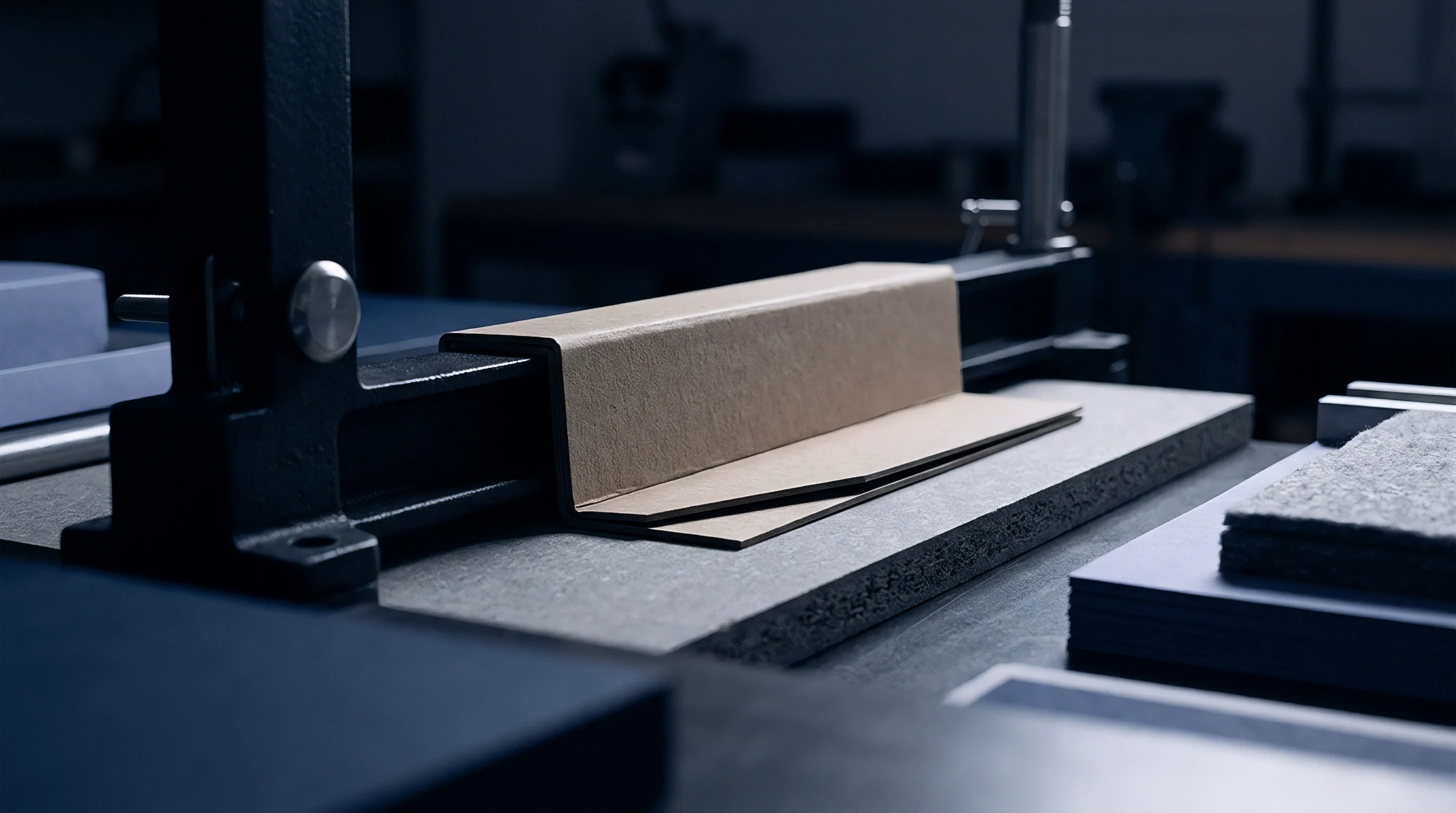
Flatbed and rotary die-cutting systems transfer cutting and creasing pressures through opposing mechanical surfaces. The flatbed platen provides uniform vertical penetration along the entire sheet length during each stroke. Rotary units subject the board to continuous progressive nip mechanics, where crease formation occurs over a dynamic contact zone spanning a few milliseconds.
In both configurations, the counterplate bed supports the female matrix that directs board displacement around the creasing edge.
Hardness across the counterplate bed controls score definition over production runs exceeding one hundred thousand impressions.
Milled Pertinax counterplates dominate commercial folding carton conversion for coated recycled grades. Pertinax, a phenolic resin-bonded paper composite conforming to DIN 7735 grade HP 2061, provides rigid dimensional stability and crisp channel shoulders. Hand-applied plastic channel matrix strips remain standard for short test runs, but the adhesive backing permits lateral creeping under heat and pressure.
Channel matrix strips shift up to 0.08 millimetres over an eight-hour shift on abrasive recycled boards, closing the groove clearance and initiating score cracking.
Counterplate Composition and Wear Profiles
Recycled paperboard contains high concentrations of residual abrasives, including calcium carbonate, clay fillers, and trace silica from post-consumer collection streams. These particles scour steel rules and counter channels under production loads.
| Counterplate Material | Shore D Hardness | Channel Width Drift Per 100k Hits | Dimensional Swell At 70% RH | Run Life Limit (Impressions) |
|---|---|---|---|---|
| Pertinax Phenolic Composite | 85 to 90 | +0.04 mm | 0.12 percent | 150,000 |
| Milled Steel Plate | 120 to 130 | +0.01 mm | 0.00 percent | 1,000,000 |
| Polymer Film Matrix Strip | 70 to 75 | +0.09 mm | 0.25 percent | 35,000 |
| Epoxy Resin Cast Counter | 80 to 85 | +0.06 mm | 0.15 percent | 80,000 |
| Test methodology tracks abrasive widening across 1.45 mm channels under 350 g/m² CRB at 6,500 sheets per hour. | ||||
Steel counterplates prevent channel widening, maintaining exact crease dimensions across multi-million container contracts. Pertinax provides a middle ground for orders running between fifty thousand and one hundred fifty thousand sheets. The material machines cleanly on dedicated flatbed milling plotters equipped with carbide engraving bits.
Make-Ready Calibration on Recycled Substrates
Setting up the platen bed requires systematic leveling to accommodate basis weight and caliper drift inherent to recycled furnishes. Press operators employ carbon impression paper to balance cutting rule contact before introducing the creasing package. The operational sequence relies on specific hardware checks:
- Hardness assessment validates the backing plate baseline at minimum 60 Rockwell C to prevent rule deflection.
- Spot sheet leveling uses thin 0.03-millimetre tissue under the cutting plate to eliminate uneven platen impressions across the sheet format.
- Channel depth verification measures milled counter pockets with optical micrometres to confirm uniform vertical clearance.
- Positioning pin registration locks the counterplate to the die board within 0.02 millimetres across all corner reference marks.
The industry leaves unresolved how high-speed rotary anvils can compensate dynamically for cross-web caliper shifts without causing instantaneous surface rupture.

Drift
Web production on multi-ply board machines generates dimensional variations across the deckle. Recycled furnish slurry settles unevenly across cylinder vats, producing localized caliper drift of plus or minus five percent from nominal targets. Machine operators at paperboard mills adjust wet-end slice openings to control basis weight, but moisture content varies independently.
When a converting plant receives stock running below five percent moisture, the fibrous matrix turns brittle, reducing fold endurance dramatically.
Caliper drift of thirty micrometres alters female groove clearance by ten percent across a single parent sheet.
Water content serves as a plasticizer for both cellulose fibres and surface coating binders. Testing under TAPPI T 412 reveals that coated recycled board reaching six to seven percent absolute moisture exhibits optimum creasability. Board stored in dry warehouse environments loses bound water rapidly, dropping to four percent or lower.
At this dryness, even perfectly calculated tooling parameters fail to prevent liner cracking. The score line shatters under tensile fold forces.
What Delamination Depth Prevents Carton Erection Jamming?
Automated cartoning machines demand uniform opening force from folded carton flats. Delamination must penetrate through fifty to sixty percent of total board caliper to lower carton opening resistance to acceptable operating windows. If the crease tool penetrates only thirty percent of the thickness, the unseparated plies act as a solid elastic spring, resisting 90-degree folding and causing erection feed jams.
Excessive penetration causes the reverse failure. Driving the tool through seventy-five percent of the sheet caliper destroys structural integrity entirely. The resulting carton side panels bow inward under top-load compression during pallet stacking, collapsing warehouse tiers.
The folding resistance test, conducted under ISO 2493 at a 15-degree angle, establishes the ratio between crease stiffness and uncreased board stiffness. High-performing recycled cartons maintain a crease ratio between 0.40 and 0.55.
Equilibrium Moisture and Cross-Deckle Caliper Variance
Converters resolve material drift through strict floor staging routines. Arriving pallets remain enclosed in polywrap barriers until sheet temperature reaches pressroom equilibrium. Opening reels or skid stacks in cold conditions induces condensation along outer edges, producing wet, expanded sheet margins and bone-dry centres.
- The plant logs delivered ambient temperature and relative humidity inside the staging bay across a twenty-four-hour acclimation hold.
- Floor inspectors strip packaging shrink films and measure core moisture using capacitive probe instruments across ten positions per skid.
- Press technicians adjust bottom dead centre platen pressure in increments of 0.02 millimetres to track cross-deckle thickness variations found during inspection.
- The lead operator inspects folded score samples under 10x magnification at five thousand sheet intervals to catch progressive liner splitting before batch completion.
Standard purchase specifications stipulate that board moisture content must remain between 6.0 and 7.5 percent at delivery under penalty of immediate lot rejection.
Spoilage
Converting economic viability hinges on folder-gluer waste rates and parent-sheet yield. Coated recycled paperboard trades at a discount against virgin solid bleached sulphate, typically offering twenty to thirty percent lower cost per metric ton. This furnish cost saving evaporates rapidly if poor creasing tooling parameters trigger carton splits on high-speed filling lines.
Carton gluer lines running at four hundred metres per minute cannot tolerate wandering scores or irregular opening resistance.
Assume a commercial packaging run of two million pharmaceutical secondary cartons converted from 450-micrometre coated recycled board. The plant commits 120 metric tons of board at a landed cost of 950 dollars per ton, totaling 114,000 dollars in substrate outlay. Virgin sulphate stock for the identical run commands 1,320 dollars per ton, representing 158,400 dollars.
The initial raw material differential favors the recycled stock by 44,400 dollars.
Folder-Gluer Jam Frequency and Line Velocity
Running recycled stock on narrow female channels increases crease stiffness by forty percent. The folder-gluer operator slows machine speed from fifty thousand cartons per hour down to twenty-eight thousand to prevent pre-breaking belts from skewing carton blanks. The production run lengthens from forty operating hours to seventy-one hours.
Plant overhead costs bill at 280 dollars per operating press hour, absorbing 8,680 dollars in additional machine run time.
Carton rejects during folding operations account for direct yield loss. When tooling is sized incorrectly for multi-ply board, liner cracking appears intermittently across sheets cut from the machine-direction edges. The plant rejects three percent of total die-cut blanks at the gluer inspection cameras, destroying 3,420 dollars in stock.
Finishing rework adds 1,800 dollars in handling labour.
Landed Tonnage Economics under Crease Failure Rates
Customer filling line performance drives final financial settlements. High-speed cartoning machines loading blister strips into cartons at four hundred units per minute reject blanks that require opening force exceeding 120 centinewton-metres. Blanks creased with insufficient groove clearance retain high panel memory, jamming cartoner feeder magazines.
Filling line downtime charges pass directly backward to the packaging converter under delivery agreements.
If the cartoner jam rate reaches two cartons per ten thousand cycles, the customer stops the packing line to purge feed chutes. Two stoppages per shift across thirty production shifts generate sixty downtime hours, triggering contract penalty back-charges of 250 dollars per hour, or 15,000 dollars. Subtracting additional machine run time, scrap loss, sorting labour, and client downtime fees reduces the initial 44,400 dollar substrate saving to 15,500 dollars.
Sizing crease tooling without precise furnish compensation converts anticipated raw material savings into operational loss across customer packing halls.