Dynamic Viscoelastic Crease Recovery and Orthotropic Panel Deflection Limits in High Speed Packaging
Dynamic viscoelastic springback coupled with orthotropic panel deflection governs cartoning line efficiency and side-wall structural limits under high speeds.

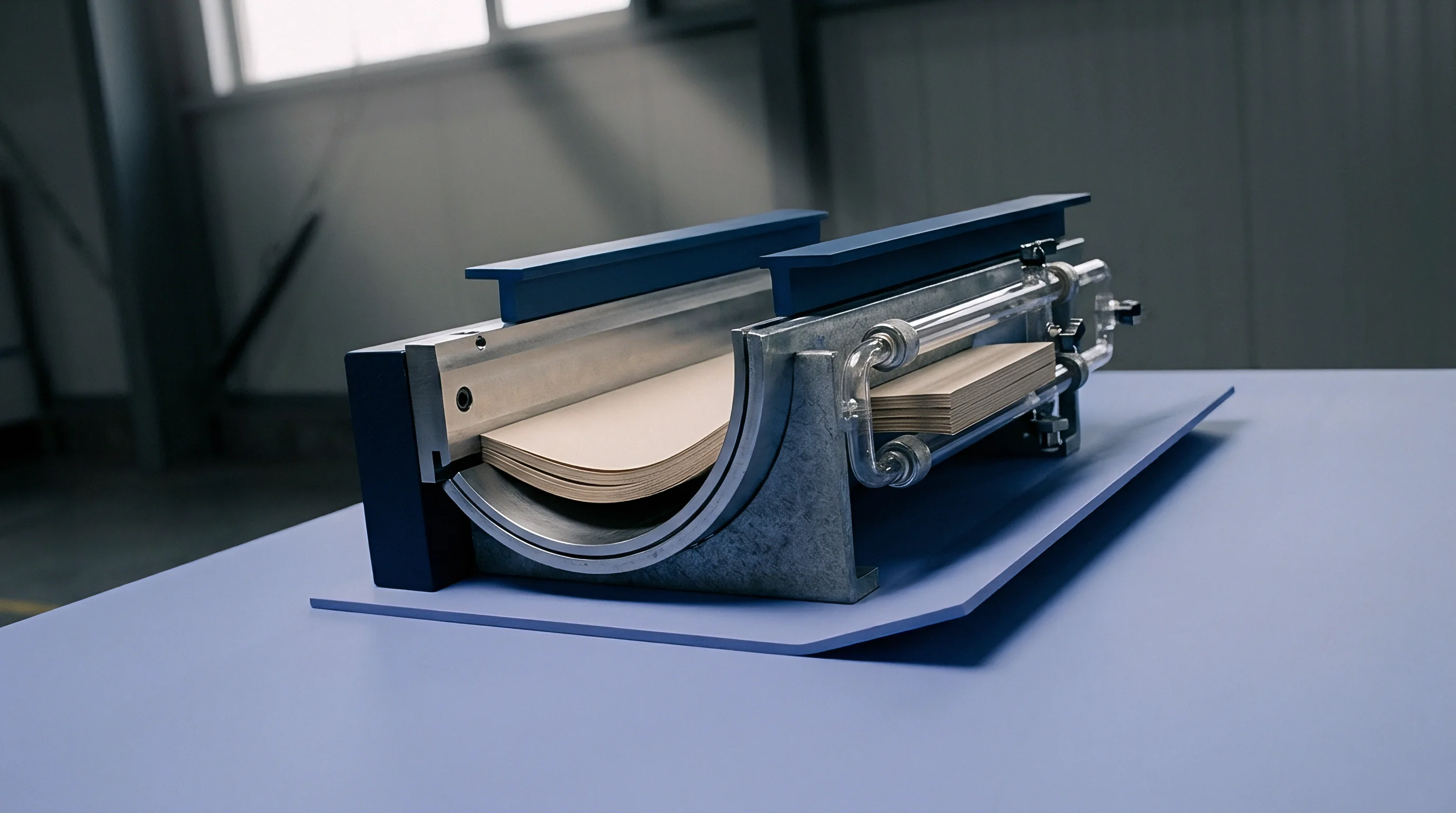
Hysteresis
When paperboard passes through high-speed cartoning machines at rates exceeding 400 packages per minute, mechanical deformation at pre-broken scorelines occurs within timeframes as short as 15 to 30 milliseconds. Because fibers resist rapid flexure, standard laboratory measurements taken under static or quasistatic conditions fail to capture the transient stress states present during rapid rotary folding operations. The internal polymer network of native cellulose fibers, combined with synthetic or starch sizing agents, exhibits time-dependent viscoelastic response profiles.
Upon immediate mechanical folding to 90 or 180 degrees, the internal stress within the scoreline peaks sharply and initiates a rapid decay process termed stress relaxation.
The residual force attempting to return the folded panel toward its original uncreased planar state represents the dynamic crease recovery force. Immediately following deformation, the board panel exerts maximum springback force against packaging line guide rails, tucking blades, and adhesive compression belts. Within the initial 50 milliseconds post-folding, this recovery force can run 40 percent to 70 percent higher than static force values measured 15 seconds after deformation on standard benchtop testers.
If the adhesive system or mechanical holding mechanism fails to restrain the panel during this critical initial window, springback causes immediate carton geometry distortion or catastrophic line jams.

Viscoelastic Energy Dissipation in Deformed Scorelines
Polymer networks in native cellulose fibers undergo immediate elastic strain during folding, followed by time-dependent micro-structural relaxation. Creasing dies force the multi-ply board structure into localized shear failure, creating an internal delamination zone that acts as a mechanical hinge, reducing the effective bending moment of the crease relative to the uncreased board panel.
Delamination separates adjacent fiber layers, allowing them to slip past one another during flexure without sustaining massive tensile failure on the outer surface or compressive crushing on the inner surface. In viscoelastic terms, the strain energy introduced by the mechanical folder converts partly into permanent plastic deformation through inter-fiber bond breakage, partly into heat via frictional ply slipping, and partly into stored elastic strain energy within unyielded cell walls. The fraction stored as elastic strain energy powers the dynamic recovery process.
- Springback carton jam causes immediate line stoppages when the folded flap exerts force exceeding tucking guide resistance within 20 milliseconds of rotary folding.
- Flap opening spring forces cold-melt adhesive bonds apart before setting occurs during high-speed line compression stages.
- Panel bowing distortion appears when unrelaxed score resistance pushes adjacent uncreased board areas outward during carton square-up.
- Tuck tab buckle occurs during automated insertion when residual score stiffness alters the effective column strength of the closure blade.
Higher delamination depth within middle plies during scoring lowers residual springback force on high-speed folding rails.
Strain Rate Effects in Rapid Fold Mechanics
Rapid deformation speeds generate higher resistance forces across paperboard joints compared to quasistatic laboratory test environments. Hemicellulose and amorphous cellulose domains exhibit strain-rate dependence. At deformation rates exceeding 1,000 degrees per second, typical of high-speed rotary tucking units, polymer chain segments lack time to undergo thermal motion and structural rearrangement.
Consequently, the apparent storage modulus of the board increases, yielding higher initial bending resistance.
Moisture content governs this strain-rate sensitivity directly. Water acts as a plasticizer within the cell wall, lowering glass transition temperatures of amorphous regions and accelerating relaxation rates. Board conditioned at 35 percent relative humidity exhibits elevated dynamic recovery forces and pronounced brittle cracking during rapid folding.
Conversely, board equilibrated at 65 percent relative humidity demonstrates accelerated stress relaxation, lowering springback forces but sacrificing panel structural rigidity under top-load compression.
Board mills frequently contend that elevated springback forces reflect superior fiber virginity and strength rather than defective scoring geometry or improper surface sizing.


Score
Tooling configuration determines the physical shear zone created in solid bleached board and folding boxboard substrates. Male creasing rules pressing the board sheet into female matrix channels induce combined transverse shear and out-of-plane compression. Proper creasing parameters force internal ply separation while maintaining outer liner sheet integrity, directly controlling the ratio of uncreased board bending stiffness to creased hinge stiffness.
Optimization of this ratio prevents score resistance from overpowering adjacent structural panels during automated packaging assembly. When matrix channels run too wide, shear stresses spread across a broad area, producing diffuse deformation, incomplete ply delamination, and excessive residual bending resistance. When matrix channels run too narrow, male rules shear through outer liner fibers, reducing tensile strength and inviting score cracking during high-speed folding operations.

Matrix Geometry and Indentation Depth Parameters
Male creasing rule width and female channel gap dimensions govern the extent of ply separation within paperboard layers. Die-cutter operators select matrix dimensions based on nominal substrate caliper, grain direction, and board furnish type. Standard empirical formulations establish matrix channel width as twice the board thickness plus the creasing rule thickness for cross-grain creasing, while machine-direction creasing demands tighter channel dimensions to compensate for fiber orientation alignment.
| Substrate Grade | Caliper (mm) | Rule Pt | Channel Width (mm) | Channel Depth (mm) | BS/TS Ratio |
|---|---|---|---|---|---|
| Solid Bleached Sulfate (SBS) | 0.350 | 2.0 (0.71 mm) | 1.40 | 0.45 | 2.45 |
| Folding Boxboard (FBB) | 0.380 | 2.0 (0.71 mm) | 1.50 | 0.50 | 2.10 |
| Coated Recycled Board (CRB) | 0.400 | 3.0 (1.05 mm) | 1.85 | 0.55 | 1.75 |
| Coated Unbleached Kraft (CUK) | 0.450 | 3.0 (1.05 mm) | 2.00 | 0.60 | 2.30 |
- Clean the cutting plate thoroughly and mount the vinyl backing matrix sheet without residual air bubbles under the rule channels.
- Calibrate the impression cylinder pressure until the creasing rule enters the female channel to 85 percent of total substrate caliper.
- Measure the crease stiffness of sample cuts using a two-point bending tester within five minutes of production die-cutting.
- Adjust channel width in increments of 0.10 millimeters if the bending stiffness ratio falls below 1.8 or exceeds 2.5.
Grain Orientation and Anisotropic Resistance Ratios
Cross-machine direction folds generate higher initial bending forces and faster relaxation rates than machine-direction folds. Fiber alignment along the machine direction creates anisotropic mechanical properties across the sheet plane. When creasing along the machine direction, folding occurs across the longitudinal axis of aligned fibers, demanding higher shear stress to rupture inter-fiber hydrogen bonds.
Machine-direction scores display higher springback angles relative to applied strain because individual cellulose fibers act as miniature elastic beams undergoing flexure. Cross-direction scores fold by unbuckling pre-separated fiber bundles, resulting in lower springback resistance. Converters track the ratio of uncreased board stiffness to creased score stiffness.
Values between 2.0 and 3.0 ensure smooth panel square-up on cartoning equipment operating at speeds above 500 units per minute.
At 23 C and 50 percent relative humidity, solid bleached board with 350 micron thickness maintains a bending stiffness ratio of 2.2 when matrix width equals 1.4 millimeters.
Selecting a narrower creasing channel than recommended always elevates crease stiffness and increases side-panel bulging on cartoning lines.


Flexure
Paperboard panels function structurally as orthotropic thin plates possessing distinct elastic moduli along machine and cross directions. Structural load capacity depends on in-plane stiffness tensors and flexural rigidity matrix values. Elastic modulus ratios between machine and cross directions routinely range from 2.0 to 3.5 in modern paperboard machines, establishing pronounced directional asymmetry in panel deflection profiles under out-of-plane force inputs.
When high-speed packaging machinery pushes tuck flaps into carton bodies or applies vacuum cups to pull flat blanks from hoppers, side panels undergo complex two-dimensional flexure. If panel flexural rigidity falls below threshold limits, operational vacuum pressures suck carton walls inward, causing misfeeds, square-up failures, or internal volume reduction during liquid and powder filling cycles.

Orthotropic Elastic Constants for Panel Stiffness Calculations
Four key material parameters govern structural plate response: longitudinal Young’s modulus, transverse Young’s modulus, in-plane shear modulus, and major Poisson’s ratio. Fiber orientation distribution functions during wet-end sheet formation dictate these orthotropic constants. Unbleached softwood fibers in multi-ply kraft designs elevate machine-direction modulus, whereas high filler loads in recycled furnish grades degrade overall stiffness values.
| Substrate Specification | Grammage (g/m2) | E_MD (MPa) | E_CD (MPa) | G_MDCD (MPa) | Poisson Ratio v_MDCD |
|---|---|---|---|---|---|
| Solid Bleached Sulfate (SBS) | 270 | 6800 | 2900 | 1850 | 0.38 |
| Folding Boxboard (FBB) | 250 | 7200 | 2800 | 1600 | 0.36 |
| Coated Recycled Board (CRB) | 320 | 4500 | 1800 | 1100 | 0.32 |
| Coated Unbleached Kraft (CUK) | 300 | 8100 | 3200 | 2100 | 0.40 |

Differential Plate Deflection under out of Plane Loads
Governing partial differential equations for orthotropic plate flexure balance internal bending moments against applied edge forces and distributed surface loads. Out-of-plane deflection of a thin rectangular board panel under uniform distributed pressure or edge moments obeys Huber’s orthotropic plate formulation. Bending stiffness in the machine direction D_x and cross direction D_y, along with torsional rigidity D_xy, control the maximum central deflection amplitude.
Unbalanced directional stiffness creates non-uniform deflection shapes under load. Panels with low cross-direction modulus flex excessively along their vertical axis when edge moments transmit from unrelaxed crease recovery forces. Because plate flexural stiffness varies with the cube of sheet caliper, small reductions in grammage or density loss through calendering exert massive effects on panel deflection resistance.
- Substrate elastic ratio dictates the balance between top-load column compression strength and side-panel bulging resistance under internal filling loads.
- Ply thickness distribution determines outer ply stress levels during dynamic flexure, where dense virgin outer layers maximize flexural rigidity per gram.
- Bulking factor specification allows converters to increase overall panel caliper without adding total mass, increasing moment of inertia.
- Internal bond strength prevents inter-ply shear failure when orthotropic panels experience high out-of-plane flexural strains on high-speed conveyors.
ISO 5628 testing standards dictate two-point bending measurements at 15 degrees angle, where non-linear elastic deflection invalidates linear beam calculations.
Substrate choices that underestimate orthotropic deflection limits produce crushed cartons, secondary packaging jams, and massive pallet rejection costs at customer distribution centers.

Interactions
Dynamic crease springback couples directly with adjacent side-wall flexure during automated carton erecting and tucking operations. Unrelaxed score forces act as continuous moment boundary conditions applied to panel edges. When a carton blank erects into a three-dimensional sleeve, scorelines attempt to spring open toward their flat uncreased state, transferring bending moments into adjacent side panels.
These edge moments force side panels to bulge outward in an elliptical arc. If the panel possesses insufficient cross-direction bending stiffness, side wall deflection exceeds line clearance envelopes, contacting machine guides or interfering with automated product loading rams. The interaction grows severe on wide, shallow carton formats where long scorelines frame expansive uncreased panels.

How Does Crease Recovery Force Distort Panel Geometries?
Unrelaxed score moments transmit shear and flexural forces directly into adjacent uncreased carton walls. To quantify this operational risk, consider a 350-micron Folding Boxboard carton running at 500 cartons per minute on an automated cartoning line. Side panel dimensions measure 150 millimeters in length along the scoreline by 100 millimeters in width.
The dynamic crease recovery moment M_r at 25 milliseconds post-folding equals 0.035 N mm per millimeter of score length.
Using orthotropic plate deflection equations for a rectangular panel subjected to simple edge moment support along two opposite score edges, central panel deflection w_max scales according to edge moment magnitude divided by cross-direction bending stiffness D_y. For Folding Boxboard with cross-direction modulus E_CD equal to 2,800 MPa and caliper 0.35 mm, D_y equals 10.82 N mm. Calculated central deflection yields 3.2 millimeters under peak dynamic springback conditions.
When cartoning machine guides mandate a maximum side clearance tolerance of 1.5 millimeters, this 3.2 millimeter deflection induces structural binding, surface scuffing, and line stoppages.
| Line Velocity (units/min) | Relaxation Window (ms) | Allowable Bulge (mm) | Primary Failure Mode | Corrective Action |
|---|---|---|---|---|
| 300 | 40 | 2.5 | Flap Pop-open | Increase compression belt length |
| 500 | 24 | 1.5 | Side Panel Binding | Increase creasing matrix depth 10% |
| 750 | 16 | 1.0 | Tuck Blade Buckle | Switch to higher bulk FBB grade |
| 1000 | 12 | 0.8 | Vacuum Pick Misfeed | Increase MD/CD stiffness ratio |
| Test data evaluated at 23 C and 50% RH. Dynamic stiffness recorded at 15 ms post-crease using high-speed rotational transducer. | ||||
- Dynamic score stiffness upper limit defines maximum allowable springback moment at 20 milliseconds post-creasing measured via high-speed bending tester.
- Minimum orthotropic ratio threshold mandates the required stiffness balance between machine direction and cross direction to prevent panel bowing.
- Equilibrium moisture range band specifies relative humidity tolerances during converted blank transit to preserve viscoelastic relaxation profiles.
- Matrix depth tolerance specification sets dimensional limits on die-cutter tooling wear before replacement becomes mandatory.
Rotary tuckers on packaging lines operating at 600 cartons per minute engage carton flaps within a 12-millisecond time window.
Inserting a mandatory TAPPI T577 dynamic crease stiffness clause into substrate delivery contracts transfers financially quantifiable quality liability back to board mills when unrelaxed score forces cause high-speed line jams.

Stipulations
Procurement contracts for high-speed packaging substrates demand strict parameter bounds on material viscoelasticity and structural stiffness. Reliance on standard grammage and static caliper specifications no longer guarantees runnability on modern cartoning equipment. Converters and brand owners incorporate dynamic bending resistance, score stiffness ratios, and orthotropic elastic constants directly into mill technical specification sheets.
Receiving inspection audits employ automated two-point bending units and dynamic crease recovery meters to verify compliance prior to press run authorization. Material failing dynamic score stiffness thresholds incurs immediate lot rejection or mill credit claims to offset line downtime expenses. Storage conditions within converter warehouses must remain within controlled relative humidity bands to prevent shifts in viscoelastic relaxation time constants.

Method Standardization and Specification Bands
Testing protocols under ISO 5628 and TAPPI T577 define standardized environment conditions and sample preparation rules. Laboratory testing at 23 C and 50 percent relative humidity provides baseline comparisons, but converters establish secondary acceptance bands for non-standard atmospheric conditions encountered during tropical transport or winter warehousing. Downgauging projects present financial savings in tonnage costs, yet lowering board caliper from 0.40 mm to 0.35 mm drops orthotropic panel flexural rigidity by 33 percent, demanding compensatory increases in fiber elastic modulus or optimized matrix creasing parameters.
Whether real-time ultrasonic velocity measurements during die-cutting can accurately predict millisecond-scale viscoelastic crease relaxation on downstream cartoning equipment remains an open industrial question.