Predictive Bending Stiffness Reduction Modeling for High Speed Coated Packaging Converting Lines
Predictive stiffness loss modeling prevents folder-gluer waste by adjusting crease depth and binder chemistry to compensate for high-speed dynamic strain.
Score
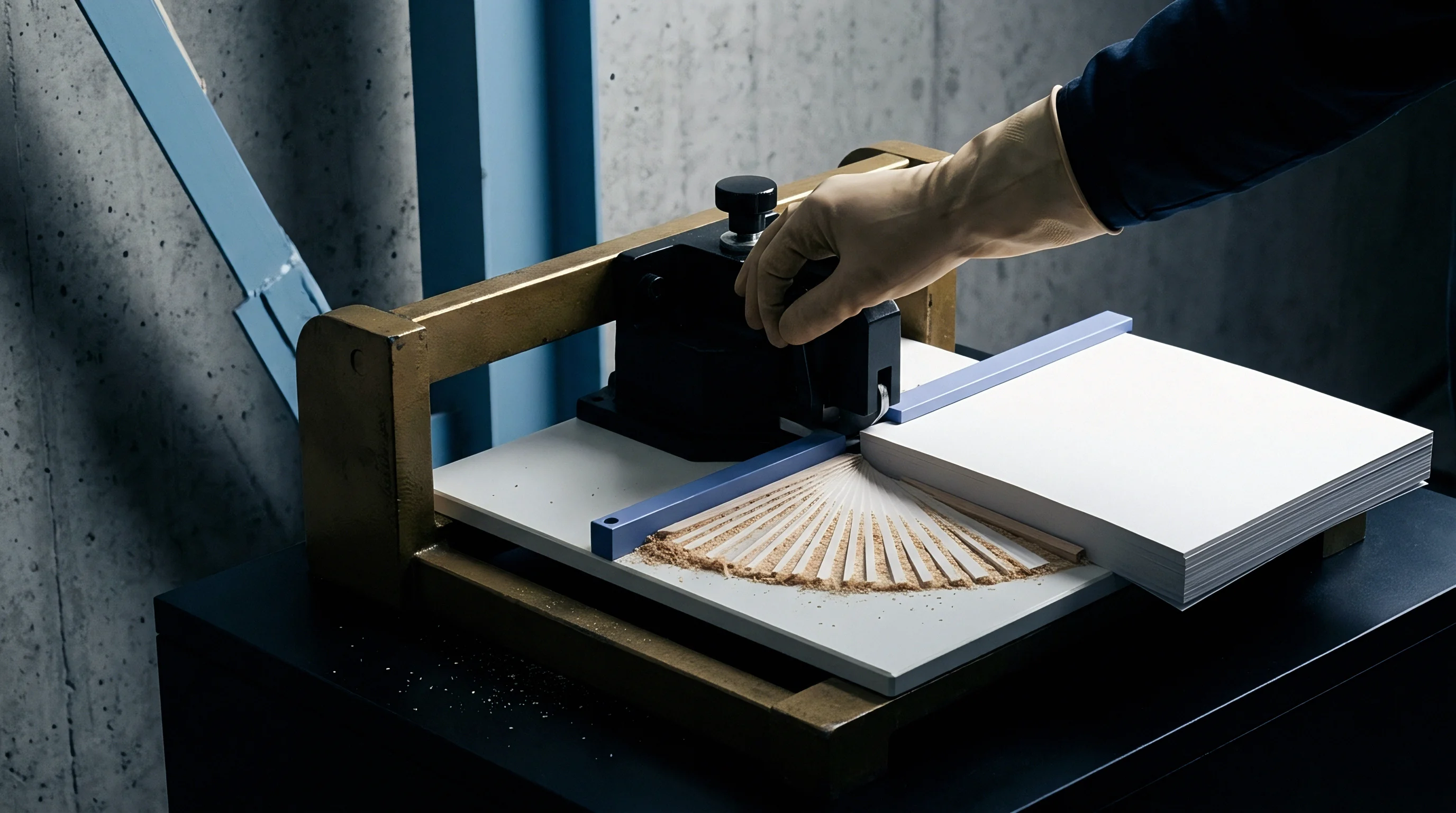
Mechanical indentation during board converting imposes concentrated cross-direction compressive forces. High-speed packaging lines running above four hundred meters per minute submit the coated paperboard structure to sudden, localized shear stresses during the creasing step. When male rule blades press board stock into female grooves, the localized flexural rigidity drops dramatically.
This stiffness degradation stems from engineered internal shear failures designed to allow folding without outer surface rupture. The balance between controlled ply separation and structural collapse dictates whether a finished packaging blank maintains panel flatness during automated cartoning.
Crease Mechanics and Ply Delamination
Indentation tools compress top and bottom liners into a female groove, forcing internal fiber layers to separate. Fiber bond failure accelerates quickly. Controlled delamination in the mechanical pulp core reduces the bending moment required to form a ninety-degree crease.
Solid bleached sulfate substrates handle this deformation through long softwood fiber entanglement, yielding predictable stiffness drop ratios between forty and sixty percent. Coated recycled board formulations containing higher filler fractions and shorter hardwood fibers experience severe z-directional strength decay. Excessive internal delamination eliminates the recovery force needed to keep carton side panels square during high-speed filling.
Creasing tool clearance selection dictates the residual cross-direction flexural rigidity. When the rule width exceeds substrate caliper by insufficient margins, crushed fibers lose structural elasticity permanently. Shear stresses concentrate internally.
Calipers collapse under pressure. A narrow groove forces the outer liner into high tensile strain, micro-cracking the mineral coating layer before the blank reaches the folder-gluer section.
A deeper creasing depth on recycled board degrades cross-direction flexural resistance faster than an increase in die clearance.

Coating Layer Rupture during Rapid Bending
Pigment particles bound by synthetic latex experience intense tensile strain along the outer fold axis. Ground calcium carbonate and kaolin clay layers possess lower ultimate strain limits than underlying virgin kraft fibers. Higher speeds demand wider die clearances.
As the sheet bends rapidly around folder-gluer belt transfers, tensile stresses exceeding three percent strain create microscopic fissures across the coating surface. These micro-fractures propagate downward through the pre-coat layer, destroying the continuity of the flexural beam skin. Residual bending stiffness drops beyond predicted design thresholds when pigment layer cracking aligns with internal ply delamination.
Incorrect die geometry specification accelerates stiffness loss, forcing line speed reductions and increasing carton reject rates during automated cartoning.

Modulus
Flexural rigidity governs carton panel stiffness during high-speed folding and filling operations. The effective flexural elastic modulus decreases non-linearly as deformation velocity increases on modern converting equipment. Static test methods like ISO 2493-1 or TAPPI T 556 measure bending resistance at slow angular rates of fifteen degrees per second, failing to capture strain-rate-dependent structural softening occurring at operational line speeds.
Converting machinery forces paperboard through ninety-degree deformations within milliseconds, creating local strain rates exceeding one thousand percent per second.
Strain Rate Sensitivity in Coated Boards
Polymeric binder networks within mineral coatings exhibit distinct viscoelastic deformation profiles under varying folding speeds. Styrene-butadiene latex formulations show significant dynamic modulus stiffening under rapid impact, increasing tensile stress concentration in the top coat. Polyvinyl acetate systems demonstrate greater relaxation capability, dissipating stress through controlled polymer chain movement.
Moisture drives viscoelastic relaxation. Under rapid deformation, starch-bound coating layers transfer strain directly to underlying cellulose fibers, accelerating fiber-to-fiber bond failure in the top ply.
The elastic modulus ratio between top coating layers and internal mechanical pulp plies determines flexural stress distribution across the sheet cross-section. Solid bleached sulfate features a relatively uniform modulus across plies, whereas multi-ply folding boxboard exhibits high modulus outer skins surrounding a low modulus mechanical core. High strain velocities reduce the apparent flexural modulus of recycled core fibers faster than outer kraft liners, shifting the neutral bending axis and causing unexpected panel bulging under top-load compression.

Can Cross-Direction Elastic Strain Limits Predict Post-Folding Micro-Cracking?
Elongation at break measured along the transverse web orientation indicates substrate resistance to outer surface fracture. Standard tensile testing under ISO 1924-2 measures static strain limits, but rapid dynamic bending exposes pigment-coated surfaces to severe impact strain. When cross-direction elastic strain capacity falls below two percent under high-speed deformation, kaolin pigment matrices rupture instantly along creased edges.
Coating minerals crack under tension. Evaluating dynamic stretch capacity alongside dynamic flexural modulus retention provides direct insight into carton corner integrity after folder-gluer passage.
| Grade Description | Grammage g/m2 | Static Stiffness ISO 2493 mN m | Dynamic Stiffness Loss at 400 m/min % | Primary Top Coat Binder |
|---|---|---|---|---|
| Solid Bleached Sulfate SBS | 280 | 18.5 | 22 to 26 | Styrene-Butadiene Latex |
| Folding Boxboard FBB Virgin Core | 250 | 19.0 | 31 to 35 | Styrene-Acrylic / Starch |
| Coated Recycled Board CRB | 320 | 16.2 | 42 to 48 | Polyvinyl Acetate / Starch |
| Coated Unbleached Kraft CUK | 300 | 22.1 | 18 to 23 | Styrene-Butadiene Latex |
Paper mills frequently attribute carton bulge complaints to warehouse humidity variations rather than high-speed binder network shear failure.

Fatigue
Repeated mechanical cycling across folder-gluer belt transfers induces microstructural damage within multi-ply paperboard. Web tension alters strain velocity. Blanks traveling through modern converting lines experience sequential flexural deformations at pre-folding stations, rotary scoring nips, and final flap compression sections.
Each mechanical deformation pass breaks inter-fiber hydrogen bonds inside the furnish, permanently lowering flexural rigidity before final package assembly.

Nip Passages and Cyclic Web Strain
Multiple compressive passes through rotary scoring wheels generate cumulative shear damage inside the mechanical pulp core. As the sheet passes between high-speed rubber nip rollers and steel folding guides, localized mechanical hysteresis generates internal thermal spikes. Delamination reduces panel flexural rigidity.
Softwood kraft fibers absorb cyclic bending without significant fiber breakage, but stiff mechanical pulp fibers fracture under high-frequency flexural fatigue. Substrates subjected to three consecutive ninety-degree pre-folding cycles lose up to thirty percent of their initial uncreased flexural rigidity.

Microstructural Breakdown in Calcium Carbonate Matrices
Ground mineral pigments bound by binder networks form a stiff top skin that fracturing degrades under cyclic flexure. High aspect ratio kaolin clays align parallel to the sheet surface, offering resistance to moisture but showing susceptibility to delamination under repeated bending. Needle-like aragonite calcium carbonate structures provide higher porosity but create stress concentration points within the latex matrix.
Under high-frequency cyclic bending, micro-cracks form at particle-binder interfaces, connecting into continuous fracture planes that reduce top-coat tensile load capability.
- Crease Flap Springback resulting from residual elasticity in un-delaminated core fibers causing automated cartoner jams.
- Panel Bulge Distortion induced by dynamic loss of structural moment of inertia across large side panels under vertical stacking loads.
- Top-Coat Flaking caused by complete loss of interfacial adhesion between mineral pre-coat and fiber liner along outer score lines.
- Cross-Direction Score Separation occurring when internal shear stresses exceed z-directional bond strength across the creasing zone.
DIN 53121 specifies two-point bending methods that understate dynamic stiffness loss occurring in folder-gluer belt transfers by up to eighteen percent.
Standard delivery contracts referencing ISO 2493 stiffness values permit board shipments that experience excessive degradation during high-speed folder-gluer processing.

Computation
Mathematical modeling of flexural stiffness loss requires accounting for structural moment of inertia changes across multi-ply sheets. Flexural rigidity of a multi-layer board is expressed through composite beam mechanics, summing the product of elastic modulus and area moment of inertia for each individual layer. Creasing and rapid bending selectively degrade the effective elastic modulus of inner core layers and outer coating films, changing overall beam performance.

Predictive Model Formulation for Stiffness Decay
Analytical frameworks calculate post-converting residual beam strength by combining sheet caliper, elastic modulus, and strain rate parameters. Late-stage bending stiffness reduction (Rs) is calculated using the established empirical degradation function:
R_s = 1 –
Where dc represents creasing rule impression depth in millimeters, t is nominal board caliper in millimeters, Ecoat and Ecore are initial elastic moduli of the top coating layer and mechanical core in megapascals, v is converting line speed in meters per minute, vref is baseline testing velocity (ten meters per minute), M is sheet moisture percentage, and Mref is reference conditioning moisture at eight percent. Empirical weighing coefficients α = 0.42, β = 0.18, γ = 0.25, and δ = 0.035 govern stiffness loss across standard folding boxboard grades.
At fifty-five percent relative humidity and twenty-three degrees Celsius, a ten-gram coating weight increase reduces effective strain tolerance by four percent.

Multi-Ply Elastic Strain Distribution
Layered packaging substrates divide tensile and compressive stresses unequally across outer bleached kraft faces and recycled inner plies. Late-stage structural retention depends on preserving outer skin modulus while achieving controlled core breakdown. Consider a 350-micrometer folding boxboard consisting of a 20-micrometer mineral top coat (E = 4500 MPa), a 60-micrometer bleached kraft top ply (E = 3200 MPa), a 210-micrometer mechanical pulp core (E = 950 MPa), and a 60-micrometer unbleached kraft bottom ply (E = 2800 MPa).
Calculated uncreased flexural stiffness equals 24.6 millinewton-meters. Processing this sheet at four hundred fifty meters per minute with a creasing depth ratio (dc / t) of 0.50 and five percent board moisture alters mechanical values:
R_s = 1 –
R_s = 1 –
R_s = 1 – = 1 – 0.2208 = 0.7792
Predicted residual flexural stiffness equals 19.17 millinewton-meters, representing a 22.08 percent stiffness reduction directly attributable to dynamic high-speed strain and score line delamination mechanics.
| Moisture Content % | Crease Depth Ratio d_c / t | Converting Speed m/min | Predicted Stiffness Loss % | Measured Stiffness Loss % |
|---|---|---|---|---|
| 6.0 | 0.40 | 300 | 18.4 | 17.9 |
| 6.0 | 0.60 | 500 | 31.2 | 32.5 |
| 8.5 | 0.40 | 300 | 14.2 | 15.0 |
| 8.5 | 0.60 | 500 | 26.8 | 26.1 |
| Methods note: Test samples conditioned according to ISO 187 at 23 degrees Celsius and 50 percent relative humidity prior to dynamic converting trials. | ||||
- Mount dynamic load cell instrumentation on folder-gluer entrance guide rails.
- Calibrate baseline flexural resistance using non-creased control blanks at low speed.
- Increase converting line speed in fifty meter per minute increments while capturing peak compression forces.
- Extract creased carton samples at each speed threshold for laboratory two-point bending verification.
- Adjust empirical degradation coefficients inside predictive press control software based on variance between calculated and measured stiffness values.
Whether real-time acoustic emission monitoring during creasing can dynamically adjust folder-gluer tool nip clearance remains unproven on commercial production lines.
Ledger
Substrate specification choices dictate landed package production economics and post-converting performance margins. Grammage reduction lowers total sheet cost. Board mills market lower-caliper, high-bulk grades as direct replacements for standard SBS or CRB substrates, claiming equivalent static bending stiffness.
Converting lines running lightweight, high-bulk boards at speeds above four hundred meters per minute frequently experience higher spoilage rates due to unpredicted dynamic flexural stiffness loss.

Commercial Implications of Over-Specifying Caliper
Purchasing excess sheet thickness to ensure box strength inflates material expenditure without guaranteeing line efficiency. A buyer specifying 380-micrometer CRB instead of 330-micrometer virgin FBB pays for thirty percent additional fiber weight per square meter. Heavy recycled sheets experience greater dynamic stiffness decay during scoring step processing, neutralizing caliper advantages when blanks pass through high-speed automatic cartoning equipment.
Selecting optimized fiber furnishes with specialized latex binder formulations preserves flexural rigidity after creasing, allowing converters to downgauge caliper while maintaining finished packaging structural requirements. Top-load box compression depends directly on panel bending stiffness retention. Modern folder-gluers running high-grade FBB achieve lower waste rates despite running thin substrate calipers, because virgin softwood fibers maintain ply integrity across creased corners.
Unintended stiffness loss on high-speed carton lines turns calculated board savings into waste inside the gluer catching section.

Waste Recovery and Tonnage Yield Calculations
Material efficiency calculations compare parent roll sheet yield against finished carton output minus converter scrap. Carton springback causes line jam. High-speed line jams caused by inadequate flap crease stiffness generate significant material waste, with high-speed lines dumping hundreds of ruined blanks within seconds of a sensor shutdown.
| Substrate Option | Grammage g/m2 | Caliper um | Dynamic Stiffness Retention % | Gluer Spoilage Rate % | Landed Cost per 10k Cartons USD |
|---|---|---|---|---|---|
| Standard CRB Baseline | 350 | 420 | 54 | 2.8 | 420 |
| Downgauged CRB High Latex | 310 | 370 | 61 | 1.9 | 395 |
| Premium FBB Virgin Core | 260 | 370 | 76 | 0.4 | 380 |
| Lightweight CUK Virgin Fiber | 240 | 330 | 81 | 0.2 | 372 |
- Dynamic Stiffness Ratio Verification demanding high-speed flexural resistance figures on mill analysis certificates.
- Latex Binder Chemistry Auditing identifying coating formulations optimized for high elongation under rapid deformation.
- Crease Matrix Geometry Specification establishing precise depth and width thresholds matched to substrate fiber length.
- Moisture Envelope Control enforcing strict warehouse storage conditions between forty-five and fifty-five percent relative humidity.
Lower grammage substrates with optimized latex binder levels achieve target box compression metrics at a lower total delivered landed cost.