Hardwood Substitution Impacts on Mechanical Stiffness and Converting Line Headroom
Hardwood pulp substitution increases sheet density but reduces caliper, dropping bending stiffness cubically and eroding high-speed converting line speed headroom.
Grain
A digital micrometer spindle closes onto a conditioned board sample under ISO 534 standard load of fifty kilopascals, recording three hundred forty-five micrometres on a nominal three hundred fifty-micrometre sheet. That five-percent thickness variance originates in the furnish blend at the wet end of the paper machine. Substituting short hardwood kraft pulp for long softwood kraft pulp alters fiber network topology before the sheet reaches the press section.
Northern bleached softwood kraft fibers, derived from species such as Pinus sylvestris or Picea abies, feature average fiber lengths between two point two and three point two millimetres. These long fibers form an entangled matrix that resists web consolidation under press rolls. Bleached eucalyptus kraft fibers, sourced from Eucalyptus grandis or Eucalyptus globulus, average only zero point seven to one point one millimetres in length.
A high hardwood fraction increases fiber population density per gram of pulp by a factor of four.

Fibre Morphology and Matrix Density Shifts
Fibre geometry determines sheet density. Short hardwood fibers fill internal voids within the wet web during vacuum dewatering and wet pressing. This packing efficiency increases sheet consolidation, raising dry density from zero point six five grams per cubic centimetre up to zero point seven four grams per cubic centimetre at equivalent pressing loads.
Tensile stiffness index increases within the plane of the sheet because short fibers create higher specific bonded surface area. Inter-fiber bonding area per unit volume expands significantly, driving up density as fiber length drops. Higher sheet density achieved through tight hardwood packing directly reduces sheet caliper at a constant basis weight.
A shift from thirty to sixty percent hardwood kraft in top-ply furnish reduces average fibre length from two point two millimetres to one point one millimetres while increasing sheet density by four percent.
Eucalyptus Density Profiles and Network Elastic Modulus
In multi-ply folding boxboard constructions, middle plies typically contain mechanical pulps to build caliper while outer plies utilize chemical kraft pulps for surface smoothness and printability. Increasing eucalyptus content in outer plies elevates the in-plane elastic modulus, measured under ISO 1924-3, due to superior sheet formation and uniform hydrogen bonding networks. Elastic modulus grows linearly with consolidated sheet density.
Yet, structural flexural rigidity depends on both the elastic modulus and the vertical distribution of mass across the sheet profile. When mills substitute low-cost hardwood market pulp into middle plies to replace thermomechanical pulp, total Z-direction density spikes and bulk drops. The structural gain in elastic modulus fails to compensate for the volumetric collapse of the central core.
High tensile strength from dense hardwood furnishes is often cited to justify equivalent box performance, ignoring the non-linear physics of structural bending moments.

Span
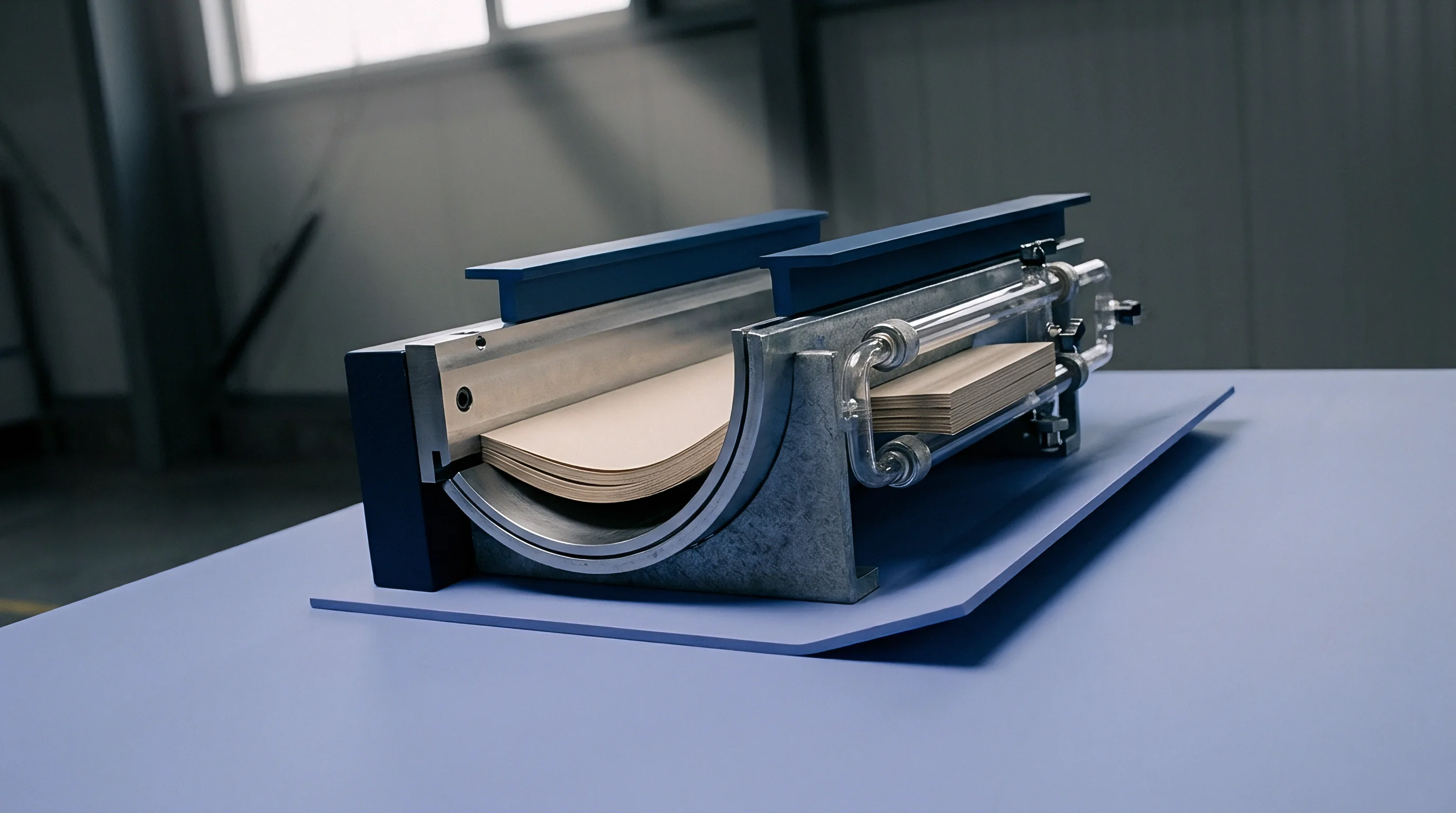
Bending stiffness governs how paperboard resists deformation under applied perpendicular loads during converting and packaging operations. Flexural rigidity per unit width, expressed as bending stiffness under ISO 2493-1, obeys classical structural beam theory. The flexural rigidity equals the product of the elastic modulus and the moment of inertia per unit width.
Mathematically, flexural rigidity scales linearly with elastic modulus and cubically with sheet thickness. Sheet caliper dictates beam strength, meaning small shifts in caliper produce exponential variations in mechanical stiffness.
Cubic Caliper Dominance in Flexural Rigidity
Because thickness losses compound cubically, a six percent reduction in sheet caliper generated by dense hardwood fiber packing reduces bending stiffness by sixteen point nine percent if the elastic modulus remains constant. Even when eucalyptus substitution increases the elastic modulus by five percent through enhanced inter-fiber bonding, the net bending stiffness still suffers an eleven point eight percent reduction. Caliper losses consistently dominate mechanical performance.
The table below details physical properties measured across five furnish formulations at a target grammage of two hundred fifty grams per square metre, conditioned under ISO 187 at twenty-three degrees Celsius and fifty percent relative humidity.
| Hardwood Fraction (%) | Caliper (µm) | Density (g/cm³) | Tensile Modulus E (GPa) | MD Taber Stiffness (mN·m) | CD Taber Stiffness (mN·m) |
|---|---|---|---|---|---|
| 20 | 385 | 0.649 | 4.12 | 23.4 | 11.7 |
| 40 | 371 | 0.674 | 4.35 | 22.1 | 10.9 |
| 60 | 354 | 0.706 | 4.58 | 20.2 | 9.8 |
| 80 | 338 | 0.740 | 4.72 | 18.1 | 8.7 |
| 100 | 322 | 0.776 | 4.85 | 16.0 | 7.6 |
| Testing methods: Caliper per ISO 534; Tensile Modulus per ISO 1924-3; Taber Bending Stiffness 15-degree per ISO 2493-2 / TAPPI T 489. | |||||
Laboratory Test Methods for Bending Resistance
Evaluating bending stiffness requires a strict distinction between instrument geometries. ISO 2493-1 specifies the two-point bending method at a five-degree deflecting angle over a fifteen-millimetre bending length, widely embodied in Lorentzen & Wettre stiffness testers. TAPPI T 489 and ISO 2493-2 define the Taber method, utilizing a fifteen-degree deflection angle over a fifty-millimetre span.
Hardwood substitution alters the shear deflection component during laboratory testing, as short-fiber sheets demonstrate lower transverse shear resistance. Consequently, five-degree resonance or deflection methods record different stiffness drop percentages compared to fifteen-degree Taber methods on high-hardwood stocks. Standardizing test geometry prevents misinterpreting material performance during mill trials.
Conditioned at twenty-three degrees Celsius and fifty percent relative humidity under ISO 187, a four percent reduction in sheet thickness produces an eleven point five percent drop in Taber bending stiffness under ISO 2493-2.
When hardwood pulp content rises without structural ply expansion, caliper loss always penalizes bending stiffness faster than elastic modulus gain can restore it.

Nip
High-speed folder-gluers extract flat carton blanks from bottom-infeed hoppers using friction belts and localized vacuum suction. Conversion line speeds on modern equipment reach six hundred metres per minute, processing up to one hundred thousand cartons per hour. At these acceleration rates, carton blanks experience intense mechanical forces.
Lower flexural rigidity caused by hardwood substitution compromises structural headroom throughout the feeding section.
Feeder Extraction Mechanics and Blank Flutter
When feeder vacuum cups engage a limp carton blank, insufficient cross-direction stiffness causes the board to flex downward into the suction gap. This deflection breaks the perimeter seal around the suction cup, causing misfeeds or double-blank extractions. As blanks pass into the acceleration belts, low bending stiffness allows aerodynamic lift to induce blank flutter.
The lead edge of a fluttering blank strikes registration gates, forcing emergency feeder stops. Downstream in the side-seam gluing module, fluttering blanks deviate from the zero-line rail, pushing cold-adhesive lines off the glue flap target area.

How Does Bending Stiffness Shift Impact High Speed Gluer Headroom?
Converting line headroom represents the operational speed margin between flawless runnability and frequent machine stoppages. Hardwood substitution directly narrows this operational window. Decreased bending stiffness reduces the critical buckling load of carton panels under end-compression forces during folding.
When folding belts strike side panels, low-stiffness board buckles out of plane rather than bending cleanly along the score line. Operators must reduce machine speeds by fifteen to thirty percent to prevent carton deformation, undermining converting line profitability.
Failure to maintain cross-direction Taber bending stiffness above the eighteen millinewton-metre minimum threshold specified in ISO 2493-2 triggers automatic batch rejection at high-speed filling line goods-in inspection.
Operating high-speed folder-gluers with under-spec stiffness board leads to jam stops, crushed transport belts, damaged sensor arrays, and thousands of ruined cartons within seconds.
- Feeder vacuum blow-by ~ Low flexural stiffness allows blank edges to bow upward under suction pressure, breaking vacuum seals across feed belts.
- Side-guide edge compression ~ Reduced bending stiffness causes carton lead edges to buckle against registration guides prior to fold insertion.
- Flap rebound alignment clearance ~ Insufficient stiffness in dust flaps creates elastic deflection memory, throwing flap squareness out of tolerance during automatic glue gun pass.
- High-speed aerodynamic blank flutter ~ Low caliper sheets flutter inside the transport track above four hundred meters per minute, causing sensor detection delays and machine emergency trips.
Fold
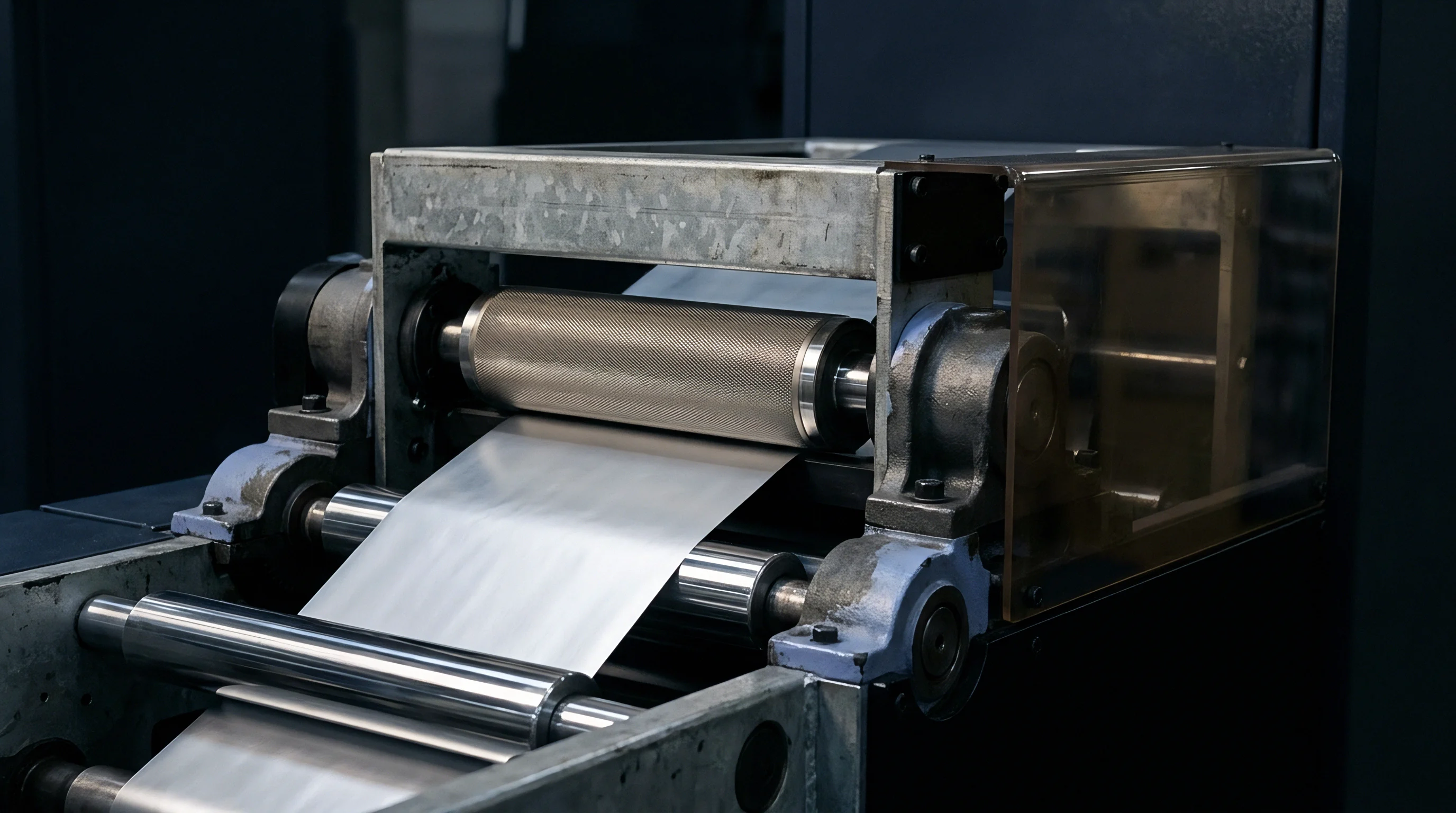
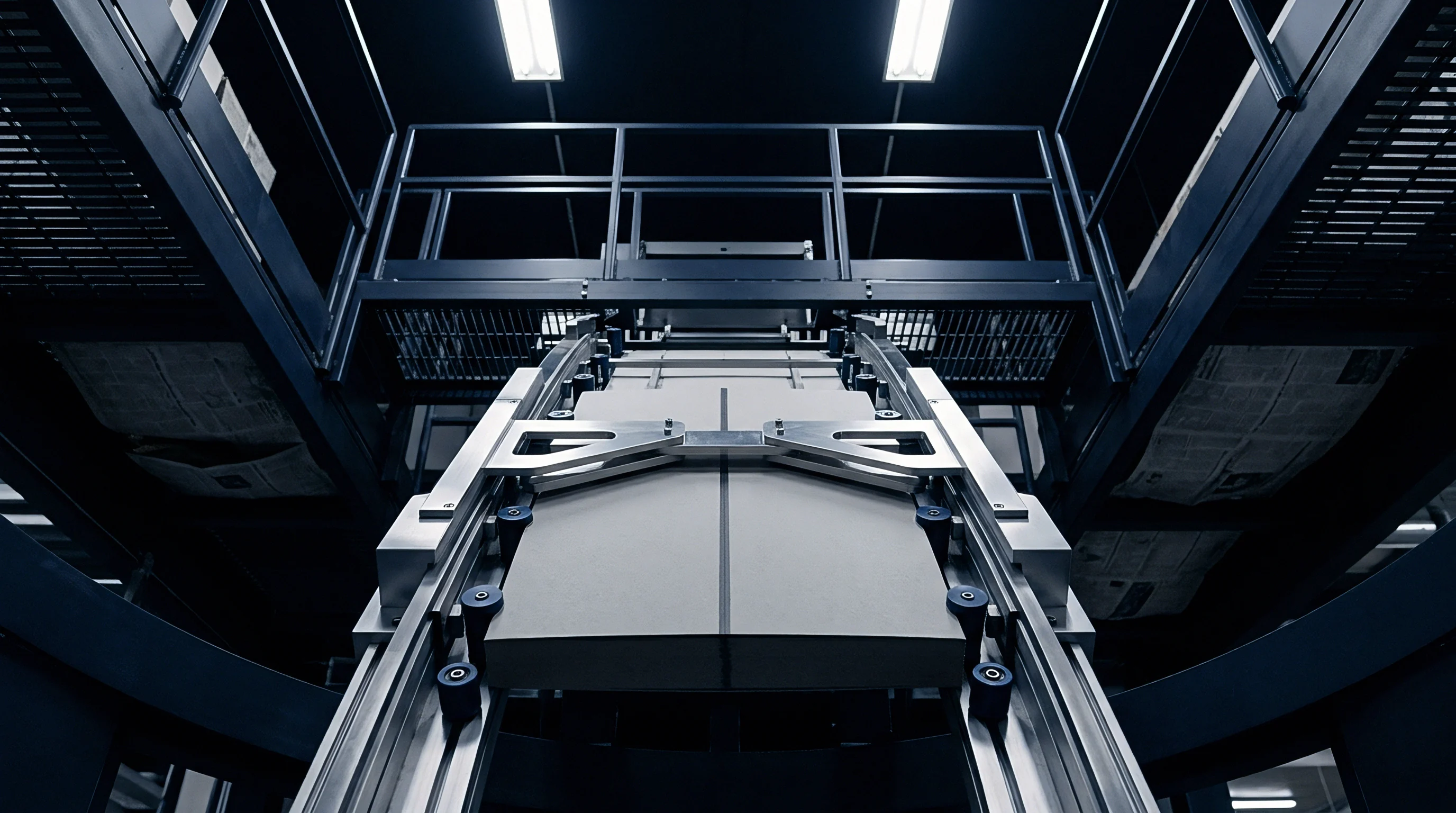
Creasing prepares paperboard for clean, low-force folding along precise geometrical lines without rupturing outer liner surfaces. During creasing, a steel male rule forces the board into a female matrix channel, creating localized shear stress and internal ply delamination. This controlled internal cracking reduces the bending moment required to fold the carton panel and drops crease stiffness sharply.
Hardwood substitution alters the internal shear failure mode during score formation.
Creasing Matrix Penetration and Score Resistance
Short hardwood fibers alter delamination energy. Softwood fiber networks delaminate into distinct internal horizontal planes under crease impact, absorbing energy and creating a flexible hinge. Short eucalyptus fibers produce short, localized micro-fractures rather than continuous delamination planes, so creased hardwood board retains higher residual folding resistance.
When folded on high-speed packaging lines, the stiffer crease hinge exerts high spring-back force against carton squaring guides, causing out-of-square boxes and automatic reject triggers on filling machinery.
Consider a worked converting line trial comparing two three-hundred-gram-per-square-metre folding boxboards running on a Bobst Masterfold operating at four hundred fifty cartons per minute. Sample A contains forty percent hardwood in outer plies with a mechanical pulp core, generating a total caliper of four hundred twenty micrometres. Sample B contains seventy percent hardwood throughout a homogeneous bleached kraft construction, yielding a caliper of three hundred seventy-five micrometres.
The creasing geometry utilizes a zero point seven one millimetre male rule and a one point four millimetre female matrix width with a depth of zero point three eight millimetres.
Sample A exhibits an uncreased cross-direction bending stiffness of sixteen point two millinewton-metres and a creased folding resistance moment of six point eight millinewton-metres, producing a crease ratio of zero point four two. Sample B, impacted by hardwood caliper loss, displays an uncreased cross-direction stiffness of eleven point eight millinewton-metres. Under identical creasing penetration, Sample B exhibits incomplete internal delamination, yielding a folding resistance moment of seven point one millinewton-metres and an elevated crease ratio of zero point six zero.
High folding resistance forces carton panels outward during top-loading, causing glue seam failure on automated packing lines.
| Furnish Type | Caliper (µm) | Uncreased Stiffness (mN·m) | Crease Bending Moment (mN·m) | Crease Ratio (Sc/Sb) | Liner Fracture Limit (%) |
|---|---|---|---|---|---|
| Standard Softwood Core FBB | 420 | 16.2 | 6.8 | 0.42 | 0.0 |
| 40% Hardwood SBS Blend | 395 | 13.8 | 6.5 | 0.47 | 0.5 |
| 70% Hardwood Homogeneous SBS | 375 | 11.8 | 7.1 | 0.60 | 4.2 |
Hinge Bending Moments and Side-Seam Alignment
Adjusting creasing parameters on high-hardwood board requires systematic optimization of male rule penetration depth and matrix channel width to achieve acceptable crease ratios without inducing top-liner tension fractures.
- Adjust female creasing matrix width from one point six millimetres to one point four millimetres to increase shear deformation on high-hardwood board.
- Calibrate male creasing rule penetration depth in steps of ten micrometres until ply delamination occurs without outer liner fracturing.
- Measure crease bending moment on an L&W Crease Monitor at a ninety-degree fold angle under two hundred millisecond dwell.
- Verify that the ratio of crease bending moment to uncreased board bending stiffness remains below zero point five zero to prevent side-panel bulging.
What structural modifications inside the paper machine wet end will allow papermakers to incorporate eighty percent eucalyptus furnishes while maintaining the delamination shear energy characteristics of long-fiber softwood boards?

Margin
Paperboard purchasing contracts evaluate material value through landed cost per thousand finished carton blanks, bridging the gap between mill tonnage pricing and converting line yield. Paper mills promote hardwood substitution as a cost-reduction strategy, offering lower pricing per metric tonne due to eucalyptus hardwood pulp market index discounts compared to northern bleached softwood kraft. However, evaluating cost strictly per tonne ignores the physical caliper loss that accompanies dense hardwood furnish recipes.

Downgauging Dynamics and Tonnage Yield Arithmetic
When a paper mill substitutes eucalyptus pulp without altering nominal grammage, the buyer receives less sheet caliper per tonne, offsetting potential margin gains. If a customer attempts to offset hardwood cost by downgauging basis weight from two hundred eighty grams per square metre to two hundred sixty grams per square metre, sheet caliper collapses further. Yield savings evaporate at converting.
The resulting mechanical stiffness loss forces converting machinery speed reductions, increasing fixed line-hour manufacturing costs that quickly swallow pulp price discounts.
The financial matrix below analyzes the net commercial impact of furnish substitution and grammage adjustments across an annual purchasing volume of ten million pharmaceutical cartons.
| Specification Scenario | Sheet Grammage (g/m²) | Price per Tonne (€) | Max Gluer Speed (cartons/hr) | Conversion Cost (€/1k Blanks) | Landed Net Cost (€/1k Blanks) |
|---|---|---|---|---|---|
| Baseline Softwood SBS | 280 | 1,450 | 80,000 | 12.50 | 48.10 |
| Substituted Hardwood SBS | 280 | 1,340 | 55,000 | 18.18 | 50.68 |
| Bulked Multilayer Hardwood FBB | 290 | 1,390 | 85,000 | 11.76 | 47.07 |
Commercial Specification Clauses and Sourcing Safeguards
Mill tolerances directly move unit costs. Sourcing practices must guard against unannounced hardwood fiber substitution by replacing generic basis-weight purchasing orders with strict functional performance specifications. Contracts must establish tight standard deviations around caliper and cross-direction bending stiffness.
Under Section 4.2 of standard ISO 186 sampling agreements, buyers can incorporate a strict specification clause asserting that any delivered reel batch demonstrating a cross-direction Taber bending stiffness more than seven point five percent below contract baseline shall trigger non-conformance claims, forcing the supplier to reimburse converting line speed loss penalties or accept full pallet lot rejections.