Viscoelastic Constitutive Equations for High Speed Board Converting Machine Optimization
Optimizing high-speed board converting requires nonlinear viscoelastic models that tune matrix clearances and nip temperatures to microsecond dwell times.
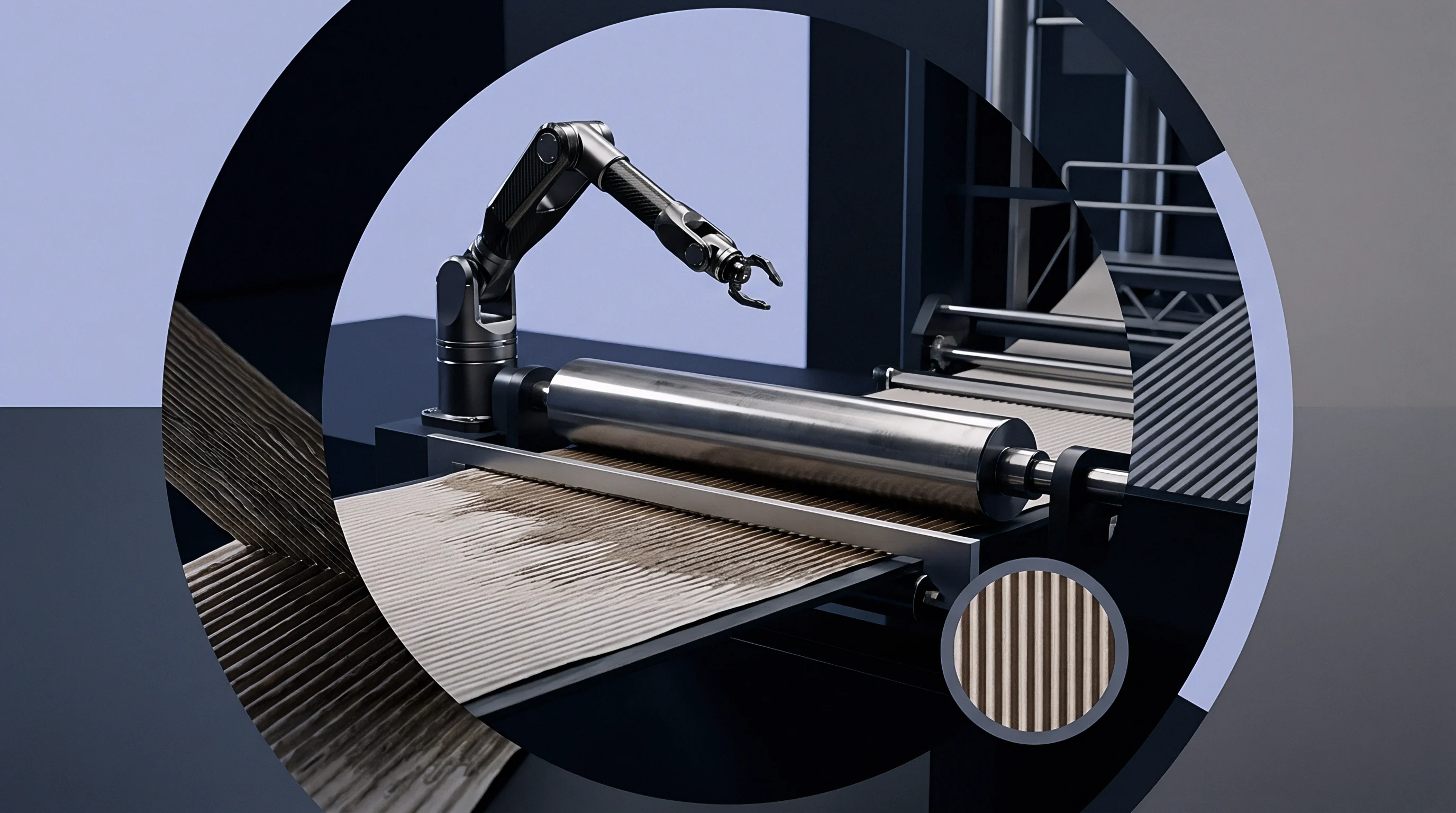

Relaxation
Line speeds exceeding four hundred meters per minute compress mechanical contact times during rotary die cutting and creasing into intervals below five milliseconds. Substrate fibers and polymeric coatings undergo rapid multiaxial deformation that triggers time-dependent dissipation. When a creasing rule strikes a multi-ply solid bleached sulfate board at these velocities, linear elastic models predict peak stresses fifty to eighty percent higher than empirical measurements show.
The cellulose matrix yields through interfiber friction, micro-delamination, and polymer chain rearrangement within the sizing and barrier films. An accurate mathematical formulation demands constitutive equations that separate instantaneous elastic response from time-dependent viscous decay across several logarithmic decades of strain rate.
High-speed board conversion relies on the generalized Maxwell model, formulated mathematically as a Prony series representation of the relaxation modulus. In this formulation, the time-dependent relaxation modulus decomposes into an equilibrium modulus summed with a discrete spectrum of exponential decay modes:
G(t) = G_inf + sum(G_i exp(-t / tau_i))
Here, G_inf denotes the fully relaxed long-term shear modulus, G_i represents the relaxation strength of the i-th Maxwell element, and tau_i denotes the characteristic relaxation time of that respective element, defined by the ratio of element viscosity eta_i to element modulus G_i. For folding boxboard moving through high-speed rotary cutting units, the relevant relaxation spectrum spans from 0.0001 seconds up to ten seconds. The ultra-short relaxation times govern die impact and scoring rule penetration, while the intermediate modes dictate spring-back angle recovery as the blank leaves the converting nip and travels toward the folder-gluer.
Polymer-coated folding boxboard subjected to a three-millisecond nip impact at sixty percent relative humidity dissipates forty-two percent of applied stress through instantaneous plastic slip rather than delayed viscoelastic relaxation.
Nonlinear viscoelastic effects emerge when strain amplitudes exceed 0.5 percent in the thickness direction or two percent in the machine direction. The Schapery nonlinear viscoelastic model provides thermodynamic consistency under these high-amplitude deformation fields by modifying the hereditary integral with state-dependent stress factors:
epsilon(t) = g_0 D_0 sigma(t) + g_1 integral(Delta_D(psi(t) – psi(s)) d(g_2 sigma(s)) / ds ds)
The variable psi represents reduced time, incorporating an internal shift factor a_sigma that accelerates intrinsic material time under severe deviatoric stress. Parameter g_0 measures the stress-dependent instantaneous compliance, g_1 scales the transient compliance contribution, and g_2 captures the stress-dependent loading rate effect. In solid bleached board, elevated shear forces during creasing accelerate the internal clock of the material.
Polymer chains slip under rapid elongation.
Constitutive modeling frameworks for converting optimization must account for distinct physical phenomena occurring simultaneously across individual plies:
- Instantaneous elastic stiffness controls initial force transmission into the counter-matrix channel and establishes the threshold for localized shear yield before significant viscous dissipation activates.
- Short-term relaxation modes attenuate peak bending moments within the first twenty milliseconds after rule extraction, preventing outer liner rupture during subsequent high-speed folding passes.
- Nonlinear stress shifting accelerates internal energy dissipation in heavily compressed score cores, reducing permanent spring-back variation across shifts with fluctuating web velocity.
- Hydro-viscoelastic coupling modulates the Prony series coefficients in response to ambient moisture shifts, shifting relaxation spectra into lower frequency regimes as relative humidity climbs.
Calibrating these constitutive parameters demands dynamic mechanical analysis across frequencies from 0.1 to 100 Hertz combined with high-speed micro-tensile tests operating at strain rates up to 1000 reciprocal seconds. Standard low-speed tensile testing yields values that grossly underestimate transient stress peaks during rotary scoring, leading to insufficient tool penetration settings on production presses.
| Model Formulation | Mathematical Parameters | Target Converting Phase | Strain Rate Range (s⁻¹) | Computational Cost per Mesh Node (ms) |
|---|---|---|---|---|
| Linear Maxwell Fluid | E_0, eta_0 | Web tension pull roll transit | 0.01 to 10 | 0.04 |
| Prony Series (5-Term) | G_inf, G_i, tau_i (i=1. 5) | High-speed rotary creasing | 10 to 800 | 0.28 |
| Schapery Nonlinear Model | g_0, g_1, g_2, a_sigma, D_0 | Matrix channel shear scoring | 100 to 1500 | 1.45 |
| Kelvin-Voigt Solid | E_1, eta_1 | Blank stacking and pallet settling | 0.001 to 0.1 | 0.06 |
| Burger Four-Element | E_M, eta_M, E_K, eta_K | Folder-gluer belt nip hold | 1 to 50 | 0.18 |
Mismatched relaxation parameters cause converting engineers to over-compensate through excess anvil penetration depth. The resulting micro-fractures in the top linerboard cause delamination, aesthetic chalking along print margins, and eventual package failure at the automated erecting station.
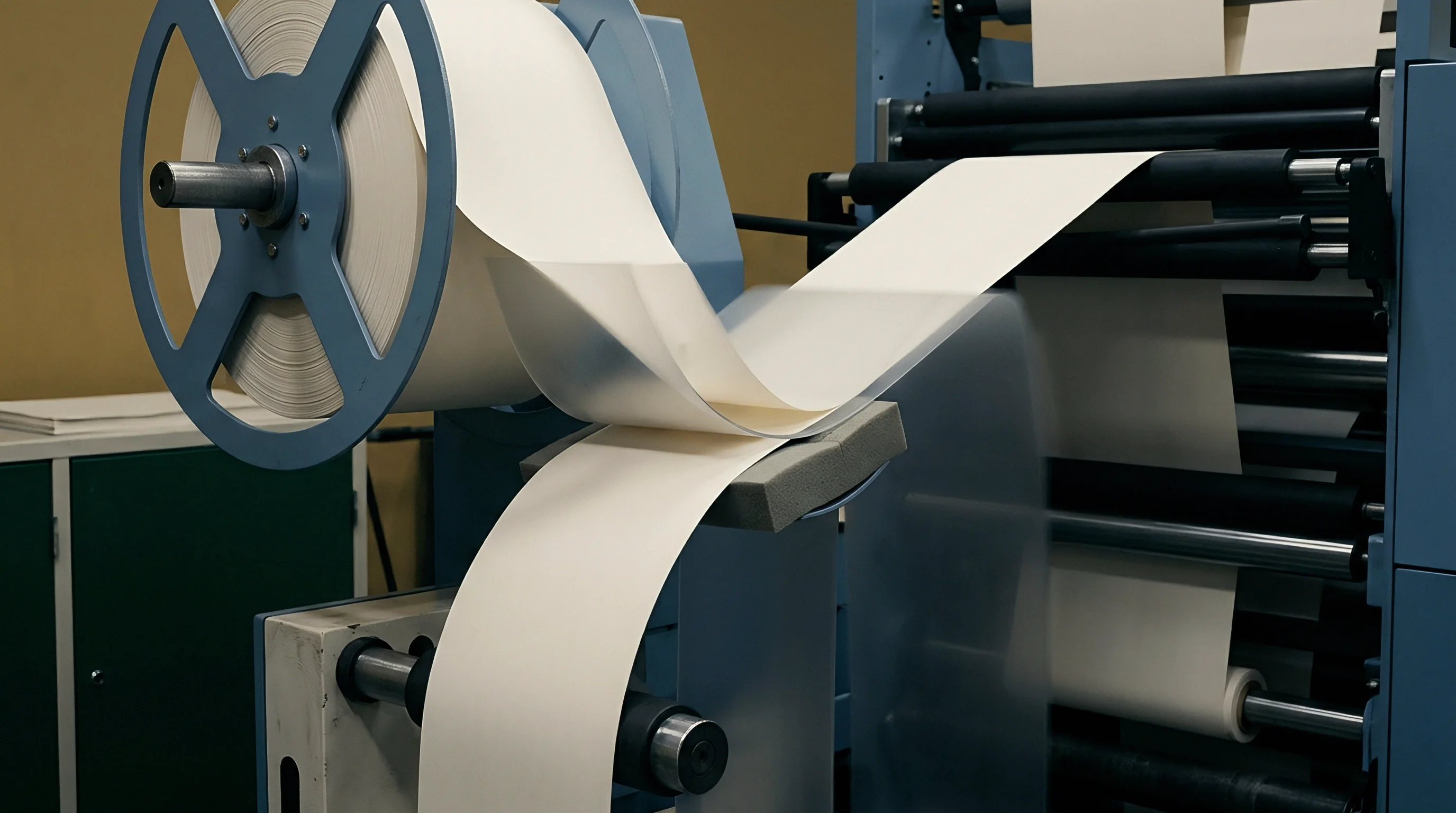
Rule
Creasing tooling forces paperboard into a narrow counter-channel to create an internal shear delamination zone that functions as an engineered hinge. This hinge controls subsequent panel formation on high-speed cartoning machines. During a machine stroke running at seven thousand sheets per hour, the male creasing rule enters the substrate, compresses the top liner, drives the core into shear, and retracts within twelve milliseconds.
Creep compliance doubles under sustained load. The mechanics inside that twelve-millisecond contact window dictate whether the fold will form a crisp, square edge or rupture the coated outer print surface.
The deformation mechanics split into three concurrent kinematic modes governed by the substrate’s anisotropic viscoelastic compliance tensor:
- Out-of-plane compression under the rounded rule tip compacts the porous fiber network, collapsing lumen structures and driving localized densification that raises the local transverse elastic modulus by up to four hundred percent.
- Inter-ply shear failure between individual fiber sheets initiates deliberate delamination cracks that travel horizontally outward toward the shoulders of the counter-matrix channel, creating independent thin plates capable of bending without outer tensile rupture.
- Membrane tensile stretching along the lower surface forces the reverse side of the board against the bottom edges of the female channel, where excessive friction or insufficient viscoelastic elongation produces catastrophic tensile bursting.
Linerboard fractures under excessive rule depth. When converting speed doubles from two hundred to four hundred meters per minute, the strain rate inside the shear deformation zone surges proportionally. Because cellulose fibers and inter-fiber starch bonds exhibit pronounced strain-rate hardening, the apparent shear yield strength of the carton core increases by fifteen to thirty percent.
The material behaves stiffer than it does in a static laboratory press. Counter dies demand precise channel alignment.
Narrower creasing matrix channels increase shear localization within the carton core while suppressing outer liner split during high-speed female die penetration.
A rigorous understanding of viscoelastic damage mechanics prevents premature outer layer splitting. The viscoelastic damage tensor tracks micro-void formation within the hemicellulose-lignin matrix. If the male rule penetrates too deeply before the core fibers can relax through viscous flow, hydrostatic pressure builds rapidly beneath the rule tip.
This pressure drives tensile cracks vertically upward through the bleached kraft coating layer instead of channeling shear stress horizontally through the core. Delamination begins along the middle ply.
The channel width of the female matrix die must expand when press velocity increases. At higher strain rates, the effective relaxation time tau_eff of the board shifts relative to the process observation time. The dimensionless Deborah number, defined as De = tau / t_process, rises above unity.
When De exceeds unity, the substrate responds like a brittle solid rather than a ductile fiber composite. Widening the counter-channel by five to ten percent decreases the localized shear strain rate, bringing the Deborah number back toward the ductile deformation envelope. Die penetration reaches seventy microns.
Tooling setups calibrated exclusively on slow make-ready pulls consistently fail during volume production runs. Higher line speeds shift the neutral axis of the crease bead outward, concentrating residual tensile stress on the exterior printed ink film unless counter-channel clearances expand to absorb the rate-induced stiffness increase.
Dwell
Contact duration inside a continuous laminator nip or a rotary embossing cylinder governs interface wetting, mechanical interlock, and polymer flow. In high-speed barrier coating lines operating at eight hundred meters per minute, the nip dwell window shrinks to between one and three milliseconds. Dwell time drops below three milliseconds.
Within this brief interval, an extrusion-coated polyethylene or water-based barrier varnish must achieve intimate molecular contact with an uneven, rough paperboard topography while withstanding peak hydraulic pressures that surpass six megapascals.
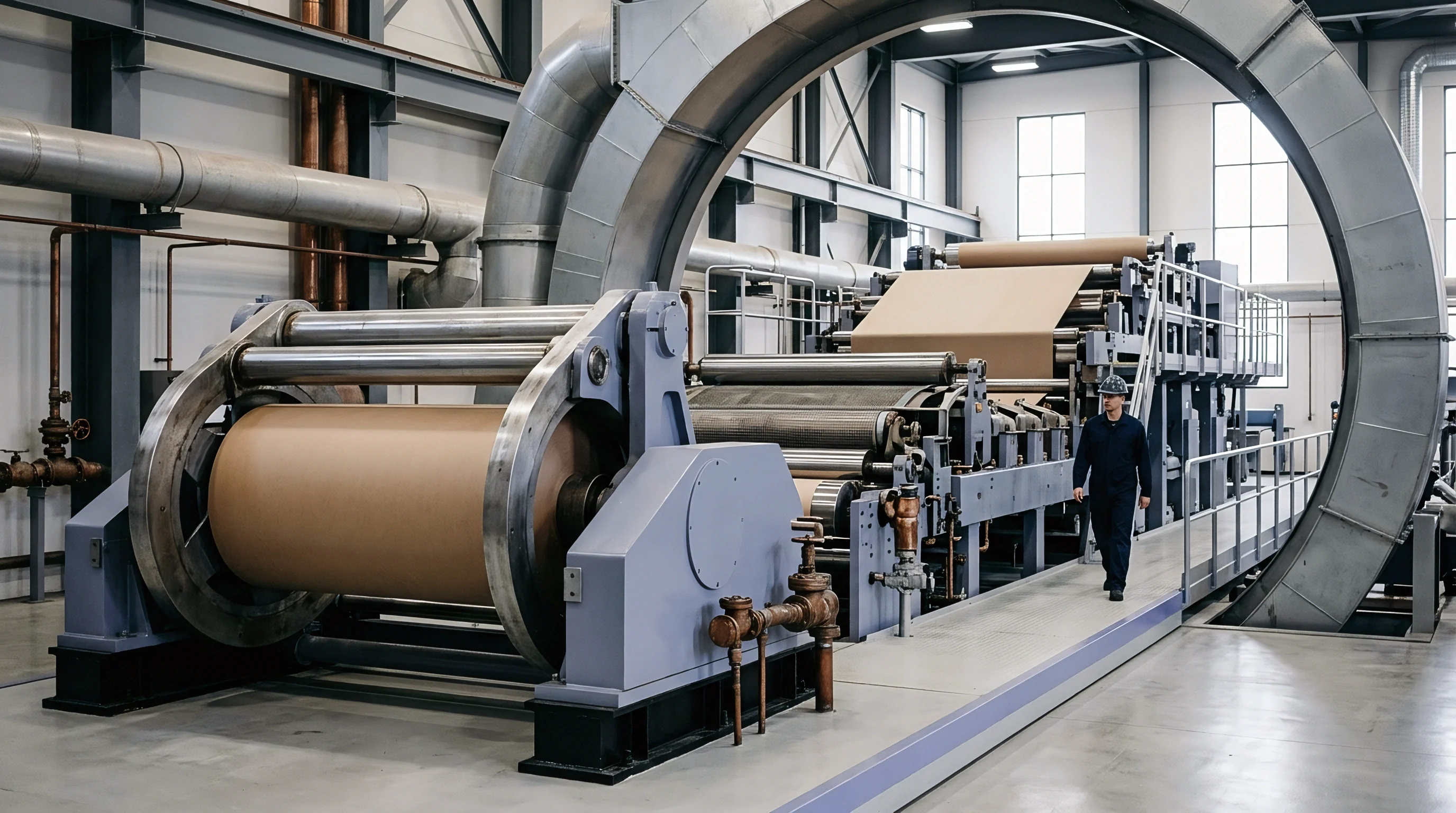
Does High Converting Speed Inhibit Viscoelastic Recovery?
Rapid transit through mechanical nips limits both forward viscous flow and subsequent elastic spring-back. During embossing passes, an engraved steel roll forces coated board against a resilient backing cylinder. The backing roll cover, typically polyurethane or synthetic elastomer with a hardness between eighty and ninety-five Shore D, exhibits its own pronounced viscoelastic hysteresis.
If the machine runs faster than the relaxation rate of the elastomer cover, the backing roll does not fully rebound before the next cylinder rotation. Nip pressure exceeds four megapascals. The effective nip geometry flattens dynamically, reducing localized embossing depth by twenty to thirty-five percent across the production shift.
Viscoelastic recovery within the paperboard itself determines tactile sharpness and structural permanence. Following nip exit, the compressed fibers experience immediate elastic snap-back driven by unrelaxed internal strain energy, followed by delayed viscoelastic creep recovery over minutes or hours. Recovery stalls at forty percent.
If the initial nip dwell is too short to dissipate peak stresses through permanent viscous sliding, the elastic snap-back dominates, causing embossed patterns to fade within twenty-four hours of palletization.
ISO 187 conditioning mandates twenty-three degrees Celsius and fifty percent relative humidity because a five percent moisture swing shifts polymer glass transition frequencies directly into the operating band of high-speed converting cylinders.
Evaluating and controlling these dwell-dependent phenomena requires a disciplined sequence of diagnostic steps during press setup:
- Run high-frequency dynamic mechanical analysis on raw board plies to determine the glass transition temperature and alpha-relaxation peak of internal hemicellulose components.
- Measure the dynamic nip footprint width using pressure-sensitive tactile film at crawl speed and at production line velocity to map out rate-dependent footprint shrinkage.
- Calculate the true dwell duration using the ratio of dynamic nip contact length to surface web velocity.
- Adjust cylinder surface temperatures to exploit the Williams-Landel-Ferry time-temperature superposition principle, compensating for reduced dwell duration by softening polymer barriers through heat.
- Audit finished carton crease recovery force using a two-second holding test on a digital score quality tester to verify adequate internal shear dissipation.
Polymer barrier layers like polyethylene, polybutylene succinate, and aqueous dispersion barriers introduce strong thermo-rheological complexity. Their relaxation behavior follows the Williams-Landel-Ferry relationship, which defines an empirical shift factor a_T for operating temperatures above the glass transition temperature T_g:
log10(a_T) = -C_1 (T – T_g) / (C_2 + (T – T_g))
Standard empirical constants C_1 and C_2 approximate 17.44 and 51.6 Kelvin for typical synthetic barrier films. Raising the laminating or embossing cylinder temperature shifts the relaxation spectrum toward shorter timescales. An elevated roll temperature acts as a mechanical surrogate for longer dwell time, permitting clean molecular bonding and crisp foil stamp definition at speeds exceeding five hundred meters per minute.
Foil release fails at higher line speeds.
| Substrate Layer | Initial Storage Modulus E’ (MPa) | Loss Factor tan(delta) | Characteristic Dwell Needed (ms) | Residual Elastic Spring-Back (%) |
|---|---|---|---|---|
| Bleached Top Kraft Liner | 5400 | 0.045 | 8.5 | 68 |
| Mechanical Pulp Core Ply | 2100 | 0.085 | 4.2 | 38 |
| Unbleached Bottom Liner | 4600 | 0.052 | 7.0 | 62 |
| Extruded LDPE Barrier (20 g/m²) | 280 | 0.220 | 1.8 | 18 |
| Aqueous Acrylic Dispersion Varnish | 1150 | 0.140 | 2.5 | 25 |
Substrate suppliers frequently assert that poor embossing retention or delaminated barrier coatings stem entirely from substandard operator make-ready or fluctuating ambient pressroom humidity rather than deficient low-shear viscous compliance in their coating formulations.
Web
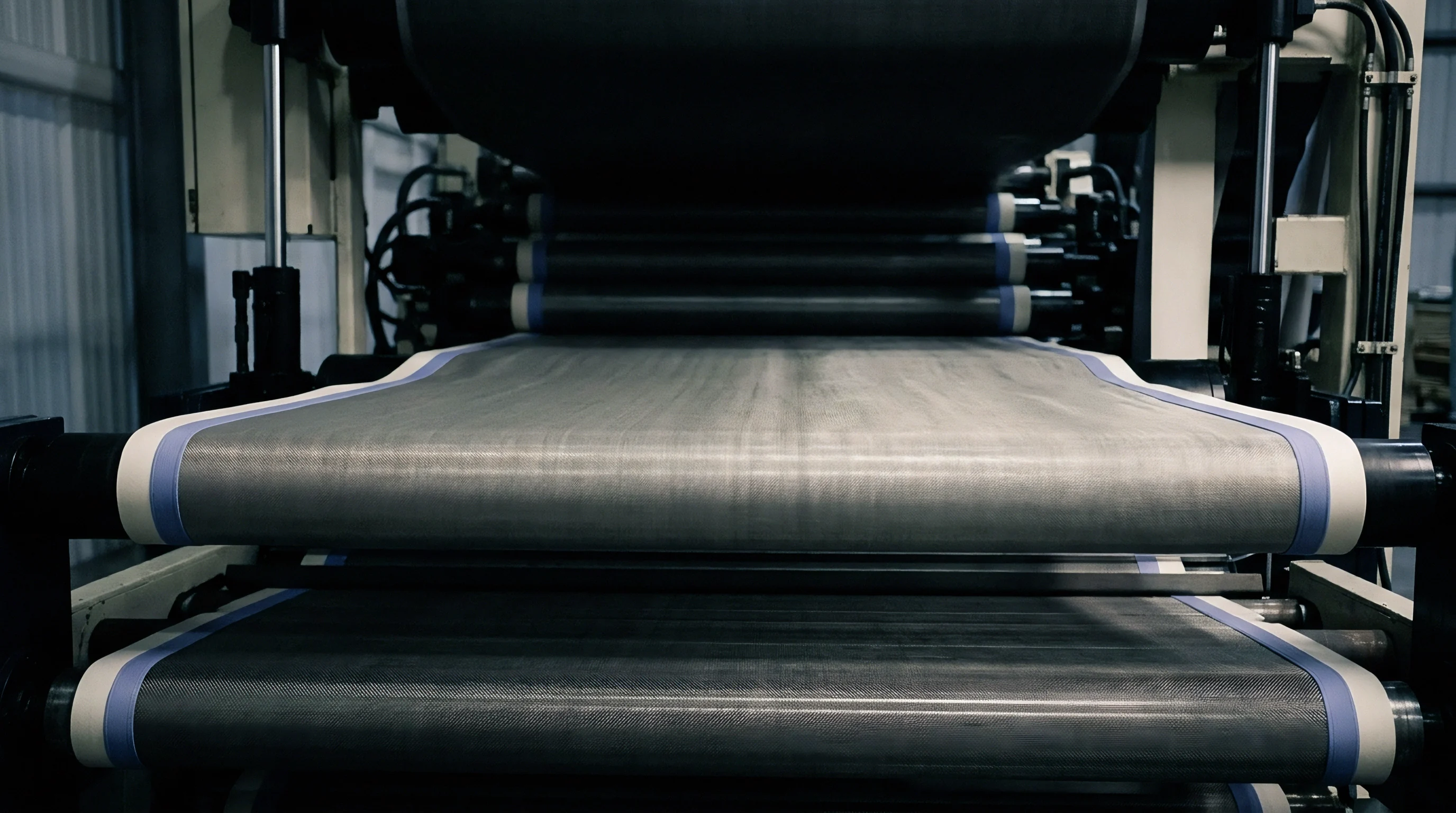
Continuous paperboard substrates traveling through unwinds, coating heads, drying tunnels, and rotary die units behave as moving viscoelastic strings under tension. Unlike static structural beams, a moving continuous strip carries mechanical history from every upstream nip, tension pull roll, and heated drying hood. If web tension spikes across an acceleration ramp, cellulose fibers undergo instantaneous elastic stretching accompanied by delayed primary creep.
Web tension fluctuates by fifteen newtons. When the strip reaches the rotary cutter five seconds later, delayed viscoelastic recovery is still actively altering the physical pitch between printed register targets and rotary cutting dies.
Tension control systems that utilize pure elastic assumptions fail during speed transitions. The viscoelastic web span equation governs strain distribution along an open machine draw between two driven rollers:
d(epsilon_e) / dt = -v / L (epsilon_e – epsilon_upstream) – d(epsilon_v) / dt + (v_2 – v_1) / L
In this dynamic equation, epsilon_e represents the recoverable elastic strain, epsilon_v is the accumulated viscoelastic creep strain, v denotes web velocity, L is the physical length of the unsupported span, and (v_2 – v_1) defines the peripheral speed differential between the downstream and upstream boundary rollers. As converting velocity v increases, the convective transport term v / L dominates the time derivative, pulling unrelaxed transient strains through successive processing stations. Register drift expands past two tenths.
Moisture desorption inside convection drying ovens exacerbates dimensional instability. When hot air evaporates moisture from the water-based varnish or dispersion coating on the top liner, the board matrix shrinks transversely and longitudinally. Moisture loss reaches two percent.
Because drying takes place under axial web tension, longitudinal shrinkage is mechanically restrained while transverse shrinkage proceeds unhindered. This restraint induces anisotropic internal stresses. As moisture evaporates, the glass transition temperature of cellulose rises sharply from fifty degrees Celsius toward one hundred degrees Celsius, freezing non-uniform viscoelastic strains permanently into the fiber network.
To calibrate web handling systems against viscoelastic stretch during high-speed commissioning, technical crews follow a defined sequence:
- Lock out all load-cell closed-loop tension overrides to establish baseline open-loop drive speed ratios across every draw zone.
- Feed unprinted substrate through the converting line at base crawl speed while logging baseline motor torque draws.
- Accelerate the production line in fifty-meter-per-minute increments up to peak rated output speed while recording physical draw elongation using synchronized optical mark sensors.
- Extract the steady-state creep rate and calculate the transient strain transfer matrix across heated drying tunnels.
- Program rate-dependent electronic drive draw offsets into the digital press control architecture to counteract speed-induced viscoelastic pitch expansion.
Shear rates top ten thousand reciprocal seconds. Bending resistance drops by twelve percent. When the processed board finally reaches the cross-cutter, non-uniform residual stresses cause immediate out-of-plane distortion.
The edges curl upward toward the coated surface as tension drops to zero. Rotary dies require tungsten carbide rules. This curl disrupts sheet stacking in the delivery delivery pile, trips safety photocells, and forces press operators to throttle line speed thirty percent below rated design capacity.
The core uncertainty remains whether dynamic fiber reorientation under rapid multiaxial web draws can ever be modeled adequately using isotropic continuum approximations, or if converting machine algorithms must evolve toward discrete multi-scale fiber network simulations running in real-time edge processors.
Ledger
Commercial performance in paperboard packaging converting balances machine velocity against line yield and tooling amortization. When a high-speed converting line throttles down from five hundred to three hundred meters per minute to prevent score rupture or register walking, fixed operating overhead per thousand cartons climbs directly. Every finishing pass, whether hot foil stamping, structural embossing, or barrier varnish application, adds a distinct process window that consumes material yield, expands setup waste, and increases downstream quality liabilities.
Consider a typical high-volume production scenario: a four-hundred-tonne carton run running on solid bleached sulfate board of 350 grams per square meter, converting into retail pharmaceutical cartons on an automated rotary die line. The gross material investment totals 520,000 dollars based on a delivered paperboard price of 1,300 dollars per tonne. Operating costs for the converting line, encompassing labor, tooling depreciation, energy, and plant overhead, average 450 dollars per operating hour.
Make-ready scrap consumes two pallets.
Assume an initial setup running at a conservative line speed of two hundred and fifty meters per minute to avoid viscoelastic score splitting. At this speed, the job requires forty-four operating hours, generating 19,800 dollars in direct machine operating costs. The make-ready waste consumes 1.5 percent of the total stock, adding 7,800 dollars in discarded substrate expense.
Total initial conversion expense reaches 27,600 dollars, or 69.00 dollars per converted tonne.
Now consider the same job optimized via non-linear viscoelastic constitutive calibration. By expanding female matrix channel dimensions by eight percent and raising heated creasing cylinder temperatures by fifteen degrees Celsius, the line runs reliably at four hundred and fifty meters per minute without liner fracturing. Running time drops to twenty-four point four hours, trimming operating machine expenses down to 10,980 dollars.
Tooling modifications and advanced rheological substrate qualification add an upfront engineering expenditure of 3,200 dollars. Running scrap remains low at 1.8 percent, or 9,360 dollars in lost material. Net conversion expense drops to 23,540 dollars, generating a direct saving of 4,060 dollars on the job while liberating nineteen point six hours of press capacity for subsequent customer orders.
Converting line velocity balances mechanical throughput against the compounding scrap expense of spring-back rejects at downstream packaging stations.
The financial ledger suffers catastrophic damage when optimized converting speeds trigger downstream filling line rejections. If creasing parameters fail to account for long-term viscoelastic relaxation, the spring-back angle of the carton flaps will drift by four to seven degrees over forty-eight hours of warehouse storage. When these cartons enter the client’s automated packaging line running at eighty strokes per minute, stiff flaps jam the erecting mandrels.
Under standard supply contracts, the converter bears full financial liability for packing line downtime, sorting labor, and rejected packaging stock.
| Line Velocity (m/min) | Effective Dwell Window (ms) | Carton Crease Spring-Back (deg) | Make-Ready Waste Rate (%) | Net Converted Cost per 10k Units ($) |
|---|---|---|---|---|
| 150 | 8.8 | 89.8 | 1.2 | 845 |
| 250 | 5.3 | 93.4 | 1.5 | 680 |
| 350 | 3.8 | 96.1 | 1.8 | 595 |
| 450 | 2.9 | 98.5 | 2.4 | 540 |
| 550 | 2.4 | 103.2 | 6.8 | 675 |
Modulated producer responsibility packaging fees introduce an additional financial dimension. Heavy synthetic film laminations that obscure fiber viscoelastic defects penalize the finished pack under European packaging fee schedules, whereas water-based dispersion barriers retain mono-material recyclability ratings. Sourcing teams must reconcile the mechanical ease of converting thick polymer-laminated board against the fee surcharges levied on non-recyclable composites.
Standard manufacturing purchase agreements dictate that carton blanks must hold fold opening force tolerances between 1.2 and 2.5 newton-centimeters when tested in accordance with DIN 55437 ninety days after manufacturing, invalidating any delivery lot whose viscoelastic relaxation decays outside certified packaging machine limits.