Water Sorption Effects on Synthetic Latex Barrier Film Stiffness
Water sorption depresses latex film glass transition temperatures, slashing barrier composite stiffness by up to 45% and requiring controlled crosslinking.
Plasticization
Moisture Uptake inside Aqueous Polymer Dispersions
Synthetic latex barrier coatings applied to paperboard substrates experience rapid changes in mechanical modulus when exposed to elevated relative humidity. Carboxylated styrene-butadiene, styrene-acrylate, and pure acrylic polymer films absorb ambient water vapor through free volume transport and hydrogen-bonding coordination with residual hydrophilic groups. Polymer films conditioned according to ISO 187 at 23 degrees Celsius and 50 percent relative humidity maintain high elastic stiffness, yet this rigidity drops precipitously as environmental moisture increases to 85 percent relative humidity.
Water molecules disrupt interchain dipole-dipole associations, acting directly as an internal plasticizer within the coalesced latex particle network.
Glass transition temperatures shift downward by 10 to 25 degrees Celsius as moisture fills the coating layer. The dry glass transition temperature of a functional barrier binder commonly resides between 15 and 30 degrees Celsius to prevent blocking during reel winding, while simultaneously allowing sufficient flexibility during scoring. Water sorption depresses this temperature below the ambient running temperature of downstream packaging machinery.
Converting lines encounter limp webs, decreased crease definition, and premature seal failure when the barrier coating transitions from a glassy state into a leathery or rubbery regime.
Water sorption lowers the effective glass transition temperature of carboxylated styrene-butadiene films by up to 1.8 degrees Celsius per percentage point of absorbed moisture under ISO 187 conditioning.
Moisture uptake values differ across polymer chemistry classes. Styrene-acrylate formulations balance grease resistance with moderate moisture vapor permeability, whereas high-styrene carboxylated latexes prioritize mechanical stiffness and mineral oil barrier performance. The chemical nature of the surfactant system and acid monomer functionalization dictates how aggressively the cured latex draws atmospheric water.
| Latex Binder Chemistry | Carboxylation Level Percentage | Moisture Uptake At 50 Percent RH | Moisture Uptake At 85 Percent RH | Dry Tensile Modulus Megapascals | Conditioned Modulus At 85 Percent RH |
|---|---|---|---|---|---|
| Carboxylated Styrene-Butadiene (XSB) | 2.5 | 0.8% | 3.4% | 420 | 185 |
| Styrene-Acrylic Copolymer (SA) | 3.8 | 1.4% | 5.2% | 680 | 210 |
| Pure Acrylic Dispersion (AC) | 4.2 | 1.9% | 6.8% | 310 | 95 |
| Ethylene Vinyl Acetate (EVA) | 1.2 | 0.6% | 2.8% | 190 | 80 |
Plasticization diminishes the storage modulus measured by dynamic mechanical analysis across commercial operating frequencies. When the elastic stiffness collapses, the coated composite substrate loses structural snap and resistance to edge deflection. Converters observing web flutter on high-speed folder-gluers trace the loss of runnability back to uncontrolled moisture absorption in stored barrier reels.
An unresolved dispute in the barrier industry remains whether surfactant exclusion to particle interfaces causes more plasticization damage than ionic crosslinking with divalent salts can counteract.
Swelling
Volumetric Expansion and Free Volume Redistribution
Penetration of water into synthetic latex barrier matrices initiates physical swelling that increases the average distance between polymer chain backbones. This expansion alters the volume fraction of the cohesive polymer phase while simultaneously dilating hydrophilic microdomains created by surfactant pockets, neutralizing agents, and hydrophilic acid monomers. Polymer films do not expand isotropically when adhered to cellulose fibres, because the fibrous base restrains dimensional movement along the web plane.
Lateral restraint forces the swelling stress into thickness expansion, weakening the shear strength at the coating-board interface.
The mechanical effect of this swelling appears clearly during dead-fold and three-point flexural testing according to ISO 2493. The dry barrier film acts as a tension-carrying member on the outer face of a fold, preserving the structural moment of the paperboard composite. Swelling reduces the cohesive bond strength of the latex matrix, permitting individual latex particles to undergo micro-slippage when subjected to flexural loading.
Elastic recovery declines sharply, leading to unrecoverable panel deformation during secondary packaging assembly.
Water uptake within latex coatings occurs through distinct sorption modes across relative humidity gradients:
- Henry Mode Sorption accounts for water dissolved directly into polymer free volume at low activity levels, which produces negligible volume dilation.
- Langmuir Mode Sorption occurs when water molecules bind tightly to localized polar sites, carboxyl functional groups, and residual hydrophilic emulsifiers.
- Clustering Domain Sorption operates above 70 percent relative humidity, where water molecules self-associate into localized aqueous clusters that force structural micro-voiding and severe film softening.
The clustering phase degrades barrier film integrity. As water aggregates within the dispersion film, the percolation threshold of the aqueous network is reached, multiplying moisture vapor transmission rates by factors of three to six. High cluster density softens the interstitial material between latex spheres, reducing the static shear modulus to values beneath machine-handling tolerances.
Converting equipment pulling board over forming collars induces surface scuffing when film softening coincides with surface condensation.
Coating thickness swells by four to nine percent between dry application and equilibrium at 85 percent relative humidity.
Surfactant migration amplifies this volumetric breakdown. Sodium dodecyl sulfate or alternative ionic stabilizers migrate toward coating interfaces during drying on the paper machine. When re-exposed to high humidity during storage, these surfactant clusters hydrate aggressively, turning into microscopic mechanical fault lines.
The stiffness of the composite construction plummets because the continuous phase within the coating contains water-filled domains incapable of carrying mechanical stress. Skipping incoming humidity verification forfeits the converter claim when soft films cause carton collapse in cold storage transit.
Furnish
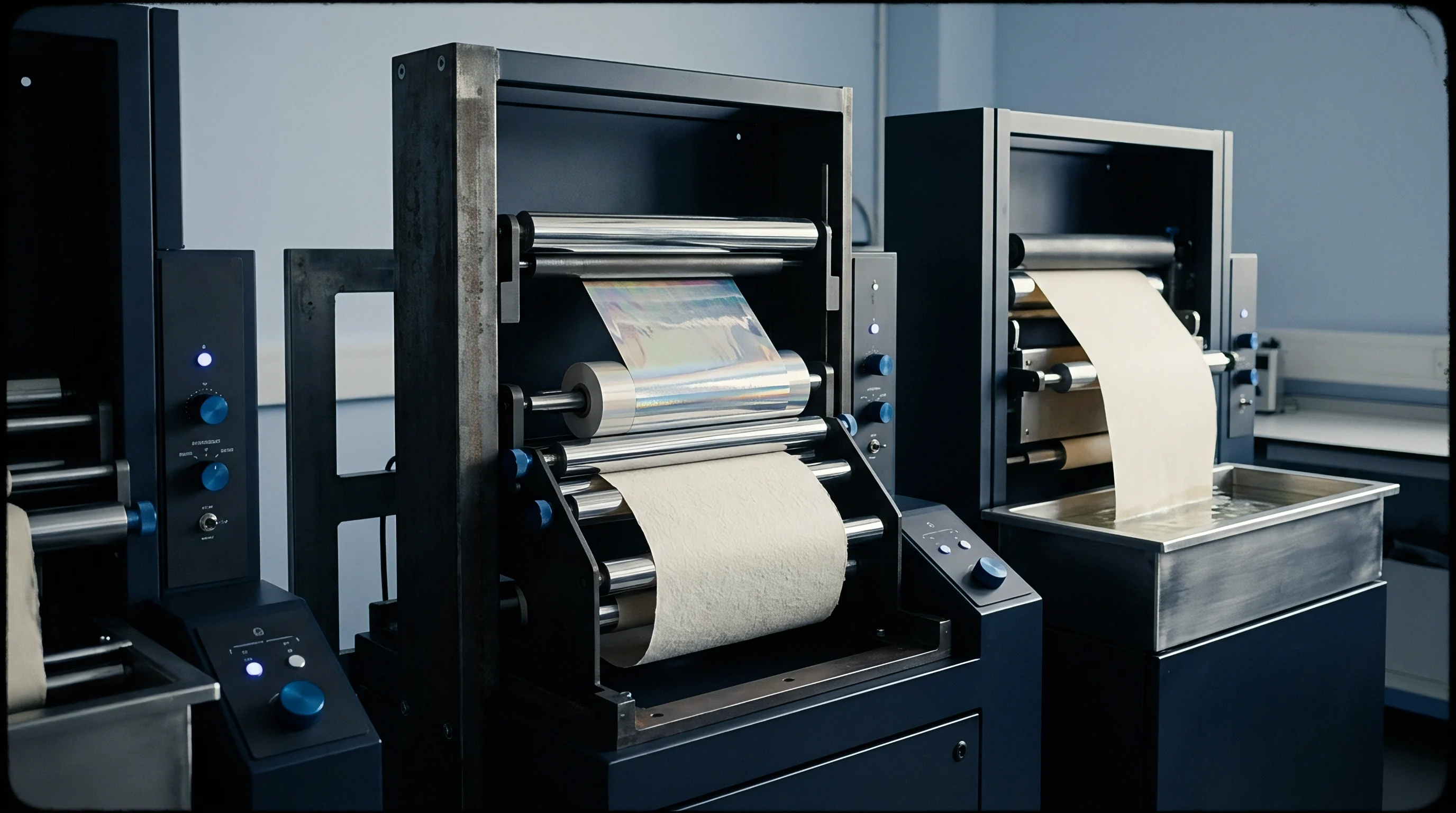
Substrate Interaction and Moisture Migration Dynamics
Liquid and vapor transfer across the coated interface depends heavily on base sheet morphology and pulp composition. Bleached chemical pulp provides a uniform, highly consolidated substrate for latex application, while unbleached kraft and recycled paperboard furnish contain residual lignin, hemicellulose variations, and higher pore volume fractions. Latex dispersions penetrate porous sheets, anchoring into the upper fibre layers and forming a composite interphase zone.
Moisture absorbed by the paperboard migrates through the fibre network and attacks this interphase from the substrate side, altering both board stiffness and film adhesion simultaneously.
Fibre swelling inside the base substrate exerts mechanical stress on the applied synthetic latex film. According to TAPPI T410 and T411 measurements, wood fibres expand up to twenty percent in width upon full hydration while lengthening less than two percent along their longitudinal axes. This directional expansion applies severe cross-direction shear stress to the barrier film adhering to the sheet surface.
If the latex barrier has already lost tensile modulus via water plasticization, the expanding fibres induce micro-fissures throughout the coating thickness.
| Base Board Type | Grammage Grams Per Square Metre | Coating Weight Dry GSM | MD Bending Stiffness At 50% RH | MD Bending Stiffness At 85% RH | Stiffness Loss Percentage |
|---|---|---|---|---|---|
| Solid Bleached Sulphate (SBS) | 230 | 12.0 (XSB Latex) | 24.5 mNm | 17.8 mNm | 27.3% |
| Folding Boxboard (FBB) | 215 | 14.0 (Styrene-Acrylic) | 21.0 mNm | 14.1 mNm | 32.8% |
| Coated Recycled Board (CRB) | 250 | 15.0 (Pure Acrylic) | 18.5 mNm | 10.2 mNm | 44.9% |
| Unbleached Kraft Liner (UKL) | 175 | 10.0 (XSB Latex) | 19.2 mNm | 14.0 mNm | 27.1% |
Recycled fibres accelerate the loss of composite stiffness under wet conditions. Recycled pulp exhibits lower hornification resistance and carries variable ash content that absorbs water rapidly via capillary draw. Mineral fillers like calcium carbonate provide high initial smoothness, but create micro-channels that direct water vapor straight to the underside of the synthetic latex film.
The water pools at the coating boundary, softening the latex binder and weakening mechanical interlocking.
Paperboard buyers evaluating barrier performance must address the composite structure rather than the isolated polymer film. High Cobb sizing values measured by ISO 535 indicate insufficient internal hydrophobic sizing, leaving the base sheet free to pull water from moist air and saturate the coating from below. If the sizing is tight, moisture uptake slows, shielding the barrier film from rapid plasticization cycles during sea freight transit.
Quality variation between paperboard lots creates substantial performance discrepancies on identical converting machinery.
The rate of composite stiffness loss correlates with base sheet water absorption values rather than latex film water vapor transmission rates alone.
The balance of machine-direction and cross-direction fibres also controls the severity of barrier degradation. Machine-direction oriented fibres distribute stress along the line of travel, stabilizing the coating against tensile fracture during winding. Cross-direction bending forces, however, place maximum stretch on plasticized, water-swollen latex films, frequently causing micro-cracking across creases.
Base sheet selection dictates half of the overall water resistance of the finished barrier system.
Moisture transfer through the substrate creates distinct failure pathways during converting:
- Interfacial Delamination separates the water-softened synthetic latex layer from unbonded surface fibres during rotary die-cutting.
- Scoreline Flaking shatters the barrier coating along score lines when board stiffness collapses faster than latex elongation can adjust.
- Pinholing via Fibre Puffing ruptures dried barrier coatings when coarse hardwood and mechanical pulp fibres swell outwards under high humidity.
- Blocking on the Reel welds adjacent wraps together when moisture lowers the surface polymer glass transition temperature below warehouse temperatures.
Every board grade balances yield, stiffness, and barrier affinity differently. Folding boxboard offers high bulk per unit weight, but its mechanical pulp core absorbs moisture readily if cut edges remain unsealed. Solid bleached board provides structural density and smooth coating laydown, keeping the latex film thickness uniform across the sheet profile.
Recycled liners run cheaper per tonne, yet their unpredictable internal sizing creates substantial variance in wet stiffness stability. A mill line technician will often state that wet web limpness is an inevitable consequence of using high-yield mechanical furnish in humid climates.
Fracture
Why Does Moisture Softening Induce Barrier Pinholing?
Water sorption modifies the fracture toughness and strain-at-break characteristics of synthetic barrier films. In the dry state, high-modulus coatings resist pinholing from mechanical abrasion but crack under tight-radius folding operations. Wet latex films behave in the opposite manner: high elongation prevents brittle fracture, but the drastic reduction in yield stress permits mechanical penetration and tearing under point loads.
Converting machinery applies severe shear, tensile, and compressive stresses across narrow areas during creasing, folding, and gluing.
When plasticized latex barrier films pass through folder-gluer belts, localized friction creates shear forces exceeding the reduced yield strength of the water-softened polymer. The film deforms plastically, thinning across the apex of carton creases. This thinning exposes underlying cellulose fibres, generating macroscopic pinholes that destroy oxygen and water vapor barrier continuity.
Standard testing via turpentine or dyed oil solutions reveals barrier breakthrough directly on the folded edges of cartons conditioned at 85 percent relative humidity, while identical cartons tested under dry conditions show continuous holdout.
The fracture resistance of latex films depends on the physical cohesion between coalesced polymer particles. Synthetic latex coatings dry via water evaporation, particle deformation, and interdiffusion of polymer chains across particle boundaries. If surfactant residues or water molecules sit at these inter-particle boundaries, they prevent complete macromolecular interdiffusion.
When water enters the film during storage, it segregates into these unentangled interfacial zones, causing boundary decohesion under tension.
Per ASTM F1249 testing at 38 degrees Celsius, water vapor transmission rates across folded carton creases increase by over 400 percent when film modulus drops below 120 Megapascals.
Mechanical stress during converting amplifies these micro-defects into open tears. Folding scores that require clean, ninety-degree profiles end up rounded and uneven when the coating layer cannot support the compressive stress on the internal face of the fold. The soft coating rolls into ridges along the crease channel, lifting away from the board surface.
The resulting packaging containers fail seal-integrity audits and leak liquid contents when filled with grease, oil, or aqueous goods. An unresolved question remains whether high-pressure calendering before coating improves particle coalescence sufficiently to prevent moisture-induced boundary decohesion entirely.

Drying
Thermal History and Crosslinking Optimization
The curing and drying profile applied to synthetic latex barrier coatings dictates their ultimate sensitivity to moisture plasticization. Fast, high-temperature hot air drying evaporates water rapidly, but can skin the coating surface, trapping residual moisture and surfactant clusters inside the core layer. Slower drying profiles that maintain web temperatures above the minimum film formation temperature allow polymer chains to interdiffuse fully, eliminating internal voids.
Curing stations that integrate infrared heating units consolidate the latex film into a cohesive barrier structure that resists water ingress.
Chemical crosslinking introduced during the drying phase counteracts water sorption. Zirconium salts, glyoxal resins, and multifunctional aziridines react with carboxyl groups on the latex polymer backbone to form covalent networks. These chemical crosslinks do not dissolve in water; they restrict the swelling of polymer chains when water molecules enter the system.
Dynamic mechanical analysis demonstrates that crosslinked carboxylated styrene-butadiene coatings retain over seventy percent of their dry elastic modulus when conditioned at 85 percent relative humidity, whereas uncrosslinked variants lose up to sixty percent of their dry modulus.
Converters and coaters follow specific verification checks to ensure proper cure and moisture resilience:
- Minimum Film Formation Temperature Monitoring ensures drying temperatures exceed the coalescence threshold of the polymer blend by at least fifteen degrees.
- Residual Surfactant Extraction Testing measures water-extractable compounds that act as nucleation points for moisture clustering.
- Attenuated Total Reflectance Spectroscopy tracks the consumption of carboxylic acid groups by ammonium zirconium carbonate or polycarbodiimide crosslinkers.
- Wet Scrub Abrasion Assessment verifies that the barrier film resists mechanical rub-off after two minutes of direct water immersion.
Crosslinking chemistry introduces a trade-off between stiffness retention and film flexibility. Heavy covalent crosslinking preserves elastic modulus in wet environments, but raises the effective glass transition temperature of the dry coating, increasing the risk of brittle fracture on high-speed creasing equipment. Coating formulators navigate this envelope by pairing low glass transition temperature base latexes with reactive crosslinkers, producing a film that is rubbery enough to bend without cracking yet chemically bound against moisture softening.
Oven temperatures on commercial barrier coaters often operate between 110 and 160 degrees Celsius, bringing the moving web surface up to 90 degrees Celsius. Inadequate dwell time in the drying tunnel prevents crosslinking reactions from reaching full conversion. Undercured coatings leave the machine looking uniform, but soften rapidly when wound into heavy reels, resulting in blocking, web distortion, and catastrophic loss of stiffness during warehouse storage.
Under standard purchase specifications, the presence of surface tackiness on slit reels justifies the immediate rejection of the delivered tonnage.
Yield
Landed Costs and Down-Gauge Economics
Water-induced stiffness loss impacts commercial conversion yields and total packaging unit economics. Packaging converters purchase paperboard by the metric tonne but sell finished folding cartons by the thousand units. When a barrier coating softens under humid ambient conditions, the overall composite bending stiffness drops below packaging line runnability limits.
To maintain required carton rigidity, packaging engineers are frequently forced to increase base board grammage, adding unnecessary paper mass to offset the softening of the polymer barrier.
Consider a commercial run producing one million dry-food cartons from folding boxboard coated with an aqueous synthetic latex barrier. The specification mandates a minimum carton machine-direction bending stiffness of 18 millinewton-metres to prevent panel bowing during vertical carton loading and case packing. Evaluating two operational strategies demonstrates the financial impact of environmental humidity controls:
Under Strategy A, an uncrosslinked styrene-acrylic coating is applied at 14 grams per square metre onto a 215 gram-per-square-metre folding boxboard. During humid summer storage at 80 percent relative humidity, moisture plasticization drops the composite machine-direction bending stiffness from 21.0 millinewton-metres down to 14.1 millinewton-metres. Cartons jam in the packaging plant magazine feeder, generating four percent make-ready spoilage and slowing line speeds by fifteen percent.
To compensate, the plant buyer shifts the baseline paperboard substrate up to a 240 gram-per-square-metre board grade, adding raw tonnage cost to every subsequent pallet.
Under Strategy B, the buyer retains the lighter 215 gram-per-square-metre board, but specifies a crosslinked, moisture-resistant carboxylated latex coating priced at an additional 180 dollars per dry tonne of coating. The crosslinked coating absorbs minimal water, keeping the machine-direction bending stiffness at 18.2 millinewton-metres under identical 80 percent relative humidity conditions. Line runnability is preserved, carton spoilage stays below one percent, and the converted yield per tonne of purchased paperboard remains intact.
| Production Metric | Strategy A Uncrosslinked Humid Fallback | Strategy B Moisture-Resistant Barrier |
|---|---|---|
| Base Board Grammage | 240 GSM (Up-gauged) | 215 GSM (Maintained) |
| Barrier Coating Weight | 14 GSM | 14 GSM |
| Total Composite Grammage | 254 GSM | 229 GSM |
| Total Paperboard Tonnage Required | 63.5 Tonnes | 57.25 Tonnes |
| Base Board Cost At 1,200 USD Per Tonne | 76,200 USD | 68,700 USD |
| Coating Surcharge Per Run | 0 USD | 1,030 USD |
| Line Spoilage Loss (4% vs 1%) | 3,048 USD | 697 USD |
| Total Landed Substrate Cost | 79,248 USD | 70,427 USD |
| Cost Per Thousand Finished Cartons | 79.25 USD | 70.43 USD |
Down-gauging paperboard while relying on soft, uncrosslinked latex barriers fails because water uptake undermines the calculated structural moment of the finished carton. The financial model proves that investing in high-integrity barrier latexes with controlled crosslinking and hydrophobic monomer balancing lowers overall carton costs by preventing substrate up-gauging. Every additional gram of unnecessary fibre added to correct for a moisture-softened barrier film reduces square-metre yield per tonne and increases freight charges throughout the supply chain.
Converters who neglect water sorption mechanisms find their operational profit margins eroded by scrap rates, sorting labor, and credit claims from brand owners. Mill contracts containing fixed grammage tolerance bands of plus or minus four percent do not protect against moisture-induced stiffness collapse when storage conditions violate basic relative humidity parameters. When wet web stiffness falls below specification thresholds, the cost of paperboard waste on modern high-speed lines escalates within hours.
Compliance
Repulpability Standards and End-of-Life Sorting
Modifying synthetic latex coatings to prevent moisture plasticization alters the chemical breakdown and fibre recovery properties of the coated substrate during mill recycling operations. Packaging regulations across Europe and North America demand that barrier-coated paperboard repulps readily in conventional hydropulpers without requiring specialized chemical digestion or extended soaking cycles. Standard recyclability protocols, such as PTS-RH 021/97 and CEPI recyclability test guidelines, measure accepted fibre yield, macrostickies content, and flake disintegration rates.
High levels of chemical crosslinking used to lock down latex stiffness under humid conditions can impede film fragmentation during standard repulping at 40 degrees Celsius. Highly crosslinked carboxylated styrene-butadiene films do not disperse into microscopic particles; instead, they tear into rubbery, insoluble flakes that clog screen baskets and cause deposit build-up on paper machine wires. Conversely, uncrosslinked films that disintegrate easily into small particles pass through fine screens but form tacky microstickies that contaminate recycled paper stock and reduce the tensile strength of the recycled sheet.
Recyclability protocols demand balanced barrier formulations:
- Mechanical repulping for ten minutes at four percent stock consistency must achieve a coarse reject rate below twenty percent according to CEPI Method 2.
- Macrosticky areas must remain below fifty square millimetres per kilogram of dry pulp to prevent machine deposits during subsequent sheet formation.
- Fibre recovery yields must exceed eighty-five percent of total input cellulose content without requiring secondary chemical digestion or elevated temperatures.
- Screened accept pulp must show no residual film flakes larger than one square millimetre in optical sheet inspections.
Extended producer responsibility schemes classify barrier-coated paperboard based on its processing behavior inside standard recycling facilities. Boards utilizing heavy polyethylene extrusion laminates incur premium recycling penalty fees, driving packaging designers toward aqueous synthetic latex dispersions. If an aqueous coating uses synthetic resins that fail standard repulpability screenings due to crosslinked stiffness retention, the pack forfeits its paper-stream recyclability certification and faces incineration or landfill tax assessments.
Mills managing recycled furnish monitor the balance between moisture performance and defibring capacity. A coating formulated with ester crosslinkers designed to hydrolyze under alkaline repulping conditions (pH 8.5 to 9.5) maintains water resistance during dry storage while cleanly breaking down inside the hydropulper. This chemical approach preserves carton stiffness during logistics transit without running afoul of circular economy packaging mandates.
Standard master service agreements for barrier-coated stock increasingly incorporate explicit recyclability pass-fail clauses tied directly to third-party mill testing certificates. If a delivered lot of barrier-coated cartonboard fails the CEPI coarse reject threshold of twenty percent due to excessive crosslinking insoluble residues, the converter holds the right to reject the entire shipment back to the coating mill at the supplier’s expense.