Viscoelastic Strain Rate Hardening Effects on Dynamic Crease Delamination in High Speed Die Cutting
Dynamic strain rate hardening increases Z-direction stiffness during high-speed die cutting, demanding wider matrix channels to prevent crease cracking.
Impulse
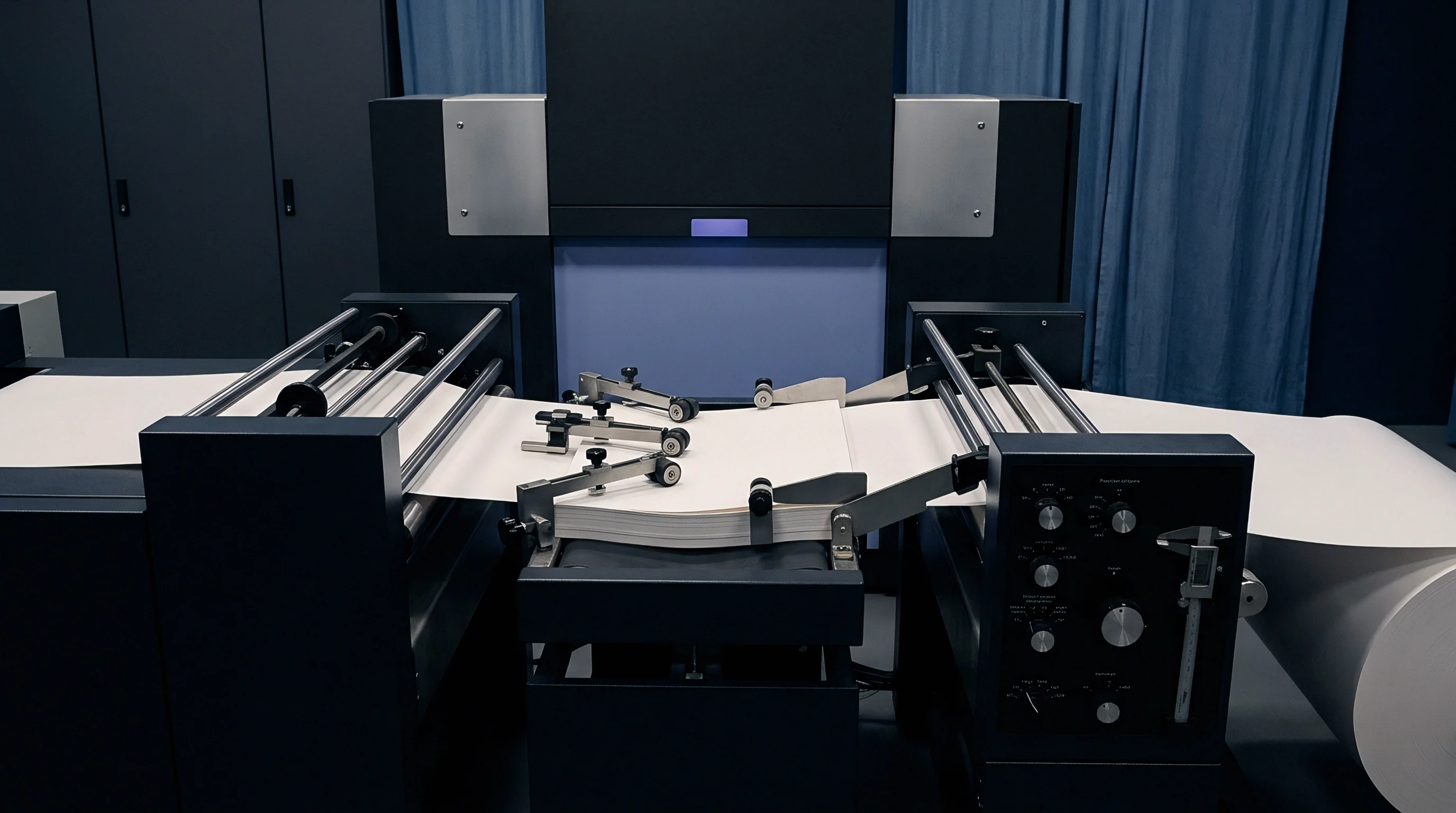
High-velocity converting lines subject paperboard to deformation rates past one hundred reciprocal seconds during impact creasing. With a steel rule striking the web at production speeds between 300 and 600 meters per minute, the window for mechanical deformation narrows to between 1.5 and 3.0 milliseconds. In that brief span, the viscoelastic constituents of the wood fiber network ~ amorphous cellulose, hemicellulose, and residual lignin ~ cannot undergo conformational molecular relaxation.
The sheet’s response departs quickly from the static mechanical models found in standard converting handbooks.
Strain Rate Sensitivity in out of Plane Shear
Rapid tool engagement forces internal polymer chains to take up kinetic energy before they can rearrange spatially, with fiber orientation governing how shear propagates. Under static ISO 1924 testing, paperboard relaxes under stress and yields plastically at moderate loads. Under dynamic creasing conditions, however, the apparent out-of-plane (Z-direction) modulus climbs sharply through strain rate hardening.
Increasing the strain rate from 0.01 s⁻¹ to 150 s⁻¹ can double the initial elastic modulus in the Z-direction, while strain to failure drops by as much as 40 percent.
The internal network of paperboard consists of oriented cellulose fibers held by hydrogen bonds and polymeric wet-end additives. When dynamic Z-direction shear occurs during creasing, energy inputs outpace viscous dissipation in the amorphous inter-fiber regions. Because moisture content alters network stiffness, the hydrogen bonds resist localized shear displacement much more aggressively under rapid loading.
The stress needed to trigger intra-ply delamination climbs accordingly; rather than yielding through broad plastic shear across several plies, stress concentrates into narrow planes that raise peak rupture forces.
At deformation rates above 150 s⁻¹, Z-direction tensile energy absorption increases by 35 percent over static ISO 1924 testing.
This hardening directly alters how delamination runs through the caliper. Delamination is an essential mechanism in paperboard creasing: for a score to fold cleanly at 90 or 180 degrees without fracturing the outer linerboard, the core plies have to shear apart in a controlled fashion. That internal split divides the core into thin sub-laminates, lowering the bending stiffness along the crease line.
When strain rate hardening stiffens the internal plies against shear, the board resists separation and misses the kinetic window for delamination, driving bending stresses straight out into the surface liners.
Stress Wave Propagation through Board Caliper
Energy from the striking rule moves through the sheet at the acoustic velocity of the fiber network. In dense paperboard, this out-of-plane acoustic velocity runs from 1,000 to 1,800 meters per second, governed by caliper, density, and Z-direction fiber alignment. While this transmission easily outpaces the penetration time of the rule, compressive stress waves bounce back off the anvil plate, setting up localized stress spikes across internal ply interfaces.
These reflected waves run directly into the transient shear fields created by the descending rule tip. In thick multi-ply boards, reflected compressive waves and lateral shear waves can fall into phase alignment, producing localized dynamic tension within the core. Where tooling setup governs score depth and this local dynamic tension outstrips the dynamic yield strength of starch-bonded fiber interfaces, micro-cracks open ahead of the rule.
High-speed video shows that dynamic delamination begins not right beneath the rule tip, but slightly ahead of the shear front inside the mechanical pulp layers.
At higher machine speeds, the physical margin for controlled delamination shrinks. When a board’s strain rate hardening factor runs too high, stress wave amplitudes surpass the ultimate tensile strength of the top liner before internal shearing can relieve the load. The resulting crease shows outer liner cracking, severe flaking, or full fracture along the bead, producing blanks that jam high-speed cartoning equipment.
Furnish
Layered board construction governs how mechanical forces disperse across individual fiber layers. A ply’s physical makeup ~ fiber length, pulping process, filler loading, and internal sizing ~ determines the viscoelastic relaxation spectrum of the composite sheet. Solid Bleached Sulfate (SBS), Folding Boxboard (FBB), and Coated Recycled Board (CRB) react differently to dynamic die-cutting forces because of these structural differences in furnish.

Does High Strain Rate Hardening Elevate Delamination Energy?
Rapid loading raises the apparent modulus of paperboard during tight compression cycles. Solid Bleached Sulfate consists entirely of bleached chemical pulp, combining long softwood fibers in the core with refined hardwood fibers on the surfaces. Chemical pulp fibers stay flexible and maintain an extensive hydrogen-bonded network.
Under dynamic impact, SBS hardens considerably, but its high ultimate tensile strain absorbs energy without fracturing catastrophically. The energy needed to propagate delamination rises at speed, yet the uniform furnish prevents localized stress concentrations.
Folding Boxboard pairs chemical pulp liners with a thick core of mechanical pulp, such as Thermomechanical Pulp (TMP) or groundwood. Mechanical pulp provides short, stiff fibers coated in rigid lignin, which shows sharp rate-dependent viscoelasticity. At room temperature and high deformation rates, amorphous lignin sits well below its glass transition temperature and acts as a brittle solid.
Where starch migration weakens the central plies, the mechanical core of an FBB sheet delaminates abruptly at low energy under high-speed impact. While that drop in core fracture resistance can help if controlled, excessive press speed drives chaotic cracking through the mechanical layer.
Coated Recycled Board shows the most erratic strain-rate sensitivity. Built from mixed waste streams, CRB contains short, repeatedly recycled, and heavily hornified fibers alongside heavy loads of calcium carbonate and clay fillers. Hornification keeps cellulose walls from swelling or flexing, which narrows the relaxation window and leaves internal bond strength dependent on wet-end spray starches.
Under rapid creasing, brittle hornified fibers combined with rigid starch interfaces produce steep strain hardening and uneven, asymmetric ply separation.
Mechanical pulps in central plies require 20 percent lower dynamic shear stress to initiate delamination than chemical softwood layers.
Inter-Ply Bond Strength across Multi-Layer Architecture
Coated recycled stock depends on starch adhesives and mechanical entanglement to hold its ply boundaries together. Each interface marks a transition in density, fiber orientation, and chemistry. Static inter-ply bond measurements from TAPPI T 541 (Z-direction tensile strength) correlate poorly with actual performance on a die-cutter running at 400 meters per minute.
Static Z-tensile testing pulls a sample apart perpendicularly at low speed, whereas dynamic creasing applies simultaneous out-of-plane compression, transverse bending, and shear at strain rates five orders of magnitude higher. The ratio of dynamic to static Z-tensile strength diverges widely across board grades:
| Grade | Furnish Architecture | Moisture Content (%) | Static Z-Tensile (kPa) | Dynamic Z-Tensile at 150 s⁻¹ (kPa) | Dynamic Hardening Ratio (K) |
|---|---|---|---|---|---|
| SBS (Solid Bleached Sulfate) | 100% Chemical Softwood/Hardwood | 6.5 – 7.0 | 450 | 720 | 1.60 |
| FBB (Folding Boxboard) | Chemical Liners / TMP Core | 7.5 – 8.0 | 310 | 589 | 1.90 |
| CRB (Coated Recycled Board) | Recycled News/Containers/Fillers | 5.5 – 6.0 | 220 | 484 | 2.20 |
| SUB (Solid Unbleached Board) | Unbleached Softwood Kraft | 7.0 – 7.5 | 520 | 780 | 1.50 |
The Dynamic Hardening Ratio (K = σdynamic / σstatic) highlights how substrates diverge under load. Recycled boards show high hardening ratios alongside weak baseline static strength. When struck at high speed, the stress required to part the plies in CRB spikes well above baseline numbers, frequently exceeding the burst strength of the coated top liner.
Qualifying paperboard furnish for high-speed conversion requires purchasing specifications built around strain-rate sensitivity rather than static mill tests.
- Furnish Moisture Envelope requires maintaining board moisture within 6.5 to 8.0 percent to preserve polymeric chain mobility and allow viscous energy dissipation during dynamic scoring.
- Z-Direction Tensile Floor specifies a minimum static Z-tensile strength adjusted for furnish type, ensuring CRB grades maintain sufficient baseline bonding to prevent premature shear failure.
- Core Fiber Length Distribution restricts the fraction of short fines in mechanical or recycled core plies to maintain structural inter-fiber entanglement under dynamic loading.
- Inter-Ply Starch Stiffening Cap sets limits on spray starch application rates at the wet end to prevent forming rigid, brittle inter-ply boundaries that shatter under strain wave reflections.
Higher static internal bond figures are often assumed to ensure sound score formation on press, yet that assumption overlooks how impact stiffens cross-linked starches and short recycled fibers, turning a pliable interface brittle once press speeds pass three hundred meters per minute.
Matrix
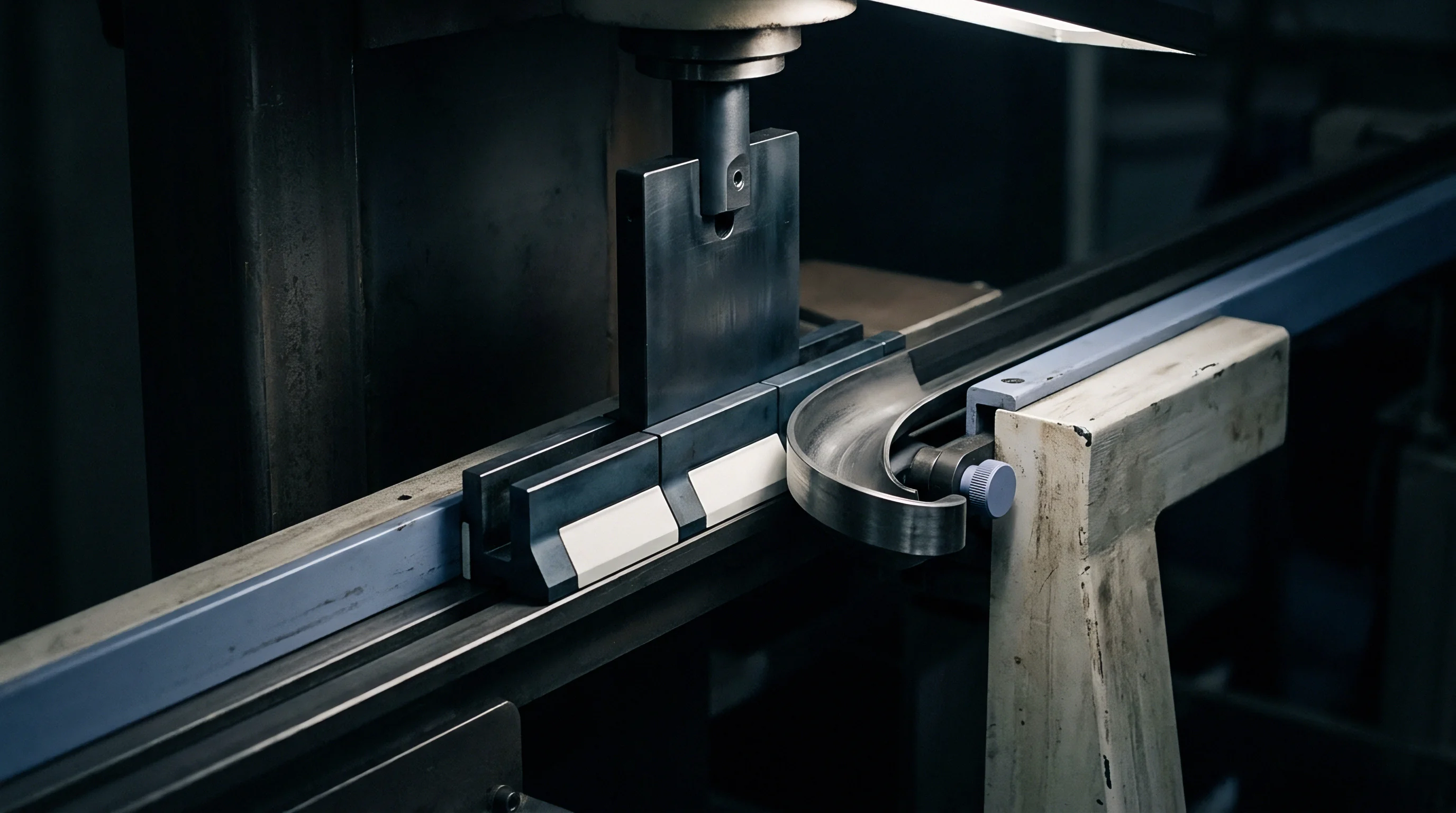
Female groove dimensions define the cavity into which paperboard buckles during scoring. Tooling geometry on flatbed or rotary die-cutters must account for both caliper and the temporary structural changes brought on by dynamic strain hardening. Standard static scoring formulas determine female channel width (w) using w = 1.5t + s, where t is board caliper and s is creasing rule thickness, but that relationship fails at production speeds.
Channel Clearance Adjustment for Dynamic Crease Formation
Tooling setups establish the lateral clearance between rule edges and matrix sidewalls. As strain rate hardening raises the board’s apparent bending stiffness and out-of-plane yield point, the sheet resists entering the channel. Under sudden impact, the board’s effective thickness in the crease zone expands briefly from micro-delamination before full compression sets in.
If the channel is sized purely by static rules, the stiffened board wedges against the matrix shoulders, generating lateral shear that slices through the bottom liner.
Preventing shear cuts at elevated strain rates requires widening the matrix channel. For press speeds above 350 meters per minute, the channel formula shifts to w = 1.7t + s for chemical pulp boards, and up to w = 1.9t + s for recycled grades showing dynamic hardening ratios above 2.0. The extra clearance lets the stiffened board form a rounded crease bead without pinching against the steel matrix edges.
Anvil clearance and rule tip profile equally influence dynamic shear depth. A tight rule radius focuses stress waves and cracks the liner early. A broader tip radius ~ typically a 2-pt rule with a full round crown ~ spreads kinetic energy over more area, protecting the outer liner until the internal plies have begun delaminating across the matrix opening.

Calculation of Delamination Depth Ratio
Analyzing internal sheet shear requires setting baseline values for caliper and rule penetration. On a packaging line running 450-micrometer (0.018-inch) Folding Boxboard at 400 meters per minute with a 2-point (0.71 mm) rule, the goal is to calculate the effective delamination depth ratio under dynamic strain hardening and adjust penetration depth to prevent liner cracking.
Starting with a static board caliper t0 = 0.450 mm, dynamic impact at 180 s⁻¹ causes a bulk expansion factor β = 1.08 from internal micro-buckling before full penetration occurs. Peak dynamic caliper td is calculated as:
td = t0 × β = 0.450 mm × 1.08 = 0.486 mm
A static channel width calculation gives ws = (1.5 × 0.450) + 0.71 = 1.385 mm, which binds the board laterally. Adjusting for strain rate using the FBB dynamic coefficient of 1.7 yields:
wd = (1.7 × 0.450) + 0.71 = 1.475 mm
This rounds to a standard 1.50 mm counter-matrix channel. Penetration depth h must then be determined. Static penetration targets 65% of caliper (0.2925 mm), but dynamic strain hardening stiffens Z-direction compression and cuts net rule penetration by a resilience factor γ = 0.92.
Effective penetration depth hd at 400 m/min drops to:
hd = hs × γ = 0.2925 mm × 0.92 = 0.2691 mm
This loss of penetration leaves internal shear delamination incomplete. To recover the target delamination depth ratio (Dr = hd / t0 = 0.65), press stroke depth must be increased by 0.0234 mm (23.4 micrometers) using precision steel make-ready shims under the creasing plate.
Setting up tooling requires a methodical check of scoring clearances before committing to full production runs.
- Mount the die plate with targeted steel rule thicknesses and verify rule height uniformity across all impression zones using a dial indicator.
- Select counter-matrix materials featuring milled phenolic or steel channels, avoiding flexible plastic matrix strips that flex under high dynamic impact forces.
- Calculate initial matrix channel widths using the strain-rate adjusted formula wd = (1.7t + s) for virgin grades or wd = (1.9t + s) for recycled grades.
- Perform an initial slow-speed impression check at 50 meters per minute to establish baseline crease bead formation and check for liner cutting.
- Accelerate the press in increments of 100 meters per minute up to target operating speed, stopping at each plateau to measure crease stiffness using a two-point bending tester.
- Inspect internal delamination patterns across the board cross-section using optical microscopy or a illuminated pocket loupe to verify multi-layer ply separation.
- Add micro-shims in 10-micrometer increments beneath the creasing rule base if dynamic spring-back prevents full crease bead penetration at maximum press speed.
As phenolic channel shoulders round off over two million die impressions, the channel widens, dispersing shear and allowing score stiffness to climb during extended runs.

Bench
Bench evaluations require equipment that reproduces the deformation speeds seen on converting presses. Standard tests run under ambient conditions monitor mill uniformity reasonably well, but they miss the dynamic strain failures that appear on high-speed lines.
Laboratory Methods for Dynamic Z Axis Characterization
Standard lab fixtures measure static properties, whereas dynamic behavior requires drop-weight or impact instruments. Standard TAPPI T 541 testing pulls a 6.45 square centimeter sample apart over 1 to 3 seconds, generating a strain rate near 0.01 s⁻¹. Production die cutting, by comparison, drives localized Z-direction compression and shear rates to between 100 s⁻¹ and 500 s⁻¹.
To evaluate dynamic behavior accurately, specialized test facilities rely on Split Hopkinson Pressure Bar (SHPB) setups or high-speed hydraulic benches adapted for paperboard. SHPB units send a stress pulse through a metal bar into a board sample, recording microsecond responses through strain gauges. These tests quantify the Dynamic Hardening Ratio (K) directly and pin down the velocity where ductile fiber displacement shifts into brittle fracture.
| Parameter | Standard Bench Test | Standard Method | Dynamic Line Condition | Strain Rate Gap |
|---|---|---|---|---|
| Z-Tensile Speed | 12.5 mm/min | TAPPI T 541 / ISO 1924-3 | 2,000 to 5,000 mm/s | 10,000x faster |
| Crease Bending Velocity | 15 degrees/sec | ISO 2493-1 / Taber | 900 to 1,800 degrees/sec | 100x faster |
| Compression Duration | Static dwell | ISO 9895 (SCT) | 1.5 to 3.0 milliseconds | Transient impact |
| Conditioning State | 23 C / 50% RH | ISO 187 | 18-35 C (Mill/Press friction) | Thermal dissipation loss |
This gap between static quality control methods and dynamic press mechanics explains why board reels that satisfy every mill certificate parameter still suffer severe liner cracking at line speed.
Failure Modes in High Velocity Crease Delamination
Converting defects occur when internal shear stresses exceed the dynamic yield point of the fiber network. Isolating the underlying failure modes allows press operators to adjust substrates or machine settings methodically.
- Top Liner Rupture occurs when extreme strain rate hardening prevents internal core delamination, forcing the outer tensile liner to exceed its dynamic elongation limit during folding.
- Uncontrolled Shear Propagation manifests as erratic diagonal cracking that travels outside the matrix channel, caused by local density variations and severe fiber hornification in recycled furnish.
- Shear Band Asymmetry presents when one side of the crease bead delaminates completely while the opposite side remains rigid, resulting in skewed carton geometry during final folding and gluing.
- Delamination Lockup develops when excess inter-ply starch or high dynamic compression forces compress core fibers into a dense mass, eliminating the void space needed for internal ply sliding.
ISO 187 conditioning at 23 C and 50 percent relative humidity fixes the baseline moisture content necessary to prevent brittle liner fracture.
Supply contract dispute clauses routinely tie quality to static ISO or TAPPI metrics. A shipment that meets static ISO 1924 Z-tensile thresholds but cracks persistently on press because of dynamic strain hardening is non-refundable unless dynamic ratings or specific operating-speed warranties are written into the purchase agreement.
Margin
Converting economics hinge on line throughput and gross yield. Running a die-cutter at 450 meters per minute delivers clear financial gains over 300 meters per minute, but only if the sheet tolerates the higher strain rates without generating scrap. When strain rate hardening triggers delamination defects, the resulting waste and lost press time quickly overtake any discounts negotiated on lower-grade board.

Waste Curves across Production Velocity Bands
Press acceleration shifts the mechanical loads placed on scores during flatbed or rotary cutting. Between 100 and 200 m/min, strain rates stay moderate enough that most boards delaminate cleanly within standard matrix profiles. Past 350 m/min, however, scrap climbs steeply if the furnish carries a high Dynamic Hardening Ratio.
Financial losses accumulate across three distinct areas: direct scrap from split cartons, downtime spent clearing jams and resetting matrix channels, and filling-line stops caused by stiff, unopened creases. Running low-cost recycled stock without checking dynamic strain hardening frequently inflates the final cost per thousand finished boxes.
| Line Speed (m/min) | Substrate Grade | Crease Rupture Rate (%) | Scrap Cost per 100k Cartons ($) | Downtime Cost per Shift ($) | Net Landed Cost Shift (%) |
|---|---|---|---|---|---|
| 250 | CRB (Standard Recycled) | 0.3% | 135 | 200 | Baseline |
| 400 | CRB (Standard Recycled) | 4.2% | 1,890 | 1,800 | + 8.5% |
| 400 | FBB (Mechanical Core) | 1.1% | 545 | 450 | + 2.1% |
| 400 | SBS (Virgin Chemical) | 0.2% | 110 | 100 | – 3.2% (Net gain) |
The operational data confirms that running recycled board at high speeds increases waste and maintenance costs enough to cancel out the raw material price spread between CRB and virgin SBS.
Unintended ply delamination during high-speed scoring increases finishing spoilage by up to four percent per run.

Unit Cost Impact of Substrate Strain Hardening
Cost calculations must include the scrap allowances associated with scoring failures at full line speed. Sourcing evaluations require a landed-cost approach that accounts for press speed restrictions: virgin SBS at $1,400 per delivered tonne often yields a lower net unit cost at 450 m/min than CRB at $1,050 per tonne that forces the press down to 280 m/min to prevent cracked liners.
Protecting margin requires converters to qualify substrates against speed thresholds determined by furnish, caliper, and tooling geometry. Matching board viscoelasticity to press targets maintains throughput without driving up spoilage.
Production estimates for high-speed runs must absorb the labor for matrix adjustments and make-ready shimming, alongside downstream liability from packaging line rejections. When a score requires excessive folding force, automated cartoners misfeed and jam lines running at 600 packs per minute. The costs of downstream downtime rapidly eclipse raw board price differences, making dynamic strain rate qualification essential for high-speed converting.