Folding Boxboard Internal Ply Shear Stiffness Standards during Die Cutting
Core shear stiffness governs folding boxboard creasing performance; correct values enable middle ply delamination while preventing outer coated liner failure.

Fibre
Multi-ply paperboard builds flexural stiffness by separating its outer skins across the board’s cross-section. Folding boxboard places dense, fully bleached chemical pulps with a high tensile modulus in the top and bottom layers, while using bulkier mechanical pulps ~ such as chemi-thermomechanical pulp ~ in the middle plies. The board acts like an I-beam: the outer skins carry tensile and compressive loads during bending, while the core maintains structural depth and resists shear between the faces.
In a high-speed flatbed die-cutter, folding boxboard encounters sudden, localized compressive and shear forces. Whether the board forms a clean, repeatable crease or splits at the surface depends on how the middle ply yields under shear. Internal ply shear stiffness defines how strongly this core matrix resists sliding along the horizontal plane ~ a requirement for transferring bending moments without delaminating during early handling.
During creasing, these mechanical demands invert. The scoring rule forces the board into a matrix channel, driving sharp shear strain directly into the mechanical pulp core. If core shear stiffness is too high, the board resists local strain concentration, transferring extreme tensile stress to the outer chemical plies until the top liner splits.
If core stiffness drops too low, the middle layer collapses under standard feeding tension, delaminating before reaching the die cutter.
The middle layer uses coarse chemi-thermomechanical pulp fibres, which form fewer interfibre hydrogen bonds than the refined chemical pulps flanking them. Paper mills tune the shear strength of this central layer during wet-end formation using starch additions and refining. Target shear stiffness must balance pallet rigidity, clean blade penetration during cutting, and uniform internal delamination during creasing ~ a compromise governed by the density of the hydrogen bonding network inside the mechanical core.
| Grade Type | Grammage (g/m²) | Caliper (µm) | Scott Bond (J/m²) | Core Density (g/cm³) | Delamination Yield Threshold (kPa) |
|---|---|---|---|---|---|
| GC1 Bleached Core | 215 | 305 | 140–165 | 0.705 | 210 |
| GC1 Bleached Core | 280 | 415 | 130–155 | 0.674 | 195 |
| GC1 Bleached Core | 350 | 540 | 120–145 | 0.648 | 180 |
| GC2 Unbleached Core | 230 | 350 | 125–150 | 0.657 | 185 |
| GC2 Unbleached Core | 300 | 480 | 115–140 | 0.625 | 170 |
| GC2 Unbleached Core | 380 | 630 | 105–130 | 0.603 | 155 |
The mechanical core is anisotropic. Fibre alignment on the forming wire creates clear differences between the machine direction and cross direction. Machine-direction alignment increases tensile strength and transverse shear modulus, whereas the cross direction provides lower shear resistance and higher strain tolerance.
Scoring parallel to the machine direction acts across weaker transverse fibre bonds. Scoring perpendicular to it forces the rule through aligned long fibres, demanding higher energy input to initiate core delamination.
Mineral coatings add mechanical complexity. Double and triple coatings of calcium carbonate, kaolin clay, and styrene-butadiene latex increase the flexural modulus of the top liner. Because mineral coatings lack elasticity, any core that fails to delaminate under rule impact causes the brittle surface layer to snap, exposing raw fibres along the crease.
Preventing surface cracking across coated and film-laminated boards requires matching core shear stiffness to top-liner elongation capacity.
Extruding polyethylene or bio-polymer barrier films onto the reverse side shifts the sheet’s neutral axis during bending. While the high elongation of these thermoplastic polymers protects the bottom liner from tensile failure, it redirects additional shear stress into the adjacent mechanical core. In mill trials, barrier-coated sheets require a 10 to 15 percent reduction in core shear strength to form proper crease bead geometry without increasing die penetration force.
Controlled core delamination under rule impact prevents brittle surface coatings from cracking during ninety degree folding.
Delamination within the middle ply forms the internal hinge required for carton erection. As the scoring rule pushes board into the matrix channel, the core shears along horizontal planes. This fracture converts a rigid structure into thin, unbonded lamellae that slide past one another, preventing destructive tensile stress from reaching the outer skins.
Without controlled internal shear failure, paperboard behaves like a solid sheet, cracking along the outer radius when folded ninety degrees.
Higher core bulk does not automatically yield better converting performance or guarantee superior stiffness-to-weight ratios for lighter boards. Expanding bulk without maintaining uniform internal bonding leaves pockets of exceptionally low shear strength that collapse under feeder suction or yield under side pressure during die-cutting, causing uneven crease depths across a sheet. These defects stem directly from raw material shear variance rather than press make-ready errors.


Deformation
Die cutting subjects paperboard to mechanical loads lasting only milliseconds. As the press platen closes, the counter-plate supports the board while steel cutting and creasing rules descend from above. Cutting rules shear through the full caliper, while creasing rules drive the sheet into counter-matrix channels, subjecting the material to three-point bending and deep transverse shear along the rule line.
Effective creasing requires structural failure inside targeted layers while leaving adjacent zones intact. As the creasing rule penetrates, compressive stress beneath the rule tip drives material into the channel. The outer chemical skins experience tension on the matrix side and compression on the rule side, while the central mechanical core undergoes horizontal shear strain.
When strain exceeds the core’s shear yield limit, the fibre matrix fractures along horizontal planes to begin delamination.
Fibre Network Fracture and Channel Displacement
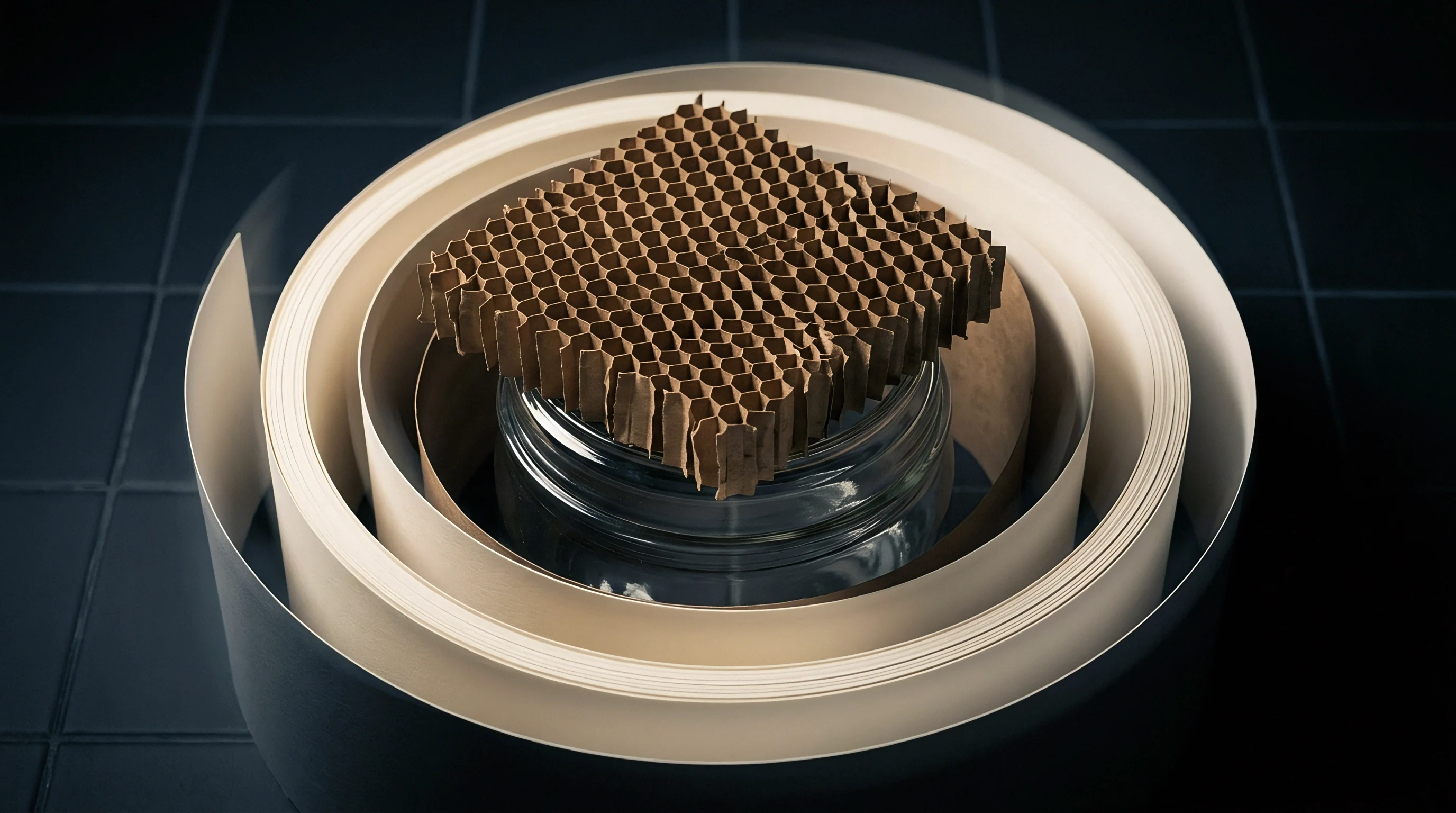
Initial displacement forces core fibres apart at their hydrogen-bonded points, relieving tensile strain in the outer skins. As the rule advances, the middle ply breaks down into unbonded parallel micro-layers that bow into the matrix channel, forming a rounded internal bead on the reverse side. This bead acts as a mechanical relief joint, allowing the carton panel to fold ninety degrees without tearing the liner or generating excessive resistance.
Mismatching core shear stiffness with creasing rule dimensions causes immediate defects. If core shear strength is too high, fracturing internal hydrogen bonds demands more force than the top coated liner can withstand in tension, splitting the liner before the core delaminates. If core strength is too low, the core collapses broadly, leaving a flat bead that fails to support automated folding on packaging lines.
Counter-matrix channel geometry defines the shear zone. Channel width sets the bending radius, while depth controls how far the scoring rule draws material. Standard setup calculates width as 1.5 times board caliper plus creasing rule thickness.
Using a narrower channel concentrates shear forces along the rule edges, shearing through the outer liner rather than delaminating the core.
High press speeds increase deformation rates, altering board mechanics. At speeds exceeding eight thousand sheets per hour, rule dwell time in the counter-matrix drops below ten milliseconds. Paperboard’s viscoelastic nature means its dynamic shear modulus rises under rapid loading.
A core that tests soft in slow laboratory evaluations can act as a rigid, brittle mass at full production speeds, forcing operators to widen channels or adjust platen pressure to compensate for strain-rate hardening.
- Initial Rule Contact drives the upper coated liner down, compressing the material directly beneath the rule crown.
- Transverse Shear Accumulation forces coarse mechanical core fibres to slide horizontally along weak internal boundaries.
- Internal Delamination Failure spreads outward toward the shoulders of the female matrix, splitting the middle ply into discrete lamellae.
- Matrix Clearance Penetration draws those unbonded lamellae into the channel floor, forming the reverse crease bead without straining the outer liner.
- Elastic Recovery Step occurs as the die retracts, letting the new bead retain its shape as outer tensile forces clear.
Higher line speeds increase the dynamic shear modulus of paperboard, turning ductile cores brittle under fast impact rates.
Over-creasing occurs when platen pressure drives the rule past board caliper into the matrix floor. Excessive penetration crushes the delaminated lamellae, compacting broken fibres into a solid mass. Once compressed, the mechanical pulp can no longer slide, restoring high shear resistance in the crease zone.
When folded downstream on a folder-gluer, the outer liners are forced to stretch around this re-compacted core, causing surface cracks.
Under-creasing leaves the core partially unbroken. Low impression force or inadequate rule height leaves the center of the mechanical ply intact. On automated packaging lines, this un-delaminated core resists bending, elevating carton opening force and bowing sidewalls.
Packaging machinery rejects stiff cartons when high restoring forces trigger jams. Proper core shear stiffness maintains the narrow operating window between liner cracking from over-creasing and excessive rigidity from under-creasing.
Poor platen settings or erratic core shear strength generate immediate scrap. If an entire run splits due to sudden core stiffness spikes, converters lose printed inventory, make-ready hours, and press capacity. The financial loss covers wasted machine time on die-cutters and folder-gluers as well as the value of printed substrate.

Standardization
Standardized test methods quantify internal bonding and shear resistance in paperboard. ISO 16260 specifies internal bond testing using a pendulum impact apparatus ~ the Scott Bond test. The method applies rapid dynamic stress to a sample taped between an aluminum angle block and a rigid base.
A pendulum strikes the block, splitting the internal core and measuring total absorbed energy per unit area in Joules per square meter.
TAPPI T 569 outlines a parallel internal bond testing protocol, establishing procedures for sample preparation, pressing pressure, and dwell time. Although Scott Bond serves as the primary mill quality metric, it measures a combination of Z-direction tension and dynamic shear failure rather than pure horizontal shear stiffness. The pendulum’s impact velocity reflects press speeds, but the multi-axial stress state inside the sample sandwich prevents clean isolation of shear stress-strain values.
Direct measurement of horizontal shear stiffness requires specialized tooling, such as Z-direction shear frames or ultrasonic devices. Ultrasonic testing measures shear wave velocity through the board’s thickness. Transverse shear modulus, in megapascals, scales with core density multiplied by the square of wave velocity.
Paper mills employ ultrasonic sensors for continuous inline monitoring, whereas converting plants rely on physical delamination testing to evaluate incoming reels.
| Standard Code | Primary Parameter | Measurement Mechanism | Conditioning ISO 187 Requirements | Relevance to Die Cutting |
|---|---|---|---|---|
| ISO 16260 | Internal Bond Strength | Dynamic Pendulum Impact (Scott Bond) | 23°C ± 1°C, 50% ± 2% RH | High correlation with core fracture energy under rule impact |
| TAPPI T 569 | Internal Bond Energy | Z-Direction Impact Delamination | 23°C ± 1°C, 50% ± 2% RH | Standard American baseline for FBB ply bond qualification |
| ISO 2493-1 | Bending Resistance | Two-Point Bending (15 Degree Deflection) | 23°C ± 1°C, 50% ± 2% RH | Predicts panel rigidity prior to crease deformation |
| SCAN-P 80 | Z-Tensile Strength | Quasi-Static Vertical Pull Test | 23°C ± 1°C, 50% ± 2% RH | Measures static bond strength; low correlation with dynamic shear |
| ISO 5628 | Bending Stiffness | Resonance and Multi-Point Bending | 23°C ± 1°C, 50% ± 2% RH | Establishes global elastic modulus parameters for structural design |
Environmental conditions strongly affect internal shear measurements. ISO 187 defines standard testing conditions as twenty-three degrees Celsius and fifty percent relative humidity. Because paperboard is hygroscopic, moisture content responds rapidly to ambient shifts.
Absorbed water plasticizes amorphous cellulose and hemicellulose, weakening hydrogen bonds across mechanical core fibres.
At sixty-five percent relative humidity, absorbed moisture reduces core shear stiffness by up to twenty-five percent. The board yields too readily during die-cutting, producing wide, poorly defined crease beads with unstable spring-back. Conversely, at thirty-five percent relative humidity, moisture loss stiffens the mechanical core.
The hardened pulp resists shear delamination, causing immediate liner splitting along score lines. Storing unconditioned board in pressrooms leads to sharp seasonal performance swings.
Static lab tests rarely predict performance at production speeds. Standard Z-tensile tests separate board samples slowly to measure equilibrium bonding, but die-cutting rules strike the web at several meters per second. Inertia within the pulp matrix resists sudden displacement, shifting failure from ductile fibre pullout to brittle matrix fracture.
Evaluating static lab figures against high-speed converting requires empirical correction factors.
Relative humidity fluctuations shift paperboard moisture content, altering core shear stiffness by up to twenty-five percent.
Mill datasheets quote Scott Bond values as lot averages, masking internal variance. A batch averaging one hundred and thirty Joules per square meter can contain localized formation dips as low as eighty Joules per square meter. These low-density spots delaminate under light web tension, causing blistered channels across printed panels.
Procurement specifications should mandate individual minimum test thresholds alongside lot averages.
Quality specifications must establish mandatory core shear stiffness limits tied to caliper and finishing workflows. Commercial contracts typically require suppliers to certify that delivered board stays within agreed Scott Bond ranges under ISO 187 conditioning, allowing converters to reject material that delaminates during standard make-ready at the supplier’s expense.
Validation
Verifying core shear performance prior to full production requires testing in both the laboratory and the pressroom. Initial lab screening evaluates Scott Bond profiles across the reel width ~ front, center, and back. Cross-reel density variations stem from headbox dilution or wet-end press profiles, causing inconsistent creasing behavior across multi-up die layouts.
Benchtop validation relies on cross-sectional microscopy. Technicians section creased samples and embed them in low-viscosity resin to prevent edge distortion during polishing. Under polarized light, microscopic analysis exposes internal crack patterns within the mechanical pulp core.
Clean shear failure appears as multiple parallel horizontal fractures contained within the middle ply, leaving outer liners smooth and intact.

Does High Scott Bond Always Prevent Crease Cracking?
In practice, excessively high Scott Bond values increase crease cracking on high-speed lines. When internal bonding is too strong, tight hydrogen bonds prevent core fibres from sliding under rule impact. Because the core cannot shear, bending strain concentrates directly on the top coated liner.
High Scott Bond levels protect against picking during offset printing, but they frequently trigger surface cracking in die-cutting.
Pressroom validation uses sample dies mounted in proofing presses or dedicated crease testers. Instruments like the Papirindustriens Forskningsinstitutt crease tester fold samples ninety degrees while recording resistance moment. The device plots crease moment against fold angle: a steep peak followed by a sharp drop indicates an un-delaminated core, whereas a low, smooth plateau confirms proper internal shear failure.
The Crease Stiffness Ratio compares the folding moment of a creased sample to the bending moment of uncreased board. Ratios between zero point three zero and zero point forty-five indicate optimal core delamination. Values above zero point fifty-five show incomplete core shear, predicting surface cracking or erection failures on downstream packaging lines.
- Scott Bond energy testing measures the work required to delaminate the core under dynamic impact.
- Cross-sectional micro-analysis reveals the vertical placement and frequency of internal core cracks.
- Crease stiffness ratio measurement evaluates residual folding resistance against intact board stiffness.
- Surface liner elongation mapping tracks outer strain limits with high-resolution optical cameras.
- Spring-back angle tracking measures permanent plastic deformation inside the mechanical pulp layer.
Advanced non-destructive validation employs high-speed digital imaging during folding. Optical cameras record the outer radius profile as the crease bends ninety degrees, while software maps micro-surface strain. If surface strain spikes before the core shears, core stiffness is too high.
This optical monitoring detects microscopic cracks in kaolin coatings prior to total liner failure.
Double-sided film laminations require separate validation due to the tensile strength of polyester or polypropylene films. Synthetic films bridge micro-cracks in the board liner, concealing structural failure from visual inspection. However, an intact film stretched over a broken liner produces soft, hollow creases that spring back after folding.
Validating film-laminated board demands cross-sectional microscopy to confirm the underlying paper liner remains intact.
Testing three distinct GC1 folding boxboard batches with varying internal ply bond levels pinpoints where liner splitting gives way to clean delamination. Sheets were run through a standardized 2-Pt creasing rule at a fixed indentation depth of zero point four millimeters, tracking outer liner integrity and crease moment across every run.
Performance across these test batches highlights the non-linear relationship between internal bond energy and crease quality. Batch A, with elevated internal bond strength, failed due to extreme surface strain, whereas Batch C failed from structural weakness.
| Batch Designation | Measured Scott Bond (J/m²) | Crease Stiffness Ratio | Observed Core Failure Mode | Converter Surface Status |
|---|---|---|---|---|
| Batch A (High Bond) | 185 | 0.62 | Negligible core shear breakdown | Severe liner rupture along rule edge |
| Batch B (Target Range) | 135 | 0.38 | Uniform multi-layer horizontal cracks | Clean outer surface, smooth bead |
| Batch C (Low Bond) | 85 | 0.24 | Total core collapse, soft structure | No surface rupture, loose box corners |
Interpreting validation data allows operators to adjust press tooling based on failure modes. When tests indicate high core shear resistance, technicians narrow the creasing rule or deepen the matrix channel to increase localized shear strain. If tests reveal insufficient shear resistance, narrowing the channel supports the weak core during penetration.
Fine-tuning tooling profiles on press compensates for minor material variance and prevents job rejections.
Dynamic press validation concludes after first-off sheets pass dimensional stability checks following twenty-four hours of conditioning. Stress relaxation alters crease bead dimensions over time as elastic memory forces partial recovery. A crease showing clean geometry off the die can lose fold memory overnight if internal shear delamination was incomplete, making post-stabilization recovery angle checks essential for final sign-off.
A simple pressroom rule of thumb applies: if the reverse crease bead feels soft and collapses under light thumb pressure, the core lacks structural integrity; if the bead remains rigid and resists bending, internal shear delamination failed to occur.

Specification
Procurement specifications for folding boxboard must translate shear behavior into enforceable technical tolerances. Relying solely on nominal grammage and caliper exposes buyers to wide quality swings. Contracts require defined ranges for internal bond strength, transverse shear modulus, and core density.
Setting a Scott Bond window between one hundred and twenty and one hundred and fifty Joules per square meter protects converters from both liner cracking and core collapse.
Substrate represents fifty to sixty-five percent of total carton production cost, making high die-cutting scrap rates lethal to operating margins. When board exhibits erratic shear stiffness, flatbed die-cutter make-ready can expand from forty minutes to three hours as operators adjust impression pressure and swap channels. That downtime wastes platen capacity while pushing running waste from two percent to over eight percent.
Secondary lamination alters converting economics. Applying a twenty-micron metallized polyester film adds raw material cost, handling steps, and lead time. If a laminated sheet cracks during die cutting due to an off-spec mechanical core, the loss covers board, film, adhesive, and printed ink.
Tighter shear stiffness tolerances for laminated grades represent essential risk mitigation.
| Job Metric | Standard Quality Lot | Out-of-Spec High Shear Lot | Out-of-Spec Low Shear Lot |
|---|---|---|---|
| Run Size (Sheets) | 50,000 | 50,000 | 50,000 |
| Die Cutter Make-Ready Time | 45 minutes | 180 minutes | 120 minutes |
| Running Waste Rate | 1.5% | 7.2% | 5.8% |
| Platen Speed (Sheets/Hour) | 8,500 | 5,200 | 6,000 |
| Total Spoiled Printed Sheets | 750 | 3,600 | 2,900 |
| Folder-Gluer Jam Rate | 0.05% | 4.10% | 2.80% |
| Net Landed Unit Cost Penalty | Baseline (€0.12/pack) | + 28% (€0.154/pack) | + 19% (€0.143/pack) |
Extended producer responsibility regulations are reshaping multi-ply packaging economics. Environmental fee structures penalize non-separable plastic laminates and synthetic adhesives. As converters switch from plastic films to dispersible water-based barrier coatings, core shear dynamics require re-evaluation.
Water-based coatings penetrate deep into top-liner chemical pulp, stiffening the surface layer and increasing the shear stress required to delaminate the middle ply without cracking the face.
Food contact compliance imposes strict limits on core chemistry. Sizing agents, wet-strength resins, and starches used to adjust middle-ply shear strength must satisfy Regulation 1935/2004 and BfR Recommendation XXXVI guidelines. Using uncertified starches to address low Scott Bond values invalidates food contact certifications, rendering converted cartons unusable for direct dry food contact.
Recyclability scoring frameworks penalize grades that use high chemical pulp ratios to compensate for poor core shear behavior. Frameworks like PTS-RH 021/97 evaluate repulpability through fibre yield and coarse reject rates. While mechanical pulps in boxboard cores repulp cleanly in hydrapulpers, adding excessive polyacrylamide dry-strength agents to build shear resistance hinders dispersion, triggering fee surcharges under European eco-modulation schemes.
Purchase orders must specify incoming quality audit protocols. Supply contracts should mandate sampling per ISO 186 and conditioning to ISO 187 standards. If incoming Scott Bond tests deviate by more than twelve percent from agreed datasheets, converters require the contractual right to reject shipments or claim compensation for make-ready downtime and scrap.
Supply framework agreements with strict internal ply shear tolerances trigger automatic financial rebates whenever batch Scott Bond variance exceeds ten percent of baseline targets.
A technical specification for high-speed converting boxboard must integrate five core material parameters:
- Target Grammage and Caliper Windows must stay within a plus or minus three percent tolerance across the full reel width.
- Scott Bond Energy Limits must set clear floors to prevent core collapse and ceilings to avoid surface cracking.
- Cross-Direction Bending Resistance values must align with crease channel dimensions to maintain low carton opening forces.
- Moisture Content Thresholds must stay between six point two and seven point eight percent upon arrival.
- Surface Roughness Limits measured under PPS ISO 8791-4 must ensure uniform coating smoothness over the mechanical core.
Balancing raw substrate specifications, finishing requirements, and recycling fees requires active technical oversight. Buyers selecting paperboard on price per ton often incur higher total costs through press scrap, rejected lots, and folder-gluer downtime. Controlling internal ply shear performance transforms paperboard procurement from a spot-market gamble into a reliable engineering decision.
How far can mill-side refining and starches adjust core shear before eroding the bulk advantage that makes folding boxboard preferable to solid bleached sulphate in the first place?