Viscoelastic Dynamic Mechanical Analysis Methodologies for Multi Ply Folding Boxboard Caliper Retention
Dynamic mechanical analysis optimizes folding boxboard caliper retention by quantifying out-of-plane storage modulus decay in CTMP cores under high-speed converting loads.

Plies
Multi-layer folding boxboard relies on a varied fiber architecture through its thickness to maximize bending stiffness at low basis weights. Bleached chemical hardwood and softwood pulps form the outer layers, refined for high tensile network density and smooth print surfaces. Between these skins sits a core of high-yield mechanical pulp ~ typically chemithermomechanical pulp (CTMP) or stone groundwood (SGW) ~ acting as a bulky elastic spacer.
In standard GC1 or GC2 specifications, this central core accounts for 60 to 70 percent of total caliper while representing less than half the furnish cost per tonne. Density distribution governs initial stiffness: bending resistance scales cubically with caliper, provided the outer plies maintain a high elastic modulus and the core keeps its thickness under load.
Compressive stresses applied perpendicular to the sheet plane act directly on the mechanical fiber network in the inner plies. Running boxboard through calenders, printing presses, or rotary die-cutters subjects this bulk-generating core to dynamic compression through its thickness. A purely elastic material would recover its full caliper instantly upon strain release.
Paperboard, being viscoelastic, dissipates part of that mechanical energy through viscous flow, inter-fiber slip, and permanent lumen collapse in the mechanical fibers. Dynamic mechanical analysis (DMA) measures this by splitting the total complex compressive modulus into its real part (elastic storage) and imaginary part (viscous dissipation). Testing these moduli across different frequencies, temperatures, and humidity levels shows how well the core holds its caliper under converted equipment loads.
Mechanical Fiber Differentiation in Multi-Layer Construction
Bleached chemical kraft pulp in the outer plies forms a dense, hydrogen-bonded network with an apparent density between 800 and 1000 kilograms per cubic meter. Good fiber conformability and fibrillar bonding give these layers a high storage modulus both in-plane and out-of-plane. In contrast, mechanical pulps in the core keep their stiff, lignin-rich cell walls, which resist collapsing into flat ribbons during stock preparation.
This preserves open voids and keeps core density down to 350 to 500 kilograms per cubic meter, yielding high static stiffness per unit grammage. However, the residual amorphous lignin in those mechanical fibers makes the core’s viscoelastic spectrum sensitive to temperature and moisture.
Core compaction under out-of-plane compression happens via two micro-mechanical mechanisms: reversible elastic bending of stiff fiber segments spanning interstitial voids, and permanent network restructuring driven by micro-fractures in middle lamella lignin alongside plastic deformation of wet hemicellulose chains. Standard static caliper tests under ISO 534 apply 50 kPa contact pressure with a flat presser foot for two seconds, a setup that cannot separate instant elastic recovery from time-dependent viscous flow. Dynamic mechanical testing applies an oscillatory compression strain instead, isolating storage and loss moduli across timescales from milliseconds to hours.
| Layer Furnish Composition | Conditioning State | Storage Modulus E’ (MPa) | Loss Modulus E” (MPa) | Loss Factor tan delta | Core Density (kg/m³) |
|---|---|---|---|---|---|
| Bleached Softwood/Hardwood Kraft (Top Ply) | 23 °C / 50% RH | 142.5 | 8.55 | 0.060 | 910 |
| Bleached Softwood/Hardwood Kraft (Top Ply) | 35 °C / 80% RH | 108.0 | 11.88 | 0.110 | 895 |
| Chemithermomechanical Pulp (Middle Core) | 23 °C / 50% RH | 38.2 | 3.44 | 0.090 | 420 |
| Chemithermomechanical Pulp (Middle Core) | 35 °C / 80% RH | 18.6 | 3.53 | 0.190 | 395 |
| Recycled Deinked Furnish (GD2 Core) | 23 °C / 50% RH | 29.4 | 3.82 | 0.130 | 560 |
| Recycled Deinked Furnish (GD2 Core) | 35 °C / 80% RH | 11.2 | 2.69 | 0.240 | 525 |
Data collected across varying temperature and humidity shows that mechanical core plies lose storage modulus much more aggressively than chemical outer plies. At standard atmosphere, CTMP core stock holds an out-of-plane storage modulus of 38.2 MPa. Shifts to 35 °C and 80 percent relative humidity drop that storage modulus by 51.3 percent down to 18.6 MPa.
Meanwhile, the loss factor (the ratio of loss modulus to storage modulus) more than doubles from 0.090 to 0.190 ~ a shift indicating that the core moves from elastic strain storage toward viscous dissipation, which translates into unrecoverable thickness loss during converting or storage.

Glass Transition Dynamics of Chemithermomechanical Pulp Structures
Lignin functions as a thermoplastic amorphous matrix binding cellulose microfibrils inside mechanical pulp fiber walls. Dry native lignin has a glass transition temperature between 130 °C and 150 °C, but absorbed moisture plasticizes the matrix, driving down glass transition points for both lignin and hemicellulose. At equilibrium moisture contents above 12 percent ~ common once relative humidity clears 75 percent ~ localized hemicellulose regions reach a glass transition near room temperature.
Crossing this threshold increases segment mobility within cell wall polymers, undermining the core’s resistance to cyclic compression.
At 35 °C and 80 percent relative humidity, the out-of-plane storage modulus of a 400-micron chemithermomechanical pulp core drops by 51.3 percent under 1 Hz oscillatory loading.
During high-speed converting, mechanical energy lost to viscous dissipation turns directly to heat within the core, accelerating plasticization of the amorphous polymer matrix. Spikes in loss modulus during continuous dynamic deformation track this self-reinforcing softening. Mills trying to trim furnish costs by lowering CTMP chemical pre-treatment yields can unintentionally boost native lignin content in the core; without adequate sulfonation, higher lignin loads increase moisture sensitivity and leave finished boxboard prone to caliper collapse in ocean freight or unconditioned storage.
Post-converting caliper loss is sometimes attributed strictly to moisture equilibration, under the assumption that nominal thickness specifications apply only to freshly reeled stock. That framing overlooks basic viscoelastic mechanics: thickness drops because low-frequency dynamic stresses during converting exceed the yield point of the softened core. Retaining caliper requires keeping a high storage modulus in the middle plies under peak converting forces rather than relying on post-conversion equilibration arguments.
Nip
High-speed converting lines subject paperboard to rapid compression pulses as the web runs between rotating cylinders. In offset presses, rotary die-cutters, and flexographic units, dwell time in the nip lasts only 2 to 15 milliseconds. Capturing behavior at these strain rates requires testing methods beyond standard static thickness gauges.
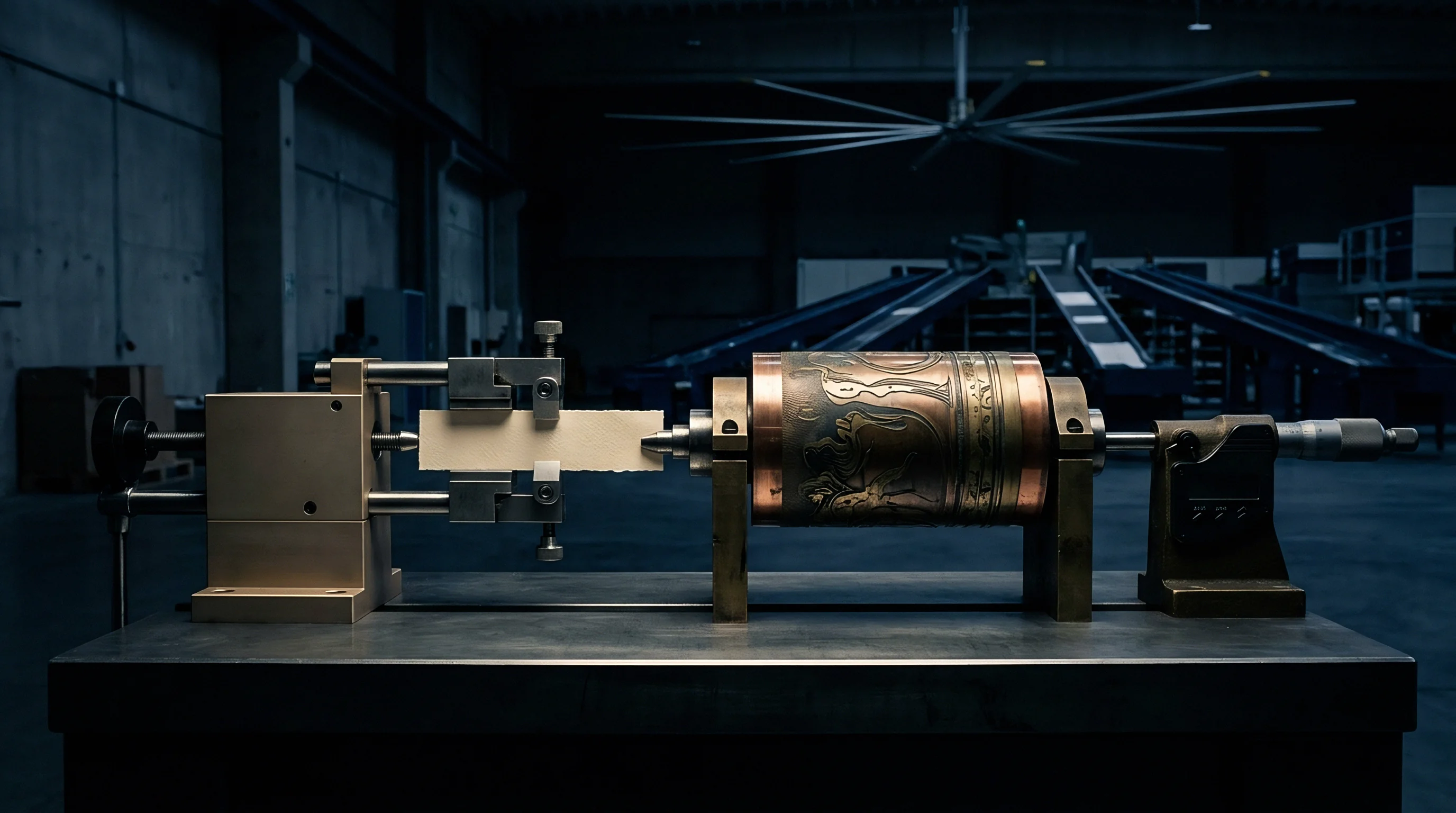
Oscillatory compression DMA with parallel-platen geometry allows bench testing at frequencies that mirror operational web speeds; sweeping from 0.1 Hz to 100 Hz yields the master relaxation curve needed to evaluate caliper stability.
Measuring thickness retention directly demands tight control over static preload, dynamic strain amplitude, and sample alignment in the test rig. Misalignment between upper and lower platens introduces parasitic shear forces that invalidate out-of-plane compression figures. To avoid flexural compliance artifacts, DMA platens must hold parallel alignment within 2 micrometers across a 10-millimeter test disc.
Setting static preloads establishes a baseline pressure that mimics web tension and feeder force on commercial converting equipment.

Compression Rheology under Oscillatory Force Fields
Subjecting multi-ply board to controlled oscillatory displacement shows clear frequency dependence in the storage modulus. At low frequencies, polymer chains in the wood structure have time to rearrange, resulting in lower storage modulus values and greater permanent deformation. At high frequencies ~ matching rapid nip passes ~ short contact times prevent large-scale molecular shift, making the material appear stiffer with an elevated storage modulus.
This high-frequency stiffening can mislead engineers into expecting stronger caliper retention during converting than the core actually delivers.
Total deformation within a press nip breaks down into instantaneous elastic strain, delayed viscoelastic strain, and permanent viscous flow. Instant elastic strain recovers immediately upon exiting the compression zone, whereas delayed viscoelastic strain recovers over seconds or hours. Permanent viscous flow represents true, unrecoverable caliper loss.
Multi-frequency sinusoidal testing isolates these individual responses, allowing engineers to calculate exact storage and loss compliance functions for a given furnish.
- Platen Parallelism requires active alignment verification via optical auto-collimation so edge-concentrated shear loads do not skew out-of-plane storage modulus readings.
- Static Preload Level must match baseline pressures on target converting equipment, typically set between 20 kPa and 50 kPa for standard folding boxboard grades.
- Dynamic Strain Amplitude must stay within the linear viscoelastic limit of the structure, capped below 0.5 percent of initial thickness to avoid damaging the core before testing.
- Environmental Chamber Isolation maintains thermal stability within 0.1 °C and relative humidity within 1.0 percent across extended frequency sweeps.
- Contact Area Geometry uses circular polished steel platens with chamfered edges to prevent stress spikes along the edge of the specimen disc.
Calibration of Parallel-Platen Z-Axis Testing Geometries
Calibrating the displacement transducer is critical when measuring sub-micron thickness changes. Shaft expansion during temperature sweeps generates artificial displacement signals that can match the magnitude of sheet compression itself. Correcting for system compliance requires baseline dynamic force sweeps on a quartz or hardened steel reference block across the full temperature and frequency spectrum, allowing instrument frame deflection to be subtracted from raw displacement data.
Specimen preparation requires clean die-punching without edge crush or delamination. Standard punch dies flatten the porous mechanical core along the edge of the disc, forming a dense perimeter ring that artificially inflates measured storage modulus. High-speed rotary hollow drills with liquid nitrogen cooling preserve undamaged core geometry.
While stacking discs boosts total displacement signals on thin grades, it adds interface compliance errors between sheets that require mathematical cancellation via multi-stack extrapolation.
Frequency sweeps across four orders of magnitude show that higher core bulk steepens the loss modulus curve. Substrate qualification trials indicate that low-yield CTMP cores exhibit strong frequency sensitivity, causing severe residual caliper loss despite acceptable static bulk ratings. Dynamic response under transient loading dictates converted package dimensions far more than static bench measurements.
Whether laboratory DMA metrics reliably predict if a board grade holds caliper through a four-color offset press and high-speed rotary embosser remains a central practical question.

Creep
Time-dependent caliper loss under sustained static loads or cyclic compression represents a primary failure mode in palletized storage. Viscoelastic creep compliance, D(t), measures this time-dependent strain normalized by applied stress. Bottom-tier cartons in a warehouse bear heavy static loads from upper pallets for weeks or months, and elevated humidity accelerates structural loss through mechanosorptive compliance.
Superimposing a small oscillatory stress onto a sustained static load during dynamic creep testing isolates how core degradation progresses over extended storage.
Continuous dynamic excitation under long-term static load accelerates internal stress relaxation. As humidity fluctuates, water molecules adsorb and desorb from hydroxyl sites in the cellulose matrix; this constant breaking and reforming of hydrogen bonds under stress lets wood fibers slide past each other far below their static yield point. DMA testing under controlled humidity cycles quantifies this mechanosorptive rate, providing the data needed to set safe pallet stacking limits.
Time-Temperature-Humidity Superposition in Lignocellulosic Arrays
The time-temperature superposition principle holds that viscoelastic behavior at elevated temperatures over short periods mirrors room-temperature behavior over extended timescales. In wood-based multi-ply structures, this concept extends to moisture, creating a time-temperature-humidity superposition framework. Shift factors calculated from short DMA runs at higher temperatures and humidities allow master creep curves to be built for years of storage, with the horizontal shift factor aT,RH tracking the softening of amorphous core lignin.
Master curves for GC1 folding boxboards show out-of-plane compliance climbing sharply once relative humidity clears 65 percent. Below that level, the core retains structural integrity under moderate loads; above 75 percent, the effective glass transition of core hemicellulose drops below room temperature. Thickness collapse then accelerates under low-frequency vibration from truck or rail transit, causing cartons to lose stacking height before ever reaching distribution centers.
| Middle-Ply Furnish Type | Relative Humidity (%) | Initial Caliper (µm) | Compliance D(1h) (1/MPa) | Compliance D(24h) (1/MPa) | Permanent Set (%) |
|---|---|---|---|---|---|
| Bleached CTMP (Standard GC1) | 50 | 350 | 0.026 | 0.038 | 4.2 |
| Bleached CTMP (Standard GC1) | 75 | 350 | 0.048 | 0.082 | 11.8 |
| Bleached CTMP (Standard GC1) | 90 | 350 | 0.095 | 0.210 | 26.5 |
| Stone Groundwood (GC2 Core) | 50 | 350 | 0.031 | 0.044 | 5.8 |
| Stone Groundwood (GC2 Core) | 75 | 350 | 0.059 | 0.098 | 14.6 |
| Recycled Furnish (GD2 Core) | 75 | 350 | 0.082 | 0.145 | 21.4 |
Compliance data shows that CTMP core plies maintain higher creep resistance than recycled furnishes across all humidity levels. At 75 percent relative humidity, standard CTMP records a 24-hour compliance of 0.082 1/MPa and a permanent set of 11.8 percent. Under identical conditions, recycled GD2 core stock reaches a compliance of 0.145 1/MPa with 21.4 percent permanent set.
Shorter fibers and higher fines content in recycled furnish weaken network connectivity, promoting viscous inter-fiber shear under dynamic load profiles.

Dynamic Strain Amplification and Caliper Loss Kinetics
Superimposing low-amplitude dynamic vibrations onto a constant compressive load accelerates thickness loss. Road transport subjects palletized cartons to continuous vertical vibration between 2 Hz and 20 Hz, and combined static-oscillatory testing shows how these micro-vibrations feed energy into the softened core, overcoming energy barriers that normally slow static creep. Under combined loading, caliper loss rates can double relative to static creep under equivalent mean force.
Dynamic vibration superimposition accelerates creep compliance decay in mechanical pulp cores by overcoming localized hydrogen bond energy barriers.
Thickness loss kinetics follow a power law through primary creep, settle into linear secondary creep, and eventually accelerate into tertiary structural collapse. Identifying the transition point between primary and secondary creep helps packaging specifiers establish safe storage windows. Boards with higher chemical pulp ratios in the core show delayed secondary creep, extending structural shelf life under humid or warm conditions.
A practical rule of thumb for packaging specifiers is that every 10 percent increase in sustained relative humidity above 60 percent doubles the creep strain rate of a mechanical pulp core under vertical compression.

Matrix
Converting boxboard into finished blanks involves severe localized deformation during scoring and die-cutting. Creasing tools apply compressive and shear loads to crush the internal core along fold lines while keeping the outer liners intact. The goal is targeted delamination within the middle plies to lower bending resistance without cracking the surface.
If the out-of-plane storage modulus of the core is off-target, creasing forces either rupture the outer liner or fail to achieve the low-stiffness fold needed on high-speed erecting lines.
Creasing rules impose instant compressive strains above 30 percent along the score line, driving the mechanical core well past its yield point into non-linear viscoelastic behavior. DMA testing in non-linear regimes yields the stress-strain curves needed to optimize matrix channel depth and rule width. Conversely, boards with overly soft cores collapse too broadly, losing thickness across the whole flap rather than isolating delamination along the intended crease.

Transient Deformation during Scoring and Die Impression
As the male rule forces paperboard into the female matrix channel, the top liner experiences strong in-plane tension while the bottom liner undergoes localized bending and tension. The mechanical core takes the brunt of out-of-plane shear and compression. Multi-axial DMA measurements indicate that a high core shear modulus keeps deformation from spreading into adjacent un-scored board; maintaining a sharp stiffness gradient between the score line and uncreased areas keeps side panels flat and cartons square.
Dynamic forces on flatbed die-cutters run at speeds up to 10,000 sheets per hour, leaving dwell times under 10 milliseconds. At these strain rates, response is governed by the dynamic storage modulus. If core furnish has a high loss modulus at 100 Hz, mechanical energy converts to localized heat, triggering micro-thermal softening and rapid core collapse beneath the rule.
While this local thickness drop lowers fold stiffness as intended, it can also permanently reduce caliper in adjacent un-scored land areas.
- Crease Wall Delamination occurs when a low shear modulus lets internal core plies split cleanly into parallel sub-layers without cracking outer liners.
- Unintended Caliper Rollback manifests as permanent thickness loss in flat panels adjacent to score lines when tool pressure spreads laterally.
- Liner Shear Fracture develops when high core storage modulus resists out-of-plane displacement, transferring tensile strain directly to the outer kraft layers.
- Bending Moment Drift occurs when post-creasing viscoelastic recovery gradually increases fold stiffness, leading to jams on high-speed cartoning lines.
Can Dynamic Storage Modulus Predict Score Caliper Retention?
Evaluating whether dynamic lab metrics translate to score-line performance requires examining non-linear core response. A high storage modulus at converting frequencies ensures uncreased areas retain original caliper when passing through matrix pressure zones. If storage modulus falls below critical thresholds, peripheral contact pressure can reduce panel caliper by up to 15 micrometers, compromising stacking strength before the carton is even erected.
Press-room data shows that boards with high tan delta values under high-frequency shear exhibit wider variation in crease folding torque. Energy dissipated during scoring causes micro-void collapse that does not recover after impression. This structural change lowers secondary fold stiffness ~ helping initial carton erection, but weakening top-load strength once packed into corrugated transit cases.
Transient compression during high-speed die scoring permanently reduces core thickness in adjacent flat panels if the dynamic storage modulus falls below 25 MPa at 100 Hz.
Selecting boxboard based solely on static caliper swatches while ignoring high-frequency viscoelastic behavior introduces real operational risk. When low-modulus core stock runs through a converting line, cumulative impression forces from printing cylinders, embossing rolls, and creasing dies reduce caliper across the entire sheet. Finished cartons arrive at filling lines with degraded wall stiffness, lower internal volume, and compromised stacking strength, driving up reject rates and commercial disputes.
Loss
Quantitative modeling of thickness decay enables packaging engineers to accurately project structural container performance from raw mill substrate data. In multi-ply folding boxboards, bending stiffness Sb is defined by the classical beam theory model for layered composite structures:
Sb = fracEskin · (h3 – hcore3) + Ecore · hcore312 · (1 – ν2)
where Eskin represents the tensile modulus of the outer chemical pulp layers, Ecore represents the out-of-plane modulus of the mechanical core, h is total board thickness, hcore is core thickness, and ν is Poisson’s ratio. Because total caliper h is cubed, small percentage losses in core thickness produce disproportionate reductions in bending stiffness: a 5 percent loss in caliper from viscoelastic core compression cuts structural bending stiffness by roughly 14 percent, directly reducing box compression strength (BCT).
To evaluate the technical and commercial impact of caliper loss, consider a procurement evaluation of three competing 350-micrometre folding boxboard specifications for a high-volume pharmaceutical carton program requiring 10,000,000 units annually. The specification requires a minimum post-converting machine-direction bending stiffness of 22.0 mNm to maintain filling line stability, along with a target box compression strength of 280 N under standard storage conditions.

Quantitative Caliper Retention Modeling under Transit Compression
The three candidate substrates represent different furnish formulation strategies targeting an initial nominal caliper of 350 micrometers:
Option A is a standard high-quality GC1 board made with a high-yield bleached CTMP core (density 400 kg/m³, basis weight 295 g/m², cost €1,450 per tonne). DMA testing gives an out-of-plane storage modulus E’ of 38.0 MPa and a loss factor tan δ of 0.085 at 1 Hz, 23 °C / 50% RH. Dynamic creep modeling projects a 3.5 percent (12.25 µm) caliper loss during converting and transport, leaving a final converted caliper of 337.75 µm.
Option B is a downgauged high-yield CTMP board designed to reduce fiber mass (density 360 kg/m³, basis weight 270 g/m², cost €1,520 per tonne). While basis weight is lower, the higher bulk comes from reduced mechanical refining and lighter chemical pre-treatment, which weakens fiber-to-fiber bonding. DMA testing shows a lower storage modulus E’ of 22.5 MPa and a higher loss factor tan δ of 0.165 at 1 Hz. Dynamic creep modeling projects an 8.2 percent (28.70 µm) post-converting caliper loss, dropping final caliper to 321.30 µm.
Option C is a heavier, medium-yield GC2 board built with a stone groundwood core and unbleached back liner (density 450 kg/m³, basis weight 325 g/m², cost €1,310 per tonne). DMA testing indicates an out-of-plane storage modulus E’ of 42.5 MPa and a low loss factor tan δ of 0.065 at 1 Hz. Dynamic creep modeling projects a 2.1 percent (7.35 µm) loss, yielding a converted caliper of 342.65 µm.
| Substrate Performance Parameter | Option A (Standard CTMP GC1) | Option B (High-Yield Core GC1) | Option C (Stone Groundwood GC2) |
|---|---|---|---|
| Initial Nominal Caliper (µm) | 350.0 | 350.0 | 350.0 |
| Basis Weight (g/m²) | 295 | 270 | 325 |
| Unit Price (€ / Tonne landed) | €1,450 | €1,520 | €1,310 |
| Initial Bending Stiffness MD (mNm) | 24.5 | 24.2 | 24.8 |
| Out-of-Plane Storage Modulus E’ (MPa) | 38.0 | 22.5 | 42.5 |
| Loss Factor tan delta (1 Hz) | 0.085 | 0.165 | 0.065 |
| Projected Caliper Loss (%) | 3.5% | 8.2% | 2.1% |
| Final Converted Caliper (µm) | 337.75 | 321.30 | 342.65 |
| Retained Bending Stiffness MD (mNm) | 22.02 | 18.65 | 23.28 |
| Projected Box Compression Strength (N) | 285 | 241 | 302 |
| Filling Line Performance Status | Compliant (Pass) | Failed (Jam Risk) | Compliant (Pass) |
| Parent Sheet Area Yield (m² / Tonne) | 3,389.8 | 3,703.7 | 3,076.9 |
| Substrate Cost per 1,000 Packs (€) | €21.39 | €20.52 | €21.29 |
| Effective Compliant Cost per 1,000 (€) | €21.39 | €26.80 (Incurred Waste) | €21.29 |

Landed Yield Calculations for Downgauged Folding Boxboard Stock
Looking strictly at raw unit price suggests Option B is cheapest per thousand sheets because of its low basis weight (270 g/m²). Option B yields 3,703.7 square meters per tonne, producing a raw blank cost of €20.52 per thousand packs compared to €21.39 for Option A and €21.29 for Option C. However, that baseline figure ignores viscoelastic caliper loss.
Under converted forces, Option B undergoes an 8.2 percent caliper drop to 321.30 micrometers. Calculating composite stiffness reveals that Option B’s machine-direction bending stiffness drops from an initial nominal 24.2 mNm down to 18.65 mNm, missing the 22.0 mNm line requirement. Projected box compression strength drops to 241 N against the 280 N target.
On high-speed cartoning lines running at 400 cartons per minute, this 15.2 percent stiffness deficit triggers panel bulging, misfeeds, and downtime.
Factoring in a modest 3.0 percent waste rate from jams and rejects when running Option B ~ along with sorting costs and downtime penalties ~ raises its true landed cost to €26.80 per thousand units. Option A meets all performance criteria without penalty, holding its landed cost at €21.39 per thousand. Option C offers extra structural margin at €21.29 per thousand, though its 325 g/m² basis weight adds freight expense.

Structural Performance and Box Compression Economics
Verifying out-of-plane caliper retention during substrate qualification requires a structured test procedure:
- Sample five full-width parent sheets across the web from three distinct manufacturing lots, conditioning specimens at 23 °C and 50 percent relative humidity per ISO 187 for 24 hours.
- Punch precision 10-millimeter diameter disk specimens from front, center, and back web positions using hollow rotary drills cooled to prevent edge distortion.
- Measure baseline static caliper for each disk using an ISO 534 dead-weight micrometer at 50 kPa pressure, recording initial thickness to within 0.1 micrometer.
- Load specimens into a parallel-platen dynamic mechanical analyzer equipped with optical alignment sensors and an environmental control chamber.
- Apply a static preload of 30 kPa, followed by a dynamic sinusoidally varying compressive strain of 0.2 percent amplitude at 1 Hz for 60 minutes.
- Ramp ambient humidity inside the specimen chamber to 85 percent relative humidity at 30 °C, sustaining combined dynamic excitation for an additional 120 minutes.
- Release dynamic stress, allow 15 minutes of elastic recovery at standard atmosphere, and re-measure final post-test static caliper using the ISO 534 micrometer.
- Calculate percentage caliper retention by dividing final recovered caliper by initial nominal caliper, logging values into the statistical batch MTR dossier.
Long-term tracking of dynamic compliance curves confirms that yield calculations based solely on dry basis weight introduce real commercial risk. High-bulk CTMP offerings often mask viscoelastic losses; when buyers select Option B based on surface yield per tonne, the apparent 4 percent savings disappear during converting and packaging. Real cost optimization requires weighing substrate price against retained post-converting caliper and structural performance limits.

Contract
Standard paperboard supply contracts specify basis weight, static caliper, moisture content, and surface roughness under ISO test conditions. However, these static parameters fail to protect buyers against converted caliper loss caused by weak viscoelastic performance in the core. Adding dynamic mechanical specifications directly into purchasing agreements sets enforceable standards for caliper retention.
Setting minimum storage modulus values and maximum loss factor limits under defined strain rates forces mills to maintain core fiber quality.
Mill specifications usually allow static caliper tolerances of plus or minus 5 percent across a production run. In high-speed packaging, a negative 5 percent static drift combined with an unmonitored 8 percent viscoelastic compression loss produces a 13 percent drop in total thickness ~ a loss that virtually guarantees line failure. Modern supply contracts must tighten static caliper tolerances to plus or minus 2.5 percent while establishing firm dynamic mechanical performance limits.
Formulating DMA Compliance Metrics into Purchasing Specifications
A legally sound specification defines explicit test methods, reference environments, and pass-fail criteria for viscoelastic properties. Contract clauses should cite standard test protocols such as ASTM D5024 or equivalent ISO out-of-plane compression procedures adapted for paperboard. Specifications need to outline static preload, dynamic strain frequency, temperature limits, and humidity conditioning steps used during audit testing.
Including dynamic compliance parameters places responsibility for core quality back on the paper mill. Suppliers can no longer meet caliper specs simply by boosting bulk through lower refining if doing so damages fiber bonding and dynamic storage modulus. Under updated audit protocols, mills submit dynamic mechanical test certificates alongside standard mill test reports (MTR) for every master reel produced for high-specification orders.
- Out-of-Plane Storage Modulus Minimums mandate that core plies maintain E’ above 35.0 MPa when tested at 1 Hz, 23 °C, and 50 percent relative humidity under a 30 kPa preload.
- Maximum Loss Factor Thresholds cap tan delta below 0.100 under standard conditions, ensuring viscous dissipation does not exceed 10 percent of total dynamic energy input.
- Mechanosorptive Creep Limits hold permanent thickness set under 10.0 percent following 24-hour cyclic exposure between 50 percent and 85 percent relative humidity under continuous dynamic preload.
- Batch Verification Protocol requires suppliers to archive physical reel samples for 12 months, allowing third-party lab verification if field caliper disputes arise.

Mill Certificate Auditing and Reel Traceability Requirements
Ensuring compliance across global supply chains requires clear traceability from finished cartons back to specific paper machine tambour reels. Modern procurement agreements enforce batch-level MTR reporting that includes dynamic modulus data. If incoming quality checks at converting plants find caliper drops beyond contract limits, automated hold procedures freeze the affected master rolls pending lab verification.
When performance disputes arise over converted cartons, dynamic mechanical testing gives objective evidence to establish responsibility. If post-converting lab analysis shows the core’s retained storage modulus fell below contractual limits, liability for line downtime, wasted make-ready stock, and damaged product lies with the substrate manufacturer. Clear viscoelastic specification thresholds turn subjective vendor disputes into objective, data-driven contract remedies.
Contractual specification of dynamic out-of-plane storage modulus minimums shifts financial liability for converted caliper collapse directly onto the substrate mill.
The standard procurement clause for high-speed folding boxboard supply contracts states: “Substrate supplied under this agreement must maintain an out-of-plane dynamic storage modulus (E’) of not less than 35.0 MPa and a maximum loss factor (tan delta) not exceeding 0.095 when tested under 1 Hz oscillatory compression at 23 °C and 50% RH per ASTM D5024; failure to meet these dynamic viscoelastic thresholds constitutes grounds for rejection of the entire mill roll batch at the supplier’s expense.”