Dynamic Mechanical Analysis of High Bulk Middle Ply Compression Set under High Speed Converting Conditions
Dynamic Mechanical Analysis reveals high-speed converting nips collapse high-bulk BCTMP middle plies, dropping bending stiffness up to twenty-six percent.

Impulse
Modern packaging lines compress paperboard through narrow press gaps in milliseconds. Rotary die-cutters, matrix strippers, creasing tools, and print nips subject folding boxboard to severe mechanical force over microsecond and millisecond windows. At web speeds reaching six hundred meters per minute, nip dwell time drops below two milliseconds.
At these strain rates, the sheet behaves very differently than standard bench tests predict under laboratory conditions.
How the substrate responds under transient loading determines whether a carton holds its intended dimensions or loses thickness during converting. Packaging buyers often specify high-bulk folding boxboard to reduce basis weight while maintaining structural stiffness. These lighter boards rely on multi-ply architectures where a low-density middle ply spaces out the dense, high-modulus outer liners.
How this central layer holds up internally dictates how the web absorbs local compression, and static tests cannot show whether a lightweight middle ply will spring back after clearing an impression nip at line speed.

Converting Line Speeds and Dynamic Strain Rates
High-speed rotary converting equipment drives z-direction strain rates in paperboard from one hundred to over ten thousand reciprocal seconds. Laboratory caliper gauges apply loads orders of magnitude slower, placing a static pressure of fifty kilopascals over five seconds per ISO 534. Static thickness measurements obscure how resistance in the fiber network depends on loading speed.
When force hits the sheet in a single millisecond, viscoelastic strain energy dissipates through molecular and structural mechanisms that never engage during slow bench testing.
Nip dwell profiling on high-speed folding carton lines tracks the duration of peak compressive stress. Impression nips exert local z-direction stresses between two and twelve megapascals. The incoming pressure wave drives free air out of the open fiber network pores, alongside elastic deformation of pulp fibers and viscoelastic shear across inter-fiber hydrogen bonds.
Above four hundred meters per minute, trapped air cannot escape fast enough; the resulting transient pore pressure briefly resists consolidation before venting through cross-direction channels.
Impulse Compression Kinetics in Die Nips
Rotary die-cutters use creasing rules, cutting blades, and resilient anvil blankets to convert flat paperboard blanks into foldable cartons. Creasing nips subject the middle ply to concentrated shear and compression, with local strain often exceeding forty percent of total sheet thickness at maximum penetration. Rapid strain shifts the yield point of the central fiber network, making the sheet appear stiffer upon initial impact before it undergoes fast stress relaxation or permanent structural failure.
Tracking the transition between elastic bounce-back and permanent compaction requires examining micro-mechanical strain components inside the central ply. Once compressive stress surpasses the structural yield limit of an unrefined fiber network, individual wood fibers suffer permanent lumen collapse and broken inter-fiber bonds. The extent of that damage decides whether the sheet holds its specified caliper or thins out.
Thinning closes the spacing between outer plies, degrading folding performance on downstream gluers and lowering eventual box compression strength.
Statutory ISO caliper measured under static bench conditions defines baseline deliverable guarantees, even though converter nip velocities alter dynamic behavior.

Cellulose
Multi-ply paperboard manufacturing uses targeted fiber selection to maximize structural stiffness at low basis weights. The middle plies of folding boxboard (FBB) rely on high-yield mechanical pulps to build caliper without adding weight. Bleached chemi-thermomechanical pulp (BCTMP), stone groundwood (SGW), and pressure groundwood (PGW) form the primary furnish of high-bulk central layers.
These pulps retain stiff, lignin-rich fibers that resist close packing, producing open networks with bulk factors between 1.4 and 2.2 cubic centimeters per gram.
Retaining lignin keeps individual mechanical pulp fibers cylindrical and stiff. Hardwood BCTMP, mostly from aspen or eucalyptus, provides short, rigid fibers that fill voids and deliver uniform bulk. Softwood BCTMP, made from spruce or pine, supplies longer fibers that create a resilient structural skeleton bound by hydrogen bonds and physical entanglement.
The ratio of hardwood to softwood pulp, alongside refining intensity and chemical pre-treatment, sets how the middle layer responds under dynamic compression.
Middle Ply Furnish Microstructure
Open pore structures in mechanical fiber layers yield high void fractions that trap air and allow compliance. Building bulk requires preventing total fiber collapse during wet pressing and calendering on the paper machine. Wet-end strength resins and debonding agents adjust inter-fiber bond density to control internal void space.
Over-debonding boosts initial bulk but weakens internal bonding, leaving the central network prone to permanent compaction under converting tools.
Inter-fiber bond density inside the middle ply determines how compressive energy spreads through the sheet thickness. Unrefined mechanical fibers touch only at discrete points, creating a sparse hydrogen-bonded network. Under z-direction loading, stress concentrates at these contact points.
When local stress exceeds the shear strength of individual bonds, they fail in sequence and allow micro-structural slipping. Fiber segments shift into adjacent void spaces, permanently altering internal geometry and densifying the central layer.

BCTMP Matrix Morphology under Compression
Scanning electron microscopy of compressed middle plies shows two main failure modes: fiber lumen buckling and inter-fiber slip. Lumen buckling dominates when stiff softwood fibers sit perpendicular or oblique to the loading axis. Under dynamic impact, the tubular cell wall of an unrefined fiber bends elastically before buckling along fault lines in the S2 cell wall layer.
That failure flattens the internal lumen cavity, cutting individual fiber diameter by up to sixty percent.
Hardwood BCTMP fibers resist lumen collapse better than softwood fibers because they have thicker cell walls and smaller initial lumen diameters. Middle layers rich in hardwood fail mainly through bond rearrangement and void consolidation. As compressive stress pushes hardwood fibers into open pore spaces, overall layer thickness drops.
If void volume collapses entirely, the central ply loses its porous structure and turns into a dense fiber mass that no longer functions as a lightweight structural spacer.
| Furnish Type | Bulk Factor (cm3/g) | Lumen Collapse Resistance | Inter-Fiber Bond Density | Dynamic Recovery Index |
|---|---|---|---|---|
| 100% Softwood BCTMP | 2.15 | Moderate | Low | 0.62 |
| 70/30 Softwood/Hardwood BCTMP | 1.85 | High | Moderate | 0.74 |
| 50/50 Softwood/Hardwood BCTMP | 1.65 | Very High | High | 0.81 |
| 100% Stone Groundwood (SGW) | 1.45 | Low | High | 0.55 |
| Deinked Recycled Pulp (DIP) | 1.30 | Very Low | Very High | 0.42 |
Freeness targets chosen to maximize bulk always trade off compressive elastic recovery when converting speeds exceed impression limits.
Spectrum
Evaluating the viscoelastic response of middle plies during millisecond converting operations requires dynamic instruments that can sweep wide frequency and temperature ranges. Dynamic Mechanical Analysis (DMA) applies sinusoidal compressive strain to paperboard samples while measuring stress response. By separating stress into in-phase and out-of-phase components, DMA determines storage modulus, loss modulus, and loss factor.
These parameters show how much energy the fiber network stores elastically compared to what is lost to internal friction and plastic deformation.
Testing paperboard along its thickness axis requires parallel-plate compression fixtures with high-precision displacement sensors. Standard tensile DMA setups miss z-direction deformation mechanics because paperboard is highly anisotropic. Z-direction DMA isolates compressive behavior within the web, and adjusting excitation frequency lets engineers simulate speeds from static laboratory tests up to fast converting lines.
Dynamic Mechanical Analysis Methodologies
Dynamic test equipment runs frequency sweeps from 0.01 Hertz to 200 Hertz at controlled temperatures. For z-direction testing, paperboard swatches are conditioned to specific temperature and humidity targets before being clamped between temperature-controlled platens. A static preload keeps the platens from separating during oscillation while holding mechanical strain inside the linear viscoelastic region.
The resulting complex modulus reflects total network resistance to high-speed deformation.
Storage modulus measures energy stored elastically in hydrogen bonds and intact fiber walls during impact. Loss modulus accounts for energy dissipated through micro-sliding at unbonded fiber contacts, viscous relaxation in amorphous lignin-cellulose regions, and air flow through pores. The damping factor ~ the ratio of loss to storage modulus ~ indicates internal friction directly.
Higher damping factors signal increased energy loss, correlating with greater dynamic compression set and permanent caliper loss in converting nips.
Storage modulus values measured at 23 °C and 50 percent relative humidity under 100 Hz excitation show a forty percent increase compared to static 1 Hz bench assessments.

Viscoelastic Spectrum and Time Temperature Superposition
At six hundred meters per minute, converting nips subject paperboard to excitation frequencies in the kilohertz range, far beyond the direct mechanical reach of bench instruments. Time-Temperature Superposition (TTS) allows engineers to build master curves for these high frequencies. Because polymer chains in amorphous cellulose and lignin move faster at elevated temperatures, testing at higher temperatures corresponds directly to higher deformation rates at room temperature.
Using the Williams-Landel-Ferry (WLF) equation or Arrhenius shift factors, experimental data gathered from -40 °C to 120 °C across modest frequencies (0.1 Hz to 100 Hz) can be shifted horizontally along a logarithmic frequency axis. The resulting master curve predicts storage modulus, loss modulus, and damping factor down to sub-millisecond durations. These curves show that under fast strain rates, the middle fiber network undergoes a viscoelastic transition from flexible and compliant to stiff and brittle, where stress relaxation takes longer than nip dwell time.
Does Dynamic Compression Set Correlate Directly with Millisecond Crease Recovery?
Experiments show that dynamic compression set measured by high-frequency DMA correlates directly with post-converting crease recovery angles. As paperboard passes through creasing rules, the central ply undergoes concurrent z-direction compaction and shear. If the loss factor in the middle furnish stays high at line strain rates, internal stress relaxes during nip passage, leaving too little stored elastic energy to drive recovery.
The sheet suffers permanent compaction along score lines, lowering folding resistance and distorting carton squareness.
Unbound water in the central layer strongly affects dynamic relaxation. Moisture plasticizes amorphous cellulose and hemicellulose regions, lowering the glass transition temperature and speeding up viscoelastic relaxation. Above eight percent equilibrium moisture, storage modulus drops noticeably while loss factor rises across tested frequencies.
Higher moisture worsens dynamic compression set in converting nips, causing permanent thickness loss even under moderate impression pressures.
How does localized shear dissipation in amorphous hemicellulose regions affect long-term elastic recovery in highly refined mechanical pulps under dynamic cyclic fatigue?
Strain
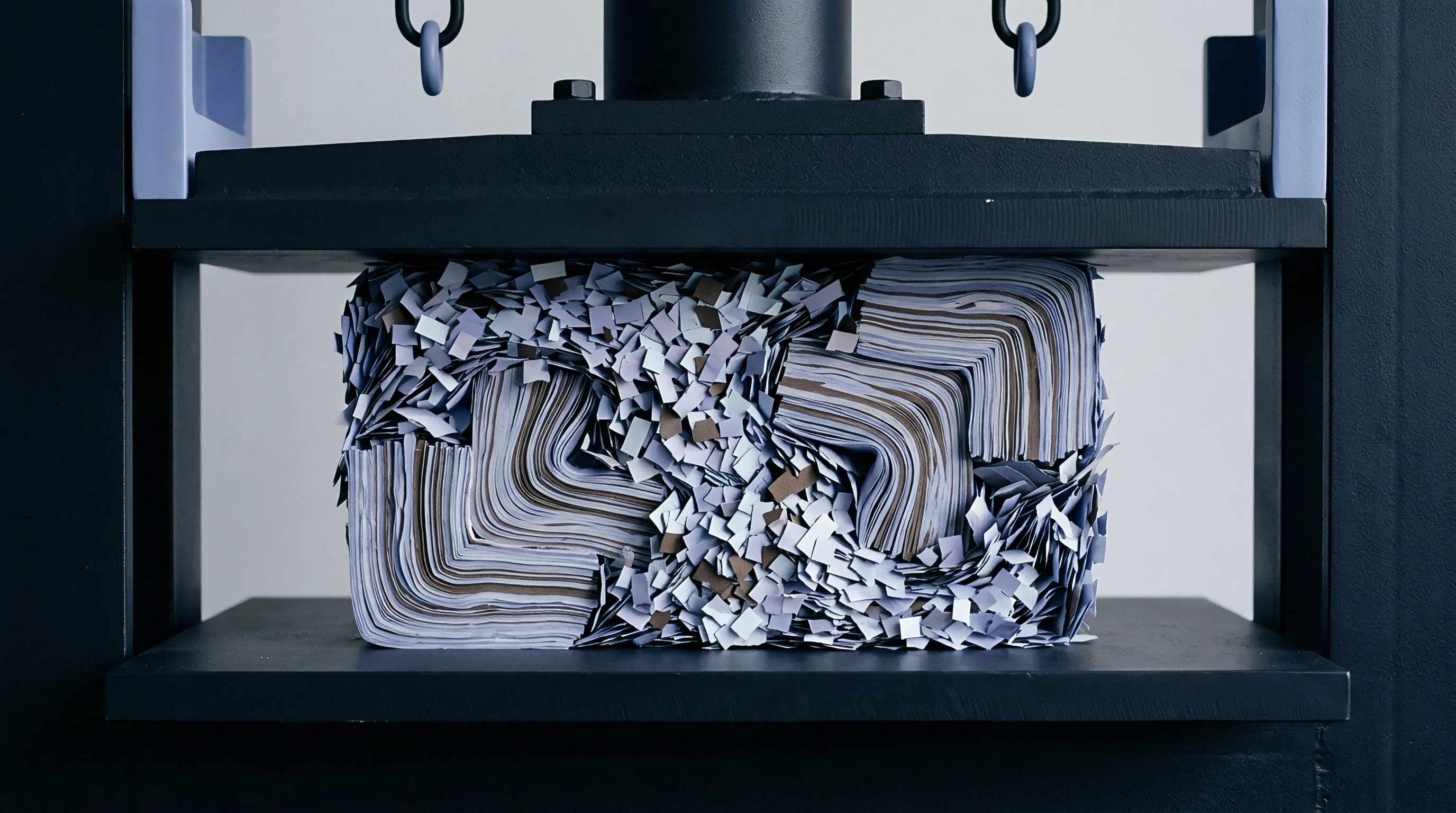
Compacting paperboard in high-speed converting nips causes both temporary and permanent dimensional changes. Total compressive strain splits into three parts: immediate elastic strain, time-dependent viscoelastic strain, and permanent plastic strain. Elastic strain recovers immediately upon exiting the nip.
Viscoelastic strain recovers over minutes or hours as polymer chains relax. Plastic strain represents permanent set caused by damaged fiber lumens, broken inter-fiber bonds, and collapsed pore spaces.
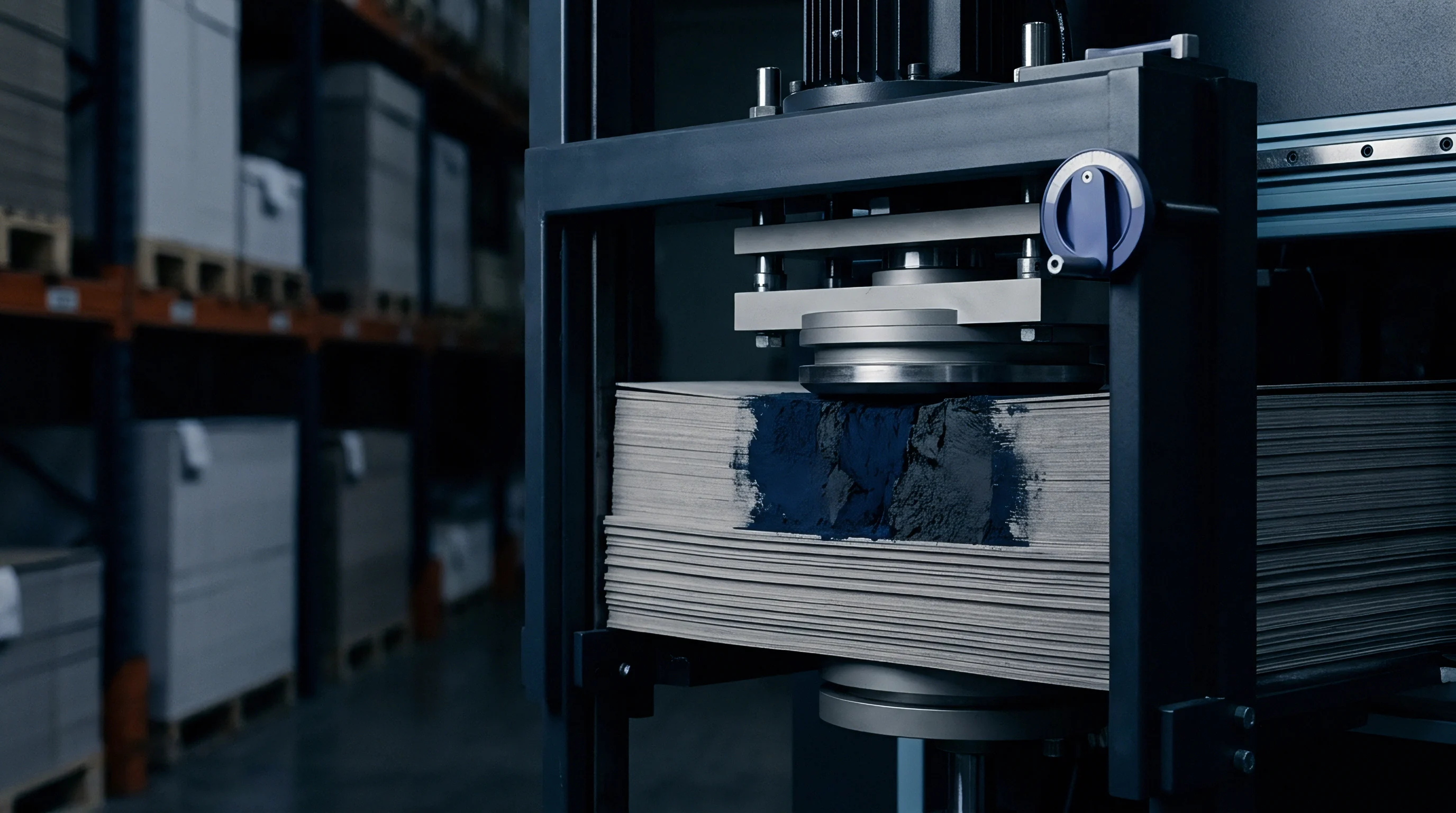
Measuring permanent compression set requires tracking sheet thickness at set time intervals after dynamic impact. When high-bulk boxboard passes through impression tools operating at peak pressures up to twelve megapascals, initial strain can hit thirty percent of total caliper. Upon leaving the nip, elastic rebound recovers part of that loss, but plastic strain prevents full recovery, leaving the converted sheet permanently below original thickness specifications.

Z-Direction Permanent Deformation Mechanics
Plastic deformation in high-bulk middle plies begins when internal compressive stress exceeds the yield strength of the unrefined mechanical pulp. At low strain rates, stress spreads evenly across inter-fiber contact points, permitting micro-scale adjustment without widespread bond failure. Under millisecond loading, concentrated stresses snap the hydrogen bonds maintaining the softwood skeleton.
Once those primary structural bonds fail, adjacent fibers collapse into empty pores, locking the matrix into a dense, lower-volume structure.
An unverified high-bulk board run lost twelve microns of caliper in the matrix stripper and jammed the high-speed gluer line, sending forty tonnes of cartonboard back to the pulper.
High strain rates also alter how individual wood fibers fail inside the sheet. Softwood mechanical fibers fracture brittly rather than bending ductily under fast compression. This shatters the tubular cell wall into small fragments that settle into open voids, eliminating internal elastic spring-back and increasing permanent compression set.
Irrecoverable Caliper Loss in Web Nips
Dynamic impression nips produce varying degrees of permanent caliper loss depending on web speed, nip geometry, and anvil hardness. Soft anvil covers widen the contact zone and lower peak stress, reducing permanent set in the middle ply. Steel-to-steel rotary impression rolls concentrate force across narrow contact zones, generating sharp, high-amplitude stress pulses that maximize fiber collapse.
Caliper loss accumulates across multiple converting stations. A web running through printing units, die-cutters, matrix strippers, and embossing rolls takes incremental compression set at each step. If cumulative caliper loss exceeds four percent of initial thickness, downstream package performance drops sharply below design thresholds.
- Creasing score fracturing occurs when excessive z-direction compaction destroys internal shear planes, causing outer liners to snap during folding.
- Print mottle generation arises from local caliper variations across the web, causing uneven ink transfer and density variations in solid print areas.
- Matrix stripping interference develops when converted blanks distort or lose caliper, causing automated pins to miss targeted waste sections.
- Carton gluer jamming results from thickness variations along side-seam flaps, disrupting automatic feed wheels and compression belts.
- Box compression strength loss manifests when reduced middle ply thickness lowers the overall section modulus and moment of inertia of converted carton panels.
| Impulse Duration (ms) | Peak Stress (MPa) | Elastic Strain (%) | Viscoelastic Strain (%) | Plastic Strain Set (%) | Net Caliper Loss (µm) |
|---|---|---|---|---|---|
| 1.0 | 10.0 | 8.2 | 4.1 | 12.7 | 18.5 |
| 2.5 | 10.0 | 9.5 | 5.8 | 10.2 | 14.8 |
| 5.0 | 10.0 | 11.1 | 7.2 | 7.9 | 11.5 |
| 10.0 | 10.0 | 12.8 | 8.9 | 5.4 | 7.8 |
| 50.0 (Static) | 10.0 | 15.4 | 11.2 | 2.8 | 4.1 |
Stiffness
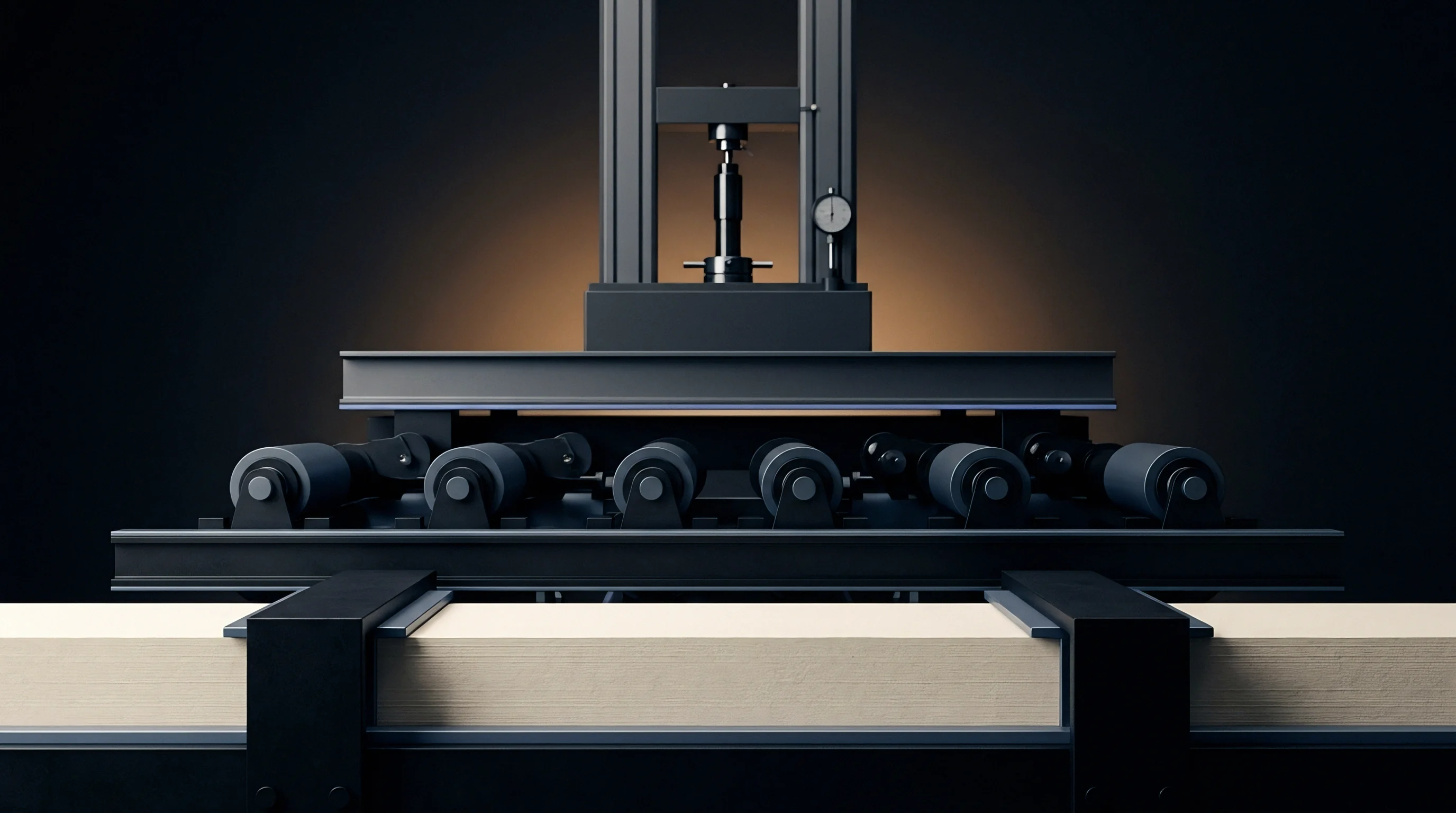
Structural rigidity governs how well a carton resists bulging, crushing, and deformation under stacking loads. Bending stiffness depends on sheet caliper and the modulus distribution across individual plies. Engineers model folding boxboard like an I-beam: solid bleached chemical outer plies serve as high-modulus flanges carrying tensile and compressive flexural loads, while the central mechanical layer acts as a spacer that maintains ply separation and resists vertical shear.
Bending stiffness scales with the cube of sheet thickness in uniform structures, and with ply separation squared in layered composite boards. Losing central layer thickness through dynamic compression directly reduces the distance between high-modulus outer plies. Consequently, small percentage losses in middle ply caliper lead to larger percentage losses in overall cross-direction bending stiffness, compromising box performance.
Bending Stiffness Loss Equations
Calculating bending stiffness loss from middle ply set requires integrating tensile modulus profiles across the sheet thickness. Total bending stiffness, S, is the sum of each ply’s elastic modulus multiplied by its moment of inertia relative to the neutral axis. Outer plies dominate total stiffness because their distance from the neutral axis is squared.
When converting compression reduces central ply thickness from t_m to t_m prime, the distance z separating outer liner centers decreases proportionally. The revised bending stiffness S prime drops according to the structural relationship governing composite flexure:
S_prime = S_outer (z_prime / z)^2 + S_middle (t_m_prime / t_m)^3
Because the elastic modulus of the high-bulk central layer is much lower than that of the bleached chemical outer plies, central ply thinning affects bending stiffness mainly by pulling the outer layers closer together. Laboratory measurements show that a five percent drop in central layer caliper from dynamic compression can cause up to a fourteen percent loss in cross-direction bending stiffness under ISO 2493.
Bending stiffness lost during high-speed nip compression can never be recovered by raising moisture in post-converting storage.

Box Compression Resistance Degradation
Box Compression Test (BCT) strength measures the vertical load-bearing capacity of an assembled carton. BCT performance depends on box geometry, panel buckling resistance, and cross-direction bending stiffness. Standard packaging formulas, such as McKee’s equation, model box compression strength from edge crush (ECT) values and bending stiffness in both machine and cross directions.
McKee’s formula links box compression strength to the square root of cross-direction bending stiffness multiplied by edge crush strength. When converting nips compact the high-bulk middle ply, bending stiffness and edge crush resistance drop together. Edge crush strength falls because the compacted central layer buckles earlier under vertical load, failing to support the stronger outer liners.
- Determine baseline ISO 534 caliper, grammage, and cross-direction bending stiffness under standard conditioning prior to press trials.
- Measure converting nip pressures and dwell times using calibrated tactile force sensors passed through production tools.
- Take post-converting board samples directly downstream of matrix stripping and creasing stations to measure dynamic caliper loss.
- Run ISO 2493 bending stiffness tests on converted samples to quantify flexural rigidity loss in both machine and cross directions.
- Perform ISO 12048 box compression tests on glued cartons to measure structural load loss against design models.
Standard mill specifications relying on ISO 534 thickness guarantees should include dynamic z-direction compression set thresholds under high strain rates to prevent unexpected strength losses.

Spec
Paperboard procurement balances basis weight reduction against mechanical performance limits. Buyers often replace solid bleached board (SBS) or white-lined chipboard (WLC) with high-bulk folding boxboard (FBB) containing BCTMP middle plies to save on raw materials. High-bulk board provides more caliper per unit weight, allowing lower grammages for the same target thickness.
However, aggressive downgauging makes the sheet far more vulnerable to dynamic compression set during high-speed converting.
A mill offering a 275 gram per square meter folding boxboard at a 1.6 bulk promises an unconverted caliper of 440 microns ~ matching a standard 330 gram per square meter solid bleached board at 1.33 bulk. On paper, this substitution cuts raw material tonnage costs by sixteen percent. But if the high-bulk middle layer undergoes a twelve percent dynamic compression set during converting, finished caliper drops to 387 microns.
That loss eats up structural stiffness margins, leading to stacking failures in the field.

Procurement Protocols for High Bulk Board
Effective procurement specifications need to move past static bench thickness figures. Contracts for high-bulk folding boxboard should set dynamic compression set limits verified by DMA or high-rate impulse testing. Buyers ought to require dynamic mechanical analysis certificates showing storage modulus stability and loss factors at frequencies matching target line speeds.
| Grade Specification | Basis Weight (g/m2) | Unconverted Caliper (µm) | Dynamic Set @ 500 m/min (%) | Converted Caliper (µm) | CD Bending Stiffness Loss (%) | Net Tonnage Savings (%) |
|---|---|---|---|---|---|---|
| Standard Solid Bleached Board (SBS) | 330 | 440 | 2.1 | 431 | -4.2 | Baseline |
| High Bulk FBB (Standard BCTMP) | 275 | 440 | 11.8 | 388 | -26.4 | 16.6 |
| High Recovery FBB (Optimized BCTMP) | 285 | 440 | 4.5 | 420 | -9.8 | 13.6 |
| Recycled White Lined Chipboard (WLC) | 360 | 440 | 14.2 | 377 | -31.5 | -9.1 |
Mill certificates guaranteeing static ISO 534 thickness fail to indemnify buyers against dynamic caliper collapse on lines exceeding five hundred meters per minute.

Goods-In Verification and Machine Room Audits
Quality assurance routines at converting plants should include receiving tests that screen incoming reels for dynamic compression risk. Standard bench calipers will not catch batches with weak or overly debonded mechanical pulp middle plies. Using short-duration dynamic impulse gauges or DMA screening allows quality teams to reject vulnerable board lots before reels hit high-speed converting lines.
- Furnish composition validation requires checking mill batch certificates to confirm softwood BCTMP ratios meet minimum structural requirements.
- Z-direction tensile testing under ISO 15754 verifies internal bond strength to ensure the middle layer resists compression-induced delamination.
- Dynamic compression set screening subjects conditioned swatches to five-millisecond, ten-megapascal impression pulses before measuring caliper recovery.
- Equilibrium moisture audit checks that incoming reel moisture stays within five-point-five to seven-point-five percent equilibrium bounds to prevent plasticization.
Mill audits show that optimizing mechanical pulp refining increases inter-fiber hydrogen bonding in central plies, lowering viscoelastic loss factors under high-frequency loading. Adjusting chemical debonding dosages gives papermakers direct control over the trade-off between initial bulk and dynamic compression resistance. Converting plants running fast machinery track converted caliper against raw reel certificates, producing real-time data that ties dynamic nip settings directly to finished carton stiffness and field stacking performance.