Mass Balance Conversion Factor Calculations for Multi-Ply Folding Boxboard Manufacturing Ledgers
Conversion factor calculations for multi-ply boxboard ledger balances demand ply-separated dry furnish accounting to isolate mechanical core broke from virgin liners.


Broke

Stratified Forming and Internal Recirculation
Multi-ply folding boxboard distributes mass across three distinct furnish layers. The top liner uses bleached chemical kraft pulp for brightness and print stability. Center plies rely on high-yield pulp ~ typically bleached chemi-thermomechanical pulp (BCTMP) or stone groundwood ~ to build bulk and bending stiffness without driving up basis weight.
On the reverse side, the ply consists of chemical kraft or a secondary mechanical blend, depending on whether the specification calls for a GC1 white back or GC2 cream back. Mineral pigments (calcium carbonate and kaolin bound in a styrene-butadiene or polyacrylate latex matrix) are applied to the top surface across two or three coating stations. Each layer retains solids, absorbs moisture, and shrinks differently during forming and drying.
Recycling fiber internally complicates mass balance accounting across these plies. Wet trim from the wire pit and couch roll returns directly to the wet end chests without suffering thermal damage. Meanwhile, heavy dry trim from the reel slitter, off-spec parent rolls, and winder shavings go through dry hydrapulpers before returning to stock prep.
Most operations route broke back into the middle plies regardless of whether it originated in the chemical liner or the mechanical core, putting chemical kraft fibers into the bulk layer while keeping virgin BCTMP out of the smooth top liner.
Under standard conditioning at 23 degrees Celsius and 50 percent relative humidity, finished folding boxboard retains between six and nine percent residual moisture.
Web breaks cause broke proportions in stock prep chests to swing significantly, changing the physical fiber composition over a shift. As coated surfaces are repulped, mineral pigments re-enter the flow and introduce unwanted ash into plies built for fiber-to-fiber bonding. The raw slurry reaching the headbox contains an unmeasured fraction of recirculated solids from earlier runs.
Pulper scale records log gross fiber intake accurately enough, but internal circulation loops obscure the link between incoming bale weight and finished sheet yield.
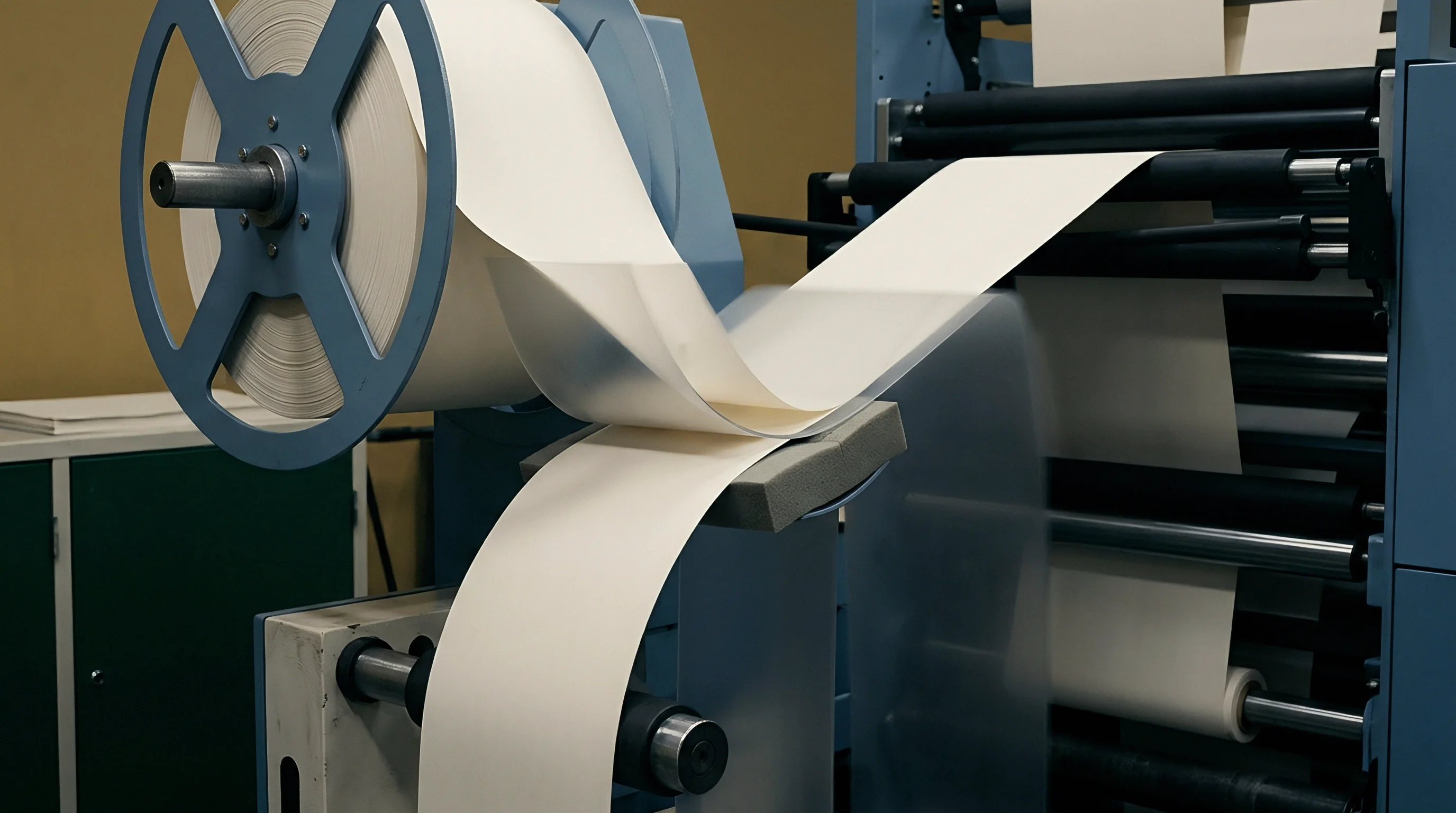
Fiber Shrinkage and Water Elimination Routes
Mass is lost continuously along the forming wire. Water draining through the fabrics carries loose fines, microfibrils, and unbonded mineral fillers into the white water system. Multi-fourdrinier and twin-wire formers retain ninety-five percent of long fibers, but first-pass filler retention drops below seventy percent unless polymer retention aids are added.
Clarification systems process this water through disc filters and dissolved air flotation cells, pumping the recovered fiber sludge back into the middle ply. This closed cycle creates an ongoing split between gross furnish inputs and net reel yield.
- First pass retention drop reduces the solid fraction retained on the wire, washing mechanical fines into the saveall circuit prior to redistribution.
- Thermal volatilization losses drive low-molecular-weight organic binders, dispersants, and pulp extractives into dryer exhaust hoods at temperatures exceeding one hundred degrees Celsius.
- Soluble starch migration draws applied surface starch deep into the void volume of the middle ply, altering targeted dry pick resistance across the board’s caliper.
- Mineral ash drainage settles pigment fines into sludge cakes that escape the finished board web entirely.
The conversion factor measures how efficiently raw input mass is converted into saleable finished reels. On machines running multiple grades during a single campaign, fiber losses fluctuate. Mechanical core fibers yield water quickly in the press nips, whereas chemical liner plies retain moisture through hydrogen bonding.
Wet pressing and steam drying extract this water unevenly across plies, while machine-direction and cross-direction shrinkage reduces the final dry web width relative to the wet wire.
Tonnage gaps between furnish inputs and pallet tallies are often written off on the assumption that internal broke loops balance out over quarterly accounting periods.


Furnish

Oven-Dry Calculations and Commercial Moisture Allowances
Commercial pulp contracts trade on an air-dry basis, set by international convention at ninety percent bone-dry fiber and ten percent moisture. Receiving docks weigh bales with varying moisture content ~ often between eight and thirteen percent depending on shipping conditions. Entering incoming bales directly at scale weight without correcting for moisture introduces systemic error into the conversion factor denominator.
Proper technical qualification relies on gravimetric testing under ISO 638, where core samples dry at one hundred and five degrees Celsius to constant mass. Converting raw input mass to bone-dry figures sets the actual baseline for certified input accounting.
Coating slips introduce inorganic minerals that distort furnish totals. A double-coated board specifying twenty-two grams per square meter of pigment per side adds substantial weight without contributing any wood fiber. Cold water extraction under EN 645 and hot water extraction under EN 647 isolate chemical additives from fibers, while ISO 1762 ash testing at five hundred and twenty-five degrees Celsius establishes the exact inorganic mass.
Because mineral pigments cannot count as certified wood input under chain-of-custody rules, ledgers must separate fibrous yield from coating slurry to keep non-wood material from generating phantom fiber credits.
Paperboard surfaces receive coatings that add inorganic mass without contributing certified fiber units.
Basis weight variations across the deckle alter local conversion factors. On multi-ply lines running at four hundred meters per minute, stock distribution across the manifold causes noticeable grammage shifts. Scanning continuous mass profiles with beta-ray absorption gauges and infrared moisture sensors highlights these localized mass deviations, which ultimately skew full material balances once edge trims are cut at the winder.
| Board Ply Stratum | Raw Furnish Pulp Type | Air-Dry Weight Share | First-Pass Retention Rate | Net Converted Yield |
|---|---|---|---|---|
| Top Liner (Coated) | Bleached Hardwood/Softwood Kraft | 22 % | 92.4 % | 86.8 % |
| Middle Core (Bulk) | Bleached Chemi-Thermomechanical | 54 % | 87.1 % | 81.4 % |
| Bottom Liner (Reverse) | Bleached Softwood Kraft | 14 % | 94.2 % | 89.1 % |
| Mineral Coating Formulations | Ground Calcium Carbonate and Kaolin | 10 % | 68.5 % | 65.2 % |
BCTMP provides high bulk and bending stiffness, but it suffers higher washing and refining losses than chemical kraft. Heat softens the lignin retained in its mechanical matrix, and high-consistency refining breaks off fine fiber fragments. From raw wood, mechanical pulping yields eighty-five to ninety percent compared to just forty-five to fifty-two percent for chemical pulping.
Once inside the paper machine loop, however, that dynamic flips: chemical kraft fibers retain structural integrity and web cohesion better, generating far less broke during forming than delicate mechanical cores.
Virgin pulps with higher freeness ratings drain rapidly, washing fine fibers straight into the wire pit.


Yield

Derivation of Conversion Factor Equations
The conversion factor expresses the ratio of net certified product output to gross certified raw material input. Defining system boundaries clearly is critical here: calculations must account for pulp bales, internal dry broke returns, chemical binders, clays, slitter edge shavings, and finishing roll wrapper waste. The baseline formula divides Net Certified Finished Product Mass by Gross Certified Raw Material Input Mass.
A factor of 0.88 means one metric ton of purchased pulp yields eight hundred and eighty kilograms of finished board, with the rest lost to moisture adjustments, effluent fiber, and trimmed edge rejects.
Multi-ply mills cannot use a single conversion factor across an entire product line. A three-hundred-gram boxboard with a sixty percent BCTMP core behaves very differently from a two-hundred-gram grade built on a heavy chemical kraft shell. Thick core grades absorb higher broke fractions, driving up internal recirculation and processing cycles.
Technical ledgers handle this by grouping campaigns into narrow basis-weight brackets and recalculating conversion factors across seventy-two-hour production windows.

Can Broke Recirculation Skew Claim Allocation?
Internal recirculation causes major ledger distortions whenever non-certified broke blends into certified production runs. Pulpers re-pulp edge trims from prior runs, mixing uncertified fibers into certified stock chests. Crediting this broke as virgin input invalidates the conversion calculation.
Chain-of-custody audits demand clear separation: broke from certified runs may count toward output mass, but broke from uncertified or mixed runs must be treated as non-qualifying material or neutral filler.
Input claims on mixed board machines rely on strict physical segregation of recycled dry broke.
Physical balances reconcile through mass ledger auditing steps:
- Weighing total air-dry bales loaded into pulping vats across the production run window.
- Adjusting bale mass to absolute bone-dry metric tons using gravimetric moisture test results.
- Deducting non-fibrous additives, including synthetic sizing agents, wet strength resins, and mineral pigments.
- Measuring wet broke pit volumes and dry broke silo levels at campaign initiation and termination.
- Recording gross master reel mass directly at the dry end weighing platform before slitting.
- Subtracting winder edge trim mass and rewinder reject spools rejected for surface defects.
- Dividing net packaged skid weight by the adjusted dry raw furnish input mass.
Moisture changes further complicate slitting and sheeting balances. Pulp arrives at ten percent moisture, dries down to two percent in the main dryer section, and reabsorbs up to seven percent moisture through coating and calender water boxes. Finishing operations then slit sheets at ambient plant humidity.
Because of these swings, conversion ledgers must track bone-dry mass rather than scale weights; failing to isolate moisture shifts artificially inflates calculated efficiency, building up paper credit balances that disappear during physical inventory audits.
| Production Run Component | Gross Wet Mass (t) | Moisture Basis (%) | Oven-Dry Solids (t) | Allocated Credit (t) |
|---|---|---|---|---|
| Bleached Softwood Kraft Input | 220.00 | 10.2 % | 197.56 | 197.56 |
| Bleached Hardwood Kraft Input | 110.00 | 9.8 % | 99.22 | 99.22 |
| BCTMP Mechanical Pulp Input | 680.00 | 11.5 % | 601.80 | 601.80 |
| Internal Certified Dry Broke Return | 85.00 | 6.5 % | 79.47 | 0.00 |
| Coating Pigments and Latex Binders | 125.00 | 38.0 % | 77.50 | 0.00 |
| Gross Reel Production at Winder | 1,090.00 | 7.2 % | 1,011.52 | 898.58 |
| Trim, Core Slittings, and Off-Cuts | 92.00 | 7.1 % | 85.47 | 0.00 |
| Net Saleable Packaged Board | 998.00 | 7.2 % | 926.14 | 898.58 |
| Campaign Conversion Factor: 0.846 (Calculated as Net Packaged Board Dry Fiber divided by Total Virgin Pulp Dry Solids). | ||||
Failing to subtract non-fibrous coating weight from output figures leads to unbacked sustainability claims on packaging, which triggers automatic decertification during annual audits.

Allocation
Credit Account Mechanics and Claim Administration
Chain-of-custody standards such as FSC-STD-40-004 and PEFC ST 2002 allow mills to run mass balance credit accounts. Because of storage constraints, multi-ply machines often process certified and non-certified fiber together. The ledger tracks eligible inputs, applies the conversion factor, and lets the mill assign accumulated credits to outgoing invoices.
For instance, buying one thousand metric tons of certified pulp at a conversion factor of 0.85 yields eight hundred and fifty metric tons of credit board. Even though physical pallets contain mixed fiber, the accompanying documentation carries the certified claim legally.
Input groups set strict boundaries for this accounting. Mills cannot combine chemical softwood pulp with recycled post-consumer waste in one credit group unless the end-product specification explicitly allows both. Dedicated groups separate virgin and recycled grades on multi-ply lines.
Trying to balance high-yield BCTMP inputs against recycled chipboard outputs corrupts credit pools. Sales claims remain valid only when credit debits match the precise conversion math for that specific run.

Is Continuous Web Allocation Legally Defensible?
Regulators increasingly scrutinize how credits are assigned across lines, questioning whether volume credits generated on an unprinted board machine can attach to high-end cartons converted elsewhere. Credit accounts operate strictly as volume banks: ledger credits remain valid for twelve months from manufacturing before expiring permanently. Deficit accounting is prohibited, meaning outgoing certified shipments can never draw against expected future pulp deliveries.
Credit accounts require immediate debiting upon invoice generation to preserve physical ledger balance integrity.
European market regulations, particularly the Packaging and Packaging Waste Regulation (PPWR) and the Green Claims Directive, enforce strict qualification gates for credit transfers:
- Documentary trace matching aligns incoming pulp bill of lading metrics directly with electronic registry volume deductions.
- Batch integrity confirmation prevents crediting virgin mechanical pulp production toward chemical liner export claims.
- Chemical coating exclusions mandate subtracting synthetic resins and minerals from total mass declarations before calculating recycled or certified percentages.
- Regional mass pool isolation stops mills from offsetting fiber deficits in domestic facilities using surplus credits generated by subsidiary mills across borders.
| Regulatory Mechanism | Applicable Metric Boundary | Credit Expiration Horizon | Primary Failure Mode |
|---|---|---|---|
| FSC-STD-40-004 V3-1 | Fiber mass only, excluding coatings | 12 rolling months | Deficit banking against future input orders |
| PEFC ST 2002:2020 | Dry solids mass balance calculation | 12 rolling months | Cross-site credit transfers between legal entities |
| EU PPWR Recycled Content | Post-consumer waste allocation | Per production campaign | Dilution of post-consumer claims with pre-consumer broke |
| Green Claims Directive | Substantiated lifecycle inventory | Batch-specific validation | Averaging conversion factors across distinct machines |
Supply agreements for high-speed cartoning lines routinely enforce strict documentary rules. Paragraph 14 of the standard European Paper Packaging Master Agreement requires annual third-party audit of conversion factors, automatically voiding credit claims whenever actual scrap exceeds baseline allowances by more than three percentage points.


Balance

Audit Reconciliation and Border Vulnerability
Physical inventory balancing operates across three distinct operational layers. Warehouse floor stock counts verify the physical presence of finished board rolls. Production logbooks tally total gross metric tons sliced at the cutters.
The digital mass balance ledger records credited inputs, calculated conversion deductions, and outgoing claim assignments. Reconciling these three layers reveals latent operational slippage. When the physical reel weight in the warehouse exceeds the ledger’s remaining balance, uncredited production has entered the stream.
Conversely, when the credit ledger displays a surplus while the raw materials warehouse sits empty, the mill has operated under an inflated conversion factor.
As conversion factors drop, yield losses compound across plies. Fiber fines wash through the wire, coating slips add uncredited mineral weight, and wet broke goes unmeasured. When moisture shifts distort dry weight, starch migration skews the ratio, and machine shrinkage alters yardage, operating margins vanish.
Auditors insist on bone-dry accounting, credit balances expire on rolling annual schedules, and liability falls squarely on the invoice when customs rejects an unsupported entry.
Customs officials verifying packaging waste obligations examine material origin documents at ports of arrival. A declaration asserting eighty-five percent certified sustainable forest content or specific post-consumer recycled inclusion must show alignment with mill-side mass balance books. Under European Union Deforestation Regulation (EUDR) enforcement, mass balance credit dilution cannot obscure raw material provenance.
Importers of record bear ultimate legal liability for incorrect claim percentages printed on secondary cartons. Penalties extend past administrative fines to complete shipment rejection and mandatory destruction of finished packaging lots at customs border control posts.
Physical multi-ply sheet production leaves unresolved whether individual plies require separate conversion factors when middle mechanical layers experience radically different waste rates than virgin chemical liners.