Predicting High Speed Packaging Panel Bulge through Multi Ply Ultrasonic Wave Dispersion Modeling
Predicting package panel bulge demands measuring multi-ply out-of-plane shear stiffness C44 via ultrasonic wave dispersion to prevent high-speed line failures.


Echo
Acoustic wave propagation through paperboard thickness provides non-destructive measurements of out-of-plane mechanical constants that traditional tensile testing misses. High-speed cartoning machines subject paperboard side panels to severe dynamic pressures during dry powder, liquid, or granular filling operations. When speeds exceed 300 cartons per minute, transient fluid and bulk forces push side panels outward, causing permanent geometric deformation known as panel bulge.
Standard quality control still relies on static bending stiffness measured under ISO 2493 or TAPPI T 556, which treats paperboard as a homogeneous isotropic sheet and ignores the three-dimensional elastic tensor variations inherent to multi-ply constructions.
Predicting dynamic panel bulge demands full characterization of the nine independent elastic constants that govern orthotropic solid media. Out-of-plane longitudinal stiffness, designated as the C33 component of the stiffness tensor, directly resists thickness compaction, while out-of-plane shear moduli C44 and C55 govern transverse shear slip between individual fiber layers during bending. Non-contact or immersion ultrasonic testing measures sound velocity across the board caliper to determine these out-of-plane elastic constants without destroying the sample.

Out-of-Plane Stiffness Matrix Determination
Direct wave transmission through paperboard caliper uses high-frequency longitudinal transducers operating between 1 MHz and 5 MHz. The fundamental relationship between ultrasonic wave speed and elastic stiffness depends on board apparent density, measured under ISO 534 conditioning. Wave speed varies with pulp orientation; longitudinal velocity Vp propagating through board thickness across caliper thickness d and transit time t defines the out-of-plane modulus C33 through the governing wave equation:
C33 = density multiplied by the square of Vp
Shear wave transducers transmitting polarized shear waves across the thickness yield velocities Vs13 and Vs23, supplying shear moduli C44 and C55 for shear deformation in the machine direction and cross direction planes, respectively. Low out-of-plane shear stiffness allows internal fiber plies to slide past each other when side panels flex under fill loads, reducing effective flexural rigidity by up to thirty percent compared to pure Euler-Bernoulli beam predictions.
An out-of-plane longitudinal stiffness C33 below 1.45 GPa measured at 23 °C and 50 percent relative humidity under TAPPI T 541 conditions correlates directly with structural panel cleavage during rapid creasing.
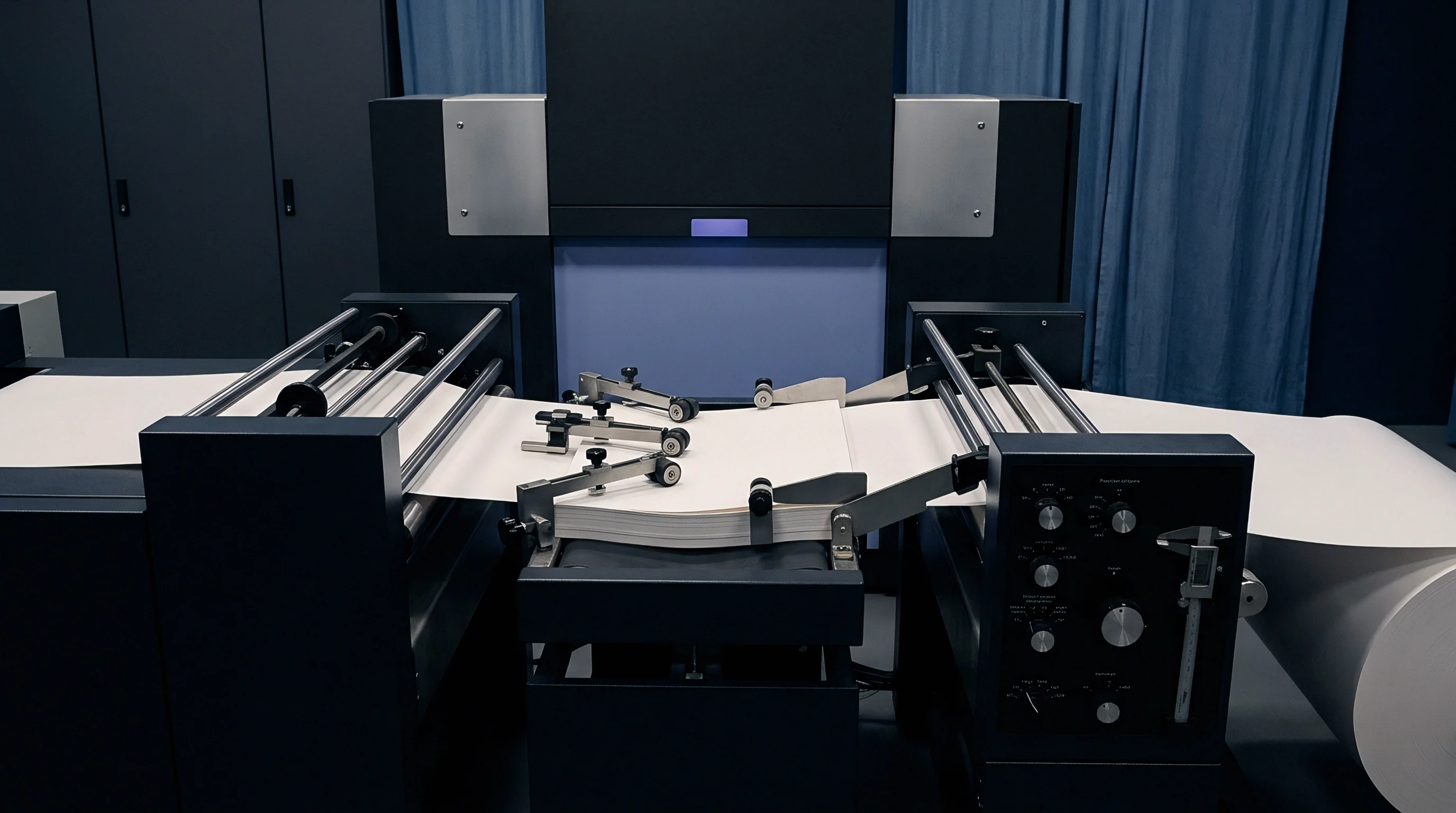
Ultrasonic Time-of-Flight Transducer Configuration
Contact ultrasonic testing on porous paperboard introduces measurement errors because physical coupling pressure alters local sheet thickness. Dry-coupled piezoelectric transducers with controlled clamping forces eliminate fluid absorption while maintaining signal transfer. Evaluating frequency-dependent phase velocity shifts through wave dispersion analysis isolates individual ply contributions, though high-frequency acoustic signals decay rapidly in porous mechanical pulp cores and require broad-bandwidth excitation pulses to maintain acceptable signal-to-noise ratios.
Measuring ultrasonic propagation across paperboard reveals dynamic failure modes that occur under packaging line stresses:
- Inter-Ply Shear Lamination Slip occurs when out-of-plane shear stiffness C44 drops below 0.18 GPa, permitting core fiber detachment under fluid impact loads.
- Caliper Compression Collapse manifests when C33 falls below threshold values, causing local panel crushing beneath guide rails during high-speed transfer.
- Cross-Direction Crease Yielding happens when out-of-plane elastic asymmetry accelerates localized panel bulging along score lines.
- Transient Viscoelastic Hydro-Bulge arises from low out-of-plane stiffness combined with moisture absorption, permanently distorting package geometry within seconds of filling.
Ignoring out-of-plane elastic tensor components during substrate selection leads directly to unexpected package bulging on high-speed filling lines, triggering automatic stoppages, jammed cartoning machinery, and batch rejections at the customer facility.


Plies
Multi-ply paperboard structures achieve flexural stiffness by placing high-density, high-modulus chemical pulp on outer surfaces and lower-density mechanical or recycled pulp in the central core. Folding Boxboard (FBB), Solid Bleached Board (SBB), and White Lined Chipboard (WLC) rely on distinct ply arrangements to balance basis weight against panel rigidity. SBB consists entirely of bleached chemical pulp plies, giving it high internal bond strength and uniform density, whereas FBB places bleached chemical pulp top and bottom layers around a thick mechanical pulp core to maximize caliper for a given grammage.
In multi-ply constructions, the ratio of outer layer modulus to core shear modulus determines whether a panel behaves as a monolithic plate or a laminated sandwich structure. A lower core shear modulus permits transverse shear deformation, which degrades the total flexural rigidity D of the composite board. Ultrasonic dispersion modeling isolates the elastic properties of individual plies by analyzing phase velocity variations across a spectrum of acoustic frequencies.

Stratified Core and Surface Fiber Architectures
High-frequency ultrasonic waves penetrate only surface layers, while lower-frequency acoustic waves pass through the total caliper, interacting with inner core plies. By sweeping frequencies from 0.2 MHz to 10 MHz, dispersion models generate a velocity profile through sheet thickness. High core bulk increases board caliper efficiently, but insufficient core refining lowers out-of-plane shear moduli C44 and C55, showing up as a low ultrasonic velocity trough in acoustic dispersion profiles.
Top layer chemical fibers undergo extensive refining to raise tensile modulus and surface smoothness. Core mechanical fibers retain lignin, providing high bulk but lower intrinsic bonding capability. When side panels experience bending during product filling, maximum normal stresses occur in outer plies while maximum shear stresses concentrate in the core center.
Core shear failure allows outer layers to buckle independently, resulting in severe panel bulge.
| Board Grade Type | Grammage (g/m²) | Caliper (µm) | Bulk (cm³/g) | Top Ply Tensile Modulus E11 (GPa) | Core Shear Velocity Vs13 (m/s) | Out-of-Plane Shear Modulus C44 (GPa) |
|---|---|---|---|---|---|---|
| Solid Bleached Board (SBB) | 300 | 380 | 1.27 | 8.5 | 620 | 0.38 |
| Folding Boxboard (FBB) | 300 | 460 | 1.53 | 6.2 | 410 | 0.21 |
| White Lined Chipboard (WLC) | 350 | 490 | 1.40 | 4.8 | 330 | 0.14 |
| Coated Unbleached Kraft (CUK) | 330 | 420 | 1.27 | 9.1 | 580 | 0.34 |
| Testing conducted per ISO 534 for caliper and bulk. Ultrasonic wave speeds measured using 1 MHz dry-coupled transducers under ISO 187 atmospheric conditioning. | ||||||

Z-Direction Modulus Variations across Grade Types
Recycled fibers in White Lined Chipboard contain short, hornified wood fibers with reduced inter-fiber bonding potential. Ultrasonic phase velocity through WLC core layers drops significantly compared to virgin fiber cores, reflecting reduced Z-direction stiffness and decreased resistance to shear slip. When a packaging line fills cartons with heavy powder, WLC side panels experience greater panel bulge than FBB panels of equal bending stiffness due to this low core shear performance.
Substituting a virgin mechanical core FBB with a recycled core WLC without accounting for out-of-plane shear modulus reductions inevitably leads to package wall deformation. The two grades are often treated as functionally equivalent based on identical classical bending stiffness figures (ISO 2493), but bending resistance alone does not guarantee side panel performance because it overlooks the transverse shear slip that occurs in lower-density recycled cores under dynamic filling forces.

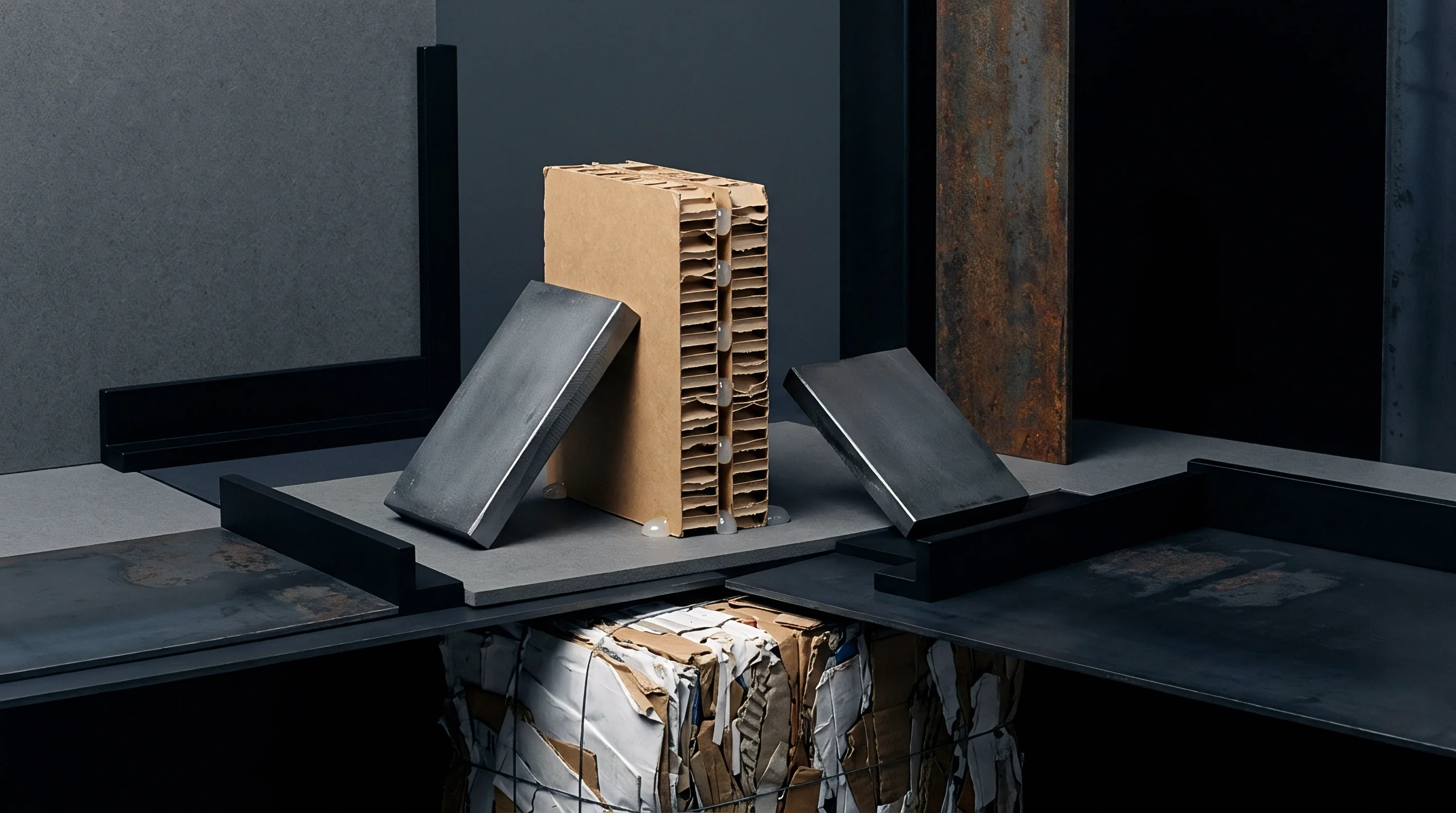
Hygral
Moisture absorption destabilizes the internal fiber network, severely reducing elastic moduli across all three principal directions. Paperboard stored in unconditioned environments absorbs ambient water vapor, causing fiber swell and hydrogen bond softening. The out-of-plane moduli C33, C44, and C55 experience greater relative degradation from moisture ingress than in-plane elastic constants.
Moisture gradients through sheet caliper create internal stress distributions that exacerbate panel distortion during high-speed filling.
As relative humidity increases from 50 percent to 80 percent, out-of-plane shear stiffness C44 can fall by more than forty percent. Moisture softens middle plies first when moisture enters along cut carton edges or unsealed seams.
Compliance with ISO 187 conditioning mandates standard atmosphere testing to prevent environmental humidity drift from masking a ten percent reduction in shear modulus.

How Does Ultrasonic Dispersion Isolate Z-Direction Ply Weakness?
Acoustic wave velocity decreases proportionally with moisture uptake due to mass loading and fiber bond attenuation. High-frequency ultrasonic dispersion waves pass through individual plies, sensitive to localized moisture concentrations. Higher attenuation and reduced phase velocity in specific frequency bands pinpoint softening in mechanical core layers before visual panel bulge occurs on the packing line.
Evaluating acoustic attenuation spectra across a range of 0.5 MHz to 3 MHz detects localized Z-direction weakening as humidity rises, with lower sonic frequency modes penetrating the core layer directly to measure reductions in core shear modulus C44 caused by water vapor uptake along packaging edges.
Moisture Absorption and Transient Internal Stresses
Quality teams must follow a precise qualification procedure when evaluating board resistance to moisture-induced panel bulge:
- Condition paperboard samples at 23 °C and 50 percent relative humidity for 24 hours in compliance with ISO 187.
- Measure baseline thickness using ISO 534 micrometer methods and baseline out-of-plane sound velocities using 1 MHz ultrasonic transducers.
- Transfer samples to an environmental chamber maintained at 85 percent relative humidity for a duration of 12 hours.
- Re-measure ultrasonic phase velocities across the 0.2 MHz to 5 MHz dispersion spectrum to identify core stiffness loss.
- Mount conditioned samples in a pressure-cell fixture simulating hydrostatic filling loads of 1.5 kPa and record panel bulge deflection after 60 seconds.
As a standard rule of thumb for packaging converters, paperboard exposed to ambient environments above 70 percent relative humidity requires an initial out-of-plane shear modulus at least twenty-five percent above dry production targets to prevent visible panel bulge during filling operations.


Modeling
Guided acoustic wave dispersion modeling calculates the propagation of Lamb waves and Shear Horizontal (SH) waves through multi-ply paperboard structures. Guided waves propagate along the sheet plane, but their velocity dispersion depends on thickness-direction elastic properties and multi-layer boundary conditions. Solving the Rayleigh-Lamb frequency equations for multi-layered orthotropic media maps acoustic phase velocity against the product of frequency and sheet thickness.
Reconstructing the full elastic tensor requires inversion of phase velocity dispersion curves obtained from non-destructive ultrasonic sweeps.
A multi-ply board consisting of N discrete layers possesses layer-specific density, thickness, and elastic stiffness components. Phase velocity dispersion modeling treats each ply as an orthotropic layer with interface continuity conditions requiring equal stress and displacement vectors across ply boundaries.
Higher phase velocity dispersion in the fundamental symmetric wave mode indicates superior structural integrity across inner ply boundaries.

Lamb Wave Dispersion Curve Inversion Mechanics
Acoustic dispersion curves split into symmetric (S) and anti-symmetric (A) wave propagation modes. The fundamental anti-symmetric mode A0 is sensitive to out-of-plane shear stiffness C44 at low frequency-thickness products. The fundamental symmetric mode S0 correlates with in-plane elastic modulus at low frequencies, but couples strongly with out-of-plane longitudinal modulus C33 as frequency increases.
Measuring A0 and S0 phase velocities over a frequency range of 100 kHz to 2 MHz permits mathematical extraction of C33, C44, and C55 using non-linear least-squares optimization algorithms.
The inversion process minimizes the residual error between measured phase velocities and theoretical dispersion curves generated by transfer matrix modeling methods.
| Paperboard Grade | Relative Humidity (%) | Density (kg/m³) | In-Plane C11 (GPa) | In-Plane C22 (GPa) | Out-of-Plane C33 (GPa) | Shear Modulus C44 (GPa) | A0 Mode Velocity at 500 kHz (m/s) |
|---|---|---|---|---|---|---|---|
| Virgin FBB | 50 | 680 | 7.8 | 3.6 | 1.52 | 0.24 | 480 |
| Virgin FBB | 80 | 710 | 5.9 | 2.8 | 1.15 | 0.15 | 390 |
| Recycled WLC | 50 | 710 | 5.2 | 2.4 | 1.28 | 0.16 | 370 |
| Recycled WLC | 80 | 740 | 3.8 | 1.8 | 0.88 | 0.09 | 280 |

Numerical Calculation of Orthotropic Elastic Constants
Consider a 350 g/m² Folding Boxboard with a total caliper d of 480 µm and an apparent density of 729 kg/m³. Ultrasonic phase velocity measurements yield an out-of-plane longitudinal wave speed Vp of 1450 m/s and an out-of-plane shear wave speed Vs13 of 550 m/s in the machine direction. Out-of-plane longitudinal stiffness C33 is derived directly:
C33 = 729 kg/m³ multiplied by (1450 m/s)² = 1.532 GPa
Out-of-plane shear modulus C44 is computed similarly:
C44 = 729 kg/m³ multiplied by (550 m/s)² = 0.221 GPa
The flexural rigidity matrix component D11 incorporates in-plane elastic modulus E11, board thickness d, Poisson’s ratios, and transverse shear correction factor k, where k depends on the C44 profile across plies:
D11 = (E11 multiplied by d³) divided by 12, adjusted for transverse shear slip through the shear correction factor factor k = 1 divided by (1 + (12 multiplied by D11) divided by (k_shape multiplied by C44 multiplied by d))
When out-of-plane shear modulus C44 drops from 0.221 GPa to 0.110 GPa due to core recycling or moisture absorption, the effective flexural stiffness D11_eff degrades by twenty-two percent without any change in sheet caliper or in-plane tensile properties. This mathematical reduction proves why classical tensile and bending tests fail to predict panel bulge in lower-grade multiply substrates.
How multi-ply acoustic models account for micro-scale fiber orientation gradients across boundary interfaces remains an active area of investigation in computational mechanics.


Bending
Panel displacement in filled paperboard packages follows non-linear plate deformation theory. When a package is filled rapidly with dry dense powders, liquids, or heavy particulates, internal fluid and granular pressure exerts a hydrostatic load against side walls. The maximum pressure occurs near the package base, producing three-dimensional bulging.
Classical Mindlin-Reissner plate theory accounts for transverse shear deformation, rendering it far more accurate than Kirchhoff plate theory for multi-ply board modeling.
Side panels bounded by creased corner scores act as partially constrained rectangular plates. Crease stiffness dictates boundary rotation angles under load, directly influencing peak bulge magnitude.
Flexural rigidity calculations derived solely from in-plane tensile tests consistently underestimate vertical side panel bulge in tall package geometries.
Plate Deflection under Hydrostatic Powder Filling Loads
Hydrostatic internal pressure distribution P(z) varies linearly from zero at the fill height to maximum value P_max at the carton bottom. Deflection w(x,y) across a panel of width a and height b obeys the governing partial differential equation for shear-deformable orthotropic plates:
D11 (d4w/dx4) + 2 (D12 + 2 D66) (d4w/dx2dy2) + D22 (d4w/dy4) = P(z) – transverse shear correction terms
Transverse shear deformation terms depend directly on C44 and C55 moduli. Low core shear stiffness increases center panel deflection w_max significantly beyond classical thin-plate calculations.
| Board Substrate Grade | Panel Height b (mm) | Panel Width a (mm) | Classical Thin-Plate Bulge Model (mm) | Ultrasonic Dispersion Shear Model (mm) | Converter Floor Measured Bulge (mm) |
|---|---|---|---|---|---|
| SBB 300 g/m² | 200 | 100 | 1.82 | 2.14 | 2.18 |
| FBB 300 g/m² | 200 | 100 | 1.64 | 2.35 | 2.41 |
| WLC 350 g/m² | 200 | 100 | 2.10 | 3.48 | 3.55 |
| FBB 350 g/m² | 250 | 120 | 2.85 | 4.12 | 4.20 |

Post-Fill Creep and Viscoelastic Bulge Progression
Panel bulge expands over time due to viscoelastic creep in the cellulose fiber matrix. After immediate elastic deformation upon filling, side panels continue outwards under sustained internal load. Creep rates accelerate under elevated humidity.
Ultrasonic stiffness values measured at high frequencies provide elastic modulus parameters, which must be scaled using time-temperature-humidity superposition principles to model long-term storage panel bulge over weeks of warehouse stacking.
Material specifications must address both elastic and viscoelastic parameters:
- Out-of-Plane Shear Threshold requires core C44 modulus above 0.20 GPa to limit instant filling deformation.
- Hydro-Expansion Coefficient Limit demands cross-direction expansion below 0.15 percent per percent change in moisture content.
- Internal Bond Resistance specifies Z-direction tensile strength above 350 kPa under TAPPI T 541 conditions.
- Crease Stiffness Retention dictates score line rotational resistance between 1.5 and 2.5 times uncreased board flexural stiffness.
Under formal packaging supply agreements, board lots failing to meet minimum C44 shear stiffness thresholds specified in the quality annex face immediate rejection at goods-in inspection, with costs borne entirely by the board mill.


Yield
Substrate selection balances structural rigidity against board yield per metric tonne. Tonnage prices favor lower-grammage, higher-bulk boards such as Folding Boxboard over Solid Bleached Board. Downgauging grammage while relying on mechanical cores maintains total sheet thickness, but reduces out-of-plane shear stiffness C44.
When high-speed packaging lines experience panel bulge on downgauged FBB, production line efficiency drops, creating costly waste and downtime that negates material cost savings.
Assessing yield purely through caliper and grammage metrics overlooks the operational costs of converter line stoppages. Ultrasonic dispersion testing gives purchasing teams an effective screening protocol to qualify lower-cost board options without risking side panel structural failure.

Commercial Board Specifications and Quality Audits
Mill specification sheets typically report grammage, ISO caliper, Taber or L&W bending stiffness, and Cobb water absorption values. They omit out-of-plane elastic tensor metrics such as C33 and C44. Packaging engineers sourcing board for high-speed powder or liquid filling lines must require mills to include out-of-plane sonic velocities or derived C44 shear moduli in official Mill Test Reports (MTR).
Receiving pallets audited with handheld ultrasonic pitch-catch transducers can verify out-of-plane stiffness compliance in under two minutes per pallet before board enters press rooms.
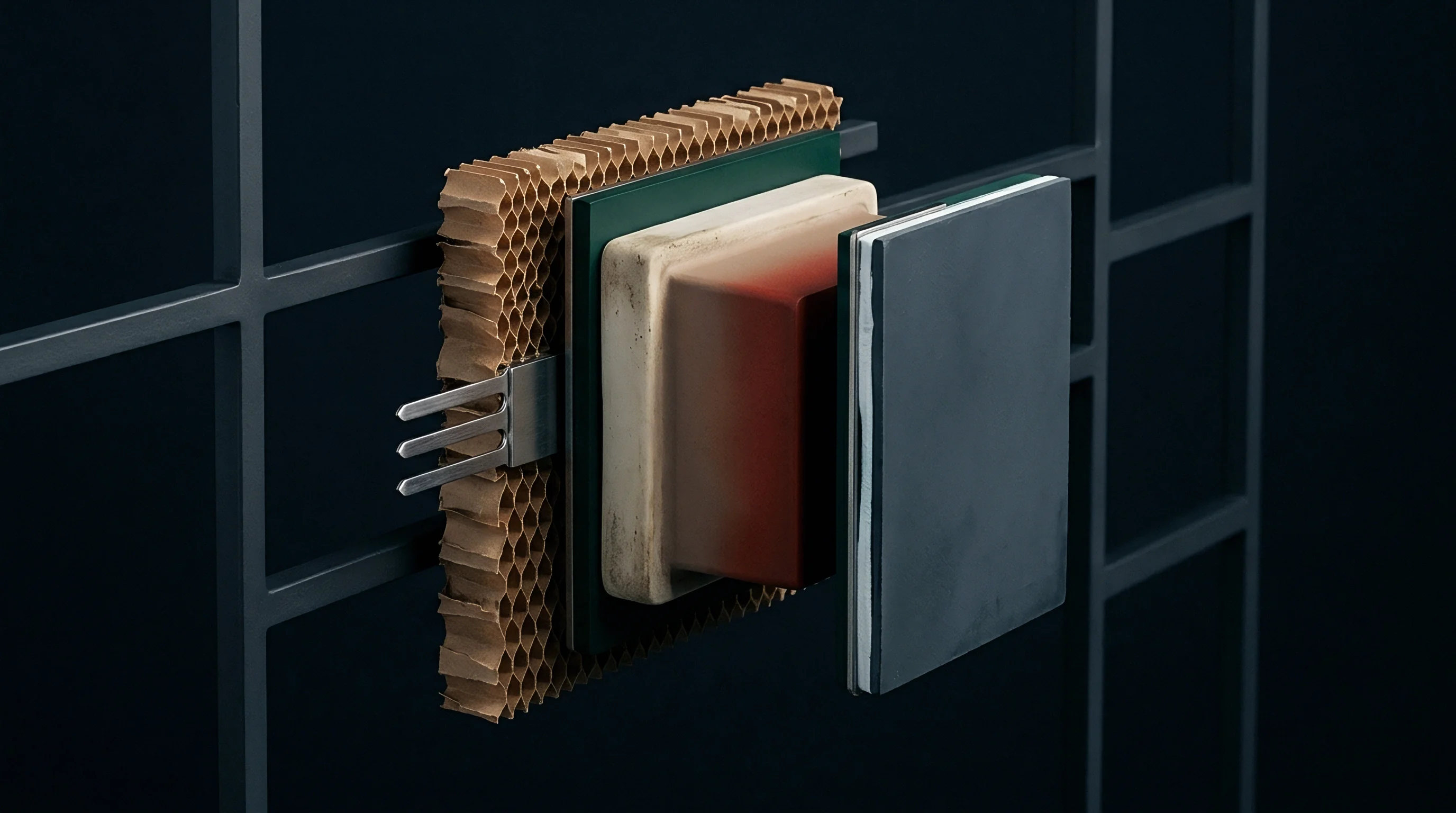
Economic Impact of Downgauging Virgin Core Grades
Consider an order of 100,000 packaging units produced from 350 g/m² FBB costing 1,450 EUR per metric tonne. A proposed cost-saving move downgauges stock to a 320 g/m² high-bulk FBB costing 1,520 EUR per tonne, promising an eight percent yield increase in square meters per tonne. The lower grammage stock maintains identical caliper d through higher mechanical core bulk, but exhibits a thirty percent drop in out-of-plane shear modulus C44 due to reduced core refining.
On high-speed cartoning machinery operating at 320 cartons per minute, the lower C44 modulus causes side panel bulge exceeding maximum allowable tolerances of 2.5 mm. Automated vision inspection systems reject 4.2 percent of filled cartons due to panel distortion. Material savings from downgauging generate 3,800 EUR in raw board purchase reductions per 100,000 units.
Spoilage costs, re-packing labor, line downtime, and waste disposal total 8,400 EUR per 100,000 units, producing a net financial loss of 4,600 EUR per run.
Substrate substitution executed without validating out-of-plane shear constants degrades converting headroom and turns theoretical yield gains into real operational losses at the packaging plant.