Standard Laboratory Conditioning versus Unheated Warehouse Storage for Coated Folding Boxboard Stock
Unheated warehouse storage alters boxboard moisture equilibrium, inducing wavy edges and core bond loss; thermal acclimation before press release prevents spoilage.
Equilibrium
Coated folding boxboard exits the paper machine at a target internal moisture balance between 6.0 percent and 7.5 percent wet basis. At 23 degrees Celsius, this moisture level is in thermodynamic equilibrium with an atmospheric relative humidity of 45 percent to 50 percent. Commercial boxboard grades like GC1 and GC2 use an asymmetric multi-ply structure: fully bleached chemical kraft pulp forms the outer layers for tensile strength and print smoothness, while a chemi-thermomechanical pulp core provides bulk and bending stiffness per unit weight.
A double or triple pigment coating of calcium carbonate, kaolin clay, and latex binders seals the top liner. Inside this sheet, water moves through vapor diffusion across the coating and capillary condensation within the porous mechanical core. When raw pallets are exposed to changing ambient conditions, the hygroscopic cellulose fibres exchange moisture with the surrounding air to match chemical potential, disrupting the balance achieved during manufacture.
Thermodynamics of Sorption Isotherms in Multi-Ply Board
Cellulose fibres absorb and desorb water along a sigmoidal hysteresis curve ~ the moisture sorption isotherm. The relationship between relative humidity and equilibrium moisture content in coated boxboard is non-linear. Below 30 percent relative humidity, water molecules bind directly to primary hydroxyl groups on cellulose through hydrogen bonding, creating a monomolecular layer.
Between 30 percent and 70 percent, secondary absorption builds polymolecular layers within amorphous regions of the fibre wall. Above 70 percent, capillary condensation takes over inside the inter-fibre pores of the chemi-thermomechanical core. Because the adsorption and desorption paths differ, a sheet reaching equilibrium from a dry state holds less moisture at 50 percent relative humidity than one arriving from a saturated state.
Consequently, two identical pallets of GC1 board kept in the same room can carry different moisture levels if their storage histories differ.
The z-direction distribution of furnish in folding boxboard complicates moisture kinetics. The chemical pulp top liner, mechanical core, and bleached kraft back liner absorb water at different rates and to different capacities. Bleached softwood kraft absorbs moisture quickly through its open capillary structure, while high-yield mechanical pulp contains hydrophobic lignin that delays initial uptake but swells considerably as moisture builds.
The top coating functions as a partial vapour barrier, so moisture enters an intact ream mostly through unsealed edges. This creates a steep moisture gradient from the outside of the stack inward. In a four-thousand-sheet pallet exposed to high humidity, moisture penetrates twenty to fifty millimetres along the edges within forty-eight hours, causing local swelling while the core of the stack remains at mill moisture.
Standard Laboratory Conditioning Frameworks and Measurements
Testing under ISO 187 and TAPPI T402 requires a controlled atmosphere at 23.0 degrees Celsius plus or minus 1.0 degree Celsius, and 50.0 percent relative humidity plus or minus 2.0 percent relative humidity. Standard conditioning isolates the sheet’s intrinsic mechanical properties by controlling moisture variables. The protocols require pre-conditioning stock in a low-humidity environment ~ 10 percent to 35 percent relative humidity at temperatures under 50 degrees Celsius ~ for at least twenty-four hours.
This forces test samples onto the adsorption side of the hysteresis curve, guaranteeing repeatable baseline data across laboratories. Skipping pre-conditioning can cause measured grammage, thickness, bending resistance, and internal bond strength to vary by up to eight percent, depending on whether the sheet gained or lost moisture to reach equilibrium.
Relative humidity fluctuations of ten percent in testing rooms alter measured Taber stiffness values on folding boxboard stock by up to six percent.
Standard laboratory conditioning provides reliable physical baselines across key board properties. Grammage, determined under ISO 536, requires weighing precision-cut samples once full atmospheric equilibrium is established. Caliper, measured per ISO 534 with a micrometer applying 50 kilopascals of dead-weight load over a two-square-centimetre presser foot, shifts directly with moisture content.
Water absorption swells cell walls perpendicular to the fibre axis, increasing total thickness. Bending resistance, measured under ISO 2493 using two-point or three-point bending instruments like Taber or L&W testers, drops as moisture rises; water plasticizes the amorphous cellulose, softening inter-fibre bonds and lowering the elastic modulus of the outer kraft layers. Internal bond strength, evaluated via Scott Bond testing under TAPPI T569, measures the energy needed to delaminate the core.
Higher moisture content weakens hydrogen bonds between mechanical fibres, reducing Scott Bond readings.
How quickly board reaches moisture equilibrium in a laboratory depends on sheet grammage, stack volume, and surface airflow. Loose, single sheets in circulating air equilibrate within four to six hours. An unopened, sealed ream or pallet takes weeks because moisture movement is confined to edge diffusion.
Unwrapping a cold or warm pallet without prior thermal stabilization generates temperature gradients, causing condensation on cold board or fast edge drying on warm sheets. Laboratory protocols require thermal acclimation before unwrapping, bringing the pallet core within one degree Celsius of room temperature. Testing stock straight from a shipping container bypasses this requirement and produces non-conforming reports that distort true sheet quality.
Whether laboratory conditioning protocols genuinely reflect performance under actual pressroom conditions remains an open analytical question when press halls operate outside standard ISO atmospheric ranges.
Frost
Unheated warehouses expose coated boxboard to severe environmental swings. Temperature ranges from minus fifteen degrees Celsius in winter to plus thirty-five degrees Celsius in summer, combined with relative humidity between thirty percent and ninety-five percent, keep stored pallets in constant physical flux. Unlike climate-controlled facilities, unheated space lets interior water vapour pressure mirror outdoor weather.
Moving cold pallets from an unheated warehouse directly into a heated plant creates an immediate condensation risk along sheet edges. The cold air around the pallet holds little moisture; contacting warm, humid plant air drops local air temperature below its dew point, depositing liquid water onto the exposed sheet edges.

Condensation Kinetics and Stack Moisture Gradients
Edge dampening causes the most immediate damage during unheated winter storage. Water condensed along sheet edges is drawn rapidly into the porous chemi-thermomechanical core through capillary action. Cobb values measured under ISO 535 quantify absorptivity over set times ~ typically sixty seconds for top coatings and three hundred seconds for board backs.
Uncoated raw edges routinely show Cobb values exceeding two hundred grams per square metre per hour. As edge fibres take on water, localized hygroexpansion occurs: individual fibres expand up to fifteen percent in diameter but less than one percent in length. Because fibres align mostly in the machine direction during sheet forming, cross-direction moisture absorption drives pronounced lateral swelling along sheet margins.
Swelling at the sheet perimeter while the core stays dry leads to severe distortion. Wavy edges form when the sheet border expands in length and width while the dry center stays put, forcing surplus edge material into vertical waves. Conversely, when warm, high-moisture pallets sit in a cold, low-humidity warehouse, edge evaporation outpaces core drying.
The perimeter shrinks relative to the center, producing tight edges or dish-shaped curl. These distortions ruin sheet flatness and cause feeding failures on converting lines. High-speed offset presses and die-cutters require flat stock for vacuum pickup and precise registration; wavy or curled sheets jam feeders, trigger optical sensor faults, and throw off registration during multi-pass converting.
Stretch film offers partial protection against humidity changes, but unheated storage eventually compromises its performance. Polyethylene packaging film has a finite water vapour transmission rate. Over thirty days or more, ambient moisture migrates through overlaps, top sheets, and wooden pallet bases.
Temperature shifts in the warehouse drive air movement inside the wrap. As ambient air cools, trapped air inside the packaging cools faster than the dense paperboard core, condensing water onto the inner film surface. This condensation drips onto top sheets or runs down the sides, softening coatings, soaking fibres, and ruining top reams.
| Storage Environment | Storage Duration | Equilibrium Moisture (%) | CD Hygroexpansion (%) | Taber Stiffness Retention (%) | Flatness Status |
|---|---|---|---|---|---|
| Standard ISO 187 (23°C / 50% RH) | 24 Hours | 6.8 | 0.00 | 100.0 | Completely Flat |
| Unheated Winter (-5°C / 85% RH) | 14 Days | 8.9 | 0.35 | 84.2 | Severe Wavy Edges |
| Unheated Summer (32°C / 75% RH) | 14 Days | 8.2 | 0.22 | 89.5 | Moderate Wavy Edges |
| Arid Dry Storage (20°C / 25% RH) | 30 Days | 4.5 | -0.28 | 112.0 | Tight Edges / Up-Curl |
| Dew Point Transition (Condensation) | 2 Hours | 12.5 (Edges) | 0.85 (Edges) | 52.0 (Edges) | Localized Edge Buckling |
Dimensional Instability and Hygroexpansion Mechanics
Hygroexpansion occurs as water molecules push into amorphous regions of cellulose microfibrils, forcing them apart and expanding the fibre structure. The extent of expansion depends on fibre species, refining, and machine orientation. Boxboard typically exhibits a machine-direction to cross-direction bending stiffness ratio of 1.8 to 2.5, and hygroexpansion follows this anisotropy ~ running two to four times higher in the cross direction.
If unheated storage causes average moisture to rise from six percent to nine percent, a 700 mm by 1000 mm sheet expands by roughly 0.5 mm in the machine direction and up to 2.2 mm in the cross direction. That shift far exceeds tolerance for high-definition packaging, where color-to-color alignment must hold within 0.05 mm.
Roll and axis curl reflect structural responses to moisture and thermal gradients through the sheet thickness. Coated boxboard layers are naturally dissimilar: the top side uses synthetic latex binder and mineral pigments that resist moisture, while the back liner exposes moisture-sensitive chemical or mechanical fibres. In humid air, the back liner expands faster than the top coating, curling the sheet toward the coated side (top-curl).
In dry, freezing winter storage, fast drying shrinks the back liner, pulling the sheet into back-curl. Curled board will not lie flat on feed tables, forcing press operators to adjust decurling bars ~ a process that damages core stiffness.
Long-term exposure to cycling temperature and humidity causes permanent dimensional changes. Fibres subjected to repeated swelling and shrinking experience hysteresis fatigue, releasing internal stress within the consolidated network. Micro-compressions set during machine drying relax irreversibly, altering sheet dimensions even if the board is later reconditioned to standard laboratory levels.
Stock stored in unheated warehouses for six months under wide ambient swings will not recover its original caliper or flat geometry, leaving structural distortions that permanently impair converting efficiency.
Pallets stored near cold exterior walls absorb moisture unevenly compared to those in central storage aisles.
Delamination
The structural integrity of coated folding boxboard relies on cohesion between its fibre layers. Bending stiffness ~ the core performance metric of FBB ~ comes from separating high-tensile kraft outer liners with a thick, lightweight mechanical core. Under Euler-Bernoulli beam theory, bending stiffness scales with the third power of caliper for a given elastic modulus.
Maintaining caliper economically requires high core bulk, but mechanical pulp cores have lower internal bond strength than dense chemical layers. Storing board in unheated warehouses weakens this ply bond strength through moisture plasticization and thermal stress, making the sheet prone to delamination during creasing, folding, and gluing.
Lignin Softening and Core Structure Breakdown
Lignin, the natural polymer binding fibres in chemi-thermomechanical pulp, behaves viscoelasticly depending on temperature and moisture. Its glass transition temperature drops as moisture content rises. When dry, lignin stays rigid and supports core bulk.
But at moisture levels above eight percent combined with warm summer temperatures, lignin shifts from a glassy to a rubbery state. This plasticization reduces the elastic modulus of core fibres, lowering Taber and Kenley bending stiffness. When plasticized board runs through high-speed converting lines, the core cannot recover from mechanical deflections, causing permanent matrix collapse and loss of caliper.
Excessive moisture absorption in unheated storage breaks down inter-fibre hydrogen bonding within the core. Water molecules compete with cell-wall hydroxyl groups, substituting fibre-to-water interactions for fibre-to-fibre bonds. In GC2 grades with high mechanical pulp content, this degradation substantially cuts Z-direction tensile strength.
Transferring cold pallets directly to warm converting lines without acclimation triggers internal moisture migration: outer layers warm and dry quickly, driving a vapour pressure gradient that pushes water into the cold core. This trapped moisture weakens the core right as the sheet hits high shear forces in die-cutting presses and folder-gluers.
Evaluating Z-direction bond strength and crease recovery in stored boxboard requires isolating thermal and hygrothermal factors using standardized testing procedures.
- Cut twenty representative board specimens measuring 38 mm by 38 mm from central and edge sheets across the test pallet using a double-blade precision board cutter.
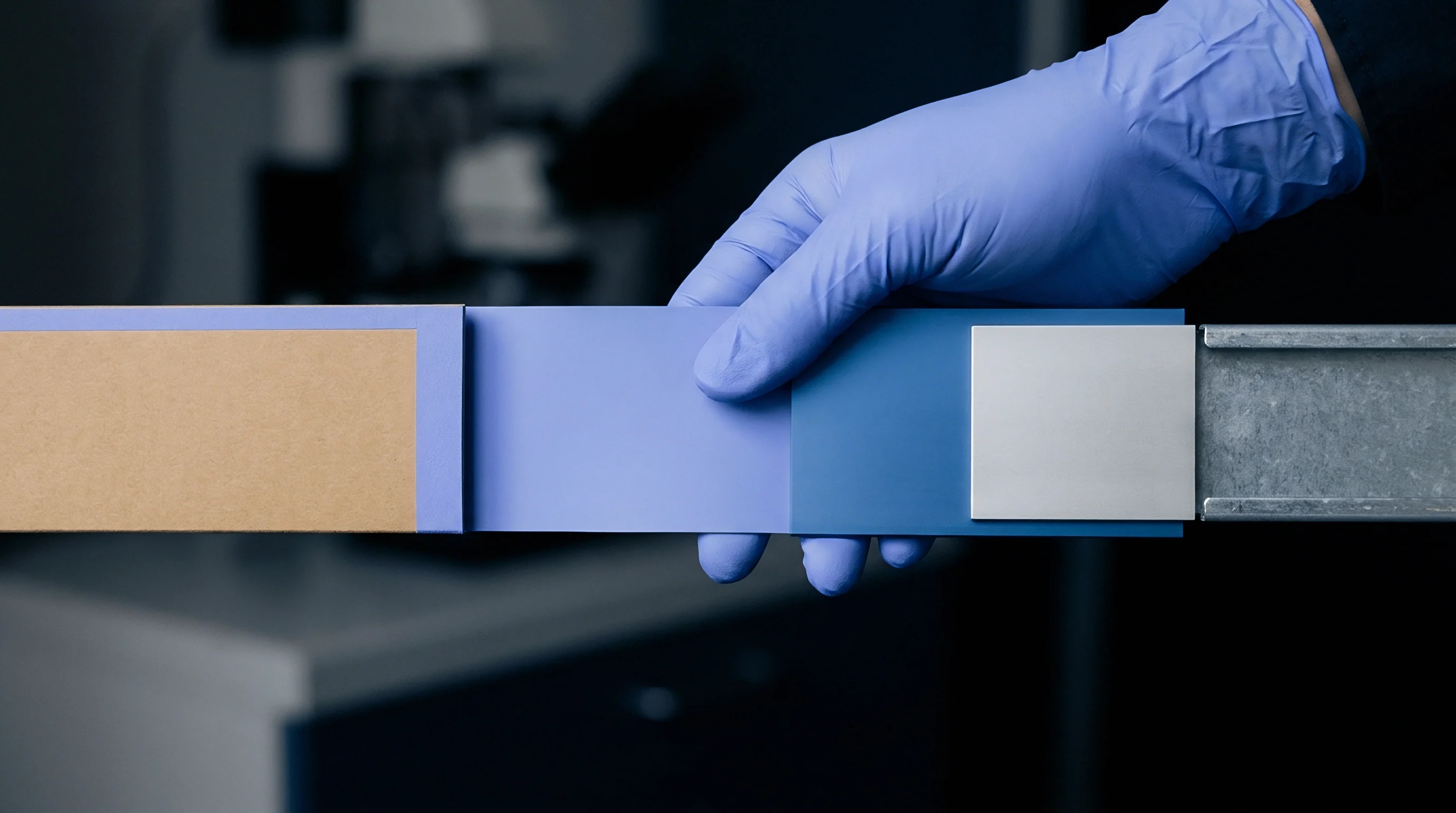
- Mount each specimen between metal testing blocks with double-sided pressure-sensitive adhesive tape, applying a pneumatic clamping force of 0.7 MPa for fifteen seconds to establish full bond contact.
- Insert the mounted assembly into an internal bond strength tester (Scott Bond apparatus) operating under TAPPI T569 parameters, recording the energy required to split the board layers in Joules per square metre.
- Condition half of the remaining cut specimens in an ISO 187 standard atmosphere for forty-eight hours to separate reversible strength recovery from permanent bond loss.
- Measure dynamic creasing resistance under ISO 2493 using a crease test instrument, recording the bending force required to fold the score line ninety degrees at constant angular velocity.
- Calculate the ratio of crease strength to uncreased bending stiffness to determine the residual crease stiffness factor in both machine and cross directions.
Standard ISO 187 conditioning requires twenty-three degrees Celsius and fifty percent relative humidity to achieve steady-state sheet moisture within two-tenths of a percent.
Crease Crack and Liner Splitting Failure Modes
Converting boxboard into cartons depends on controlled deformation along crease lines. During die-cutting, a creasing rule pushes board into a matrix channel, creating an internal delamination zone in the mechanical core while keeping outer kraft liners intact. This controlled split forms a flexible hinge that lets the flange fold ninety or one hundred eighty degrees without cracking the clay coating or tearing the outer liner.
Unconditioned stock disrupts this mechanism. Dry board under five percent moisture lacks fibre elongation; when creased, the stiff top kraft liner fractures, cracking the surface coating along score lines.
Damp board above eight percent moisture fails in the opposite direction. Softened core fibres flex without delaminating cleanly. Instead of forming a defined hinge, the core collapses, producing wide, weak score lines with poor stiffness memory.
On automatic packing lines, weak creases fail to hold shape, causing carton bulge and machine jams. Damp back liners can also split during reverse folding as swollen kraft fibres yield under tension, exposing raw wood fibres, spoiling graphics, and compromising liquid resistance along edges.
Storage-damaged stock also causes gluing failures. High-speed folder-gluers apply vinyl acetate ethylene or water-based dispersion adhesives to carton flaps. Bonding depends on water absorbing from the emulsion into the back liner so polymer molecules can interlock with cellulose fibres.
Damp board already saturated with water slows this absorption, delaying tack and extending open time. Conversely, cold board from winter storage chills hot-melt adhesives instantly, solidifying the adhesive before it penetrates the sheet surface and creating weak bonds that can pop open during transit.
When score lines crack on coated board, claims quickly turn to substrate specifications and historical conditioning logs.

Registration
Print accuracy and converting precision require consistent sheet dimensions through press grippers. High-speed offset presses apply ink across four to eight stations in milliseconds, with inter-unit registration tolerances measured in hundredths of a millimetre. Unconditioned stock from unheated storage introduces moisture variations that throw off registration, cause blanket wraps, and trigger double-sheet trips.
Thermal expansion adds another variable: paperboard expands with rising temperatures independent of moisture, changing sheet dimensions during multi-pass operations.
Does Storage Relative Humidity Alter Creasing Matrix Selection?
Moisture shifts force press operators to adjust creasing matrix channels to avoid score cracking or loose hinges. When boxboard absorbs moisture in a humid warehouse, caliper increases. A sheet designed for 450 micrometres caliper at standard moisture expands to 480 micrometres at eight percent moisture.
Dies set up for normal caliper crush this swollen board inside the channel, destroying the core and fracturing the coating. Converting plants must either re-tool with wider matrix channels or stop production until the stock acclimates back to target caliper.
Matrix depth and channel width follow strict geometric rules based on board caliper and score direction. Machine-direction scores cut across fewer continuous fibres and need narrower channels, whereas cross-direction scores require wider channels to accommodate swollen fibres. Sizing channels on assumed nominal caliper rather than actual measured thickness causes scoring failure on high-speed folder-gluers.
| Nominal Board Caliper (µm) | Actual Storage Caliper (µm) | Stock Moisture State (%) | Matrix Channel Depth (mm) | Matrix Channel Width: CD (mm) | Matrix Channel Width: MD (mm) |
|---|---|---|---|---|---|
| 350 | 350 | 6.5 (Standard ISO 187) | 0.50 | 1.20 | 1.00 |
| 350 | 372 | 8.8 (High Humidity Storage) | 0.55 | 1.35 | 1.15 |
| 450 | 450 | 6.5 (Standard ISO 187) | 0.60 | 1.50 | 1.30 |
| 450 | 482 | 9.1 (High Humidity Storage) | 0.70 | 1.70 | 1.45 |
| 600 | 600 | 6.5 (Standard ISO 187) | 0.80 | 2.00 | 1.75 |
| 600 | 638 | 8.7 (High Humidity Storage) | 0.90 | 2.25 | 1.95 |
Converting Failure Modes under Dynamic Press Conditions
High-speed converting magnifies minor material variations into major press downtime. Unconditioned stock from unheated storage shows distinct failure patterns across feeding, ink transfer, drying, and die-cutting.
- Feed-Table Mis-Pick occurs when wavy edges or curl prevent vacuum suckers from sealing against the rear of the sheet stack, causing double-feeds or press trips.
- Color-to-Color Misregistration develops as sheets absorb water from offset dampening units, expanding in the cross direction by up to two millimetres between the first and sixth printing units.
- Blanket Piling and Delamination happens when low Z-direction bond strength in cold, damp board lets tacky inks pick fibres or coating off the top liner, fouling blankets and plates.
- UV Coating Blistering occurs during UV or water-based varnish curing when trapped internal moisture flashes to steam, causing surface bubbles and delamination.
- Matrix Crushing and Cut-Flush Error takes place in die-cutting as swollen board compresses unevenly, driving blank dimensions outside specified structural tolerances.
- Flange Skewing on Folder-Gluers stems from unequal crease resistance along machine and cross-direction score lines on damp board, preventing flaps from squaring accurately at operational speeds.
Standard commercial purchase contracts state that mill caliper warranties apply strictly to board tested under ISO 187 standard atmosphere at twenty-three degrees Celsius and fifty percent relative humidity.
Static electricity creates severe operational problems during freezing weather. Cold winter air holds little moisture, and unheated warehouses frequently drop below twenty-five percent relative humidity. Dry boxboard loses surface conductivity, generating heavy static charges during slitting, unwinding, and sheet feeding.
Electrostatic attraction causes sheets to stick together, causing double-sheet feeds or preventing clean delivery stacking. High static charges also pull dust onto the coated surface, producing hickey defects in printed solids.
UV varnish curing also degrades on cold stock. Cold board acts as a thermal heat sink, absorbing radiant energy from UV lamps or hot-air dryers. Lower surface temperatures retard the polymerization cross-linking reaction in UV inks and coatings.
Incomplete curing leaves unreacted monomers in the ink layer, causing strong odors, poor chemical resistance, and blocking in the delivered stack as adjacent sheets fuse under pile pressure.
Printing misregistration on delivered board can stem from improper pressroom humidity management rather than prior warehouse storage.
Appraisal
Verifying board quality before production requires systematic receiving appraisal and acclimation procedures. Buying stock by the tonne and running it by the sheet means converting failures cut straight into margins. Unheated storage does not automatically ruin board, but running unconditioned stock without verifying thermal and moisture equilibrium leads to high spoilage.
Quality assurance requires tracking temperature stabilization, moisture content, and sheet flatness before unwrapping pallets in warm pressrooms.
Acclimation Timetables and Thermal Stabilization Physics
Moving cold or warm pallets from unheated storage into climate-controlled plant space demands planned acclimation delays. An eight-hundred-kilogram pallet of paperboard is a dense thermal mass. Paper has a specific heat capacity around 1.3 to 1.5 kilojoules per kilogram per degree Celsius and acts as a thermal insulator through its thickness.
Heat transfers into the core slowly via conduction from the outer faces. Removing protective stretch wrap before the core reaches room temperature causes immediate condensation or rapid edge drying, spoiling sheet flatness in minutes.
Equilibration time depends on pallet volume, board caliper, temperature differential, and wrap configuration. Moving a single pallet from zero degrees Celsius into a twenty-two degree pressroom requires at least forty-eight hours to bring the core within two degrees Celsius of ambient. Stacking pallets tightly doubles this time by reducing exposed surface area.
Probe thermometers inserted into the pallet core provide the only reliable check; relying on surface readings leads to premature unwrapping because outer layers warm days ahead of the core.
| Pallet Weight / Format | Temp Delta: 5°C | Temp Delta: 10°C | Temp Delta: 15°C | Temp Delta: 20°C | Temp Delta: 25°C |
|---|---|---|---|---|---|
| Single Pallet (500 kg / 700×1000 mm) | 12 Hours | 24 Hours | 36 Hours | 48 Hours | 60 Hours |
| Single Pallet (1000 kg / 1000×1400 mm) | 18 Hours | 30 Hours | 42 Hours | 54 Hours | 72 Hours |
| Stacked Pallets (2 High / 2000 kg Total) | 30 Hours | 48 Hours | 66 Hours | 84 Hours | 108 Hours |
| Full Truckload Stacked (Block Storage) | 48 Hours | 72 Hours | 96 Hours | 120 Hours | 144 Hours |

Quality Assurance Audit Checklist for Arriving Stock
A structured receiving inspection protects converting operations from running compromised board. Quality teams follow defined verification steps before releasing incoming pallets to press queues.
- Thermal Core Verification ~ Insert a lance probe thermometer at least three hundred millimetres into the pallet side to confirm the core temperature matches pressroom ambient within two degrees Celsius.
- Barrier Wrap Integrity Audit ~ Inspect stretch film, corner protectors, and poly-coated top covers for punctures, tears, or liquid water from warehouse condensation.
- Non-Destructive Moisture Content Measurement ~ Check surface and edge moisture with a calibrated dielectric or microwave meter to confirm levels stay between 6.0 percent and 7.5 percent.
- Dimensional Flatness Inspection ~ Cut a vertical slot in the side wrap, place a precision aluminum straightedge across the top sheet, and measure edge wave height or curl depth with a wedge gauge.
- Cross-Direction Hygroexpansion Test ~ Cut a 100 mm cross-direction strip from edge and core sheets, weigh on a balance, dry to oven dryness at 105 degrees Celsius, and calculate wet-basis moisture.
- Crease and Score Crack Resistance Check ~ Hand-crease samples with a benchtop rule, fold through one hundred eighty degrees, and inspect the clay coating under ten-times magnification for micro-fractures.
Pallets of folding boxboard left unwrapped in pressrooms operating outside fifty percent relative humidity gain or lose up to fifty grams of water per square metre within seventy-two hours.
Mandatory thermal acclimation carries real costs in high-volume packaging plants. Holding hundreds of pallets in staging areas for three to five days ties up working capital, consumes floor space, and disrupts lean scheduling. But attempting to speed up acclimation with forced air or infrared heat damages the stock.
Rapid external heating warms pallet edges while the core remains cold, creating thermal stresses that distort sheet geometry worse than unheated storage alone. Scheduled acclimation in climate-controlled staging zones remains the only sound way to process stock from unheated warehouses.
Under standard CEPI and DIN packaging purchase terms, claims regarding moisture deviation or dimensional distortion are invalid if stock was unwrapped before reaching thermal equilibrium with the printing environment.

Settlement
Commercial resolution of packaging stock claims hinges on compliance with testing standards and contractual conditioning definitions. Paper mills sell folding boxboard based on nominal grammage and caliper certified at the reel end under ISO 187 laboratory conditions. When converters experience poor runnability, score cracking, or registration failures on stock stored in unheated warehouses, liability disputes follow.
Claims pivot on whether quality failures stem from unconditioned warehouse storage or initial non-uniformity and excessive baseline moisture variation from the paper machine.
Yield Loss and Spoilage Arithmetic
The cost of running unconditioned boxboard extends well beyond ruined sheets. High-speed packaging plants suffer compound losses from press downtime, wasted ink and coating, damaged creasing matrixes, and customer sorting penalties. A representative 100,000-unit folding carton run highlights the cost gap between fully conditioned, ISO-compliant board and unconditioned stock from an unheated winter warehouse.
Consider a job using 450 micrometre GC1 board (nominal 300 grams per square metre basis weight) on a 700 mm by 1000 mm sheet with six blanks per sheet. The order calls for 16,667 net sheets. Normal make-ready and spoilage allowances on conditioned stock run at 3.0 percent, requiring 17,167 sheets total ~ 5.15 tonnes of board at 1,400 Euros per tonne, or 7,210 Euros in substrate.
Running at 12,000 sheets per hour, press time takes 1.43 hours at 350 Euros per hour (500.50 Euros). Die-cutting and folder-gluing add 650 Euros, bringing total production cost to 8,360.50 Euros, or 83.61 Euros per thousand finished cartons.
Running unconditioned stock from an unheated warehouse changes the numbers dramatically. Wavy edges and static increase feeder trips, dropping press speeds from 12,000 to 7,500 sheets per hour. That extends print time to 2.29 hours, adding 301.00 Euros in labor and overhead.
Misregistration and edge splitting push spoilage from 3.0 percent to 9.5 percent, raising sheet requirements to 18,250 sheets (5.48 tonnes, or 7,672 Euros in board). Matrix adjustments and feeder jams add two hours of unplanned press downtime valued at 700 Euros. Total production cost jumps to 9,323.00 Euros, or 93.23 Euros per thousand cartons.
Skipping acclimation incurs an absolute penalty of 962.50 Euros per 100,000 units ~ an 11.5 percent cost increase that wipes out profit margins on typical converting jobs.
Legal Frameworks and Standard Rejection Clauses
Resolving claims over non-conforming stock involves trade customs set by international paper organizations like CEPI, TAPPI, and FEFCO. Standard sales terms explicitly decouple mill liability from post-delivery environmental exposure. Once a shipment arrives at the buyer’s facility, risk of moisture pick-up or thermal distortion transfers to the buyer unless latent manufacturing defects can be proven independently of storage conditions.
Proving latent mill defects on board stored in unheated space requires isolating properties unaffected by short-term weather. Ash content testing under ISO 2144 determines coating weight regardless of moisture state. Ultrasonic stiffness testing measures structural anisotropy established on the paper machine wire.
If baseline furnish composition or ash content violates mill certificate specs, the converter has grounds for a claim regardless of storage history. But if failure stems strictly from elevated moisture, hygroexpansion, or low Scott Bond strength brought on by unheated storage, standard liability terms protect the supplier.
Converters limit financial exposure by adding environmental compliance terms to purchase agreements. Standard clauses specify that winter deliveries must use reinforced poly-coated barrier wrap on all six pallet faces, complete with temperature indicators inside the film. Contracts also set rejection limits for arrival moisture, requiring replacement if core moisture exceeds 7.5 percent wet basis before warehouse unloading.
When stock disputes go to formal arbitration, independent laboratories perform referee testing under ISO 187 conditions, conditioning samples at 23 degrees Celsius and 50 percent relative humidity for up to seven days to see if physical metrics recover to original mill certificate values.