Preserving Folding Boxboard Bending Stiffness during Weight Reduction
Preserving folding boxboard bending stiffness during weight reduction relies on maintaining mechanical core bulk while elevating outer ply elastic modulus.


Layer

Flexural Rigidity in Stratified Board Structures
Bending stiffness in multi-ply folding boxboard follows basic I-beam mechanics. Resisting an applied flexural moment depends on how the elastic modulus is distributed through the sheet thickness. Flexural rigidity per unit width, recorded as bending stiffness, equals the integral of the local elastic modulus multiplied by the square of the distance from the neutral plane.
Placing high-modulus materials at the outer surfaces produces maximum moment resistance, while lower-density, lower-modulus core furnish simply keeps those outer plies apart. Because the geometric contribution of layer thickness scales cubically, losing overall caliper sharply reduces bending stiffness unless offset by higher outer-ply modulus or a deliberate shift in core density.
The total bending stiffness S of a symmetrical three-ply board comes from integrating each ply’s stiffness contribution relative to the neutral axis of the cross-section:
S = frac112 sumi=1n Ei left( zi3 – zi-13 right)
where Ei represents the elastic modulus of ply i, zi defines the distance from the neutral centerline to the top boundary of ply i, and zi-1 defines the distance to the bottom boundary of ply i. In a standard three-ply folding boxboard made with bleached chemical pulp skins over a high-bulk mechanical pulp core, the outer layers take the highest tensile and compressive loads during bending. The central ply sees much lower tensile stress, but it carries critical transverse shear.
When weight-reduction efforts compress this middle layer to cut overall grammage, the outer plies end up closer together, sharply reducing total flexural rigidity.
Taber 15-degree bending stiffness tests conducted under ISO 2493-1 at 23 degrees Celsius and 50 percent relative humidity confirm that a 10 percent loss in total sheet thickness reduces bending resistance by approximately 27 percent when ply moduli remain constant.

Neutral Axis Shift and Asymmetric Modulus Distribution
Commercial folding boxboards are often asymmetric because of differing surface treatments, unequal outer ply weights, or one-sided clay coatings. Top plies usually rely on fully bleached hardwood and softwood kraft pulps for brightness and print smoothness, while back plies might use unbleached kraft or recycled fibers with different elastic profiles. An uneven modulus distribution pulls the neutral axis away from the geometric mid-plane toward the stiffer skin.
Moving this axis changes the moment arm for both outer layers, cutting overall flexural rigidity compared to a symmetrical board of the same thickness and mass.
Engineers optimizing lightweight specifications calculate the position of the neutral axis z0 relative to the back surface using the weighted elastic modulus profile across total caliper t:
z0 = fracint0t E(z) · z , dzint0t E(z) , dz
When the neutral axis shifts toward a denser, stiffer top ply, the back ply becomes less effective at resisting bending moments. Retaining stiffness during mass reduction means adjusting refining and wet-end chemistry so the outer skins remain elastic matches. Programs that protect outer-ply modulus while thinning only the core preserve stiffness much better than taking mass equally out of all plies.
| Ply Identification | Furnish Type | Layer Mass Share (%) | Density Range (g/cm³) | Elastic Modulus (GPa) |
|---|---|---|---|---|
| Top Skin (Coated) | Bleached Hardwood Kraft / Filler | 15 – 20 | 0.95 – 1.10 | 6.5 – 8.5 |
| Top Underlayer | Bleached Softwood Kraft | 10 – 15 | 0.75 – 0.85 | 5.0 – 6.2 |
| Central Core | BCTMP / Mechanical Pulp / Broke | 50 – 65 | 0.35 – 0.50 | 1.5 – 2.8 |
| Back Skin | Bleached or Unbleached Kraft | 12 – 18 | 0.80 – 0.90 | 5.5 – 7.0 |

Transverse Shear Deformation and Thick-Plate Limits
Classical Euler-Bernoulli beam theory assumes cross-sections remain perfectly plane during bending, ignoring transverse shear. Thick, low-density cores in high-bulk boxboards break this assumption. Timoshenko beam theory factors in transverse shear strain, which turns significant as the caliper-to-span ratio grows.
In short-span bending ~ like carton corners or narrow folds ~ shear deformation inside the mechanical core drops effective bending stiffness below what pure flexural equations predict.
The effective bending stiffness Seff incorporating transverse shear stiffness Ks follows the relation:
Seff = fracS1 + frac12 · SKs · L2
where L represents the flexural test span length. Dropping core density to save weight can weaken internal bonding and lower the shear modulus Gxz. If that modulus falls too far, layers slip past one another under load.
This inter-ply displacement causes rapid structural failure during converting and pallet stacking. In practice, aggressive core debulking ruins carton column strength long before the outer skins fail in tension.
Uncontrolled core compression during pressing or calendering ruins the ideal I-beam geometry. The lost caliper shrinks the area moment of inertia faster than any gains in core elastic modulus can recover. When grade redesigns overlook this cubic caliper dependence, the result is bulging carton walls, weak top-load strength, and frequent jams on automated packaging lines.


Pulp
Fibrillation and Furnish Refine Optimization
Virgin wood fiber selection and stock prep set the structural floor for lightweight board. Outer plies need high tensile strength and high elastic modulus, which comes from refining long-fiber bleached softwood kraft pulps. Refining drives internal and external fibrillation, opening up surface area and boosting hydrogen bonding.
While this densifies the outer layers, it creates the stiff, thin skins needed to maximize flexural rigidity per unit of mass.
Shorter hardwood kraft fibers, with higher fiber counts per gram, fill surface voids in the top ply to yield a smooth print face. Refining softwood kraft to 28 to 35 degrees SR (Schopper-Riegler) hits the sweet spot for specific elastic modulus without shortening fibers too much. Pushing refining beyond this range cuts fiber length, reducing tear resistance and sheet toughness while needlessly driving up stock prep energy consumption.
High-Yield Mechanical Pulps and Core Bulk Retention
The middle ply relies on Bleached Chemithermomechanical Pulp (BCTMP) or Stone Groundwood (SGW) to build caliper at low weight. BCTMP fibers retain lignin inside their cell walls, keeping them stiff, uncollapsed, and tubular. These resilient structures resist Z-direction crushing in the presses and calenders, maintaining middle-layer bulk levels between 2.2 and 2.8 cubic centimeters per gram.

Mechanical Pulp Selection for Bulk Maximization
Spruce and fir yield BCTMP with higher specific bulk and a longer fiber fraction than hardwood mechanical pulps. Alkaline peroxide treatment during pulping softens wood chips before mechanical defibration, protecting fiber length while boosting brightness enough for boxboard grades. Impregnation parameters dictate the balance between fiber flexibility and rigidity: lower chemical charges keep fibers stiff and coarse, giving the bulky network needed for maximum caliper.

Microfibrillated Cellulose and Chemical Reinforcement Systems
Adding Microfibrillated Cellulose (MFC) to outer or inner plies boosts bonding strength at reduced grammages. MFC networks offer enormous surface area, creating dense hydrogen bonding sites throughout the fiber matrix. Adding 1.5 to 3.0 percent MFC by dry weight to outer chemical pulp plies increases elastic modulus by 15 to 25 percent, making it possible to trim caliper without losing flexural rigidity.
Wet-end additives also stabilize the high-bulk core. Dual-polymer retention systems ~ combining cationic starch and anionic synthetic polymers ~ retain fines and fillers while preserving an open web structure. Meanwhile, Glyoxalated Polyacrylamide (GPAM) dry-strength resins raise inter-fiber bond strength in low-density cores, preventing ply delamination during scoring without adding fiber weight.
A rule of thumb dictates that maintaining core bulk above two point two cubic centimeters per gram preserves board flexural rigidity during grammage reductions of up to twelve percent.
Structural Foaming and Gas Injection Technologies
Advanced wet-end forming introduces an aqueous micro-foam into the middle-ply headbox flow. Foam forming swaps the traditional water suspension for a stable foam matrix with high air content. Microscopic bubbles disperse fibers evenly across the web, stopping micro-flocculation and yielding a very uniform pore structure in the core layer.
Foam-formed core plies achieve higher bulk at equivalent strength than conventional water-formed sheets. Better network uniformity smoothes out density variations along the Z-axis, reducing stress concentrations when the board bends. In practice, mills using foam forming can cut total basis weight by 8 to 14 percent while keeping caliper and bending stiffness unchanged.
Expecting bonding agents alone to offset the caliper lost to press consolidation ignores basic mechanics: extra chemical bonding cannot restore the geometric moment of inertia once collapsed fiber walls reduce overall sheet thickness. Holding onto flexural rigidity takes balanced control over furnish morphology, wet-end chemistry, and press dewatering.

Wire
Multi-Ply Web Formation and Jet-to-Wire Speed Ratios
Dewatering and sheet forming on multi-wire board machines drive the directional anisotropy of the final sheet. Multi-ply Fourdrinier, crescent former, or gap former setups build separate webs that join in the press section. Slice hydrodynamics control fiber alignment, setting the ratio between Machine Direction (MD) and Cross Direction (CD) elastic modulus.
Tuning jet-to-wire speed differentials adjusts fiber orientation through each ply layer.
Running headboxes close to a 1.0 jet-to-wire ratio creates more isotropic alignment, boosting CD elastic modulus and CD bending stiffness. Higher speed differentials orient fibers along the machine direction, increasing MD stiffness at the expense of CD properties. Because carton performance is usually limited by the weakest panel direction, tuning jet-to-wire ratios for an MD to CD stiffness ratio of 1.8 to 2.2 gives the best structural balance at minimum basis weight.
Press Section Dewatering and Extended Nip Pressing
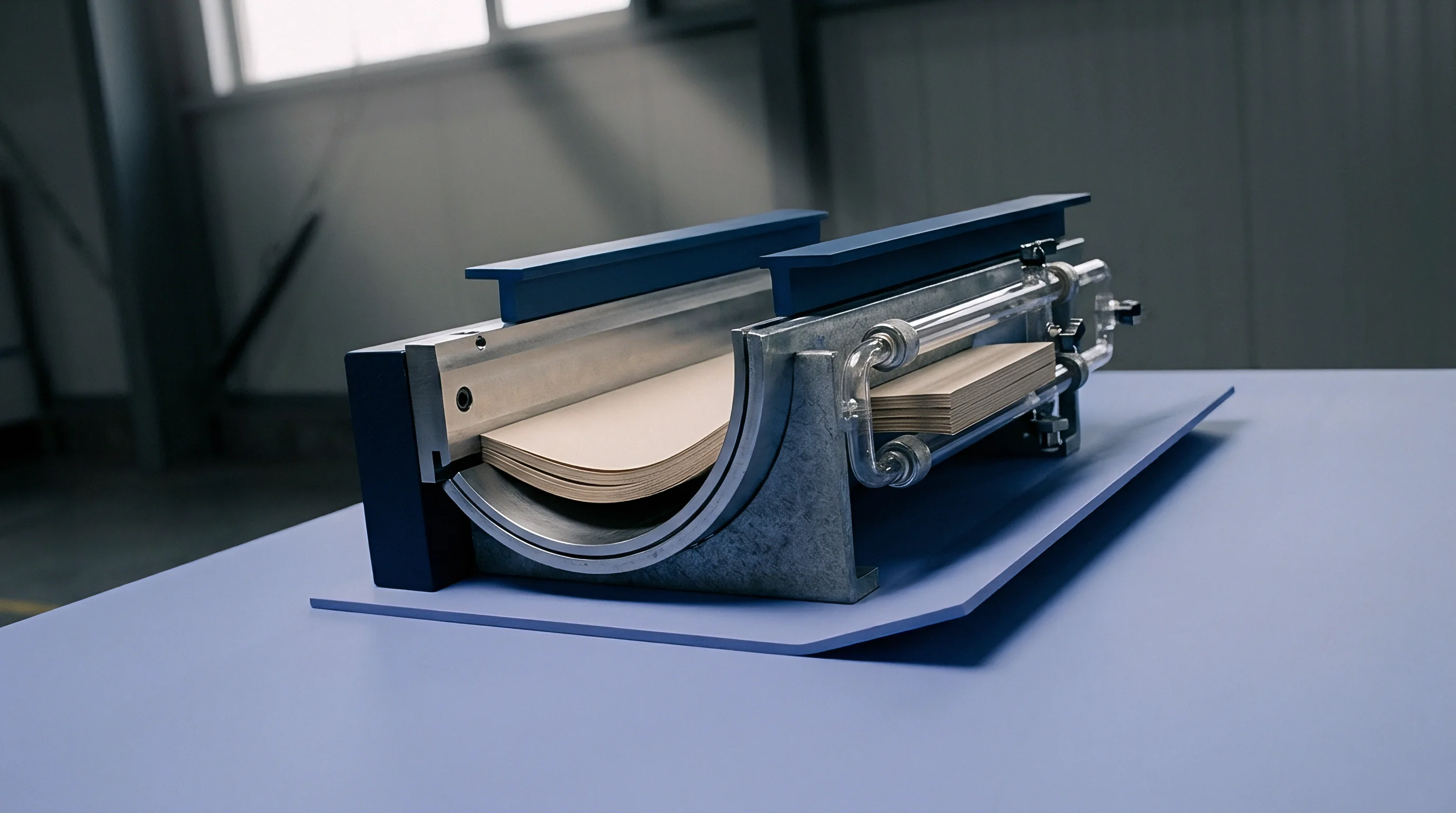
Dewatering multi-ply webs without crushing the high-bulk mechanical core is one of the toughest challenges in lightweight board production. Standard roll presses exert high peak pressures over brief dwell times, collapsing the tubular BCTMP fibers in the middle layer. Extended Nip Pressing (ENP), or shoe pressing, replaces roll nips with a wide concave shoe, extending dwell time in the nip by five to eight times.
Shoe presses spread dewatering impulse energy across a wider window, reaching high solids content at much lower peak pressures. Protecting core fibers from Z-direction collapse keeps bulk intact while elevating post-press dryness to 46 ~ 52 percent. Entering the dryers at higher dryness cuts steam demand and minimizes shrinkage stresses that degrade dimensional stability.
- Verify headbox stock temperature and viscosity parameters to optimize initial drainage capacity across top and bottom forming fabrics.
- Adjust shoe press hydraulic pressure profiles to maintain peak nip intensity below three point five megapascals while extending nip width.
- Synchronize press felt conditioning and continuous high-pressure shower vacuum levels to eliminate re-wetting at the press exit nip.
- Regulate cylinder drying section tension controls to prevent web draw strain from degrading cross-direction modulus properties.
| Press Configuration | Peak Nip Pressure (MPa) | Nip Dwell Time (ms) | Exit Dryness (% Solid) | Core Bulk Retention (%) |
|---|---|---|---|---|
| Standard Roll Press | 7.0 – 9.5 | 2.5 – 4.0 | 41 – 44 | 78 – 82 |
| Double Felted Roll Press | 5.5 – 7.5 | 4.0 – 6.0 | 43 – 46 | 83 – 86 |
| Single Shoe Press (ENP) | 3.0 – 4.5 | 15.0 – 25.0 | 47 – 50 | 91 – 95 |
| Tandem Shoe Press System | 2.5 – 3.8 | 20.0 – 30.0 | 50 – 54 | 94 – 97 |
Calendering and Surface Smoothness Management
Calendering delivers the smoothness and gloss needed for printing, but it threatens sheet caliper. Soft-nip calenders pair heated steel rolls with resilient polymer rolls to flatten surface high points via localized thermal softening, avoiding uniform Z-direction compaction. Temperature, roll hardness, and nip load determine the resulting surface topography.
Running soft-nip calenders at high roll temperatures (160 to 220 degrees Celsius) selectively softens outer coatings and surface fibers while keeping the internal BCTMP core cool. This thermal gradient approach smooths the surface under low mechanical nip pressure, preserving bulk. Swapping hard-roll calender stacks for hot soft-nip or metal-belt systems preserves 5 to 10 percent more caliper at equivalent Sheffield or Bendtsen roughness, protecting flexural rigidity in lightweight grades.
Controlling moisture ahead of the calender stack prevents core fiber damage. If web moisture exceeds 9 percent during calendering, the glass transition temperature of core lignin drops, causing permanent collapse of the mechanical pulp structure. Mills have to hold pre-calender moisture profiles within tight limits to protect the bulk-to-smoothness ratio.

Creasing
Deformation Mechanics during Scoring and Folding
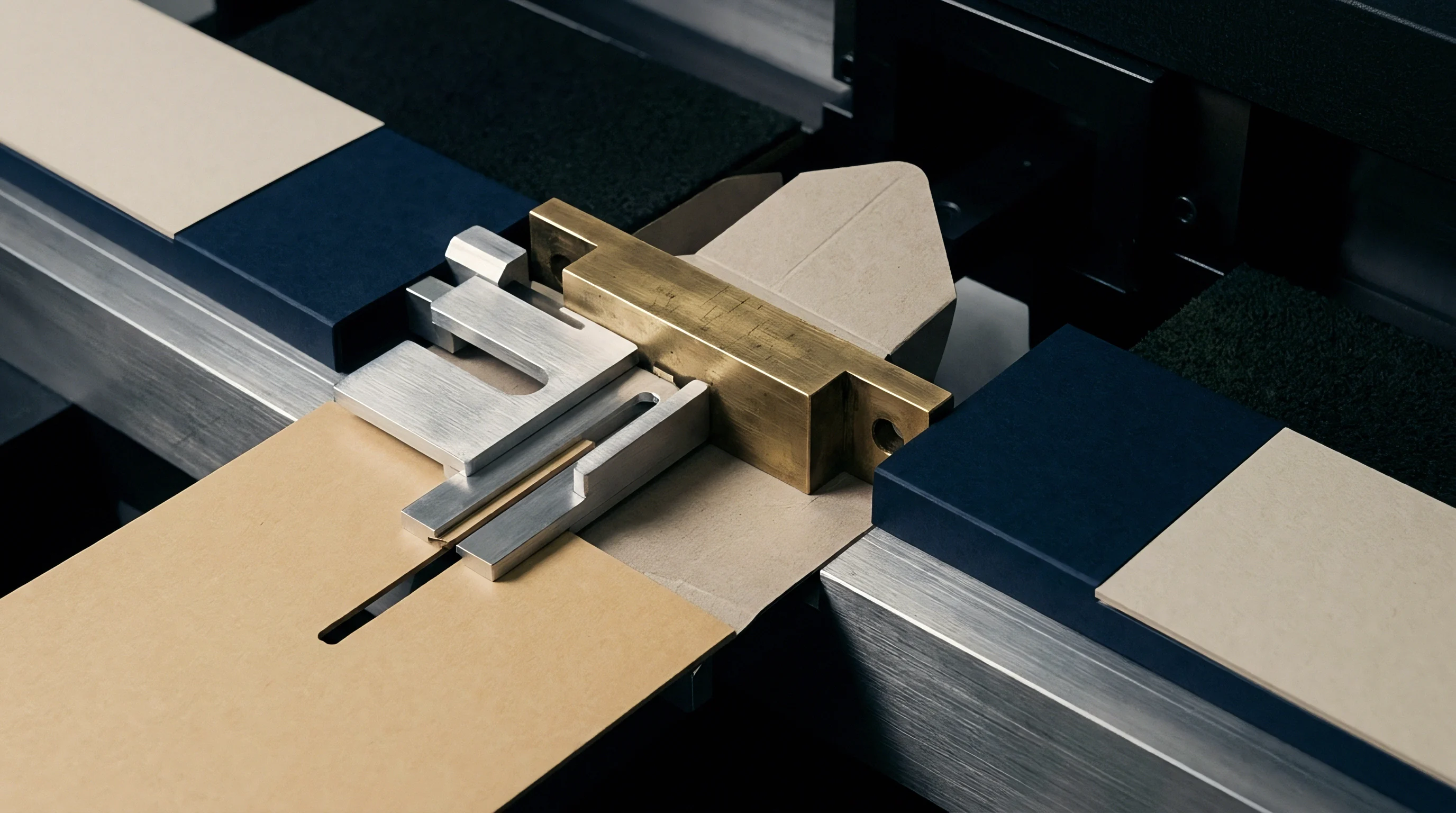
Converting folding boxboard into finished cartons requires precise scoring to create clean, low-resistance fold lines. Male rules push board into a female matrix die, inducing deliberate shear delamination along the middle ply to create an internal hinge. During folding, outer surface fibers take tensile strain while the back ply compresses inward.
This controlled internal delamination stops the top skin from cracking and preserves clean score edges.
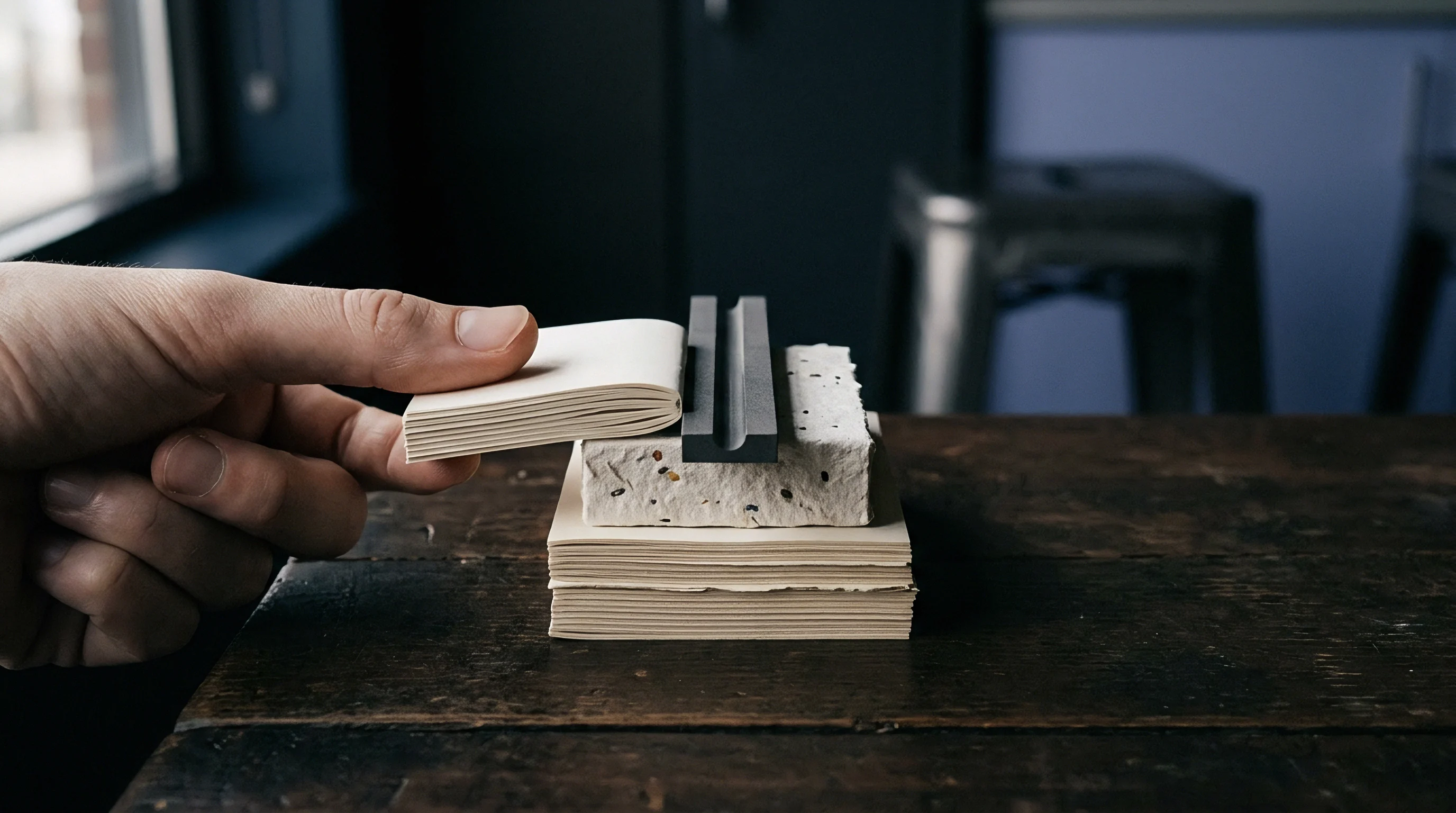
Lightweight boards present distinct creasing challenges. Cutting middle-ply mass changes how shear stress distributes during rule indentation. If internal bond strength ~ measured by Z-tensile or Scott Bond testing ~ is too high, the core resists shearing and the top skin cracks during folding.
If bond strength drops too low from aggressive debulking, delamination spreads into adjacent panel areas, weakening overall carton wall stiffness.
ISO 2493-2 stiffness measurements confirm that proper crease depth selection preserves up to eighty-five percent of uncreased panel bending stiffness along parallel carton fold lines.
Evaluating Bond Strength and Crease Depth Windows
Optimizing lightweight specifications requires establishing a balanced internal bond window. Scott Bond energy values for high-performance folding boxboard should fall within 120 to 190 Joules per square meter. Values below 100 Joules per square meter risk premature shear failure during high-speed printing and gluing, while values above 220 Joules per square meter restrict internal delamination during scoring operations.
Creasing tool geometry has to adapt when sheet caliper drops. Male rule width wr, matrix channel width Wm, and matrix depth dm follow standard geometric relationships based on board thickness t and rule thickness:
Wm = wr + 1.5 · t + 0.1 mm
Reducing caliper without adjusting channel geometry results in improper crease formation, high folding torque, and score line cracking. Properly matched tooling keeps folding resistance within normal operating ranges.
How Does Caliper Downgauging Impact Box Compression Strength?
Carton load-bearing strength depends directly on panel flexural rigidity and edge crush resistance. The McKee formula models Box Compression Test (BCT) strength based on Edge Crush Resistance (ECT), MD and CD panel stiffness (SMD and SCD), and carton perimeter P:
BCT = 5.876 · ECT0.746 · left( SMD · SCD right)0.127 · P0.492
Lowering board mass reduces both ECT and bending stiffness. Because flexural rigidity carries an exponent in compression models, even modest stiffness drops translate into measurable losses in BCT performance. Converting lines have to compensate by optimizing crease geometry, ensuring score lines do not induce micro-cracks that weaken vertical corner-post strength.
| Failure Mode | Physical Root Cause | Primary Test Metric | Corrective Mill / Mill-Floor Action |
|---|---|---|---|
| Top Surface Cracking | Insufficient core delamination; outer skin tensile failure | Scott Bond / Crease Stiffness Ratio | Lower middle-ply internal refining; widen creasing matrix channel |
| Carton Panel Bulging | Inadequate CD bending stiffness; low elastic modulus | ISO 2493 CD Bending Stiffness | Adjust jet-to-wire ratio toward unity; increase outer ply refining |
| Corner Post Buckling | Deficient ECT and transverse shear rigidity | ISO 13820 ECT / Transverse Shear | Increase core BCTMP fraction; reduce calender nip pressure |
| Delamination Flaking | Excessive core micro-foaming; weak Z-tensile bond | ISO 1924-2 Z-Tensile Strength | Raise wet-end dry strength resin dosage; lower core air content |
Questions remain about how high-speed rotary die-cutting affects long-term shear stiffness in foam-formed cores under fluctuating humidity. Micro-fractures created during rapid scoring might propagate during transit and storage, weakening carton strength over time in the field.
Compliance

Standardized Test Methods and Environmental Conditioning
Evaluating lightweight boxboard properties requires strict adherence to international testing standards. Bending resistance and stiffness must be measured under controlled conditions per ISO 187 (23 degrees Celsius and 50 percent relative humidity). Because wood fibers are hygroscopic, a 2 percent rise in equilibrium moisture content cuts outer ply elastic modulus by up to 15 percent, rendering unconditioned test results invalid.
Bending resistance is typically evaluated using ISO 2493-1 (L&W 15-degree flexural method) or ISO 2493-2 (Taber 15-degree rotation method). Resonance methods under ISO 5629 measure fundamental flexural stiffness without causing plastic deformation. Mill certificates must state the exact test method, deflection angle, loading rate, and conditioning environment for reported figures.
ISO 534 thickness standards specify that caliper measurements must apply a static dead-weight pressure of one hundred kilopascals over a ground anvil surface area of two hundred square millimeters.
Goods-In Inspection and Statistical Acceptance Sampling
Receiving inspection relies on structured sampling protocols under ISO 186. Selecting rolls or skids at random across production lots ensures representative quality checks. Inspection plans should cover basis weight, total caliper, MD and CD bending stiffness, and Scott Bond energy profiles.
Acceptance limits build on statistical process control bands. Cross-machine basis weight variations must stay within plus or minus 2.5 percent of target, while caliper tolerances are capped at plus or minus 3.0 percent. Because stiffness scales cubically with caliper, a 3 percent drop in thickness reduces bending stiffness by roughly 8.7 percent, which warrants immediate batch quarantine.
- Documented Test Methods state complete ISO or TAPPI protocols alongside calibration records and environmental logs.
- Batch Mill Certificates list roll and heat numbers matching pallet tags delivered to the plant.
- Directional Stiffness Values provide separate MD and CD flexural data taken at standard 15-degree deflection angles.
- Z-Direction Bond Metrics verify internal shear strength through Scott Bond or Z-tensile test data.
- Moisture Content Readings confirm delivered web moisture stays within the target 6.5 to 8.5 percent range.
Mill Test Reports and Tolerance Defenses
Resolving delivery disputes over non-conforming board requires evaluating mill test reports against contracted limits. Standard supply agreements often state that property guarantees apply at the mill reel. Receiving inspection must determine whether low values stem from mill variability or transit moisture gain.
Most purchase agreements stipulate that shipments measuring more than 5 percent below guaranteed CD bending stiffness qualify for price adjustments or outright rejection. Including explicit test method and conditioning clauses prevents suppliers from blaming low stiffness readings on converter warehouse storage conditions.
Costing

Yield Mathematics and Basis Weight Downgauging
Mills sell paperboard by the metric tonne, but converters sell cartons by surface area and volume. Downgauging basis weight while preserving caliper and stiffness improves yield efficiency, giving more usable square meters of board per tonne purchased. Evaluating true material cost requires converting mill price per tonne into landed area cost per thousand square meters.
The total surface area A in square meters obtained from one metric tonne (1,000 kg) of board with basis weight BW in grams per square meter (g/m2) follows the relationship:
A = frac1,000 · 1,000BW = frac1,000,000BW
Reducing basis weight from 250 g/m2 to 215 g/m2 increases yield per tonne from 4,000 to 4,651 square meters ~ a 16.28 percent gain in usable area. Even if the lightweight grade carries a 6 percent price premium per tonne due to specialized BCTMP and chemistry, overall net area cost drops significantly.
Take an annual production run of 12,000,000 cartons, where each blank requires 0.125 square meters. Total annual surface area equals 1,500,000 square meters. The baseline order uses a standard 250 g/m2 board priced at 1,200 per metric tonne landed.
The lightweight alternative uses a 215 g/m2 high-bulk board engineered to match baseline stiffness, priced at $1,280 per metric tonne landed.
Calculating baseline tonnage requirements:
Baseline Mass = frac1,500,000 m2 · 250 g/m21,000,000 g/kg · 1,000 kg/tonne = 375 metric tonnes
Baseline Board Cost = 375 tonnes · $1,200/tonne = $450,000
Calculating lightweight alternative tonnage requirements:
Lightweight Mass = frac1,500,000 m2 · 215 g/m21,000,000 g/kg · 1,000 kg/tonne = 322.5 metric tonnes
Lightweight Board Cost = 322.5 tonnes · $1,280/tonne = $412,800
The downgauged specification generates net raw material savings of $37,200 per year ~ an 8.27 percent reduction in material spending despite the higher price per tonne. High-volume production models consistently show that yield gains outweigh per-tonne price surcharges.

Freight Logistics and Transport Optimization
Mass reduction also cuts downstream freight costs. Transporting flat folded cartons from converting plants to filling facilities incurs freight fees based on payload weight and container space. Cutting carton weight by 14 percent lowers pallet weight without reducing the number of cartons shipped per container load.
Full truckload (FTL) shipments limited by gross weight limits can carry more finished units per truck when using lightweighted board. Moving 322.5 tonnes of cartons instead of 375 tonnes eliminates 52.5 tonnes of freight annually. At an average regional freight cost of $45 per metric tonne, this weight reduction saves an additional $2,362 in annual transit costs.
| Specification Metric | Standard Grade (250 g/m²) | Lightweight Grade (215 g/m²) | Absolute Variance | Percentage Change |
|---|---|---|---|---|
| Basis Weight (g/m²) | 250.0 | 215.0 | -35.0 | -14.00 % |
| Target Caliper (µm) | 380.0 | 375.0 | -5.0 | -1.32 % |
| CD Bending Stiffness (mNm) | 11.2 | 10.9 | -0.3 | -2.68 % |
| Yield per Tonne (m²/tonne) | 4,000.0 | 4,651.2 | +651.2 | +16.28 % |
| Substrate Cost ($/tonne) | $1,200.00 | $1,280.00 | +$80.00 | +6.67 % |
| Landed Cost / 1,000 Cartons | $37.50 | $34.40 | -$3.10 | -8.27 % |
| Annual EPR Fee Exposure ($) | $67,500.00 | $58,050.00 | -$9,450.00 | -14.00 % |

Extended Producer Responsibility and Environmental Fee Modulation
Extended Producer Responsibility (EPR) regulations in many jurisdictions levy packaging fees based on the total mass placed on the market. These schemes penalize heavy packaging and reward mass reduction through tiered fee structures. In Western Europe, compliance fees for virgin-fiber boxboard average 180 per metric tonne.
Applying EPR fee rates to the anνal tonnage baseline demonstrates additional financial savings:
Baseline EPR Fee = 375 tonnes · $180/tonne = $67,500
Lightweight EPR Fee = 322.5 tonnes · $180/tonne = $58,050
The basis weight reduction lowers annual compliance fees by $9,450. Combined with raw material savings ($37,200) and shipping reductions ($2,362), total annual savings reach $49,012. Optimizing bending stiffness while reducing mass delivers compounding savings across the entire packaging lifecycle.
Combining proper furnish selection, optimized wet pressing, thermal gradient calendering, and tuned creasing tooling allows converters and brand owners to execute aggressive lightweighting without sacrificing box compression or appearance. Ultimately, landed packaging economics favor high-bulk multi-ply substrates that strike the right balance between sheet stiffness, yield per tonne, and regulatory fees.