Waterborne Barrier Dispersion Application Parameters on Folding Boxboard
Waterborne dispersion application on folding boxboard requires precise coat weight control, shear-matched viscosity, and staged drying to prevent pinholing.
Blade
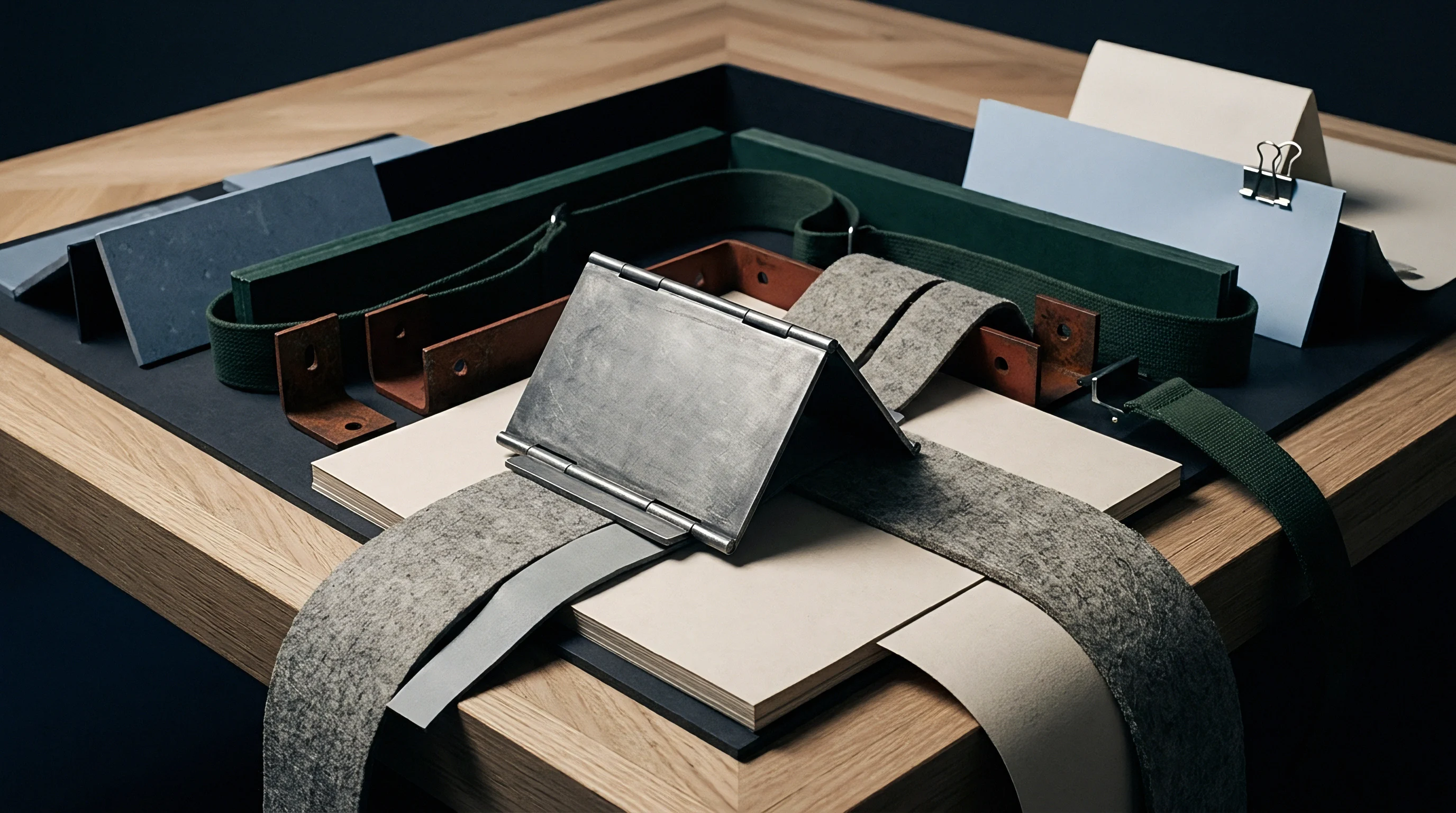
Waterborne barrier dispersions can replace extruded polyolefin films on folding boxboard by building a continuous polymer film directly over the clay-coated board. Laying down a dependable barrier against moisture, liquid water, oil, and grease comes down to controlling fluid rheology under high dynamic shear on rapid application lines. Folding boxboard substrates between 200 and 450 grams per square meter vary widely in surface roughness and absorption kinetics, so the wet film profile depends heavily on the mechanical metering system used ahead of the drying deck.
High Shear Metering Dynamics on Boxboard Substrates
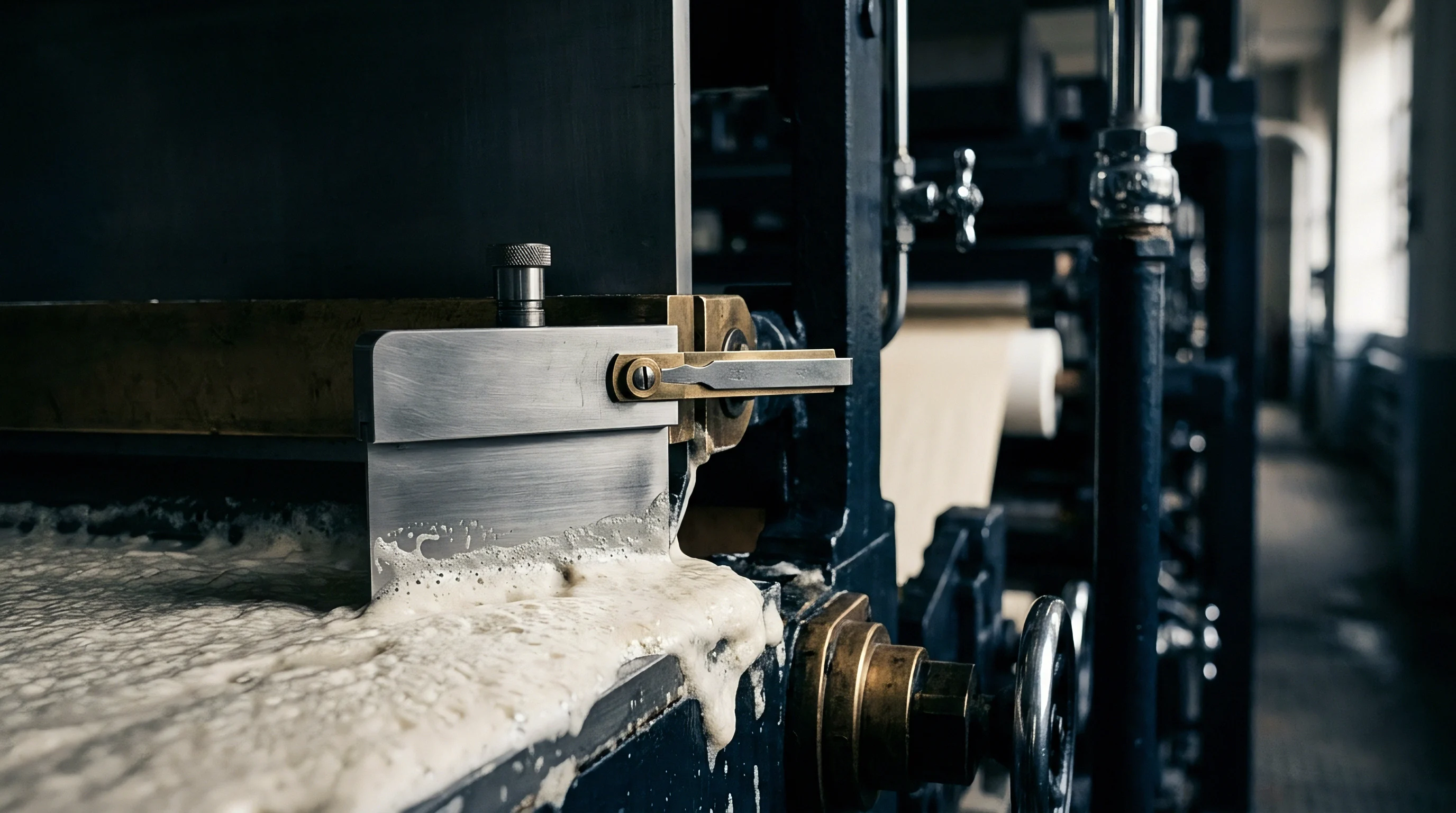
Running liquid polymer emulsions at line speeds above four hundred meters per minute requires tightly controlled mechanical deposition. Depending on the target water vapor transmission rate or oil resistance specification, target dry coat weights range from 4 to 12 grams per square meter. The choice of metering setup governs hydrodynamic pressure across the interface: bent blades produce smooth surface profiles on triple-coated folding boxboard, whereas stiff blades exert higher hydraulic force, forcing polymer binder into micro-roughness valleys at the cost of higher strike-through risk on porous boards.
Smooth coater rods suit lower-viscosity formulations running at moderate web speeds. Grooved rods meter out discrete wet film volumes that have to level out before reaching the dryers. Air knife coaters apply dispersion in excess before a focused air jet shears off the surplus, sparing the fiber web from high mechanical stress, preserving board bulk, and leaving a contour-conforming barrier layer.
Curtain coating avoids contact entirely, dropping a stable liquid sheet onto the moving web, though maintaining curtain stability requires tight management of dynamic surface tension alongside formulation solids between 42 percent and 52 percent.
| Method | Shear Rate Range (s⁻¹) | Solids Limit (%) | Dry Coat Weight Range (g/m²) | Pinhole Susceptibility |
|---|---|---|---|---|
| Bent Blade | 500,000 to 1,200,000 | 58 | 3.5 to 8.0 | Moderate |
| Smooth Metering Rod | 50,000 to 200,000 | 50 | 4.0 to 10.0 | Low |
| Air Knife | 10,000 to 40,000 | 45 | 6.0 to 14.0 | Very Low |
| Curtain Coater | 1,000 to 5,000 | 52 | 5.0 to 12.0 | Low |
| Data evaluated across GC1 and GC2 folding boxboard grades at web speeds between 250 m/min and 450 m/min under ISO 187 standard conditioning atmospheric testing. | ||||
Rheological Behavior under High Hydrodynamic Pressure
Polymer dispersions thin under shear as they pass through narrow application gaps. Under high-speed blades, latex particles experience shear rates past one million reciprocal seconds. Viscosity must fall enough at those shear rates to spread evenly over pigment topcoats, then rebuild quickly once metered to prevent sagging or excessive bleed into internal board pores.
Synthetic thickeners reshape the viscoelastic response of aqueous dispersions. Alkali-swellable emulsions and hydrophobically modified ethylene oxide urethane polymers tune low-shear yield stress without triggering high-shear dilatancy. Dilatant behavior leads straight to blade bleeding, micro-streaking, and spatter on the backing roll, which is why formulators keep solids within strict boundaries to avoid particle jamming beneath the blade tip.
- Styrene-butadiene latex binder forms the core hydrophobic network providing water resistance across the board surface.
- Surfactant wetting agents lower dynamic surface tension to promote uniform film spreading without inducing excessive foam.
- Rheology modifiers control low-shear yield stress to prevent settling while maintaining fluid transport under high shear.
- Ammonia buffer additives stabilize dispersion pH between 8.5 and 9.5 to prevent premature polymer agglomeration.
Barrier micro-voids often trace back to base sheet surface defects rather than high-shear rheological breakdown beneath the metering blade.

Pore
Substrate micro-geometry determines how wet latex behaves the moment it hits the paperboard surface. Folding boxboard grades differ considerably: GC1 features fully bleached chemical pulp on top, while GC2 carries a mechanical pulp core beneath. A mineral pre-coat seals off porosity to provide a consistent base for thin polymer films; uncoated or lightly sized boards draw water out of the dispersion too quickly for latex particles to coalesce properly.
Capillary Penetration and Surface Energy Matching
Liquid penetration into paperboard follows capillary mechanics driven by pore radius, dynamic viscosity, and contact angle. To avoid losing binder into the substrate, wet dispersion surface tension needs to match the critical surface energy of the mineral pre-coat, which generally sits between 38 and 44 millinewtons per meter. Using fluorosurfactants or modified siloxanes brings dynamic surface tension down to between 28 and 34 millinewtons per meter, prompting rapid wetting across fiber valleys.
Excessive penetration draws latex solids down into the web, leaving too little material on the surface to form a closed barrier. If capillary draw cuts an 8.0 grams per square meter coat down to an effective surface layer of 3.2 grams per square meter, pinholes develop. These pinholes compromise Cobb water absorption and turpentine oil holdout tests by opening pathways directly to the base fibers.
Higher base sheet sizing reduces binder migration into the fiber matrix and stabilizes film formation.
Substrate absorbency is evaluated through ISO 535 Cobb water absorption and ISO 8791-2 Bendtsen roughness. Boxboard intended for waterborne barrier coatings generally calls for a 60-second base sheet Cobb below 25 grams per square meter, with top-liner Bendtsen roughness under 150 milliliters per minute. Keeping within those thresholds prevents the wet film from draining away and preserves a predictable barrier thickness across the web.
When base sheet surface energy sits comfortably above the dispersion’s dynamic surface tension, the wet coating wets out completely across exposed fiber peaks.


Dwell
Available drying capacity directly limits line speed and film quality in aqueous dispersion coating. Removing water requires heat input balanced carefully enough to evaporate the vehicle without tearing apart the forming polymer layer. The drying tunnel has to guide the coating through constant rate drying, falling rate drying, and final thermal fusion; short dwell times or uneven heat transfer leave interstitial voids that ruin moisture vapor barrier performance.
Thermal Gradient Profiling across Air Floatation Zones
Drying proceeds in staged thermal zones along the tunnel. Medium-wave infrared emitters heat the wet film rapidly to the evaporation threshold at the start of the line, though web temperature in this initial stage must stay below the boiling point of water to prevent steam blistering. Air floatation dryers take over after the infrared section, carrying the board on air cushions while clearing evaporated moisture from the boundary layer.
Air velocity and temperature must be balanced from zone to zone. Blasting high-velocity air in the entry zone forms an impermeable latex skin over trapped liquid, which later boils in hotter zones down the line to leave blisters and pinholes. Stepped temperature zones keep evaporation steady without disrupting the tender polymer film.
| Dryer Section | Air Velocity (m/s) | Web Temperature Range (°C) | Evaporation Rate (kg/m²·h) | Dominant Coalescence State |
|---|---|---|---|---|
| Zone 1 (Infrared) | 12 to 15 | 55 to 68 | 18 to 25 | Particle Packing |
| Zone 2 (Hot Air) | 22 to 28 | 70 to 88 | 12 to 18 | Particle Deformation |
| Zone 3 (Hot Air) | 25 to 32 | 90 to 110 | 5 to 10 | Interdiffusion |
| Zone 4 (Cooling) | 18 to 22 | 45 to 55 | 0 to 1 | Film Fusion Lock |
Coalescence Mechanics and Minimum Film Formation Temperature
As water evaporates, capillary forces draw suspended latex spheres into a close-packed arrangement. As capillary pressure mounts, the spheres deform into polyhedral shapes, and film formation finishes when polymer chains interdiffuse across particle boundaries into a continuous sheet.
A coat weight of 8 grams per square meter cured under an initial infrared zone at 110 degrees Celsius maintains water vapor permeability below 15 grams per square meter per day.
Minimum Film Formation Temperature marks the lowest temperature at which an emulsion coalesces into a coherent film. Formulations with low glass transition temperatures, between minus 15 and plus 5 degrees Celsius, form films easily at room temperature but yield soft surfaces that risk blocking in rewound rolls. Harder grades with glass transition points above 25 degrees Celsius require elevated web temperatures and coalescing aids to fuse.
Chill rolls at the dryer exit cool the board below the polymer softening point to prevent roll blocking under rewind tension.
Skinning over too early in the drying cycle traps steam beneath the surface, forming micro-blisters that compromise gas and moisture barriers.
Crease
Converting subjects the barrier coating to heavy mechanical stress during die-cutting and folding. Scoring and creasing fold the top liner outward, stretching the applied dispersion layer along the outer bend radius. If the polymer lacks elongation, it fractures along the score line, letting grease and moisture migrate directly into the paperboard fibers underneath.
How Does Scoring Rule Width Affect Dispersion Integrity?
Rule geometry sets the strain profile along the crease. Narrow scoring rules produce sharp folds that easily exceed the elongation limits of stiffer latexes, while wider rules spread bending strain over a broader radius to lower peak surface stress.
Matrix channel dimensions must match board caliper and rule point sizing. A standard setup pairs channel depth to board thickness and channel width to 1.5 times board caliper plus rule width. Mismatched male and female tools will pinch or shear the top liner, rupturing the barrier coating regardless of its inherent elasticity.
- Measure caliper across ten test sheets using an electronic micrometer to set accurate baseline board thickness.
- Select a female matrix channel width equal to one point five times board thickness plus rule width.
- Set male scoring rule depth to achieve seventy percent penetration into the board thickness without splitting top liner fibers.
- Perform forty-five degree preliminary folding trials while measuring grease penetration along the crease using turpentine testing.
- Adjust scoring rule clearance until pinhole count along the fold line drops below two per linear meter.
Crease barrier retention is checked by applying dyed oil solutions to board folded 180 degrees flat under standard load, evaluated against ISO 16532-1 grease resistance standards. Formulations based on flexible polyolefin or acrylic-butadiene copolymer chemistries can maintain intact films at up to 250 percent strain at break, preserving grease holdout along primary carton creases.
Non-compliance with ISO 5628 bending stiffness specifications leads to severe barrier film delamination along the primary crease line.
Formulators add plasticizers or soft co-binders to give dispersions the ductility needed for converting, though too much plasticizer opens up free volume in the polymer matrix and increases water vapor transmission. The goal is balancing tensile strength and elongation at break so the cured film handles creasing without slipping out of barrier spec.
- Pinholes formed during flash drying ruin oil barrier performance regardless of final polymer film thickness.
- Micro-cracking along carton score lines permits fat migration into interior paperboard layers.
- Roll blocking occurs when un-cured low glass transition latex adheres to the uncoated backliner under stack pressure.
- Blistering defects arise when trapped volatile vapors rupture the surface coating during rapid infrared heating.
Commercial supply contracts referencing DIN 55437-1 typically allow no more than a twenty percent drop in grease barrier retention following a standardized one-hundred-and-eighty-degree crease test.
Margin
Commercial viability rests on balancing coat weight against barrier specifications and running waste. Waterborne dispersion coating replaces polyethylene extrusion lamination, removing a separate off-line converting stage. Extrusion lamination typically applies 12 to 18 grams per square meter to ensure a continuous seal over rough board, whereas on-machine or off-line dispersion coating reaches comparable barrier performance at 5 to 9 grams per square meter.
Coat Weight Optimization and Material Yield Arithmetic
Specifying barrier coverage requires balancing polymer cost against functional test targets. Aqueous polymer dispersions run between $3.20 and $5.50 per dry kilogram depending on polymer type and additive package, higher than base extrusion-grade low-density polyethylene resin. Dispersion coatings make up for that price difference through lower coat weights, lower shipping mass, and better converting efficiency.
On a 50-tonne order of 300 gram per square meter folding boxboard, applying 15 grams per square meter of polyethylene extrusion consumes 2.5 tonnes of resin. Applying an 8 gram per square meter dry dispersion barrier uses 1.33 tonnes of dry polymer. That weight reduction lowers finished roll mass, feeding directly into freight and duty savings.
Excess coat weight increases drying energy demands and raw polymer costs without yielding proportional gains in moisture barrier performance.
Evaporating water from dispersion coatings takes far more thermal and electrical energy than extruding molten polymer. High-velocity air floatation dryers add to utility costs per metric tonne of board, so lines running heat recovery loops reclaim exhaust air to preheat primary burner intake and protect margins.
Extended Producer Responsibility and Recyclability Fees
Packaging waste regulations across European markets tie fees to repulpability performance. Extrusion-laminated board incurs steep Extended Producer Responsibility surcharges because polyethylene films resist standard repulping and leave plastic residues. Under PTS method PTS-RH 021/97, laminated board scores poorly, drawing penalties as high as $220 per metric tonne of packaging placed on the market.
Dispersion-coated board breaks down in standard hydrapulpers without extra chemistry. The polymer film fractures into fine particles that screen out cleanly during flotation, reaching repulpability yields above 98 percent. Those yields qualify for substantial Extended Producer Responsibility discounts under EU Packaging and Packaging Waste Regulations, offsetting higher upfront formulation costs on commercial boxboard runs.