Optimizing Matrix Channel Dimensions for Recycled Content Folding Boxboard Conversion
Recycled folding boxboard requires expanding matrix channel width from 1.5 to 1.8 times caliper plus rule thickness to prevent top-liner rupture.

Web
Scoring recycled folding boxboard requires a firm grasp of how secondary fibres behave under mechanical load. Unlike virgin chemical or mechanical pulps, recovered plies bring shorter average fibre lengths, heavy mineral filler loads, and noticeably weaker inter-fibre bonds. When the creasing rule strikes the board, the internal plies have to delaminate cleanly without fracturing the outer print liner.
Virgin sheets manage this shear stress through long softwood fibres that shift and reorient as the rule descends. Secondary fibres, stiffened and shortened over repeated pulping cycles, have neither the aspect ratio nor the wall flexibility to deform the same way, which changes how the sheet behaves under the platen and forces adjustments to matrix sizing.
Delamination patterns depend heavily on fibre length. Standard coated recycled boxboard ~ classified as GD2 or GT2 under European trade conventions ~ pairs a bleached chemical pulp top liner with backing plies made of unsorted recovered paper. Internal bond strength for these recycled grades, measured under ISO 16260 energy absorbency protocols, typically lands between 100 and 130 J/m², whereas virgin folding boxboards regularly clear 190 J/m².
With less internal cohesion, the recycled core plies shear early under scoring pressure. Unless the female channel supports the shoulders properly, that shear plane tears outward and breaks the top liner before the blank ever reaches the folder-gluer.
ISO 16260 internal bond testing at 23 °C and 50% relative humidity reveals a 35 percent reduction in Z-directional strength when recycled fibre substitution exceeds sixty percent.
Substrate bulk dictates channel depth selection. Recycled furnishes yield lower specific volume, producing a denser sheet with less internal void space to take up rule displacement. Caliper testing under ISO 534 demonstrates that recycled grades demand higher compression force per unit of thickness to form an acceptable bead.
The mechanical differences between virgin and recycled families outlined below govern these creasing parameters.
| Grade Family | Furnish Type | Bulk (cm³/g) | Scott Bond (J/m²) | Bending Resistance (mN) |
|---|---|---|---|---|
| GC1 Virgin FBB | Bleached Chemical / Mechanical | 1.45 to 1.60 | 180 to 220 | 210 to 450 |
| GC2 Virgin FBB | Coated White Back / Mechanical | 1.35 to 1.50 | 165 to 200 | 190 to 410 |
| GD2 Recycled FBB | Coated Grey Back / Waste Plies | 1.15 to 1.30 | 100 to 130 | 140 to 320 |
| GT2 Recycled FBB | Coated White Back / Waste Plies | 1.20 to 1.32 | 110 to 140 | 150 to 340 |

Mechanical Behavior of Recovered Furnish Plies
Multi-ply recycled construction creates steep density gradients across the sheet. While the outer liner needs enough tensile strength to hold up during package forming, the middle plies ~ often a mix of old newsprint and corrugated container waste ~ are loaded with short hardwood fibres and recycled clay. Ash content analysis via ISO 1762 demonstrates filler loads up to eighteen percent by weight in these secondary cores.
Because mineral particles occupy surface area that would otherwise form hydrogen bonds between cellulose fibrils, the plies split much more readily under stress.
Delamination must remain confined within those middle plies. As creasing forces drive board material down into the counter-die cavity, the top liner experiences intense tensile stress along the outer radius while the bottom liner undergoes sharp local compression. If the middle plies fail to yield horizontally through shear micro-cracking, the outer liner absorbs the entire displacement strain and ruptures immediately, exposing underlying grey waste plies through a cracked coated surface.
- Scott Bond Energy thresholds define the minimum Z-axis energy absorption needed to stop the sheet collapsing under platen impact.
- Fibre Length Distribution profiles track the balance between long softwood and short hardwood fibres, setting the workable limit for lateral bend radius.
- Ash Content Percentage values measure the mineral filler loading that disrupts hydrogen bonding across the core plies.
- Moisture Equilibrium Range targets ensure the sheet retains enough moisture to plasticize and separate cleanly under dynamic impression.
Internal Bond Strength and Z Directional Strain
Scoring concentrates tensile stress directly against the matrix channel shoulders. If local stretching exceeds the strain-to-break limit of the bleached top liner, the surface tears. Under TAPPI T 494 conditioning, standard bleached kraft liners reach ultimate elongation values between 2.0% and 2.5%.
Recycled liners, weakened by fibre fragments from repeated processing, fail at elongation levels as low as 1.2%. Matrix channel dimensions require modification to offset this lower elongation capacity.
Shear deformation must proceed cleanly across the crease zone. High Z-directional stiffness in recycled board prevents the middle plies from collapsing inward willingly during rule penetration. Instead of forming a gradual, uniform internal swell, the board resists displacement until the structural limit breaks catastrophically.
Inadequate ply delamination during scoring results in immediate top-liner ruptures along the fold hinge, causing total carton rejections on automatic cartoning lines.
Groove
Determining counter-die channel geometry for recycled boxboard requires departing from classical virgin board formulas. Standard industry conventions for virgin folding boxboard calculate matrix channel width by multiplying board caliper by 1.5 and adding the creasing rule thickness. For recycled content substrates, this multiplier proves insufficient.
Short fibres and high filler loads reduce sheet elasticity, causing narrow channels to pinch and shear the board edges rather than forming a smooth internal bead. Matrix channels on secondary fibre substrates demand expanded width ratios.
Widening the female cavity alters stress distribution during die impact. A wider channel increases the bending radius of the board as the creasing rule pushes the substrate downward, and expanding width from 1.5 times caliper to 1.8 or 1.9 times caliper lowers peak tensile strain on the outer coated liner. Channel depth selection requires equal precision.
Excess channel depth allows the board to sink too far into the cavity without achieving proper ply compression, resulting in weak, spongy creases that resist folding on high-speed lines.
Widening the matrix channel accommodates board swelling and prevents exterior liner tensile fractures during high-speed folding operations.
The baseline mathematical model for recycled boxboard channel width uses the formula Channel Width equals Rule Thickness plus 1.8 times Board Caliper. For board calipers exceeding 0.60 mm, the multiplier increases to 1.9 or 2.0 to account for springback stiffness. Matrix depth generally matches the nominal board thickness, though dense GD2 recycled grades frequently require depth reductions of 0.05 mm to establish sufficient bead consolidation.
The table below presents optimized matrix dimensions across standard recycled calipers.
| Board Caliper (mm) | Rule Thickness (pt) | Virgin Channel Width (mm) | Recycled Channel Width (mm) | Channel Depth (mm) |
|---|---|---|---|---|
| 0.40 | 2 pt (0.71 mm) | 1.31 | 1.43 | 0.40 |
| 0.50 | 2 pt (0.71 mm) | 1.46 | 1.61 | 0.50 |
| 0.60 | 3 pt (1.05 mm) | 1.95 | 2.13 | 0.60 |
| 0.70 | 3 pt (1.05 mm) | 2.10 | 2.31 | 0.65 |
| 0.80 | 4 pt (1.42 mm) | 2.62 | 2.94 | 0.75 |
| Calculated using ISO 534 caliper values at 23 °C and 50% relative humidity. | ||||
Matrix Channel Width Formulations for Short Fibre Furnishes
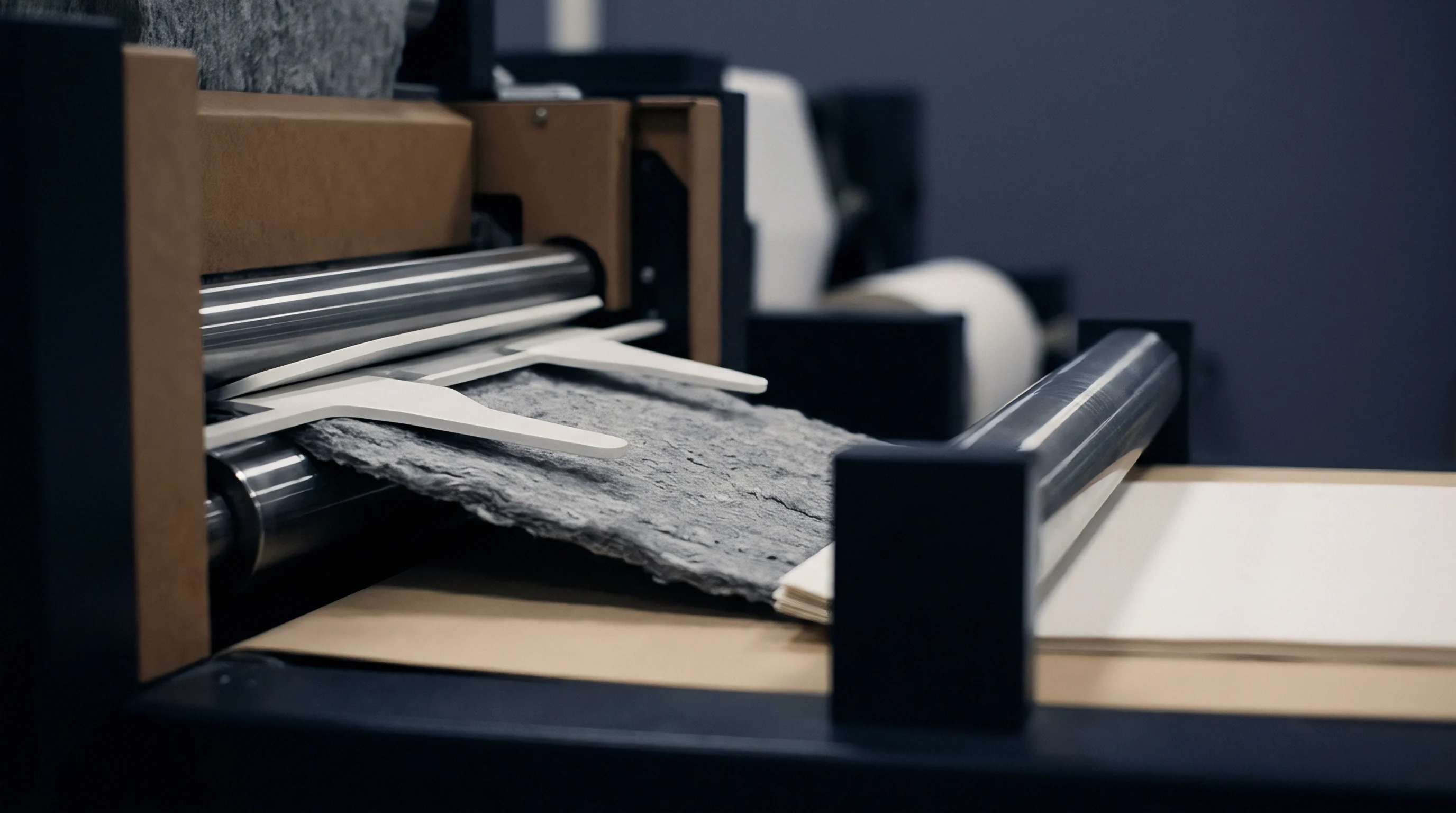
When converting a 0.50 mm GD2 recycled board with a 2 pt (0.71 mm) creasing rule, standard virgin calculations yield a channel width of 1.46 mm. Applying this dimension to recycled stock forces the rigid, short-fibre outer liner into a tight 0.37 mm bending radius, cracking the surface along ninety percent of the creased edges. Recycled board requires a channel width of 1.61 mm minimum, expanding the bending radius and allowing internal plies to delaminate safely.
Phenolic and PVC matrix channels exhibit different performance characteristics under continuous press loads. Phenolic matrix channels maintain sharp shoulder edges throughout extended press runs, resisting lateral pressure from stiff recycled stock. PVC matrix materials compress under load, causing channel shoulders to deform outward over time.
- Top Liner Tensile Rupture occurs when narrow channel geometry induces excessive outer face elongation during male rule penetration.
- Female Channel Bottoming develops when excessive channel depth prevents required density consolidation within the crease bead structure.
- Asymmetrical Bead Displacement results from improper locator centering, forcing uneven ply shear and skewing fold lines.
- Delamination Shear Plane Failure arises when undersized matrix cavities prevent horizontal propagation of internal layer separation.
Depth Selection and Counter Die Clearance
Matching matrix depth strictly to board caliper can lead to insufficient compression when handling dense, heavily calendered recycled boxboard. Recycled sheets feature lower compressibility than virgin mechanical boards. Standard virgin GC2 board compresses by up to thirty percent of its original caliper under creasing impression force.
Dense GD2 board compresses by only fifteen to twenty percent under identical platen pressure.
Channel depth selection must compensate for this reduced compressibility. Selecting a channel depth slightly shallower than the board caliper forces the male rule to consolidate the crease bead firmly against the bottom of the matrix strip. For a 0.70 mm recycled board, specifying a 0.65 mm depth ensures that the male rule creates a defined bead profile.
Tooling setups must maintain total channel clearance without crushing adjacent board areas. Selecting matrix channels based on board caliper alone fails when switching from virgin to recycled board grades because short fibres demand wider lateral clearance.
Ridge
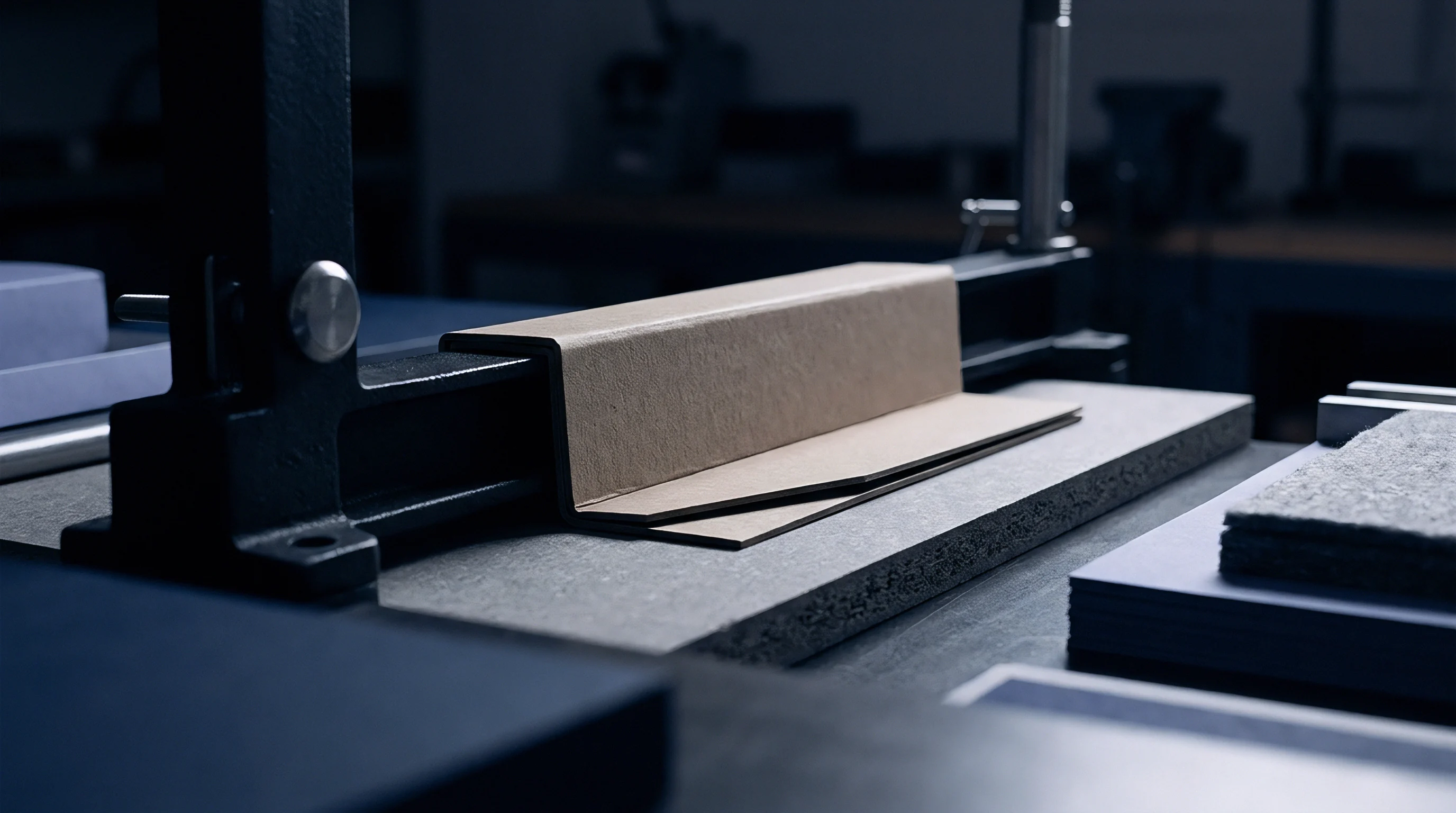
Crease bead formation dictates the bending stiffness of the finished carton blank. When a creasing rule forces recycled board into a matrix cavity, the material creates a distinct male ridge on the reverse side of the sheet. This ridge forms the hinge mechanism for all subsequent folding steps.
In recycled boxboard, the geometry of this ridge must achieve a substantial reduction in bending resistance while preserving structural integrity. Virgin board achieves high stiffness reduction through broad internal delamination. Recycled board requires higher mechanical deformation within a narrower processing window.
Evaluating crease quality relies on measuring bending resistance before and after scoring. ISO 2493-1 defines the standard protocol for measuring board bending resistance at a 15-degree angle. The ratio of creased bending resistance to uncreased bending resistance defines crease stiffness.
Virgin folding boxboards typically achieve a crease stiffness reduction ratio of 50% to 60% without surface cracking. Recycled boxboards struggle to reach these reduction levels because short fibres resist clean internal shearing, often yielding reduction ratios of only 30% to 40% before outer liner cracking begins.
Adherence to ISO 2493-1 bending resistance test protocols prevents cartoner feed jams by establishing verified crease stiffness thresholds before production release.
Proper matrix selection allows recycled board to reach acceptable stiffness reduction without destroying outer coatings. The geometry of the male ridge must remain crisp and uniform across the web width. Skewed or shallow ridges create erratic folding resistance, leading to packaging line stoppages during automated carton erect and fill steps.

Crease Bead Geometry and Shear Deformation
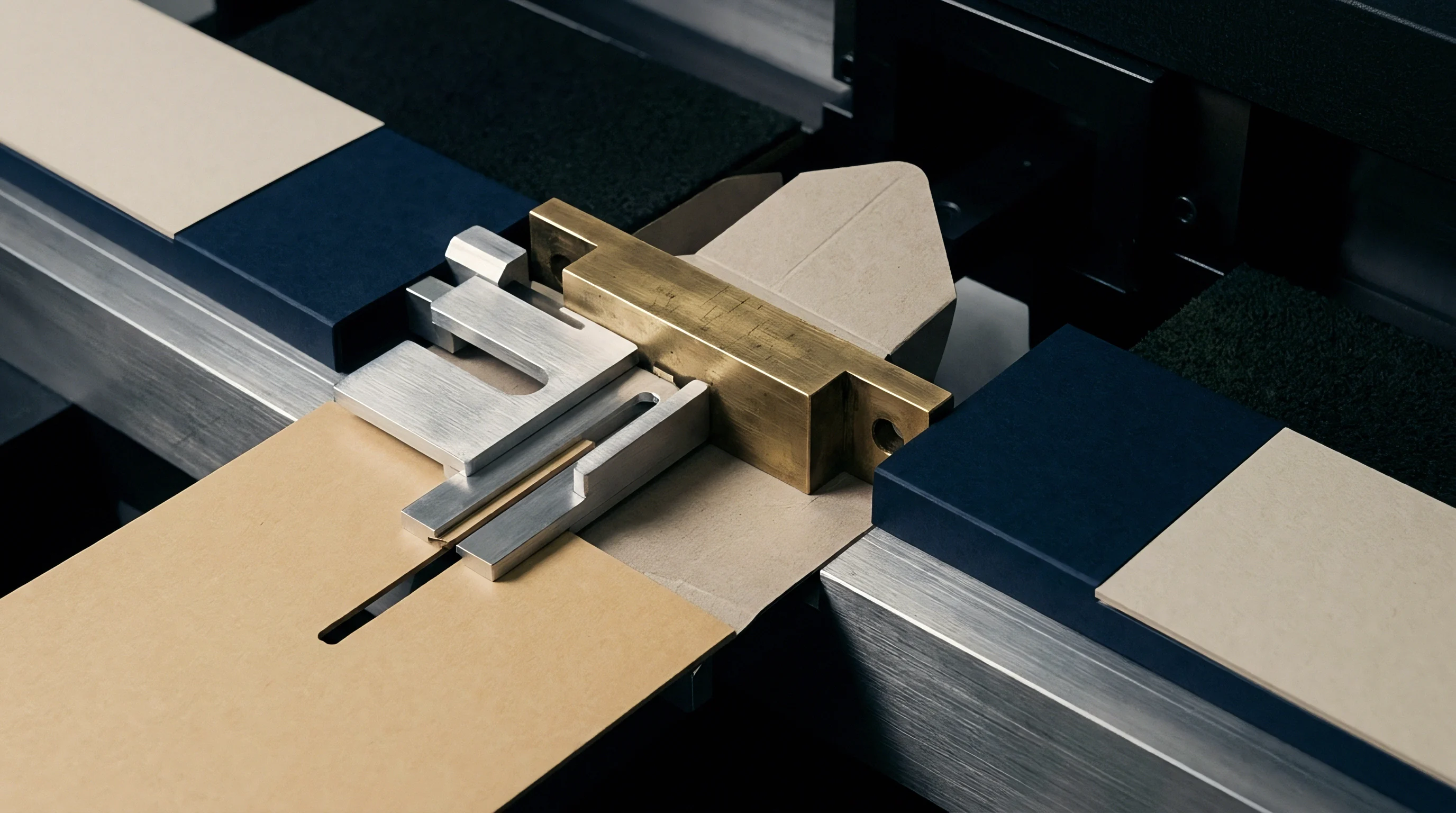
Cross-sectional inspection of a well-formed recycled board crease reveals three distinct structural zones. The top surface exhibits a rounded indentation corresponding to the male rule tip. The central core shows controlled delamination, where horizontal shear cracks separate adjacent recycled plies into independent thin sheets.
The reverse surface displays a defined, square-shouldered bead that projects into the counter-die channel. Improvised press adjustments cannot substitute for correct geometry.
Bead geometry controls carton squareness. If the bead shoulders appear rounded or collapsed, the board was compressed without adequate side support. This condition occurs when the matrix channel width is excessively large, exceeding 2.2 times the board caliper.
Loose matrix cavities fail to force the middle plies into localized shear, causing the sheet to bend as a single solid unit. Bending without delamination severely damages the top liner coating.
Why Do Short Fibres Alter Crease Stiffness?
Fibre network morphology directly governs stress distribution inside the crease zone. Long softwood fibres in virgin pulp form interlocking networks that distribute bending torque over a relatively wide area. When folded, these long fibres slide past one another, absorbing mechanical energy through friction and partial bond rupture.
Secondary fibres possess shorter average lengths, often below 0.8 mm, and feature blunt, damaged ends from repeated mechanical pulping and repulping operations.
Short fibre networks lack the ability to redistribute localized strain. Bending forces concentrate entirely along the primary hinge line rather than dissipating across the adjacent board structure. As a result, uncreased recycled board exhibits high initial resistance to folding, followed by sudden structural failure if the crease geometry is inadequate.
Excessive press impression and reduced Scott Bond strength in secondary furnish layers represent competing explanations for liner cracking.

Tolerance
Operational stability on the converting floor depends on maintaining strict control over environmental and mechanical variables. Recycled folding boxboard absorbs ambient moisture rapidly due to its porous middle plies and exposed edge fibers. Relative humidity variations in the converting plant cause immediate shifts in substrate caliper and sheet flexibility.
Controlling moisture prevents dimensional drift that invalidates pre-selected matrix channel widths.
Matrix selection must account for caliper drift across the paper machine web width. Mill certificates report nominal caliper, but actual delivered sheets exhibit variations of plus or minus five percent from edge to center. On a 0.60 mm nominal GD2 board, caliper can range from 0.57 mm to 0.63 mm across a single pallet.
A matrix channel dimensioned strictly for 0.57 mm will crush 0.63 mm sections, causing severe liner cracking along the drive side of the press.
Phenolic matrix channels sustain high operational accuracy over extended production runs, but continuous impact against rigid recycled stock gradually broadens the channel opening. Expanding the channel width by as little as 0.08 mm through shoulder erosion reduces the compressive force on the crease bead, leading to higher folding resistance at the cartoning machine. Machine operators must audit channel wear systematically.
Moisture Content Fluctuation and Caliper Drift
Substrate conditioning governs material response inside the die-cutter. ISO 187 specifies standard conditioning parameters of 23 °C and 50% relative humidity. Recycled boxboard stored in unconditioned warehouses often drops below four percent moisture content during winter months.
Dry board turns brittle, lowering tensile strain limits and causing widespread liner cracking under standard matrix dimensions.
Compensating for dry board requires increasing matrix channel width by 0.05 mm to 0.10 mm beyond standard recycled guidelines. Alternatively, raising press ambient humidity to fifty percent restores lost moisture, increasing board pliability. The table below outlines matrix wear limits and calibration intervals for high-speed platen die-cutters running secondary fibre board grades.
| Matrix Material | Impression Count | Width Expansion (mm) | Crease Stiffness Loss (%) | Recommended Action |
|---|---|---|---|---|
| Standard PVC Strip | 25,000 | +0.06 | 12% | Inspect shoulder integrity; adjust location. |
| Standard PVC Strip | 50,000 | +0.12 | 25% | Replace matrix strips immediately. |
| Phenolic Composite | 100,000 | +0.04 | 8% | Continue production; monitor crease force. |
| Phenolic Composite | 250,000 | +0.09 | 18% | Replace matrix strips prior to next run. |
Wear Rates of Phenolic Channel Walls versus Press Impression Pressure
Die impression force must be set to the absolute minimum necessary to produce clean cuts and well-defined creases. Over-impression crushes the board, destroying bulk and wearing matrix shoulders prematurely. Operators frequently increase overall press tonnage to compensate for dull cutting dies or uneven press platens.
Excess tonnage drives male creasing rules deep into the counter-die base, deforming the matrix channel walls and inducing shear fractures in recycled stock.
Correct press calibration follows a strict sequence to align creasing rule heights with substrate mechanical limits without relying on excessive platen tonnage. The steps below detail the impression setup process for converted recycled board sheets.
- Measure delivered substrate caliper across five web positions under ISO 534 test standards to determine absolute peak thickness.
- Select matrix channel width based on maximum measured board caliper using the 1.8 multiplier formula for recycled furnishes.
- Install phenolic matrix channels using micro-locator centers to ensure perfectly balanced clearance on both sides of the male rule.
- Set platen impression tonnage to baseline level, advancing in 0.02 mm steps until cutting rules achieve complete sheet separation.
- Evaluate crease stiffness using ISO 2493-1 bend testing, verifying that folding force meets packaging line operational limits.
Maintaining tight mechanical control over die-cutting variables protects job efficiency, prevents substrate waste, and reduces dust generation. Incorporating DIN 55437 crease test compliance limits into substrate procurement contracts shifts financial liability for scoring failures back to the board mill when caliper variance exceeds five percent.


Yield
Optimizing matrix channel dimensions yields measurable financial returns by reducing carton spoilage and avoiding cartoner downtime. Recycled boxboard is selected primarily to lower raw material cost per square meter and meet corporate sustainability directives. Material savings disappear quickly when improper scoring geometry causes higher defect rates at the folder-gluer or customer packaging plant.
Tooling adjustments represent a minimal one-time expense compared to recurring scrap costs.
Consider a practical production example comparing default virgin matrix dimensions against optimized recycled matrix specifications. Assume a production run of 500,000 folding cartons produced from 0.52 mm GD2 recycled boxboard (400 gsm). The converter utilizes a 2 pt (0.71 mm) creasing rule across a multi-up platen layout.
Net board cost sits at 1,150 EUR per metric tonne, equivalent to 0.46 EUR per square meter. Total substrate value for the job equals 46,000 EUR.
Applying standard virgin matrix calculations yields a channel width of 1.49 mm. When run at 7,000 sheets per hour, this narrow channel induces micro-fissures in the top liner, leading to an average carton spoilage rate of 4.8% due to visible liner cracking during 180-degree flap folding. Total defective units equal 24,000 cartons, representing a direct substrate loss of 2,208 EUR, plus 1,400 EUR in wasted press time and folder-gluer downtime.
Proper female channel geometry allows controlled micro-delamination inside the middle plies while maintaining exterior liner continuity.
Recalculating channel dimensions for recycled board mechanics changes the operating financial balance. Applying the 1.8 multiplier yields an optimized channel width of 1.65 mm. Matrix channel depth is set to 0.50 mm.
Implementing this custom phenolic matrix specification drops the liner cracking spoilage rate to 0.3%, representing fewer than 1,500 defective cartons across the entire 500,000 unit run. Direct substrate waste drops to 138 EUR.

Worked Unit Conversion and Spoilage Arithmetic
Net financial recovery extends beyond raw material savings. Eliminating liner cracking allows the folder-gluer line to increase operating speed from 250 meters per minute to 380 meters per minute without risking blank jams. Packaging plant efficiency improves simultaneously.
Automated cartoning lines experience zero feeder stoppages caused by stiff or misshapen crease hinges, eliminating high-cost line clears at the customer facility.
Tooling setup costs for phenolic matrix channel strips total approximately 350 EUR per die layout. Subtracting tooling expense from total material and press time savings yields a net job benefit of over 3,100 EUR on a single 500,000 sheet production order. Unit cost per thousand delivered boxes drops from 98.80 EUR to 92.40 EUR, demonstrating the commercial leverage inherent in precise physical converting parameters.

Commercial Impact on High Speed Packaging Operations
Substrate substitution strategies require comprehensive technical alignment before ordering mill tonnage. Swapping virgin folding boxboard for recycled grades changes sheet density, ply cohesion, and strain limits. Purchasing departments that execute board grade changes based solely on price per tonne without updating tooling specifications routinely incur total cost penalties that far outweigh raw material savings.
Packaging engineers must mandate matrix channel adjustments directly within job routing documentation. Establishing clear matrix specifications based on substrate furnish mechanics ensures repeatable, defect-free production across all converting assets. Adjusting creasing geometry to match recycled furnish mechanics protects finished carton integrity while maintaining target conversion speeds across high-volume production schedules.