Creasing Matrix Sizing Baseline for Virgin Folding Boxboard
Base matrix channel width for virgin folding boxboard on rule thickness plus 1.45 times caliper, setting channel depth equal to measured sheet thickness.


Gauge
Creasing virgin folding boxboard demands channel geometry dictated by the mechanical delamination of interior plies under shear. In converting plants running solid bleached sulphate or folding boxboard with mechanical pulp centres, tool setters calculate the crease channel baseline through board thickness, creasing rule width, and an empirical multiplier reflecting fibre resistance. Tool setters establish matrix channel depth equal to caliper, while channel width follows the standard formula: rule thickness plus 1.4 to 1.5 times the board caliper.
Board thickness measured under ISO 534 at 23 degrees Celsius and 50 percent relative humidity provides the primary input. When processing a 450-micrometre virgin folding boxboard (FBB) alongside a two-point creasing rule (0.71 mm), the channel width sits between 1.34 mm and 1.39 mm. Deviating from this envelope alters delamination mechanics across the hinge.
Tool setters who drop the width factor below 1.40 compress the board into the matrix channel, crushing the bleached chemical pulp liner and shearing exterior fibres. Increasing the channel factor beyond 1.55 produces an unconfined hinge with low bending stiffness and uncontrolled bead formation.
Channel width for virgin boxboard tracks rule thickness plus 1.45 times measured caliper under ISO 534 conditioning.
Virgin folding boxboard features multi-ply sheet architecture engineered to crack along internal interfaces during creasing. The top and reverse plies consist of bleached chemical kraft pulp, providing high tensile strength and folding endurance. The central plies consist of mechanical groundwood, thermomechanical pulp (TMP), or bleached chemi-thermomechanical pulp (BCTMP).
This mechanical core yields high bulk, between 1.4 and 2.1 cubic centimetres per gram, alongside low internal shear resistance. When the rounded steel creasing rule strikes the board, it depresses the sheet into the matrix channel. This forces internal plies to delaminate permanently into distinct sub-plies without rupturing surface layers.
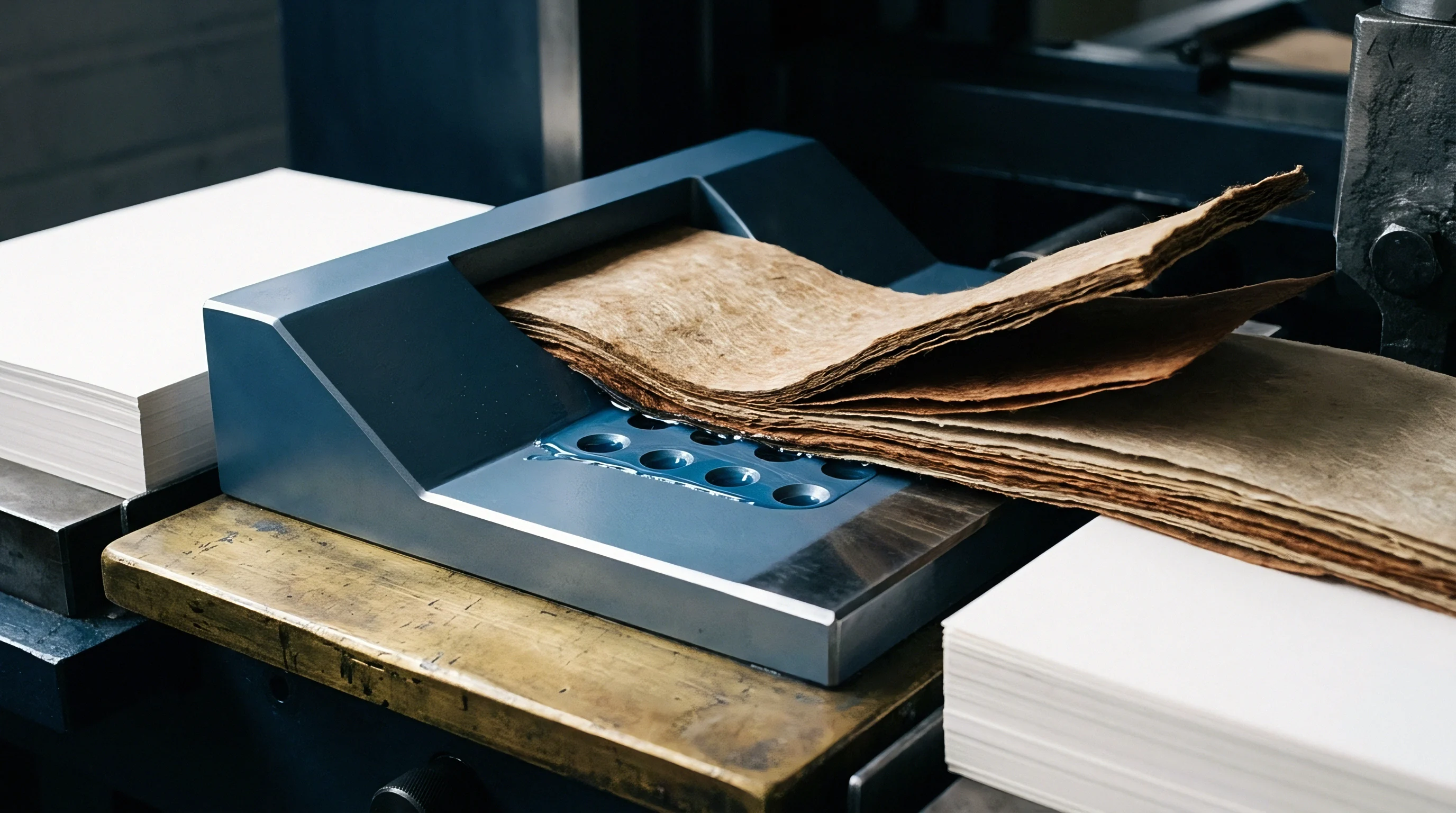
Mechanical Differentiation across Furnish Types
Fibre morphology determines the boundary conditions for matrix selection. Recycled boards, including coated duplex boards with grey backs, contain short, stiff fibres that underwent multiple refining cycles, resulting in low internal bond strength and high brittle fracture susceptibility. Virgin folding boxboard maintains long softwood fibres in the liner plies, delivering high Scott bond internal values (150 to 250 Joules per square metre under TAPPI T 569).
These chemical layers absorb severe plastic deformation, while the high-bulk mechanical core compresses elastically before yielding into deliberate delamination bands.
Tool setters account for the directionality of the web. Machine direction (MD) fibres align with sheet flow along the paper machine, presenting elevated tensile stiffness and resistance to creasing. Cross direction (CD) fibres exhibit lower tensile strength, bending across the rule with reduced hinge resistance.
Creasing parallel to the machine direction requires deeper penetration to break inner plies cleanly, whereas cross-direction creasing risks surface liner splits under excessive rule pressure.
| Grade Architecture | Nominal Caliper (microns) | Bulk (cm3/g) | Scott Bond (J/m2) | Tensile MD (kN/m) | Tensile CD (kN/m) |
|---|---|---|---|---|---|
| Bleached Chemical Board (SBS) | 350 | 1.25 | 210 | 14.5 | 8.2 |
| Bleached Chemical Board (SBS) | 450 | 1.26 | 195 | 19.8 | 11.4 |
| Mechanical Core Virgin (FBB) | 350 | 1.60 | 160 | 11.2 | 5.8 |
| Mechanical Core Virgin (FBB) | 450 | 1.62 | 145 | 15.4 | 7.9 |
| High-Yield Virgin Board (BCTMP) | 550 | 1.85 | 130 | 16.8 | 8.5 |
Channel depth selection must equal sheet caliper. Some press operators adjust matrix depth downwards to compensate for soft backings, but selecting a shallower depth restricts bead expansion, increasing rule penetration pressure and slicing through bottom liner plies. Selecting a channel depth deeper than board caliper leaves the formed crease bead unconfined, producing asymmetric hinge folds and erratic folding resistance on high-speed cartoning machines.
The channel depth remains fixed to board caliper, leaving width as the variable parameter for fine-tuning hinge properties.

Depth
Creasing matrix sizing relies on physical calculations balancing board thickness against rule parameters. Selecting an improper channel configuration causes visual defects, production stoppages, and carton failures on customer packaging lines.
Matrix suppliers distribute sizing cards specifying baseline channels, but high-performance cutting dies operate against precise tolerances. Channel calculations treat paperboard as a compressible solid governed by shear deformation rather than fluid displacement.

Mathematical Derivations for Matrix Sizing
The established formula for matrix channel width defines clearance for the folded sheet beneath the tool:
Matrix Width = Rule Thickness + (Caliper x Board Factor)
For virgin folding boxboard, the board factor sits between 1.40 and 1.50 for standard die configurations. When scoring across the grain (CD scores), setters apply a factor of 1.40 to 1.45. When scoring parallel to the grain (MD scores), setters increase the factor to 1.45 to 1.50 to provide space for stiff axial fibres to clear channel walls without jamming.
A standard converting job running 500-micrometre (0.50 mm) virgin folding boxboard under a 2-point rule (0.71 mm) yields the following width target:
Matrix Width (CD) = 0.71 mm + (0.50 mm x 1.40) = 1.41 mm
Matrix Width (MD) = 0.71 mm + (0.50 mm x 1.50) = 1.46 mm
Matrix manufacturers supply commercial increments in discrete steps, typically 1.40 mm, 1.50 mm, and 1.60 mm. The die setter selects the 1.40 mm matrix for CD creases and the 1.50 mm matrix for MD creases. Using an identical channel width in both directions compromises fold formation or splits the board.
| Board Caliper (microns) | Target Channel Depth (mm) | Calculated Width CD (mm) | Calculated Width MD (mm) | Commercial Size CD (mm) | Commercial Size MD (mm) |
|---|---|---|---|---|---|
| 300 | 0.30 | 1.13 | 1.16 | 0.30 x 1.10 | 0.30 x 1.20 |
| 350 | 0.35 | 1.20 | 1.24 | 0.35 x 1.20 | 0.35 x 1.30 |
| 400 | 0.40 | 1.27 | 1.31 | 0.40 x 1.30 | 0.40 x 1.30 |
| 450 | 0.45 | 1.34 | 1.39 | 0.45 x 1.30 | 0.45 x 1.40 |
| 500 | 0.50 | 1.41 | 1.46 | 0.50 x 1.40 | 0.50 x 1.50 |
| 600 | 0.60 | 1.55 | 1.61 | 0.60 x 1.50 | 0.60 x 1.60 |
Applying this calculation to heavy calipers above 650 micrometres introduces geometric constraints requiring 3-point rules (1.05 mm). Forcing thick board into a 2-point channel induces severe shear stresses at rule edges, causing liner fracturing. A 3-point rule distributes bending moments over a broader radius, allowing mechanical core fibres to separate without tearing the chemical liner.
Suppliers frequently defend split liner defects by claiming incoming board moisture fell below specifications, while tooling geometry errors remain the actual root cause.


Flaw
Creasing defects present distinct failure modes detectable through lab inspection and high-speed packaging performance. Distinguishing tool sizing errors from board furnish failures protects production schedules and prevents warranty claims.
Primary Failure Mechanisms
When channel sizing deviates from virgin board physical limits, predictable physical failures occur:
- Liner cracking ruptures outer bleached kraft plies along the fold line, exposing unbleached mechanical fibres or base coatings. Excessively narrow channels or oversized rules over-stretch external plies past their ultimate elongation limit, which sits between 2.0 and 3.5 percent for chemical pulp.
- Reverse side burst splits bottom plies contacting matrix channel shoulders during initial penetration. Sharp channel edges, steel counter-plate burrs, or insufficient matrix width induce knife-edge shearing instead of gradual deformation.
- Uncontrolled roll produces asymmetric, wandering fold beads along panel edges. Excessive channel width allows board plies to shift laterally rather than seat firmly around the rule tip, destabilizing carton glue tabs.
- Flaking coating detaches mineral pigment layers from the top liner without tearing base cellulose fibres. The creasing rule creates extreme shear displacement along brittle calcium carbonate or clay latex binder matrices.
Assessing crease quality requires measuring bending moment reduction on finished blanks. A pristine uncreased board sample bent to 90 degrees exhibits a baseline bending resistance measured in milliNewtons (mN) per ISO 2493-1. A correctly sized and executed crease delaminates the internal furnish, reducing bending resistance to 30 to 50 percent of the original uncreased value.
Ratios exceeding 60 percent force packaging machine folders to exert excess pressure, resulting in jammed hoppers and bowed carton side panels.
Crease bending resistance between 35 and 50 percent of virgin board stiffness ensures stable high-speed carton erection.
When the creasing ratio falls below 25 percent, the crease structure collapses. Folding resistance drops drastically, but the board loses structural corner rigidity, causing cartons to cave inward during case packing and pallet compression loading.
Converting plants verify crease profiles by cutting 10-micrometre cross-sections with an industrial microtome. Microscopic inspection reveals whether the mechanical core delaminated into multiple shear planes. In defective creases with tight matrix width, inspection reveals crushed core fibres with cracked tensile plies, rather than the desired layered internal separation.
Incorrect matrix width damages virgin fibre networks, causing automatic cartoner jams that cost plants upwards of fifteen hundred dollars per hour in downtime.


Press
Matrix installation requires strict calibration on the cutting platen to maintain calculated tolerances under dynamic load. Platen deflection, worn counter-plates, and variable press speeds alter effective channel sizing during long production runs.

Substrate Behaviour under Dynamic Loading
Autoplaten die-cutters operating between 6,000 and 9,000 sheets per hour apply load across milliseconds. Under high strain rates, virgin boxboard cellulose fibres stiffen viscoelastically. Creasing depth achieved during static slow-speed make-ready decreases once the press accelerates to full rated speed.
Press operators compensate for this viscoelastic resistance by establishing baseline channel depths five to eight percent shallower than static caliper values, raising platen pressure via make-ready patches beneath the counter plate.
Platen temperature introduces further dimensional drift. Running continuous production elevates platen steel temperatures to 35 or 45 degrees Celsius via mechanical friction. This thermal expansion alters matrix channel widths, especially when running polymeric or pressboard matrix strips bonded to steel plates.
Phenolic resin counters and milled pertina matrices maintain higher dimensional stability under thermal load than low-cost synthetic strips.
Die-cutting tool rooms face structural tradeoffs between matrix materials across multi-thousand sheet runs:
- Milled Pertinax counters provide continuous channel fidelity and chamfered entries across long production cycles, holding channel geometry within 15 micrometres through 300,000 impressions.
- Steel counter-plates with chemically etched or CNC-milled grooves deliver tight tolerances for pharmaceutical cartons, eliminating adhesive migration risks encountered with strip matrices.
- Phenolic matrix strips backed with locator noses enable rapid job changeovers on small-format presses, though adhesive creep risks widening the crease channel over continuous high-tonnage runs.
- Synthetic polymer matrix channels accommodate slight variations in board caliper across split mill batches, but soften under thermal friction, degrading crease formation after 50,000 impressions.
Rule bevel geometry governs initial sheet penetration. Standard creasing rules carry a full round edge, distributing force symmetrically across channel shoulders. Modified profiles, including trapezoidal or crown-point rules, optimize high-speed mechanical pulp separation on rigid virgin grades.

How Does Relative Humidity Dictate Tooling Adjustment?
Paperboard is a hygroscopic material that trades moisture with pressroom air. In unconditioned converting facilities, seasonal shifts in relative humidity (RH) alter internal board moisture, shifting mechanical properties without changing basis weight.
| Ambient RH (%) | Equilibrium Moisture (%) | Tensile Strain to Break (%) | Internal Bond Delta (%) | Recommended Width Action |
|---|---|---|---|---|
| 30 (Dry Winter) | 5.2 to 5.8 | 1.8 to 2.2 | +15 | Increase channel factor by +0.05 |
| 50 (Standard) | 7.0 to 7.8 | 2.5 to 3.2 | Baseline | Maintain baseline (Rule + 1.45 C) |
| 70 (Humid Summer) | 9.0 to 10.2 | 3.8 to 4.6 | -20 | Decrease channel factor by -0.05 |
When relative humidity drops below 40 percent, board moisture falls under six percent. Fibre walls lose elasticity and become brittle. Running standard matrix dimensions under dry conditions induces outer liner cracking along the creasing axis.
Tool setters running dry virgin stock widen the crease channel by five to ten percent or add steam humidification directly to feeder piles to raise sheet moisture above seven percent.
Excessive humidity above 65 percent softens the mechanical core excessively, requiring narrower matrix channels to achieve clean internal delamination.

Yield
Substrate specification decisions balance sheet caliper, basis weight, and converting efficiency on high-speed lines. Virgin folding boxboard holds a structural yield advantage over recycled grades (white lined chipboard, WLC) and solid bleached boards (SBS), stemming from the bulk efficiency of its mechanical fibre core.
Converters leverage this bulk advantage by specifying lower basis weight FBB to achieve bending stiffness equal to heavier recycled sheets. A 300 g/m2 virgin FBB delivers equivalent stiffness to a 350 g/m2 recycled board, saving 14 percent in raw material tonnage. Realizing these commercial savings requires maintaining exact creasing matrix tolerances; improper channel geometries cause processing waste that erodes raw material cost advantages.

Comparative Cost Modelling and Line Headroom
Consider an operational order of 2,000,000 pharmaceutical cartons run from 400-micrometre board. The converter evaluates 270 g/m2 virgin folding boxboard against a 330 g/m2 recycled coated board offering identical bending stiffness (ISO 2493-1 CD stiffness of 12.5 mNm). Assume a delivered virgin board price of $1,450 per metric tonne, alongside a recycled board price of $1,150 per metric tonne.
Each carton blank requires a sheet area of 0.06 square metres. Net raw material requirements total 120,000 square metres of board before trim and make-ready losses.
Virgin FBB Material Mass: 120,000 m2 x 0.270 kg/m2 = 32.40 metric tonnes
Recycled Board Material Mass: 120,000 m2 x 0.330 kg/m2 = 39.60 metric tonnes
Virgin Board Material Cost: 32.40 tonnes x $1,450 = $46,980
Recycled Board Material Cost: 39.60 tonnes x $1,150 = $45,540
The gross material spend for virgin board sits $1,440 (3.1 percent) above the recycled alternative. However, converting yield and machine processing performance reverse this initial cost difference during production.
A three percent material cost saving disappears if improper creasing setup generates two percent scrap across high-speed finishing lines.
Recycled board exhibits narrow creasing matrix tolerances. Short, recycled fibres yield lower ply bond strength, narrowing the operating window between liner cracking and weak crease formation to plus or minus 0.03 mm. Virgin FBB provides a wide operational tolerance window of plus or minus 0.08 mm, tolerating caliper variations across parent reels without manual die re-shimming.
On high-speed folder-gluers running 50,000 cartons per hour, erratic crease resistance from recycled stock leads to carton skewing, glue flap misalignment, and machine downtime. If carton processing scrap rises from 1.0 percent on virgin FBB to 3.5 percent on recycled board, the converter scraps an additional 50,000 cartons. At a finished carton valuation of $65 per thousand, scrap losses total $3,250.
This scrap cost eliminates the $1,440 raw material purchase saving, resulting in a net penalty of $1,810 on the recycled board order.
European and North American extended producer responsibility schemes levy fees based on overall pack mass and recyclability tiering. Specifying lightweight virgin FBB lowers carton weight by 18 percent compared to recycled alternatives. This reduction yields recurring freight savings during distribution, while minimizing EPR eco-modulation fees tied to packaging mass.
Procurement contracts incorporating pulp price indexation link virgin board purchases directly to published indexes like PIX Pellets or Fastmarkets RISI. Tooling baselines established on qualified virgin boards protect converter margins by preventing line waste when indexation clauses adjust raw material pricing.
Purchase contracts stipulating strict caliper tolerances without creasing performance bands leave converters exposed to line stoppages during seasonal temperature swings.

Audit
Goods-in quality protocols must verify board converting characteristics before master reels pass to the sheet cutter or die platen. Swatch book values provide generalized specifications, while delivered pallets require systematic verification across critical creasing parameters.

Pallet-Level Inspection Protocol
Receiving inspection follows ISO 2859-1 sampling plans, testing samples conditioned to ISO 187 standards. Quality inspectors execute the following procedural sequence upon receiving parent rolls or sheet pallets:
- Caliper and bulk mapping measures sheet thickness across five points per sample using a dead-weight micrometer under 100 kPa pressure per ISO 534, recording deviations exceeding plus or minus three percent of specification.
- Moisture verification tests internal sheet water content via capacitive moisture meters or oven-dry evaluation per ISO 287, confirming values fall within the six to eight percent safe converting range.
- Z-directional internal bond testing measures ply cohesion via a Scott Bond tester per TAPPI T 569, verifying values exceed 140 Joules per square metre to confirm presence of mechanical pulp core delamination characteristics.
- Pilot creasing qualification cycles full-sheet test blanks through a standardized laboratory crease ruler under controlled penetration, assessing score profiles through a crease stiffness tester.
Pilot crease testing determines whether calculated matrix sizes perform predictably on production equipment. The laboratory technician mounts a 2-point rule (0.71 mm) in a benchtop proof press, testing five matrix channel widths spanning 1.20 mm to 1.60 mm on sample sheets cut in both grain directions. Technicians measure resulting crease recovery profiles after 24 hours of conditioning.
The bench evaluation establishes the Crease Recovery (Spring-Back) Ratio. This ratio compares residual folding resistance to uncreased board stiffness, governed by the following formula:
Crease Recovery Ratio (%) = (Creased Bending Force at 90 degrees / Uncreased Bending Force at 90 degrees) x 100
Optimal converting performance requires this ratio to remain between 35 and 50 percent. Ratios exceeding 55 percent demand wider channels or deeper rule penetration to prevent carton spring-back inside cartoner gathering magazines.
Cross-checking mill test certificates requires comparing reported values against laboratory test results. European and North American mills report caliper and bending resistance under standardized conditions, but methods vary. A supplier certificate quoting L and W bending resistance under DIN 53121 at a 15-degree angle does not correlate directly with Taber stiffness measured under ISO 2493-2 at a 50-millimetre bending length.
Sourcing personnel must insist on harmonized test methodologies across suppliers to ensure matrix configurations deliver predictable channel performance on production machinery.
Suppliers facing complaints often state that the board performed cleanly during laboratory trials, deflecting responsibility onto die setup choices.


Remedy
Resolving line failures requires systematic diagnostic procedures that correlate visual crease defects with specific tooling and press parameters. Press operators often raise total platen tonnage when encountering fold issues, but this practice crushes board structure and accelerates tool wear without correcting channel mismatches.
Systematic Remediation Workflow
When carton crease defects emerge during production, operators work through structured diagnostic sequences rather than making uncalibrated press adjustments:
- Channel width expansion corrects white liner splits along crease outer profiles. Operators replace matrix channels with sizes 0.10 mm wider, maintaining channel depth to allow chemical fibres to form an unconstrained external bead.
- Channel depth reduction resolves reverse liner cutting caused by rule edges shearing the bottom sheet ply. Installing a matrix 0.05 mm shallower prevents bottom liners from bottoming out on hard platen surfaces.
- Rule profile modification remedies brittle coating flaking along creasing hinges. Technicians swap sharp-shouldered standard rules for wide-crown or double-crease rules, distributing stress over broader surface areas.
- Platen pressure zoning corrects localized spring-back defects across large sheet layouts. Press operators apply targeted paper shims beneath the counter plate rather than raising global cutting pressure across the entire die chase.
Addressing persistent cracking on heavyweight virgin board (calipers above 500 micrometres) requires examining rule bevel condition. Over prolonged production runs exceeding 150,000 cycles, steel creasing rules suffer crown flattening. A flattened rule increases effective width, reducing clearance against matrix walls and inducing severe shear fractures.
Checking rule profile wear using a 20x optical magnifier or profile comb reveals edge deformation. When rule edges display asymmetrical mushrooming exceeding 50 micrometres, tooling technicians must replace the rule rather than widening channel widths to compensate for degraded steel.
The interaction between dynamic press speeds, variable room humidity, and fibre batch variance means matrix baseline sizing remains an active calibration process. Sourcing teams who understand the multi-ply mechanics of virgin boxboard specify realistic tolerances on purchasing documents, install validated matrix geometries on the floor, and resolve running defects without disrupting line output.
Whether modern high-bulk mechanical pulp cores delaminate predictably under low-temperature converting operations remains an open engineering question.