Determining Microstructural Stress Distribution Dynamics during High Speed Score Line Creasing in Dispersion Coated Boards
Dynamic shear delamination within middle plies absorbs scoring impact, preserving surface dispersion barrier continuity during high-speed carton converting.

Anisotropy
Paperboard exhibits distinct mechanical properties along three orthogonal axes due to the alignment of wood fibers during wet-end web formation. Fiber orientation dictates local stiffness. The machine direction aligned along the web movement displays high tensile modulus and flexural rigidity, whereas the cross direction exhibits roughly half the stiffness and higher elongation capacity.
In multi-ply folding boxboard, the out-of-plane z-direction possesses the lowest strength, driven entirely by inter-fiber hydrogen bonding and ply-interface cohesion. High-speed scoring tools impinge upon the board surface within five milliseconds, creating localized stress concentrations that force simultaneous out-of-plane shear and through-thickness compression. The mechanical response depends on how fiber alignment distributes these forces away from the impact center.
Orthotropic Elastic Constants in Multi Ply Boards
Mechanical stress analysis requires defining elastic moduli across all orientation planes. Measured according to ISO 1924-2 under standard conditioning at 23 °C and 50 percent relative humidity, the machine direction modulus for a 350 gram per square meter folding boxboard averages 7.8 gigapascals, while the cross direction modulus measures 3.2 gigapascals. The z-directional modulus, measured per ISO 15754, drops to 0.04 gigapascals.
When a score knife strikes perpendicular to the machine direction fibers, compressive forces generate shear stresses along the weak z-axis interfaces. Sheet moisture alters matrix response. If the fiber orientation ratio exceeds 2.5:1, the cross-direction bending resistance drops, causing asymmetric deformation profiles during scoring that lead to premature liner rupture.
Directional Strain Response under High Impact Velocity
Die speed changes stress distribution. At commercial converting velocities between three and six meters per second, fiber networks lack the duration required to dissipate mechanical energy via viscoelastic relaxation. Under rapid impact, the effective elastic modulus increases by 15 to 25 percent compared to static testing rates.
This dynamic stiffening forces the absorbed impact energy into localized deformation zones beneath the scoring rule. Multi-ply cartonboards with recycled middle plies demonstrate higher strain localization than solid bleached boards because shorter, degraded fibers reduce energy dissipation path lengths. The resulting strain concentration accelerates shear crack initiation along ply boundaries before the outer top liner reaches its yield point.
Cross-directional scoring forces outer fibers into pure tension while inner fibers undergo sharp radius compression, establishing a steep strain gradient across the caliper. Alignment ratios favoring cross-machine orientation permit greater ply slip without fiber tearing.

Groove
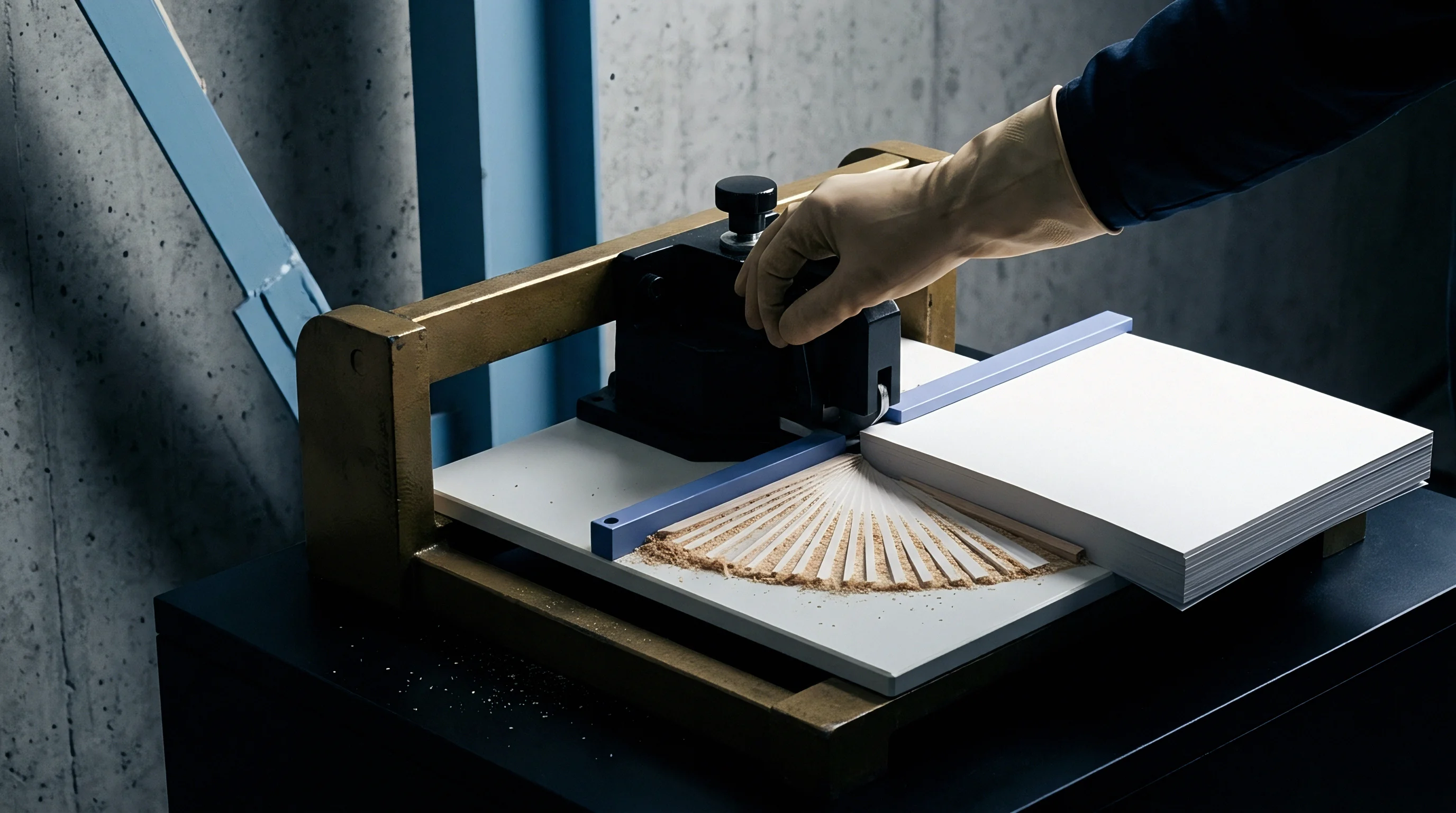
Female matrix channels define the volumetric clearance into which board plies are forced during male rule engagement. Counter matrix depth controls shear. Tooling wear destabilizes local strain.
As the male steel rule enters the channel, the substrate undergoes controlled delamination and folding, establishing a permanent hinge line. Incorrect channel dimensions force extreme compressive stress into the board core, crushing bulk density rather than initiating internal ply separation. Precision die-cutting at 350 impressions per minute demands channel widths calculated from board thickness and rule width, maintaining balanced clearance to prevent surface scuffing while maintaining sufficient depth for clean delamination.
Matrix Clearance Ratios for Dispersion Stock
Aqueous polymer dispersion coatings alter surface friction and lateral compressibility during tool contact. Calculating matrix width requires taking rule thickness, adding 1.5 times the board caliper, and accounting for the 15-micrometer barrier film layer. When scoring a 450-micrometer board with a 0.71-millimeter male rule, the optimal matrix channel width ranges between 1.38 and 1.43 millimeters.
If channel width drops below 1.30 millimeters, the excessive lateral confinement increases compressive stress beyond 45 megapascals, driving shear micro-cracks upward into the dispersion coating layer.
| Board Caliper (µm) | Rule Width (mm) | Matrix Width (mm) | Matrix Depth (mm) | Peak Shear Stress (MPa) | Barrier Intactness |
|---|---|---|---|---|---|
| 300 | 0.71 | 1.18 | 0.45 | 22.4 | Pass |
| 350 | 0.71 | 1.25 | 0.50 | 26.8 | Pass |
| 400 | 1.05 | 1.68 | 0.60 | 31.2 | Marginal |
| 450 | 1.05 | 1.75 | 0.65 | 38.5 | Fail |
| Data gathered under ISO 187 atmospheric conditioning using flatbed die-cutting at 300 strokes per minute. Peak shear calculated via dynamic finite element modeling verified against piezoelectric sensor pins. | |||||

Rule Width Selection across Board Calipers
Narrow scoring rules concentrate vertical force over a smaller surface area, initiating ply shear at lower penetration depths. However, an excessively thin rule generates sharp local strain peaks that exceed the ultimate elongation of dispersion polymers. Switching from a 0.71-millimeter rule to a 1.05-millimeter rule spreads the contact area, reducing peak strain on the coated surface by up to 18 percent.
This distribution protects barrier continuity during high-velocity die impact.
- Shear Banding Disruption occurs when insufficient matrix channel depth prevents internal ply separation, causing unpredictable surface bulges and uneven carton folding resistance.
- Coating Delamination Micro-Cracking emerges when tight channel clearances force lateral extrusion of top-layer fibers, tearing the overlying aqueous barrier layer.
- Core Crushing Failure arises when high male rule penetration combined with insufficient matrix width reduces board caliper permanently by over 60 percent without forming internal slip planes.
- Asymmetric Score Flange Tension develops when channel registration strays more than 0.05 millimeters off-center, causing unequal stress distribution during 180-degree carton erecting.
Purchase orders must specify scoring tool channel tolerances within plus or minus 0.02 millimeters to guarantee reproducible shear plane generation across high-speed runs.

Polymer
Aqueous dispersion coatings form continuous hydrophobic films over pulp fibers via latex particle coalescence during thermal drying. Polymer latex hardens under strain. These water-borne acrylic, styrene-butadiene, or polyhydroxyalkanoate formulations replace traditional extruded polyethylene, presenting fundamentally different mechanical responses under high-speed impact.
While extruded polyethylene exhibits high elongation at break exceeding 300 percent, synthetic latex dispersions achieve elongation rates between 40 and 120 percent. The thin polymer layer, typically applied at grammages between 6 and 14 grams per square meter, sits directly in the zone of maximum tensile strain during score formation and subsequent carton folding.
Viscoelastic Glass Transition and Strain Rate Shifts
Temperature shifts alter polymer chain mobility during deformation. Dynamic mechanical analysis shows that aqueous dispersion polymers possess glass transition temperatures ranging from 5 °C to 25 °C. At converting operating speeds where strain rates exceed 1000 s⁻¹, the effective glass transition temperature shifts upward by 10 °C to 18 °C. Operating a converting line at 18 °C when using a coating with a static glass transition of 15 °C moves the polymer into its brittle glass regime during impact. Microscopic cracks compromise barrier integrity.
The rigid latex particles can no longer deform plastically, leading to brittle fracture along the score line crease fold.
Dispersion coated boards conditioned at 23 °C and 50 percent relative humidity exhibit a 35 percent reduction in film fracture density when score line impact duration increases from 3 milliseconds to 15 milliseconds.
Testing Impact Resistance of Latex Films
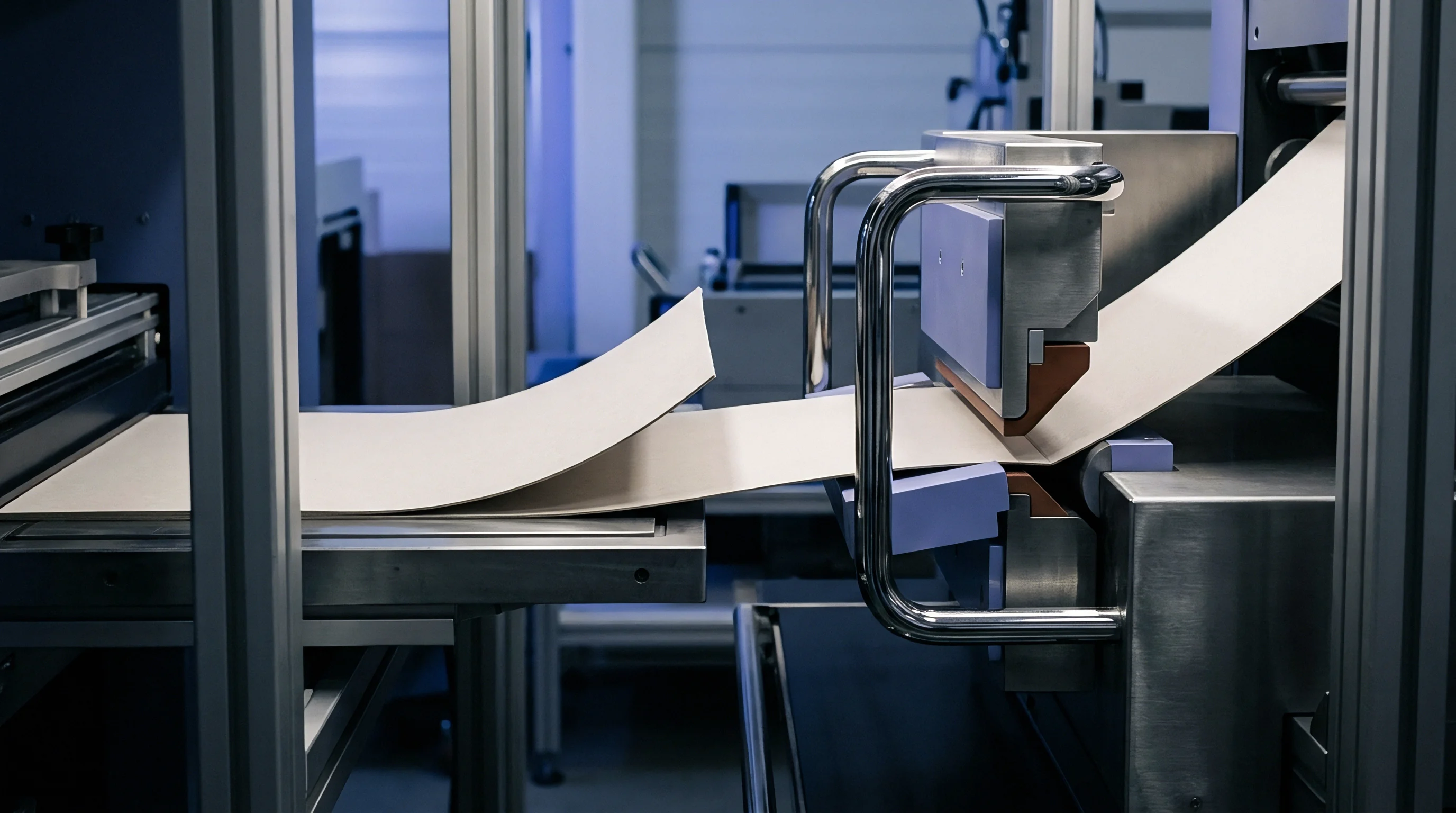
Evaluating coating performance prior to commercial production requires standardized dynamic testing workflows that replicate die-cutter strain rates. The sequence provides repeatable qualification parameters for high-speed converters.
- Cut representative board samples measuring 100 by 100 millimeters from web center and edge positions, ensuring square grain alignment.
- Condition samples per ISO 187 at 23 °C and 50 percent relative humidity for a minimum of 24 hours prior to dynamic impact testing.
- Mount sample into high-rate mechanical test bench equipped with a 0.71-millimeter steel scoring rule and custom load cell.
- Execute impact scoring at a calibrated velocity of 4.5 meters per second, capturing force-displacement profiles at a sampling rate of 100 kilohertz.
- Fold score line through 180 degrees using a motorized crease stiffness tester conforming to DIN 55437 at a constant angular rate of 15 degrees per second.
- Inspect folded surface under pinhole stain test using low-surface-tension dye solution according to EN 13676 to quantify barrier film ruptures per meter.
Coating suppliers frequently claim their latex chemistries provide universal drop-in compatibility for polyethylene replacement, yet testing reveals substantial variance in high-speed score flexibility.
Shear
Internal delamination along z-direction interfaces constitutes the functional core of high-quality score line formation. Ply detachment absorbs impact energy. When the scoring rule pushes into the board, out-of-plane shear stresses exceed the interlaminar bond strength of middle fiber layers, causing controlled micro-fractures along horizontal planes.
This internal delamination creates a flexible paperboard hinge, dramatically reducing the bending moment required to erect the packaging carton. Without controlled internal shear, the rigid board board resists bending, forcing outer fibers to stretch beyond their ultimate tensile strain limits and rupturing both pulp and dispersion barrier coatings.

How Does Crease Depth Control Internal Delamination?
Rule penetration distance determines the magnitude and vertical distribution of shear strain within the fiber network. Insufficient penetration below 50 percent of total board caliper fails to generate high enough shear stress to break inter-fiber hydrogen bonds, resulting in poor crease memory and high fold resistance stiffness. Over-penetration exceeding 85 percent of caliper crushes board bulk, damaging the bottom liner and causing severe stress concentrations that snap the top liner upon 90-degree folding.
Optimal crease depth achieves complete shear plane detachment throughout middle plies while maintaining outer liner structural integrity.
Standard delivery contracts stipulate that internal bond strength measured via TAPPI T 569 Scott Bond test must fall within 120 to 180 Joules per square meter to guarantee uniform score line delamination without surface cracking.
Energy Dissipation across Distinct Furnish Layers
Multi-ply paperboards utilize varied furnish compositions across outer and inner layers to maximize flexural rigidity at minimal weight. Top plies feature strong, long-fiber bleached softwood kraft, while middle plies incorporate thermomechanical pulp or recycled furnish with low internal bond strength. The low bond strength middle ply acts as a built-in strain relief zone.
During impact, shear crack propagation remains confined within this middle zone, dissipating mechanical energy laterally rather than vertically toward the coated surface coating layer.
| Furnish Grade | Grammage (g/m²) | Scott Bond (J/m²) | Critical Shear Strain (γ_crit) | Delamination Energy (J/m) |
|---|---|---|---|---|
| Solid Bleached Board (SBB) | 300 | 210 | 0.085 | 45.2 |
| Folding Boxboard (FBB) | 350 | 145 | 0.052 | 28.6 |
| Coated Recycled Board (CRB) | 400 | 110 | 0.038 | 19.4 |
| Dispersion Coated FBB | 350 | 140 | 0.050 | 27.8 |
Whether dynamic shear strain distribution models can accurately predict microscopic barrier pinhole creation in ultra-thin dispersion coatings running at speeds above 500 meters per minute remains an open engineering question.

Tension
Subsequent folding converts score line microstructures into active bending hinges subjected to extreme outer surface stretching. Bending forces concentrate outer strain. As a scored blank is folded through 180 degrees on high-speed folder-gluers, the dispersion coated top liner faces severe tensile strain along the outer radius.
Elastic deformation of the dispersion film must accommodate this elongation without initiating micro-fissures that degrade gas and water vapor barrier properties. If the underlying pulp fiber matrix has delaminated correctly in shear during scoring, the neutral axis shifts inward, minimizing outer tension.

Outer Surface Strain during Carton Folding
Mathematical modeling of score line bending geometry shows that tensile strain in the outer liner depends directly on remaining board thickness along the crease root and fold angle. For a 400-micrometer board folded through 180 degrees, the tensile strain on the top surface layer reaches 8 to 14 percent depending on score delamination efficiency. Untreated long kraft fibers tolerate up to 10 percent strain before fracture, but cross-linked acrylic dispersion coatings can fail at strains as low as 6 percent when applied over uneven fiber topographies.
Coating cohesion depends strongly on moisture content, where a 2 percent drop in board moisture increases surface film cracking incidence by over 40 percent during high-speed folding.

Humidity Conditioning Effects on Coating Cohesion
Pulp fibers absorb and desorb atmospheric water vapor rapidly, altering sheet flexibility and strain tolerance. Dry board increases cracking risks. Moisture acts as a natural plasticizer within the cellulosic fiber network and the water-borne polymer film.
When ambient relative humidity drops below 40 percent in unconditioned converting plants, board moisture content falls below 5.5 percent, increasing fiber elastic modulus and lowering ultimate strain to break. Scoring dry board creates sharp strain peaks that split the top liner and tear the barrier film.
- Relative Humidity Control Target mandates maintaining converting floor atmospheric conditions between 50 and 55 percent relative humidity at 23 °C to maintain board moisture between 6.5 and 7.5 percent.
- Water Vapor Transmission Rate Verification requires testing folded score lines under ISO 2528 conditions to confirm moisture barrier degradation stays below 10 percent compared to flat un-creased board.
- Crease Bending Resistance Limit sets maximum peak bending moment targets per DIN 55437 to prevent carton bulging and erecting machine jams on automated packaging lines.
- Surface Fiber Separation Threshold defines maximum allowable top-liner cracking length under 20x optical magnification following standard 180-degree crease fold testing.
Ignoring environmental conditioning control during autumn and winter production shifts results in catastrophic batch failures where barrier packaging loses liquid tightness along every folded edge.
Yield
Defects occurring at high-speed score lines dictate total commercial run efficiency and converting landed unit costs. Line stoppages raise overall waste. Tonnage arithmetic governs supplier selection.
Moisture control prevents scoring defects. Correct clearance protects barrier continuity. When dispersion coated boards crack along score lines, barrier properties fail, rendering the packaging unsuitable for perishable food products.
Beyond direct material scrap generated at the die-cutter, cracked score lines lead to line stoppages on high-speed filling machinery, driving up operational downtime overhead and eroding overall profitability.
Converting Waste Calculations on High Speed Lines
Calculating the true landed cost of dispersion coated cartonboard requires factoring in scrap percentages resulting from score line defect rates. Consider a production order of 50 tonnes of 350 gram per square meter dispersion coated folding boxboard purchased at a base rate of 1,650 Euros per tonne. At a press speed of 350 sheets per minute, a 3 percent score-cracking reject rate generates direct material loss and press downtime penalties.
Evaluating waste arithmetic across three substrate run scenarios highlights the financial risk of improper stock qualification.
| Parameter | Standard FBB (Baseline) | High-Flexibility FBB | Sub-Optimal Recycled Board |
|---|---|---|---|
| Base Tonnage Price (€/tonne) | 1,650 | 1,820 | 1,420 |
| Delivered Tonnes | 50.0 | 50.0 | 50.0 |
| Total Parent Sheets Yielded | 380,000 | 380,000 | 380,000 |
| Score Line Defect Rate (%) | 4.2% | 0.5% | 8.5% |
| Defective Cartons (Units) | 15,960 | 1,900 | 32,300 |
| Press Downtime Cost (€) | 3,200 | 400 | 6,800 |
| Net Usable Cartons | 364,040 | 378,100 | 347,700 |
| Final Landed Cost per 1,000 Cartons (€) | 235.40 | 241.70 | 223.75 |

Landed Cost Impact of Score Line Failures
Although sub-optimal recycled stock displays a lower initial purchase price per tonne, high defect rates resulting from poor internal shear delamination dramatically reduce total usable carton output. Press downtime penalties combined with scrap losses narrow the apparent price advantage. Conversely, paying a premium for a high-flexibility folding boxboard with tailored internal ply bond strength eliminates scoring fractures, maximizing net carton yield and preventing downstream commercial non-conformance claims.
In high-speed food packaging lines, a 1 percent increase in carton score line cracking increases customer filling line rejection costs by an average of 4,200 Euros per shift.
Specifying board furnish parameters and dispersion polymer elongation characteristics within substrate purchasing specifications remains essential for securing reliable high-speed converting performance. Establishing clear receiving inspection protocols for Scott Bond internal strength, board moisture content, and coating glass transition temperature protects buyers from costly production failures. Rigorous material qualification bridges the gap between laboratory swatch promises and real-world converting floor performance.