Calculating Surface Temperature Limits during High Speed Thermal Paperboard Embossing
Maximum surface temperature limits during high-speed paperboard embossing are bounded by latex binder scorching and steam-induced Z-direction blistering.


Heat
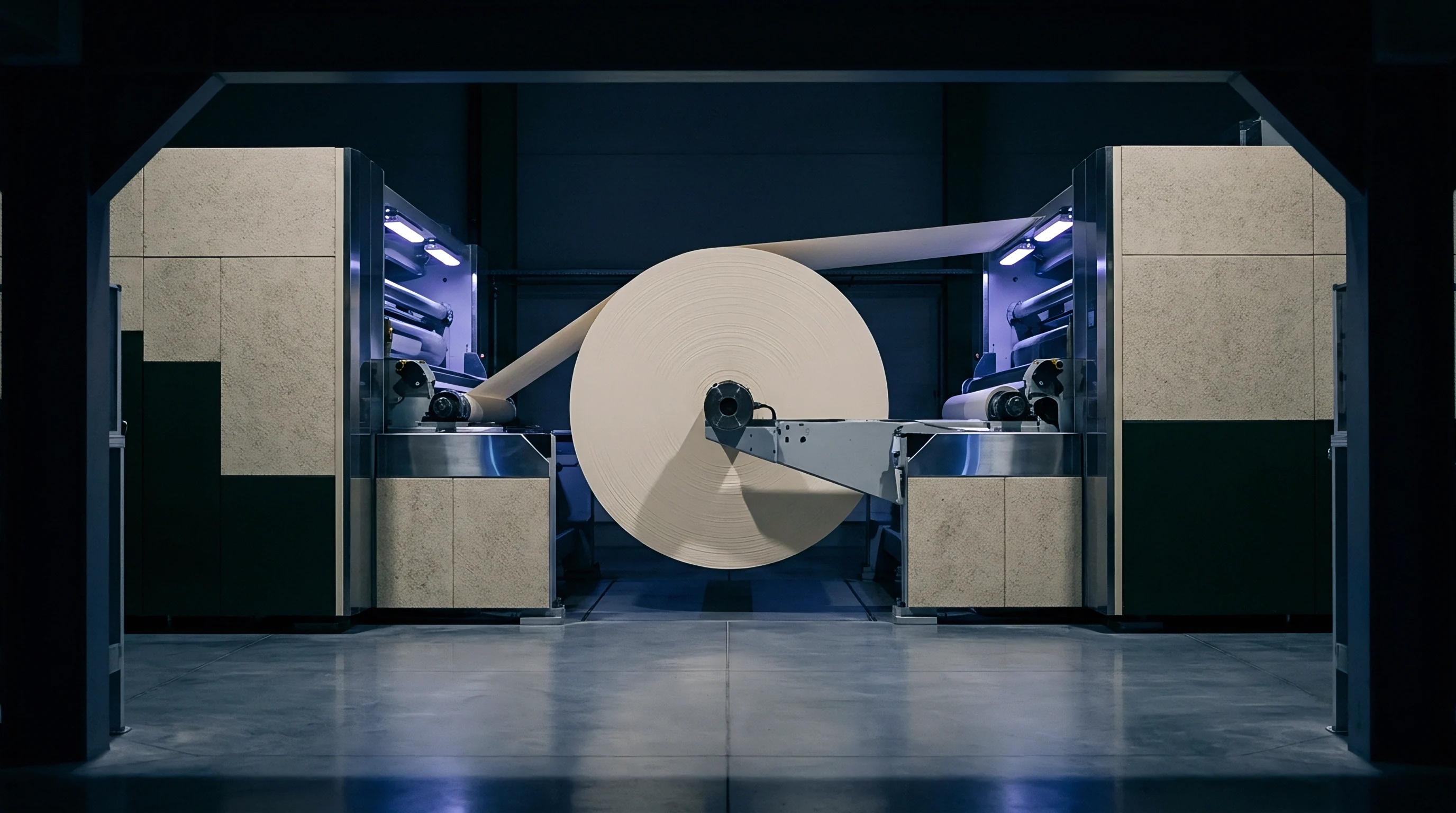
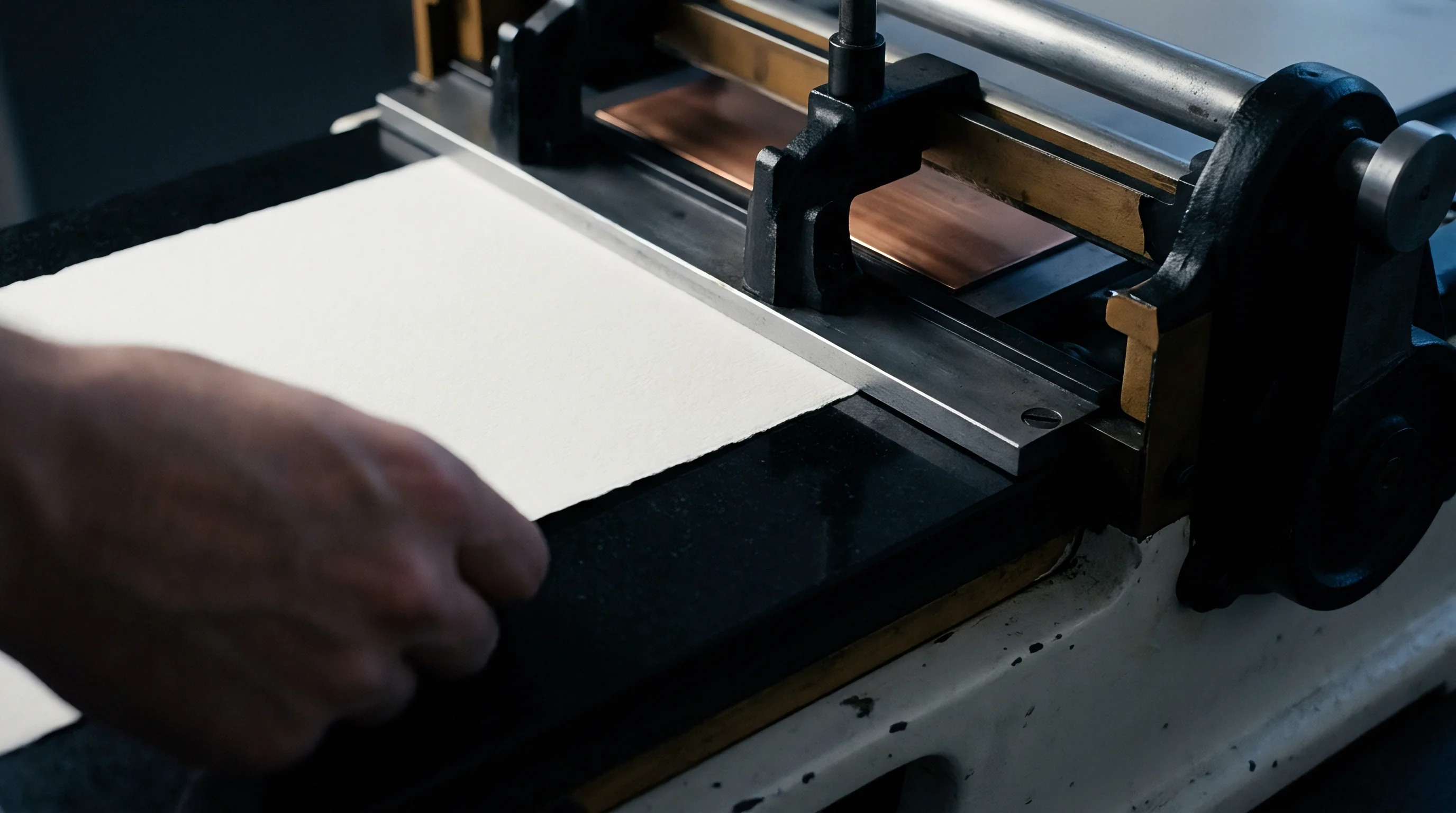
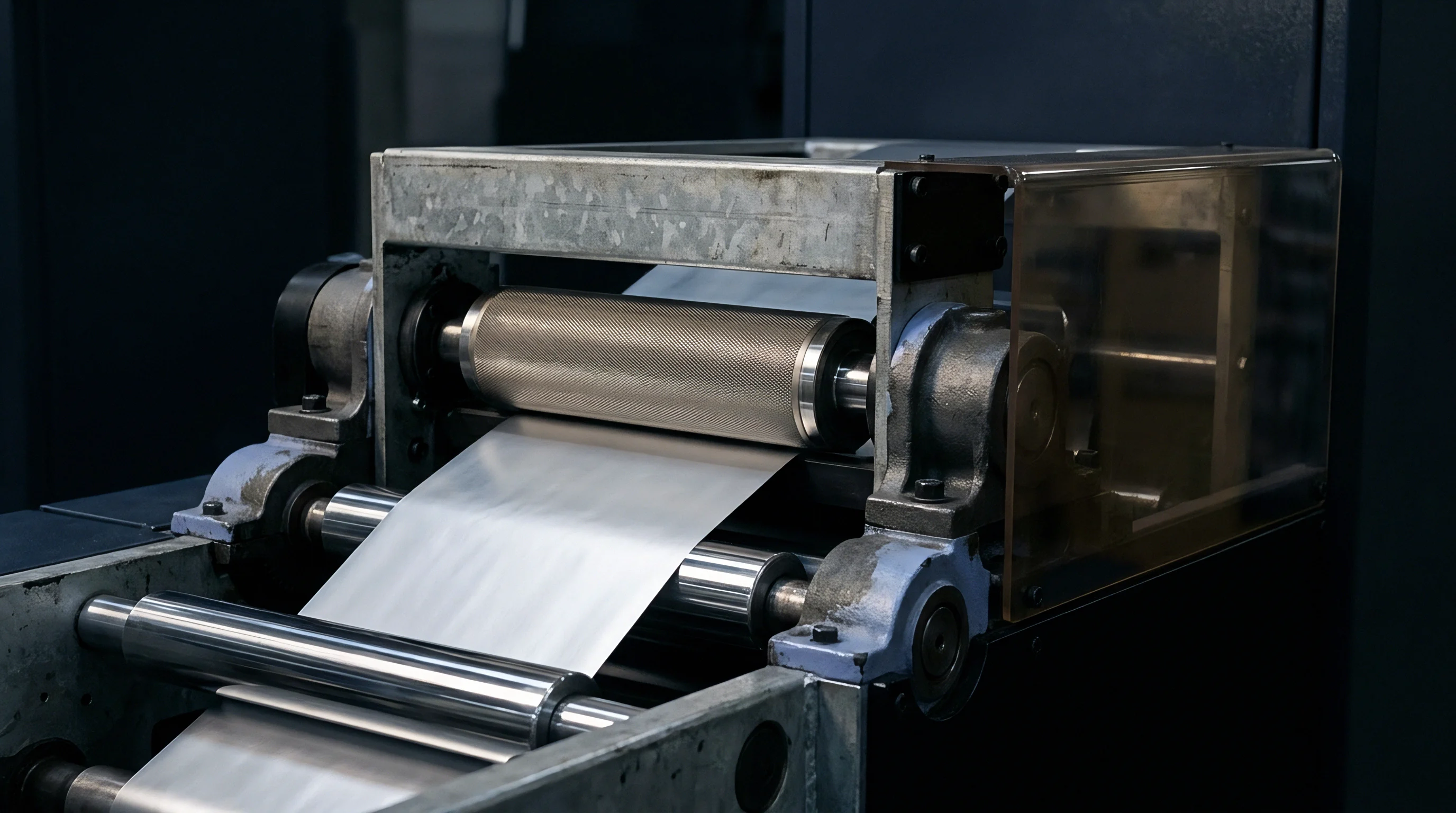
In high-speed rotary embossing operations running between 120 and 300 meters per minute, solid brass or hardened steel engraved cylinders supply thermal energy directly to the top surface of moving folding cartonboard. Heat softens the synthetic binder matrix in clay-coated surfaces and relaxes cellulose fibers long enough for the male-female tool set to permanently re-form the board structure without cracking the outer coating layer. Operating temperature boundaries are determined by transient thermal contact dynamics rather than steady-state bulk board equilibrium, because dwell time inside a rotary nip lasts only between 4 and 20 milliseconds.
When the heated metallic die contacts the moving substrate, thermal conduction across the interface causes an instantaneous shift in surface temperature. Standard solid bleached sulfate (SBS) board with a grammage of 300 grams per square meter entering the nip at 21 degrees Celsius experiences rapid surface heating that decays exponentially with depth into the sheet thickness. If the heated tool set sits at 160 degrees Celsius, the interface temperature immediately reaches a value determined by the thermal effusivity ratio of the two contacting materials.
Thermal effusivity ratios between hardened tool steel and clay-coated cartonboard force the surface contact temperature within two degrees of the tool face temperature within one millisecond of contact.

Transient Thermal Energy Transfer at Die Interface
Convective air cooling becomes negligible inside the closed nip, leaving pure heat conduction as the governing physical process. Heat flux across the boundary relies on the surface roughness of both the engraved metallic die and the coated board layer. Microporosity and micro-roughness create trapped air pockets that act as localized thermal insulators, reducing the real contact area to 35 to 60 percent of the total nominal impression area under nominal nip pressures ranging from 15 to 35 megapascals.
Calculating the true surface contact temperature requires modeling the conductive boundary condition between a semi-infinite solid tool and a non-homogeneous multi-layer substrate. Thermal diffusivity governs how quickly the thermal wave penetrates the clay coating layer into the underlying paperboard fibers. Clay coatings containing calcium carbonate or kaolin bound with styrene-butadiene latex possess thermal conductivities between 0.25 and 0.42 Watts per meter-Kelvin, whereas the bulk cellulosic fiber layer below exhibits thermal conductivities of only 0.11 to 0.16 Watts per meter-Kelvin.
| Material Layer | Density (kg/m3) | Thermal Conductivity (W/m K) | Specific Heat (J/kg K) | Thermal Effusivity (J/m2 K s0.5) |
|---|---|---|---|---|
| Hardened Tool Steel (1.2379) | 7850 | 30.00 | 460 | 10410 | C21000 Engraving Brass | 8730 | 115.00 | 380 | 19520 | Clay Coating Layer (SBR/CaCO3) | 1650 | 0.35 | 1250 | 850 | SBS Fiber Matrix (12% Moisture) | 780 | 0.14 | 1350 | 384 |
| Recycled Board (CRB/GD2) | 680 | 0.11 | 1400 | 324 |

Thermal Effusivity Mismatch between Tool and Substrate
Effusivity quantifies the ability of a material to exchange thermal energy with its surroundings during transient contact. Steel or brass tooling displays effusivity values forty to fifty times higher than the paperboard substrate. During initial physical contact, the interface temperature instantly snaps to a value dominated by the metallic cylinder, calculated through the standard contact equation:
T_interface = (b_tool T_tool + b_board T_board) / (b_tool + b_board)
Where b represents thermal effusivity, calculated as the square root of the product of thermal conductivity, density, and specific heat capacity. Because the effusivity of the metallic tool dwarfs that of the paperboard layer, the contact interface temperature settles within 1.5 to 3.0 degrees Celsius of the actual tool temperature during the entire duration of the nip contact pass.
Controlling the process requires maintaining the surface temperature within a narrow window. The minimum limit must exceed the glass transition temperature of the coating latex binder to prevent micro-fracturing along high-relief emboss crests. The maximum limit must remain strictly below the thermal degradation threshold of the optical brighteners and the moisture flash point that causes substrate delamination.

Transit
Line velocity dictates the precise duration that an element of paperboard remains clamped under pressure against the heated cylinder. Dwell time varies inversely with web speed, meaning a line accelerating from 80 meters per minute to 240 meters per minute drops the thermal contact duration from 18.8 milliseconds to 6.2 milliseconds on a 200 millimeter diameter embossing roller with a 25 millimeter nip footprint width.
Shorter contact time reduces the depth to which thermal energy diffuses into the sheet structure. Heat penetration depth is proportional to the square root of the product of thermal diffusivity and dwell time. At high running speeds, thermal energy remains localized in the outer 10 to 20 micrometers of the clay coating layer, failing to warm the underlying structural cellulose fibers required to yield permanent mechanical deformation.
Dwell Time and Penetration Depth Dynamics
Operators frequently compensate for higher running speeds by increasing the setpoint temperature of the heated roll. Elevating the roll temperature from 140 degrees Celsius to 195 degrees Celsius restores the heat flux transferred into the top surface during a brief 5 millisecond window. Excessive cylinder temperatures create steep thermal gradients across the z-direction of the sheet that cause immediate surface defects while leaving the deeper board layers cold and elastic.
Thermal wave propagation across the thickness of the sheet follows Fourier second law of unsteady state conduction. The characteristic thermal penetration depth x_p, defined as the depth where the temperature change reaches 13.5 percent of the surface temperature jump, is calculated using the following relation:
x_p = 2 sqrt(alpha t_d)
Where alpha is the substrate thermal diffusivity and t_d is the nip dwell time. For a typical coated cartonboard with a thermal diffusivity of 1.70 x 10^-7 square meters per second running at a dwell time of 8 milliseconds, the thermal wave penetrates approximately 73 micrometers into a sheet that may measure 350 micrometers in total caliper.
Thermal penetration depth scales directly with the square root of dwell time, making speed adjustments non-linear in their impact on substrate heat absorption.
Machine Velocity Influence on Contact Energy
Increasing velocity without adjustments to roll temperature causes insufficient binder softening, resulting in surface micro-cracking along score lines and raised embossing patterns. Mechanical stress imposed by the sharp edges of the tool splits the cold, unyielding pigment layer. Adjusting the system requires precise mapping between web speed, nip width, roll surface temperature, and substrate moisture content.
Calculations must account for the rapid reduction in effective contact pressure as velocity increases. Dynamic viscoelastic response of the board fiber matrix means higher strain rates increase the apparent stiffness of the board, requiring higher localized thermal softening to achieve the same mechanical impression depth. The required surface temperature limit must therefore shift higher as line speed increases, bounded strictly by the thermal stability of the top surface components.
- Measure baseline board temperature using a calibrated infrared pyrometer immediately prior to entering the heated embossing unit.
- Determine target penetration depth based on substrate caliper, selecting a minimum target depth equal to the maximum relief depth of the embossing die tooling.
- Calculate required dwell time using line velocity and physical nip footprint width measured under dynamic load using pressure-sensitive film.
- Compute maximum interface temperature using the non-steady conduction formula to prevent internal moisture vapor pressure from exceeding z-directional tensile strength.
- Verify post-emboss surface integrity using a dye-penetrant test to detect microscopic ruptures in the clay coating matrix.
Increasing production speed by fifty percent requires an elevated die temperature that shortens tool lifespan unless bearing lubrication and thermal expansion allowances are resized accordingly.
Scorch
Thermal degradation occurs when surface temperatures exceed the structural stability threshold of organic and inorganic components in the board coating. Clay-coated folding boxboard typically uses styrene-butadiene or styrene-acrylic polymers as binding agents to hold calcium carbonate and kaolin clay particles to the raw fiber surface. When surface temperatures surpass 185 degrees Celsius for more than 10 milliseconds, these synthetic polymers undergo thermal depolymerization and cross-linking, causing yellowing, gloss loss, and severe embrittlement.
Optical brightening agents (OBAs) blended into the coating formulation are particularly sensitive to thermal overexposure. Stilbene-based fluorescent whitening agents begin thermal breakdown at 165 degrees Celsius, resulting in immediate loss of ultraviolet fluorescence and a drop of 2 to 5 ISO brightness points on the finished carton face. Heat-induced discoloration creates severe batch-to-batch color variation across the production run.
Optical brightening agents exposed to surface temperatures above 165 degrees Celsius suffer permanent degradation, dropping finished board brightness by up to five ISO points.

Why Do Coated Paperboards Blister before Reaching Embossing Depth?
Blistering is driven by the explosive vaporization of free water trapped within the porous structure of the paperboard core. Paperboard stored at standard climate conditions of 23 degrees Celsius and 50 percent relative humidity holds an equilibrium moisture content between 6.0 and 8.0 percent by weight. When the heated embossing die contacts the sheet, surface water immediately vaporizes into superheated steam.
If the surface clay coating layer is dense and non-porous, generated steam cannot escape rapidly through the top surface. Moisture vapor pressure accumulates within the Z-directional layer of the board substrate. When internal steam pressure exceeds the internal bond strength (Scott Bond value) of the fiber matrix, typically between 150 and 250 Joules per square meter, the board splits internally, creating hollow raised pockets known as thermal blisters.
| Failure Mode | Physical Mechanism | Critical Temperature Range | Primary Substrate Vulnerability |
|---|---|---|---|
| Thermal Blistering | Internal steam expansion exceeding z-strength | 145°C – 170°C | High moisture content (>7.5%), low porosity coating | OBA Discoloration | Pyrolysis of fluorescent whitening molecules | 160°C – 180°C | High-brightness SBS boards with stilbene additives | Latex Scorching | SBR binder depolymerization and charring | 185°C – 210°C | High binder-to-pigment ratio coating formulations |
| Coating Flaking | Extreme embrittlement from binder cross-linking | 175°C – 200°C | Low latex content, over-dried coating layers |
| Foil Pick-Off | Pre-applied foil adhesive remelting and offset | 130°C – 155°C | Cold-foil or hot-stamp foil decorated substrates |

Binder Softening and Clay Layer Disruption
Maintaining temperature below the blistering threshold requires precise management of the maximum allowable surface heat flux. Binder softening is necessary to make the clay layer pliable, but excess heat reduces the cohesive strength of the latex polymer to near zero. Under heavy mechanical shear inside the nip, softened latex adheres to the hot brass die face, causing coating pick-off and buildup on the metal die tool that ruins subsequent impressions.
Coating formulation adjustments offer some protection against high-speed thermal failure. Replacing styrene-butadiene latex with high-temperature acrylic binders elevates the blistering threshold by 15 to 20 degrees Celsius. Elevating kaolin content relative to calcium carbonate reduces thermal conductivity, providing a minor shield to the moisture-laden core fibers below, though this reduces overall coating brightness and flexibility during folding operations.
Exceeding the maximum surface thermal threshold results in rejected pallets, severe dusting on downstream gluer lines, and complete delamination during packaging filling operations.


Arithmetic
Calculating the maximum surface temperature limit for a high-speed thermal embossing pass requires solving a transient heat transfer model combined with a water phase-change pressure equation. The upper thermal boundary T_max is reached when internal vapor pressure P_v equals the Z-directional tensile strength sigma_z of the paperboard at the current operating moisture content and temperature.
The Clausius-Clapeyron equation models the saturation vapor pressure generated by free moisture as a function of local temperature inside the board core. Combining this with transient heat diffusion yields a clear upper ceiling for allowable die face temperatures under specific operational parameters.
Multi Variable Energy Balance Formula
The interface temperature between die tool and board is governed by the transient heat conduction model for two semi-infinite bodies in contact. Temperature at a specific depth z below the surface after dwell time t_d is expressed through the complementary error function (erfc):
T(z, t_d) = T_initial + (T_interface – T_initial) erfc( z / (2 sqrt(alpha t_d)) )
To prevent internal steam blistering, the temperature at the interface between the clay coating and the fiber core (typically at depth z = 20 micrometers) must not force the internal vapor pressure to exceed the internal bond strength of the sheet. The vapor pressure of water as a function of local temperature T in Kelvin can be approximated using the Antoine equation:
log10(P_v) = A – (B / (T – C))
Where P_v is pressure in bar, and A, B, and C are Antoine constants for water (A = 5.20389, B = 1733.926, C = -39.485 for temperatures between 99 and 374 degrees Celsius). Setting P_v equal to the Z-tensile strength of the sheet provides the absolute thermal ceiling at the coating-fiber interface.

Worked Calculation for a Rotary Nip Line
Consider a commercial run using a 350 micrometer thick SBS folding boxboard with a moisture content of 6.5 percent, an initial temperature of 22 degrees Celsius, and an internal z-directional tensile strength of 280 kilopascals (2.8 bar absolute pressure). The line runs at 180 meters per minute through a rotary embossing unit with a dynamic nip width of 20 millimeters. The coating thickness is exactly 22 micrometers, with a thermal diffusivity alpha of 1.65 x 10^-7 square meters per second.
- Calculate dwell time t_d by dividing nip footprint width by web velocity: 0.020 meters divided by 3.0 meters per second yields 0.00667 seconds (6.67 milliseconds).
- Determine critical internal temperature by solving Antoine equation for P_v = 2.8 bar: yields a maximum allowable core interface temperature of 131.3 degrees Celsius.
- Calculate thermal diffusion length term: twice the square root of alpha times t_d equals 0.0000663 meters (66.3 micrometers).
- Evaluate error function argument at z = 22 micrometers: 22 divided by 66.3 yields 0.332. The value of erfc(0.332) is approximately 0.641.
- Solve for maximum interface temperature using transient diffusion formula: 131.3 = 22 + (T_interface – 22) (1 – 0.641), which yields T_interface = 325.6 degrees Celsius theoretically, but actual die surface limit is constrained by latex degradation at 180.0 degrees Celsius.
- Select governing operational constraint by taking the minimum of blistering limit and latex degradation threshold: final operational setpoint ceiling is 175.0 degrees Celsius.
| Line Speed (m/min) | Dwell Time (ms) | Penetration Depth (µm) | Blister Temperature Limit (°C) | Latex Thermal Limit (°C) | Governing Die Max Temp (°C) |
|---|---|---|---|---|---|
| 100 | 12.00 | 88.9 | 152.0 | 180.0 | 152.0 |
| 150 | 8.00 | 72.6 | 164.5 | 180.0 | 164.5 |
| 200 | 6.00 | 62.9 | 176.0 | 180.0 | 176.0 |
| 250 | 4.80 | 56.2 | 188.5 | 180.0 | 180.0 |
| 300 | 4.00 | 51.3 | 199.0 | 180.0 | 180.0 |
Specialized nickel-teflon die coatings allow running temperatures up to 220 degrees Celsius without board damage, but running at these temperatures ignores internal moisture vapor expansion within the underlying fiber network.
Margin
Verifying surface temperature compliance across a high-speed production run requires continuous, calibrated measurement techniques that account for the low emissivity of polished metal dies and moving paperboard surfaces. Standard non-contact infrared pyrometers misread polished brass cylinders due to thermal reflections from surrounding press components. Emissivity settings must be locked to 0.95 for clay-coated board surfaces and 0.22 for polished brass tooling, or cross-checked using high-speed thermal imaging cameras equipped with narrow-band filter optics operating at 7.9 micrometers, where paper coatings behave as pure blackbody emitters.
Quality assurance protocols demand offline destructive testing of first-off sheets and samples pulled every five thousand impressions. Optical 3D surface profiling, using white-light interferometry or chromatic confocal microscopy, quantifies embossing depth retention and detects micro-fractures in the clay layer before structural failure reaches the packaging line.

Verification Protocols for Surface Integrity
Evaluating coating damage requires applying a low-viscosity dye penetrant solution composed of 1 percent methylene blue in an isopropyl alcohol-water mixture to the embossed area for 10 seconds, then wiping clean. Any microscopic cracking of the clay layer allows dye absorption into the underlying raw fibers, showing dark blue streak lines under visual inspection. Samples failing the dye test indicate that the die surface temperature dropped below the binder glass transition point or exceeded the latex embrittlement limit.
Measuring internal bond strength degradation post-embossing provides an early warning indicator for incipient thermal blistering. A loss of Scott Bond strength exceeding 15 percent compared to unheated raw board stock confirms that internal steam pressure compromised the Z-directional fiber orientation, even if visible surface blisters have not yet erupted.
- Online thermal imaging calibration using multi-channel infrared sensors aligned across the full web width to detect hot spots.
- Offline Scott Bond energy testing according to TAPPI T 569 standards on pulled production samples to quantify Z-strength loss.
- Dye penetrant micro-fracture analysis applied along high-strain embossing crests to verify binder flexibility.
- Brightness and colorimeter sweeps according to ISO 2470 to ensure optical brightening agents remain uncompromised.
- Gloss measurement at 60 degrees using ISO 2813 test methods to detect localized surface scorching and resin re-flow.
Financial Impact of Thermal Overexposure Waste
Improperly calibrated embossing temperatures incur high financial costs during long-run production orders. A high-speed line running 350 gsm cartonboard at 200 meters per minute processes roughly 4.2 tonnes of premium substrate per hour. Running at excessive temperatures that cause micro-fracturing or subtle OBA yellowing can result in full pallet rejections at the customer packaging plant during high-speed automated cartoning.
Waste costs compound rapidly when added processing steps are considered. An embossed job typically carries the costs of print passes, cold foil application, and precision scoring. Scorching or blistering at the final embossing step destroys the accumulated value of all prior converting operations, turning a high-margin job into an unrecoverable waste ledger entry.
Purchasing specifications must incorporate strict thermal processing limits, specifying that any delivered carton lot exhibiting a surface brightness loss greater than 1.5 ISO points or a Z-directional bond degradation exceeding 10 percent relative to baseline stock will result in full material rejection at the converter dock.