Dynamic Crease Stiffness Reduction Ratios under Ultra High Speed Packaging Line Strain Rates
Dynamic crease stiffness reduction ratios must be evaluated under operational strain rates of 1000°/s to 5000°/s to prevent high-speed cartoning line jams.

Rheology

Viscoelastic Breakdown of Cellulosic Networks
Folding paperboard requires controlled internal damage across the fibre matrix. When a male rule presses a crease into multi-ply board, the mechanical work breaks hydrogen bonds between fibres and separates internal lamina along designated shear planes. Standard lab tests like ISO 2493 or TAPPI T 553 evaluate bending resistance slowly, at angular deflection rates of 15 degrees per second.
These quasi-static conditions give polymer chains in the cell wall ~ specifically hemicellulose and amorphous cellulose ~ time to reorient and dissipate stress through molecular relaxation. As a result, static bending moments reflect a structural network that has already relaxed while being bent.
High-speed cartoning equipment operates under very different physical constraints. Packaging lines running between 600 and 1200 cartons per minute drive pre-creased flaps through 90-degree or 180-degree folds in just 4 to 12 milliseconds. Local strain rates along the crease line jump to between 1000 and 5000 per second.
Under these rapid strain rates, paperboard responds far more stiffly. Because the molecular relaxation time of hydrated cellulose is longer than the folding event itself, the board stores more elastic strain energy and resists permanent plastic deformation much more aggressively than static lab instruments indicate.
The key metric governing carton erection at line speed is the dynamic crease stiffness reduction ratio. In static laboratory testing, the crease recovery ratio equals the moment required to fold a creased score line divided by the bending moment of the uncreased board stock. The dynamic ratio captures this relationship under operational strain rates.
Rapid folding increases both uncreased stiffness and creased score resistance, but not equally. Internal delamination requires micro-scale structural sliding, which kinetic limits restrict during rapid impact, leaving the score line with higher residual elastic memory during high-speed folding.
The bending moment of 400 micrometre folding boxboard increases by 34 percent when the folding velocity scales from 15 degrees per second to 1200 degrees per second under ISO 187 standard atmosphere.
Strain Rate Sensitivity in Multi-Ply Structures
Multi-ply paperboard grades respond to dynamic strain based on layer architecture and furnish distribution. Solid Bleached Board, made entirely of bleached chemical pulp, uses long, flexible softwood fibres in the outer layers and refined hardwoods in the core. Under rapid deflection, these chemical pulp fibres show high tensile strength and strong elastic recovery.
As strain rates climb, Solid Bleached Board exhibits a steep rise in crease spring-back force. Strong inter-fibre bonding within chemical pulp layers resists localized micro-delamination under millisecond pulses, forcing the score line to store strain energy rather than dissipating it through fibre slip.
Folding Boxboard sandwiches a mechanical pulp core ~ such as thermomechanical or groundwood pulp ~ between chemical pulp surface layers. Mechanical fibres are short, stiff, and high in hydrophobic lignin. Under static bending, this bulky core yields easily in shear, generating micro-cracks that deaden the crease.
Under high strain rates, however, the lignin matrix acts like a rigid polymer below its glass transition temperature. The rapid shear pulse fails to form clean delamination planes through the thick core. Force propagates outward instead, causing top-liner tension fractures or high residual spring-back against cartoner folding shoes.
White Lined Chipboard shows the greatest strain rate sensitivity because of its mixed recycled fibre stock. Successive recycling shortens fibres, strips surface micro-fibrils, and builds up inorganic fillers like calcium carbonate. Under static conditions, recycled cores have lower shear strength than virgin layers.
Under high strain rates, that low shear strength leads to chaotic delamination spreading well past the crease line. The dynamic crease reduction ratio for recycled board drops non-linearly as line speeds rise, often causing side-wall bulging or corner tearing during cartoning.
Quantifying this viscoelastic shift requires analyzing the rate-dependent modulus of the board. The modified Maxwell model describes dynamic stress as a function of strain rate:
stress = Elastic Modulus strain + Viscosity (strain rate)^m
where m represents the strain rate sensitivity exponent of the furnish. For virgin chemical pulp, m ranges from 0.08 to 0.14, while heavily filled recycled furnishes fall between 0.15 and 0.22. A higher exponent means that as cartoner speeds increase, the force needed to fold the carton rises more rapidly, altering the mechanical balance on automated lines.
Thicker board calipers demand non-linear increases in matrix groove width to maintain dynamic delamination zones under rapid strain.
Fibre alignment from the paper machine wet end amplifies these dynamic stiffness variations. Machine direction orientation aligns fibres parallel to reel length, producing high tensile stiffness and bending resistance. Cross direction alignment has lower stiffness but higher strain capacity.
When a crease runs along the machine direction, folding perpendicular to main fibre orientation relies entirely on inter-fibre bond shear. Under dynamic strain rates, machine direction creases display up to 45 percent higher residual spring-back than cross direction creases on the same layout, directly affecting folder-gluer stability.
Smooth carton erection depends on dropping dynamic crease stiffness to a specific fraction of uncreased board stiffness. If the dynamic reduction ratio remains too high, the score line acts like a rigid hinge, drawing excess power from the cartoner and distorting flat panels. If the ratio drops too low, the crease loses structural integrity and collapses during high-speed tucking.
Specifying packaging without accounting for rate-dependent stiffness frequently leads to failure at scale.
High board moisture lowers the glass transition temperature of amorphous hemicellulose, speeding up molecular relaxation during rapid strain. Conversely, dry winter conditions freeze these polymer chains into a rigid state, heightening dynamic stiffness spikes and cracking outer coatings during fast folding strokes.
Converting lines running without real-time dynamic stiffness metrics routinely miscalculate required crease depth ~ setting press tooling for static lab approval while suffering high jam rates on high-speed packaging lines.

Geometry
Creasing Rule and Matrix Interaction Dynamics
The mechanical impression from a creasing rule establishes the physical limits of folding performance. Tooling geometry depends on three main parameters: male rule width, female matrix channel width, and rule penetration depth. Standard setup calculations derive these dimensions from static board thickness ~ setting groove width equal to rule thickness plus twice the board caliper, adjusted by a clearance factor.
This static formula assumes paperboard compresses uniformly and that internal delamination stays strictly within the male rule footprint.
High-speed flatbed or rotary die-cutting changes this geometry. At press speeds of 8,000 to 12,000 sheets per hour, rule-to-board impact drops below 10 milliseconds. Because paperboard contains trapped air within its porous matrix, rapid compression prevents air from escaping through surface pores.
This air trapping generates transient pore pressure that resists mechanical compaction. Effective core compression decreases during high-speed die-cutting, requiring deeper nominal penetration to match the physical shear displacement seen in slow hand-proofer tests.
Matrix channel profiles govern how shear stress spreads across board layers. Standard rectangular channels create sharp stress concentration points at upper channel shoulders. Under high strain rates, these sharp edges shear the bottom liner, causing surface ruptures known as liner splitting.
Radiused or chamfered shoulders spread dynamic shear across a wider zone, promoting internal layer separation without cracking the surface. The shoulder radius must match the dynamic bending radius of the specific caliper to maintain clean delamination channels at high velocity.
Creasing rule edge profiles also influence dynamic strain distribution. Standard semi-circular tips concentrate compressive forces along the central axis of the crease, driving middle plies outward into matrix space. Edge-trimmed or flat-faced rules spread initial impact across a wider contact surface instead.
That flat contact zone initiates dual shear planes along the outer edges of the rule, forming a wider, more uniform delamination zone that reduces spring-back forces during fast cartoning operations.
Penetration depth dictates the extent of internal ply separation. Insufficient penetration leaves central plies intact, yielding high dynamic stiffness and heavy spring-back. Over-penetration crushes outer liners, destroying tensile strength and bursting creases on high-speed lines.
Target penetration depths for optimal dynamic reduction ratios sit between 40 percent and 65 percent of uncreased board caliper, depending on furnish density and moisture content.
| Substrate Grade | Caliper (µm) | Rule Thickness (mm) | Matrix Width (mm) | Static CRR (15°/s) | Dynamic CRR (1500°/s) |
|---|---|---|---|---|---|
| Solid Bleached Board (SBB) | 350 | 0.71 | 1.40 | 0.52 | 0.68 |
| Solid Bleached Board (SBB) | 500 | 1.05 | 2.10 | 0.48 | 0.64 |
| Folding Boxboard (FBB) | 350 | 0.71 | 1.50 | 0.44 | 0.58 |
| Folding Boxboard (FBB) | 500 | 1.05 | 2.20 | 0.41 | 0.55 |
| White Lined Chipboard (WLC) | 350 | 0.71 | 1.60 | 0.39 | 0.52 |
| White Lined Chipboard (WLC) | 500 | 1.05 | 2.40 | 0.36 | 0.49 |
Quantifying the Internal Delamination Footprint
A successful crease leaves behind a well-defined internal delamination zone. Within this zone, primary bonds between plies break, creating a micro-corrugated structure of unbonded paper webs. As the board folds on a packaging line, inner plies buckle inward into a smooth bead, while the outer ply stretches around the perimeter without cracking.
The width of this delamination zone sets the bending radius of the crease hinge. A wider zone yields a larger bending radius, lowering bending moments and reducing dynamic spring-back force.
Dynamic strain rates alter delamination geometry. At high folding speeds, shear stress follows paths of least resistance through the matrix. In low-density, bulked Folding Boxboard, dynamic shear splits the weak mechanical core cleanly across a broad zone.
In dense Solid Bleached Board, those same forces concentrate in narrow bands. If the matrix channel is too narrow, delamination cannot expand laterally, forcing the outer liner to absorb excess tensile strain. This confinement drives up the dynamic crease reduction ratio, creating a stiff crease that resists automated folding arms.
Standard quality control relies on a six-step verification sequence to confirm score geometry before high-speed production runs begin:
- Extract three full-width sheet samples across the drive side, center, and operator side of the die-cutting platen during steady-state production speed.
- Section the creased score lines perpendicular to the crease axis using a double-bladed microtome cutter to prevent structural distortion of the cross-section.
- Mount the cut specimens under an optical microscope equipped with a calibrated digital reticle at 50x magnification under low-angle incident lighting.
- Measure outer top-liner elongation, bottom-liner depression depth, internal delamination width, and internal bead symmetry across both fold shoulders.
- Record the ratio of delamination width to male rule thickness to ensure internal shearing extends at least 1.2 times the rule width into adjacent board structures.
- Verify that bottom-liner tensile integrity remains intact with zero surface micro-fractures extending deeper than 5 micrometres into the pigment coating layer.
Matrix selection must account for paperboard anisotropy. Machine direction creases require tighter matrix channels because fibres running parallel to the reel resist lateral displacement during impression. Cross direction creases need wider channels to accommodate lateral swelling of transversely oriented fibres under dynamic impact.
Ignoring sheet orientation leads to uneven dynamic crease stiffness across the blank, skewing carton erection on the line.
Wear on male creasing rules changes impression geometry over long production runs. As the steel tip flattens under repeated high-speed impacts, its effective width expands, driving higher compression into the board core and shifting the dynamic reduction ratio. Regular laser-profilometry audits prevent quiet quality drift across multi-million carton orders.
Incorrect matrix depth settings compromise packaging line efficiency by creating inconsistent score line hinge points that cause cartoner insertion jaws to misfeed flat blanks.
Anvil

Rotary and Flatbed Impression Dynamics
The mechanical press delivering creasing force largely determines the dynamic stiffness reduction ratio. Die-cutting uses either flatbed platen presses or rotary cylinder die-cutters. Flatbed presses apply force uniformly across the whole sheet in a single perpendicular stroke, while rotary systems apply force along a narrow contact line between counter-rotating cylinders.
Energy transfer and impact duration differ sharply between these methods, directly shaping final sheet properties under high-speed folding.
Flatbed platen presses run on a cyclic acceleration curve. The platen slows as it reaches top dead center, applies maximum compressive load across the sheet, and accelerates away. At modern production rates, dwell time under full compression lasts 15 to 35 milliseconds.
This window gives compressed fibres time to relax structurally, forming deep delamination planes through the board. Flatbed creasing yields consistent dynamic crease reduction ratios that resist thermal and moisture shifts during storage.
Rotary systems run at line speeds over 300 meters per minute, squeezing board through a narrow nip between the creasing cylinder and anvil cylinder. Dwell time in the nip drops to just 0.5 to 2.0 milliseconds. With impact times that short, compressive deformation is sudden.
Paperboard resists brief compression because of structural inertia and air trapped in internal voids, meaning rotary systems require higher nominal loads to match flatbed deformation.
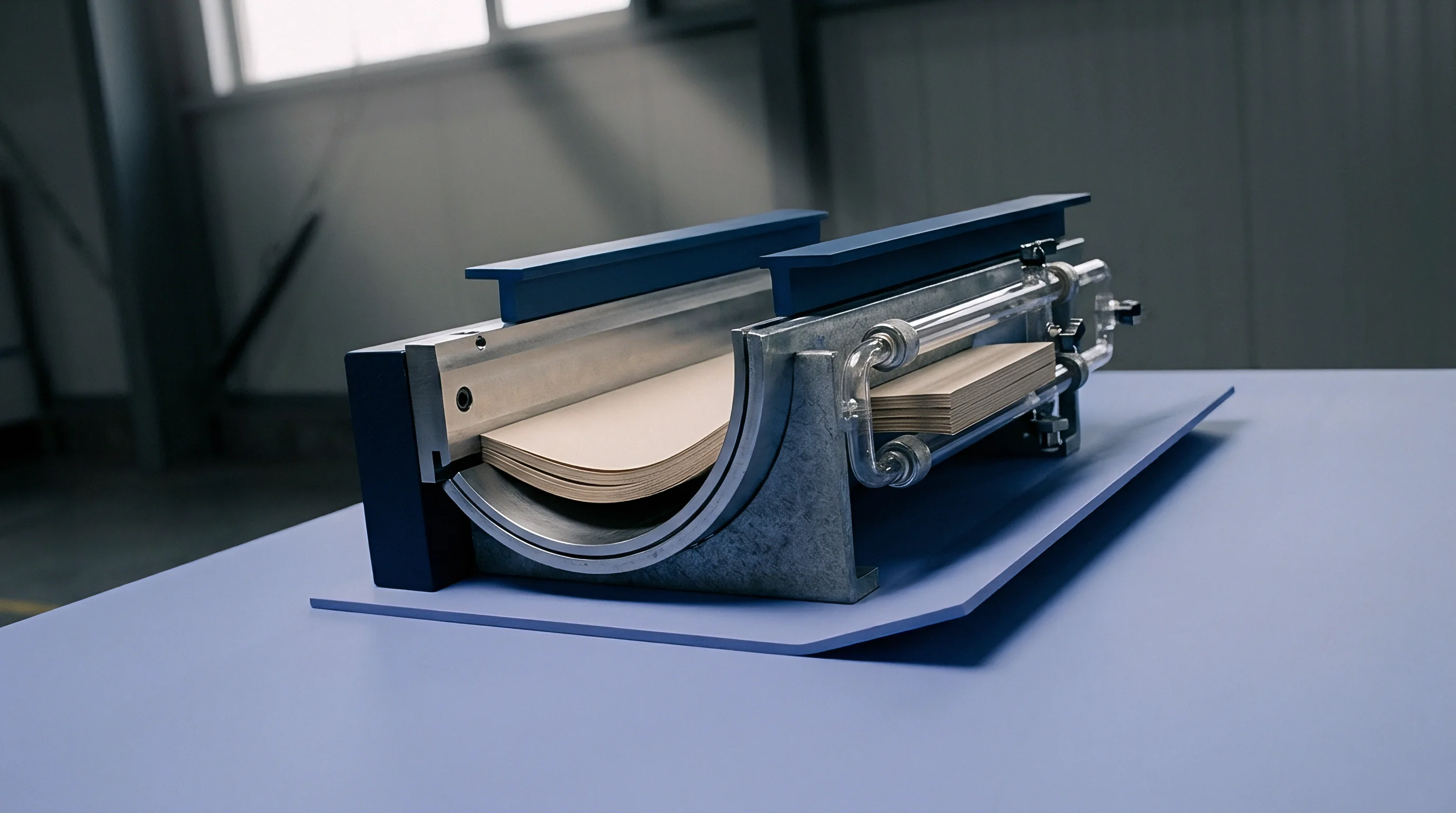
Anvil cylinder construction directly influences score quality at speed. Solid steel anvils provide a rigid surface that maximizes energy transfer into the board matrix, producing sharp, narrow shear zones with deep delamination. Polyurethane or sleeve covers yield slightly under dynamic load, widening the contact footprint and extending impression dwell time by up to 40 percent.
This softened impact spreads shear stress over a broader zone, cutting the risk of top-liner cracking on brittle, double-coated board.
Standard supply agreements that define score depth using static caliper gauges without specifying dynamic nip dwell times fail to protect buyers from high-speed spring-back defects.
Hysteresis Loss and Elastic Energy Storage
Energy transfer during the creasing stroke governs residual score elasticity. As the rule drives into paperboard, it performs work (Wtotal). Some of that energy breaks inter-fibre bonds and causes plastic deformation (Wplastic).
The rest stays stored elastically in compressed cell walls (Welastic). The ratio of plastic work to total work reflects hysteresis loss: high hysteresis loss means a deadened crease with low spring-back, which runs smoothly on fast cartoning equipment.
High strain rates reduce the share of plastic work during impact. Short dwell times limit stress relaxation, leaving a larger portion of input energy stored elastically within the cellulose structure. Upon leaving the die-cutting nip, the board rebounds immediately, partially closing delamination voids created at peak compression.
This rebound elevates dynamic crease stiffness, raising resistance when the score is folded rapidly on packaging lines.
Controlling rebound requires balancing anvil clearance against rule height. Over-compressing board to force plastic deformation crushes protective surface coatings, causing micro-cracking along the fold line. Under-compressing leaves elastic storage dominant, producing high spring-back forces that jam carton erecting equipment.
Heat generated in the die-cutting zone affects anvil energy transfer. High-speed rotary converting generates friction at the anvil surface, bringing local temperatures up to 50°C to 70°C. This warmth softens outer polymer coatings and internal moisture, increasing plastic energy dissipation during impact. Lines started on cold machinery frequently run high dynamic crease stiffness until anvil rolls reach operating temperature.
Dynamic anvil deflection under heavy load causes cross-web variation in score performance. As the cylinder bows under peak compression, central creasing rules penetrate less than rules near cylinder journals. This deflection gradient creates systematic shifts in dynamic crease reduction ratios across the web width, so cartons converted from the center show higher spring-back on packaging lines.
Die-cut score lines that meet standard static hand-proofer specifications frequently suffer dynamic spring-back failures because of the significant stiffness amplification that occurs at high production speeds.


Dynamics
High-Speed Cartoning Line Performance
Carton erection on high-speed packaging equipment is the ultimate test of score line prep. Modern automated lines fold, fill, and seal cartons at rates up to 1200 units per minute. At these speeds, mechanical folding arms, tucking blades, and transfer belts hit flat blanks with high impact velocities.
Folds complete in a fraction of a second, driving angular deflection rates past 1500 degrees per second. Under these conditions, static laboratory stiffness data tells you very little about actual runnability.
Carton Opening Force measures mechanical resistance when erecting a flat sleeve into a square container. As vacuum cups pull opposing panels apart, all four longitudinal score lines flex at once. Peak force during this cycle determines whether the carton opens smoothly or buckles against transport lugs.
High dynamic crease stiffness drives up required opening force; if that force exceeds feeder cup vacuum capacity, the machine misses a stroke and shuts down automatically.
Spring-back force exerts continuous pressure against guides, tucking flaps, and adhesive bonds throughout cartoning. Once a flap folds 90 degrees, the score line acts like a loaded spring trying to flatten out. On fast lines, hot-melt adhesive is applied milliseconds before end flaps close.
If dynamic spring-back exceeds green-tack strength during the brief compression segment, sealed flaps spring open coming off the belt. Operators then have to add glue or slow the line, undermining packaging economics.
How Does High Speed Crease Recovery Alter Cartoner Efficiency?
Dynamic crease recovery alters cartoner efficiency by shifting structural force balances during machine sequences. At low speeds, mechanical guides hold creased flaps in position while adhesive sets. At high line speeds, kinetic energy transferred by rapid folding arms combines with high dynamic spring-back.
That force vector causes carton side-walls to bow outward, creating dimensional instability that jams tucking blades and misaligns product insertion rams.
Calculating dynamic force balance on a rotary folding arm shows the impact of stiffness amplification. Consider a standard packaging line erecting a 400 micrometre Folding Boxboard carton at 900 cartons per minute. The folding arm flexes the main side-seam crease through 90 degrees in 8 milliseconds ~ an angular velocity of 11.25 radians per second (about 644 degrees per second).
The static bending moment of the score line, measured per ISO 2493 at 15 degrees per second, is 45 millinewton-meters. Under dynamic strain, viscoelastic response increases effective bending moment to 72 millinewton-meters.
The dynamic mechanical torque required to complete the fold equals the sum of the dynamic bending resistance and the inertial resistance of the carton panel:
Torque_dyn = Bending Moment_dyn + (Inertia × angular acceleration)
For a panel with a moment of inertia of 0.00012 kilogram-square-meters and an angular acceleration of 2800 radians per second squared at initial contact, required torque jumps from 0.079 Newton-meters (calculated using static data) to 0.408 Newton-meters under actual operating conditions. This five-fold spike in peak load stresses mechanical linkages, accelerates belt wear, and bows panels whenever flat paperboard cannot support the column load delivered by the folding arm.
| Substrate Grade | Caliper (µm) | Static Stiffness Sb (mN) | Static Crease Sc (mN) | Dynamic Stiffness Sb,dyn (mN) | Dynamic Crease Sc,dyn (mN) | Dynamic Stiffness Amplification |
|---|---|---|---|---|---|---|
| Solid Bleached Board (SBB) | 300 | 180 | 85 | 245 | 142 | 1.67x |
| Solid Bleached Board (SBB) | 450 | 420 | 195 | 580 | 335 | 1.71x |
| Folding Boxboard (FBB) | 300 | 140 | 55 | 185 | 92 | 1.67x |
| Folding Boxboard (FBB) | 450 | 330 | 125 | 445 | 215 | 1.72x |
| White Lined Chipboard (WLC) | 300 | 120 | 42 | 170 | 78 | 1.85x |
| White Lined Chipboard (WLC) | 450 | 290 | 98 | 415 | 195 | 1.98x |
Panels subjected to heavy spring-back force deform outward along uncreased centerlines. This distortion, called side-wall bulging, changes the internal volume of the erected carton. In automated pharmaceutical or food packaging, bulging reduces internal clearance, causing rigid containers or blister strips to strike carton edges during insertion.
Jams stop production instantly, often damaging upstream loading hardware and generating scrap.
Outer surface coating friction interacts directly with dynamic folding. High-gloss UV coatings and extrusion-coated barrier films show rate-dependent friction coefficients. As folding arms slide across coated surfaces at speed, hydrodynamic air films and surface polymer shear reduce friction, though local heating can cause stick-slip behavior.
Paired with elevated dynamic spring-back, erratic friction twists the carton sleeve during transport, producing out-of-square packs that fail palletizing standards.
Dynamic crease stiffness scales non-linearly with strain rate, causing standard laboratory tests at low angular speeds to consistently underestimate high-speed carton erecting forces.
Converters supplying high-speed packaging lines need to shift from static test protocols to dynamic stiffness characterization. Testing score lines across a range of angular velocities reveals the strain rate sensitivity of the furnish. With that data, converting engineers can adjust die-cutting geometries to maintain dynamic crease reduction ratios that keep opening forces within machine limits.
How much dynamic spring-back can be compensated for by increasing hot-melt adhesive tack without causing fibre-tear failure upon carton opening remains an unresolved operational trade-off on modern cartoning lines.
Furnish
Raw Material Impact on Dynamic Fracture Mechanics
Paperboard furnish determines dynamic fracture behavior under high-speed folding strain. Cellulosic fibre species, pulping method, refining intensity, and filler content establish the internal structure that either absorbs or stores kinetic energy during rapid score line deflection. Understanding these furnish mechanics lets sourcing engineers specify board grades that hold stable dynamic crease reduction ratios under fast converting conditions.
Softwood chemical pulping yields long, highly fibrillated cellulose fibres from pine or spruce. These long fibres form an entangled network joined by extensive hydrogen bonding. During creasing, long softwood fibres stretch and slide without snapping immediately.
This ductility helps softwood-rich grades, like premium Solid Bleached Board, absorb dynamic strain without surface rupture. However, high inter-fibre bond strength increases elastic memory, creating strong dynamic spring-back that requires precise matrix tooling to deaden effectively.
Hardwood chemical pulp supplies shorter, stiffer fibres from eucalyptus or birch. Hardwood fibres pack tightly, filling voids and smoothing the surface for printing. In core layers, unrefined hardwood provides compressive resistance and bulk.
Under dynamic creasing, hardwood networks undergo clean internal shear separation because their shorter length limits entanglements. Hardwood-heavy furnishes produce low dynamic crease stiffness, but too much hardwood lowers top-liner tear strength, making the sheet prone to surface cracking during sharp, fast folds.
Mechanical pulping, including groundwood and thermomechanical methods, retains natural lignin within fibre walls. Lignin acts as a rigid, cross-linked polymer coating cellulose micro-fibrils. Under static bending, mechanical pulp cores yield easily in shear, giving strong stiffness-to-weight bulk efficiency.
Under high-speed strain, however, the lignin matrix behaves like a glassy, brittle polymer. Rapid shear pulses trigger abrupt structural fractures rather than smooth plastic shear, creating erratic delamination that weakens carton corners and drops dynamic crease stiffness unpredictably.
Recycled fibre introduces material variations that complicate high-speed packaging performance. Recycled stocks undergo multiple wetting, repulping, and drying cycles that hornify fibre walls. Hornification permanently closes internal cellulose pores, reducing fibre flexibility and hydrogen bonding potential.
To rebuild strength, recycled paperboard mills add cationic starches and inorganic fillers like calcium carbonate and clay. These additions improve static compression strength but make the matrix brittle under dynamic shear.
High strain rates on recycled boards shatter brittle filler-starch complexes instead of producing clean inter-ply delamination. The dynamic crease stiffness reduction ratio for recycled board degrades quickly once line speeds cross 800 cartons per minute. Micro-fractures propagate through the thin virgin top liner, exposing grey recycled core and ruining printed graphics along the score line.
Managing this risk requires strict limits on recycled content specs for high-speed lines.
Moisture acts as a plasticizer within cellulosic networks. At standard ISO 187 conditioning (23°C and 50 percent relative humidity), paperboard holds 6.5 to 8.5 percent equilibrium moisture. Bound water molecules disrupt rigid hydrogen bonds between amorphous cellulose chains, increasing flexibility and damping dynamic strain waves.
When ambient humidity drops below 30 percent in unconditioned converting plants, board moisture falls below 5.0 percent. Dry paperboard exhibits severe strain rate sensitivity: dynamic bending stiffness jumps up to 40 percent, and top-liner cracking rates quadruple during fast cartoning runs.
Surface starches and pigment coatings also alter dynamic score behavior. Heavy surface sizing increases top-liner tensile modulus, improving surface strength but reducing local strain capacity for tight-radius bends. Mineral coatings made of calcium carbonate, kaolin clay, and latex binders provide excellent print surfaces but act like rigid thin films.
When subjected to rapid 180-degree pre-breaking on folder-gluers, brittle mineral coatings snap before the underlying fibre matrix delaminates, forming fine hairline cracks that spoil appearance and barrier performance.
Substrate selection for high-speed cartoning involves managing specific failure modes associated with furnish performance under dynamic strain rates:
- Top Liner Cracking occurs when brittle, highly-refined chemical pulp or heavily coated surfaces undergo ultimate tensile failure during rapid outer-radius extension.
- Bottom Liner Splitting manifests when excessively narrow matrix channel shoulders drive sharp shear stresses directly through the lower board surface.
- Uncontrolled Core Crushing develops in high-bulk mechanical pulps when dynamic compressive loads collapse core void structures without creating functional internal shear planes.
- Delamination Flared Shearing appears in heavily filled recycled boards when dynamic shear waves propagate laterally into flat panel regions, destroying carton wall rigidity.
- Elastic Memory Rebound dominates long-fibre chemical pulps when high inter-fibre bond strength stores kinetic strain energy rather than dissipating it through plastic deformation.
- Crease Score Shear Inversion occurs when incorrect rule profile selection forces the internal bead to buckle outward instead of inward, jamming machine folding channels.
Sourcing practices for high-speed automated packaging lines rely on structured technical criteria to qualify paperboard substrates prior to committing large commercial volumes:
- Furnish Architecture Verification requires mill certificates detailing exact percentage ratios of virgin softwood, hardwood, mechanical pulp, and recycled fibre content per ply layer.
- Dynamic Modulus Profiling mandates high-speed tensile testing across strain rates ranging from 10 to 3000 per second to establish the material strain rate sensitivity exponent.
- Moisture Sensitivity Banding evaluates dynamic stiffness reduction ratios across an equilibrium moisture spectrum from 4.5 percent to 9.5 percent to simulate seasonal storage variations.
- Surface Coating Extensibility measures maximum fracture elongation of pigment coatings under dynamic impact rates exceeding 1000 degrees per second.
- Inter-Ply Bond Strength Audit establishes internal polar wax and Scott Bond energy thresholds to ensure clean internal shear delamination under high-speed converting.
In corporate procurement contracts, standard technical clauses specify that delivered paperboard lots must maintain a dynamic crease reduction ratio between 0.45 and 0.60 when tested at 1200 degrees per second under ISO 187 environmental conditioning. This single requirement forces paper mills to tune furnish refining and sizing specifically for high-speed line compatibility.
Window
Operational Headroom and Process Optimization
Achieving zero-defect execution on high-speed packaging lines demands establishing a clear operational window for dynamic crease performance. That window represents the narrow intersection where score lines are deadened enough to prevent high-speed erection jams while remaining structurally sound enough to maintain carton squareness, stacking strength, and visual appeal. Operating outside this zone leads to material spoilage, line downtime, and field failures.
The lower boundary of the operational window is defined by minimum structural score integrity. If converting tooling uses excessive penetration depth or overly aggressive rule profiles, the dynamic crease reduction ratio drops below 0.35. A score line in this state has lost its internal elastic recovery entirely.
When folded on a high-speed cartoner, the deadened crease lacks the localized stiffness needed to guide panels along fold axes. The carton sleeve sags during transfer, causing out-of-square erection, flap overlaps, and collapsed corners under vertical loads. Over-creased scores also risk bottom-liner rupture, destroying grease and moisture barriers.
The upper boundary of the window is set by maximum allowable spring-back force and carton opening resistance. When tooling or substrate choices yield a dynamic crease reduction ratio above 0.65, the score line retains heavy elastic memory. On automated cartoning lines running at 1000 cartons per minute, stiff scores resist vacuum feeder cups, opening blades, and folding shoes.
Carton opening forces climb beyond machine limits, causing feeder misfires, side-wall bowing, insertion jams, and popped flaps. Operating near this upper limit reduces machine efficiency and increases scrap rates exponentially.
Converting plants optimize tooling configurations to hit the middle of the dynamic window, typically targeting a dynamic crease reduction ratio between 0.48 and 0.55 for standard folding boxboard. Hitting this target consistently across millions of sheets requires managing real-world variables, including web tension drift, die-cutting platen thermal expansion, and substrate caliper variations across tambour reels.
Quantifying the cost of dynamic crease failures highlights the need for precise score specification. Consider a high-volume consumer goods operation producing 50 million cartons annually on two automated lines running at 900 cartons per minute. The baseline stock is a 400 micrometre Folding Boxboard costing 1,450 USD per metric tonne, yielding roughly 25,000 finished cartons per tonne.
Raw material cost per thousand cartons equals 58.00 USD.
When converting tooling is set up using static hand-proofer tests without accounting for high strain rate stiffness amplification, the dynamic crease reduction ratio on the packaging line sits at 0.64. At this level, the cartoning line suffers an average jam rate of 1.8 percent from feeder misfires and flap popping. Line stoppages take an average of 3 minutes to clear, but each event destroys about 45 cartons and incurs 180 USD per hour in direct overhead and lost operating margin.
Running 50 million cartons with a 1.8 percent dynamic scrap rate generates 900,000 spoiled units annually, representing 52,200 USD in wasted board stock alone. Downtime accumulated across the annual volume totals 600 line stoppages, consuming 30 hours of lost production capacity valued at 5,400 USD in direct overhead. Total cost of running near the upper boundary of the dynamic crease window reaches 57,600 USD annually per line.
Optimizing die-cutting matrix geometry ~ widening female channels by 0.10 millimetres, introducing radiused shoulder profiles, and adjusting penetration depth to hit a dynamic reduction ratio of 0.50 ~ drops the line jam rate from 1.8 percent to 0.15 percent. Material scrap drops to 75,000 cartons annually, saving 47,850 USD in direct board cost. Downtime events fall to 50 stops annually, reclaiming 27.5 hours of operating capacity valued at 4,950 USD.
Total annual savings from dynamic crease optimization reaches 52,800 USD per packaging line, fully paying off precision die-cutting tooling upgrades within two months.
Long-term operational stability relies on continuous dynamic score verification within converting plant quality systems. Inline optical inspection systems on high-speed folder-gluers measure crease symmetry, bead height, and internal delamination on every folded blank at production speeds up to 500 meters per minute. Combining inline vision with periodic dynamic stiffness sampling catches tooling wear, batch anomalies, and moisture drift before non-compliant stock reaches high-speed packaging plants.
Sourcing engineers and packaging buyers who ground material specs in dynamic strain rate mechanics bridge the gap between laboratory compliance and packaging floor performance. Specifying precise dynamic crease reduction ratios guarantees runnability, protects brand appearance, and secures the lowest landed cost per thousand delivered packs across global supply chains.