Optimizing Secondary Slitter Knife Repositioning Schedules across Variable Deckle Widths
Optimizing secondary slitter schedules requires balancing changeover downtime against deckle off-trim waste using dynamic knife positioning thresholds.


Deckle
Parent reel width utilization determines the raw yield of secondary rewinder operations. In web converting facilities, the gap between master reel width and total ordered trim width represents immediate material scrap. Web tension and slitter knife geometry establish the physical boundaries of edge removal, where a minimum off-cut width of fifteen to twenty-five millimeters per side prevents web tears during high-speed rewinding.
Operating secondary slitter-rewinders without continuous deckle optimization increases off-trim volume, directly reducing the sellable tonnage per mill master reel.
Balancing slitter knife repositioning frequency against parent web off-trim involves calculating the exact trade-off threshold where setup changeover time equals the cost of off-gauge trim waste. Repositioning knife heads every three to five tambours achieves peak operational yield when deckle variance exceeds forty-five millimeters, provided automated positioning systems hold lateral setup tolerance within 0.1 millimeters. On high-speed winders running containerboard or coated fine paper above 1200 meters per minute, unoptimized scheduling creates unnecessary setup downtime or excessive off-cut waste.
Geometric Constraints in Multi-Width Web Splitting
Primary paper machines produce master rolls spanning six to ten meters in width, which converting plants standardly divide into narrower commercial formats. Lower slitter bottom anvils and upper shear knives require specific physical clearance along the slitter shaft, limiting the absolute minimum slit width to approximately 100 millimeters for standard pneumatic head assemblies. Narrower custom cuts demand specialized modular knife holders or staggered slitter banks, which alter the web entry envelope and increase setup complexity.
Deckle trim generates solid scrap.
When multiple order widths are combined across a single parent web, edge trim variance fluctuates across production runs. A parent web width of 4800 millimeters carrying five roll cuts of 910 millimeters yields an ideal edge trim of fifty millimeters total, split equally across both deckle edges. If the next docket demands four roll cuts of 1150 millimeters, total trim scrap expands to 200 millimeters unless a supplementary narrow ribbon order fills the remaining deckle gap.
Batching roll width orders within a fifty-millimeter deckle variance band minimizes off-trim scrap without introducing excessive changeover downtime.
Off-Trim Loss Curves against Setup Latency
Quantifying downtime against fiber wastage reveals the financial equilibrium point for blade adjustment timing. Manual positioning of secondary slitter heads requires an operator to halt the winder, unlock individual top and bottom knife units, measure positioning with a optical scale, and verify edge gaps. This manual sequence consumes between twelve and twenty-five minutes per changeover.
During this setup duration, a high-capacity converting line loses significant production capacity.
Off-gauge edges penalize total yield.
Allowing a wide deckle gap to run continuously saves changeover time but consumes virgin furnish in the form of elevated trim bin waste. Converting facilities running high-grammage virgin kraftliner face higher monetary scrap penalties per minute than plants processing lightweight recycled medium. Calculating the precise setup break-even point establishes whether to pause the winder for a minor three-centimeter deckle adjustment or run the off-trim into the pulper repulper system until the current tambour exhausts.
Failing to balance slitter changeover frequency with deckle fill calculations elevates fiber waste by three to five percent while accelerating mechanical wear across the slitter drive linkage.


Blade
Slitting head hardware endures intense mechanical stresses during continuous paper web cutting. Shear slitting relies on controlled interference between a powered lower anvil ring and a free-rotating top circular knife. The interaction zone requires precise control of three geometric parameters: depth of overlap, side load pressure, and rake angle.
Misalignment of these parameters increases cutting edge friction, driving rapid thermal expansion and blunting high-speed steel or tungsten carbide blades within hours.
Mechanical Tribology of Variable-Position Cutters
Friction between upper circular knives and motor-driven lower anvils generates localized thermal expansion along the cutting edge. Operating temperatures at the shear point exceed 180 degrees Celsius when cutting mineral-filled uncoated woodfree grades at high web velocities. Tungsten carbide upper blades offer superior abrasion resistance compared to D2 tool steel, holding a sharp cutting edge up to ten times longer when processing abrasive board stocks.
Blade wear alters cut geometry.
Lateral runout destroys slit consistency.
Axial runout in top knife holders causes cyclic variation in side pressure as the blade rotates. When runout exceeds fifteen micrometers, the shear cutting action alternates between excessive friction and momentary blade separation. Microscopic gaps between upper and lower cutting edges allow paper fibers to bend rather than shear cleanly, causing severe burrs along the roll margin.
Lateral knife runout exceeding 0.015 millimeters at 1200 meters per minute accelerates edge burr formation on 200 gram per square meter containerboard.

Dust Generation Thresholds under Shear Misalignment
Inappropriate lateral blade pressure fractures matrix fibers rather than shearing them cleanly. When upper slitter pressure drops below two Newtons per millimeter of cut depth, paper fibers slip past the shearing edge without crisp separation. This partial tearing action releases free filler particles, micro-fibers, and fiber fragments directly into the surrounding winder air stream.
Slitter dust contaminates print blankets.
Accumulation of airborne fiber dust on slitter head assemblies accelerates mechanical wear on linear guide rails and pneumatic position encoders. Dust deposits absorb ambient lubrication, creating an abrasive paste that degrades positioning repeatability during automated schedule shifts. Installing localized vacuum exhaust hoods directly adjacent to the shear nip mitigates debris accumulation while maintaining clean web margins.
- Side Pressure Tolerance verification ensures that spring-loaded or pneumatic top slitter side loads stay within four to eight Newtons per millimeter of cut depth.
- Blade Overlap Depth measurement verifies top blade penetration beneath the lower anvil edge remains strictly between 1.0 and 1.5 millimeters.
- Shear Rake Angle alignment keeps the vertical cut plane within forty-five angular minutes of nominal web perpendicularity.
- Runout Amplitude Limits check that total radial and axial deviation across top slitter assemblies stays below twelve micrometers.
| Blade Material Grade | Hardness (HRC) | Maximum Web Speed (m/min) | Typical Edge Life (Hours) | Lateral Runout Max (mm) |
|---|---|---|---|---|
| D2 Tool Steel | 58-60 | 800 | 120 | 0.025 |
| M2 High-Speed Steel | 62-64 | 1200 | 250 | 0.018 |
| Tungsten Carbide Submicron | 75-78 | 2200 | 2000 | 0.008 |
| Ceramic Composite Insert | 80-82 | 2500 | 3500 | 0.005 |
Equipment manufacturers frequently claim that edge burrs and dust spikes stem entirely from ambient humidity fluctuations across unconditioned converting facilities.

Schedule
Temporal sequencing of roll layout adjustments governs both daily throughput and paper loss ratios. Developing an effective repositioning schedule demands comprehensive analysis of customer order books, paper machine reel sizes, and physical slitter head displacement speeds. Automated algorithms group individual roll orders into deckle patterns that minimize overall setup counts while respecting strict delivery deadlines and roll diameter parameters.
Sequencing Logic for Multi-Deckle Converting Runs
Orders sharing identical roll diameters and core specifications are grouped into coherent production blocks to reduce manual knife repositioning. When transitioning between distinct deckle patterns, slitter heads move along common linear shafts to reach their new positions. Modern scheduling software employs dynamic programming models to identify transition paths that require moving the minimum number of individual slitter assemblies.
Rethinking batching reduces trim waste.
Minimizing total lateral displacement distance across all slitter heads shortens changeover duration significantly. Moving four slitter heads by fifty millimeters consumes less time and lowers positioning error risks compared to shifting ten slitter heads across two meters of shaft space. Strategic sequencing reduces cumulative setup latency while keeping slitter assemblies within their optimal operating zones.
Worked Optimization Mechanics for Continuous Web Repositioning
Assume a 4.5-meter broad paper machine producing 180 gram per square meter kraftliner at a continuous winder operating velocity of 900 meters per minute. A fifty-tonne master production docket is assigned to secondary slitting with two competing operational schedule options.
Option A utilizes frequent slitter head adjustments, executing a repositioning sequence every two parent tambours (approximately every forty-five minutes of winding time). Each changeover requires two minutes under fully automated head positioning, generating thirty millimeters of off-trim scrap per set. Total setup downtime over fifty tonnes reaches fourteen minutes, while total off-trim scrap stays low at 1.1 percent of master reel weight.
Option B minimizes setup changes, running a fixed slitter pattern for eight consecutive tambours before repositioning. Setup changeover downtime drops to three minutes total over the lot, but average deckle trim waste expands to 3.8 percent due to wider non-standard edge trim clearance. Converting the numbers to mass, Option A produces 550 kilograms of trim scrap, whereas Option B generates 1900 kilograms of scrap on the same fifty-tonne allocation.
At a virgin fiber furnish cost of 620 EUR per tonne landed at the mill repulper, Option A saves 837 EUR in un-scrapped raw material while forfeiting eleven minutes of winder run time. On high-speed winders where total capacity exceeds paper machine output, Option A proves superior, generating net material savings without creating a mill bottleneck.
Is Automation Justified for Secondary Slitting?
Motorized slitter positioning systems equipped with optical laser feedback adjust knife blocks in under ninety seconds across full web spans. Automated systems utilize individual linear motors or rack-and-pinion drives attached to each top and bottom slitter housing. By eliminating manual locking screws and mechanical feeler gauges, automated positioning removes operator technique variability from knife alignment protocols.
Manual adjustments cause positioning errors.
Automated slitter systems continuously monitor knife displacement and side loads via integrated sensor arrays. If a top knife encounters resistance or strays from its target coordinate during high-speed deckle adjustments, pneumatic interlocks immediately halt blade engagement to prevent anvil damage. Capital expenditure for retrofitting automated positioning systems typically amortizes within twelve to eighteen months through reduced off-trim scrap and increased effective winder availability.
ISO 1924 tensile test failures along roll margins trace directly to micro-cracking caused by misaligned slitter anvils during high-speed deckle transitions.
- Halt web motion completely and lock out pneumatically operated upper knife carriage assemblies to guarantee operator safety during blade displacement.
- Disengage individual anvil locking clamps using pneumatic pressure drop circuits before sliding lower knife bodies along the spline shaft.
- Align lower anvil cut lines against precision linear encoder scales, verifying absolute positions against digital readout counters.
- Reset upper slitter shear angle and lateral side load pressures to match specific sheet grammage and caliper specifications.
- Execute a slow-speed test cut on lead-in scrap paper, measuring cut width precision with a calibrated steel scale before commencing full-speed production.
| Parent Web Width (mm) | Target Cut Configuration | Total Trim Width (mm) | Trim Waste Percent (%) | Setup Change Interval |
|---|---|---|---|---|
| 3200 | 3 x 1050 mm | 50 | 1.56 | 4 Tambours |
| 3200 | 4 x 780 mm | 80 | 2.50 | 6 Tambours |
| 4500 | 5 x 880 mm | 100 | 2.22 | 3 Tambours |
| 4500 | 4 x 1110 mm | 60 | 1.33 | 2 Tambours |
Standard DIN EN 1034-3 machinery safety directives specify that automated knife positioning systems maintain dual-channel position confirmation before restarting web drive motors.

Shear
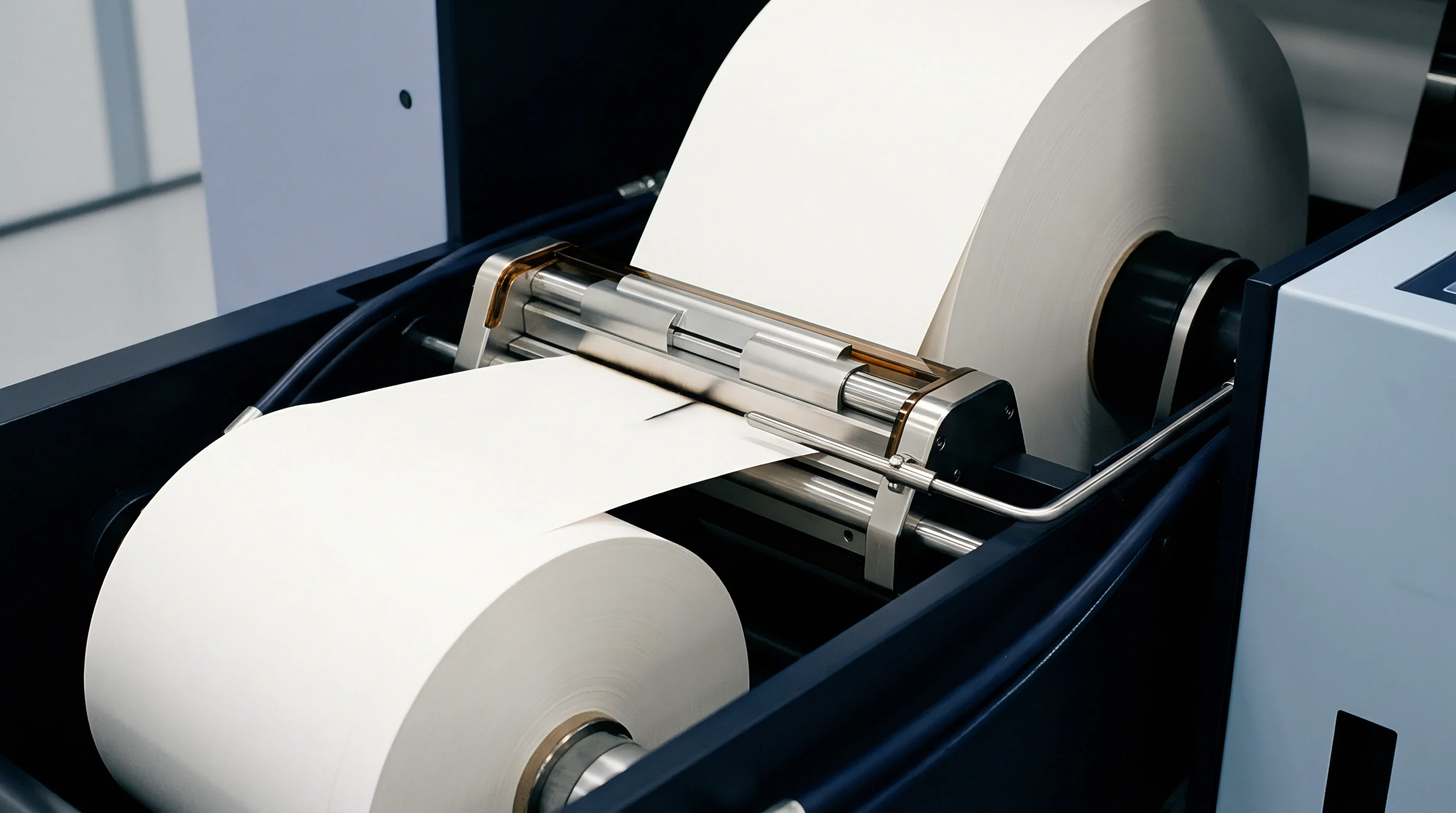
Cutting web substrates involves localized compression followed by tensile fracture along a controlled knife interface. Paper caliper, grammage, moisture content, and filler loading dictate physical responses under high-speed shear slitting. High-density papers with extensive refining offer clean cut margins, whereas bulkier recycled board grades exhibit lower internal bond strength, rendering them prone to edge cracking and delamination when slitter knives dull.
Substrate Mechanical Responses to Blade Repositioning
Paper furnish composition dictates how cellulose fibers yield under focused mechanical force. Softwood kraft fibers provide long structural matrix networks that resist localized tearing, requiring sharp knife edges and exact side load pressure to achieve clean cutting. Hardwood fibers and recycled secondary furnishes possess shorter average fiber lengths, which shear with lower mechanical energy but shed loose debris when cut under incorrect shear angles.
Fibre orientation alters slit resistance.
Moisture softens cellulose fiber networks.
Standard conditioning atmospheres defined under ISO 187 (23 degrees Celsius, 50 percent relative humidity) establish baseline sheet moisture levels for off-line physical testing. Web moisture content at the secondary slitter winder often deviates from these standard conditions, fluctuating between 5.5 and 8.0 percent depending on mill drying performance. High moisture increases sheet elongation before fracture, demanding greater knife overlap to prevent fuzzy slit edges.

Edge Deformation Modes across Uncoated and Coated Stocks
Coating layers containing latex binders and mineral pigments exhibit brittle fracture behavior during high-speed roll trimming. When top slitter circular knives penetrate a double-coated fine paper sheet, the brittle mineral coating shatters locally before the base fiber sheet splits tensilely. Microscopic coating fragments break free from the cut rim, creating abrasive dust that contaminates print shop blankets and web guides.
Adjusting the shear rake angle between top and bottom blades controls fracture propagation through coated substrates. A forward rake angle of forty-five angular minutes directs compressive forces downward into the lower anvil ring, producing a crisp, clean shear line without fracturing brittle mineral coats. Over-lapping upper blades too deeply into lower anvils increases lateral friction, forcing coating particles off the sheet surface.
Excessive knife overlap on heavy board stocks creates raised edge ridges that induce web telescoping during high-tension rewinding operations.
- Slitter Edge Burst arises when excessive lateral knife force creates micro-fractures that propagate inward along cross-direction web fibers.
- Rolled Margins occur when dull top blades push paper caliper downward into worn anvil channels rather than cutting cleanly.
- Fiber Shedding Spikes develop when zero-overlap knife settings tear matrix fibers through friction instead of shearing them under clean mechanical pressure.
- Telescoping Roll Profile emerges when edge burr buildup increases roll diameter along slit margins compared to the roll center.
| Defect Category | Primary Root Cause | Measurement Method | Acceptance Limit |
|---|---|---|---|
| Margin Burr Height | Excessive blade overlap or dull edge | Optical Profile Gauge | < 0.03 mm |
| Slitter Dust Mass | Low side pressure / fiber tearing | TAPPI T 547 / Gravimetric Filter | < 5.0 mg/m² |
| Edge Micro-Cracking | Incorrect rake angle / blunt anvil | SEM Analysis at 100x | < 0.10 mm depth |
| Delamination Depth | Low internal bond / dull top knife | Cross-Section Microscopy | < 0.05 mm width |
| Test evaluations performed on conditioned paper samples at 23°C and 50% relative humidity per ISO 187. | |||
Whether acoustic emission monitoring attached to slitter block housings can detect knife blunting before measurable edge burrs appear on delivered rolls remains an open empirical question.
Draft
Commercial paper purchasing agreements establish mandatory width tolerances and edge quality standards for secondary rewinder production. Mill contracts set narrow acceptable bands for delivered reel dimensions, standardly specifying roll width tolerances within plus or minus 0.5 millimeters of targeted purchase order dimensions. Exceeding these contractual boundaries allows buyers to issue formal quality rejections or demand off-gauge price discounts.

Contractual Tolerances for Custom Roll Widths
Specifications written into buyer purchase orders define strict upper and lower limits for delivered web dimensions. High-speed web offset presses and automated packaging converting machinery demand strict roll width consistency to prevent web tracking errors or register misalignment. When secondary slitter schedules push knife repositioning intervals too far, minor mechanical drift in blade blocks can slip roll widths outside acceptable contract parameters.
Verification of roll width accuracy relies on calibrated digital callipers or laser distance sensors deployed across finished reel faces before packaging. Mill certificates document roll width compliance alongside TAPPI T 411 caliper and ISO 536 grammage data. If goods-in inspections at converting plants detect width variations exceeding certified tolerances, the supplier covers freight returns and immediate replacement tonnage costs.

Integration of Real-Time Slitter Scheduling with Enterprise Resource Planning
Modern mill management systems calculate optimal roll combinations continuously as incoming customer dockets land in production queues. Advanced scheduling engines communicate directly with winder automation layers, transferring top and bottom knife coordinate matrices electronically without manual operator input. Automated data transfer prevents human transcription errors during fast-paced production shifts.
Pulp index variations alter margins.
Integrating real-time deckle optimization with enterprise resource planning allows mills to evaluate the monetary trade-off between off-trim scrap recycling and winder changeover downtime instantly. When virgin pulp indices spike, scheduling algorithms adjust thresholds to prioritize fiber retention, favoring shorter production runs with tighter deckle fill over continuous high-speed winder operations.
Reconciling exact customer width demands with mill trim efficiency requires continuous recalculation of knife setup schedules against real-time scrap credit market prices.