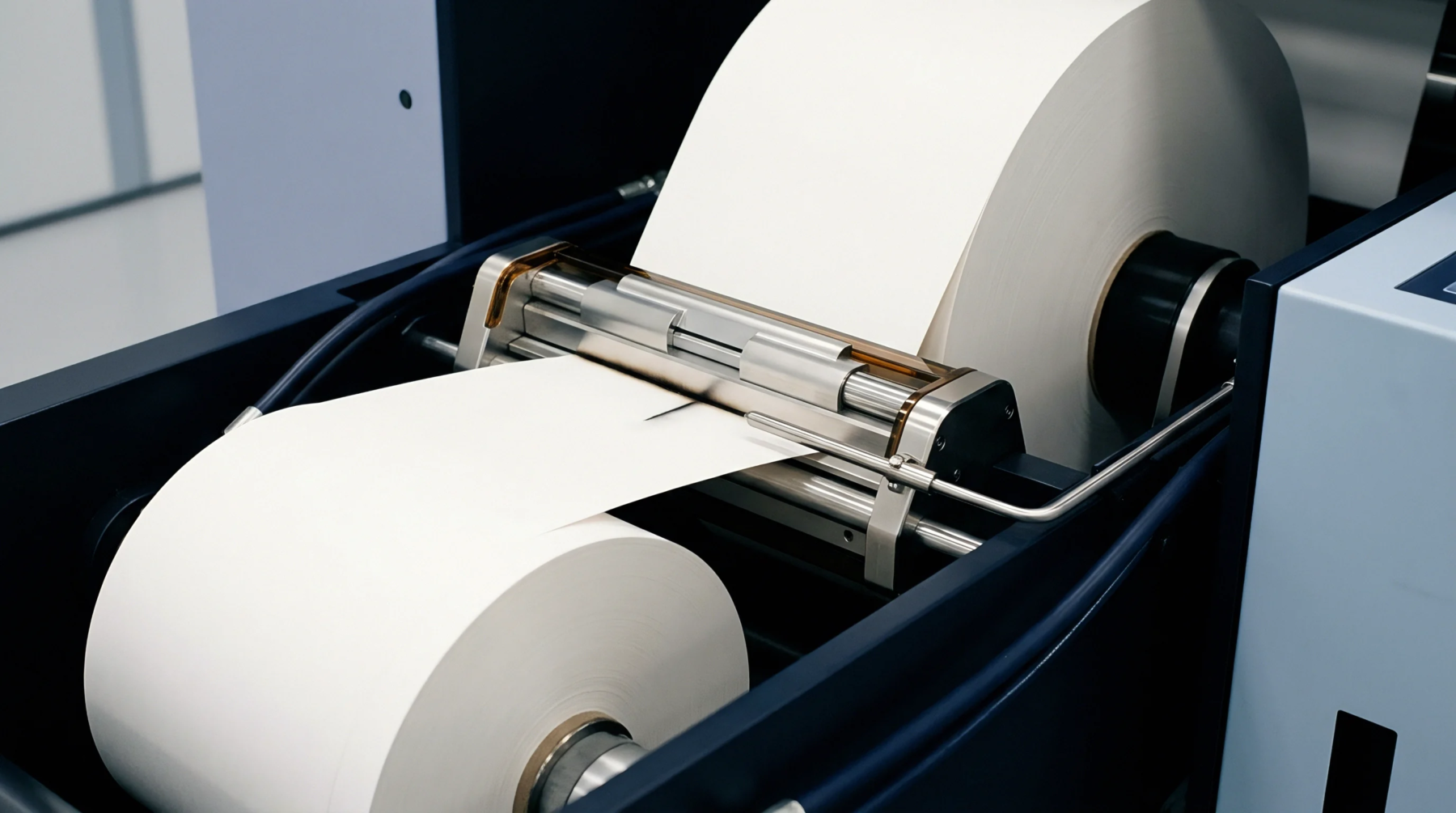
Shear Defect
Raised, irregular edge distortions along slit paper reel margins result from blunt cutting tools or improper shear engagement angles. The physical defect known as roll margin burr forms when rotary slitter knives tear and compress fibrous paper structures instead of generating a clean shear plane. Fibres protrude beyond the uniform roll face, forming a thickened ridge along the wound perimeter.
Ridge accumulations cause uneven diameter expansion, localized tension bands and reel shape deformities during winding. Roll margin irregularities provoke handling jams on automated converting and packaging lines.
Defect Genesis
Rotary slitting relies on controlled penetration and exact lateral overlap between sharp upper dish blades and lower counter-knives. Roll margin burr develops when tool wear degrades edge sharpness, changing clean mechanical shearing into destructive plastic deformation. Dull knives stretch surface fibers beyond their yield points, leaving ragged burrs along the bottom or top cut boundaries.
The problem intensifies on abrasive mineral-coated boards where friction rounds cutting edges rapidly during long production campaigns. Loose fiber debris dislodges from the burred edges, contaminating downstream printing blankets, flexographic plates and folder-gluer glues. Burr thickness multiplies across hundreds of reel layers, creating severe edge banding that stretches outer sheet borders during winding.
High burr edges induce localized web stretch, leading to continuous edge wrinkles or tears during subsequent high-speed rotary printing. Converting operations deploy edge inspection cameras and tactile feeler gauges to detect raised burrs before winding full reels.
Converting Impact
Finished rolls exhibiting pronounced edge burrs cause feeding failures in high-speed carton packaging machines. Slit width tolerances fail inspection criteria when roll margin burr increases local thickness beyond allowable caliper limits. Downstream rotogravure printing units suffer ink spitting and misting when raised burred edges lift the web away from impression cylinders.
Printers reject burred rolls to avoid constant plate washing cycles driven by loose paper dust. Regular slitter blade regrinding and knife clearance calibration prevent burr formation across high-volume board conversion.