Acoustic Impedance Profiling of Polymer Barrier Film Layer Debonding
Acoustic impedance profiling detects multi-layer film debonding by measuring ultrasonic phase inversion and amplitude jumps caused by air voids at polymer boundaries.


Reflection
Acoustic impedance profiling measures the boundary characteristics between laminated polymer barrier webs by tracking the reflection coefficient of high-frequency ultrasonic waves. When an acoustic pulse propagates through a multi-layer barrier film, each interface reflects a portion of the sound wave proportional to the mismatch in specific acoustic impedance between the adjacent materials. The acoustic impedance, denoted as Z, equals the product of material density and longitudinal sound velocity.
In a solid multi-layer coextrusion consisting of polyethylene terephthalate, ethylene vinyl alcohol, and low-density polyethylene, the impedance values remain closely matched within the range of 1.7 to 3.2 megarayls. The reflected pulse amplitude remains low, and the reflected waveform preserves its phase polarity. When a debonding event occurs, the intimate molecular contact between the polymer layers breaks, leaving an air or vacuum cavity.
The acoustic impedance of air sits near 0.0004 megarayls. This drop creates an interface reflection coefficient approaching negative one, reversing the phase of the reflected echo and multiplying the amplitude tenfold.
Scanning acoustic microscopy pinpoints these debond zones at production speeds without destroying the web structure. Traditional mechanical peel tests, governed by ASTM D903 or ISO 11339, destroy the test specimen and measure only an averaged separation force over a wide strip. Those mechanical tests miss localized micro-voids, interfacial blistering, and tie-layer cohesive failure spots smaller than two millimeters.
High-frequency acoustic transducers, focused through fluid coupling mediums, project sound beams that resolve interfacial defects down to five micrometers. The resulting acoustic time-of-flight profile delivers a depth-resolved map of layer integrity throughout the laminate thickness.
Acoustic impedance profiling registers a negative phase reversal at any interface where air replaces polymeric contact.
The boundary behavior of an ultrasonic wave follows the classical reflection coefficient equation:
R = (Z2 – Z1) / (Z2 + Z1)
Here, Z1 represents the acoustic impedance of the incident material layer, and Z2 represents the acoustic impedance of the subsequent material layer. In a bonded ethylene vinyl alcohol to tie-layer interface, Z1 equals approximately 2.7 megarayls and Z2 equals approximately 1.9 megarayls. The reflection coefficient yields a positive 0.174, directing a modest 17 percent of the incident acoustic pressure back to the scanning transducer.
When interfacial peeling introduces gas into that boundary, Z2 collapses to 0.0004 megarayls. The reflection coefficient shifts to negative 0.999. The phase shifts by 180 degrees.
The acoustic receiver processes this inverted waveform as an absolute delamination signature.
| Polymer Layer Material | Density (g/cm³) | Longitudinal Velocity (m/s) | Acoustic Impedance (MRayl) | Typical Layer Thickness (µm) |
|---|---|---|---|---|
| Biaxially Oriented PET | 1.40 | 2540 | 3.56 | 12 to 23 |
| Ethylene Vinyl Alcohol (32 mol% Ethylene) | 1.19 | 2280 | 2.71 | 3 to 8 |
| Maleic Anhydride Grafted LLDPE Tie | 0.92 | 2050 | 1.89 | 2 to 5 |
| Low Density Polyethylene Sealant | 0.92 | 1980 | 1.82 | 25 to 70 |
| Cast Polypropylene Retort Grade | 0.90 | 2200 | 1.98 | 30 to 80 |
| Aluminum Foil (Barrier Core) | 2.70 | 6320 | 17.06 | 6 to 9 |
| Entrained Void Air (Defect Site) | 0.0012 | 343 | 0.0004 | 0.01 to 2.0 |
Signal analysis relies on time-gated radiofrequency data acquisition. Because barrier films present total web thicknesses between 40 and 180 micrometers, echoes returning from successive layer interfaces arrive spaced mere nanoseconds apart. An ultrasonic pulse traversing a 15-micrometer oriented polyamide layer reaches the interface in twelve nanoseconds.
The return trip takes another twelve nanoseconds. Resolving these distinct arrival intervals demands transducers operating at center frequencies between 50 megahertz and 300 megahertz, paired with digitizers sampling at four to eight gigasamples per second.
Thicker layers dampen higher acoustic frequencies through viscoelastic attenuation. Thin barrier layers tolerate gigahertz interrogation only when the substrate exhibits minimal mechanical scattering.

Pulse
Piezoelectric elements made of zinc oxide or lithium niobate generate the acoustic waveforms utilized in high-frequency diagnostic lines. The excitation pulser applies a short, negative electrical spike measuring less than two nanoseconds in duration. This shock causes the transducer crystal to ring at its fundamental resonant frequency.
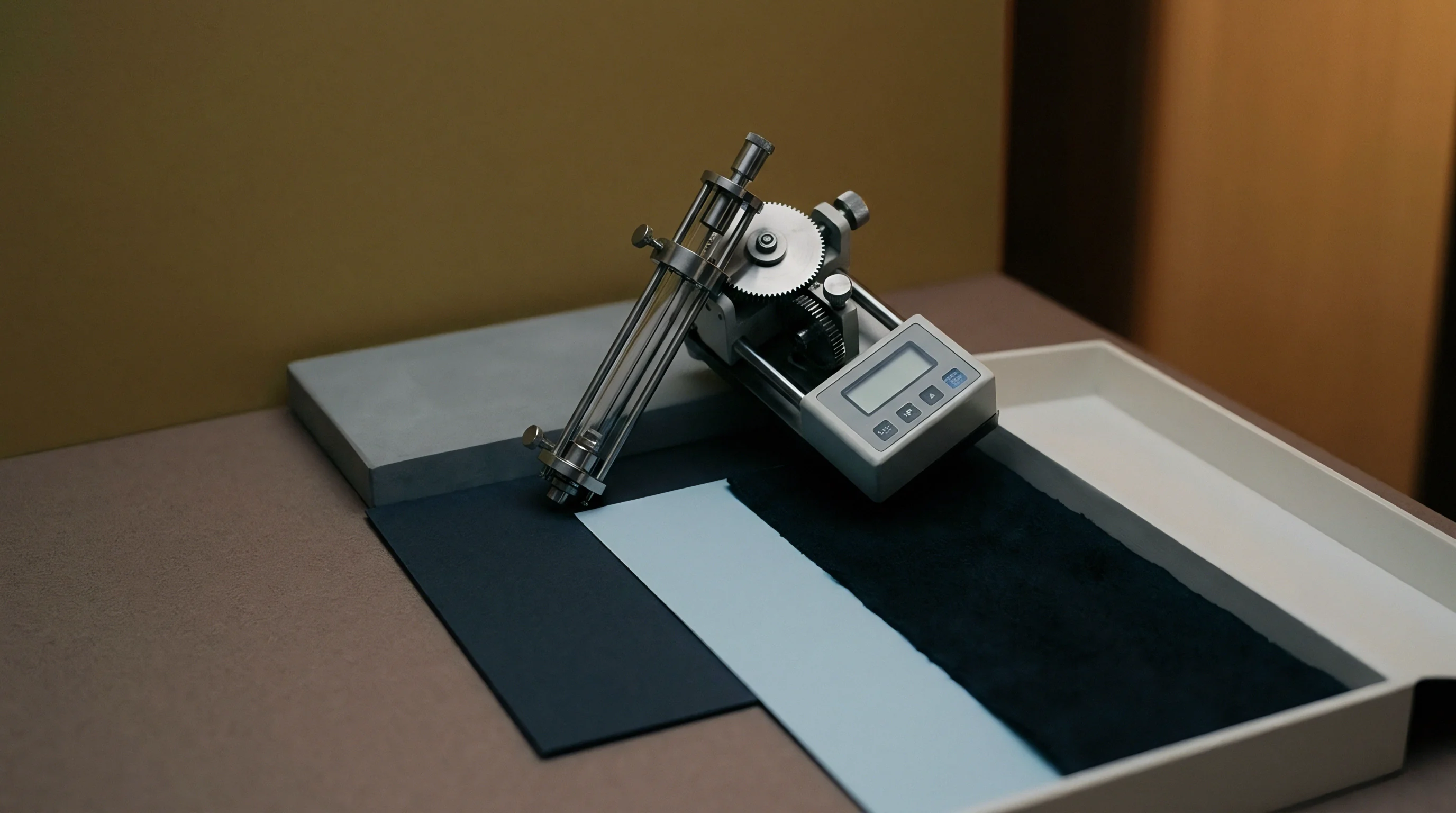
An acoustic lens machined into sapphire or quartz focuses the sound beam into a convergent cone. The beam diameter at the focal spot defines the lateral resolution of the acoustic profiling system. A 100-megahertz transducer with an f-number of 1.2 yields a focal spot diameter of fifteen micrometers in water.
Coupling the acoustic energy from the transducer into the moving packaging film presents distinct processing constraints. Sound waves at frequencies exceeding 20 megahertz attenuate rapidly in ambient air, losing up to 40 decibels per millimeter of travel. Practical scanning setups route the moving barrier web through a localized liquid meniscus, an immersion tank, or a specialized bubbler column.
Water acts as the standard acoustic couplant because its acoustic impedance of 1.5 megarayls sits close to that of aliphatic packaging polymers, suppressing entry reflections at the outer web surface.
Does High Frequency Acoustic Excitation Degrade Paper Substrates?
Acoustic energy deposition remains well below the destructive thresholds of cellulosic and synthetic web structures. The peak acoustic power delivered during a scanning cycle stays below five milliwatts per square millimeter. The true operational risk stems from liquid water absorption when scanning paper-laminated barrier boards.
Bleached sulfate board absorbs moisture rapidly, causing fiber swelling and sheet curling. To eliminate this issue, non-contact gas-coupled ultrasonic transducers operating at lower frequencies between 500 kilohertz and 2 megahertz enter the production line. These systems exchange lateral spatial resolution for moisture preservation, detecting debonding zones down to three millimeters wide without wetting the fiber base.
Transducer selection governs depth resolution through the relationship between acoustic wavelength and material sound speed. Shorter wavelengths isolate thinner individual film strata:
- High Frequency Immersion Transducer delivers center frequencies between 100 and 250 megahertz for pure polymer barrier laminates, isolating film layers down to two micrometers thick.
- Focused Bubbler Assembly projects a continuous laminar water column onto a passing web, confining liquid contact to a six-millimeter stripe and operating at 50 megahertz.
- Air Coupled Transducer Array operates dry at 800 kilohertz, resolving structural debond defects larger than two millimeters on moisture-sensitive paper-backed folding boxboard.
- Laser Ultrasonic Excitation System pulses a nanosecond infrared laser onto the film surface to generate thermoelastic acoustic waves, monitoring surface displacement with a separate optical interferometer.
The time-domain radiofrequency signal displays peaks corresponding to each material transition. When inspecting an unprinted barrier film, the front surface reflection appears first as a positive spike. The subsequent peaks trace the tie-layer junctions.
In a pristine film, the amplitude of these internal echoes stays uniform across the entire roll width.
Acoustic attenuation in polyolefin films increases linearly with frequency at room temperature.
An unexpected increase in interfacial echo amplitude signals adhesive failure. When the tie-layer polymer loses adhesion to an adjacent EVOH barrier core, the local acoustic reflectivity climbs toward unity. The diagnostic software isolates this behavior by establishing a temporal gate over the tie-layer region.
The system extracts the peak amplitude within that time window and encodes the numerical value into a false-color spatial map known as a C-scan. Regions of complete adhesion appear dark blue or green, while unbonded blisters show bright red.
Section 8.3 of ASTM E1065 details transducer electrical impedance characterization, setting limits on pulse distortion that prevent false delamination readings on calibrated converting lines.


Rupture
Interfacial separation in polymer barrier laminates originates from thermal stress, mechanical strain during converting passes, or chemical incompatibility at the adhesive boundary. Extrusion lamination lines bond polyolefins to polar barrier films using maleic anhydride grafted tie resins. These graft copolymers depend on covalent bond formation between anhydride groups and the hydroxyl groups of EVOH, alongside chain entanglement with the polyethylene matrix.
When the melt temperature inside the extruder drops below 210 degrees Celsius, maleic anhydride reactivity declines, suppressing chemical bonding. The film exits the chill roll with low interfacial fracture toughness.
Subsequent manufacturing passes apply severe mechanical loads to this weak boundary. Slitting knives generate localized shear along the cut edge. Embossing rollers compress the laminate structure, inducing shear strain differentials between rigid barrier materials like biaxially oriented PET and ductile sealant layers like LDPE.
Creasing rules crush the paperboard base in folding box operations, forcing the multi-layer barrier liner to bend around an internal radius under two hundred micrometers. If the interface lacks sufficient peel strength, the polymer layers shear apart, creating delamination channels that destroy gas barrier integrity.
How Do Microscopic Voids Alter Phase Signatures?
Acoustic echoes from debonded interfaces exhibit phase inversion due to the lower acoustic impedance of the void medium. In an intact coextruded barrier film where the sound beam moves from LDPE into EVOH, the wave travels from a lower-impedance material into a higher-impedance material. The reflection coefficient remains positive.
The reflected pressure wave matches the polarity of the incident pulse. When interfacial debonding occurs, the sound wave encounters an entrained pocket of gas. The wave moves from a higher-impedance polymer into a low-impedance gas void.
The reflection coefficient flips to a negative sign. The returned radiofrequency pulse inverts, swinging downward into a negative voltage trough before rising. Phase analysis software tracks this polarity shift at the sample gate, separating genuine delamination voids from simple variations in layer thickness or pigment concentration.
Mineral fillers such as titanium dioxide alter acoustic velocity and raise echo amplitude, but they do not reverse waveform phase polarity.
| Interface Condition | Echo Polarity | Reflection Coefficient (R) | Spectral Frequency Shift | Visual Inspection Correlate |
|---|---|---|---|---|
| Pristine Covalent Tie-EVOH Bond | Positive | +0.12 to +0.22 | Negligible attenuation shift | Optically clear, zero haze |
| Thermal Retort Micro-Debonding | Negative | -0.85 to -0.99 | High frequency loss > 6 dB | Localized blanching or haze |
| Flex-Crack Crease Delamination | Negative | -0.95 to -1.00 | Broadband acoustic scattering | Visible tunnel delamination |
| Pigment Loading (TiO2 Dispersion) | Positive | +0.25 to +0.40 | Frequency dependent scatter | Opaque white solid layer |
| Adhesive Cohesive Failure Layer | Mixed Phase | -0.30 to -0.60 | Intermediate damping loss | Faint optical distortion |
Flex cracking represents an acute failure mode for multi-layer barrier substrates. Gelbo flex testing according to ASTM F392 repeatedly twists and crushes the packaging film across defined cycles. In poor laminates, the brittle EVOH or aluminum oxide barrier layer fractures long before the outer polyolefin films fail.
These micro-cracks propagate along the tie-layer interface, initiating delamination zones that spread under interior gas pressures.
- Mechanical Shear Injection forces interfacial shear stresses past the yield point of the functional tie-layer during rotary die creasing.
- Micro-Cavity Nucleation occurs at points of unreacted maleic anhydride or localized contamination along the polymer boundary.
- Crack Propagation proceeds along the machine direction under residual tensile web stresses stored from the laminator nip.
- Blister Expansion accelerates when volatile migrants or moisture desorb into the newly formed interfacial void cavity.
Environmental stress cracking further accelerates this mechanical breakdown. Packaging lines handling oily foodstuffs, surfactants, or ethanol-containing formulations experience chemical attack at the seal edges. These volatile compounds diffuse through the sealant film, plasticizing the tie-layer and lowering the critical strain energy release rate.
Debonding follows rapidly, progressing along the package perimeter and opening pathways for oxygen ingress that spoil shelf-stable foods.
Converters report that tie-layer resins with melt indices above three grams per ten minutes naturally form micro-voids during fast chill cycles.

Spoilage
Interfacial delamination directly ruins converting throughput and drives up run waste. When a barrier film debonds during high-speed pouch forming or carton creasing, converting lines face jam-ups, seal ruptures, and lost vacuum integrity. An unresolved debonding issue that escapes initial line make-ready propagates through thousands of linear meters before offline quality assurance identifies the barrier loss.
Modern modified atmosphere packaging demands oxygen transmission rates below 0.5 cubic centimeters per square meter per day at standard conditions. A debonded patch as small as four square millimeters can raise the localized oxygen ingress rate twentyfold by creating a capillary conduit along the web interface.
Consider a typical commercial production run of multi-layer retort stand-up pouches. The job docket calls for 500,000 pouches running on an intermittent horizontal form-fill-seal line operating at 120 units per minute. The substrate consists of 12-micrometer BOPET, adhesive laminated to 15-micrometer BOPA, extrusion laminated with a tie resin to 9-micrometer aluminum foil, and sealed with 70-micrometer cast polypropylene.
The raw web material costs 0.42 dollars per square meter. Each pouch consumes 0.08 square meters of web, yielding a base substrate cost of 0.0336 dollars per unit. Add print passes, lacquer coating, tooling amortization, and pouch machine operating costs, and the finished pouch cost reaches 0.085 dollars per unit.
A three percent delamination reject rate on high-barrier retort stock eliminates the standard commercial profit margin of a converting run.
Assume a tie-layer extrusion chill roll temperature runs four degrees Celsius too cold across half a shift. The laminate passes visual inspection at the rewinder because optical clarity remains unaffected. Three weeks later, during steam retort sterilization at 121 degrees Celsius, thermal expansion mismatch between the aluminum foil and the cast polypropylene pops the weakened adhesive bond.
The resulting blisters ruin seal hermeticity across 32,000 filled pouches. The direct scrap calculation reveals the financial damage:
Pouch material and converting losses: 32,000 units multiplied by 0.085 dollars equals 2,720 dollars.
Food product loss inside the spoiled retort pouches: 32,000 units filled with prepared product valued at 1.45 dollars per unit equals 46,400 dollars.
Retort energy, secondary carton packaging, palletization, and scrap disposal fees add an additional 4,800 dollars.
Total direct loss sits at 53,920 dollars. That sum excludes brand penalties and line cleaning downtime. Online acoustic impedance profiling installed directly after the extrusion laminator detects that tie-layer adhesion loss within the first thirty meters of make-ready, limiting scrap generation to under 50 dollars of raw web.
| Process Operation | Make-Ready Waste Baseline | Running Waste With Debonding | Added Cost Per 10,000 m² Run | Detection Point |
|---|---|---|---|---|
| Extrusion Lamination | 150 meters | 4.5 percent web scrap | $1,890 in lost resin/film | Online acoustic scanning |
| Rotogravure Printing | 200 meters | 1.2 percent web scrap | $840 in wasted ink/solvent | Visual register tracking |
| High-Speed Slitting | 50 meters | 2.8 percent edge loss | $1,176 in trim cull | Edge guide sensors |
| Pouch Form-Fill-Seal | 80 pouches | 6.2 percent jam scrap | $4,250 in ruined pouches | Offline burst/vacuum test |
| Retort Autoclave Pass | 0 pouches | 8.5 percent pack failure | $12,800 in spoiled product | Post-autoclave visual cull |
Recyclability penalties under European packaging frameworks create an additional commercial liability. The Packaging and Packaging Waste Regulation imposes modulated eco-contributions based on design-for-recycling grades. Multi-layer barrier laminates containing non-separable layers of EVOH, polyamide, and polyolefins face Class D or Class E penalties, adding surcharges up to 450 euros per tonne of packaging material placed on the market.
Delamination profiles provide the mechanical baseline data required to formulate mono-material solutions. By qualifying polyolefin tie resins that maintain cohesion without polyamide reinforcement, converters drop their fee structure to Class A or Class B rates, saving up to 320 euros per tonne in extended producer responsibility fees.
Unmonitored web debonding cascades into product recalls, retail chargebacks, and terminated co-packing agreements across cross-border food distribution chains.

Docket
Procurement dossiers and converting contracts govern technical disputes over laminated barrier failures. When a filling plant encounters split pouches, the commercial inquiry focuses on whether the fault lies in the base raw film, the converter’s lamination pass, or the packager’s heat-sealing parameters. Acoustic impedance profiling data serves as objective proof within quality claims dossiers.
Because an acoustic C-scan provides a spatial map of debonding linked to machine roll footage, the analytical record reveals whether an adhesion failure spans an entire master roll or clusters near splices.
A rigorous specification protects buyers by establishing clear acoustic thresholds for acceptable web uniformity. Rather than relying on destructive 180-degree peel tests that cannot isolate buried tie layers, technical supply agreements incorporate non-destructive ultrasonic scanning parameters:
- Verify that the maximum allowable interfacial acoustic reflection coefficient across any functional barrier interface remains below positive 0.35 when measured with an ultrasonic transducer operating at a minimum center frequency of 100 megahertz.
- Establish that the total area of localized acoustic phase inversions indicating interfacial micro-voids or debonding must encompass less than 0.05 percent of the total web surface area per master roll.
- Reject any roll displaying continuous acoustic debonding tracks exceeding two hundred micrometers in width and five millimeters in length along the slit edge.
- Audit acoustic impedance C-scans submitted with certificates of analysis against retained production retain samples at six-month intervals.
DIN 55543 and ISO 15106 define test conditions for water vapor and oxygen gas transmission, but neither standard specifies mechanical bond longevity. Incorporating acoustic impedance criteria into the purchase order fills this contractual gap. When testing laboratories evaluate questionable material, high-frequency ultrasonic scanning distinguishes between cohesive failure within the adhesive matrix and adhesive failure at the polymer interface.
Cohesive failure points to degraded tie-layer resin or improper melt indexing during extrusion. Adhesive failure demonstrates insufficient surface corona treatment, low dyne levels, or mismatched surface energy states between the substrate and the tie resin.
The industry leaves open the question of how to standardize non-contact acoustic inspection on porous, high-yield paperboard substrates running at converting speeds above four hundred meters per minute without compromising signal-to-noise ratios.