Dynamic Relative Humidity Creep Decay in Corrugated Packaging Substrates
Dynamic relative humidity cycling drives exponential creep decay in corrugated board through mechano-sorptive bond cleavage, requiring dynamic safety factors.

Rheology
When cellulosic fiber networks carry a load under fluctuating atmospheric moisture, deformation accelerates dramatically. This mechano-sorptive effect degrades structural integrity at stresses far below the static yield strength established in standard conditioned lab tests. Consequently, static tests in fixed climates do not predict how corrugated boxes behave in a real cold chain or during maritime transit.
As relative humidity swings between ambient and high levels, moisture drives into and out of the cell wall matrix of unbleached kraftliner and recycled medium. That transient flux continuously breaks and reforms hydrogen bonds in the amorphous cellulose and hemicellulose fractions under shear tension.
At constant humidity, static creep deformation follows a predictable logarithmic decay over time. Cyclic moisture exposure, however, introduces a non-converging strain rate. Each sorption and desorption cycle produces irreversible slip between adjacent fibers in the paperboard web.
Load capacity deteriorates exponentially with the amplitude of the humidity swings, their frequency, and the baseline stress on the pack. Fiber networks subject to dynamic cycling can enter tertiary creep rupture in a few days, whereas identical boxes held at steady relative humidity retain their stability for months.
Mechanisms of Mechano Sorptive Strain
Microfibrils in the cell walls of both softwood and hardwood pulps respond immediately to internal vapor pressure. Water plasticizes the amorphous hemicellulose matrix surrounding crystalline cellulose microfibrils. As moisture is adsorbed, water molecules interrupt inter-polymer hydrogen bonding, giving microfibrils room to slip under compressive load.
When the board dries out and desorbs, hydrogen bonds reform around the deformed geometry. Repeating that cycle locks in additional plastic strain with every shift in humidity.
The degradation worsens when fiber alignment runs against the principal forces. Corrugated packaging depends heavily on cross-directional compressive strength to sustain vertical stacking loads, but the cross direction contains more amorphous matrix per unit length than the machine direction. Moisture moving through these transverse bonds magnifies lateral displacement between fibrils, so the incremental creep strain from each cycle stays positive and builds over time.
The fluting walls thin progressively as a result.
Transient Moisture Gradients and Microstructural Slippage
Atmospheric moisture shifts do not penetrate multi-ply board uniformly. The outer plies respond first, generating steep moisture gradients across the thickness toward the core. Tensile stresses develop in the drier layers while compressive stresses concentrate where moisture is higher.
These internal differentials can trigger localized micro-buckling on the linerboard faces well before the overall container structure gives way.
Relative humidity fluctuations drive irreversible structural strain in paperboard through continuous hydrogen bond rearrangement during moisture transport.
Recycled fibers follow distinctly different creep kinetics from virgin kraft pulps. Hornification from prior drying cycles cuts their swelling capacity and internal surface area. Although this restricts total moisture uptake, recycled webs have fewer inter-fiber bonds per unit volume to begin with, which concentrates higher stress onto each surviving junction.
Humidity cycling in recycled fluting grades consequently causes bond failure across smaller moisture deltas, speeding up structural collapse in boards manufactured with high recycled fractions.
Chamber
Standard laboratory conditioning under ISO 2233 or TAPPI T402 relies on a static climate of 23 degrees Celsius and 50 percent relative humidity to establish baseline comparisons. But static benchmarks mask the structural liabilities that appear in transit. Meaningful accelerated testing calls for chambers capable of cycling relative humidity across wide ranges while holding a constant vertical compressive load on the sample.
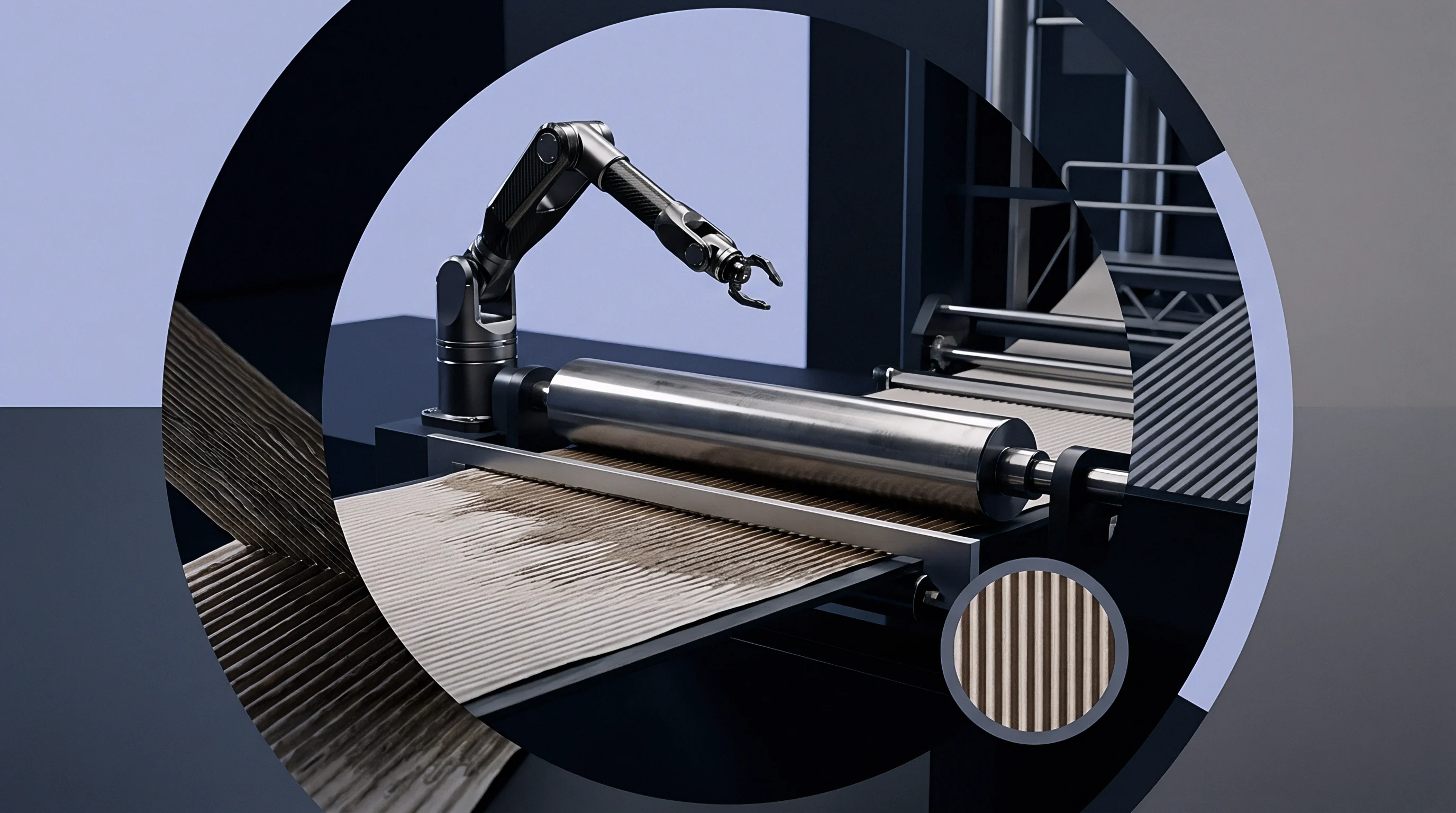
Simulating this degradation in the lab requires environmental chambers fitted with electromechanical or servo-hydraulic load frames. Profiles typically cycle relative humidity between 50 percent and 90 percent using controlled transition ramps lasting 3 to 6 hours. Linear variable differential transformers track real-time deflection throughout the test, capturing total strain, cycle-by-cycle strain rates, and the time to physical collapse for each tested substrate.
Bench Protocols versus Environmental Dynamics
Standard short-term compression values reflect only initial, dry-state strength. An ISO 12048 test applies a steady platen displacement rate until failure, running its course within a few minutes. That speed precludes any moisture transport during the run.
Standard test results therefore systematically overstate load capacity for distribution environments where static loads endure changing ambient humidity over weeks or months.
Dynamic creep protocols instead apply sustained loads pegged to fixed percentages of initial peak strength ~ typically 30, 45, or 60 percent ~ while sensors log vertical displacement through the humidity cycles. Under these conditions, substrates that share an identical static rating diverge sharply. Combinations built from virgin kraftliner survive repeated cycling, whereas recycled testliner constructions frequently collapse during the first few desorption phases.
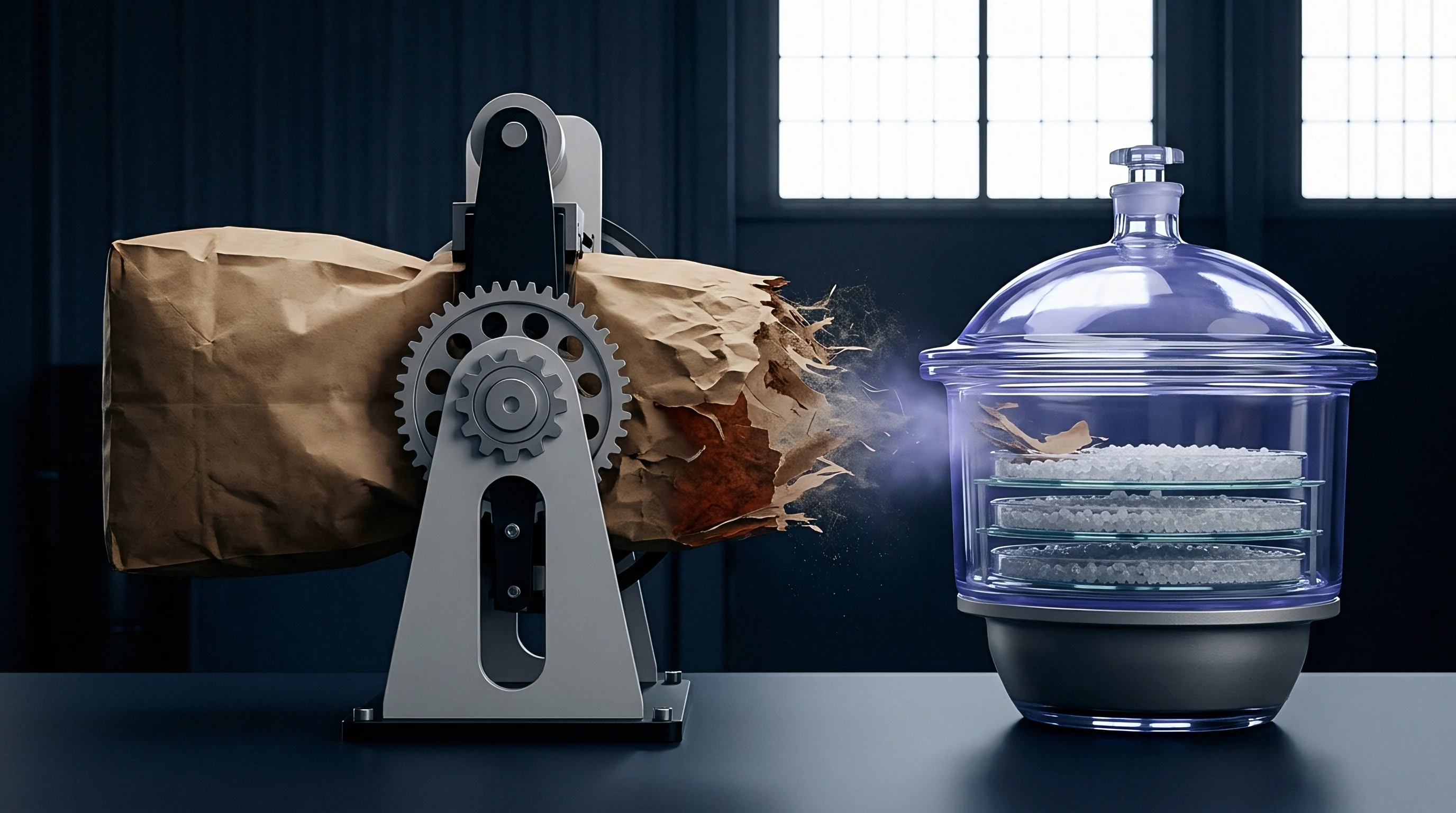
Step Sequence for Laboratory Creep Verification
Evaluating dynamic creep requires strict control over both atmospheric transitions and mechanical loading. Laboratories follow a defined sequence to map substrate fatigue:
- Sample pre-conditioning takes place at 30 percent relative humidity and 40 degrees Celsius for 24 hours to establish a dry moisture baseline across all paper plies.
- Equilibration follows inside the chamber at standard baseline conditions of 23 degrees Celsius and 50 percent relative humidity for at least 48 hours.
- Initial static compression testing determines baseline box compression strength and short-span compressive strength values using representative control samples.
- Test specimens are placed in the environmental frame under a sustained vertical static load set to 40 percent of baseline ultimate compression strength.
- Relative humidity cycling begins, ramping from 50 percent to 90 percent over 4 hours, holding at 90 percent for 2 hours, ramping back to 50 percent over 4 hours, and holding at 50 percent for 2 hours.
- Continuous measurement logs displacement data at 60-second intervals until physical collapse or until reaching a target threshold of 100 complete cycles.
Creep curves generated from these runs exhibit the three classical stages: primary creep with a diminishing strain rate, steady-state secondary creep, and tertiary creep accelerating toward ultimate failure. Cycling the humidity compresses the secondary phase drastically, forcing the board into premature tertiary rupture.
| Substrate Combination | Conditioning Profile | Applied Load (% BCT) | Secondary Creep Rate (mm/hr) | Time to Failure (Hours) |
|---|---|---|---|---|
| 175g Kraftliner / 120g Semi-Chem / 175g Kraftliner | Static 50% RH | 45% | 0.012 | > 1,200 |
| 175g Kraftliner / 120g Semi-Chem / 175g Kraftliner | Dynamic 50% to 90% RH (8h cycle) | 45% | 0.185 | 142 |
| 170g Testliner / 120g Recycled Medium / 170g Testliner | Static 50% RH | 45% | 0.028 | 840 |
| 170g Testliner / 120g Recycled Medium / 170g Testliner | Dynamic 50% to 90% RH (8h cycle) | 45% | 0.640 | 31 |
| 140g Lightweight Testliner / 100g Recycled Medium | Dynamic 50% to 90% RH (8h cycle) | 35% | 0.910 | 18 |
Suppliers often attribute box collapse under cyclic conditions to rough handling or warehouse mismanagement rather than substrate limits. Sales data sheets routinely cite dry box compression values measured under static TAPPI standards, leaving buyers to design around safety margins that do not hold up outside the laboratory.
Flute
The geometry of corrugated board determines how load is shared across the structure. The fluted medium spaces and braces the linerboards against buckling while transferring shear across the sheet. When humidity fluctuates, liners and fluting take on water at different rates because of differences in furnish, density, and refining history.
That differential expansion sets up internal shear stresses directly along the adhesive bond line.
Flute profiles shape how stresses concentrate within the board. Coarser geometries like A-flute and C-flute provide substantial vertical compression per unit weight in dry air, but their wider unsupported spans between flute tips become liabilities once moisture cycling saps linerboard flexural stiffness. Finer profiles like B-flute and E-flute feature shorter spans, distributing stress more evenly across the face and offering superior resistance to dynamic creep fatigue.
Substrate Fiber Architecture and Recycled Content
Virgin softwood kraft brings long, undamaged fibers that provide high tensile strength and extensive hydrogen bonding. Virgin semi-chemical hardwood pulps used in fluting retain native lignin networks that preserve wet stiffness and resist softening as moisture climbs. Because of this, high-yield semi-chemical media keep their flute geometry even when moisture content exceeds 10 percent.
Repeated cycles of pulping, refining, and drying progressively shorten recycled fibers, generate fines, and stiffen the cell walls through hornification. To hit dry specification targets, paper mills rely heavily on chemical aids such as cationic starch and polyacrylamide derivatives. These chemicals lift dry short-span compressive strength, but they lose efficacy under humidity.
Water hydrates the polymer chains, dropping their glass transition temperature and allowing fiber-to-fiber junctions to slip as the atmosphere cycles.
Adhesive Interface Integrity under Moisture Cycling
Starch adhesives secure the tips of the fluted medium to the inner and outer liners. Standard corrugator pastes blend native corn or wheat starch with caustic soda and borax to achieve fast gelatinization on high-speed corrugators. Under dry conditions, the cured starch bond line is stronger in shear than the base paper, but absorbed moisture reverses that balance.
Box strength decay under dynamic humidity accelerates when adhesive starch bonds absorb moisture faster than adjacent paper fibers.
Un-crosslinked starches absorb moisture readily from humid air, plasticizing the polymer matrix and lowering the elastic modulus of the joint. Differential hygro-expansion between the linerboard and the fluting medium subjects this weakened bond line to cyclic shear. In the absence of cross-linking wet-strength resins such as ketone-formaldehyde or melamine-formaldehyde, the adhesive softens until the flute tips delaminate, removing lateral support and prompting fluting collapse.

Structural Failure Modes under Mechano Sorptive Fatigue
Depending on furnish quality, flute profile, and adhesive selection, dynamic creep triggers several characteristic failure modes:
- Flute Tip Delamination occurs when moisture cycles plasticize non-water-resistant starch lines, separating liners from the fluting medium under shear stress.
- Crease Line Creep Collapse manifests at pre-scored container corners where mechanical fiber damage from converting lowers local flexural resistance.
- Linerboard Micro Buckling develops in wide unsupported spans between flute peaks when moisture absorption reduces the cross-directional elastic modulus.
- Fluting Wall Rolling takes place when recycled medium loses structural stiffness, causing the wave profile to lean laterally under vertical compressive load.
| Furnish Combination | Flute Type | Adhesive Type | BCT Loss @ 10 Cycles (%) | BCT Loss @ 50 Cycles (%) | Primary Failure Mode |
|---|---|---|---|---|---|
| Virgin Kraft / Semi-Chem Medium | C-Flute | Water-Resistant Resin Starch | 12% | 28% | Liner Micro-Buckling |
| Virgin Kraft / Semi-Chem Medium | B-Flute | Water-Resistant Resin Starch | 8% | 19% | Compressive Fiber Yield |
| 100% Recycled Testliner / Recycled Medium | C-Flute | Standard Native Starch | 34% | 68% | Flute Delamination & Rolling |
| 100% Recycled Testliner / Recycled Medium | B-Flute | Standard Native Starch | 26% | 52% | Fluting Wall Buckling |
| Kraft Top Liner / High-Performance Recycled Medium | BC-Double Wall | Water-Resistant Resin Starch | 15% | 35% | Inner Liner Crease Instability |
As a rule of thumb, substituting a recycled medium for a semi-chemical medium requires at least a twenty percent increase in dry basis weight to match dynamic fatigue life under cycling humidity.
Logistics
During multi-modal global transit, corrugated boxes encounter severe microclimatic extremes. Closed shipping containers transiting equatorial waters experience internal temperature swings greater than 20 degrees Celsius within a 12-hour diurnal cycle. Solar heating drives moisture out of cargo and timber pallets into the headspace.
When temperatures plunge at night, internal air cools past the dew point, condensing on container roofs and raining down on top pallets. In these enclosed spaces, relative humidity regularly swings between 60 percent and 98 percent every twenty-four hours.
Cold chains impose similarly punishing conditions. Chilled food and pharmaceutical consignments move between refrigerated storage (0 to 4 degrees Celsius at 85 percent RH), ambient staging docks (20 degrees Celsius at 60 percent RH), and refrigerated trailers. Every temperature change causes condensation on chilled packaging faces.
Droplets soak rapidly into the outer liner, driving surface moisture content past 18 percent. Subsequent re-chilling dries out the exterior, exposing the board to steep moisture gradients while under steady stacking loads.

Supply Chain Microclimates and Diurnal Cycling
Extended warehousing compounds this mechano-sorptive fatigue. Conventional engineering assumptions base pallet stacking strength on static loads sustained over 30 days, yet distribution networks routinely store finished goods for 90 to 180 days in unconditioned warehouses. Over that span, seasonal weather patterns subject cases to hundreds of diurnal moisture cycles, gradually eroding nominal safety margins.
Pallet stacking configurations can further compromise box endurance under cyclic moisture. Column stacking aligns the vertical corners directly over one another to exploit their stiffness. Yet an alignment error of just 15 millimeters shifts stacking forces away from these corner posts onto unsupported panel areas.
Interlocking layers improves pallet stability, but at the cost of a 30 to 45 percent drop in vertical compression strength. In fluctuating humidity, this off-center loading accelerates panel bulging and causes premature collapse.
Is Diurnal Humidity Cycling Covered under Standard Warranties?
Standard supply agreements rarely cover failures resulting from ambient conditions that exceed laboratory test baselines. Converter warranties are routinely tied to initial dry compression and edge crush values certified at delivery, effectively transferring environmental transit risk to the buyer. Without explicit performance terms for dynamic humidity, standard contract clauses categorize mechano-sorptive failure as an operational defect caused by improper storage.
Standard commercial purchase specifications based solely on TAPPI dry compression values leave buyers fully liable for load collapse caused by dynamic humidity cycling during transit.
Failing to account for cyclic moisture creep frequently ends in warehouse collapses. Structural failure in lower tiers cascades down the pallet column, crushing contents, creating personnel hazards, and prompting freight rejections. The resulting costs ~ inventory write-offs, carrier surcharges, and contractual chargebacks ~ readily eclipse the modest savings gained by downgrading paperboard specifications.
Stiffness
Calculating realistic package performance requires formulas that reflect environmental degradation. The classical McKee equation provides the baseline method for estimating box compression strength from edge crush values, flexural stiffness, and box geometry:
BCT = 5.87 ECT (U d)^0.5
where BCT is box compression strength in Newtons, ECT is cross-directional edge crush strength in Newtons per meter, U is inside box perimeter in meters, and d is total board caliper in meters. The empirical constant 5.87 is calibrated strictly to standard static laboratory conditions (23 degrees Celsius, 50 percent RH).
McKee Formula Limitations in Dynamic Environments
The original McKee formula assumes linear elastic deformation and stable flexural stiffness. High humidity and dynamic cycling induce non-linear plastic strain, invalidating those assumptions. Under cyclic moisture, edge crush strength (ECT) and flexural stiffness (D) degrade at different rates.
Flexural stiffness drops more rapidly because modulus loss in the outer linerboards cuts heavily into the board’s area moment of inertia.
To obtain valid estimates for dynamic operating conditions, engineering models adjust the McKee equation with environmental derating coefficients. These models decouple liner flexural retention from fluting crush retention, incorporating empirical fatigue factors that account for fiber furnish and the amplitude of humidity cycles.
Derivation of Mechano Sorptive Reduction Factors
Dynamic box compression capacity is calculated by applying cumulative derating factors to the baseline dry strength:
BCT_dynamic = BCT_dry Alpha_env Alpha_creep Alpha_fatigue
In this formulation, Alpha_env reflects static moisture loss at elevated humidity, Alpha_creep accounts for sustained load duration, and Alpha_fatigue captures the degradation caused by humidity cycle frequency and amplitude. Table 3 provides empirical values established through controlled chamber testing.
| Environmental Exposure Condition | Alpha_env (Equilibrium) | Alpha_creep (30-Day Load) | Alpha_fatigue (Cyclic RH) | Combined Retention (BCT_dynamic / BCT_dry) | Required Minimum Design Safety Factor |
|---|---|---|---|---|---|
| Standard Lab (23°C / 50% RH Static) | 1.00 | 0.70 | 1.00 | 0.70 | 1.43 |
| High Humidity (23°C / 85% RH Static) | 0.55 | 0.60 | 1.00 | 0.33 | 3.03 |
| Moderate Cycling (50% to 75% RH Daily) | 0.75 | 0.60 | 0.70 | 0.315 | 3.17 |
| Severe Cycling (50% to 90% RH Daily) | 0.50 | 0.50 | 0.50 | 0.125 | 8.00 |
| Cold Chain Condensation Cycling | 0.40 | 0.45 | 0.40 | 0.072 | 13.88 |
Using conventional static safety factors (typically 1.5 to 2.0) on boxes destined for cyclic humidity invites failure in the field. Standard margins cannot offset the compound retention losses shown in Table 3. Severe humidity cycling demands combined safety multipliers of 5.0 to 8.0, depending on furnish composition and planned storage duration.

Worked Calculation for Pallet Compression Allowance
A representative case illustrates how these adjustments work in practice. A standard case must support 3,500 Newtons in a bottom-tier pallet position. Warehousing in an unconditioned subtropical depot exposes the packaging to daily humidity cycling between 50 percent and 90 percent for up to 60 days.
The initial baseline specification specifies a single-wall C-flute construction using 100 percent recycled testliner and recycled medium.
Determining the target baseline dry compression strength (BCT_dry) under static assumptions might lead a buyer to apply a simple safety factor of 2.0:
BCT_required_static = 3,500 N 2.0 = 7,000 N
Evaluating that specification against dynamic conditions reveals substantial under-engineering. Table 3 indicates a combined retention coefficient of 0.125 for severe daily cycling (50% to 90% RH). The required dry compression rating must therefore absorb the full mechano-sorptive loss:
BCT_required_dynamic = 3,500 N / 0.125 = 28,000 N
Reaching a dry compression strength of 28,000 Newtons with single-wall board is commercially impractical, requiring excessively heavy grammages. The practical solution is re-engineering the board architecture rather than simply adding paper. Moving to a double-wall BC-flute configuration with virgin kraftliner facings and a semi-chemical medium shifts the retention parameters.
The improved moisture tolerance raises Alpha_fatigue from 0.50 to 0.75 and Alpha_env from 0.50 to 0.65, resulting in a revised combined retention factor of 0.244.
BCT_required_revised = 3,500 N / 0.244 = 14,344 N
Adjusting the furnish and flute architecture cuts the required dry compression target by nearly 50 percent while maintaining structural integrity in transit. This calculation model prevents failure across cross-border freight corridors without adding excessive paper weight.
Under ISO/IEC 17025 accreditation rules, section 7.8.2 mandates that performance claims for packaging exposed to humid transit must explicitly document the environmental test schedule and creep coefficients used in load models.
Dossier
Substantiating structural integrity and regulatory compliance demands auditable documentation traceable through technical files. Legislation such as the European Union Packaging and Packaging Waste Regulation (PPWR) sets strict packaging optimization targets. Specifications must minimize packaging weight and volume while providing enough strength to prevent product spoilage.
Under-designed packs create waste through transit damage, breaching baseline rules, while over-designed containers incur financial penalties under eco-modulated Extended Producer Responsibility (EPR) fee schemes.
Compliance files must demonstrate that source reduction has not undermined dynamic load endurance. A complete verification dossier includes mill test reports, chain-of-custody certificates, applicable food contact declarations, and accredited environmental chamber creep data. Relying on nominal supplier spec sheets without proof from dynamic conditioning testing leaves brand owners exposed during customs inspections or regulatory audits.

Regulatory Dossiers and Packaging Optimization Criteria
Chain-of-custody systems under FSC or PEFC trace virgin fiber back to certified forestry sources, while standards like FSC-STD-40-004 and PEFC ST 2002 govern credit and percentage tracking for recycled content. When converters replace virgin kraftliner with recycled testliner to meet sustainability metrics, the container’s mechano-sorptive creep behavior changes fundamentally. The technical dossier must document these substrate changes, showing that the recycled board still satisfies required transport performance standards.
Food contact mandates introduce additional material constraints for humid distribution environments. European Regulation 1935/2004 and Regulation 10/2011, along with BfR Recommendation XXXVI for paper and board, govern the chemical additives used to improve wet strength and creep resistance. Functional coatings and wet-strength chemistries, including epichlorohydrin-based resins, must undergo migration testing using food simulants under specified temperature and exposure durations.
Test reports in the file must confirm that these additives remain within overall and specific migration limits.
Verification File Audit Requirements for Structural Claims
Building a defensible compliance file requires systematic assembly of lab test certificates and audit documentation. Procurement teams review dossiers against explicit technical criteria prior to commercial sign-off:
- Chain of Custody Certificates must cover the exact mill code, manufacturing site, and substrate grade listed on commercial delivery notes.
- Accredited Test Reports must originate from ISO/IEC 17025 certified test laboratories specifying exact relative humidity cycling profiles and load durations.
- Chemical Migration Analysis must prove compliance with food contact standards for wet-strength resins and synthetic sizing agents incorporated into paper plies.
- Recyclability Assessments per EN 13430 must confirm that water-resistant starch adhesives or synthetic cross-linkers do not impede repulping operations.
- Structural Load Calculations must detail environmental correction factors applied under McKee derivations, signed off by a qualified packaging engineer.
Customs authorities and market surveillance inspectors review packaging files during cross-border trade inspections, and missing or unverified documentation risks container holds at entry ports. Technical file audits verify that certified material claims align with the physical properties of delivered board. Commercial agreements should allocate compliance liability clearly across the mill, converter, and buyer, ensuring documentation is verified prior to product shipment.