Dynamic Vapor Sorption Kinetics and Interfibrillar Swelling Stress Redistribution in Recycled Barrier Substrates
Dynamic vapor sorption in recycled barrier substrates triggers localized interfibrillar swelling stresses that disrupt coating integrity under humidity transients.
Diffusion
Sorption Dynamics in Recycled Cellulosic Matrices
Water vapor transport through recycled paperboard with dispersion or extrusion barriers differs fundamentally from transport through virgin networks. The wicking, pressing, drying, and resuspension cycles inherent to recycling cause hornification ~ an irreversible collapse of the internal lumen and interfibrillar pore structure. This structural change lowers the water retention value of mechanical and chemical pulps, altering thermodynamic equilibrium during vapor uptake.
While virgin cellulose displays predictable Fickian diffusion at low relative humidity, dynamic vapor sorption measurements reveal that recycled matrices follow anomalous non-Fickian transport under typical storage conditions.
Cellulose fibrils bind water vapor at active hydroxyl sites across crystalline and amorphous surfaces. Hornification restricts access to these sites by promoting inter-chain hydrogen bonding within amorphous regions during mechanical repulping. Under elevated humidity, vapor migrates through secondary cell walls via Knudsen diffusion in sub-micron pores alongside molecular surface diffusion across internal walls.
Once localized relative humidity exceeds 60 percent, capillary condensation inside residual voids generates osmotic pressure sufficient to force collapsed inter-fiber spaces back open.
Transient vapor sorption kinetics in recycled packaging boards show altered absorption rate constants and pronounced hysteresis. Sorption isotherms from gravimetric microbalances yield wider hysteresis loops between sorption and desorption limbs than those of virgin fibers. Capillary condensation within narrowed lumens and tortuous micro-voids keeps moisture bound on the desorption branch down to much lower water activities.
Substrates with high post-consumer content absorb vapor rapidly upon sudden humidity spikes, then undergo an extended equilibration phase over several days as bound water redistributes into crystalline microfibril domains.
Aqueous barrier coatings face acute local stress during these sorption cycles. Whether formulated from polyvinyl alcohol, polyhydroxyalkanoates, acrylic dispersions, or microfibrillated cellulose, the barrier film must maintain its integrity while the underlying fiber network swells. Shorter fiber lengths and higher fines content in recycled boards create an uneven density distribution across the sheet.
Regions dense with fines take up vapor quickly, setting up steep localized moisture gradients against adjacent fiber bundles.
Water vapor sorption isotherms measured via dynamic gravimetric balance at 23 °C confirm that recycled fiber mats exhibit up to 18 percent lower total moisture capacity at 90 percent relative humidity than virgin kraft pulp while displaying 35 percent faster initial vapor absorption rates during moisture transients.
Thermodynamics of Bound Water and Hysteresis
The free energy of mixing between moisture and amorphous cellulose dictates the swelling force within a recycled fiber web. At low relative humidity, water molecules bind directly to accessible cell-wall hydroxyls through primary hydrogen bonds, with an enthalpy of sorption well above the latent heat of vaporization of bulk water. Above 40 percent relative humidity, secondary sorption builds multi-layer water films within interfibrillar spaces.
Because hornification eliminates primary bonding sites, the ratio of primary bound water to total moisture drops in recycled pulp, shifting the balance toward capillary condensation.
High post-consumer furnish introduces kinetic irregularities through residual hemicellulose fragments, oxidized lignin, and broken fines. Fines absorb water quickly due to their high specific surface area and abundant exposed amorphous cellulose. This disparity between core fibers and surface fines establishes vapor pressure gradients across the board thickness.
During humidity swings, the surface layers reach equilibrium well ahead of the core, generating internal pressure differentials that strain the paper-barrier interface.
Standard qualification relies on static water vapor transmission rate measurements at steady-state relative humidity to evaluate barrier performance, attributing transport failures to ambient swings outside the material’s nominal design envelope. That approach overlooks the transient physical mechanics within recycled fiber networks, where sudden humidity shifts induce localized swelling stresses long before steady-state transport develops across the cross section.

Strain
Cell Wall Expansion and Interfibrillar Mechanics
Absorbed moisture destabilizes recycled fiber mats through anisotropic expansion at the fiber level. Individual cellulose fibers swell extensively in transverse radial and tangential directions ~ often 15 to 20 percent of dry diameter ~ while longitudinal expansion rarely exceeds 1.5 percent. Because recycled fibers lose compliance over repeated drying cycles, their altered transverse swell ratios concentrate mechanical deformation directly within inter-fiber bonds.
Bonds formed during pressing and drying sustain high shear loads when fibers swell transversely against neighbors aligned in perpendicular machine directions. Hydrogen bonds across these contact zones undergo continuous strain during humidity cycles. When ambient humidity shifts from 50 percent to 85 percent, localized stress concentration at interfibrillar joints can reach three times the average macro-scale strain measured across the bulk sheet.
Stress redistributes through viscoelastic relaxation within wet cellulose and hemicellulose chains. At low moisture levels, the cell wall behaves as a rigid, glassy polymer with a high elastic modulus. Once moisture content exceeds 8 to 10 percent dry weight, the water plasticizes the matrix, depressing the glass transition temperature of amorphous cellulose and hemicellulose below ambient operating conditions.
As the network transitions from a glassy to a rubbery state, localized shear stress relaxes, accelerating dimensional creep across folded or corrugated structures.
| Substrate Fiber Composition | Water Retention Value (g/g) | Transverse Fiber Swell (%) at 85% RH | Hygro-expansion Coefficient (% per % RH) | Elastic Modulus Retention (%) at 85% RH |
|---|---|---|---|---|
| 100% Unbleached Virgin Kraft Pulp | 1.45 | 16.2 | 0.028 | 62.4 |
| 70% Virgin Kraft / 30% Post-Consumer Recycled | 1.28 | 14.1 | 0.034 | 51.8 |
| 100% Post-Consumer Recycled Containerboard | 0.98 | 11.5 | 0.048 | 38.2 |
| 100% De-inked Post-Consumer Fine Paper | 1.05 | 12.3 | 0.042 | 41.5 |
| Data recorded at 23 °C following equilibrium conditioning per ISO 187 standards across relative humidity steps from 50% to 85%. | ||||
Redistribution of Internal Network Stresses
Interfibrillar swelling stresses propagate outward through the fiber network toward the surface layers. Aqueous dispersion barriers and biopolymer extrusion coatings applied to recycled board form thin, rigid films bonded directly to top-deckle fibers. When the underlying network expands with moisture, the surface coating experiences planar tensile strain dictated by the expanding substrate.
Uncoated boards dissipate swelling strain through out-of-plane cockling and z-direction fiber shear. A continuous vapor barrier alters this behavior entirely. By restricting moisture egress, the barrier creates a localized accumulation zone directly beneath the polymer-cellulose boundary.
The fibers immediately adjacent to the coating swell faster than those in the core, concentrating interfacial shear stresses along the bond line.
Interfacial shearing develops along the dispersion boundary during dynamic climate chamber testing. The magnitude of this shear stress depends directly on the stiffness gradient between the dry barrier polymer and the hydrated cellulose substrate. When a barrier material has a high elastic modulus and low elongation at break, it cannot accommodate localized fiber movement through plastic deformation.
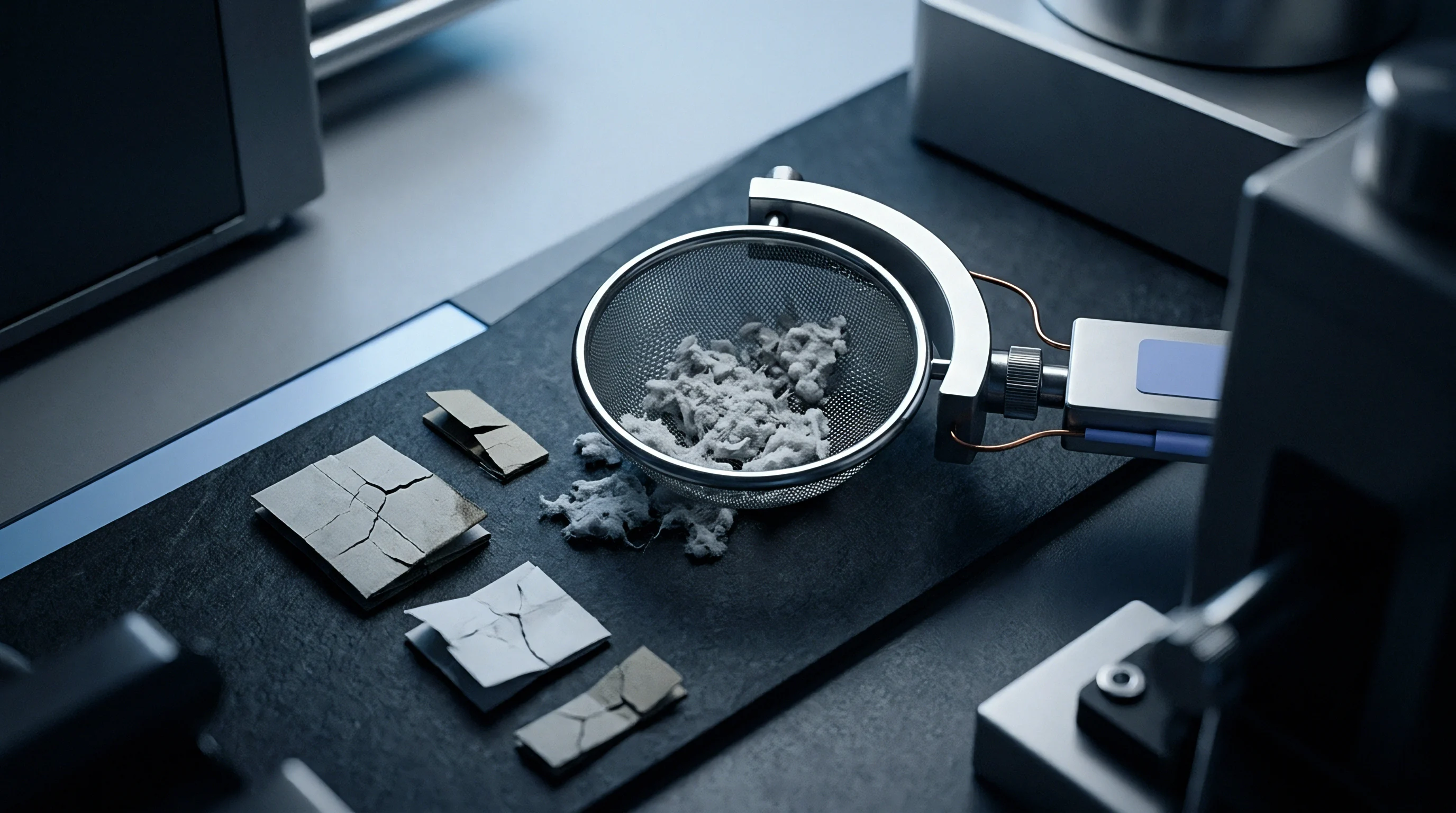
Unrelaxed strain energy then ruptures micro-bonds between the fiber surface and the polymer film, initiating macro-scale delamination.
Ignoring interfibrillar stress redistribution during material specification leads to barrier failure during distribution, resulting in delamination, shortened shelf life, and batch rejections.
Disruption

Mechanisms of Barrier Layer Shear Degradation
Barrier disruption under dynamic vapor sorption begins at microscopic stress concentrations across the board surface. Recycled paperboard exhibits significant surface roughness, with protruding coarse fibers, pinholes, and uneven porosity from wide fiber-length distributions. When aqueous dispersions are applied by blade, rod, or curtain coaters, dry film thickness varies over this profile, running thin across fiber peaks and pooling in valleys.
As the recycled substrate absorbs vapor, transverse swelling in elevated fiber tips pushes vertically into the thinnest sections of the barrier film, concentrating tensile stresses in those regions. If this localized strain exceeds the ultimate elongation limit of the dry polymer, micro-fissures open over the swelling tips. These fractures breach the barrier, creating direct pathways for vapor transport that bypass the bulk coating.
Cyclic humidity fluctuations simultaneously generate alternating tension and compression across the polymer-fiber interface. Swelling places the coating under planar tension during absorption. During desorption, the substrate contracts rapidly, subjecting the attached barrier to compressive loading.
If the polymer underwent plastic deformation while in tension, subsequent substrate shrinkage forces the film to buckle, producing pinholes and interfacial blisters.
How Does Interfibrillar Strain Alter Coating Adhesion?
Interfacial adhesion between aqueous dispersion coatings and cellulosic substrates depends on mechanical interlocking, hydrogen bonding, and polar surface interactions. Moisture migrating through the polymer or substrate competes directly for hydrogen bonding sites along the interface. Because water molecules have higher polarity and a greater dipole moment than barrier polymers such as polyvinyl alcohol, polyacrylates, or polyesters, absorbed water displaces polymer functional groups from cellulose surfaces.
This displacement reduces the thermodynamic work of adhesion before fiber swelling introduces mechanical shear. As moisture accumulates along the boundary, the failure mode transitions from cohesive rupture within the cellulose substrate to adhesive failure at the polymer-fiber interface. When mechanical swelling strain acts on an interface already weakened by moisture displacement, delamination occurs at much lower stress levels than in dry conditions.
Compliance with EN 13430 material recyclability standards mandates that barrier polymer coatings must separate cleanly during repulping operations, establishing a direct conflict between high wet-interfacial adhesion required for long shelf life and low repulping bond strength demanded for recycling certification.
Microscopic inspection of failed recycled barrier boards demonstrates that delamination spreads outward from initial pinhole defects and fiber peak locations. Propagation rates track the frequency and amplitude of ambient relative humidity cycles. While steady-state humidity rarely causes catastrophic failure, cycling between 20 percent and 80 percent relative humidity induces fatigue failure along the interface within 48 to 72 hours.
The structural degradation of recycled barrier packaging proceeds through several distinct mechanisms:
- Micro-cracking along fiber contours occurs when thin coating regions over protruding coarse recycled fibers exceed their ultimate tensile elongation during localized transverse fiber swelling.
- Interfacial debonding via moisture displacement develops when absorbed water molecules displace polymer functional groups from cellulose hydroxyl sites along the coating boundary layer.
- Compressive buckling and pinhole generation appears during rapid desorption phases as the contracting fiber mat forces plasticized barrier coatings to buckle outward from the substrate plane.
- Pin-hole propagation through residual stickies originates around hydrophobic contaminant inclusions in recycled pulp that prevent uniform aqueous dispersion film formation during industrial coating drying cycles.
- Cross-directional shear rupture establishes along machine-direction and cross-direction fiber density transition zones where localized differential hygro-expansion forces out-of-plane stress concentration.
These disruption mechanisms cause an irreversible step-change increase in water vapor transmission. A single high-humidity transient can permanently degrade barrier performance by orders of magnitude, even after conditions return to nominal room temperature and humidity. Qualifying barrier boards solely on pre-shipment steady-state permeability leaves packaging vulnerable to failure across variable distribution climates.
Determining the critical threshold of interfibrillar shear energy needed to trigger irreversible delamination remains a key challenge for bio-based barrier dispersions on high-yield recycled pulp under dynamic humidity conditions.

Interactions
Pulp Impurities and Sorption Kinetic Variations
Recycled fiber furnish contains non-cellulosic impurities that affect both the rate and extent of moisture sorption. Residual lignin in mechanical pulps and unbleached linerboard has a lower hydrophilic capacity than amorphous cellulose, yet oxidized lignin from chemical de-inking and bleaching carries free carboxyl and phenolic groups that serve as secondary sorption sites. This mixture of hydrophobic native lignin and hydrophilic oxidized fragments creates localized variations in moisture transport across the web.
Starch additions, used extensively in recycled containerboard to recover lost bonding strength, influence sorption kinetics even more heavily. Wet-end cationic starches and surface starches absorb moisture rapidly, reaching equilibrium moisture levels nearly double those of refined native fibers at equivalent relative humidity. These residual starches act as localized moisture sinks, accelerating interfibrillar swelling in their immediate vicinity.
Inorganic fillers like calcium carbonate, talc, and titanium dioxide in de-inked post-consumer pulp also alter the pore structure. Fines and filler particles lodge within interfibrillar voids, modifying capillary condensation. While calcium carbonate itself has low sorption capacity, its presence shifts the contact angle and pore size distribution, altering the capillary pressure required to drive moisture through internal voids.
| Barrier Substrate Specification | Initial WVTR (g/m²/day) 23°C/85% RH | Post-Cycling WVTR (g/m²/day) 23°C/85% RH | WVTR Degradation Factor (%) | Interfacial Delamination Area (%) |
|---|---|---|---|---|
| Aqueous Acrylic Dispersion on Virgin Kraft (15 g/m²) | 1.2 | 1.5 | 25.0 | 0.5 |
| Aqueous Acrylic Dispersion on 100% Recycled (15 g/m²) | 2.8 | 18.4 | 557.1 | 14.2 |
| PVOH Barrier Coating on 100% Recycled (8 g/m²) | 0.4 | 24.8 | 6100.0 | 31.0 |
| Extruded PHA Bio-polymer on 100% Recycled (20 g/m²) | 3.5 | 5.1 | 45.7 | 2.8 |
| Humidity cycling protocol: 10 cycles consisting of 12 hours at 23 °C / 20% RH followed by 12 hours at 23 °C / 85% RH. WVTR measured per ASTM F1249. | ||||
Polymer-Cellulose Interface Energy Dynamics
Adhesion between polar barrier polymers and recycled cellulosic surfaces depends on the surface energy components of both materials. Clean cellulose displays high polar surface energy, which promotes wetting and spreading of water-based dispersions. Hydrophobic stickies, sizing agents, and fatty acid residues on recycled fibers lower the total surface energy and suppress the polar component, interfering with uniform wetting during industrial coating.
Poor wetting leaves microscopic voids and unbonded areas along the interface. These defects act as stress risers where moisture condenses during humidity shifts. Water accumulating in unbonded pockets generates hydrostatic pressure under thermal or humidity cycling, driving micro-cracks into the overlying polymer film.
Dynamic climate chamber exposure testing confirms that aqueous dispersion barrier coatings on recycled linerboards display up to a seven-fold increase in water vapor transmission rate following cyclic humidity exposure due to interfacial stress accumulation, whereas identical coatings on virgin kraft substrates exhibit less than a 30 percent increase under matching conditions.
Qualifying barrier substrates under these conditions requires a systematic evaluation protocol prior to finalizing commercial specifications:
- Determine the chemical composition and impurity profile of the recycled pulp furnish, specifically measuring residual starch content, ash content, and total extractable organic materials.
- Establish baseline water vapor transmission rates for the candidate barrier substrate under steady-state conditions at 23 °C and 50 percent relative humidity per standard testing guidelines.
- Subject candidate samples to 100 hours of cyclic relative humidity testing, alternating relative humidity between 20 percent and 85 percent every 12 hours inside a controlled dynamic environmental chamber.
- Re-measure water vapor transmission rates immediately following climate cycling to calculate the post-cycling degradation factor against baseline steady-state values.
- Perform cross-sectional scanning electron microscopy and micro-tomography imaging across failed regions to evaluate interfacial delamination depth and fiber-level micro-cracking mechanisms.
In packaging development, any recycled barrier board showing over a 50 percent increase in water vapor transmission rate after dynamic humidity cycling generally requires surface sizing adjustments or a higher coat weight before commercial release.

Validation

Analytical Methods for Sorption and Stress Measurement
Characterizing the dynamic response and compliance of recycled barrier boards requires instrumentation capable of tracking microgram mass changes alongside microscopic strain. Dynamic Vapor Sorption (DVS) balances serve as the primary tool for evaluating moisture uptake kinetics in cellulose. These systems suspend milligram-scale samples in a temperature-controlled chamber while dry and humid nitrogen streams flow past, recording mass changes with 0.1-microgram resolution across programmed humidity steps.
DVS sorption curves yield diffusion coefficients, sorption capacities, and kinetic rate constants across discrete relative humidity steps. However, standard gravimetric DVS measures mass change without isolating the mechanical strain within the expanding fiber network. Coupling gravimetric DVS with optical digital image correlation or environmental scanning electron microscopy resolves this limitation, allowing direct observation of transverse fiber swelling, interfacial delamination, and coating micro-cracking as relative humidity shifts in the chamber.
Correlating sorption isotherms with micro-mechanical strain mapping identifies the critical moisture threshold where non-linear viscoelastic creep begins in recycled webs. Measuring only steady-state water vapor transmission rates per ASTM F1249 or ISO 15106-3 yields incomplete performance data, as these methods hold relative humidity constant across a flat sample clamped inside a rigid diffusion cell. Clamping prevents natural edge swelling and planar hygro-expansion, hiding the mechanical stress redistribution mechanisms that drive real-world field failures.
Regulatory Frameworks and Compliance Files
Food-contact recycled packaging must satisfy strict safety and environmental standards. Regulation (EC) No 1935/2004 provides the overarching European framework, requiring that materials do not transfer constituents to food in quantities that endanger health or unacceptably alter food composition. Recycled substrates require verification of functional barrier properties alongside chemical migration assessments covering post-consumer pulp contaminants.
The German Federal Institute for Risk Assessment (BfR) Recommendation XXXVI governs paper and board for food contact, setting purity criteria, mineral oil hydrocarbon (MOSH/MOAH) limits, and requirements for wet-strength agents and dispersion additives. Aqueous dispersion barriers on recycled board serve two purposes: resisting water vapor and acting as a functional barrier against volatile migrants. If interfibrillar swelling ruptures the coating layer, moisture resistance and migration barrier performance fail together.
A rigorous compliance dossier for recycled barrier board verifies that migration testing reports reflect real-world mechanical stress history. Testing a pristine, un-flexed sample for mineral oil migration yields unrepresentative baseline figures that fail to capture the physical state of a package after scoring, folding, and humid transport.
Technical compliance files for international packaging supply chains require specific documentary proof:
- FSC or PEFC Chain of Custody Certificates confirming post-consumer recycled content claims through audited transfer or percentage accounting models across every manufacturing tier.
- Chemical Safety Declarations of Compliance demonstrating compliance with Regulation (EC) No 1935/2004 and BfR Recommendation XXXVI, supported by specific migration test data using food simulants.
- Recyclability Qualification Reports confirming compliance with EN 13430 or CEPI recyclability laboratory protocols, proving clean fiber separation without stickie generation during industrial repulping.
- Dynamic Vapor Sorption and Mechanical Fatigue Reports establishing barrier integrity retention following standardized dynamic humidity cycling between 20 percent and 85 percent relative humidity.
- Compostability Certificates per EN 13432 or ASTM D6400 where bio-based barrier coatings are declared as organically recyclable, including disintegration and ecotoxicity testing.
Procurement contracts should include an explicit compliance warranty specifying that water vapor barrier and chemical migration limits remain valid after mechanical converting, folding, and dynamic humidity cycling between 20 and 85 percent.
Efficacy
Sourcing Strategies and Yield Economics
Specifying recycled barrier boards for commercial packaging requires balancing raw material cost, area yield, converting runnability, and regulatory compliance. Post-consumer recycled paperboard typically costs 10 to 20 percent less per metric ton than virgin solid bleached sulfate board. However, this savings can be eroded by lower substrate yield, higher barrier coat weights needed over rough surfaces, and increased waste during converting and filling.
Yield models must reflect the density and stiffness differences between virgin and recycled grades. Recycled containerboard and folding boxboard have lower bulk and tensile strength than virgin kraft of equal grammage. Achieving equivalent box compression strength and stiffness requires increasing the basis weight of recycled board by 15 to 25 percent, reducing the number of carton blanks obtained per metric ton purchased.
Aqueous dispersions also require higher coat weights on recycled substrates to reach baseline barrier targets. While an 8 to 10 g/m² acrylic dispersion coating provides an effective vapor barrier on smooth virgin kraft, uncalendered post-consumer board requires 14 to 18 g/m² to achieve continuous coverage over protruding fibers. Water vapor transport increases exponentially through uncovered fiber peaks.
This additional chemical cost must be incorporated into preliminary unit economics.
Risk Mitigation and Quality Assurance Protocols
Managing operational risk when converting to recycled barrier packaging requires rigorous incoming quality control. Supply contracts should specify exact physical boundaries beyond grammage and burst strength, incorporating water retention values, hygro-expansion coefficients, and surface energy thresholds. Auditors verify certificate scopes against public registers to ensure that supplier claims cover the specific mill, grade, and converting site handling the production run.
Receiving protocols should include dynamic humidity pre-conditioning ahead of physical and permeability testing. Routine quality checks at static 23 °C and 50 percent relative humidity miss substrates prone to delamination under stress. Subjecting sample blanks to humidity cycling prior to creasing and carton forming reveals structural weaknesses before material reaches converting lines.
When cross-border packaging shipments are detained at import terminals due to unsupported recycled content declarations or invalid food contact migration documentation, the financial liability falls directly upon the importer of record. Establishing a fully documented, test-verified compliance file containing dynamic vapor sorption kinetics data, migration reports, and chain of custody proof protects brand owners against regulatory enforcement actions, border holds, and costly retail recall events.
The transition to post-consumer recycled fiber in technical packaging is driven by extended producer responsibility fees, PPWR regulations, and brand targets. Operating successfully in this space requires moving past steady-state assumptions to consider dynamic sorption kinetics, interfibrillar swelling, and localized stress distribution throughout the packaging lifecycle.