Dynamic Mechano Sorptive Creep Coupling and Delamination Kinetics in Recycled Board Packaging under Stacking
Dynamic relative humidity cycling accelerates compressive creep strain and drives interlaminar delamination kinetics in recycled board packaging stacks.
Coupling
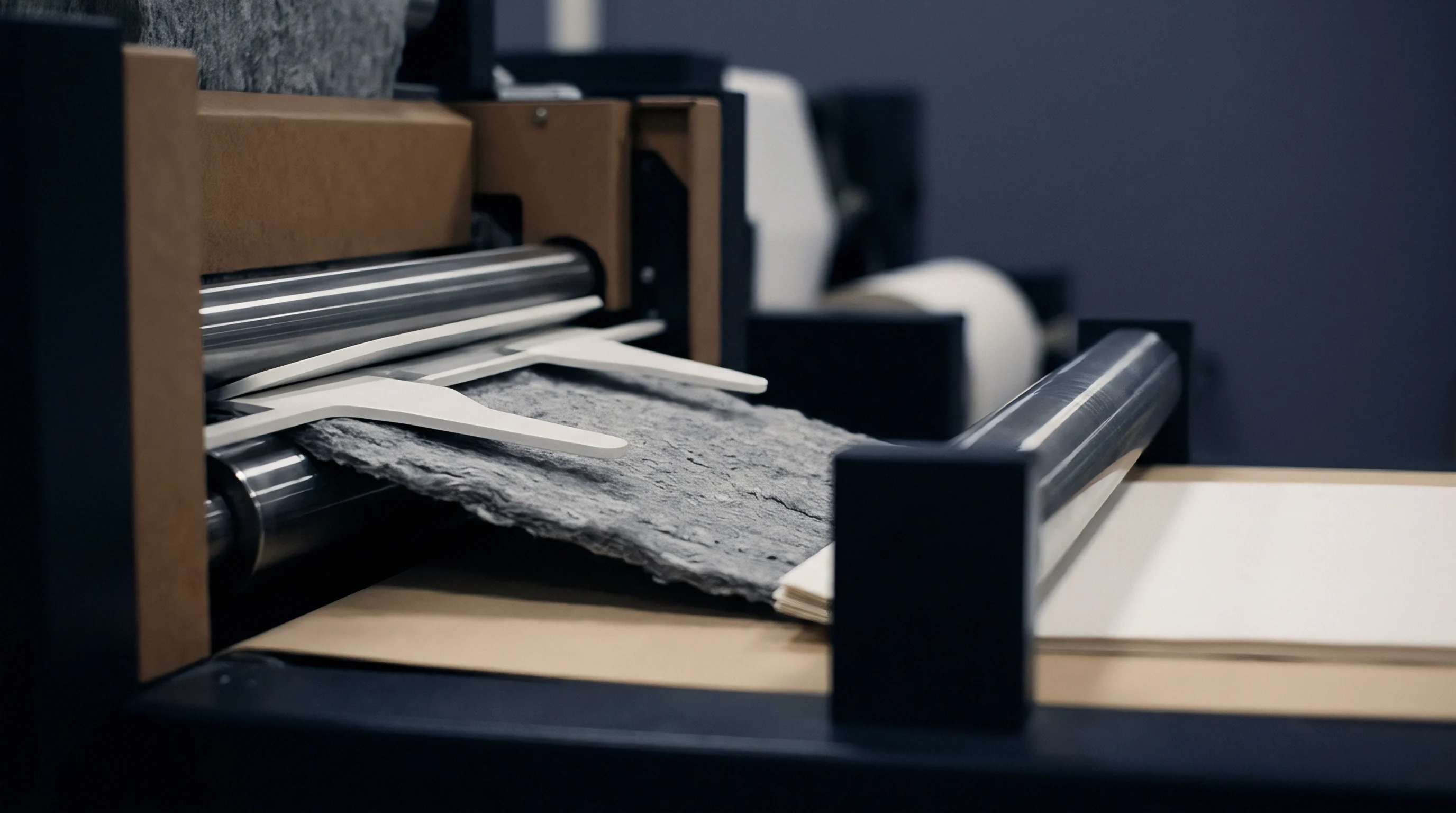
Mechanical compressive stresses on paperboard during long-term storage interact with ambient humidity fluctuations. While static loading causes standard viscoelastic creep with logarithmic strain accumulation over time, shifting relative humidity increases the strain rate by an order of magnitude compared to stable isothermal conditions. Rapid water adsorption by cellulose accelerates fiber slip and drives mechano-sorptive creep, compromising the load-bearing capacity of corrugated containers and folding cartons made from recycled fibers.
Cellulose Hydrogen Bonding under Cyclic Moisture Flux
Wood-derived polymers undergo marked structural disruption as water molecules enter the amorphous inter-fiber regions. Dense hydrogen bond networks hold cellulose chains together within the cell wall, but as relative humidity rises from 30 percent to 85 percent, adsorbed water plasticizes the matrix and severs these inter-chain bonds. Under external compressive loads ~ such as in a six-high pallet stack ~ the broken bonds allow microfibrils to slip past each other.
As humidity falls, new hydrogen bonds lock into the displaced alignment. Each complete humidity cycle acts as a mechanical ratchet, accumulating permanent plastic deformation during every sorption phase.
Dynamic relative humidity cycling increases compressive strain accumulation in recycled packaging board by up to eight times compared to constant moisture exposure under identical static loads.
Recycled pulp networks are particularly vulnerable during this cycling. Repeated repulping and drying induce hornification, an irreversible structural alteration where cell walls collapse and internal hydrogen bonding capacity drops. Compared to prime virgin fibers, recycled softwood and hardwood fibers have shorter average lengths, higher fines fractions, and elevated residual lignin.
The lower bonding capability among hornified recycled fibers leaves them prone to moisture-induced slip, while micro-voids in the reprocessed network facilitate rapid water vapor transport, accelerating localized moisture sorption and bond failure.
Transient Moisture Gradients and Accelerated Strain
Unequal absorption across the caliper generates internal stress distributions well beyond static equilibrium predictions. When an uncoated board experiences a sudden humidity spike, outer plies absorb water faster than the core. As the expanding outer plies try to stretch against the rigid, drier core, localized tensile and compressive stress fields develop through the sheet thickness.
These transient stresses combine with external stacking forces, driving local stress beyond the yield point of the recycled fiber network.
| Board Grade Designation | Fibre Source Composition | Apparent Density (g/cm³) | Equilibrium Moisture Regain at 50% RH (%) | Mechano-Sorptive Creep Rate (1/MPa·cycle) | SCT Strength Decay per 100 Cycles (%) |
|---|---|---|---|---|---|
| Solid Bleached Board (SBB) | 100% Virgin Bleached Chemical | 0.82 | 6.8 | 0.0012 | 8.5 |
| Folding Boxboard (FBB) | Virgin Mechanical Core / Chemical Plies | 0.68 | 7.4 | 0.0021 | 14.2 |
| White Lined Chipboard (WLC) | 85% Recycled Waste / Virgin Liner | 0.72 | 8.1 | 0.0048 | 26.7 |
| Coated Recycled Board (CRB) | 100% Recycled Mixed Paper / OCC | 0.70 | 8.5 | 0.0059 | 31.4 |
Evaluating short-span compressive strength (SCT) under cyclic moisture conditions highlights the relative weakness of recycled grades. After 100 cycles between 30 percent and 80 percent relative humidity, virgin solid bleached board retains 91.5 percent of its initial compressive strength, whereas 100 percent recycled board falls below 70 percent under identical exposure. The mechano-sorptive creep rate parameter (mc) ~ the incremental compliance per unit moisture change per unit stress ~ increases sharply with recycled fiber content, directly impairing column strength in vertical packaging panels under dead loads.
Selecting board with uniform fiber orientation along the z-axis limits localized hygral expansion and maintains stack stability throughout dynamic warehouse storage.

Ply
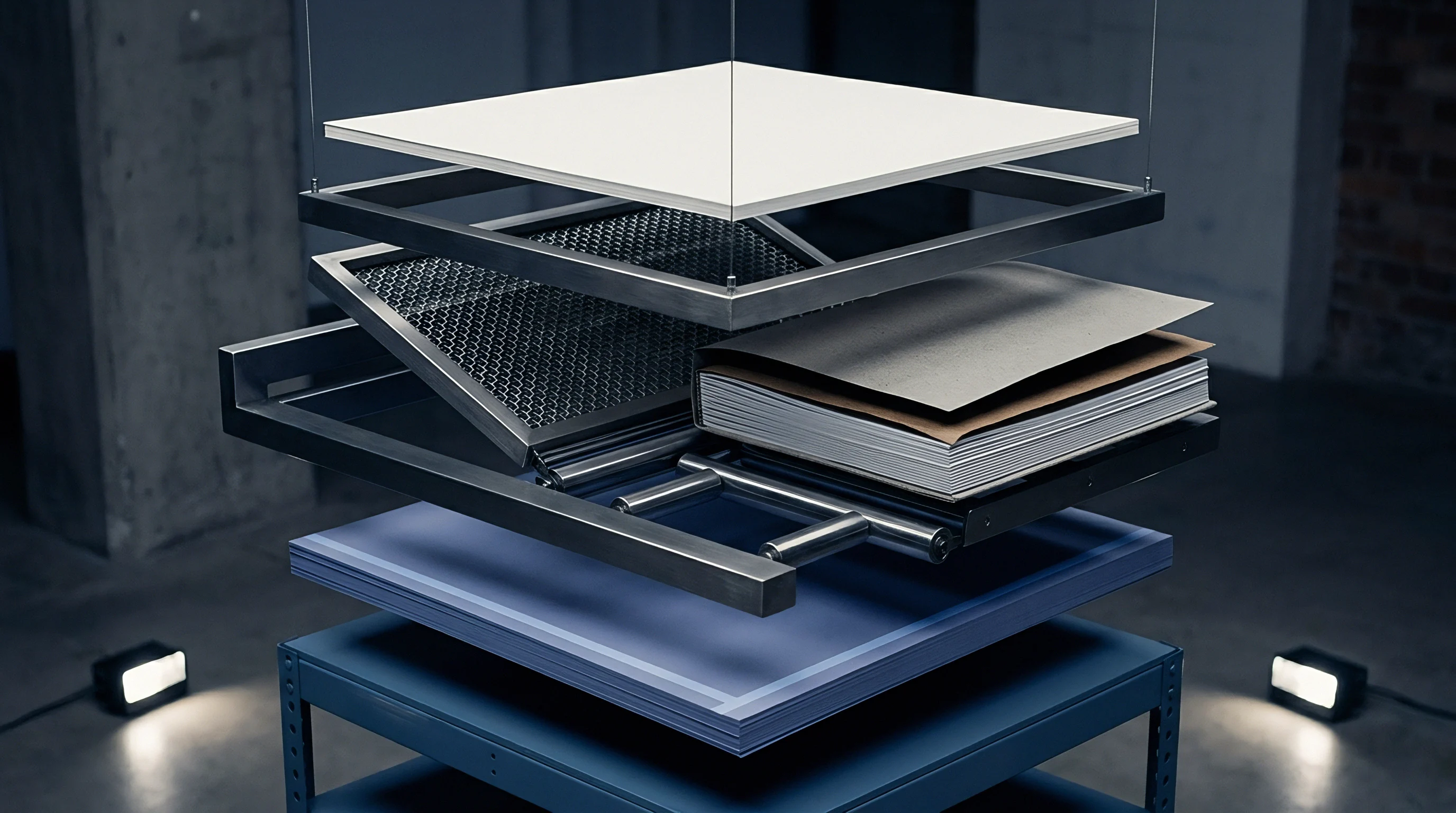
Multi-layer board structures show distinct strength variations through their thickness. In multi-ply recycled chipboard and folding boxboard, individual furnish layers are couched together while wet on the paper machine. Inter-ply bond strength, measured by Z-directional tensile strength per ISO 15754, dictates the material’s resistance to internal separation.
Under pallet compression, multi-ply boards rarely undergo simple uniform compression; combined in-plane compression, out-of-plane shear, and transient hygral expansion produce stress concentrations that target weaker ply boundaries.
Are Recycled Fibers More Vulnerable to Mechano Sorptive Degradation?
Secondary pulp fibers undergo hornification through repeated repulping and drying, which lowers their intrinsic swelling capacity and inter-fiber bonding potential. When multi-ply recycled boards encounter dynamic humidity shifts, individual plies expand and contract at different rates because density, fiber orientation, and starch distribution vary across the caliper. The middle filler plies ~ often made from low-grade unsorted waste paper ~ absorb more moisture and possess lower intrinsic Z-directional strength than fully bleached top liners.
This expansion mismatch generates cyclic shear forces at the ply interface, weakening inter-fiber bonds before macroscopic failure appears on the package surface.
Multi-ply recycled boxboard with a Z-directional tensile strength below 140 kilopascals exhibits micro-delamination propagation under dynamic moisture cycling prior to external box compression failure.
As the exterior face absorbs ambient moisture, it expands laterally against the drier core, setting up interlaminar shear stresses (τxz) parallel to the board surface. In stacked cartons, vertical compressive loads induce additional lateral expansion via Poisson effects, compounding internal shear. Once combined stresses exceed the local fracture toughness of the ply interface, micro-cracks form along starch-deficient fiber boundaries.
Interlaminar Shear and Mode Fracture Mechanics
Compressive warehouse loading paired with internal hygral expansion creates complex stress fields across internal substrate interfaces. Delamination kinetics can be modeled using dual-mode fracture mechanics covering Mode I (normal opening) and Mode II (in-plane shear). Mode I failure occurs when tensile stresses perpendicular to the surface pull plies apart ~ typically driven by steep moisture gradients or board bulging ~ while Mode II failure stems from in-plane shear sliding adjacent plies as carton walls buckle.
The energy release rate (G) at the delamination crack tip under coupled mechano-sorptive loading combines mechanical strain energy and moisture-induced swelling energy:
Gtotal = GI, mechanical + GII, mechanical + Ghygral
Micro-crack propagation follows a power-law relationship governed by cyclic humidity changes. Each humidity cycle advances the delamination front by an increment (Δ a):
fracdadN = C · (Δ Geff)m
where N represents the number of moisture cycles, Δ Geff is the effective energy release rate range, and C and m are empirical material constants for the specific recycled furnish. For high-yield recycled boards, m typically ranges from 3.2 to 4.8, reflecting high sensitivity to large humidity swings. As delamination spreads across the panel, the effective cross-sectional moment of inertia drops, reducing flexural stiffness (D) and accelerating overall panel buckling under pallet dead loads.
Inadequate ply bonding under fluctuating relative humidity leads to sudden stack collapse, resulting in crushed stock, damaged packaging, and unrecoverable freight claims.

Coating
Surface treatments applied to packaging substrates alter how water vapor moves through the fibrous matrix. Functional surface passes serve several purposes: enhancing printability, resisting grease, preventing liquid penetration, and sealing against ambient moisture. However, applying functional coatings or laminations changes internal moisture flux mechanics, establishing asymmetrical moisture distributions that significantly influence delamination kinetics under mechanical stress.

Asymmetric Barrier Layers and Moisture Trapping Dynamics
Applying a functional film to only one face of a substrate creates a sharp vapor permeability differential between sides. Single-sided polyolefin extrusion, polyethylene terephthalate (PET) film lamination, or dense acrylic dispersion passes hold moisture within the underlying network. When an asymmetric board encounters elevated relative humidity on its uncoated side, water vapor enters quickly through open fibers, accumulating at the coating-board interface once it reaches the impermeable barrier on the reverse side.
Single-sided barrier lamination on recycled board creates a localized moisture concentration zone under the film, reducing interfacial adhesion by more than forty percent during desorption cycles.
This localized accumulation produces a steep moisture gradient right behind the barrier layer. During drying phases, the uncoated side dries rapidly and shrinks, while the coated side stays saturated. The resulting differential swelling causes pronounced board curl and places high peel stresses along the coating bond line.
Trapped moisture degrades hydrogen bonding in the outermost fibers joined to the adhesive or primer, leading to clean film separation along with a thin layer of fiber ~ a failure known as surface fiber tear delamination.
| Finishing Pass Description | Dry Coat Weight (g/m²) | WVTR at 38°C / 90% RH (g/m²·24h) | Cobb 1800 Water Absorbency (g/m²) | Interfacial Peel Failure Rate (mm/cycle) | CEPI Recyclability Score (Grade A to F) |
|---|---|---|---|---|---|
| Uncoated Recycled Board Baseline | 0.0 | 1450.0 | 85.0 | 0.02 | Grade A |
| Dual Water-Based Acrylic Dispersion Pass | 8.5 | 42.0 | 12.0 | 0.14 | Grade A |
| Single-Sided BOPP Film Lamination (12 µm) | 15.2 | 6.5 | 1.5 | 0.88 | Grade D |
| Double-Sided PE Extrusion Coating (20 g/m²) | 38.0 | 3.2 | 0.8 | 0.09 | Grade C |
| UV Overprint Varnish over Water-Based Primer | 4.2 | 380.0 | 32.0 | 0.31 | Grade B |
Water Based Dispersions versus Extrusion Film Passes
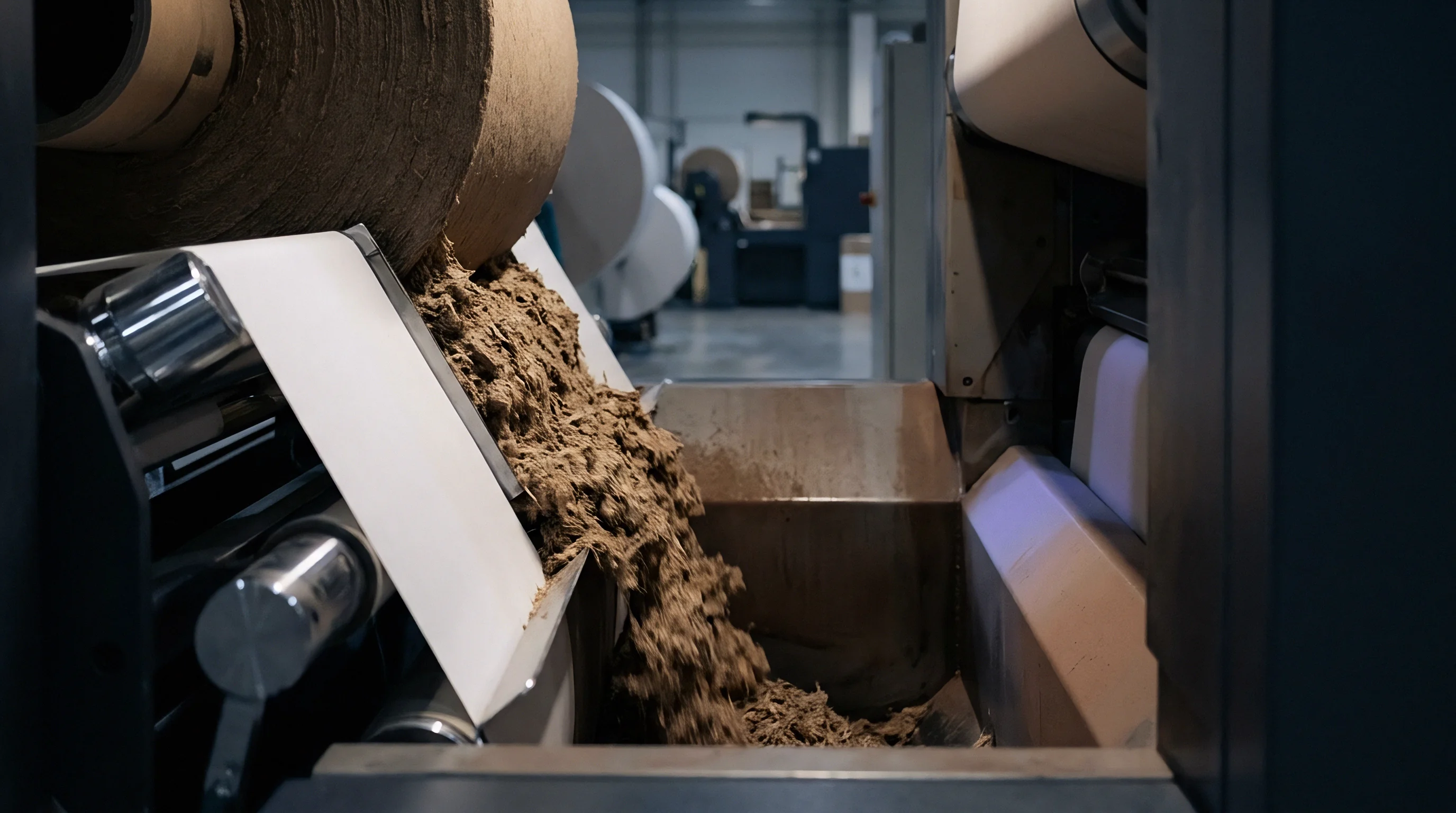
Polymer emulsions applied via metering size press yield different liquid resistance characteristics than continuous polyolefin sheets pressed onto hot webs. Water-based acrylic and styrene-butadiene dispersions build functional moisture barriers while retaining partial vapor permeability, allowing moisture to evaporate during drying without building extreme hydrostatic pressure at the interface. These dispersions penetrate top-liner fibers, forming an interpenetrating network that resists mechanical delamination during humidity cycling.
Extrusion-coated polyolefin films form a distinct physical interface with minimal fiber penetration. Although extrusion films achieve excellent water vapor transmission resistance (WVTR), their complete impermeability introduces severe mechano-sorptive risks. Under pallet loading, rigid polyolefin films cannot match the lateral creep strain of expanding recycled fibers underneath.
This physical strain mismatch generates shear forces across the polymer-board interface, accelerating delamination along scorelines and folded container edges during transit.
Edge separation stems from structural moisture trapping caused by single-sided barrier films rather than ambient box plant humidity.
Chamber
Standardized environmental test conditions provide a controlled benchmark for measuring mechanical performance decay under load. Standard atmospheres defined in ISO 187 specify constant conditioning at 23°C and 50 percent relative humidity. While these conditions ensure reproducible quality control benchmarking between converters and buyers, they rarely reflect real-world supply chain conditions.
Packages pass through unconditioned warehouses, tropical ports, and cold-chain logistics where relative humidity fluctuates between 30 percent and 95 percent.
Standard Conditioning Protocols and Accelerated Testing Regimes
Compliance testing traditionally relies on fixed temperature and humidity environments, but static testing underestimates compressive creep and delamination susceptibility in recycled board. Modern qualification protocols use cyclic relative humidity profiles inside climate chambers to trigger mechano-sorptive creep under dead-load compression fixtures. Square-wave cycling switches relative humidity between 30 percent and 90 percent every six hours at 30°C, while sinusoidal cycling provides a smoother transition that mimics 24-hour ambient diurnal shifts.
Testing programs must monitor specific degradation mechanisms throughout the exposure duration:
- Interlaminar shear detachment occurs when internal stresses exceed Z-directional tensile limits, separating the top liner from the core.
- Creep strain acceleration manifests as sudden increases in vertical deformation during the absorption phase of humidity cycles.
- Scoreline bursting develops along folded box corners where stress concentrations interact with trapped moisture.
- Barometric blistering arises under impermeable laminations as trapped air and water vapor expand during temperature spikes.

Short Span Compression and Creep Rate Measurement
Evaluating compressive strength retention during climate cycling requires test fixtures that prevent micro-buckling. The Short Span Compression Test (SCT) under ISO 9895 measures intrinsic fiber compressive resistance across a 0.70 millimeter clamped span. Tracking SCT decay over relative humidity cycles identifies internal fiber network breakdown long before macroscopic box failure occurs.
Short span compression strength drops by twenty-eight percent after twenty-four hours of dynamic humidity cycling under a static load equal to thirty percent of baseline ultimate crush capacity.
Box Compression Testing (BCT) per ISO 12048 determines top-to-bottom load capacity. Measuring static dead-load creep strain in a climate chamber defines the creep compliance function (J(t)):
J(t) = fracvarε(t)σ0
where varε(t) is time-dependent vertical strain and σ0 is applied stacking stress. Under cyclic humidity, compliance divides into viscoelastic (Jve) and mechano-sorptive (Jms) components:
J(t, RH) = Jve(t) + Jms(t, Δ RH)
Determining Jms lets packaging engineers establish precise safety factors for pallet stacking heights, avoiding over-packaging while preventing warehouse collapses during seasonal humidity swings.
Including ISO 12048 creep compliance thresholds in supply agreements assigns financial responsibility for stack deformation directly to the converter.
Crush
Box strength under static pallet loading relies on the structural integrity of vertical panels and folded corners. In stacked folding cartons or corrugated cases, vertical corner posts carry up to 80 percent of the total top-to-bottom load. Over extended storage, static top loads, scoreline damage, and cyclic ambient moisture combine to cause severe deformation, leading to panel bulging, corner crush, and interfacial delamination.

Scoreline Cracking and Corner Post Strain Concentration
Rotary creasing and folding operations introduce localized structural damage during conversion. Creasing rules crush internal plies along fold lines to ensure precise box geometry; while this intentional damage lowers hinge bending stiffness, it also forms micro-fractures in the recycled fiber network. Under compressive stacking loads, pre-damaged scorelines act as stress risers.
Moisture cycling accelerates crack growth from scorelines into vertical panels, initiating interlaminar delamination along corner posts.
As corner posts yield to mechano-sorptive creep, top loads shift toward the center of vertical panels. Because panels have lower flexural stiffness than folded corners, they buckle out of plane. This outward bowing introduces strong bending moments and Z-directional peeling forces, pulling outer plies away from core plies and triggering sudden collapse.
Worked Example Stacking Creep and Delamination Rate
A technical evaluation of a five-high pallet array illustrates expected deformation and structural failure rates. Consider a standard pallet carrying 500 folding cartons made from 400 gsm White Lined Chipboard (WLC) with a 15 percent recycled top liner and an 85 percent mixed recycled core. Cartons on the bottom row support a static dead load (σ0) of 2.8 kilopascals per vertical wall area.
The warehouse environment cycles relative humidity between 45 percent and 85 percent every 12 hours at 25°C. Initial board properties show a Z-directional tensile strength of 165 kilopascals, a short-span compression (SCT) value of 2.9 kilonewtons per meter, and a box compression strength (BCT) of 1,850 newtons.
Structural calculations determine performance retention over a 30-day storage period:
- Calculate baseline creep strain after 24 hours at static 45 percent relative humidity, yielding a purely viscoelastic vertical strain of 0.82 percent (1.48 millimeters total height loss).
- Incorporate humidity cycling effect, applying an empirical mechano-sorptive strain factor (kms) of 0.0035 per percent relative humidity shift per day, raising total strain to 4.2 percent (7.56 millimeters height loss) after 10 days.
- Calculate Z-directional strength decay over 60 humidity cycles, using an empirical strength loss rate of 0.85 kilopascals per cycle, dropping Z-direction tensile strength from 165 kilopascals to 114 kilopascals.
- Determine critical delamination crack length along corner post scorelines, applying the power-law growth rate (da/dN), yielding a crack propagation of 14.2 millimeters along the main panel score.
- Recalculate critical buckling load (Pcr) for the delaminated panel wall using reduced flexural stiffness (Deff = 0.62 · D0), resulting in a drop of maximum column capacity to 1,020 newtons.
- Compare actual stacking load (1,120 newtons equivalent bottom box force) to reduced critical buckling capacity (1,020 newtons), establishing structural failure at day 22 of storage.
Whether chemical cross-linking of surface sizing agents can arrest interlaminar micro-crack growth under dynamic ambient shifts without compromising repulpability in closed-loop recycling systems remains an open inquiry.
Yield
Commercial material specifications drive both physical container performance and total landed packaging costs across supply chains. Packaging buyers must balance required stacking strength under dynamic ambient conditions against raw material prices, mill surcharges, conversion waste, and regulatory costs. Replacing prime virgin fibers with recycled board lowers initial material spend, but often requires higher caliper or functional barrier passes to meet dynamic creep thresholds.
Modulated Extended Producer Responsibility and Recyclability Fees
European regulations increasingly penalize composite packaging that hinders fiber recovery in standard paper mills. Extended Producer Responsibility (EPR) fee modulation schemes under the Packaging and Packaging Waste Regulation (PPWR) and CEPI recyclability framework place financial surcharges on boards modified with non-soluble synthetic barriers.
A 100 percent recycled WLC carton using a 12-micron film lamination for moisture resistance receives a Grade D recyclability rating under CEPI protocols due to foil shedding issues during pulping. This rating incurs an EPR surcharge up to 280 euros per tonne of packaging placed on the market. By contrast, treating the same board with a water-based acrylic dispersion achieves a Grade A rating, qualifying for maximum EPR fee discounts while providing sufficient moisture resistance to prevent mechano-sorptive creep.
| Specification Parameter | Virgin FBB Uncoated (300 gsm) | Recycled WLC Dispersion Coated (350 gsm) | Recycled WLC PET Laminated (320 gsm) |
|---|---|---|---|
| Base Substrate Cost (€/1,000 packs) | 142.00 | 108.50 | 99.20 |
| Finishing Pass Application Cost (€/1,000 packs) | 0.00 | 18.40 | 34.10 |
| EPR Modulated Fee Surcharge / Discount (€/1,000 packs) | -4.20 | -3.80 | 22.50 |
| Converting Spoilage Allowance Cost (€/1,000 packs) | 2.80 | 4.20 | 8.60 |
| Landed Package Cost (€/1,000 packs) | 140.60 | 127.30 | 164.40 |
| Recyclable Fiber Yield Rate (%) | 98.5 | 94.2 | 76.0 |
Landed Unit Costs across Finishing Pass Options
Calculating total packaging expenditure requires weighing substrate basis weight against converting press hourly rates. Uncoated WLC substrate costs 25 percent less per tonne than virgin FBB, but compensating for lower humid SCT compressive strength requires a 15 percent weight increase (moving from 300 gsm virgin FBB to 350 gsm recycled WLC). Adding an offline dispersion pass also introduces make-ready waste and processing costs.
Procurement teams should follow a structured specification review before committing to secondary board purchases:
- Verify fiber origin claims by demanding mill certification for post-consumer recycled waste content fractions.
- Audit Z-directional tensile baseline ratings using ISO 15754 bench data to ensure internal ply bond integrity exceeds 150 kilopascals.
- Specify water-based dispersion barriers over polyolefin film laminates to secure EPR fee discounts under regional waste regulations.
- Calculate dynamic creep compliance using cyclic humidity BCT decay testing rather than relying exclusively on static ambient ISO 187 reports.
Selecting a barrier dispersion coating over a film laminate balances creep resistance against end-of-life EPR fees while preserving line yield across extended production shifts.