Corona Decay Kinetics and Solventless Adhesive Wetting in Polypropylene Lamination
Corona decay on polypropylene impairs solventless adhesive wetting, requiring in-line treatment to maintain dynamic surface energy above 40 dyn/cm.
Charge
High-voltage dielectric barrier discharge breaks carbon-hydrogen bonds on non-polar polypropylene surfaces, generating free radicals that react with ambient oxygen into hydroxyl, carbonyl, carboxyl, and ester groups. Untreated biaxially oriented polypropylene carries a baseline surface energy between 29 mN/m and 31 mN/m, which resists wetting by liquid adhesives. Corona discharge lifts this value to 42 mN/m or 44 mN/m, providing the thermodynamic drive needed for solventless adhesive spread, though the effect begins decaying immediately once discharge stops.
Dielectric Breakdown and Oxygen Functionality
Within the air gap between electrode and grounded dielectric roll, the plasma field generates reactive oxygen radicals while high-energy electrons cleave hydrogen from the polyolefin chain. The resulting carbon radicals combine rapidly with oxygen into polar functional groups, whose concentration determines the polar fraction of the film’s total surface energy. While higher power densities increase initial polarity, excessive discharge fractures the polymer matrix, leaving a weak boundary layer of low molecular weight oxidized material loose across the surface.
Severe chain scission breaks the polymer down into short-chain carboxylic acids and oligomeric debris that sit unanchored on the film. When a solventless adhesive meets this damaged layer, it bonds to mobile fragments rather than the structural core of the polypropylene, and the resulting interphase splits apart under peel stress. Maintaining discharge power between 1.5 and 2.5 kW per meter of web width at operating speeds avoids this scission while still providing sufficient surface oxidation.
Polypropylene film stored at 30°C exhibits a surface energy decay rate three times faster than film held at 18°C over a 72-hour window.
Hydrophobic Recovery and Additive Migration
Surface energy drops as flexible polymer chains twist their polar groups back into the bulk film to reduce interfacial free energy. Because the glass transition temperature of polypropylene sits around -10°C, polymer segments retain thermal mobility at room temperature, allowing functional groups to rotate continuously away from the surface during roll storage. This hydrophobic recovery follows a stretched exponential decay rate dictated largely by warehouse temperatures.
- Macromolecular reorientation velocity governs how quickly carbonyl and hydroxyl groups rotate into the non-polar substrate during early storage.
- Erucamide slip agent blooming drives fatty acid amides from the core through crystallite boundaries, depositing an additive film at the surface.
- Low molecular weight species solubilization takes place when mobile oxidized fragments dissolve directly into blooming slip agents to form an amorphous barrier.
- Ambient thermal conditioning effects speed up polymer chain motion whenever storage temperatures rise past 25°C, shortening the usable processing window.
Fatty acid amides, incorporated into resins at 500 ppm to 1500 ppm to control friction, create the primary barrier to sustained wettability. Erucamide pairs a polar amide head with an eighteen-carbon hydrocarbon tail, and hydrophobic expulsion pushes these molecules outward over time. Once at the surface, their non-polar tails shield the oxidized functional sites, degrading surface energy unless cold storage slows down migration.
For converters unwinding pre-treated stock, this migration narrows the window before adhesive wetting fails.
Rapid surface energy decay frequently tracks back to antistatic or slip additives required for high-speed roll handling.

Spread
Whether a liquid achieves molecular contact across a solid substrate depends on interfacial thermodynamic balance. Because solventless lamination lacks an evaporating carrier to pull the layer thin, it depends entirely on capillary action and mechanical spreading. Spontaneous wetting takes place only when the adhesive’s surface tension falls below the critical surface energy of the polypropylene web, producing a positive spreading coefficient.
Which Dynamic Surface Tension Value Predicts Solventless Adhesive Transfer?
Equilibrium surface tension offers little insight into what happens inside a nip running at three hundred meters per minute. Dynamic surface tension, measured across surface ages between 10 and 100 milliseconds, dictates initial contact instead. Two-component polyurethane systems ~ composed of monomeric diisocyanates and low molecular weight polyols ~ typically register dynamic surface tensions of 32 mN/m to 38 mN/m at a 40°C application temperature.
If corona decay drags the substrate’s surface energy below 38 mN/m, the dynamic spreading coefficient turns negative and wetting arrests.
Transferring adhesive from a smooth metering cylinder to a moving web requires instantaneous spread. High dynamic surface tension in the prepolymer mixture resists deformation under the steep shear rates inside the application gap. When the dynamic contact angle surpasses 45 degrees at initial impression, air becomes trapped in the micro-grooves of the film.
Nip pressure forces contact across high spots, but without evaporating solvents to pull the fluid into valleys, those micro-voids remain trapped in the curing interphase.
Adhesive wetting stops whenever the dynamic surface tension of the liquid exceeds the polar surface energy component of the oxidized film.

Owens-Wendt Analysis of Polar Components
Under the Owens-Wendt-Rabel-Kaelble model, total surface energy divides into dispersive forces and polar hydrogen-bonding contributions. Untreated polypropylene provides a dispersive value near 30 mN/m with virtually zero polar component. Corona discharge raises the polar value to between 10 mN/m and 14 mN/m without altering the dispersive base.
Hydrophobic recovery then strips away those gains: as polar groups flip back into the bulk film, the polar component drops under 2 mN/m while dispersive forces stay steady.
| Film Treatment State | Dispersive Component (mN/m) | Polar Component (mN/m) | Total Surface Energy (mN/m) | Water Contact Angle (Degrees) | Adhesive Spreading Coefficient (mN/m) |
|---|---|---|---|---|---|
| Fresh In-Line Corona (0 Hours) | 31.2 | 12.8 | 44.0 | 62.4 | +8.5 |
| Stored Off-Line Film (24 Hours) | 31.0 | 8.2 | 39.2 | 71.1 | +3.7 |
| Stored Off-Line Film (72 Hours) | 30.8 | 4.1 | 34.9 | 80.5 | -0.6 |
| Aged Film with Slip Bloom (14 Days) | 30.5 | 1.5 | 32.0 | 89.2 | -3.5 |
Polyurethane adhesives bond through hydrogen bonding and dipole interactions between isocyanate or hydroxyl groups and oxidized sites on the web. Once the polar component drops below 4 mN/m, thermodynamic work of adhesion collapses and interfacial tension rises. Rather than laying down a continuous molecular layer, the liquid beads into discrete islands, trapping air that shows up optically as silvering.
These unbonded micro-voids mar optical clarity with silvering and act as failure initiation sites when the laminate encounters thermal stress.
Viscosity
How quickly an adhesive displaces air across surface asperities depends directly on its rheology at the moment of impression. Unheated, solvent-free prepolymers show room-temperature viscosities between 800 mPa·s and 1500 mPa·s. Metering circuits warm the components to 35°C ~ 50°C just ahead of the application roll, pulling working viscosity down to 200 mPa·s ~ 400 mPa·s to speed capillary displacement into the substrate’s micro-texture.
Application Temperature and Rheological Decay
Holding metering rolls at 40°C eases prepolymer flow without triggering immediate thermal breakdown, though temperature management remains a balancing act between viscosity and reaction kinetics. While heating reduces fluid viscosity according to Arrhenius behavior, it simultaneously accelerates the reaction between polyols and diisocyanates. The resulting chain extension drives an exponential rise in viscosity across the pan if residence times drift.
Pot life sets hard operational boundaries: an adhesive pool at 45°C doubles its viscosity in roughly 30 minutes if fluid stagnates in the gap. The metering system must continuously cycle in fresh mix to keep roller rheology steady. If viscosity drifts above 800 mPa·s in the nip, displacement slows down, preventing the liquid from penetrating micro-cavities before reaching the laminating nip.
Erucamide slip agents migrate to the surface matrix and bury reactive hydroxyl groups beneath a non-polar hydrocarbon layer.
Capillary Flow in Micro-Surface Cavities
Air entrapment develops whenever line speed exceeds the rate at which fluid enters surface crevices. Film topography shows peak-to-valley roughness between 0.2 and 0.8 micrometers. Under Washburn kinetics, penetration velocity scales with surface tension and pore radius while resisting high viscosity.
As corona decay depresses surface energy, capillary driving pressure falls away; with no solvent carrier to dissolve surface contamination or assist capillary draw, the fluid fails to penetrate narrow channels.
- Bring application cylinder heating zones to equilibrium at 40°C before charging the dosing pump.
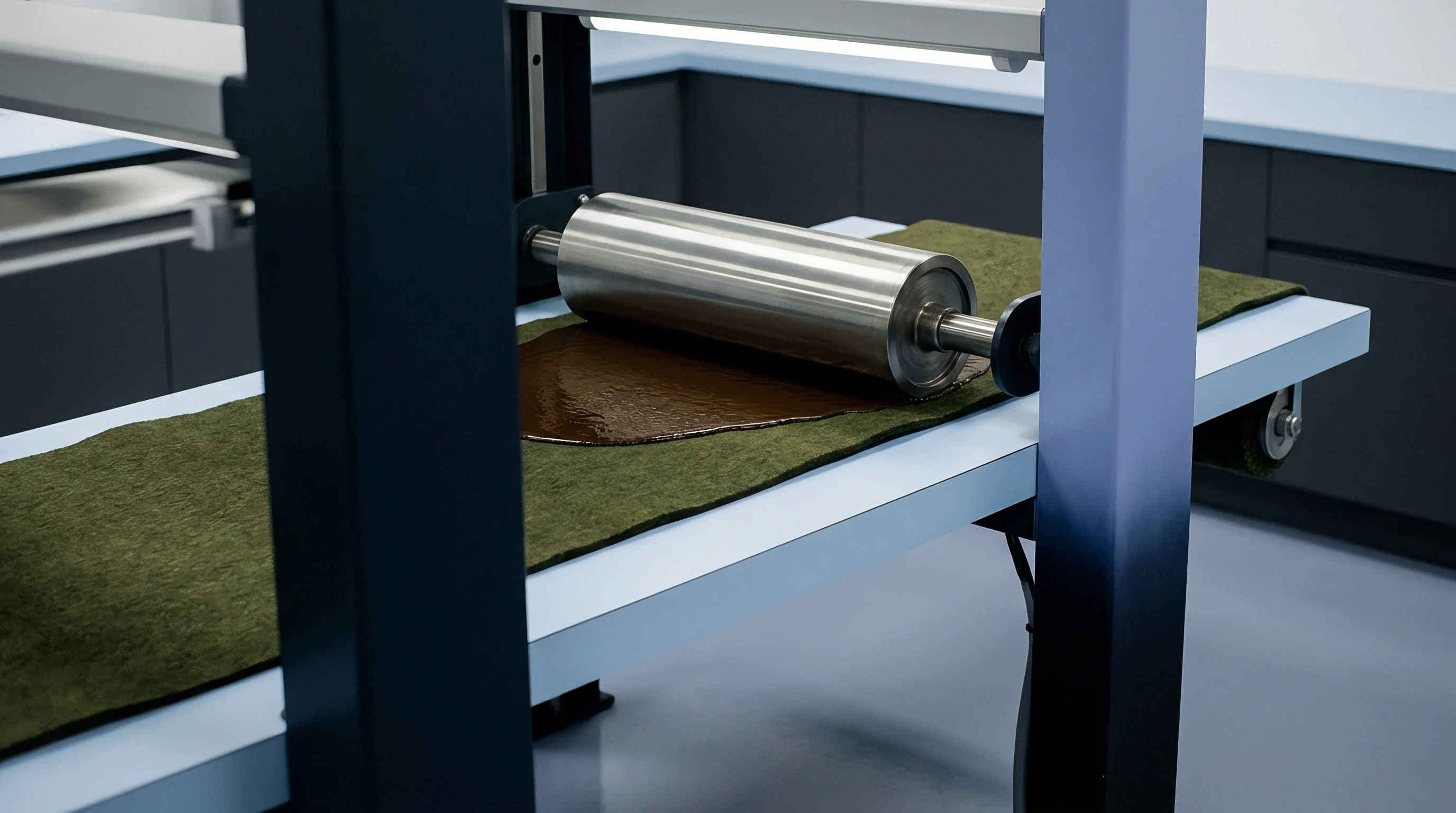
- Set the gap between smooth chrome metering rolls to deposit a wet coat weight between 1.2 g/m² and 1.8 g/m².
- Tune web tension across the primary laminating nip to preserve uniform nip pressure without stretching the polypropylene film.
- Track gap fluid temperatures with infrared sensors to catch premature exothermic viscosity spikes.
Low coat weights worsen wetting problems on decayed stock: dropping below 1.2 g/m² leaves a discontinuous film unable to bridge surface valleys, while exceeding 2.0 g/m² prolongs cure, causes edge squeeze-out, and wastes adhesive. Sound bonding relies on striking a balance between low nip viscosity and high polar surface energy, allowing capillary penetration to complete before crosslinking locks the fluid in place.
Pinpointing where prepolymer polymerization begins outrunning capillary wetting on aged film remains an ongoing challenge on high-speed lines.

Audit
Accurate surface treatment audits require standardized fluids applied under controlled conditions, as sloppy bench testing produces false passes that surface later as line failures. Plant operators commonly rely on dyne pens or liquid mixtures prepared to ASTM D2578, blending formamide with ethyl cellosolve or ethanol. Because these volatile components evaporate quickly, open bottles shift in surface tension and yield misleading floor measurements.
Dyne Solutions and Goniometric Surface Energy
Formamide and ethyl cellosolve mixtures provide a rough shop-floor check: an operator brushes a solution of known surface tension across the film, and if the bead holds continuous for two seconds without retracting, surface energy is assumed to meet or exceed that rating. The test only resolves in 2 mN/m increments, however, and cannot distinguish polar forces from dispersive ones ~ leaving slip bloom and hydrophobic recovery entirely undetected.
Contact angle goniometry provides far better thermodynamic detail by measuring sessile drop profiles of reference liquids. Using probe fluids with established polar and dispersive properties ~ typically deionized water and diiodomethane ~ allows Owens-Wendt calculation of each surface energy component. This method exposes weak boundary layers that slip past dyne pens: blooming fatty amides shift water contact angles while leaving diiodomethane untouched, revealing contamination before the web hits the laminator.
| Storage Age (Days) | Surface Energy (dyn/cm) | Green Bond 1h (N/15mm) | Cured Bond 14d (N/15mm) | Primary Failure Mode |
|---|---|---|---|---|
| 0 (In-Line Corona) | 44 | 0.85 | 3.80 | Film Tear / Substrate Failure |
| 2 (Storage at 20°C) | 39 | 0.60 | 2.90 | Cohesive Adhesive Failure |
| 5 (Storage at 20°C) | 36 | 0.35 | 1.40 | Interfacial Delamination |
| 10 (Storage at 30°C) | 32 | 0.10 | 0.25 | Adhesive Peel / Weak Boundary Layer |
ASTM F904 testing mandates a 180-degree peel angle at 300 millimeters per minute, where bond values under 1.5 N/15mm trigger batch rejection for retort packaging.
Interphase Failure Characterization
Infrared spectroscopy identifies the mechanism of failure by examining peeled surfaces after destructive testing. Attenuated Total Reflectance FTIR probes the top 1 micrometer of the delamination zone; intense carbonyl bands at 1730 cm⁻¹ alongside amide peaks at 1630 cm⁻¹ on the substrate side confirm that slip agent migration undermined the bond.
- Cohesive adhesive separation points to incomplete curing, where fracture propagates entirely within the polyurethane adhesive matrix.
- Interfacial adhesive clean peel indicates poor thermodynamic wetting or loss of polar functionality on the film before coating.
- Substrate structural tear shows the interphase bond surpassed the internal tensile yield strength of the BOPP base.
- Weak boundary layer cleavage happens when mobile oligomers or bloomed fatty amides shear under slight mechanical load.
Under ISO 18263 Clause 4.2, financial liability transfers to the film supplier if surface energy falls below 38 dyn/cm within thirty days of delivery under agreed storage terms.

Cost
Scrap and line downtime drive conversion losses in solventless packaging. Running at four hundred meters per minute, a laminator generates massive yardage before problems become apparent, particularly because polyurethane adhesives take 24 to 48 hours under heat to cure. When defects only show up at slitting, entire production runs are already ruined.

Scrap Rates and In-Line Treatment Economics
Mounting a corona treater directly on the unwind stand removes shelf-life vulnerability. Treating in-line restores surface energy to 44 mN/m seconds before adhesive application, overriding hydrophobic decay and breaking through bloomed slip agents. An in-line station costs between $35,000 and $60,000 in capital outlay, with operating power running roughly 0.05 kWh per thousand square meters of processed web ~ an investment typically recovered within months through scrap reduction alone.
Holding pre-treated inventory ties up capital while surface activity deteriorates. Once surface energy slips below 36 dyn/cm, rolls require re-treatment or downgrading to less demanding structures. Running rolls through a standalone rewinder adds handling steps, labor costs, and web-tension scrap risks, all of which are avoided when corona treatment happens directly on the lamination line.
Treating in-line bypasses storage decay entirely, securing uniform adhesive wetting across inconsistent film lots.