Atmospheric Fluctuation
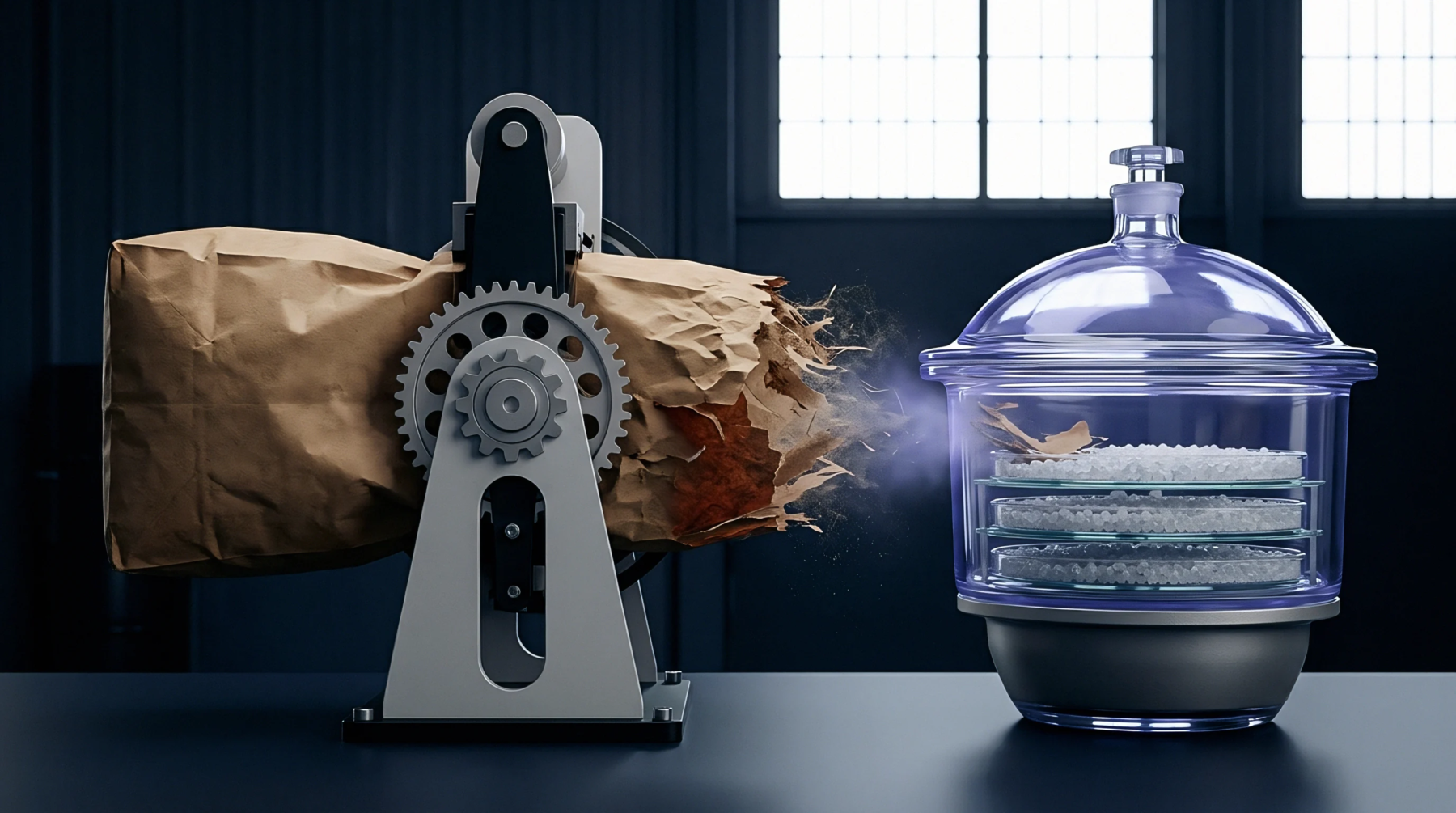
Environmental testing subjects paperboard packaging to alternating high and low relative humidity levels within a controlled chamber to measure dimensional and mechanical stability over time. Testing under cyclic humidity exposes the material to moisture swings between forty percent and ninety percent relative humidity over fixed duration intervals. Fiber swell during moisture absorption weakens hydrogen bonds between adjacent walls, whereas desorption causes localized shrinkage and micro-strains.
This test regime defines the performance boundaries of corrugated boxes and folding cartons stored in unconditioned environments without direct liquid water contact.
Structural Fatigue
Mechanical strength degrades faster under fluctuating atmospheric moisture than under constant high humidity conditions. When cyclic humidity acts on a loaded paperboard container, cumulative viscoelastic deformation accelerates box failure through mechanical creep. Flute delamination and scoreline bulging frequently develop before the material reaches its nominal compression limit.
Paperboard grades containing high yield mechanical pulps exhibit greater dimensional change during these cycles than fully bleached chemical pulp boards. Sizing agents and barrier coatings slow down moisture exchange rates, which delays structural collapse during transport.
Creep Response
Compressive load capacity decreases progressively as environmental cycles repeat over prolonged storage periods. Laboratory measurements confirm that cyclic humidity causes non-linear strain accumulation, where each successive moisture cycle adds irreversible deformation to container walls. Box compression strength drops substantially after repeated humidity swings even if peak relative humidity remains below threshold condensation levels.
Packaging engineers account for this deterioration by applying environmental design factors to target stacking loads. High wet-strength resins and synthetic surface treatments mitigate edge-wicking during moisture absorption cycles. Understanding this progressive failure mechanism enables accurate specification of board weight for long-distance maritime shipping.